Readers who have just recently discovered the Daily Bulletin may not realize that AccurateShooter.com has hundreds of reference articles in our archives. These authoritative articles are divided into multiple categories, so you can easily view stories by topic (such as competition, tactical, rimfire, optics, shooting skills etc.). One of the most popular categories is our Technical Articles Collection. On a handy index page (with thumbnails for every story), you’ll find over 120 articles covering technical and gunsmithing topics. These articles can help you with major projects (such as stock painting), and they can also help you build more accurate ammo. Here are five popular selections from our Technical Articles archive.
Stress-Free Pillar Bedding. Richard Franklin explains how to do a top-quality bedding job, start to finish.
OnTarget Software Review. Our Editors test free software that measures shot groups with great precision. We explain how to use the program and configure advanced features.
Savage Action Tuning. Top F-TR shooter Stan Pate explains how to enhance the performance of your Savage rifle by optimizing the torque settings of the action screws.
Complete Precision Case Prep. Jake Gottfredson covers the complete case prep process, including brass weight sorting, case trimming, primer pocket uniforming, neck-sizing, and, case-neck turning.
Stock Painting Instructions. Step-by-step guide for stock painting by expert Mike Ricklefs. Mike shows both simple coverage and fancy effects.
Report by Craig Arnzen, Area419.com
It’s easy to think about shooting your first precision rifle match and worry about all of the gear and trinkets that you may need to make it through. In reality, the old rules apply — keep it simple.
We wanted to put together for you a no-nonsense list of the Top Five Gear Items you need for your first match. This list focuses on the “must-have” items you’ll need for PRS-Style competitions.
1. A Rifle (That is Reliable and Sub-MOA Accurate)
Your rifle is the most obvious piece of kit, but we can give you a little more information. Most of the guys you’ll find out there are shooting 6.5 Creedmoor. Yeah, there are guys using .308 Wins and 6mm Dashers, but the 6.5 Creedmoor makes up more than half of the rounds shot in PRS competition, when looking at both national and club matches. Your comp rig needs to be mag-fed and shoot better than 1 MOA. It DOESN’T need to be better than 0.5 MOA (half-MOA). With most targets being 2-3 MOA in size, a half-MOA gun will do just fine. More accuracy is better of course, but you don’t need an exotic quarter-MOA rig to win.
[Editor’s NOTE: PRS does offer a Gas Gun division, but most guys start out with a bolt-action rifle, which will be less maintenance-intensive than an AR-platform rig.]
Muzzle brakes, like our Area 419 Hellfire, are also very popular as much of the PRS game is recoil management. If you can’t see your misses, you’re sure to have more of them.
The rifle also needs an optic with repeatable clicks and a reticle with Mil- or MOA-based hashmarks. The clicks can be either Mil system or MOA system (Mil is more common), so long as the click values match the reticle (i.e. you don’t want 1/4-moa clicks with a Mil-marked reticle). How much power do you need? Anything that zooms in the mid-teens will suffice. I could shoot a match with a fixed 12X scope and not feel disadvantaged. We love the Kahles K624i, if you’re looking for a suggestion.
Oh, and you’ll want a bipod — but the choice in bipod deserves a whole separate article by itself. Nothing wrong with starting out with a Harris swivel. Then you might look at different bipods on other competitors’ rifles for comparison.
2. Ammunition — Factory Ammo and Hand-loads
Good ammo is important, but as we discuss above, 0.5 MOA is good enough. Also, speed is great but it matters FAR less than you’d think. Drop can be calculated with precision, and distances are normally known, so a slightly flatter trajectory doesn’t really matter. Wind matters, but the difference you’ll find when eeking out that last 50 fps is very, very small.
Federal, Hornady, and Prime all make quality ammo that is widely used by shooters from local to national matches. Facebook photo by CReece.
Precision Handloads
If you want to run down the rabbit hole of finding that perfect ammo that shoots in the “twos” (0.2 MOA), get yourself an AutoTrickler and some of our billet aluminum accessories — you’ll love the setup.
3. A Versatile Support Bag
There are countless bag options. But there is ONE bag you’ll see everywhere, and for good reason. The Game-Changer from Armageddon Gear is aptly named. Many shooters use it as a barricade bag as well as a rear bag, meaning a guy could get away with using only this bag for an entire match. If you need another bag when you get there, ask someone in your squad, they’ll share. I promise.
4. Ballistics Calculator APP
All PRS/NRL shooters need reliable and accurate ballistic solutions. The software-enabled Kestrel is a very common item on the range, but you’ll also see lots of guys using mobile Apps such as Shooter or Applied Ballistics Mobile, and they have great results.
It’s also handy to have an armband or an item like the Hawk Hill data card holder for stages with various targets at differing ranges. Once the RO says “engage” and your mind stops working, you’ll appreciate having it written down.
5. Hearing Protection
PRS Competitors shoot with brakes and sometimes in enclosed spaces. That’s why you need serious hearing protection. We recommend NRR 33 earplugs, doubled up with Electronic Muffs to hear range commands. I have used the 33 dB NRR Mack’s foamies at matches for most of the last year, and the Howard Leight NRR 33 Max-1s are also very effective. The budget-priced (under $55) Howard Leight Impact Sport Electronic muffs work well, but premium electronic muffs may be more comfortable.
Growing in popularity are high-tech, in-ear digital units like the ESP Stealth. I have a set of linked ESP Steaths on the way and hope to evaluate them soon. These are supposed to be very good, but the ESP Stealths cost $2100.00 per pair!
Think we missed something? Have more questions? Let us know.
You may have heard the phrase “blueprinting an action”, but do you know what that really means? Do you know what operations are done to an action during the blueprinting process? To help you understand, gunsmith Bill Marr of RifleShooter.com has created a helpful article showing a Rem 700 blueprinting job start to finish. This article spotlights how the procedures can be done with manual tools. Bill, who runs 782 Custom Gunworks Ltd., can also perform many of these operations with modern automated machinery. In fact, Bill has written a follow-up article on Truing a Rem 700 receiver with a Lathe.
Bill explains: “Blue-printing, or truing a rifle action, ensures the receiver face, threads, lugs, bolt lugs, and bolt face are square to the center line of the receiver.” In Bill’s informative article, Bill shows how he blueprints a Remington 700 short action receiver with .308 Win bolt face. He covers the following procedures step by step:
Action Disassembly
Ream Minor Diameter of Receiver Threads
Square the Receiver Lugs
Square the Face of the Receiver
Lap the Bolt Lugs
Square the Bolt Face
We use the bushings to guide the receiver tap. This chases the threads and ensures they are square.
2. Truing the Receiver Face
Using the receiver facing tool, the front of the receiver is trued. The tool is placed over the tap and turned by hand. We used Do Drill to lubricate it.
3. Lapping the Lugs
The bolt lapping tool screws into the front of the action and applies rearward pressure on the bolt face. A little bit of lapping compound is placed on the front of the receiver lugs. The bolt handle is then raised and lowered repeatedly. Note — it is critical that we do not get any lapping compound on any other surfaces.
4. Truing the Bolt Face
On this bolt, the central part of the bolt face was low. After the truing operation, this Rem 700 bolt face is now completely square to the action.
IMPORTANT: Rifleshooter.com states: “This article highlights our project and is presented for information purposes only. This provides an overview of the process and should not be attempted without the guidance and supervision of an experienced gunsmith“.
Every year the NRA Publications group announces Golden Bullseye Award winners for various product categories (rifle, handgun, shotgun, optics, gear etc.). These awards are like the Oscars for the shooting industry. There are many Golden Bullseyes given out each year because there are separate awards given by different NRA Magazines — including American Rifleman, Shooting Illustrated, and American Hunter. Here are the 2024 Rifles of the Year (Golden Bullseye Winners) as chosen by each of those three publications.
American Rifleman 2024 Golden Bullseye — Rifle of the Year
American Rifleman says the Springfield Armory 2020 Rimfire has impressive features: “Springfield 2020 Rimfire rifles come with an accuracy guarantee to shoot a three-shot group under one inch at 50 yards with match-grade ammunition. [The] new 2020 Rimfire bolt action [has] dual cocking cams and a 60-degree bolt throw. Rifles come supplied with an interrupted Picatinny optics rail[.] The trigger is user-adjustable [and is] compatible with 700-pattern aftermarket triggers[.] The rifle is fed with a detachable-box rotary magazine with a 10-round capacity of the 10/22 pattern.”
American Hunter 2024 Golden Bullseye — Rifle of the Year
American Hunter magazine likes the Marlin 336 Classic, with its smooth lever action and traditional appearance: “A gorgeous lever-action … this is a firearm as comfortable over the fireplace as it is in the deer woods. Its American black walnut stock blends beautifully with the satin-blued finish of the receiver and barrel.”
Shooting Illustrated 2024 Golden Bullseye — Rifle of the Year
S&W’s M&P FPC folding carbine is easy to transport and has smart on-board storage for magazines. The FPC’s buttstock has twin slots that hold 17-rd and/or 23-rd magazines compatible with S&W 9mm pistols. When folded, S&W’s FPC Carbine is just 16 3/8″. S&W delivers the new FPC in a cool zippered carry case with four internal pockets. That nice, padded carry case is included in the affordable $659.00 price.
New Award Category for Suppressor
New for 2024 is the Shooting Illustrated Suppressor of the Year Award. This new category reflects the growing usage of suppressors in many shooting sports. The first-ever Suppressor of the Year is the Silencer Central BANISH Speed K:
Just 4″ long, the new Silencer Central BANISH Speed K suppressor offers outstanding noise/recoil reduction in a very small format. The BANISH Speed K features a unique baffle design and a finned blast chamber that minimizes blowback to less than 6% of unsuppressed shooting. The Speed K is built from 100% Inconel, allowing it to be durable and maneuverable.
About the Golden Bullseye Awards
Now in their 22nd year, NRA Publications’ Golden Bullseye Awards acknowledge top firearms and shooting sports products. Winners are selected by a team of editors, graphic designers, and NRA Publications staffers. To qualify for consideration for a Golden Bullseye Award, a product must have been:
— Recently introduced and available to consumers.
— Used/tested by a staff member or magazine contributor.
— Reliable in the field, meeting or exceeding the evaluator’s expectations
— Innovative in design and function.
— Readily perceived as a value to the purchaser.
— Styled in a manner befitting the shooting and hunting industry.
Golden Bullseye Awards are presented by three major NRA Publications: American Rifleman, Shooting Illustrated, and American Hunter. In addition, Golden Bullseyes were awarded by NRAWomen.com, an NRA Publication web property.
The 2024 Golden Bullseye Awards as well as the Pioneer Award and the Freedom Award will be presented in person at an invitation-only event during the NRA Annual Meetings and Exhibits in Dallas, Texas.
This story features a unique, American-designed rimfire rifle, chambered for the potent .17 HMR round. The current generation Browning T-Bolt has a tang-mounted ambidextrous safety, a choice of barrel contours, lengths, and finishes, and a variety of stock options. What sets the T-Bolt apart from other rimfire rifles is the way the action cycles. There is not a conventional bolt that requires four distinct motions (lift bolt handle up/pull back/move forward/rotate handle down). With the T-Bolt you simply pull the handle straight back to extract a round, then return it forward to chamber a new round from the Double Helix magazine. The cocking effort is divided between back pull and forward movement so the effort is relatively light and easy.
Among current rimfire rifles, the Browning T-Bolt ranks high for fit and finish. The bluing is very nice and the T-Bolt even boasts a gold-plated trigger shoe. Many different stock types have been offered in recent years including some very nice AA Maple stock models as shown below (click to zoom). These T-Bolt rifles exhibit very fine craftmanship. Current models are made in Japan under license to Browning.
Click image for full-screen T-Bolt photo with detail.
Browning T-Bolt Sporter AA Maple Model
RECEIVER – Steel; High polished finish; Drilled and tapped for scope mounts
BARREL – Medium Sporter; Blued finish; Free-floating; Semi-match chamber; Recessed crown
ACTION – Straight pull bolt action; Top-tang safety; Adjustable trigger
STOCK – AA Maple; Gloss finish; Checkered
FEATURES – Sling swivel studs installed
PRODUCTION – Limited quantities
T-Bolt Owner Talks about Function and Accuracy
“I have a Browning T-bolt in .17 HMR, but with the maple stock. It is probably my favorite .17 HMR rifle (also the most expensive). The rifle feels smaller than some of my other .17 HMR rifles. I think the length of pull is a little shorter. I do like the light weight and trim handling of the rifle and the straight-pull bolt can be cycled really quickly. Mine is quite accurate and will shoot one-inch groups at 100 yards with both Hornady ammo and the CCI A17 ammo.” — RexRay, Varminter.com Forum member.
Pros and Cons of the Browning T-Bolt
The T-Bolt has a reputation for good accuracy, provided you have a good lot of .17 HMR ammo (we recommend checking for bullet run-out before you shoot for groups). The straight-pull action works as advertised — it is fast, smooth, and easy-to-operate. The Double Helix magazine (covered below) is excellent. It is very compact yet ultra-reliable. Another plus is that the T-Bolt has been produced in many different versions, with a variety of stocks, and even a stainless action version.
What are the negatives? Some of the stocks have a somewhat short length-of-pull, but this is easily solved with spacers. The main complaint is the factory trigger — some owners say it is too heavy at about 4 pounds, though the break is clean. For varmint work, we could live with the stock trigger and put money saved into optics.
If you prefer a very light trigger, JARD makes a T-Bolt replacement trigger. Featuring an aluminum housing, the JARD T-Bolt trigger can be ordered with 12-, 16-, or 20-ounce pull weights. The JARD trigger offers a crisp, clean break significantly lighter than stock. But at $254.95 the JARD trigger is fairly expensive. Additionally there have been a couple complaints about slam fires at the lowest weights so we recommend the 20-ounce. Here is one owner review, from a Rimfire Central thread: “The new Browning T-Bolt is a great rifle in all aspects except for the trigger. In my case when I received my JARD trigger it was an almost drop-in installation with very little adjusting or fooling around. For me it made a decent little rifle a great little rifle.”
Browning Double Helix 10-Round Magazine
The T-Bolt’s patented 10-round rotary Double Helix™ magazine is a unique design that feeds very reliably and is easy to load. The Double Helix magazine uses a torsion drive spring and interlocking gear design to maintain correct timing and exact cartridge alignment for smooth, reliable feeding. The translucent gray body allows for easy verification of the number of remaining cartridges. We like the fact that the Double Helix provides TEN-round capacity while fitting nearly flush with the bottom of the action.
The Browning Double Helix rotary box magazine system is easy to load, easy to carry, and easy to use. The smooth, rounded exterior contours of the Double Helix, along with twin gripping grooves, tapered shape and a slightly extended baseplate design make insertion positive, while the spring-assisted drop-free magazine ejection feature allows for rapid magazine changes. T-bolt owners confirm that feeding and reliability is excellent — the magazine design puts cartridges in perfect alignment with the chamber.
Other Browning T-Bolt Variants
In recent years, Browning has produced T-Bolt rifles in a variety of models, with many different stock types and various barrel lengths/contours. Most of the photos above showcase the AA Maple Sporter T-Bolt, which is currently out of production, though still available from some dealers (if you search). We like the looks of the AA Maple T-Bolt, but there many other stock options including dark brown, Black, Green, and various camouflage finishes. Use the links below to see other T-Bolt configurations.
Current production T-Bolts are offered in four rimfire chamberings: .17 HMR, .22 LR, .22 Magnum, and .22 WMR. Barrel contours and lengths (from 2″ to 22″) vary from model to model. Shown below is the New-for-2024 T-Bolt Target SR (Suppressor Ready) and two other current models. Then we feature five notable discontinued T-Bolt rifle models. CLICK HERE to see all discontinued T-Bolt variants — many of which are still available if you search gun vendors.
.17 HMR Cartridge — Fast and Deadly on Small Varmints
We are big fans of the .17 HMR round. It’s just about perfect for ground squirrels, and is effective on prairie dogs out to about 200 yards. The three main .17 HMR producers have been CCI, Federal, and Hornady, but you will also see Browning and Remington .17 HMR ammo. Choose from 17gr or 20gr bullets — both work well in the varmint fields. A good source for all types of .17 HMR ammo is TargetSports USA.
Here is a Comparison Test of Multiple Types of .17 HMR Ammo
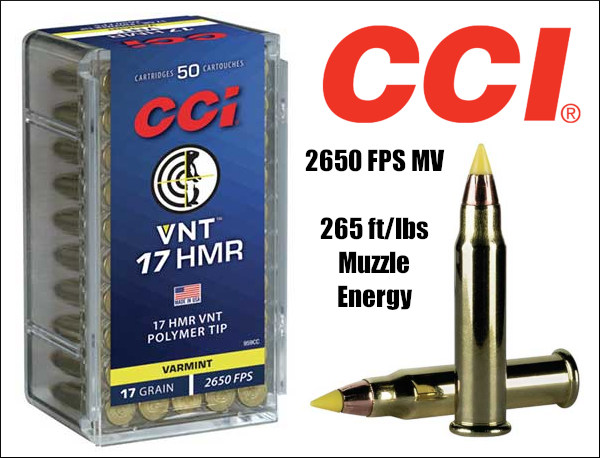
CCI .17 HMR TNT offers 2650 FPS Velocity
For varmint work we like CCI’s modern .17 HMR VNT ammo. This boasts class-leading 2650 FPS muzzle velocity. Engineered to combine good accuracy with high impact energy, this CCI TNT ammo features a 17gr polymer-tipped bullet designed for rapid expansion. We also like the Hornady .17 HMR Varmint Xpress ammo, rated at 2550 FPS with 17gr V-Max bullets.
Do you compete in rimfire benchrest, silhouette, or NRL22 matches? Then you’ll want to check out the Shooting Sports USA .22 LR Ammo Roundup on the SSUSA.org website. That article covers .22 LR ammunition from Lapua, ELEY, SK, RWS, Norma, Wolf, and Aquila. Notably there’s a detailed discussion of Lapua’s new Long Range and Super Long Range ammo. In addition, SSUSA confirms that SK ammo (made in Germany by Nammo, parent of Lapua) and Wolf Match Target ammo (made by ELEY) both offer quite good performance for a moderate price.
The article notes that there is a much wider range of .22 LR ammo types available now than a few years ago. It’s not just a choice between cheap products and high-end match ammo. As SSUSA explains: “It used to be that .22 LR was either quite expensive match grade ammo, or it was cheap plinking or hunting ammo. Today, competitors have choices in grades of .22 LR match ammunition to suit their pocketbook or firearms.” We’ve seen good results with relatively inexpensive Norma Tac-22, and the SSUSA article says that SK performs well above its price level.
Seven Brands of .22 LR MATCH AMMUNITION
Lapua Super Long Range and Long Range .22 LR
Lapua Super Long Range and Long Range ammunition comes from Finland, and is designed for the growing long-range rimfire disciplines with targets at 100-300 yards. Lapua says this ammo delivers very low ES and SD numbers. Our friend F-Class John has tested this ammo and confirmed it performs very well (SEE video above). “Each production lot of Lapua’s new rimfire products are test-fired in 50-round groups for dispersion”, Capstone’s Marketing Director, Geoff Esterline, said. “The results determine whether it makes Super Long Range or Long Range packaging.”
ELEY .22 LR Ammunition
ELEY has long been a top choice for .22 LR competition — both position shooting and benchrest. ELEY now offers 11 different varieties of .22 LR match ammunition, ranging in price from $7 (Benchrest Outlaw) to $20 (ELEY Tenex). If you compete in the rimfire benchrest, you should definitely try some ELEY ammo.
SK .22 LR Ammunition
Numerous .22 LR ammunition types are offered by SK, suitable for a variety of disciplines — from NRL22 to Biathlon. Generally cheaper than ELEY Match ammo, SK offers good “bang for the buck”. F-Class John says it performs great considering the price. The SSUSA article notes that: “German manufacturer SK has eight match-grade .22 LR offerings, including two for pistols, one for semi-automatic rifles, and one for frigid, wintertime conditions.”
RWS .22 LR Ammunition
Sometimes hard to locate at vendors in the USA, RWS is popular among European competition shooters. The top-tier RWS ammo is a choice of many competitive shooters. RWS currently offers nine Premium Line .22 LR varieties and three Professional Line offerings. The SSUSA tester noted that RWS Rifle Match ammo shot great in his Bergara BMR, shooting one-ragged-hole groups at 50 yards and about one MOA at 100 yards. That’s great performance for $10/box ammo.
Norma .22 LR Ammunition
Norma recently introduced XTREME LR-22, a new type of competition rimfire ammo with a radical new bullet. This unique, patented bullet design has a special base with a cone (see diagram). Norma claims that this “rocket tail” design reduces drag by creating less negative pressure at the back end of the bullet. It will be interesting to see how this new bullet design works in rimfire ELR competition.
Wolf .22 LR Ammunition
SSUSA says that Wolf Match Target is a top performer in the under-$10 per box category. This is because, according to SSUSA: “It is manufactured by ELEY in England (and loaded with Vihtavuori powder) and re-branded, if online information is correct.” Wolf Match Target is available from Target Sports USA for $74.99 per thousand ($0.15 per round).
Aguila .22 LR Ammunition
Made in Mexico, Aguila .22 LR rimfire ammo is the bargain item among the seven ammo-makers featured by SSUSA. It is widely available at very affordable prices.
We wouldn’t choose Aguila for a benchrest or three-position match, but it could be more than adequate for a local NRL-22 match or a steel-target competition at relatively short range. Aguila .22 LR ammunition starts at under $3.00 per box. And right now Midsouth offers a 2000-round Case of Aguila for just $114.99. That works out to just $2.87/box or six cents per round.
Past NRA President Allan Cors’s favorite firearm is this unique M1 Garand, originally given to John C. Garand by the Springfield Armory. Images courtesy NRA Museum (top) and NRA Publications.
Allan Cors, who served as NRA President 2015 to 2017, has a very special M1 Garand in his firearms collection. This unique M1 rifle was originally owned by none other than its inventor, John C. Garand. This historic Springfield Armory M1 rifle bears the serial number 1,000,000. This rifle, which came complete with a walnut-fitted case, silver-plated clip and gold-plated cartridges, was originally presented to its designer John C. Garand as a retirement gift in 1953. Remarkably, this gift was the only reward the famous gun designer received for his contribution to the Allied victory in the Second World War.
Upon his passing, Garand’s family offered the rifle for sale. As the M1 was one of his passions and realizing the extraordinary historic significance of this particular gun, Allan Cors made an offer on the M1. The Garand family accepted.
“I felt very good that they trusted me to do the right thing. Let’s face it: we are only temporary custodians of these things,” Cors said. “They are here in our hands for a while, and then they are passed on to the next generation.”
About John C. Garand
Jean Cantius Garand, also known as John C. Garand, was a Canadian designer of firearms who created the M1 Garand, a semi-automatic rifle widely used by the U.S. Army and U.S. Marine Corps during both World War II and the Korean War. Garand’s fondness for machinery and target shooting blended naturally into a hobby of designing guns, which however took a more vocational turn in 1917. That year the United States Army took bids on designs for a light machine gun, and Garand’s design was eventually selected by the War Department. The U.S. government employed Garand as an engineer with the Springfield Armory from 1919 until he retired in 1953. Born in 1888, John C. Garand died in 1974.
Credit: NPS Photo, public domain
In Springfield, Massachusetts, Garand was tasked with designing a basic gas-actuated self-loading infantry rifle and carbine that would eject the spent cartridge and reload a new round based on a gas-operated system. Designing a rifle that was practical in terms of effectiveness, reliability, and production, stretched over time; it took fifteen years to perfect the M1 prototype model to meet all the U.S. Army specifications. The resulting Semiautomatic, Caliber .30, M1 Rifle was patented by Garand in 1932, approved by the U.S. Army on January 9, 1936, and went into mass production in 1940. It replaced the bolt-action M1903 Springfield and became the standard infantry rifle known as the Garand Rifle. During the World War II, over four million M1 rifles were manufactured. The Garand Rifle proved to be an effective and reliable weapon and was praised by General MacArthur. General Patton wrote, “In my opinion, the M1 rifle is the greatest battle implement ever devised.” Source: Wikipedia.com.
This stunning Celtic Engraved Double Bolt Action rifle is from Fuchs Fine Guns.
As a New Year’s gift to our readers, we thought we’d share some beauty pictures — rifle beauty that is. In our Shooters’ Forum, a Gun Glamour thread recently started entitled: “Show me what a beautiful gun looks like!” Well here are some very handsome rifles featured in that Forum Thread and other Bulletin features. Enjoy.
Beautiful Rifles from our Shooters’ Forum
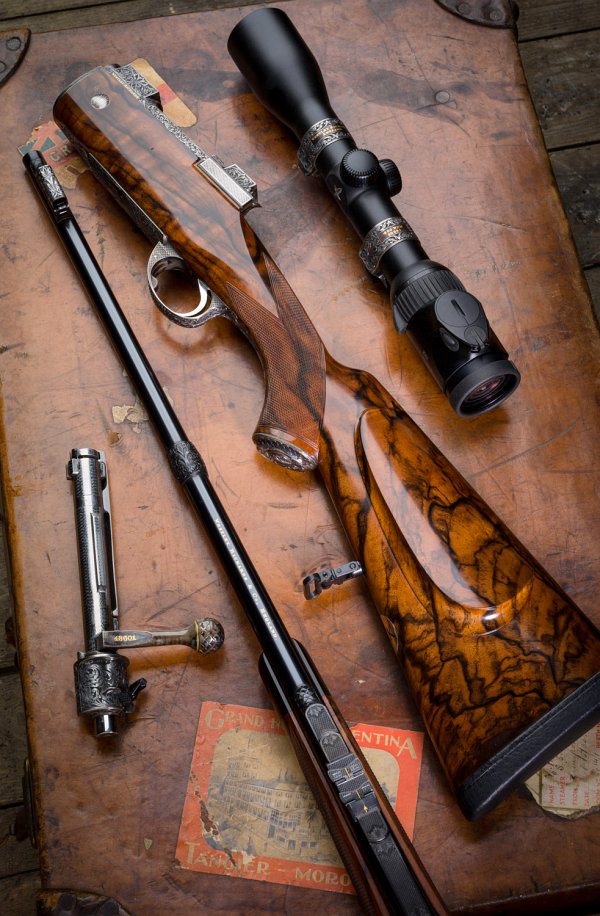
Forum member Kurz posted a dream gun owned by a friend in England. Kurz included a quote from a book created by the rifle’s owner: “There, with my father’s words ringing in my ears, I shall take that ‘step forward’ and order a perfect machine based on the Mauser ’98 action, built from metal and wood by master craftsmen who truly understand that ‘reliable’ and ‘mechanical integrity’ have as much relevance today as they did all those years ago.”
A gun can “shoot dots” and still be handsome. Here is a short-range benchrest rifle with a stunning, exhibition-grade Walnut stock. Forum member Josh B found this beauty.
Forum member JRS submitted a stunner from Europe. This beauty features a truly exquisite piece of wood with elaborately engraved receiver. It also has escutcheons and special metal work on the grip.
Lever-action Falling Block rifles can be beautiful too. This one features a color case-hardened receiver and handsome two-piece fancy wood stock. This was submitted by Forum member Kurz who notes: “Besides exhibition grade walnut, I like the variations available in spalted maple for rifle stocks.”
This F-Class rifle belongs to Shiraz Balolia, Chairman/CEO of Grizzly Industrial. Shiraz finished the highly-figured Walnut stock himself: “I installed the bottom wider track for my rear bag and also carved out the finger grooves in the grip. I went ahead and inlaid my name in Mother-of-Pearl on the Walnut stock.” The stock has Curly Maple inner laminations.
CLICK HERE to See Hundreds More ‘Pride and Joy’ Rifles…
This story first ran in 2010. But to mark our long-standing friendships with shooter Joe Friedrich and chassis builder Gary Eliseo, we wanted to reprise the article for the new year, with 2024 just hours away. Joe’s Eliseo-chassis 6mmBR rifle delivered some of the most amazing accuracy with factory ammo we’ve ever seen, in any rifle, in any caliber.
Amazing Accuracy from 6mmBR Tubegun
What kind of accuracy do you think a tubegun can deliver with factory ammo — during barrel break-in? Perhaps 0.6″ at 100 yards, half-MOA if the conditions are perfect? Well you may want to change your preconceptions about tubeguns — and factory ammo. This Eliseo R5 repeater, smithed by John Pierce with a Pierce CM action and Broughton 5C barrel, shot the Lapua 90gr factory ammo into flat ONEs during the break-in session. A day later, in tricky 8-14 mph winds, the gun nailed a witnessed and software-measured 0.174″ 5-shot group using the 105gr factory ammo. That would be impressive for a “full-race” benchgun with precision handloads. For an across-the-course rifle shooting factory ammo, it’s pretty amazing.
Eliseo Tubegun Shoots in the Ones
This accurate rifle belongs to our friend (and designated expert trigger-puller) Joe Friedrich. During the initial break-in session, since his reloading dies had not yet arrived, Joe decided to start with some Lapua factory-loaded 6BR ammo he had on hand. After doing a few two-shot-and-clean cycles (with patches and nylon brush), Joe decided to try a 3-round group just to see if the Broughton barrel had some potential. To his astonishment, the Eliseo R5 put three rounds in 0.100″ (photo below left). Joe then cleaned the barrel again, shot a couple foulers and tried a 4-shot group. The results were just as stunning — 4 shots in a mere 0.104″ but three in virtually one hole (photo below right).
You Can’t Believe How This Gun Shoots
Joe called your Editor and said “You can’t believe how this gun shoots with factory ammo!”. So we arranged a photo session for the next afternoon, where I could verify the rifle’s accuracy. Well it turned out the conditions were way more challenging than when Joe broke in the barrel the day before. Winds were running 8-14 mph and were swinging through 180 degrees half-way down the range. Joe fired a few 90s through the Oehler chronograph at my request, then opened a box of Lapua 105gr factory ammo. It took about four rounds for the barrel to settle in after being cleaned the night before. Then Joe got serious, and with your Editor looking over his shoulder, he drilled a 0.174″ five-shot group in switching winds, doping every shot. Joe felt the gun could have shot tighter but he missed one wind call.
Serious Accuracy with a Multi-Purpose Rifle
So there you have it — a tubegun that shoots in the ones with factory ammo. Joe says that, at least with the 90s, the Elesio R5 shoots as well as his 6 PPC. Joe stressed that “steering the tubegun is hard work. You really have to concentrate compared to a purpose-built bench gun like my PPC. With the tubegun, everything has to be perfect on every shot — hand position, cheek position, stock position in the bag. If you’re off just a little bit, it’s easy to steer the gun the wrong way and send a shot out of the group.”
Accuracy Great But Fouling Heavy and ES Could Be Better
Have there been any negatives to Joe’s 6BR tubegun experiment so far? Well, the Broughton 5C barrel, while phenomenally accurate, shows signs of being a bad fouler. Copper built up pretty quickly over the first 25 rounds or so. We saw best accuracy with a recently-cleaned barrel. Hopefully the fouling will lessen as the barrel polishes in with use. And the canted land barrel is slower than average with the factory ammo. Lapua rates its 90gr naked-bullet ammo at 2950 fps with a 26″ tube. In Joe’s 27.5″ barrel we only averaged 2901 fps. With the 105gr factory ammo, which is rated at 2790 fps, we averaged just 2694 fps. That’s quite disappointing. Also the ES on the factory ammo, slightly over 50 fps for both bullet types, wasn’t particularly good. Still, the overall results were stunning. This gun shoots better than many long-range benchrest rifles running carefully-developed handloads — and it does that with factory ammo, right out of the box.
Joe Friedrich is a superb benchrest shooter, who has won many matches and set National Records in ARA rimfire benchrest competition. Here is Joe with “Sweet Pea”, his favorite .22 LR rimfire rig. With over 100,000 rounds through the Benchmark barrel, this well-worn rifle set an ARA 4-target Aggregate record! READ about Sweat Pea Record HERE.
For many years, the U.S. Army Marksmanship Unit (USAMU) regularly published reloading “how-to” articles on the USAMU Facebook page. In this article, the USAMU’s reloading gurus address a question frequently asked by prospective handloaders: “Should I buy a single-stage press, or a progressive?” The USAMU says the best answer is Solomon-esque in both its wisdom and simplicity: “Get BOTH!” However, there is definitely more to the issue, as the USAMU explains below.
Progressive Press Safety Considerations
by USAMU Staff
Many are the beginning handloaders who have asked a friend about their “setting up” a progressive press for them. The idea is that the newbie could then just feed in components and crank out buckets of practice ammo without needing to really learn much about handloading. Tempting though this might be, that’s simply not how it works. Such an approach might be ok if there were never a malfunction with either press or operator, but that’s unrealistic. Our hypothetical newbie would then lack the knowledge to problem-solve most situations.
Worse yet, several different handloading operations would be occurring at different stations on the progressive press at the same time. It takes an experienced operator to keep track of, and truly understand the significance of, all those potential mini-problems. Loading without this experience is a recipe for potential disaster – such as a double powder charge (especially with pistol cartridges) dropped while the loader was attending to some other function, etc. Progressives are an animal unto themselves, and while they offer many benefits, they do take some getting used to – even by experienced handloaders!
ILLUSTRATIVE HORROR STORY
Here, enter a 40-year veteran handloader who decided to jump onto the progressive bandwagon late in his career, having used only single-stage presses all his life. A High Master NRA High Power Rifle competitor, he had no background in competitive pistol shooting, where historically most progressive presses are found.
Experienced Action Pistol shooters have typically encountered multiple episodes in which shooters “skipped” a powder charge for some reason, leading to a squib round and a bullet possibly lodged in the bore. Thus, at matches, it’s reflexive for them to yell “STOP!” in unison if they see a shooter get a “click” vs. a “bang”, and rack the slide to keep firing. This writer has personally seen several pistols saved in just such scenarios over the years.
Click No Bang — What NOT to Do
Our High Master set up a popular progressive press and began turning out .223 Rem 100-yard practice ammo with abandon. He was using a moly-coated 52gr match bullet and an economical, fast-burning surplus powder that gave great accuracy. Once on the range, he began practicing strings of rapid-fire. All was well, until he heard “Click!” rather than “Boom”.
Lacking the above experience or onlookers to halt him, he reflexively operated the charging handle on his expensive, custom NM AR15 Service Rifle, and the next trigger squeeze reportedly registered on seismographs over at least a three-state radius. He sat, uninjured but bewildered, until the hail of expensive bits and pieces quit raining down around him.
When the smoke cleared, he immediately cursed the horrid, evil, demonically-possessed progressive press for this, his first-ever reloading mishap. His $1400 NM upper was ruined, but thankfully, his $800 pre-ban lower… and he had escaped injury.
This tale is told not to discourage the use of progressive presses, but to emphasize the need to EASILY and IMMEDIATELY KNOW what is happening with the press at each station, every time the handle is cranked. Not to do so is, as they say, “bad ju-ju.”
It illustrates why we at the USAMU Handloading Shop agree in recommending that new handloaders should begin with a single-stage press. Once one thoroughly learns the steps in each phase of handloading by repeated experience, then one will be qualified to move on to a progressive press.
The single-stage press will REMAIN virtually indispensable for one’s entire handloading career, even after having purchased a progressive press (or two). There are endless small projects that are best handled on a single-stage press, and a poll of USAMU’s Handloading staff reveals that not one would willingly be without his single-stage press, despite owning at least one progressive.


 Readers who have just recently discovered the Daily Bulletin may not realize that AccurateShooter.com has hundreds of reference articles in our archives. These authoritative articles are divided into multiple categories, so you can easily view stories by topic (such as competition, tactical, rimfire, optics, shooting skills etc.). One of the most popular categories is our Technical Articles Collection. On a handy index page (with thumbnails for every story), you’ll find over 120 articles covering technical and gunsmithing topics. These articles can help you with major projects (such as stock painting), and they can also help you build more accurate ammo. Here are five popular selections from our Technical Articles archive.


 Every year the





 In recent years, Browning has produced T-Bolt rifles in a variety of models, with many different stock types and various barrel lengths/contours. Most of the photos above showcase the AA Maple Sporter T-Bolt, which is currently out of production, though still available from some dealers (if you search). We like the looks of the AA Maple T-Bolt, but there many other stock options including dark brown, Black, Green, and various camouflage finishes. Use the links below to see other T-Bolt configurations.




 Credit: NPS Photo, public domain


 Amazing Accuracy from 6mmBR Tubegun


 You Can’t Believe How This Gun Shoots