SHOT Show 2024 kicks off on Monday, January 22, 2024 with Industry Day at the Range. We’ll have friends there at the Boulder City Range testing new rifles and pistols, and checking out new optics and accessories. Then on Tuesday, January 23, the doors open at the Venetian Expo and Caesars Forum. Over 2500 companies will be exhibiting products this year, with booths and displays covering over 800,000 square feet of floor space. Show organizers expect over 50,000 attendees.
SHOT Show is restricted to industry professionals — manufacturer personnel, buyers/sellers of products, and media representatives. But thankfully, there will be lots of coverage from the event. We’ll be providing regular updates through our Daily Bulletin. In addition, we’ll be following SHOT Show coverage from leading gun-related YouTube Channels, including BackFire, Guns America Digest, The Firearm Blog (TFB-TV), RECOIL Magazine, and Ultimate Reloader. And below are official pages from the show website:
Here are two video previews for products that will be on display in Las Vegas at SHOT Show 2024.
In addition, NRA Publications’ Shooting Illustrated will provided extensive coverage of SHOT Show — from pre-show private events to Media Day At The Range to updates from the Venetian Expo and Caesars Forum in Las Vegas. Shooting Illustrated staffers will be at SHOT Show to find notable new firearms, gear, and accessories, which will be covered via regular updates on the internet. Check out ShootingIllustrated.com for daily show recaps, as well as exclusive, live content from Las Vegas on Instagram, Twitter, Facebook and YouTube.
Shooting Illustrated is the NRA’s official journal covering personal defense, concealed carry, and tactical firearms, training and gear. Shooting Illustrated reaches over one MILLION users through its print magazine, digital publications, and social media. Visit ShootingIllustrated.com for more information.
Though some manufacturers introduce new rifles mid-year, many officially launch new rifles at SHOT Show each January, though often with late fall previews before the actual show. There have been some very innovative rifles introduced recently, including the Nosler Carbon Chassis Hunter shown above and the new PWS UXR featured in a separate article.
In today’s Saturday Showcase, we feature seven videos that cover a huge variety of rifle types — from air rifles to long-range, large-caliber ELR rigs. The first video below covers 11 different rifles, and the other six videos cover more than two dozen other rifles. Watching these videos is a good way to see a host of different rifle options in a short period of time.
11 New/Recent Rifles with Factory Promo Videos
This videos features new offerings from Mossberg, Benelli, Stag Arms, Bergara, and more. There’s also the return of a classic, the Marlin 336.Rifles listed in this video (with video times):
When you’re in mountainous backcountry pursuing big game, you don’t want to be hauling around a 12-pound rifle. Thankfully, with carbon fiber and other modern materials, there are quality hunting rifles at 6 pounds or less. The host of this video notes: “When you go hunting, the last thing you want is to carry a heavy gun with you that gets you tired and weighs you down. The good news is that this is not necessary anymore. In times of titanium carbon fiber, and Kevlar, hunting rifles get lighter and lighter while keeping all the high-quality, reliability, and accuracy that you expect of them. So, without further ado, let’s take a look at these lightweights that will serve you well.”
Savage Arms KLYM Light Rifle
Here is innovative engineering from Savage Arms. The impressive new Savage KLYM rifle employs carbon fiber components for major weight savings. The HuntStand team had a chance to field test the new KLYM rifle series: “Based on a new carbon-fiber platform, Savage KLYM cuts weight so you can go farther in your quest for beasts off the beaten path.” With its Proof Research carbon fiber-wrapped stainless barrel and FBT carbon fiber stock, the new KLYM is listed as weighing under 6 pounds.
Recommended Take-Down Camp Rifles
We think every avid hunter can use a take-down rifle. Able to separate into two shorter sections, a good take-down rifle can be carried conveniently in a day pack, yet assembled easily in a minute. This video covers a variety of take-down rigs, most of which are chambered for rimfire cartridges. Some of these rifles are ultra-light, weighing less than 4.5 pounds without optic.
Accurate .22 LR Rifles for 2024
This PewPew Zone video showcases multiple .22 LR rifles. Shown above is the CZ 457 with Manners Precision stock. The rimfire rifles featured in this video (in order) are: Lithgow LA 101, Anschutz 1761, Tikka T1x MTR, CZ 457 Varmint Precision Trainer, Savage Mark II FV, and Ruger Precision Rimfire.
Long Range Rifles
This video focuses on larger-caliber rifles intended for long-range target shooting and tactical applications. Rifles featured in this video include: Barrett MRAD MK22, Howa 1500, Bergara B14, Accuracy Int’l AXSR, Tikka T3X TAC A1, Daniel Defense Delta 5, Ruger Precision Rifle. Unfortunately, the interesting rifle shown on the static intro frame is more of a teaser and is not separately tested.
Best Air Rifles for 2024
Air rifles are fun and very inexpensive to shoot. There are a variety of air rifle disciplines now: from benchrest competition, 3-position shooting, air rifle silhouette, tactical matches, and the popular Field Target Competition. You can shoot air rifles for a small fraction of the cost of centerfire firearms.
A radical new tactical rifle, the UXR (User Xchange Rifle) was just introduced by PWS (Primary Weapons Systems). This unique, revolutionary rifle allows users to quickly switch chamberings by exchanging just three parts: barrel, magwell, and bolt head. Initially available in 5.56×45 and .300 BLK variations, the UXR platform will also be available in .308 Win and 8.6 BLK configurations later this year.
Our friend True Pearce of GunsAmerica Digest Tests the new PWS UXR:
The new UXR rifle has a unique, patent-pending Xchange system. The upper receiver of the UXR is the only serialized part of the setup, enabling the shooter to easily transition from configuration to configuration, caliber to caliber. Adaptability is the core principle of the UXR, showcased in its many customizable features such as an adjustable buttstock that can fold left or right, an adjustable cheek plate, and ambidextrous-able selector switch, magazine release and even the charging handle.
The UXR platform also features a proprietary “modified long-stroke piston system” which allows the rifle to run reliably with any UXR barrels regardless of caliber. This internal system allows the user to swap calibers and barrels without needing to adjust the gas system each time. And the newly-designed Bore Evacuator reduces back pressure, especially when a suppressor is being used, making the UXR a good choice for suppressed shooting.
For more information on the UXR, visit Primaryweapons.com/firearms/uxr. PWS will have the UXR at the Industry Day at the Range on January 22, 2024, and it will be showcased at SHOT Show 2024.
The RCBS Lock-Out Die can also be used with some Dillon and Hornady progressive presses.
If you load pistol or rifle ammo with a progressive press, we strongly recommend you get a Lock-Out Die from RCBS. This unique reloading die will prevent your progressive press from advancing if the dispensed powder charge is more or less than about 0.3 grains too high or too low. The Lock-Out Die really works. Your Editor uses it on his RCBS 2000 progressive press. I can affirm that a Lock-Out Die has “saved my bacon” a half-dozen times over the years when there was an over-charge (which could cause a Kaboom) or a low charge (which could cause a squib load).
The Lock-Out Die works by using a central die detection rod that sets its vertical position based on the height of the powder column in the case. Through an ingenious design, if the powder column height is too low or too high, the rod locks in place as you start to pull the press handle. This halts the press before the ram can lift and the cartridge plate can advance. Unlike a beeping alarm system (which can be ignored or defeated), the Lock-Out Die physically stops the movement of the press ram and prevents a bullet being seated in the “problem” case.
It takes a bit of tweaking to get the Lock-Out Die detection rod setting just right, but once it is correctly positioned, the Lock-Out Die works smoothly in the background. The Lock-Out Die won’t interfere with the loading process unless it detects a high or low charge — and then it positively stops the progressive loading cycle.
While crafted for use in RCBS progressive presses, the RCBS Lock-Out Die can also be used on a Dillon XL Progressive (see video below) or Hornady Lock-N-Load progressive — though it does take up one station which could otherwise be used for a final crimp die (after the seating die). The RCBS 2000 has one more station than a Dillon 550/650, so it’s an ideal platform for using the Lock-Out Die.
Learn More at UltimateReloader.com
On the UltimateReloader.com website, run by our friend Gavin Gear, you’ll find an excellent two-part series on the function and set-up of the RCBS Lock-Out Die. Part One explains how the Lock-Out Die functions, using cut-away illustrations. Part Two shows how to install and adjust the Lock-Out Die on various progressive presses. The Ultimate Reloader video at the top of this article shows setup of the RCBS Lock-Out Die on the Dillon XL-650 progressive press, while the Reloading Bench video below shows the Lock-Out Die on a Hornady LnL progressive.
The folks at Sierra Bullets asked a few staff bulletsmiths a classic question about guns: “If you could own only one firearm which one would you choose?” There were many interesting answers including a “cheater” response — the drilling — which is really two guns in one. The most-often mentioned chambering was the venerable .30-06. Respondents cited its versatility, hunting prowess, and ready availability of ammo. The popular .308 Winchester, as expected, got mentions as did its cousins the .243 Win and 7mm-08. There were quite a few votes for classic lever guns, as well as 12-gauge shotguns. Two bulletsmiths cited the .22 LR, and we can certainly see the logic in that answer. The little rimfire cartridge is versatile, quiet, and inexpensive. SEE All Answers.
We ask our readers the same question — if you could only have one long gun, what type of firearm would it be? List the gun type and chambering in the comments section.
If You Could Have Just One Long-Gun — ANSWERS:
Media Relations Manager Carroll Pilant answered: “I would NEVER own only one gun. If I HAD to pick one, it would be a drilling in 12 gauge over .30-06.”
Ballistic Technician Rich Machholz answered: “The early tang safety Ruger M77s pretty much have all you could want in a bolt gun, but I do like the Winchester lever guns and the combination guns, particularly the drillings. Since I have the first two, I’m going for a Doug Turnbull 1886 or a side by side 20 gauge over .223 drilling.”
Ballistic Technician Philip Mahin answered: “More than likely it would have to be a bolt action .30-06. The reliability is legendary on a wide range of game animals and factory ammunition has still been available at my local stores even in these tough times.”
Ballistic Technician Duane Siercks answered: “If I had to boil it all down to one gun, it would probably be a .30-06. I have a Remington 700C (custom shop gun) that has worked very well for anything and everything I have ever wanted to do with it.”
Ballistic Technician Paul Box answered: “A .22 Rimfire.”
Chief Ballistician Tommy Todd answered: “Remington 700 in .308 Winchester.”
VP – Sales & Marketing Matt Reams answered: “A light weight Kimber in 25-06.”
Production Toolsetter Brad Vansell answered: “Savage weather warrior 7mm-08 is my rifle of choice.”
Production Toolsetter Dan Mahnken answered: “The .308 Winchester rifle — [based on the] wide range of bullets made and the wide range of things that one can hunt with it.”
Process Engineer David Palm answered: “Savage action 243 Winchester.”
Ballistic Technician Gary Prisendorf answered: “Probably a .22 LR. It may not be the best choice, but you could use it for about anything if you really had to.”
Production Manager Chris Hatfield answered: “Beretta A300 Outlander 12 gauge.”
The latest GunBroker.com Top-Selling Handguns list reveals the most popular pistols among gun buyers this past year. Turns out that two SIGs top the list. For 2023, the SIG Sauer P365 came in as the Top-Selling Handgun. The SIG Sauer P320 was second and the GLOCK G19 took third in the handgun category.
The P365 also came in as the best-selling firearm overall — meaning it sold more than any rifle or shotgun, as well as any pistol. Notable, the SIG Sauer P320 was also the second-best selling firearm overall. Both handguns have grown steadily in popularity in recent years. The P320 is the civilian version of the military’s M17. CCW holders really like the P365 because of its moderate size and good ergonomics. It also boasts a higher capacity than most handguns in its size category.
The Glock G19 has been popular with shooters pretty much since its introduction back in the 1980s, especially after numerous law enforcement agencies adopted either it or the G17, from which the G19 was derived. Shooters like the G19 because it’s more concealable than the G17, but still has the same reliability. New G19 variants are available, such as the G19 Gen 5 MOS which comes fitted with a Holosun optic.
GunBroker’s Top-Selling Handguns of 2023 (Top 10):
1. SIG Sauer P365
2. SIG Sauer P320
3. GLOCK G19
4. GLOCK G43
5. CZ-USA CZ 75
6. Colt Python
7. Ruger Mark IV
8. Smith & Wesson M&P9
9. Ruger Blackhawk
10. Beretta 90 Series
There are, of course, numerous other handguns popular with shooters, as shown by the monthly data released by GunBroker.com on the top selling firearms by category on the site. Later this month GunBroker will publish a full report of all top-selling firearms, including handguns, rifles, and shotguns. Stay tuned.
Handguns Under $400 Featured on GunBroker.com
If you are in the market for a new handgun, but have a limited budget, GunBroker has a helpful review. In the article Top 10 Handguns for under $400, Gunbroker’s editors showcase ten interesting pistols. We think the three top featured choices were the Taurus G3 9mm, Smith & Wesson SD9 VE, and Canik TP9SA Mod 2 9mm (shown below):
This thought-provoking article is one of the 15 most popular Daily Bulletin features over the last 12 months. We are republishing this story today for readers who may have missed it the first time around…
Here’s a little known fact that may startle most readers, even experienced gunsmiths: your barrel wears out in a matter of seconds. The useful life of a typical match barrel, in terms of actual bullet-in-barrel time, is only a few seconds. How can that be, you ask? Well you need to look at the actual time that bullets spend traveling through the bore during the barrel’s useful life. (Hint: it’s not very long).
Bullet-Time-in-Barrel Calculations
If a bullet flies at 3000 fps, it will pass through a 24″ (two-foot) barrel in 1/1500th of a second. If you have a useful barrel life of 3000 rounds, that would translate to just two seconds of actual bullet-in-barrel operating time.
Ah, but it’s not that simple. Your bullet starts at zero velocity and then accelerates as it passes through the bore, so the projectile’s average velocity is not the same as the 3000 fps muzzle velocity. So how long does a centerfire bullet (with 3000 fps MV) typically stay in the bore? The answer is about .002 seconds. This number was calculated by Varmint Al, who is a really smart engineer dude who worked at the Lawrence Livermore Laboratory, a government think tank that develops neutron bombs, fusion reactors and other simple stuff.
On his Barrel Tuner page, Varmint Al figured out that the amount of time a bullet spends in a barrel during firing is under .002 seconds. Al writes: “The approximate time that it takes a 3300 fps muzzle velocity bullet to exit the barrel, assuming a constant acceleration, is 0.0011 seconds. Actual exit times would be longer since the bullet is not under constant acceleration.”
We’ll use the .002 number for our calculations here, knowing that the exact number depends on barrel length and muzzle velocity. But .002 is a good average that errs, if anything, on the side of more barrel operating life rather than less.
So, if a bullet spends .002 seconds in the barrel during each shot, and you get 3000 rounds of accurate barrel life, how much actual firing time does the barrel deliver before it loses accuracy? That’s simple math: 3000 x .002 seconds = 6 seconds.
Gone in Six Seconds. Want to Cry Now?
Six seconds. That’s how long your barrel actually functions (in terms of bullet-in-barrel shot time) before it “goes south”. Yes, we know some barrels last longer than 3000 rounds. On the other hand, plenty of .243 Win and 6.5-284 barrels lose accuracy in 1500 rounds or less. If your barrel loses accuracy at the 1500-round mark, then it only worked for three seconds! Of course, if you are shooting a “long-lived” .308 Win that goes 5000 rounds before losing accuracy, then you get a whopping TEN seconds of barrel life. Anyway you look at it, a rifle barrel has very little longevity, when you consider actual firing time.
People already lament the high cost of replacing barrels. Now that you know how short-lived barrels really are, you can complain even louder. Of course our analysis does give you even more of an excuse to buy a nice new Bartlein, Krieger, Shilen etc. barrel for that fine rifle of yours.
Check out that bolt assembly. It features a fluted stainless bolt body, laser-engraved Titanium shroud, and Titanium dragon-scale bolt knob with polished stainless handle.
You haven’t seen a Ruger Precision Rifle (RPR) like this before. Forum member TerryH has customized his Second-Gen 6.5 Creedmoor RPR with a wicked purple finish, snazzy stainless/titanium bolt, and slick HDPE (polymer) bag-riders front and rear. The mods on this Hot Rod Ruger don’t stop there. Terry added a Seekins hand rail, Timney trigger, ergonomic grip, and more…
For his Hot Rod Ruger, Terry has the right skill set, learned on the job: “I work in a body shop and have pretty much custom-painted all my stuff for many years. For this 6.5 CM RPR, colors of choice are House of Kolor PBC-65 Passion Purple and black covered with Cerakote MC-161 matte clear.” Terry even painted his Bald Eagle rest purple to match his Hot Rod RPR.
Terry reports: “I’m shooting an RPR in 6.5 CM. It has a Patriot Valley Arms 26″ barrel. Josh at PVA is making a thread protector for me so I can remove the Mad Scientist brake. The butt stock has a V-Tab adjustable butt plate and Wiebad check rest pad. Glass is a currently a Vortex Gen I PST 6-24x50mm but I have a Golden Eagle on layaway”. To learn more about this rifle or ask TerryH questions about the build, visit this AccurateShooter FORUM THREAD.
Ruger Precision Rifle Modifications: Chassis and Handguards Painted Passion Purple
Patriot Valley Arms 26″ Barrel with Brake
Timney Trigger with Ambi Safety
Custom HDPE (Polymer) Bag-Riders front and Rear
V-Tab adjustable butt plate and Wiebad cheek-pad
Seekins Rail
Good Accuracy with Factory Ammunition
Terry reports: “The RPR is shooting .3 MOA @ 100 with factory Fed American Eagle 140s.” Terry plans to start handloading for the rifle with the goal of shooting F-Class matches next year: “I’ve successfully shot steel out to 1140 yards on the range but [I don’t know] if that will actually translate well in a match. I’m committed to practicing as much as I can and starting to shoot some matches in 2018.”
Front and Rear Bag-Riders with Protektor Rear Bag and Upgraded Bald Eagle Rest
Terry has engineered a slick set-up for F-Open competition and load testing. Up front is a Bald Eagle rest upgraded with windage knob mod, stainless F-Class feet, and longer adjusters. Terry also “changed the hardware to all stainless and added a couple of levels”. In the rear, Terry runs a Protektor Doctor rear bag with 1″ ear spacing.
Impressive additions are the custom HDPE bag-riders Terry crafted himself: “I realized that the butt stock wasn’t going to cut it on the rear bag and even though I got the 2 1/4″ front bag and the Seekins rail is 2″ wide and flat that it wasn’t as stable or smooth as I’d like.” So Terry made his own front and rear bag-riders from HDPE, a material similar to Delrin. Currently the front unit is 2.25″ wide, but Terry will be changing that to a 3″-wide front sled: “I decided that I’d get a 3″-wide front bag and mill a new front bag-rider. I’m going to recess the center to fit around the hand guard and I’ll mill a recess on the bottom of that one.”
Shown below is the Hot Rod Ruger before Terry added the HPDE Bag-Riders front and rear. Terry says the rifle now handles much better with the bag riders, and he plans to upsize the front sled to 3″ width.
Bling’s the Thing. Below is the Hot Rod Ruger’s bolt assembly. It features a custom flat-fluted bolt shaft, laser-engraved Titanium shroud and Titanium dragon-scale knob with polished stainless handle. Terry confesses: “I simply can’t resist anything shiny!”
Keith Glasscock is one of America’s greatest F-Class shooters, as well as a highly respected wind coach. A High Master, Keith finished second overall at the 2021 NRA F-Class Long Range Championship in F-Open division. He also finished second at the 2020 F-Open Nationals, and second at the 2019 F-Open Nationals. His consistency is unrivaled, which means he definitely knows the secrets of competition shooting and loading ultra-accurate ammo. Recently Keith has started PRS/NRL competition, bringing his shooting skills to those popular tactical disciplines.
Keith has a great YouTube Channel with new content every week. On Keith’s Winning in the Wind channel, Keith offers 190+ informative videos on a wide range of topics including wind reading, reloading, component selection, load development, and training. For today’s Video Showcase, we offer four of our favorite Keith Glasscock videos. Each video has important points that can benefit any competitive rifle shooter, whether you shoot in local 100-yard fun matches or compete at the National Level in F-Class, LR Benchrest, Palma, or High Power.
How to Reduce Extreme Spread (ES) and Standard Deviation (SD)
Having minimal Extreme Spread (ES) does not necessarily guaranteed optimal accuracy. Some PPC shooters accept a relatively high ES for a load that shoots best at 100/200 yards. But very low ES — i.e. having bullets all exit the muzzle at virtually the same FPS speed — can definitely reduce vertical dispersion at long range (assuming consistent bullet BCs). In this video, Keith talks about various methods to reduce ES and SD. This can include seating depth, primer choice, powder charge weight, brass prep, bullet seating methods and more. Our tip is to have good smoothly-chamfered case mouths, use a quality arbor press with seating force measurement, measure powder loads very precisely, and use the highest-quality brass you can find.
Keith notes that, to achieve the lowest ES, you need to look at multiple processes, including precision powder weighing, careful seating, brass annealing, and primer selection. Another factor is bullet selection. Not all bullets of the same nominal caliber and weight class have exactly the same bullet diameter or shape. Sometimes you can get better accuracy AND lower ES by trying a different brand of bullet. We have found bullet diameters, of the same stated caliber, can vary by up to .0008″ (eight ten-thousandths). Some barrels like the fatter bullets, while other barrels may favor the skinny bullets.
Top 10 Methods to Improve Your Shooting Accuracy
To shoot top scores, you need great skills and great hardware. This video covers 10 things that can improve accuracy, starting with the most important. The #1 item, notes Keith, is rifle shooting skill — you need to be able to hold on target properly and run the rifle consistently shot after shot. The second most important thing is an accurate rifle — you need a rifle with an excellent barrel, quality components, and top-tier inherent accuracy. Third, you need very accurate ammo, and this means you need to perfect your reloading skills. You need precise powder measurement and good, consistent bullet seating. Fourth in the list is related to ammo — you need the ability to do effective load development to pick the best load for your particular barrel. Number 5 is the “right bullet”. You need a high-quality, ultra-consistent bullet that is a good match for your particular barrel and discipline. Watch the video for the other five items.
Balance Beam vs. Advanced Electronic Scale with AutoTricker
Here Keith evaluates the performance of ammo loaded with a conventional balance beam scale vs. ammo loaded with a precision, electronic force-restoration scale fitted with an AutoTrickler V4. It turns out that the balance-beam loaded ammo was actually quite accurate and consistent. Keith concluded that balance-beam ammo may well be good enough for PRS/NRL competition. However for other disciplines, such as benchrest and F-Class, Keith suggest it may be worth the investment. But the key factor is also time — with the precision scale and AutoTrickler Keith can load large quantities of competition-grade ammo much, much faster. Keith points out he puts value on his time, reminding us that, indeed, “time is money”.
Barrel Break-In Procedure for Match Barrels
In this video, Keith explains his procedure for breaking-in his match barrels. He starts by bore-scoping the barrel and cleaning it. If he finds some burrs he may use some JB Bore Paste, a patch, and a worn brush and “give that throat a little scrub” (See 1:30 time-mark). He used different stroke lengths to avoid putting a “step” in the throat. When he’s satisfied he goes to the range. He fires the first five rounds, then cleans. He then fires quite a few rounds before cleaning the barrel again and beginning load development (See 8:25 time-mark).
Bullet Sorting Methodology — Effective Methods
Bullet sorting can improve scores and accuracy, particularly for long-range competitions. There are various methods for sorting — weight, base-to-ogive measurement, bearing surface length, tip condition, and max diameter. In this video Keith explains the pros and cons of various methods. The best choice can also depend on the brand, design, and caliber of each bullet. Some bullets show significant base to ogive variance, other bullets (such as Lapua Scenars), have been extremely consistent. Overall, if you are a long-range competitor, is it probably useful to bullet sort, and you can use outliers for fouling shots.
Tripod Options for PRS/NRL Competition
Over the past two seasons, Keith has added PRS/NRL shooting to his competition resume. Along with his stellar F-Class skills, Keith now has considerable experience with tactical competitions. And he’s learned that having a good tripod will make a difference over the course of a match. In this video, Keith looks at various tripod options and explains the ways you can use a tripod for PRS/NRL centerfire and rimfire competition. While the tripod can obviously be used to support the rifle, it can also be used for various other functions, as shown in the video.
Some custom barrel makers are now honing barrels (after drilling) to improve bore diameter uniformity, smooth the interior finish, and reduce barrel lapping times. For years, large-scale manufacturers of hammer-forged barrels have employed honing. Now the process is being used by smaller, “boutique” barrel-makers. This article explains how and why barrel honing is done. Take the time to watch the video. For anyone with an interest in barrel-making, this video from Sunnen Products Co. is an eye-opener.
Barrel Honing Process Demonstrated (Worth Watching!):
For custom barrel makers, honing is a time-saver and cost cutter. A few minutes on a honing machine can cut lapping times in half, leaving a cross-hatched surface finish in single or low double-digit Ra. Honing is the same process used to make diesel fuel injectors with bore roundness and straightness controlled to fractions of a micron (<0.000040"), with surface finish Ra ≤0.15 µm (6 µin).
A key manufacturing process used for hammer-forged barrels is now getting attention from the makers of custom button-rifled barrels. This process is precision bore-honing. Honing produces a high-quality bore surface fast, which is critical to hammer forging. (Why is honing so important with hammer forging? Surface finish is the one feature of the barrel that cannot be controlled in hammer forging. Surface imperfections in a barrel blank tend to be amplified as the blank is formed on the rifling mandrel. And if the bore is chromed afterwards, imperfections in the surface finish become even more obvious.)
Honing dramatically improves bore diameter size uniformity and accuracy, surface finish and roundness throughout the length of the barrel. It can certainly be used in place of a pre-rifling lap. The chief difference between a lapped and honed bore is the direction of the finish lines in the bore. Honing leaves fine spiraling crosshatch lines, while a lap leaves lines going longitudinally in the bore. After rifling the manufacturer can remove the crosshatch finish with a quick lap if desired. Honing is fast, accurate, and can be automated. Its surface quality and geometry can duplicate lapping, except for the longitudinal lines of the lapped finish.
In 2015 Frank Green of Bartlein Barrels told us: “We worked with Sunnen and we did all the initial testing on the prototype machine for them. The machine works great! We ordered and received … a new manufactured machine with the changes we wanted on it and [subsequently] ordered a second one.”
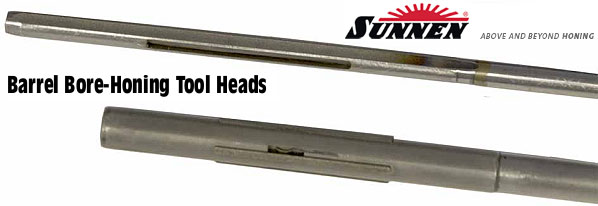
The Sunnen hone secures the barrel blank in a 3-jaw chuck, with honing oil pumped into one end while the tool works from the opposite end. Sunnen’s specialized Long Bore Tool uses metal-bond diamond or CBN superabrasives to quickly remove reamer marks, waviness, tight spots and other imperfections left by upstream processes.
Sunnen states that: “Honing is an ideal replacement for hand-lapping barrel blanks before rifling. It quickly removes reamer scratches and surface waviness without labor-intensive hand lapping. By producing a consistent bore diameter (±0.0001″ or less), parallelism, roundness and surface finish end to end, honing yields more consistent performance from rifling buttons and cutters, resulting in a constant groove depth. The ideal bore geometry reduces distortion of the bullet shape.”
Computer-Controlled Bore-Honing
Honing can be done with great precision through the use of advanced, computer-controlled honing machines. Sunnen Products Company offers an advanced machine for .17 to .50-caliber barrels (see control panel below). The spindles on this machine can correct bore size imperfections so small only an air gauge can measure them. The consistency this allows improves bore uniformity, which, in turn, produces more accurate barrels for the precision market.
Sunnen Products Company is the world’s largest vertically-integrated manufacturer of honing systems, tooling, abrasives, coolants, and gauging for precision bore-sizing and finishing. Sunnen’s customers include manufacturers of diesel and gas engines, aerospace components, hydraulic components, oil field equipment, and gun/cannon barrels. Sunnen employs more than 600 people worldwide.


 If you load pistol or rifle ammo with a progressive press, we strongly recommend you get a Lock-Out Die from RCBS. This unique reloading die will prevent your progressive press from advancing if the dispensed powder charge is more or less than about 0.3 grains too high or too low. The Lock-Out Die really works. Your Editor uses it on his RCBS 2000 progressive press. I can affirm that a Lock-Out Die has “saved my bacon” a half-dozen times over the years when there was an over-charge (which could cause a Kaboom) or a low charge (which could cause a squib load).


 Gone in Six Seconds. Want to Cry Now?