|
|
July 18th, 2013
In our Shooters’ Forum, one member posed the question: “What makes an AR accurate? What parts on an AR can really affect accuracy — such as free-floating handguards, barrels, bolts, bolt carriers?” He wanted an honest, well-informed answer, not just sales pitches. Robert Whitley posted a very comprehensive answer to this question, based on his experience building and testing dozens of AR-platform rifles. Robert runs AR-X Enterprises, which produces match-grade uppers for High Power competitors, tactical shooters, and varminters.

Building an Accurate AR — What is Most Important
by Robert Whitley
There are a lot of things that can be done to an AR to enhance consistent accuracy, and I use the words “consistent accuracy” because consistency is a part of it (i.e. plenty of guns will give a couple great 5-shot groups, but won’t do a very good 10- or 20-shot groups, and some guns will shoot great one day and not so good on others).
Here are things we think are important to accuracy.
1. Great Barrel: You’ll want a premium match-grade barrel, well-machined with a good crown and a match-type chambering, true to the bore and well cut. The extension threads must also be cut true to the bore, with everything true and in proper alignment.
2. Rigid Upper: A rigid, heavy-walled upper receiver aids accuracy. The typical AR upper receiver was made for a lightweight carry rifle and they stripped all the metal they could off it to make it light to carry (which is advantageous for the military). The net result are upper receivers that are so thin you can flex them with your bare hands. These flexible uppers are “strong enough” for general use, but they are not ideal for accuracy. Accuracy improves with a more rigid upper receiver.

3. True Receiver Face: We’ve found that truing the receiver face is valuable. Some may argue this point but it is always best to keep everything related to the barrel and the bore in complete alignment with the bore (i.e. barrel extension, bolt, upper receiver, carrier, etc.).
4. Barrel Extension: You should Loctite or glue the barrel extension into the upper receiver. This holds it in place all the way front to back in the upper receiver. Otherwise if there is any play (and there typically is) it just hangs on the face of the upper receiver completely dependent on the face of the upper receiver as the sole source of support for the barrel as opposed to being made more an integral part of the upper receiver by being glued-in.
 5. Gas Block: You want a gas block that does not impose pointed stress on the barrel. Clamp-on types that grab all the way around the barrel are excellent. The blocks that are pinned on with tapered pins that wedge against the barrel or the slip on type of block with set screws that push up from underneath (or directly on the barrel) can deform the bore inside of the barrel and can wreck the accuracy of an otherwise great barrel. 5. Gas Block: You want a gas block that does not impose pointed stress on the barrel. Clamp-on types that grab all the way around the barrel are excellent. The blocks that are pinned on with tapered pins that wedge against the barrel or the slip on type of block with set screws that push up from underneath (or directly on the barrel) can deform the bore inside of the barrel and can wreck the accuracy of an otherwise great barrel.
6. Free-Float Handguard: A rigid, free-float handguard (and I emphasize the word rigid) really makes a difference. There are many types of free-float handguards and a free-float handguard is, in and of itself, a huge improvement over a non-free-float set up, but best is a rigid set-up. Some of the ones on the market are small diameter, thin and/or flexible and if you are shooting off any type of rest, bipod, front bag, etc., a rigid fore-end is best since ARs want to jump, bounce and twist when you let a shot go, as the carrier starts to begin its cycle before the bullet exits the bore.
7. Barrel Contour: You want some meat on the barrel. Between the upper receiver and the gas block don’t go real thin with a barrel (we like 1″ diameter if it’s workable weight-wise). When you touch off a round and the bullet passes the gas port, the gas system immediately starts pressuring up with a gas impulse that provides vibrations and stress on the barrel, especially between the gas block back to the receiver. A heavier barrel here dampens that. Staying a little heavier with barrel contour through the gas block area and out to the muzzle is good for the same reasons. ARs have a lot going on when you touch off a round and the gas system pressures up and the carrier starts moving (all before the bullet exits the bore) so the more things are made heavier and rigid to counteract that the better — within reason (I’m not advocating a 12-lb barrel).
8. Gas Tube Routing Clearance: You want a gas tube that runs freely through the barrel nut, through the front of the upper receiver, and through the gas key in the carrier. Ensure the gas tube is not impinged by any of them, so that it does not load the carrier in a stressed orientation. You don’t want the gas tube bound up so that when the gas tube pressures up it immediately wants to transmit more force and impulse to the barrel than would normally occur. We sometimes spend a lot of time moving the gas block with gas tube on and off new build uppers and tweaking gas tubes to get proper clearance and alignment. Most gas tubes do need a little “tweaking” to get them right — factory tubes may work OK but they typically do not function optimally without hand-fitting.
9. Gas Port Tuning: You want to avoid over-porting the gas port. Being over-gassed makes the gas system pressure up earlier and more aggressively. This causes more impulse, and increases forces and vibration affecting the top end and the barrel. Tune the gas port to give the amount of pressure needed to function properly and adequately but no more.
10. Front/Back Bolt Play: If accuracy is the game, don’t leave a lot of front/back bolt play (keep it .003″ but no more than .005″). We’ve seen factory rifles run .012″ to .015″ play, which is OK if you need to leave room for dirt and grime in a military application. However, that amount of play is not ideal for a high-accuracy AR build. A lot of front/back bolt play allows rounds to be hammered into the chamber and actually re-formed in a non-consistent way, as they are loaded into the chamber.
11. Component Quality: Use good parts from a reputable source and be wary of “gun show specials”. All parts are NOT the same. Some are good, some are not so good, and some aftermarket parts are simply bad. Don’t be afraid to use mil-spec-type carriers; by and large they are excellent for an accuracy build. Also, remember that just because a carrier says “National Match” or something else on it does not necessarily mean it’s any better. Be wary of chrome-plated parts as the chrome plating can change the parts dimensionally and can also make it hard to do hand-fitting for fit and function.

12. Upper to Lower Fit: A good upper/lower fit is helpful. For quick and dirty fit enhancement, an Accu-Wedge in the rear helps a lot. The ultimate solution is to bed the upper to a specific lower so that the upper and lower, when together, are more like one integral unit. For the upper receivers we produce, we try to get the specs as close as we can, but still fit the various lowers in the market place.
13. Muzzle Attachments: Don’t screw up the muzzle (literally). Leave as much metal on the barrel at the muzzle as you can. People like to thread the muzzle for a flash hider, suppressor, muzzle brake, or some other attachment, but if you really want accuracy, leave as much metal as you can there. And, if you have something that screws on, set it up so that it can be put on and have it stay there without putting a lot of torque and stress on it right where the bullet exits the bore. If you are going to thread the end of the barrel, make it concentric with the bore and make sure what you screw on there is as well. For all muzzle attachments, also ensure that the holes through which the bullet passes through are dead true to the bore. Many aftermarket screw-on things are not so good that way. Anything that vents gas should vent symmetrically (i.e. if it vents left, it should vent equally right, and likewise, if it vents up, it should vent down equally). Uneven venting of gas can wreck accuracy.
14. Quality Ammunition: Ammo is a whole story by itself, but loads that are too hot typically shoot poorly in an AR-15. If you want accuracy out of an AR-15, avoid overly hot loads. Shown below are test groups shot with four (4) different uppers, all with moderate loads. These four uppers all pretty much had the same features and things done to them as explained in this article, and they all shot great.

Robert Whitley
www.6mmAR.com
July 17th, 2013
Brownells is helping a new gunsmith training program get started in Iowa. Brownells is sponsoring the Iowa Valley Community College District’s newly-created Gunsmith Technology Program, conducted at the Iowa Valley Grinnell (IVG) satelllite campus. Last week, Brownells’ CEO Pete Brownell (right) presented a check for $75,000 to MaryAnne Nickle, (left) Dean of Iowa Valley Grinnell (IVG), and Gunsmithing Instructor Dave Bennetts, (center) a former Brownells Gun Tech. The money will be used to purchase machinery and equipment for the program’s workshop.

“We proudly support a number of educational institutions and programs across the country,” said Brownell. “Our involvement with Iowa Valley is extra special because it’s right in our own backyard, and pairs our support of education with our longtime passion for helping gunsmiths. It’s also great to see a Brownells Gun Tech, Dave Bennetts, move on to fulfill his lifelong dream of teaching others his craft. We wish everyone at Iowa Valley the very best.”
“This is a major donation,” said Nickle. “It would’ve taken much longer to get this program up and running without it. It’s very nice to align our program with an industry leader like Brownells.”

Iowa Valley Community College’s Gunsmith Technology program still has openings available for its classes beginning August 26, 2013. IMPORTANT: The registration deadline for the fall 2013 program is July 26, 2013. To learn more about Iowa Valley’s new gunsmithing program, visit the IVCCD website.
CLICK HERE for Gunsmith Technology Program Admission Requirements
CLICK HERE for Iowa Valley Grinnell (IVG) Gunsmith Tech Application Form
July 15th, 2013

 Are you a skilled gunsmith looking for a salaried position? Here’s an opportunity to work for a great company with solid financials and state-of-the-art machining equipment. Barrett is seeking a Master Gunsmith for precision rifles. The selected candidate must possess the knowledge and skills necessary to independently construct, document, and deliver precise (< 0.5 MOA) long rifles while using parameters set forth by the company. The selected candidate will be considered the authority in regards to identifying critical features that result in a precision long rifle. Specific job and experience requirements are listed below. Barrett is headquartered in Murfreesboro, TN. CLICK HERE for more information. Are you a skilled gunsmith looking for a salaried position? Here’s an opportunity to work for a great company with solid financials and state-of-the-art machining equipment. Barrett is seeking a Master Gunsmith for precision rifles. The selected candidate must possess the knowledge and skills necessary to independently construct, document, and deliver precise (< 0.5 MOA) long rifles while using parameters set forth by the company. The selected candidate will be considered the authority in regards to identifying critical features that result in a precision long rifle. Specific job and experience requirements are listed below. Barrett is headquartered in Murfreesboro, TN. CLICK HERE for more information.
Job Requirements:
- Reputable Gunsmith Certification
- (7) years experience constructing highly precise and robust (<.5 MOA) long rifles
- Examples of successful long rifle constructions
- (3) years manual lathe and mill experience
- (3) years competitive shooting in a precision long rifle class
- (2) years CAD/CAM (SolidWorks preferred) experience
- Understanding of precision critical barrel and ammunition features
- Understanding of internal and external ballistics
- Ability to work closely with engineers
- Excellent communication skills
- MS Office (Word, Excel, Project) experience


M107 on duty in Afghanistan with Company F, 2nd Aviation Assault Battalion, 82nd Combat Aviation Brigade’s Pathfinders. U.S. Army photo by Spc. Cody Barber, 11th PAD.
Job find by EdLongrange. We welcome reader submissions.
July 3rd, 2013
 Here’s a news item of importance to all our readers who have an FFL or who may process firearms transfers. The FBI’s National Instant Criminal Background Check System (NICS) has announced that the current E-Check system will be upgraded to version 2.0, effective July 16, 2013. Among a host of new features will be the elimination of the digital certificate and the ability to access NICS E-Check using any computer and browser. Target date for deployment is July 16. FFLs currently using the E-Check system should plan to re-register on (or after) July 16, 2013. You can register at the NICS E-Check Web site: www.nicsezcheckfbi.gov. Here’s a news item of importance to all our readers who have an FFL or who may process firearms transfers. The FBI’s National Instant Criminal Background Check System (NICS) has announced that the current E-Check system will be upgraded to version 2.0, effective July 16, 2013. Among a host of new features will be the elimination of the digital certificate and the ability to access NICS E-Check using any computer and browser. Target date for deployment is July 16. FFLs currently using the E-Check system should plan to re-register on (or after) July 16, 2013. You can register at the NICS E-Check Web site: www.nicsezcheckfbi.gov.
Benefits of Using New E-Check System
You will be able to access NICS E-Check using any computer or browser.
Added customer protection against identity theft.
Added safeguard against theft of license number and codeword.
Ability to retrieve NICS background check results 24/7.
Ability to retrieve background checks initiated on E-Check or at the Call Center.
Ability to print completed NICS background check search requests.
The availability of messages regarding NICS operational status.
No hold times waiting for the Call Center.
No hold times waiting for a NICS Representative to review a transaction.
What is NICS?
The National Instant Criminal Background Check System (NICS) was established to aid FFLs in determining whether or not the transfer of a firearm would violate state or federal law. Mandated by the Brady Handgun Violence Prevention Act of 1993 and launched by the FBI on November 30, 1998, NICS is used by Federal Firearms Licensees (FFLs) to instantly determine whether a prospective buyer is eligible to buy firearms or explosives. Before ringing up the sale, cashiers call in a check to the FBI or to other designated agencies to ensure that each customer does not have a criminal record or isn’t otherwise ineligible to make a purchase. More than 100 million such checks have been made in the last decade, leading to more than 700,000 denials.
How NICS Functions, Step-by-Step
June 28th, 2013
When evaluating firearm finishes, one should consider hardness, chemical resistance, lubricity, abrasion resistance, and color. However, none of these factors are as critical as corrosion protection. The average firearm owner deals with corrosion more than any other finish-related problem. Accordingly, when selecting an exterior finish for the metal components of your guns, you should look for a product with superior corrosion resistance. Thanks to Cerakote, we now have some science to help you make that decision….
How well do various firearm finishes resist corrosion?
Watch the video below to find out.
Eight Gun Finishes Tested — With Surprising Results
Eight (8) various finishes are tested, including Blueing, Cerakote, DuraCoat, FailZero, Ion Bond, KG Gun Kote, NiBX, and Phosphate (Parkerizing). Eight metal firearm components (each with a different finish) are placed into the salt chamber to see how long it takes for each finish to show initial signs of corrosion. To provide a baseline for comparison, a “naked” 416 stainless steel barrel was also placed inside the test chamber. The test was started, and for each coating, the time was recorded when corrosion started to appear. FYI, if you thought “stainless steel” can’t rust, think again. The stainless barrel sample (along with the blued metal sample) showed visible corrosion after just 24 hours!
After 24 Hours in Salt Chamber

After 48 Hours in Salt Chamber

After 172 Hours in Salt Chamber

Salt Chamber Testing — 5% Salt Concentration at 95°F
According to ASTM B117-03, the Corrosion Test provides a controlled corrosive environment which has been utilized to produce relative corrosion resistance information for specimens of metals and coated metals exposed in a given test chamber. The salt chamber is set to a temperature of 95 degrees Fahrenheit with a 5% salt concentration. Salt Chamber testing is used to draw a comparison between metals and finishes and does not correlate to a specific number of hours of real world use.

Story tip by EdLongrange. We welcome reader submissions.
June 26th, 2013
 On his Facebook page, Hall-of-Fame shooter and ace gunsmith Thomas “Speedy” Gonzalez unveiled an impressive new F-Open rifle built for Bret Solomon. The rifle features Speedy’s new low-profile F-Class stock. On his Facebook page, Hall-of-Fame shooter and ace gunsmith Thomas “Speedy” Gonzalez unveiled an impressive new F-Open rifle built for Bret Solomon. The rifle features Speedy’s new low-profile F-Class stock.
Bret’s gun is chambered for his 300 Solomon wildcat, shooting heavy 210gr bullets, so it can can be a real shoulder-buster, without some kind of buffer. The stock is fitted with a Ken Rucker’s Bump Buster hydraulic recoil reduction system to tame the recoil. The Bump Buster was originally designed for shotguns and hard-hitting, big game rifles. It is interesting to see this hydraulic buffer adapted to an F-Open rig.

Here you can see Bret shooting the gun, coached by Nancy Tompkins and Michele Gallagher:
Bret’s gun features a stainless Viper (Stiller) action, barrel tuner, and an innovative Speedy-crafted wood stock. Speedy says this stock design is all-new: “It is a true, low Center-of-Gravity F-Class stock, not a morphed Palma stock merely cut out on the bottom”. See all the details in this short video:
Stock Features: Glue-in or Bolt-In and Optional Carbon Pillars and Cooling Ports
Speedy explained the features of the new stock design: “Terry Leonard and I started working on an F-Class version of his stocks last year during the F-Class Nationals and came up with what he and I consider the first true low-CG stock in the sport. As you can see by the videos, there is very little torqueing of the stock during recoil. I add the carbon fiber tunnel underneath the forearms to save Terry some time. This bonds very well to his carbon fiber skeleton within the stock adding addition stiffness to the forearm to support the heavy barrels found on the F-Class rigs. We are playing with both glue-ins like we benchresters use and bolt-ins as well. The rifles on the videos are glue-ins. Bret just took delivery today of his first bolt-in employing carbon fiber pillars and the first Leonard stock ever to have cooling ports.”
Need for Recoil Reduction Follows F-Class Trend to Bigger Calibers and Heavier Bullets
In recent years we have seen F-Open competitors move to bigger calibers and heavier bullets in pursuit of higher BC. There is no free lunch however. Shooting a 210gr .30-caliber bullet is going to produce much more recoil than a 140gr 6.5mm projectile (when they are shot at similar velocities). Does this mean that more F-Open shooters will add hydraulic buffers to their rigs? Will a recoil-reduction system become “de rigueur” on F-Open rifles shooting heavy bullets?
Our friend Boyd Allen observes: “You may imagine that shooting a short magnum, or even a .284 Win with heavy bullets, involves a fair amount of recoil, and in the prone position this can be more than a little wearing. It can in fact beat you up over the course of a match. Some time back, Lou Murdica told me about having a hydraulic recoil absorbing device installed on one of his F-Class rifles, chambered in .300 WSM. Lou is shooting heavy (210-215gr) bullets so the recoil is stout. According to Lou, the hydraulic recoil-reduction system made all the difference.”
Story tip from Boyd Allen. We welcome reader submissions.
June 22nd, 2013
 Run by Jeff Allen in Florida, CDI Precision Gunworks offers high-quality, mag-capable bottom metal for a wide variety of rifles and action types. The CDI bottom metal kits, priced at $209.00, feature an integrated trigger guard, mag-well, magazine release, and, of course, action-screw locations. Run by Jeff Allen in Florida, CDI Precision Gunworks offers high-quality, mag-capable bottom metal for a wide variety of rifles and action types. The CDI bottom metal kits, priced at $209.00, feature an integrated trigger guard, mag-well, magazine release, and, of course, action-screw locations.
Most kits are designed for use with Accuracy International (AI) magazines, sold separately. These bottom metal kits are nicely finished and gunsmiths tell us that the fit is extremely good. CDI currently offers bottom metal kits for all these rifle/action types:
• Howa 1500 Short Action
• Howa 1500 Long Action
• FN-SPR Rifles (Also works on FN-PBR rifles)
• Remington 700 Short Action (.308, .300 WSM/7MM WSM, .223 mags work as well)
• Remington 700 Long Action (300 Win Mag, 338 Lapua, 338 CIP Mag box is available)
• Savage Short Action — (Both 4.275″ stagger-feed and newer 4.400″ Center feed)
• Savage Long Action (Call for Tech Data)
• Tikka T3 (Long and Short Action)
• Winchester Short Action (All Post 1964)
• Winchester Long Action, Short Box (.308 Win Length)
• Winchester Long Action Magnum Length (7MM Rem Mag and 300 Win Mag)
• Mauser 98 Large Ring action (.308 Win Mag box size)


Single-Shot Loading Blocks just $35.00
CDI has designed a single-shot loading block (SSLB) for use with CDI short action bottom metal kits. The SSLB lets you shoot your rifle in single-shot mode without a magazine. Simply place a round on the black cartridge-holder and close your bolt. This is a good set-up for load testing from the bench, or if you want to shoot very long bullets with a COAL greater than magazine length. CDI’s SSLB costs just $35.00 plus $5.00 shipping.

June 15th, 2013
We know many of our readers own one or more SIG Sauer handguns. And now, for Father’s Day, SIG owners can get their prized guns upgraded at big savings (25% off). Now through June 19, 2013, the SIG Sauer Custom Shop is offering the popular SIG Action Enhancement Package for just $129.95 — that’s fifty bucks off the regular rate of $179.95. You can also get a factory Short Reset Trigger (SRT) for just $49.95, a 50% savings off the normal price. This Father’s Day Special is offered now through Thursday June 19, 2013. You need to call via telephone to take advantage of this deal. Have your serial number ready.

Terms and Conditions
Phone orders only. Offer applies to U.S. customers only and cannot be combined with any other offer. The sale ends June 19, 2013 at 12PM Eastern time. $55.00 return shipping/handling fee applies.
June 14th, 2013
 Thompson/Center Arms (T/C) has identified a condition that may cause the safety lever on certain ICON®, VENTURE™ and DIMENSION® rifles to bind, preventing the safety from becoming fully engaged. In this situation, closing the bolt may move the safety to the fire position. The rifle will not fire unless the trigger is pulled. Though there should be no risk of the gun going off by itself, T/C states: “Out of an abundance of caution, we are taking this action to recall the rifles so that the firearm can be inspected by our technicians to ensure that the safety lever functions as designed.” Thompson/Center Arms (T/C) has identified a condition that may cause the safety lever on certain ICON®, VENTURE™ and DIMENSION® rifles to bind, preventing the safety from becoming fully engaged. In this situation, closing the bolt may move the safety to the fire position. The rifle will not fire unless the trigger is pulled. Though there should be no risk of the gun going off by itself, T/C states: “Out of an abundance of caution, we are taking this action to recall the rifles so that the firearm can be inspected by our technicians to ensure that the safety lever functions as designed.”
This is a large-scale recall, not just a few rifles. This recall applies to all Icon, Venture, and Dimension rifles manufactured by Thompson/Center Arms prior to June 13, 2013. If you own a rifle affected by this recall, T/C recommends that you stop using the rifle and return it to T/C at once: “Because the safety of our customers is our utmost concern, we ask that you stop using your rifle until we have an opportunity to inspect the safety lever to ensure its proper function.”

To facilitate the inspection and repair, if necessary, of your rifle safety lever, contact Thompson/Center’s customer service department to receive instructions and a pre-paid shipping label for the return of your rifle to the factory. At no cost to the owner, T/C will repair the rifle and ship it back. For more information, visit www.tcarms.com. If you have any questions about this recall, contact Thompson/Center at (800) 713-0355.
June 13th, 2013
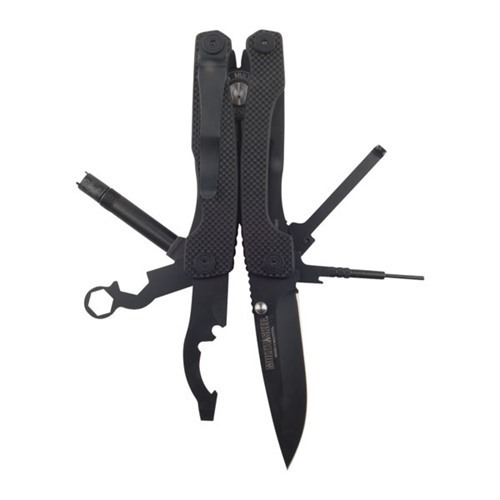
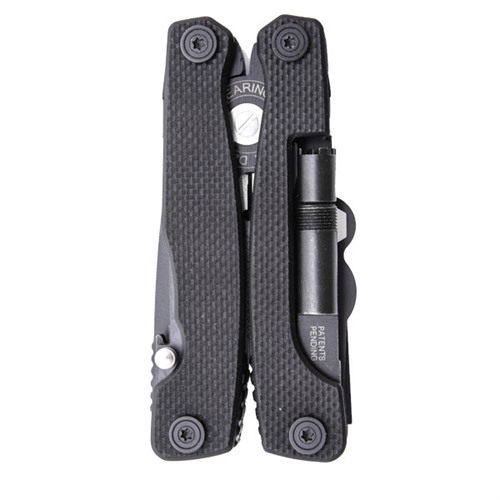
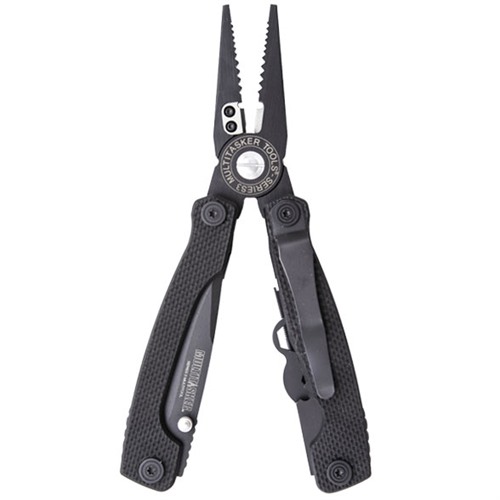
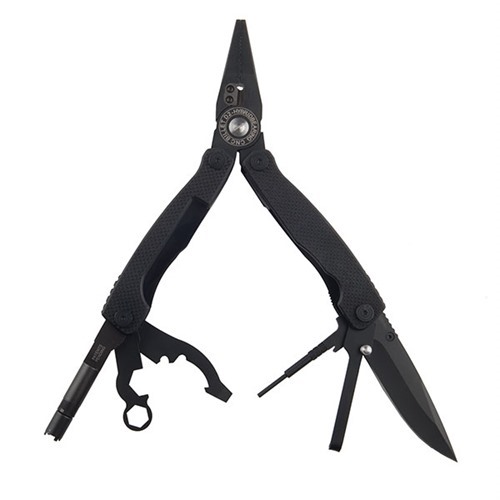
Do you own one or more AR-platform rifles? Need to fix and service critical components in the field? Then you should check out the new AR Platform Multitasker Tool sold by Brownells. This handy gadget has enough functions to keep MacGyver happy. It has hex wrenches for scope rings and LaRue mounts, front sight tool, a Castle Nut spanner wrench, a pin punch, and even a carbon scraper — something every AR owner can definitely use.
In addition to these gun-specific tools, the Multitasker includes a knife blade, pliers, and a magnetic bit driver with ten bits. The cleverly-designed tool folds up to fit in your pocket. For a further explanation of all the tool elements, and an explanation of how they work (with many good photos), see the Multitasker Review on Ar15news.com.

Brownells AR Platform Multitasker Tool Features:
- Non-slip G10 Scaled Grips (either matte black or tan)
- Billet Pliers (D2 tool steel — CNC milled)
- Carbon Scraper with Radiused Tip
- 3/8″ Hex for LaRue Mounts
- 1/2″ Hex for Scope Rings
- Magnetic Bit Driver (1/4″) with M16A2 FSP Adjuster
- Dual-Lug M4 Castle Nut Spanner Wrench
- Pin Punch (3/32″) with 8-32 male thread for Otis cleaning kit
- D2 3″-long Tool-Steel Knife Blade
- Combo Flat Screwdriver and Bottle Opener
- Pocket clip (removable)
- Kit with 10 Hex Bits for commonly used AR accessories
|