Many shooters expend considerable time and effort to coat their bullets with friction-reducing compounds such as Boron Nitride (HBN), Molybdenum Disulfide (Moly), and Tungsten Disulfide (WS2 or ‘Danzac’). Many of these same shooters believe that coated bullets permit longer strings of fire between barrel cleanings. Also, there is some evidence that coated bullets may extend barrel life (though this remains controversial).
What if you could enjoy all the benefits of coated bullets without the effort? When you think about it, why not apply the anti-friction coating to the barrel itself, rather than the bullets? That is the thinking behind salt-bath nitriding of barrels. This nitriding process creates a very slick, very hard surface coating on the steel in the bore. The coating is only 10-20 microns thick (so it doesn’t cause pressure problems). But that coating is enough to reduce friction, and just possibly, extend useful barrel life.
John Whidden, Camp Perry Long-Range National Champion in 2007, 2008, and 2010, recently had one of his Broughton 6mm match barrels nitrided by Joel Kendrick. Joel does the salt-bath nitriding for MMI TruTec. Whidden reports he “is happy as he can be with the barrel” after the nitriding process. After nitriding, the stainless Broughton 5C barrel was “every bit as accurate as before, and noticeably easier to clean”, according to John. Also, John reports that he did NOT have to change his load after the barrel was nitrided (which left it with a handsome black, semigloss finish). Whidden says, “after cleaning, the barrel takes about 3-4 rounds to settle in… that’s the same as before.” This barrel shot very well before nitriding, and after nitriding, John used it successfully at Camp Perry in the 2009 Wimbleton Cup competition.
Overall, John tells us “Everything looks good. No accuracy loss, and easier cleaning.” He is pleased enough that he has sent more barrels to Joel Kendrick for nitride processing. John also said that he’s heard that nitrided barrels in some of the big caliber rifles, such as the .338 Lapua Magnum, are showing “significantly enhanced” barrel life.
To learn more about salt-bath nitriding for barrels, or to place a processing order with MMI-TruTec, email joelkndrck [at] aol.com, or call Joel at (704) 616-6442. Joel, a past 600-yard Shooter of the Year, is very knowledgeable about both shooting and the nitriding process. He can give you well-informed answers to your questions. Price for nitriding depends on quantity — call Joel for pricing details.
Students from the Brownells-sponsored Third Year Gunsmithing program at Trinidad State Junior College (TSJC) donated their time to help shooters at the recent Black Powder Cartridge Rifle National Silhouette Championships. The students repaired guns during the event, held at the NRA’s Whittington Center Range near Raton, New Mexico.
The TSJC gunsmiths-in-training worked on almost 40 guns belonging to the 200 competitors in the event. In the photo at right, John Cowell and Bob Campbell work on a firing pin problem for one of the shooters. The Whittington Center experience let the students practice their skills with the extra time pressure of helping a shooter get back to competition. “This is exactly [what] the 3rd Year Program was designed to do — get the students hands-on experience solving real gun repair problems,” said Brownells President, Pete Brownell.
Black Powder Cartridge Rifle Silhouette Basics
You’ll find a good summary of Black Power Cartridge Rifle Silhouette History, Rules and Equipment on the Outdoor Adventures Network website.
In Black Powder Cartridge Silhouette Silhouette (BPCRS) competition, shooters must knock down steel silhouette chickens at 200 meters (656 ft.), pigs at 300 meters (984 ft.), turkeys at 385 meters (1,262 ft.) and rams at 500 meters (1,639 ft.). As in high-power rifle silhouette competitions, the chickens must be shot off-hand, in the standing position. However, BPCRS differs in that the pigs, turkeys and rams may be shot in a prone or sitting position using a cross-stick rest. Ten shots are fired at each target, for a total of 40 shots per match. The challenge is in the equipment — BPCRS is limited to single shot, exposed-hammer, American rifles of the era preceding 1896. Only original or reproduction single shot rifles that shoot cartridges loaded with black powder or Pyrodex are allowed. Only original sights may be used –- no scopes.
Black Powder Cartridge Rifle Links:
LongRangeBPCR.com (Informative site for BPCR Long-range Competition).
BPCR.net (Active Forum, Tech Pages, and Match Results).
Charles Ballard, two-time U.S. F-class Open Champion, has been working with Precision Rifle & Tool on a new F-TR (Target Rifle) stock. Charles designed the stock to combine the adjustability of the better F-Open designs with a nice rigid fore-end for bipod use. Charles has shot the new stock in competition and he says it tracks really well. When fitted with a wide-base bipod, the stock is super-stable, with minimal hop on recoil.
The new stock is officially called the “Ballard LowBoy F-Class Target Rifle (F-TR) Stock”. This new design is available immediately, in a variety of laminated colors, starting at $325.00 (without hardware). The stock can be inletted for Rem 700 actions, Rem 700 clones, the Savage Target Action, and most custom actions.
Key Features of the new Ballard F-TR stock are:
Extended front to provide proper balance with long barrels.
Low profile design for a lower, more stable center of gravity.
Buttstock has a 1/2″ machined flat on the bottom and angled sides to provide superior tracking in the rear bag.
Buttstock has a slight angle to allow minor elevation adjustments.
Optional adjustable buttplate and optional adjustable cheekpiece.
Stock Delivery Options Dictate the Price
Precision Rifle & Tool can deliver the Ballard LowBoy F-TR in any state of completion the customer desires. The basic stock costs $325, inletted for your action, but unfinished and without hardware. Complete with removable/adjustable cheekpiece, and adjustable buttplate, the stock costs $900.00 ready to be bedded and finished. Clear-coating or oil finish is available at extra cost.
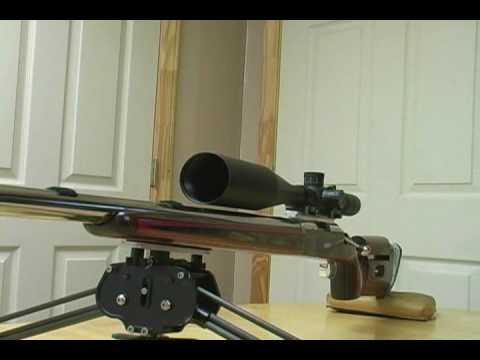
In the video, Charles Ballard gives you a “walk-around” of the stock and explains the stock’s design features. The high-tech, carbon fiber bipod is made by Center Shot Engineering in Oregon. For more info, or to order a Ballard LowBoy F-TR stock, visit PrecisionRifleSales.com, or call (336) 516-5132. Charles Ballard himself can talk you through the options.
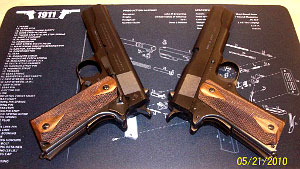
Now through July 25, 2010, GunMats.com is running a 50% off sale on printed mats used for gun cleaning and servicing. These mats are made from wetsuit-like neoprene sandwiched between fabric layers. One side of each mat is printed with an exploded diagram of a particular firearm. You can choose from a variety of designs, including handguns, rifles, and shotguns. Handgun mats are 11″x17″ and cost $6.50 (on sale) while the rifle mats measure 12″x36″ and cost $12.00 (on sale).
Handgun mats are offered for 8 handguns, including 1911, Browning High Power, Colt Python, Sig 220, Sig P225, Glock, HK USP, and Springfield XDM. Long gun mats include: AK47, AR15, Ruger 10/22, Rem 700, SKS, Winchester ’94, plus Mossberg and Rem 870 scatterguns.
Inexpensive Work Mat from Brownells.com
If you just need a durable work-mat and don’t care about the printed diagrams, Brownells.com offers an 8.75″ x 16.5″ plain black neoprene work mat for just $7.99. The Brownell’s mat is item 084-000-228, found on page 292 of Brownell’s catalog.
Pierce Engineering has just introduced its new Tactical Multi-flat action. This handsome design, crafted from chrome-moly steel, features a built-in 20-MOA rail and an integral recoil lug. The action was designed from the get-go to fit the Accuracy International chassis with no modification. With a 1/2″ flat on the bottom and 45° angled sides, the new Pierce Multi-flat short action drops right into the AI stock. Just bolt it in and shoot. The actions will cost $1295.00 and John Pierce is taking orders right now for delivery in two months.
John Pierce reports: “Our new Tactical Multi-flat action features a low-profile, 20-minute integral Picatinny rail and integral recoil lug. We made the action to drop into the Accuracy International modular stock utilizing AI’s magazines as well. Though this is a short action for .308 Win and similar-sized cartridges, the loading port is much longer than usual for better access and ejection. The current price is $1295.00, and that price includes a 30° coned bolt and/or spiral fluting if the customer desires those options.” John noted that the coned bolt option works well in Tac Comps: “I have a coned bolt on my own tactical rifle that I used at ASC. I found it picks up the rounds more smoothly from the magazine. At ASC, quite a few guys had feeding issues, but my action ran perfectly. The coned bolt works slick.” Actions will come finished with NIC CeraKote in customer’s choice of colors including: Matte Black, Titanium, OD, Sand, Brown, Gray, and Forest Green. (CLICK HERE for CeraKote color options).
Short Actions Will Be Followed By Long Actions Later This Year
Currently the new action will be available only in a short-action design. OAL is 8.050″, about the same as a Rem 700 short action if you include the thickness of the Rem’s recoil lug. The new actions will be made to order with a two-month lead time. After placing your order, you should get your new multi-flat action within about eight (8) weeks. Later this year, Pierce plans to release a larger Tactical Multi-flat action. This long action will work for cartridges such as the .30-06, .300 Win Mag, and 7mm Magnums.
For more information, or to place an order, call Pierce Engineering at (517) 321-5051, or visit www.PierceEngineeringltd.com.
For more than a century, makers of rifle stocks have used large, complicated mechanical duplicators to reproduce stock designs. These contraptions rely on mechanical linkages to follow the lines of a stock and reproduce the shape on a new blank. Now new 3D scanning technology and CNC milling systems may render the mechanical stock duplicator obsolete. Laser Design Inc. (LDI) has developed a system of scanning lasers that creates an ultra-precise 3D model of a gunstock. Digital CAD data from the scans is then used to program a CNC milling machine that produces exact duplicates of the original stock.
Keystone Sporting Arms, LLC, of Milton, PA, has already started producing rifle stocks modeled on designs derived from laser scans. Keystone, one of the nation’s biggest producers of gunstocks, turned to the laser-scanning technology after Keystone purchased another stock-maker. Keystone wanted to continue to produce the acquired company’s legacy models. However, there were no CAD models for those older stock designs. Keystone had already invested heavily in the machining equipment and needed to be able to quickly generate CAD data from scanning a master model of the stock.
Keystone owner Steve McNeal knew that 3D laser scanning was able to produce excellent results when reverse-engineering rifle stocks. When an object is hard to measure manually or with a touch probe due to its irregular surface contours, non-contact 3D laser scanning can produce accurate CAD data very quickly. The Keystone stock scans were done with a 7-axis Faro Platinum articulating arm fitted with an SLP-330 laser probe. LSI’s technical experts helped Keystone create crisp well-defined edges and corners in the data files — this is key to the reverse-engineering process. The scanning process is fast, and exporting directly to MasterCAM for milling is extremely efficient.
Amazingly, the scans from a single stock contained over 18 million data coordinates. This enormous amount of data was then exported to MasterCAM to create the CNC toolpaths. From start to finish, the project took only three hours for the scanning, data editing, and export to MasterCAM.
How Laser Scanning Works
Scanning free-form shapes and irregular surfaces, such as curved gun stocks, is an ideal application for a non-contact laser scanner. Because the scanning system projects a line of laser light onto surfaces while cameras continuously triangulate the changing distance and profile of the laser line as it sweeps along, the problem of missing data on an irregularly-shaped surface is minimal. The operator moves the laser line back and forth over the area until the complete surface is captured. The capture progress is continuously monitored by the operator on the computer screen. The system measures details and complex geometry so that the object can be exactly replicated digitally. Laser scanners measure articles quickly, picking up to 75,000 coordinate points per second.
Scanning a gun stock offers certain special challenges. Most of the gun stock had a smoothly finished surface which produces excellent scan data with very precise tolerances. However, the front end of the stock, which had a rough wood grain, needed sanding to yield more usable 3D data. A feature that was somewhat challenging to scan was a 1.5″ hole in the stock. To capture the sides and bottom of the hole the scan technician positioned the laser directly over the top of the hole so the laser could “see” the bottom, then at a 45-degree angle for the sidewalls.
As word spreads of Jackie Schmidt’s historic 0.1118″ 5-target 100-yard Heavy Varmint Aggregate, many readers have inquired about Jackie’s gear and loading procedures. Interestingly, Jackie tells us that he selected the 30 BR “on a whim” for the Heavy Varmint stage of the Midland tournament, after he couldn’t get his 6 PPC Light Varmint gun to shoot up to his standards. With the PPC, he was getting some erratic vertical, with one shot popping up to spoil the group. Jackie turned to his trusty 30 BR, and, as they say, “the rest was history”. Jackie says his 30 BR “held perfect tune all day long”, with “absolutely no vertical”. Here are some other interesting facts about Jackie’s amazing 0.1118″ 5x5x100 Agg and the 30 BR he steered to the pending NBRSA record.
Jackie Free Recoils his 30 BR
Unlike many 30 BR shooters who shoulder their guns, Jackie shoots his 30 BR totally free recoil: “The only thing I touch is the trigger. I try to keep my body out of the equation. Free recoiling a 30 BR isn’t that difficult with a true 13.5-lb rifle.”
30 BR file photo. Jackie Schmidt does not shoot Moly bullets normally.
Jackie Didn’t Clean During Record Agg
Jackie shot his entire 100-yard HV Aggregate (25 rounds plus sighters) without cleaning his 30 BR rifle. Jackie told us: “I never cleaned the rifle until the end of the day. In fact I never took the gun out of the bags.” Jackie tells us that shooting a full Agg without cleaning has become standard practice with 30 BRs: “We’ve all learned that you don’t have to clean them. It’s a phenomenon of the 30 calibers. They shoot just as good on the last shot as the first shot.” When he does clean, Jackie uses patches soaked with Butch’s Bore Shine, followed by 10 strokes with a wet brush, then dry patches. Jackie adds: “For the past few years, I’ve never put any solvent but Butch’s in my bores.”
Jackie Used 100% Case Capacity Charge
Jackie loaded a “100% usable case capacity charge” of Hodgdon H4198 (Extreme) in his rounds. His 112gr BIB bullets are “just kissing” the top of the powder column. To achieve that fill level, Jackie uses an 8″ drop tube. “That’s an old PPC-loader’s trick,” Jackie tells us. He added that his lot of H4198 is slower than most. He’s found that “some guys can reach the 3000 fps mark using nearly a full grain less powder than me.” But we wonder if loading at 100% of case capacity helps with accuracy? Folks with a faster lot of H4198 might not be able to reach 100% case capacity.
Jackie Schmidt’s ‘Snubber’ Tuner — The Inside Engineering
Everyone wants to know about Jackie’s “snubber” tuner, shown in the photo below. The Tuner is made from aluminum and brass and weighs 5.5 ounces. The tuner is 2 5/8″ long and extends past the true crown 5/8″. The inner cylinder is aluminum while the outer section is a marine bearing consisting of a brass shell with hard rubber vulcanized to the inside diameter. (These brass/rubber marine bearings are used for propeller shaft seals). The sandwiched brass/rubber bearing is then pressed on to the central aluminum shaft. The hard rubber helps dampen vibration. The tuner screws on and then is “locked” in place with a split clamp (the last 2″ of the barrel is threaded).
Unlike most tuners which have a fixed base and forward, rotating ring, Jackie’s tuner is one integrated unit. To adjust tune, Jackie’s “snubber” tuner is unclamped at the base and the whole assembly is screwed in or out on the threaded barrel. Jackie machined a very tight-pitched barrel thread so a full rotation of the tuner produces only .028″ of fore and aft movement. Jackie tells us that, once the basic position is set for a barrel, it doesn’t take much rotation to set the tune. He can usually optimize the barrel tune with less than 1/2 turn of the tuner. After the tune position is set, the split clamp at the inboard end is tightened. This way the tuner is basically locked in place while shooting.
Despite numerous requests, Jackie does not sell his tuners commercially. But someone with good machine skills could build a clone tuner. Team USA benchrest shooter Gene Bukys crafted a similar snubber-type tuner which he used successfully at the 2009 World Championships in South Africa.
The “25 Shots Heard Round the World”
Even people outside the Benchrest community are excited about Jackie’s 0.1118 Aggregate. Jackie’s achievement was noted by Michael Bane and broadcast on the Downrange TV Weekly Video Podcast.
Texan Jackie Schmidt, using a 13.5-lb 30BR Heavy Varmint rifle, has shot a pending NBRSA world record 5-target, 5-shot-per-target Aggregate at 100 yards. Jackie’s 5x5x100 Agg measured 0.1118! How small is that? To help our readers visualize this, the illustration at right shows what a SINGLE 0.111″ 5-shot group (with .30-cal holes) would look like. Jackie’s actual measured group sizes for his five-target Aggregate were: .153, .093, .120, .100, and .093.
If this record is certified, it will be the best 5×5 100-yard Agg ever shot in history by a bag gun in competition. Jackie’s Agg may also beat the “Unlimited” (Rail Gun) 5x5x100 records, but we’re still researching that. Remarkably, Jackie shot his 0.1118″ Agg with a stout-recoiling 30 BR (not a PPC), he did it in howling winds, and he did it with brass that had been fired 30 times! He also shot the entire Agg without cleaning his barrel.
We know it may be difficult for some readers to understand how hard it is to average 0.1118 for 25 shots on FIVE targets. To help demonstrate this, we’ve created an illustration that shows a SINGLE 0.111″ five-shot group. Jackie shot five groups that averaged this size. And he wasn’t “machine-gunning”. He took 6-7 minutes to shoot each target, firing on a “angle transition” in the conditions. Jackie explained: “The wind was switching, but I wasn’t shooting the dominant condition. I would wait for the transition and then shoot when the flags came around to about 15 degrees.”
Jackie gave credit to his rifle: “Though I usually use this rifle for score shoots, this 30BR is the most accurate rifle I have in terms of shooting small groups. I was lucky and hit the perfect tune. There was absolutely no vertical. You can’t shoot [an Agg] like this unless you have a rifle tuned to the hilt.” Jackie recognizes that this performance was a “once in a lifetime type experience.” He told us: “Today everything was right. The rifle was shooting impeccably, I had a good handle on the conditions, and just didn’t make a mistake.” Jackie added: “These days are few and far between — you just have to cherish the moment.”
Jackie’s 5-target Agg was so good that many experts predict it will stand as a record for a long time. On Benchrest Central, respected BR gunsmith Mike Bryant wrote: “The current record … was still Rex Reneau’s .1399 Agg from 1982. With Jackie’s Agg, I’m sure that it will easily beat Rex’s record when measured by the records committee. It’s just too far under the current record for it not to hold up… [and] to do it with a .30 BR is even more amazing. That should put to rest the notion that the .30 BR is a score cartridge only.”
Many people are surprised this pending Agg record was shot with a 30BR rather than a 6 PPC. When asked if he thinks the 30 BR can rival the 6PPC in group competition, Jackie told us: “In the 13.5-lb Heavy Varmint class, a good 30 BR is every bit as accurate as a good PPC, and possesses an equal Agging capability.” It’s different in the 10.5 classes, Jackie acknowledged: “in the LV/Sporter 10.5-lb classes, the 30 BR can get a little aggravating over the course of a match due to its greater recoil.”
Jackie’s Aggregate May Be Best in Benchrest History
Shooting in a Midland, Texas BR for group match, Jackie battled shifty, 15-20 mph winds in what may well be the greatest single-day display of “pure accuracy” in the history of the shooting sports. To put this accomplishment in perspective, Jackie’s 5-target Agg was better than any other 5×5 100-yard Aggregate ever shot in a registered benchrest match by a bag-gun. And according to the published records we could find on file with the NBRSA and IBS, Jackie’s 0.1118″ also beats even the existing rail-gun 5x5x100 Aggs. So, this could potentially be the smallest 5-target Agg ever shot in history, by any gun, in any registered match, at any time. Below are the current IBS and NBRSA World records listed on the Internet:
Current Benchrest 100-yard World Records (5 Targets, 5 shots per target)
5-5-100 Aggregate (NBRSA)
Unlimited: .1283″ Steve Kostanich 8/10/2003
Heavy Varmint: .1399″ Rex Reneau 9/6/1982
Light Varmint: .1500″ Jeff Fowler 6/11/1994
Sporter: .1573 (na) Dick Katchmar 4/14/1985
5-5-100 Aggregate Records (IBS)
Unlimited HB: .1386 (na) R. Howell 12/3/04
Heavy Varmint: .1407″ Tony Boyer 8/3/07
Light Varmint: .1599″ B. Goad 8/13/08
Sporter: .1592″ R. Boop 8/13/08
Gun Specs: Jackie was shooting a 13.5-lb 30 BR that he chambered and assembled himself. The barrel is a 4-groove, 1:18″ twist, HV-taper Krieger, fitted with a 5.5-oz. “snubber” barrel tuner made by Jackie. The action is a cast Farley, “glued and screwed” into the stock and fitted with a Jewell trigger. The stock is a Robertson Composites BRX, built with extra weight to make the gun a dedicated 13.5-pounder. The scope is a 50-power March.
Record Load: Jackie was running a stout load of Hodgdon H4198 powder, Federal 205M primers, and BIB (Robinette) 112gr flat-base bullets seated about .003″ into the lands. Load is “tuned for 3020 fps”. Cases are formed from Lapua 6mmBR brass using a dedicated forming barrel that blows the necks out to 0.330″ in one step. Trim length is 1.540″, longer than most 30 BRs. Jackie turns the necks for a total of .002″ clearance.
Amazon.com is running a big Fathers’ Day Sale on name-brand tools. There are some exceptional deals offered on quality equipment. Whether you need a gift for dad, or just want to upgrade your own tool inventory, you should check out some of these deals. Here are some examples:
There has been a trend to ever-lighter handgun frame construction, in an effort to make pistols lighter and more convenient to carry. Ruger just introduced the LCR 357, a .357 Magnum carry revolver with a frame made, in part, from plastic. Well, perhaps weight reduction efforts have gone too far, at least when it comes to magnum chamberings in handguns.
A Smith & Wesson .44 Magnum model 329 PD revolver recently broke in half while shooting Winchester factory ammo. The whole front end of the gun sheared off forward of the cylinder. Cause of the failure is unknown, but it does not appear that the barrel was obstructed, as there was no visible damage to the barrel assembly forward of the frame. We really don’t know why this revolver broke in half, though some observers speculated there may have been hairline fractures in the frame. That’s just a guess. It’s also possible that the factory ammo was over-charged. The pictures below were posted by the gun owner on Photobucket and first linked on AR15.com.
Scandium Alloy Frames
The model 329 PD has a “Scandium AirLite” frame, which is in fact an alloy of aluminum and scandium. When combined with aluminum, scandium (which costs ten times as much as gold by weight), forms an alloy that is lighter than titanium and as much as three times stronger than ordinary aluminum. Apparently however, there can be problems with scandium construction… as the photos reveal. Last year, Smith & Wesson recalled 270 limited-edition Performance Center m329 revolvers because barrel assembly may have caused frame damage. The model 329 PD shown in this article was NOT one of the recalled Performance Center guns.
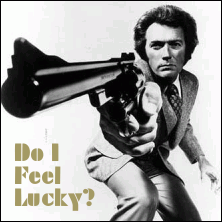
Make My Magnum from Steel… The Smith & Wesson model 329 PD weighs only 25.1 ounces total, unloaded. Why one would want to shoot “full-house”, high-pressure loads through such a light gun puzzles this Editor. For a carry gun, lower-pressure .44 Special loads seem more appropriate. Smith & Wesson makes a variety of heavier, all-steel handguns chambered in .44 Magnum. If I was to shoot a steady diet of full-power .44 Magnum loads through a revolver, give me a gun with a solid steel frame, such as the classic S&W model 29. After seeing these shocking kaboom photos, when shooting true Magnum loads through a Scandium-framed revolver I would nervously ask myself the question famously posed by Clint Eastwood’s Dirty Harry: “Do I feel lucky?”.


 Students from the Brownells-sponsored Third Year Gunsmithing program at
  In Black Powder Cartridge Silhouette Silhouette (BPCRS) competition, shooters must knock down steel silhouette chickens at 200 meters (656 ft.), pigs at 300 meters (984 ft.), turkeys at 385 meters (1,262 ft.) and rams at 500 meters (1,639 ft.). As in high-power rifle silhouette competitions, the chickens must be shot off-hand, in the standing position. However, BPCRS differs in that the pigs, turkeys and rams may be shot in a prone or sitting position using a cross-stick rest. Ten shots are fired at each target, for a total of 40 shots per match. The challenge is in the equipment — BPCRS is limited to single shot, exposed-hammer, American rifles of the era preceding 1896. Only original or reproduction single shot rifles that shoot cartridges loaded with black powder or Pyrodex are allowed. Only original sights may be used –- no scopes.
 Charles Ballard, two-time U.S. F-class Open Champion, has been working with
 Now through July 25, 2010,

 John Pierce reports: “Our new Tactical Multi-flat action features a low-profile, 20-minute integral Picatinny rail and integral recoil lug. We made the action to drop into the Accuracy International modular stock utilizing AI’s magazines as well. Though this is a short action for .308 Win and similar-sized cartridges, the loading port is much longer than usual for better access and ejection. The current price is $1295.00, and that price includes a 30° coned bolt and/or spiral fluting if the customer desires those options.” John noted that the coned bolt option works well in Tac Comps: “I have a coned bolt on my own tactical rifle that I used at ASC. I found it picks up the rounds more smoothly from the magazine. At ASC, quite a few guys had feeding issues, but my action ran perfectly. The coned bolt works slick.” Actions will come finished with
 For more than a century, makers of rifle stocks have used large, complicated mechanical duplicators to reproduce stock designs. These contraptions rely on mechanical linkages to follow the lines of a stock and reproduce the shape on a new blank. Now new 3D scanning technology and CNC milling systems may render the mechanical stock duplicator obsolete.


 Jackie Used 100% Case Capacity Charge
 Texan Jackie Schmidt, using a 13.5-lb 30BR Heavy Varmint rifle, has shot a pending NBRSA world record 5-target, 5-shot-per-target Aggregate at 100 yards. Jackie’s 5x5x100 Agg measured 0.1118! How small is that? To help our readers visualize this, the illustration at right shows what a SINGLE 0.111″ 5-shot group (with .30-cal holes) would look like. Jackie’s actual measured group sizes for his five-target Aggregate were: .153, .093, .120, .100, and .093.
 Gun Specs: Jackie was shooting a 13.5-lb 30 BR that he chambered and assembled himself. The barrel is a 4-groove, 1:18″ twist, HV-taper Krieger, fitted with a 5.5-oz. “snubber” barrel tuner made by Jackie. The action is a cast Farley, “glued and screwed” into the stock and fitted with a Jewell trigger. The stock is a Robertson Composites BRX, built with extra weight to make the gun a dedicated 13.5-pounder. The scope is a 50-power March.
 on name-brand tools. There are some exceptional deals offered on quality equipment. Whether you need a gift for dad, or just want to upgrade your own tool inventory, you should check out some of these deals. Here are some examples:


 The Smith & Wesson


