|
|
March 2nd, 2009
 Birchwood Casey has come up with a new polymer gun finish, Perma Fin™. Here’s the big news: NO BAKING or HEAT-CURING is required, and you don’t have to mix two components. Perma Fin can be applied with an air brush or a fine paint brush to provide a durable, long-lasting black satin finish. Air curing makes Perma Fin™ easier to use than most other polymer or resin gun finishes on the market. Heat-curing in an oven works fine for handgun slides or rifle actions, but what do you do with a 30″-long barrel that won’t fit in your oven? Also, with oven curing you have to be careful that the coated product doesn’t stick to the oven racks. Birchwood Casey has come up with a new polymer gun finish, Perma Fin™. Here’s the big news: NO BAKING or HEAT-CURING is required, and you don’t have to mix two components. Perma Fin can be applied with an air brush or a fine paint brush to provide a durable, long-lasting black satin finish. Air curing makes Perma Fin™ easier to use than most other polymer or resin gun finishes on the market. Heat-curing in an oven works fine for handgun slides or rifle actions, but what do you do with a 30″-long barrel that won’t fit in your oven? Also, with oven curing you have to be careful that the coated product doesn’t stick to the oven racks.
No Mixing Required. No Heat-Curing Needed.
Perma Fin is a single component, water-based polyurethane resin liquid that provides excellent adhesion to not only metal firearm surfaces, but to plastic and rubber as well. There is no mixing of components, no harsh chemicals, and because Perma Fin is water-based, clean-up is simple and easy. Perma Fin air cures, so no heating or baking of parts is required. As noted above, that simplifies the process of coating large or extra-long gun parts. Perma Fin is available as a kit with an air brush, 1 pair of vinyl gloves, 1 abrasive sanding pad and two 3-ounce bottles of Perma Fin, or in individual 3-ounce bottles. Retail price for the kit is $64.40 and $16.10 for the 3-ounce bottles.

EDITOR’s COMMENT: We haven’t tested Perma Fin™ yet, so we can’t comment on how well it works. But we think a single-component (no-mix) product that air-cures (like normal paint) holds promise for gunsmiths with access to compressed air. And this product also gives stock-painters the ability to finish metal parts (no heat required).
February 26th, 2009
Here’s an handy and affordable product that everyone can use in their home workshop. When working with a vise you have to be careful not to mar or gouge the item you’re clamping. People will use cardboard, old carpet, even scrap leather as “padding”. All those options can work, but magnetic soft vise jaws are a simpler solution. These come in matching sets, sold for $12-$20.00 by a variety of vendors. Measuring 4-6″ long these have an upside-down L-shaped cross-section. The are formed from a semi-soft polyurethane that won’t scratch metal (or gouge wood). Simply mount the plastic pieces over the metal jaws of your vise. The soft jaws are held in place by magnets embedded in the backside of the plastic. If you wish, you can saw off the ends of the soft jaws for a better fit on smaller vises.
In todays’ report, we highlight two kinds of soft vise jaws, one with pre-formed channels and the other with flat edges. The first unit, made by Wilton, is bright yellow, with shaped channels to hold various items. Shown below, these soft jaws will hold Wood, Metal, Tubing, and more. The Wilton jaws cost $13.69 at TrueValue Hardware stores (item 606400).

For those who prefer polymer vise jaws with a flat edge (no channels), Graham Tool Co. makes a nice set of Soft Vise Jaws, priced at $19.95. Graham’s bright red vise jaws feature a flat contact surface with shallow, diamond-pattern serrations. The Graham soft jaws feature powerful rare-earth magnets, so they secure to your metal vise more securely than most other types of plastic jaws.

NOT for Barrel Removal/Installation
Soft vise jaws can hold a barrel for fine work, such as engraving. However, they are not designed to resist large torque loads. Soft jaws are NOT suitable for barrel removal and installation. For those tasks, use a dedicated barrel vise with the appropriate clamping insert.
February 20th, 2009
In recent years, spray-on finishes have become a popular alternative to traditional blueing for chrome-moly barrels and receivers, plus other gun parts. Spray-on finishes provide excellent rust-proofing, some degree of abrasion resistance, and many of the finishes also provide increased lubricity for moving parts. (Be aware, however, that these finishes go on thin, and the finish can wear through on high-abrasion areas, such as slide rails on pistols.)
Matte spray-on products work well for hunters looking for a dull, non-glossy finish that blends into the background. A bake-on polymer-type finish is a very good choice for a shotgun or rifle used in the winter or in damp environments (such as duck blinds).

Brownells has created a Six-part series of videos that explain, step by step, how to apply a spray-on finish to gun parts. In Parts I & II, Brownells gunsmith Dave Bennetts explains the basics of spray-on finishes, then shows how to properly prep metal parts for finishing.
In the next four videos, Bennetts provides specific application instructions for four different spray-on gun finish products. Bennetts explains the strengths and weaknesses of each product for particular firearm types. Click the links below to watch the specific product videos:
Spray-on Finish – Chapter 3 – Baking Lacquer
Spray-on Finish – Chapter 4 – Gun-Kote
Spray-on Finish – Chapter 5 – Teflon-Moly
Spray-on Finish – Chapter 6 – Aluma-Hyde II
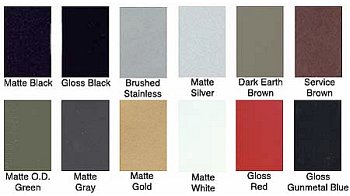
Of the four featured products, Gun-Kote, sold by Brownells under license from KG Industries, offers superior corrosion resistance, and is probably the most popular of the four products for use on rifles. Gun-Kote was originally developed for the military and was first used by Navy SEALS. Gun-Kote is an “oven-cure” finish applied to pre-heated metal. Though it goes on thin, Gun Kote cures to a hard coating that resists abrasion and won’t wear through as easily as bluing or chemically blackened surface treatments. Brownells Gun-Kote is offered in a wide variety of colors, shown below.
February 19th, 2009
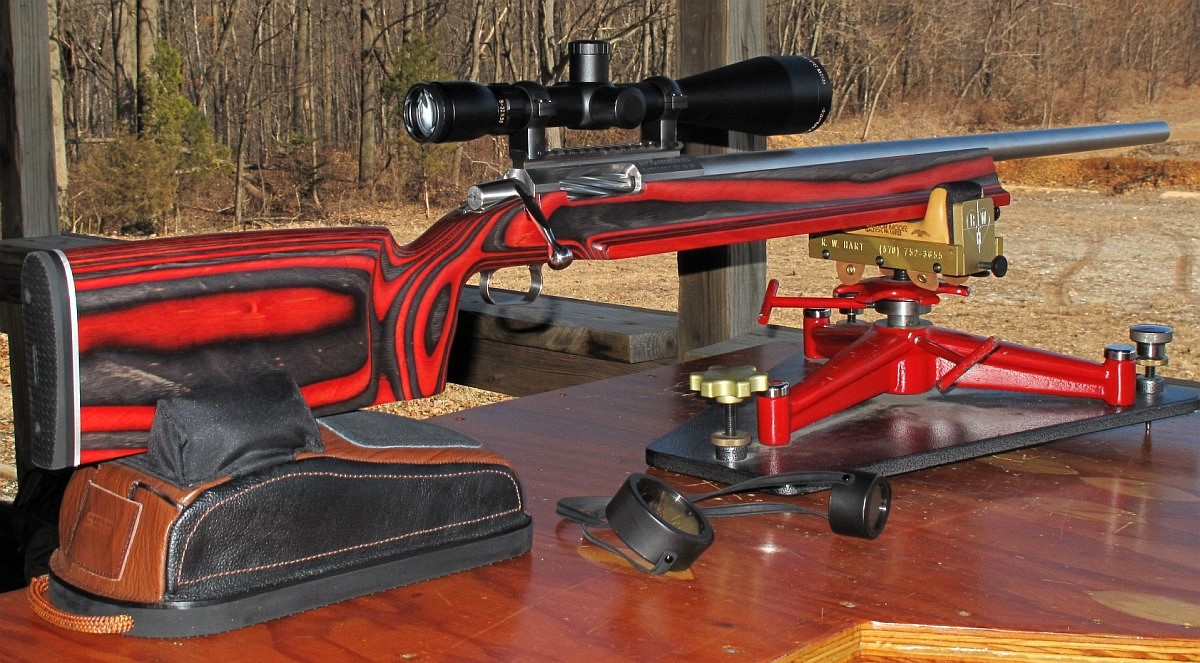
After much anticipation, we finally rolled out our latest project gun, a Bat-actioned 6-6.5×47/6.5×47 Lapua switch-barrel benchrest rifle. Equipped with two (2) Bartlein 30″ 5R barrels, the gun was designed to compete in a variety of disciplines: F-Class, Varmint Matches (Silhouette + Paper), and 600- and 1000-yard Benchrest.


The gun was built to a 17-lb. weight limit, with the goal of achieving the maximum possible accuracy with this pair of cartridges. We chose two identical, 30″ Bartlein barrels so we could evaluate the relative performance of the 6.5×47 and its necked-down 6mm version, holding as many variables constant as possible. Both barrels were chambered by ace gunsmith Mark King with tight-tolerance, no-turn necks.
 . .
Sightron provided the SIII 8-32×56 30mm scope, shown mounted in Burris Signature Zee Rings.
The rifle, two years in the making, features top-of-the-line components. The action is a BAT multi-flat MB, with a +20MOA Weaver-style rail on top. As the action was originally intended to be used in an F-Class rifle, the loading port was enlarged at the BAT factory to load full-length .284 Winchester rounds.
 The stock design is unique. It started as a Bruce Baer MB Tooley style, but we added some custom design upgrades. The sides of the fore-end are square (like a McMillan edge), and the underside of the fore-end has been relieved in the middle, creating two “rails”. The rear flat, on the underside of the buttstock, is 1.25″ wide, with a channel cut in the middle (to reduce drag, and to ensure that the bag tracks in the ears rather than on the center stitching.) The stock design is unique. It started as a Bruce Baer MB Tooley style, but we added some custom design upgrades. The sides of the fore-end are square (like a McMillan edge), and the underside of the fore-end has been relieved in the middle, creating two “rails”. The rear flat, on the underside of the buttstock, is 1.25″ wide, with a channel cut in the middle (to reduce drag, and to ensure that the bag tracks in the ears rather than on the center stitching.)
The stock was expertly inletted, pillar-bedded, and finished by Alex Sitman of Master Class Stocks. Alex put much time and effort into ensuring that the geometry was square throughout, with straight, parallel tracking surfaces. The BAT MB action has an extended front section, to allow for additional bedding surface. The MB action employs a three-action screw design. Sitman installed pillars for all three action screws then carefully bedded the entire action. Alex, one of the best stock-workers in the world, did a great job on this rifle.

Rifle Will Provide Load Data for New Cartridge Guide
This rifle was originally conceived as a match-grade test bed for the 6.5×47 Lapua cartridge and its wildcat cousin the 6-6.5×47. Jason Baney will test different powders and bullets in the rifle, to develop reliable load data for an upcoming 6.5×47/6-6.5×47 Cartridge Guide. And yes, we will be trying H4350, Reloder 17, and the relatively new Hodgdon Hybrid 100V. Jason will test a variety of flat-base and boat-tail bullets in both 6mm and 6.5mm.
Pet Loads Wanted for 6-6.5×47 and 6.5×47 Cartridge Guide
While Jason will generate load data for our planned 6-6.5×47/6.5×47 Cartridge Guide, we recognize that one rifle (even with two barrels) can’t provide all the key info. Each gun has its powder/bullet preferences, so we want to offer a broad sampling of load data for the new Cartridge Guide. That’s where you, our readers, can help.
If you shoot the 6-6.5×47 or 6.5×47 Lapua, and have developed some really great loads, share them with us. We can then include more data in our planned load charts. Send your “pet loads” to mailbox@6mmBR.com. Be sure to include: Powder Brand, Charge Weight, Primer Type, Bullet Brand and weight, and the OAL or known seating depth. We also request that you list the type of action, barrel length, and contour. Chron data is also important. Include the tested Muzzle Velocity, Extreme Spread (ES), and Standard Deviation (SD) if possible. It’s helpful if you can provide a short summary of your load, such as “Great 600-yard accuracy, near max, works best with light neck tension, low ES/SD.”
February 18th, 2009
 Ace trigger-puller Joel Kendrick, a former IBS 600-yard Shooter of the Year, has been working on a MELONITE® nitrocarburizing process for surface-hardening barrels and other gun parts. The main advantage of Melonite barrel treatment is that it reduces friction in the bore and lessens bore surface wear, potentially extending barrel life. Melonite-treatment of a bore creates a new compound layer in the top 10-20 microns of the surface, creating a very hard, slick surface. Joel has found that this surface is so slick that carbon does not easily adhere, so the barrel is easier to keep clean. Real-world tests have shown that Melonite barrel treatment definitely reduces internal barrel friction. Joel notes that, after processing, barrels deliver 50 to 100 fps LESS velocity with the same load, a reliable indicator of reduced friction. (Likewise, you’ll get less velocity when switching from naked to moly-coated bullets.) Butch Lambert has tried some Melonite-treated barrels, and he reports: “I have had Joel Kendrick do three barrels for me in Melonite. I polished them first and the finish is like a deep polished black-bluing. One Krieger has 5000 rounds on it and it is shooting just as well as when new. It has been an incredible barrel. It has no throat erosion. It has developed a bunch of pinprick looking spots in the throat, but doesn’t seem to hurt anything. The finish is so hard you can’t thread it. I have not put one of the LV barrels on yet and the heavy is a great shooter and doesn’t have many rounds on it. My experience has been great, but a more extensive test is needed.” Ace trigger-puller Joel Kendrick, a former IBS 600-yard Shooter of the Year, has been working on a MELONITE® nitrocarburizing process for surface-hardening barrels and other gun parts. The main advantage of Melonite barrel treatment is that it reduces friction in the bore and lessens bore surface wear, potentially extending barrel life. Melonite-treatment of a bore creates a new compound layer in the top 10-20 microns of the surface, creating a very hard, slick surface. Joel has found that this surface is so slick that carbon does not easily adhere, so the barrel is easier to keep clean. Real-world tests have shown that Melonite barrel treatment definitely reduces internal barrel friction. Joel notes that, after processing, barrels deliver 50 to 100 fps LESS velocity with the same load, a reliable indicator of reduced friction. (Likewise, you’ll get less velocity when switching from naked to moly-coated bullets.) Butch Lambert has tried some Melonite-treated barrels, and he reports: “I have had Joel Kendrick do three barrels for me in Melonite. I polished them first and the finish is like a deep polished black-bluing. One Krieger has 5000 rounds on it and it is shooting just as well as when new. It has been an incredible barrel. It has no throat erosion. It has developed a bunch of pinprick looking spots in the throat, but doesn’t seem to hurt anything. The finish is so hard you can’t thread it. I have not put one of the LV barrels on yet and the heavy is a great shooter and doesn’t have many rounds on it. My experience has been great, but a more extensive test is needed.”
Salt-bath nitrocarburizing by Melonite process has been applied in a wide range of industries throughout the world for many decades. It is used to improve the wear resistance, the fatigue strength, and corrosion resistance of components made from steel, cast iron, and sintered iron materials. The Melonite process is used as an alternative to other surface engineering processes such as case hardening.

Joel tells us: “I have been experimenting with this Melonite process for the last five years. I have been testing nitrocarburized barrels on my F-class and Long Range equipment since 2005 with good results. What will it cost? Joel expects Melonite treatment will cost under $100.00 per barrel, but the final pricing structure hasn’t been set yet. There will be volume discounts for gunsmiths and manufacturers.
There are many potential applications of Melonite processing for shooters, Joel believes. In addition to barrels, bolts, actions, internal components, and even reloading equipment can be surface-hardened with the Melonite process. After processing, the surface compound layers formed consist of iron, nitrogen, carbon and oxygen. Due to its microstructure, the compound layer does not possess metallic properties. Depending on material used, the compound layer will have a Vickers hardness of about 800 to 1500 HV, and a layer depth of 10 to 20 micorons. That’s so hard that conventional reamers won’t work well on a Melonited surface, so the barrel must be chambered BEFORE Melonite processing.

Lower Friction, Less Throat Erosion, Longer Barrel Life
Joel believes there are many benefits to Melonite barrel processing. The barrels he has treated and tested have shown reduced fouling, less throat erosion, and extended useful barrel life. Melonite-treated Chrome-moly barrels will have improved corrosion resistance as well. But are there negatives? According to Joel, “with stainless barrels, Melonite processing may reduce corrosion resistance slightly. Also, the treatment process makes the surface so hard that re-chambering is not practical — so this is something you do to already-chambered barrels.”
What about accuracy? Joel says: “Melonite barrel treatment should have no effect, positive or negative, on accuracy… except to the extent that your barrel may retain its best accuracy longer since it won’t wear out as fast.”
To learn more about the Melonite nitrocarburizing process and its application to shooting products, contact Joel Kendrick, joelkndrck [at] aol.com, or call (704) 616-6442.
February 7th, 2009
Larry Crow of Competitive Edge Gunworks has developed a new action that allows the rear of the receiver to float. The front of the action features a large block that secures the action in the stock. Though similar in appearance, this is NOT a barrel block. The barrel snugs up to a shoulder inside the front block, much like a conventional action. Though the oversized block does the “heavy lifting” in terms of securing the action to the stock, there are two (2) action screws. One threads into the underside of the block while the second is placed further back where it attaches to the underside of the normal-diameter section of the receiver. This provides an extremely secure mount while allowing the rear of the action to float free above the stock.
Crow has tested the rifle with a variety of calibers including large magnums. Crow explains: “Our action mounts [with] an extended front lug and allows the rear of the action to float. When fired the barrel harmonics travels back through the action with the back of the action floated. There are no bedding issues which cause vertical stringing. The action is 4340 Rockwell to 42 with 1.228″ X 1.0625″ X 16 T.P.I. barrel shank. The standard action comes with a 20-MOA Picatinny rail. Our bolts are one-piece with M16-style extractor under right lug for 3 O’Clock ejection. Bolts are 4140 Rockwell 42 with R60 hard chrome finish. This [delivers] true bench rest accuracy in a tactical platform.” Shown below is the new action installed in a laminated wood stock and in a McCree modular metal stock (lower photo).


One-Piece Bolt for New Action
For the new action, Crow has also developed a new, super-strong, one-piece bolt. The handle is integral with the bolt. This should be stronger (and more durable) than a conventional bolt handle attached only with silver solder or a spot weld. Shown below are prototype examples of the new one-piece bolt. Production versions will be fluted. Note how the M16-style extractor is integrated into the recoil lug.

January 24th, 2009
 After SHOT Show ended on Jan. 18th, many exhibitors had little time to rest. They immediately packed up their displays and headed west to attend the 2009 Safari Club International (SCI) Convention in Reno, Nevada. The SCI convention kicked off Wednesday the 21st, and concludes today, Jan. 24th. The SCI show, dubbed the “Ultimate Hunters’ Market”, attracted 20,000+ attendees, drawn by product displays from firearm and gear-makers, plus a series of informative seminars, covering everything from venison recipes to internet marketing. After SHOT Show ended on Jan. 18th, many exhibitors had little time to rest. They immediately packed up their displays and headed west to attend the 2009 Safari Club International (SCI) Convention in Reno, Nevada. The SCI convention kicked off Wednesday the 21st, and concludes today, Jan. 24th. The SCI show, dubbed the “Ultimate Hunters’ Market”, attracted 20,000+ attendees, drawn by product displays from firearm and gear-makers, plus a series of informative seminars, covering everything from venison recipes to internet marketing.
The SCI show is also famous for its fund-raising auctions. SCI’s auctions offer exotic custom firearms, once-in-a-lifetime hunts, plus fine art and collectibles. Net proceeds from the auctions are used by SCI to promote conservation and game management efforts worldwide. To learn more about the auctions, visit the SCI Convention’s Auction Preview Page on the web. There you can download e-brochures showing guns, trips, and art up for auction. CLICK HERE to download the Firearms Auction Section as a .pdf file.
As just a small sample of the exotic arms that went up for bid in Reno this week, check out these impressive firearms from the 2009 SCI Auction Catalog:
Krieghoff .470 Nitro Double Rifle — Valuation $84,000
Krieghoff’s ‘Legends of the Hunt’ double rifle, chambered in .470 Nitro Express, is custom engraved by master engravers Michael Oke and Andreas Scholz. The stock is exhibition-grade Turkish walnut with ebony pistol grip and forend tip. There are gold barrel bands and gold accents on the express sight blades and double triggers. For more info, visit www.Krieghoff.com.

Dakota .270 Win Model 10 Falling Block — Valuation $17,500
Dakota Arms LLC has donated an extraordinary Model 10 falling block rifle in .270 Winchester. Features include a French grey receiver, quarter rib, hooded front sight and full-coverage scroll engraving with gold wire accents. The stock is special select Bastogne walnut with a right-hand shadowline cheekpiece, tear drops, schnabel forend and hand-cut fleur-de-lis and ribbon checkering.

Ferlach 12ga + 9.3x72R Drilling — Valuation $6,500
Here is a side-by-side shotgun/rifle drilling by Ferlach of Austria. This magnificent boxlock features an engraved, scalloped and case-colored receiver, 27 1/2″ barrels with a fixed front sight and two folding rear sights. Other features include sideclips, cocking indicators, extractors, double triggers, and a manual Greener-style side safety.

January 23rd, 2009
The Classifieds Section in our Shooters’ Forum seems to get more popular every week. In our Classifieds you’ll find some great bargains on reloading tools, barrels, stocks, and complete rifles. A couple rifles for sale caught our eye because they were built by top smiths and good values.
Franklin-built 6BR Undertaker
The first is a handsome 6BR smithed by Richard Franklin. It features a laminated walnut, low-profile “Undertaker” thumbhole stock. The action is a blueprinted stainless Rem 700 fitted with a Jewell trigger (with safety). The gun is in “like new” condition and the Krieger barrel has only 135 rounds though it. Weight, without scope, is 13 lbs., 1 once. We bet this would be a great shooter for club varmint matches. Asking price is $1950.00 but you’d have to pay more (and wait a long time) to get Franklin to build you something similar.
• Richard’s Undertaker laminated Walnut stock with clear coat finish
• Blueprinted Remington 700 Stainless SA Receiver, Holland SS lug
• Action pillar bedded with polished SS front and steel rear pillars
• BAT polished aluminum trigger guard
• Krieger SS Match 1:8” twist LV taper 28” barrel -– polished
• SAAMI Min 0.272” no neck turn chamber with 0.080” freebore
• Callahan Firing Pin Assembly
• Mounting Solutions Picitinny 6” Scope Base
• Ken Farrell 30MM Scope Rings
• Rifle weighs 13 pounds 1 oz. without scope (scope NOT included in sale)


Stevens-Built 6PPC with .308 Boltface
The second gun is a good value for someone looking to get started in short-range Benchrest. This Stolle Grizzly 6PPC features a .308 bolt-face so it could also be converted to a 30 BR for score shooting, or a 6BR/Dasher for 600-yard shooting. The gun is built by Col. Billy Stevens, a very highly respected smith. The asking price is $1600.00 (plus actual shipping and insurance.) You may want to ask how many rounds are through the barrel. Call S. Crawford at (931) 619-8175.

“RB/LP Stolle Grizzly 6ppc Light Varmint with .308 Boltface. Kelby Flat Bottom BR Stock Molded in color Green, Jewell Trigger and Davidson Bases. Hart Barrel 1-14 Twist. Built by Billy Stevens. This gun is a shooter. Scope not included. Must ship to FFL.”
January 21st, 2009
Widespread concern over the possibility that the Obama administration will push for new, restrictive gun laws has spurred sales of all types of firearms, with self-loading, military-style rifles leading the way. The “Obama effect” has created huge demand for ‘black rifles’ of all variety. Recognizing this, Brownells has created a new website, AR15builder.com, to help buyers purchase a AR with components customized to the buyers’ individual needs. Using state-of-the-art “drag and drop” web technology, a black rifle buyer can chose from a wide variety of components (stocks, uppers, barrels, handguards, optics etc.), and see the gun, as assembled, right on the web page. As one selects among AR components, the website even provides running total of the cost of the components.
Mix and Match Components for Your Custom Build
Announced at SHOT 2009, AR15builder.com combines almost 600 images of external AR-15 parts and accessories so you can mix and match parts to see exactly what your own, custom AR can look like with your selected parts installed. The screenshot below, showing a “precision varminter” with adjustable stock and 24″ barrel, was created using parts from Brownell’s inventory.

The website allows you to preview the many options available for the AR platfrom, so you can “mix and match” scores of products in Brownells’ catalog. Color variations are shown as well. So, if you want to see a black receiver with a tan handguard and green buttstock, AR15builder.com will show you. If you want to change any component, just go back to the parts menus and drag the new selection to the center of the page. As you change components, the prices automatically change in real time.
With endless combinations, it’s easy to create the unique look you want, in the price range that suits your budget. You can also select complete uppers and lowers. Purchase items directly from AR15builder.com, Brownells.com, or call 800-741-0015 and mention code PER.
January 20th, 2009
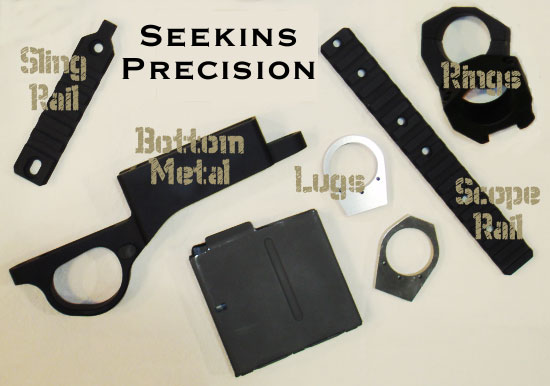
Seekins Precision produces a wide variety of expertly-machined products such as scope rings, picatinny rails, and sling rails. Seekins products are priced competitively, but give up nothing in quality to some more expensive brands.
At SHOT 2009, Glen Seekins unveiled some cool, new products, including a new AR15 lower with many unique features. The Seekins SP223 lower features flutes on the magwell front face for improved grip, plus an enlarged triggerguard allowing use with gloves. The new lower takes standard milspec mags as well as MagPul P-Mags. It should be available in April 2009, with a price of about $350. Glen tells us that a Seekins AR upper design will follow “down the road.”

Seekins also announced new Remington 700 bottom metal. The Seekins R700 bottom metal assembly is made from 7075-T6 Aluminum allow — very tough stuff. The R700 is currently offered for .223 Rem, .308 (and other standard short action rounds), and .338 Lapua. A WSM version will be available soon. This bottom metal works with 5-round magazines, but Seekins will be offering 10-round .223 and .308 mags in the summer.
|