|
|
August 22nd, 2008
At the recent IBS 100/200 Yard Nationals, Benchrest legend Tony Boyer shot a spectacular 0.1697 Grand Agg in the Heavy Varmint class (0.1552 at 100, and 0.1843 at 200). This is the combined, distance-adjusted average group size for five targets at 100 yards and five targets at 200 yards. Interestingly, Tony was shooting a very unusual new gain-twist barrel from Bartlein Barrels of Wisconsin. A “gain-twist” barrel has rifling with a variable twist rate, that starts with a slower twist and transitions into a faster twist. The barrel used by Boyer had a very slight gain twist: 1:15″ twist at the breech end, increasing to 1:14.25″ at the muzzle.

Gain twist barrels are nothing new. Barrel-makers in the 19th century experimented with gain twist. More recently, Dan Lilja did quite a bit of testing with gain-twist barrels in the 1980s. However, Lilja concluded that gain twist offers no accuracy advantages: “You get just as good or better accuracy with a standard twist…just as long as the twist remains exactly the same the entire length of the bore.” (See Elements of Accuracy Article.)
 Gain Twist — Does It Offer an Accuracy Advantage? Gain Twist — Does It Offer an Accuracy Advantage?
Given Boyer’s impressive performance, maybe it’s time to revisit gain twist technology. The theory is that a slower initial twist rate may be “kinder” to bullets as they start to engrave in the rifling. There may be some slight velocity advantages as well.
Frank Green of Bartlein barrels has noted: “Gain twist type barrels have been around forever. It was used a lot back in Pope’s day with the false muzzle loaders shooting lead bullets. A lot of lead bullet shooters and rimfire shooters have asked us to do [gain-twist] barrels for them. Also shooters shooting the new, solid, machined-type bullets with driving bands on them want a gain twist type barrel. Supposedly it’s easier on the driving bands as the bullet enters the rifling. Also in bigger calibers like 20mm the gain twist is used. Mostly because you are starting a very heavy bullet into the barrel.
At Bartlein, we designate gain-twist type rifling as “T” style rifling (“T” for transitional). Why? Simply because we can cut [many variations]: straight conventional-style twist, a very uniform slow gain-type twist, or a radical gain-type twist. We can [create] anything the customer wants. The tooling still plays a part and can effect the cost of the barrel on a gain type twist.
Is gain twist for everyone? At this point in time I would say no still. Also remember, way back when, gain twist type barrels had a radical type gain. The one that Tony and couple of other guys have are not a drastic type gain. The [gain twist barrel] that Tony has only goes from a 1-15 at the breech to 1-14.25 at the muzzle. It didn’t seem to hurt him at all at the Nationals. He picked the twist and we made it for him.
I would agree with the general statement that most gain twist type barrels don’t shoot conventional jacket/lead core bullets well or should I say [they can be] temperamental. However, a slight gain seems to be OK after what Tony did.”
Lou Murdica has been evaluating Bartlein gain-twist barrels with a 1:14″-1:13.25″ twist. Lou won a Benchrest match with a 14-13.25 Bartlein gain-twist in Sacramento convincingly, and Lou told Bartlein that a similar gain-twist barrel on Lou’s railgun has been very accurate and ultra-consistent when tested with a wide variety of bullets. Lou can’t speculate as to why, but the Bartlein gain-twist BR barrels appear to be working extremely well and are not finicky about bullet choice.
Tony Boyer photo courtesy IBS.
August 12th, 2008
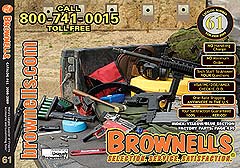 Brownell’s has released its 61st full catalog, the biggest shooting products catalog ever. The 576-page resource includes more than 36,000 products, 1100 of them new since last year. CEO Frank Brownell explained: “Every 10-15 years the Catalog Department shakes the catalog up and they’ve really done it this year. There’s a color-coded table of contents for the whole catalog with [indexes] on the first page of each section. With all the side tabs and little indexes, it should easy for folks to fine their favorites. I like to think of it as thirty, special, focused catalogs in one big binder.” Brownell’s has released its 61st full catalog, the biggest shooting products catalog ever. The 576-page resource includes more than 36,000 products, 1100 of them new since last year. CEO Frank Brownell explained: “Every 10-15 years the Catalog Department shakes the catalog up and they’ve really done it this year. There’s a color-coded table of contents for the whole catalog with [indexes] on the first page of each section. With all the side tabs and little indexes, it should easy for folks to fine their favorites. I like to think of it as thirty, special, focused catalogs in one big binder.”
Just a few of the 30 sections include: Holsters and Mag Holders; General Gunsmith Tools; Specialty Rifle Tools, plus sections for Handgun, and Shotgun Tools; Shooting Accessories; Optics and Accessories; and Spray-On Finishes. Pete Brownell said “We’ve added icons to tell you if a product is made in the USA and another to let you know if we have an online instructional video available for that product.”
The new #61 catalog will be shipped to current, active customers starting August 1, 2008 and is now available for purchase through Brownells.com or by calling 800-741-0015, Dept. #P61.
CLICK HERE to go to CATALOG ORDER PAGE. Price is $5.00 ($10.00 Overseas), refundable on your first order.
July 31st, 2008
Glen Harrison, creator of the original Nesika actions, has been designing and building precision bolt actions for over 15 years. Glen’s products are known for high-quality machining, precision tolerances, and superior accuracy. Glen’s Nesika Bay operation was sold to Dakota Arms, but Dakota tried to grow too big, too fast, and has experienced some difficulties.
Glen has started a new company, appropriately called Phoenix Machine Technologies. Phoenix is currently up and running, building a variety of actions. Some of the first Phoenix actions will be the new Templar design. The Templar features a Rem 700 footprint, Picatinny rail, precision-ground recoil lug, and oversize bolt knob. The Phoenix Templars will be used in the new Crusader Tactical Rifle built by G.A. Precision, of Kansas City, MO.
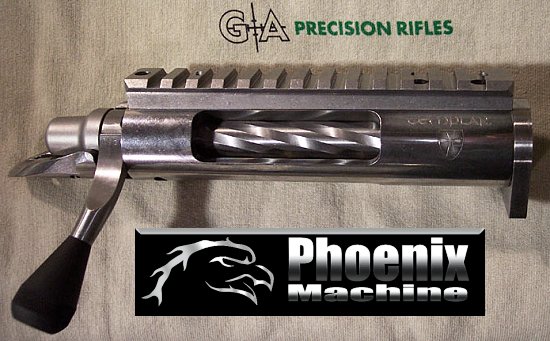
George Gardner, owner of G.A. Precision, is pleased that Glen is back in the action-building business. He reports the new Phoenix actions are top-quality: “At G.A. Precision, we use only top notch, field-tested, durable parts and accessories. We are proud to be offering the Templar Action, built by Glen Harrison at Phoenix Machine Technologies.”

For more info about Phoenix Machine Technologies, LLC, call (406) 756-2727, write to 36 Jellison Lane, Suite B, Columbia Falls, MT 59912, or email Lisa [at] boltactions.net .
July 14th, 2008
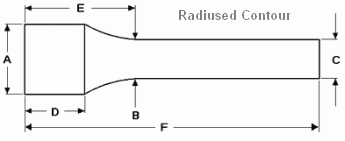
 Are you re-barreling a BR rifle and need to know if you will still make weight? Or perhaps you are trying to select the right contour to hit an optimal carry weight for a new varmint rifle? Dan Lilja offers FREE software that will calculate barrel weight for straight contour, straight taper, and radius-tapered barrels. Dan’s software even calculates how fluting alters barrel weight. Are you re-barreling a BR rifle and need to know if you will still make weight? Or perhaps you are trying to select the right contour to hit an optimal carry weight for a new varmint rifle? Dan Lilja offers FREE software that will calculate barrel weight for straight contour, straight taper, and radius-tapered barrels. Dan’s software even calculates how fluting alters barrel weight.
For general info on barrel weight calculation for straight and straight tapers, read this article on Lilja’s website. Click HERE for another article explaining weight calculation with barrels that have a radiused (curved) contour section.
Here are the free software programs offered by Dan Lilja. Right click and “Save As”:
Straight Contour (.exe file) | Straight Contour (Excel file)
Contoured Barrels with Radius (Excel file)
June 20th, 2008
The folks at Adams Lake Rifle Barrels in Chase, British Columbia, Canada have crafted a 6-6.5×47 tackdriver that is both accurate AND affordable. Smithed by Mick McPhee, the rifle is built on a blue-printed Remington XR-100 action, with custom recoil lug and Jewell. The barrel is a 28″, 4-groove, 8-twist Krieger, in a #17 Heavy Varmint contour. The complete project including the new XR100 action, was less than $2000 (Canadian) not counting scope and “Ski” bipod. The rifle was chambered with a Whitley 6mmHot reamer, and is fitted with a 12-42×56 BR model Nightforce in Leupold QRW rings on a Ken Farrell base.


Adams Lake Rifle Barrels is an authorized Canadian source for Krieger barrels. How accurate are Kriegers? Shown below is a 3-shot .094” group shot at 110 meters during load development of the 6-6.5X47.

Adams Lake also supplied a 6mm Krieger barrel for Forum member M. Thibault’s new 6mmBR rifle, shown below. This handsome gun is a Barnard-actioned 6BR Norma with a Krieger 1:8″ twist, with a modified #17 contour, 1” muzzle diameter. The gun has proven to be phenomenally accurate. Right out of the box, with limited time for load development, Thibault put it in the winner’s circle. Shooting in only his second-ever rifle match, Thibault steered this rifle to first place in the KTSA Spring 300M shoot.

June 18th, 2008
Laminated wood stocks offer an excellent combination of price and performance, and they can be obtained in a myriad of styles to suit your discipline — hunting, benchrest, tactical, silhouette, or high power. Laminated stocks can be a little trickier to finish compared to a hardwood such as walnut, as laminates are often delivered in bright or highly contrasting colors. Traditional wood finishes can alter the colors. Also, filling the pores in laminated stocks is an issue.

Automotive clearcoat products have become popular for finishing laminated wood stocks because they won’t alter the stock’s colors, and the clearcoat provides a durable weather-resistant finish. Clearcoat is also easy to “touch up” and it fills pores better than some other alternatives. Mike Ricklefs has written a comprehensive article on stock painting that includes a special section on clearcoating over laminated woods. If you want to clearcoat a stock, Mike’s article is a must-read!
In that Stock Painting Article, Mike offers these tips:
When finishing laminated stocks with clear-coat, you need to prepare the wood carefully, and build up quite a few thin layers one at a time. Begin by sanding, with progressively finer paper, all the way to 400 grit. Certain laminated stocks are so rough when they come from the stock-maker, that you may have to be very aggressive at first. But be careful with angles and the edges of flats. You don’t want to round these off as you sand.
After sanding, use compressed air to blow out all dust from the pores of the wood. This is very important to avoid a “muddy” looking finish. If you don’t blow the dust out with air before spraying the clear it will migrate out as you apply the clear. Also, after each sanding session, clean your painting area to remove excess dust. I also wet down the floor of my spray booth to keept the dust down.
Some painters recommended using a filler to close the pores. That’s one technique, but the filler can detract from the clarity of the final finish. Rather than use a pore-filling sealer, I use a high solids or “build” clear for the initial applications. This is slightly thicker than “finish” clear and does a good job of sealing the pores. Three (3) fairly heavy coats of “build” clear are applied. If you get a thick spot or a run in the finish at this point, it is not the end of the world but this does create more sanding work.”
There is a current thread in our Shooters’ Forum that discusses the use of clear-coating on laminated stocks. Member BHoges offered this advice: “Stick with Diamont, Glassurit, and Spies. If anyone has questions, I painted cars for a long time.”
Forum member Preacher, whose bolt-action pistol is shown in the photo below, states: “I buy my two-art Clearcoat from the local NAPA dealer. They recommended Crossfire mixed 4:1. Ireally like the end results. There are six coats on that stock that were sanded down to bare wood for the first two, and then 600 wet sanded for the other four coats. Two to three coats would be sufficient if the pores were filled first, but I would rather fill em with the clear as it seems to make it appear deeper and I have the time to devote to it. I have PPG’s Deltron DC 3000 clearcoat on a few stocks of mine, but I like the NAPA better price wise, and it seems to hold up just as good as the Deltron.”

June 7th, 2008
Carl Bernosky is one of America’s top marksmen, having won the NRA High Power Rifle Championship at Camp Perry eight times, most recently in 2007. What you may not know is that Carl is also a highly skilled and respected stock-maker. He produces stock blanks for Master Class Stocks, and he also sells a variety of designs in both laminated and fancy wood. Visit CarlBernosky.com to see the full selection.

While Carl specializes in target stocks such as the prone stock shown above, he also offers varmint and hunting patterns. Shown below are some of the stocks available from his inventory. Carl also has a stock duplicator and he can reproduce the shape and features of a favorite stock you may already own. Stock blanks, uninletted and unfinished, start at $200.00. Stock duplication for standard hunting style stocks starts at $150.00


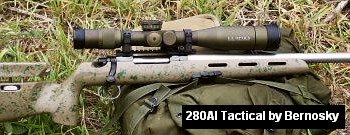
Carl also does gunsmithing — from rebarreling jobs to building complete custom rifles. Shown below is a custom, 280AI tactical rifle Carl built on a trued Rem 700 action with Broughton barrel and Master Class Prone Stock.
May 30th, 2008
Many of our readers enjoy classic military rifles as well as precision BR rigs and varmint rifles. Now through June 30th, MidwayUSA has Boyd’s M1 Garand replacement stocks on sale for just $89.99, marked down from $104.99 (item 107223). Boyd’s Garand stocks are fully-inletted and crafted from quality American Walnut. Very slight trimming and sanding may be required, but otherwise this is a “drop-in” stock.

There is a superb article by Jamie Magnum on SurplusRifle.com that explains how to install a Boyd’s Walnut stock on your Garand. The author provides complete step-by-step instructions showing how to remove the old stock, and attach the new stock. Through a series of 75 photos, the article covers every aspect of the job, including inletting, and making sure all the metal connectors are attached properly.

CLICK HERE for Downlodable .PDF version of Garand Article.
SurplusRifle.com is an online service of Tennessee Gun Parts, Covington, TN, 1-866-472-4986.
May 19th, 2008
Gunsmith Nat Lambeth, nlambeth [at] embarqmail.com, recently had a client bring in a Custom-Shop Remington that wouldn’t even hold one Minute of Angle (MOA) at 100 yards. Nat was able to correct flaws in the factory action and then fit a new barrel. Remarkably, after action truing and barrel replacement, the gun shot like a house on fire. After working his magic, Nat shot a 0.111″ 5-shot group with the gun.
Nat tells us: “I had a customer bring in a Remington 700. This rifle was supposed to have been from the custom shop. It was a stainless model 700 with a 5R Mil Spec barrel in a HS Precision stock. The customer paid a premium price for this rifle. The customer complained the rifle ‘won’t shoot groups under 1.5″ at 100 yards’, and he wanted a new barrel. He had 400 rounds down the tube. The barrel looked to be in good shape with maybe a scratch 8 inches from the muzzle.

Blue-Printing the Receiver
I removed the barrel from the receiver and looked at the internal bolt lug engagement surfaces. Only one lug seemed to be contacting. I put the bolt in a V-Block and measured the rearward bolt lug surfaces. The right or bottom lug had .019″ more reaward surface than the left or upper lug. This would have taken me two days to lap out so I set up the bolt in a truing jig and turned the bolt .020. I then put the action in a action truing jig and machined the inside lug surfaces until I got one even surface. I lapped the lugs until I had 80% bi-lateral contact, then re-faced the bolt and action face.
New Broughton Barrel
I dialed in a new 26″ Broughton 1:10, 5C barrel. It was indicated on both ends until a .0001″ indicator needle was not moving. The barrel was turned, threaded, and chambered in the same setup using thinbit tooling, a PT&G 95 Palma reamer with a .3004 bushing. The chamber was cut within .0015″ with a Lambeth/Kiff Micrometer Adjustable Reamer Stop. The factory recoil lug was replaced with a precision-ground lug.
The barrel was removed from the lathe and the muzzle was cut 1.250 shorter in a bandsaw. The barrel was re-mounted in the lathe and the muzzle dialed in the steady rest. The crown was faced with a piloted, PT&G facing tool then faced with a piloted, 79° counter bore .100″.
Stock Work
The rifle stock was re-inletted and glassed in for two inches. Then the barrel free-floated.
A Tack-Driver is Born
I thoroughly prepped 22 pieces of used 308 Federal Gold match brass, which were then loaded with 42.5 grains of H4895, CCI BR2 primers, and Hornady 168 HPBT bullets. After cleaning the barrel, I fired one test round with no problems and cleaned the barrel again. I then installed a Leupold 6.5-20AO scope in Farrell bases and rings. I bore-sighted the rifle by eye with the bolt removed at 50 yards.

After some sighters to set Point of Aim, I sat down and did 5 shots for record at 100 yards. Those five shots went into one ragged hole. (See Target Below — this editor measures the group as 0.111″ center to center using OnTarget Software.) Another customer who was there at the range, then shot a 5-shot group that went into 0.312″. That’s an 0.2115″ average for the two groups. I then was able to shoot a couple more groups in the ‘teens.”

Conclusion
Nat proved that attention to detail DOES make a difference, and that truing an action, improving the bedding, and fitting a superior barrel can make a HUGE difference in accuracy. Now, mind you, we’re not suggesting that you can take a factory .308 and make it into a gun that will win the Super Shoot. Nat’s 0.111″ group was exceptional. Still this demonstrates that major gains can be had by action blue-printing combined with bedding work and a new barrel.
April 22nd, 2008
George Gardner of GA Precision has started building custom rifles with a new action designed and crafted by Glen Harrison of Phoenix Machine LLC, in Montana. Harrison, the founder of Nesika Bay, is highly regarded as an action designer and machinist. His new actions are built with state-of-the-art methods, including EDM machining. GA Precision will not be selling the actions separately to customers, but will offer them in rifle upgrades and complete rifle builds.

Gardner notes: “The new GAP ‘Templar’ Short and Long actions will be replacing our GA 7000 action. The specs are generally the same as the former action however the new ‘Templar’ actions feature various upgrades and design improvements”:
● The tang is thicker but radiused so it still fits a Model 700 style stock.
● There is 20% more engagement for camming and unlocking.
● The bolt raceway is EDM-machined rather than broached.
● The recoil lug is double-pinned.
● The bolt stop has been changed to the GAP/Nesika Style.

Later in the year, George says, GA Precision plans to offer a 100% one-piece bolt with the new Templar actions. How do the new Harrison-built actions perform? Glen Seekins of SeekinsPrecision.com reports: “I just built a rifle with one of Glen’s actions (virtually the same as the GA Precision Templar) and they are very, very nice.”
GA Precision offers both custom rifle building services as well as complete rifles. GA Precision has already shipped a few “Crusader” tactical rifles, shown below, built with the new Templar action, with a durable CeraKote finish. The complete rifle costs $3525.00 including Badger rings, scope base, and detachable mag system, but without optics.

|


