Ever wish you could look inside your rifle, to see how the trigger and fire-control system work? Well now that is possible with the magic of 3D computer graphics. Modern software allows detailed “cutaway” side-views (see below), as well as 3D views with 360° rotation. The software can also provide X-Ray-type views into the gun’s internals — as you can see above. And computer animation can show the complete firing process from trigger pull to chambering of the next round.
Rem 700 Cutaway View from Right Side
This article covers two different animations — a bolt-action, and a self-loading “gas gun”. The first video features the popular Rem 700 action, probably the most successful American bolt-action ever created. The second video offers a lengthy exploration of the AR15/M16 platform.
READERS — Take the time to watch these videos! The Rem 700 animation is really outstanding! EVERY bolt-action shooter should watch this video all the way through.
Cutaway 3D Animation of Rem 700 Action — Watch Video
The Model 700 series of bolt-action rifles have been manufactured by Remington Arms since 1962. All are based on basically the same centerfire bolt action. They are typically sold with an internal magazine depending on caliber, some of which have a floor-plate for quick-unloading, and some of which are “blind” (no floor-plate). The rifle can also be ordered with a detachable box magazine. The Model 700 is a development of the Remington 721 and 722 series of rifles, which were introduced in 1948.
The Rem 700 is a manually-operated bolt action with forward, dual opposed lugs. It features “Cock On Opening”, meaning the upward rotation of the bolt when the rifle is opened cocks the firing pin. A cam mechanism pushes the firing pin’s cocking piece backward. The bolt face is recessed, fully enclosing the base of the cartridge. The extractor is a C-clip sitting within the bolt face. The ejector is a plunger on the bolt face actuated by a coil spring. The bolt is of 3-piece construction, brazed together (head, body. and bolt handle). The receiver is milled from round cross-section steel.
This video was made with the help of the World of Guns: Gun Disassembly interactive encyclopedia with 3D rendering. This remarkable web-based software allows users to view the inner workings of hundreds of different rifles and pistols — everything from a .22 LR Ruger to a .55-caliber Boys Anti-Tank rifle. There are also 25,000+ parts diagrams. This is a remarkable technical resource. SEE MORE HERE.
Cutaway 3D Animation of AR15/M16 Action — Watch Video
The AR platform rifles are a semi-automatic version of the M16. These feature distinctive upper and lower receivers which can be readily separated via front and rear pins. The upper includes the barrel, handguard, forward gas tube, and bolt assembly, while the lower contains grip, trigger group, fire selector, and mag well. In addition the lower is attached to the stock which encloses the buffer assembly.
The original ArmaLite AR-15 was a select-fire, air-cooled, gas-operated, magazine-fed rifle designed by American gun manufacturer ArmaLite in 1956. It was based on Armalite’s AR-10 rifle chambered for the 7.62×51 NATO (.308 Win). In 1959, ArmaLite sold its rights to the AR-10 and AR-15 to Colt. Some key modifications were made — most notably, the charging handle was re-located from under the carrying handle to the rear of the receiver. The redesigned rifle was adopted by the U.S. military as the M16 carbine, which went into production in March 1964.
These videos found by Boyd Allen. We welcome reader submissions.
Can you guess what your next barrel will weigh? In many competition disciplines, “making weight” is a serious concern when putting together a new match rifle. A Light Varmint short-range Benchrest rifle cannot exceed 10.5 pounds including scope. An F-TR rifle is limited to 18 pounds, 2 oz. (8.25 kg) with bipod.
One of the heaviest items on most rifles is the barrel. If your barrel comes in much heavier than expected, it can boost the overall weight of the gun significantly. Then you may have to resort to cutting the barrel, or worse yet, re-barreling, to make weight for your class. In some cases, you can remove material from the stock to save weight, but if that’s not practical, the barrel will need to go on a diet. (As a last resort, you can try fitting a lighter scope.)
Is there a reliable way to predict, in advance, how much a finished barrel will weigh? The answer is “yes”. PAC-NOR Barreling of Brookings, Oregon has created a handy, web-based Barrel Weight Calculator. Just log on to Pac-Nor’s website and the calculator is free to use. Pac-Nor’s Barrel Weight Calculator is pretty sophisticated, with separate data fields for Shank Diameter, Barrel Length, Bore Diameter — even length and number of flutes. Punch in your numbers, and the Barrel Weight Calculator then automatically generates the weight for 16 different “standard” contours.
Calculator Handles Custom Contours
What about custom contours? Well the Pac-Nor Barrel Weight Calculator can handle those as well. The program allows input of eight different dimensional measurements taken along the barrel’s finished length, from breech to muzzle. You can use this “custom contour” feature when calculating the weight of another manufacturer’s barrel that doesn’t match any of Pac-Nor’s “standard” contours.
Caution: Same-Name Contours from Different Makers May Not be Exactly the Same
One final thing to remember when using the Barrel Weight Calculator is that not all “standard” contours are exactly the same, as produced by different barrel-makers. A Medium Palma contour from Pac-Nor may be slightly different dimensionally from a Krieger Medium Palma barrel. When using the Pac-Nor Barrel Weight Calculator to “spec out” the weight of a barrel from a different manufacturer, we recommend you get the exact dimensions from your barrel-maker. If these are different that Pac-Nor’s default dimensions, use the “custom contour” calculator fields to enter the true specs for your brand of barrel.
Smart Advice — Give Yourself Some Leeway
While Pac-Nor’s Barrel Weight Calculator is very precise (because barrel steel is quite uniform by volume), you will see some small variances in finished weight based on the final chambering process. The length of the threaded section (tenon) will vary from one action type to another. In addition, the size and shape of the chamber can make a difference in barrel weight, even with two barrels of the same nominal caliber. Even the type of crown can make a slight difference in overall weight. This means that the barrel your smith puts on your gun may end up slightly heavier or lighter than the Pac-Nor calculation. That’s not a fault of the program — it’s simply because the program isn’t set up to account for chamber volume or tenon length.
What does this mean? In practical terms — you should give yourself some “wiggle room” in your planned rifle build. Unless you’re able to shave weight from your stock, do NOT spec your gun at one or two ounces under max based on the Pac-Nor calculator output. That said, the Pac-Nor Barrel Weight Calculator is still a very helpful, important tool. When laying out the specs for a rifle in any weight-restricted class, you should always “run the numbers” through a weight calculator such as the one provided by Pac-Nor. This can avoid costly and frustrating problems down the road.
Credit Edlongrange for finding the Pac-Nor Calculator
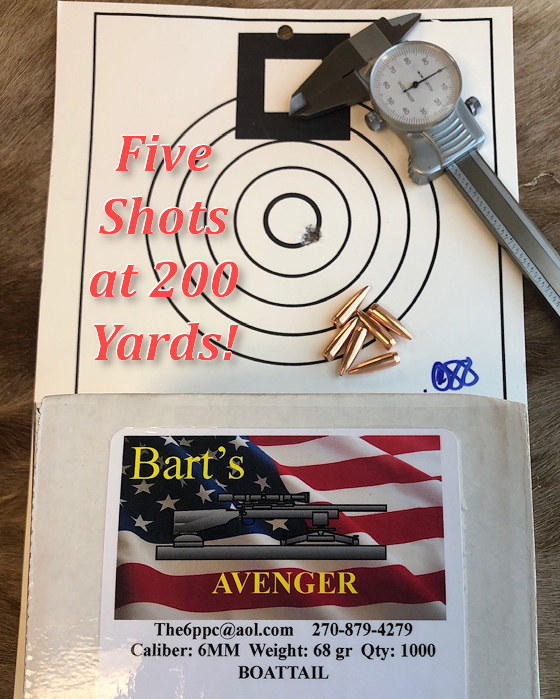
This would be an amazing group at 100 yards. But this 5-shot bughole was shot at TWO HUNDRED yards in competition by Bart Sauter of Bart’s Custom Bullets. And he did it with a borrowed barrel!
Be amazed. This five-shot group was shot at 200 yards in competition by bullet-maker Bart Sauter. Bart shot this astounding group with his 10.5-lb Light Varmint benchrest rifle at the recent East-West Match in St. Louis, Missouri. Had Bart been shooting an IBS match, this would have been a new IBS World Record, beating the .091″ by David Farrar in 2006. This .088″ group missed the NBRSA 200-yard 5-shot group record by a whisker — .013″ (thirteen thousandths). The listed NBRSA LV 200-yard Group record is 0.075″ shot by Johnnie Stewart a decade ago.
New record or not, this is one remarkably impressive group, shot by one very talented shooter and bullet-maker. Bart tells us he initially “held center” for the first three shots in the group. Then, watching his wind flags he noticed slight increase in the left-to-right condition, so he held 0.200″ to the left on shot 4 and it worked. Before shot 5, Bart detected another slight change, so he held 0.300″ left for the fifth and final shot. He explained: “If I had not held off for those last two shots, this group would have been about a flat four (0.400″).” Well done Bart!
“First three … bang bang bang … all went in one hole. Then I held left on shot 4 and it worked. On the last shot I held a little more, got lucky and it went in.” — Bart Sauter
In our Shooter’s Forum, Bart posted “This is my personal best-ever 5-shot group at 200 yards. I knew it was small, but was shocked to see it was a Zero! This will be a range record and record for the East/West match. Last group of the day! A nice way to end the match!”
Here is the 6PPC LV rifle that shot the .088″ group. Yes that’s a concrete shooting bench inside a pretty nice cabin with hunting trophies on the walls. Bart explained: “We reload and shoot out of the Monkey Hut, especially during the winter. Most of the time we shoot outside at 100/200 from a a three-bench range.
Amazing Group Shot with Borrowed Krieger Barrel!
There’s a very interesting side-note to this story. You see Bart doesn’t even own the Krieger barrel that delivered this amazing .088″ 200-yard group. That’s right this superb barrel was a “loaner” — borrowed from Bart’s buddy Gary Sullivan. [Editor: Oh that we could all be so lucky with borrowed components.] With Sullivan’s blessing, Bart has since loaned the barrel yet again to ace Billy Stevens, who will be using it at the World Benchrest Championship in Canada, July 14-21, 2019.
This photo shots Bart on the right and his good friend Billy Stevens on the left. Bart notes: “Billy is a 2-time Super Shoot Winner and 3-time USA World Benchrest Team member!”
Bart Sauter’s LV 6PPC Rifle Specifications
Chambering/Caliber: 6PPC
Gunsmith: Stevens Accuracy
Action: BAT DS RBLP Right Eject
Trigger: Jewell
Stock: Scarborough Carbon Fiber over Wood Skeleton
Barrel: Krieger — and it was borrowed!
Tuner: Bukys TSI Tuner
Optic: 40x45mm IOR-Valdada 30mm tube
Rings: Benchsource Double Rings
Front Rest: Farley Joystick
Rear Bag: Edgewood Bunny Ear, very soft, gray leather — special order from Bruno’s.
Front Bag: Edgewood — same soft gray leather.
Here is Bart’s target with a bullet removed. Bart was shooting his own 6mm 68gr Avenger bullets, a double-radius ogive design. The Avengers were seated about .004″ away from the lands: “I tried going into the lands and that didn’t seem to work, then I backed it off four thousandths [from contact] and the rifle liked that.” Bart drove those 68gr Avengers with a stout load of Accurate LT30 powder running 3407 FPS.
Bart’s Comments on His Components and Accessories
OPTICS — Bart likes his new 40x45mm IOR-Valdada Benchrest Scope. He says that, so far, it has proved very reliable and holds zero exceptionally well. This new design features a worm drive side-focus, oversized ocular with true +/- diopter adjustment, long eye relief, and fast-focusing reticle. The 40X Valdada also boasts superb HD “double-compressed” Schott glass from Germany.
TUNER — Bart says the Bukys TSI Tuner definitely helps. He notes that once he finds the “sweet spot” for his barrel he can normally leave it alone: “With that type of tuner, I have to be in a very dire straight to move it. Normally I will set it for the lifetime of the barrel.”
REAR BAG — Bart’s rear bag is an unusual Edgewood with softer gray leather. He says this was a special order by Bruno Shooters Supply. Bart likes how the rear bag works with his carbon-stocked 10.5-lb rifle: “With PPCs we ‘ride on the ears’ — this older bag just seems to work really well for that style.”
SUPER FEET — Bart told us he uses Benchsource Super Feet for his front rest: “The bench tops at St Louis are very slick. Before I set up I’ll use a spray bottle with water and wet the bench where the Super feet and rear bag will go. This really helps to keep things from sliding around!”
A few season back, our friend Kevin Thomas acquired a bit of living history — a reproduction Model 1873 Trapdoor Springfield. Here is Kevin’s story of his new rifle and the legacy it carries.
Today marks the 143rd Anniversary of Lt.Col. George Armstrong Custer’s historic ride into the valley of the Little Big Horn, along with 200+ men of the U.S. Seventh Cavalry. June 25, 1876 did not go well, as Custer and his men became a well-known, sad footnote in U.S. history. [Editor: Well it was sad for Custer fans. Native Americans have a different perspective.]
For years now, I’ve wanted one of the rifles Custer and his men carried that day, a Model 1873 Trapdoor Springfield, chambered for the 45/70 cartridge. I finally acquired one, when I walked into a gunstore a while back and saw a handsome repro Trapdoor sitting peacefully on the shelf. It called to me.
Somewhere in the distance, I could hear the bugle calls, the Sioux and Cheyenne war cries and the thundering of cavalry across the plain. It simply had to go home with me, and so it did. It seemed an especially insistent demand with this being the 138th anniversary and all, so I took it along to our regular Wednesday night practice session. All I can say is, I’m glad we don’t have to do rapid-fire with one of these in our matches today, because they do have a mule-like kick to them!
The Trapdoors were a cost saving measure that the Armory came up with at the end of the Civil War, to convert muzzle-loading Springfield muskets into breech-loading cartridge arms. A quick look will give several dead giveaways that many of the parts on the “new” rifle were actually interchangeable with the old 1861 and 1863 Springfield muskets. The parts that were altered or newly fabricated were relatively minor changes.
Above, you can see where these rifles got their name. Loading was done by flipping a lever which opened up a trap door that provided access to the chamber. Flipping that same lever and opening the trap door then ejected the case after firing.
Here is the opposite side, trapdoor open. The ring and slide on the side of the stock was to facilitate an attachment point for a lanyard that the troopers wore over their shoulders. Remember, they often used these while at a full gallop, not an easy feat!
Rifle-maker Weatherby Inc. has finalized its move to Wyoming, after leaving the politically hostile, high-taxation state of California. On June 13th, Weather had its official ribbon-cutting ceremony at its brand new facility in Sheridan, Wyoming. An estimated 5000+ visitors were in attendance. Weatherby’s directors are pleased with the move to Wyoming, which has many advantages for the company — not the least of which is getting away from the anti-gun policies of California’s corrupt, one-party-controlled state government.
“When you see the words ‘Sheridan, WY’ stamped in the side of a Mark V action, it just looks right. We are excited to see the beginning of our manufacturing in Sheridan, Wyoming”, says Adam Weatherby.
Adam Weatherby made an opening statement at the ribbon-cutting ceremony, praising how Wyoming has welcomed his company. There were plenty of VIPs at the event, including First Lady of Wyoming Jennie Gordon, Former Governor of Wyoming Matt Mead, and Mayor of Sheridan Roger Miller. During the day, factory tours were conducted, and the Weatherby Visitor Center was filled with guests viewing Weatherby historical items. Food trucks provided meals for visitors.
Goodbye California and Its Extreme Anti-Gun Policies
Is Weatherby’s Wyoming move all about dollars and cents? Not entirely. California has become increasingly hostile to firearms manufacturers. TheFireamRack.com’s Dan Zimmerman observes: “[Weatherby] wanted to do business in a state that isn’t at war with the very products they make. A state that respects the Second Amendment and won’t try to claw back every single cent it can wring out of businesses located there. So Weatherby made the entirely rational choice to take their company to a place that values what they do.”
“I have molested that rifle on several different occasions over the years. It is more beautiful in person if that is possible. Fine craftsmanship in every aspect.” — Forum Member Matt K.
Today’s Sunday GunDay feature is a “blast from the past”, part of our big Guns of the Week archive. Some years back, Forum member Corbin Shell told us he had a new, full-custom 1000-yard prone rifle. When he sent some photos of the maple-stocked masterpiece, our collective jaws dropped. Check it out — this is truly a “Maple Marvel”.
Corbin’s GunDay rig is an eye-catcher for sure. This is one handsome rifle, built with all-premium components and a stunning Curly Maple thumbhole stock with adjustable cheekpiece. The rifle is chambered in .243 Winchester. It features a custom stainless RBRP action Nesika R action, with keycuts in the bottom instead of recoil lug. A Grünig & Elmiger trigger has been specially modified (milled and pinned) to work with the Nesika action. The primary barrel is a 30″ Broughton 5R Palma-contour tube. Interestingly, Corbin has a second 30″ Broughton barrel chambered in 6mmBR for use at shorter ranges.
The trigger guard, fore-arm rail, cheek adjuster, and 4-way adjustable butt assembly are all custom metal, designed by Dan Gleason. The stock is cut from exhibition-grade fiddleback maple (from Cecil Fredi Gunstocks in Las Vegas) with a Gaboon Ebony tip wood and butt-plate spacer.
Fast and Accurate
Corbin tells us the gun will put five shots into the size of a quarter at 300 yards “when he does his part.” Corbin shoots pointed Berger 105gr VLDs and 45.5 grains of H4831SC. That load runs 3180 fps. He can push it faster, but “that’s where the node was and where it shoots best”, according to Corbin.
Forum member Jim Hardy has seen (and shot against) this beautiful rifle. Jim reports: “A casual observer might think that the trigger guard, cheek plate and butt plate hardware are Anschutz — as the stock takes on the Anschutz prone pattern. However, this is ALL custom metal. The G&E trigger breaks like a glass rod and will makes my BR triggers feel inferior at best. I had the pleasure of holding, shouldering, and lusting over this gun at Camp Perry last year, and it is even more impressive in person. The killer is that there is yet ANOTHER one in a beautiful, dark figured walnut owned by Corbin’s shooting partner. BTW, both guns will hammer at 1000 yards prone.”
Long Range Prone Shooting with the .243 Winchester
Is the .243 Winchester capable at 1000 yards? Absolutely. John Whidden has used the .243 Win to capture multiple NRA National Long-Range Championships. John selected the .243 Win because it offers excellent ballistics with manageable recoil. John says that, at least for a sling shooter, the .243 Win is hard to beat at long range. John explains that, while you CAN get somewhat better ballistics with a .284 Win or .300 WSM, you’ll pay a heavy price in increased recoil with those bigger cartridges.
Running at an impressive 3275 FPS from his .243 Win, Berger 6mm 105 grain Hybrids are hard to beat, according to Whidden: “My .243 Win shoots inside a 6.5-284 with 142-grainers. Nothing out there is really ahead of [the .243], in 1000-yard ballistics unless you get into the short magnums or .284s and those carry a very significant recoil penalty.” John has tried bigger cases: “In the past I did shoot the 6.5-284. I went to the .243 Win because it had similar ballistics but had much less recoil. It doesn’t beat me up as much and is not as fatiguing.” READ Whidden .243 Winchester Report.
Competitor Warren Dean has employed a hex-end barrel to permit rapid barrel changes on his F-Class rig. Warren wrote: “I have been running what is commonly known as a switch barrel on my F-T/R rifle. Basically it allows for removal and reinstallation of the barrel with basic hand tools and with no, or very minimal, shift in zero. The two gunsmiths that I trust, Larry Racine and John Whidden, both told me that the switch barrel system would return to a very close zero with no problems. [This system] can be a great benefit to the traveling shooter and a money-saver for the shooter wanting to shoot different calibers on the same chassis.” READ Dean Switch-Barrel Report.
Larry Racine Barrel Sytem
Larry Racine is a respected gunsmith based in New Hampshire. He is also a two-time member of the U.S. Palma Team, and a five-time New Hampshire State Highpower rifle champion. Larry, who runs LPR Gunsmithing, has developed a brilliantly simple means of switching rifle barrels with an ordinary spanner or open-end wrench. With this set-up you can switch barrels in the field in seconds without the need for a barrel vise.
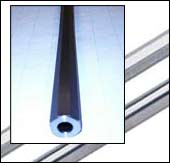
For most barrels, Larry mills a hex with six flats on the end of the barrel. This allows a shooter to change barrels quickly at home or on the line with a simple box-head wrench or a socket wrench. Larry says: “You don’t even have to take the barreled action out of the gun. Just set the buttstock on the ground, between your feet, put a wrench on it, hit it with the palm of your hand — and off comes the barrel.” For barrels fitted with a muzzle brake, Larry has a slightly different system. He mills two flats behind the brake so you can use an open-end wrench to do the job.
With either a hex on the end, or two flats for a brake-equipped rifle, the system works with any medium- to heavy-contour barrel with a muzzle-diameter of at least 0.700″. This will even work for high-power rigs using clamp-on sights or bloop tubes. Larry explains: “A lot of us here in New England use clamp-on front sights. The barrel will be turned to 0.750 for the sight, with the hex on the end. A bloop tube can go right over the end, no problem.”
Larry has used this system over the past few years to win a number of matches. In one 600-yard 3 by 20 prone match, Larry used three different barrels, with three different chamberings, on the same Savage rifle. Larry changed the barrels on the line.
Larry was able to do this because the system has little to no loss of zero from one installation of a given barrel to the next installation of that barrel. This lets the shooter start the match with confidence that the first sighter will be on paper. Larry reports that the simple system works great: “To date we have used this system on Savage, Remington, Winchester, RPA, and Nesika actions.”
Varminters Take Note — This Is Great in the Field
If you are a varminter shooting hundreds of rounds in a day, consider this system. We know some guys who bring 3 or 4 rifles into the field because their barrels get hot during long days of prarie dog hunting. With this smart system, you can easily swap barrels in a couple minutes. And no special equipment or barrel vises are required.
Modifying Barrels is Affordable
Racine’s system for rapid barrel removal/changing is very affordable. If Larry does the chamber work on your barrel he charges $45.00 extra to mill a hex or two flats on your barrel. The customer chooses the configuration.
If you only want the hex or flats done, Larry may charge a higher fee — call for current rates. Note this can also work for barrels with muzzle brakes or threads for suppressors. For more info, visit LPRGunsmith.com or call Larry at (603) 357-0055.
Posting on the 6.5 Creedmoor Group Facebook Page, Russel T. complained that his AR magazine doesn’t like to feed that last few rounds. Russell asked: “Full magazine, no problem cycling. But with five (5) or less in the magazine… this happens. What can cause this?”
It sure looks like he could use a new magazine spring, but there may be buffer-related problems as well. Or maybe a gas system issue. What’s your call? Here are some responses posted by Facebook folks:
“Weak mag spring.” — Josh N.
“Weak mag spring or too heavy of a buffer spring.” — Justin G.
“Try a different mag, if it still jams it’s probably a gas problem, if not chuck the bad mag.” — Otto G.
“Weak mag spring or literally anything that would cause the Bolt Carrier Group to short cycle.” — Reggie W.
“I’ve had the same issue with my 300 BLK when my buffer tube came apart. It would still cycle cheap rounds fine but [not] the Hornadys. Took it apart and found the buffer tube was in pieces.” — Hunter R.
“Could be a weak mag spring or buffer spring, both at the same time.” — John S.
“As mentioned it could be a list of things. However, bolt velocity is too fast/hard and the usual (but not always) culprit is over-gassing.” — Bill F.
“Short cycle — clean and LUBRICATE the weapon.” — Mark H.
“Look to see where the brass is ejecting. That will tell if it’s an over or under gas issue. If that’s ok then look at the mag spring. See Diagram” — Teddy G.
“Weak magazine spring, I tossed four brand new ‘bargain mags’ [due to] that very problem.” — John V.E.
“May not be a weak spring or bad mag. Check out a Tubb Precision flatware spring. I swapped mine in a new rifle and solved the problem of short stroking and double feeds.” — Anthony T.
“It might be the follower as well, some designs will dip in the front/rear as rounds are expended. It’s the reason why we didn’t use some service mags with the green followers.” — Chris J.
“Weak spring… time for a new magazine…or add a 5-round block and make it a 25-round magazine. But I’m positive it’s a weak spring, which means it’s just a matter of time for failure.” — Steve M.
“Without the weapon in hand I would hate to guess….
Start with the simple stuff and go from there. Trying to diagnose a problem from a photo is just like when your wife or girlfriend tells you the car won’t start. LOL.” — Mark T.
Editor: This story by Tommy C. (aka “dc.fireman”) comes from our Shooters’ Forum. It’s fascinating to see how a relatively inexpensive Savage M12 BVSS varmint rig was transformed into a sophisticated 300M match rifle with a modern chassis, Shilen barrel, and top-of-line sights. With some ingenuity, and careful parts selection, Tommy created a rifle that can compete with match rifles costing many thousands of dollars more. American ingenuity at work!
Savage Reborn — Old BVSS Transformed into 300M Match Rifle
by Tommy C. (aka “dc.fireman”)
So, I began the project of building a 300M International competition gun, about a year ago, intending to compete at the 300M Nationals this year in Minnesota at the Minneapolis Rifle Club. Realistically, I didn’t want to pay the price-tag demanded of the Bleikers, Grunig & Elmigers, Hammerlis, or Tanners that (infrequently) pop-up for sale from time to time. So I decided to build my own 300M Match rifle with an American action, barrel, chassis, and trigger.
Here is Tommy’s completed 300M Match rifle with Savage action in PDC Custom chassis.
I had decided on the .260 Remington (aka 6.5-08) as the caliber choice. This beat out 6.5×47 Lapua simply due to the cost/availability of brass. The .260 Rem cartridge is based on the .308 Win parent. I made my first batch of brass by necking down some Federal .308, and it worked great. [Editor: We do recommend Lapua .260 Remington brass for match purposes for those who don’t have a supply of good .308 brass.]
I had an older Savage M12 stagger-feed action, originally from an old .22-250 BVSS. I contacted James at Northland Shooter Supply, and he walked me through the game plan and equipment I needed: Shilen Select Match 26″ barrel, NSS Stainless recoil lug and nut, a set of Forster headspace gauges, and the NSS action wrench.
Catalog photo of current Savage M12 BVSS in .22-250 Rem.
A few months later, I replaced the original Accu-trigger with a Rifle Basix SAV-II trigger, and immediately wondered why I waited so long to do that. The Rifle Basix is perfect for my application. Mind you the he safety DOES NOT work now, but, I don’t need it for my application.
Another member on the AccurateShooter Forum sold me a BVSS stock that has been re-worked by Alex Sitman of Masterclass Stocks, and it served as a placeholder, until I could find a maker who could nearly replicate my Feinwerkbau 2700 Alu stock in my smallbore match gun.
After scouring the AccurateShooter Forum, and multiple internet searches, I found PDC Custom in Michigan. I spoke with Craig Kierstadt a few times, before finally deciding to pull the proverbial trigger on his chassis. He had a few of the older chassis stocks with spacing for the Savage stagger-feed action. He machined an Anschutz rail into the fore-end for my hand stop and sling. Then he powder-coated the chassis black, and sent it to me sans grip and butt plate.
Photo of action/chassis. Tommy says: “It locks up really tightly, and you can tell Craig spent some time on the CNC work need to make this all fit.”
There are a few minor issues with the PDC chassis, but overall, I would rate this a 9.5 out of a possible 10. The price, and the features built into it, plus the ease of which everything fit together, far outweigh any minor issues. And two of the issues I quickly corrected with Teflon tape. I will need to make a walnut cheek piece — a curved one isn’t conducive to aperture iron sight shooting.
Savage Action .260 Rem 300M Match Rifle Components:
Action, Barrel, Stock, Grip
Savage M12 stagger-feed action, 4.27″ spacing
Shilen Select Match Barrel, 26″
Rifle Basix SAV-II Trigger
PDC Custom Chassis — tool-less adjustments
Bobsled SLED for single loading (required)
MEC Contact III Butt plate (German)
MEC handstop/sling swivel (German)
Walnut Target grip for AR-15 (eBay sourced)
Sight Components and Hardware
MEC Spy Long rear sight (German)
Centra front sight tunnel (German)
Centra adjustable aperture (German)
Medesha sight extension tube + collar
Champion’s Choice front sight base
Champion’s Choice mirage band
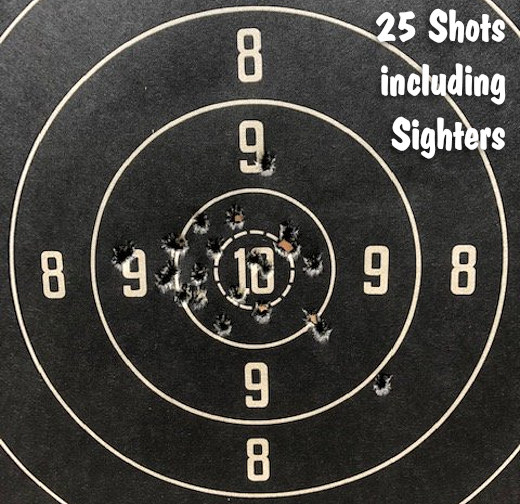
For his practice load, Tommy shot 123gr Hornady ELD-M bullets with H4831 powder and CCI BR2 primers. This load performed well — Tommy posted: “My 25-shot initial prone test today shows promise. There are five sighter shots, and 20 record shots. One of the 9s at 9 o’clock is my first sighter, the other one I own. The 8 out at 4 O’clock was a round that was difficult to chamber. My initial scoring puts me somewhere in the vicinity of 193-7X.”
The target used is the NRA C2, “300M International Rifle Target, reduced for 200 yards”. The 10 Ring is 2.40″ in diameter, while the Inner 10 (X-Ring) is 1.24″.
Match Load — Varget and Nosler Bullets
For his match load, Tommy switched to Varget and Nosler bullets: “My match load uses 37.9 grains Hodgdon Varget with a Nosler 123gr bullet. This was a recommendation by a gentleman with a lot of experience in 300M shooting.”
Tommy adds: “The amount of knowledge gained via the AccurateShooter Forum has made this all a reality, instead of just a passing thought.”
How often does this happen — a teen-aged girl helps build her own long-range benchrest competition rifle. And then she wins her first 1000-yard match with that new pink rifle! And yes, she hand-loaded her own 6mmBR ammo (naturally). Here is the remarkable story of 15-year-old Bexi from Britain, courtesy TargetShooter Magazine.
Brit Teen Competes with Rifle She Helped Build
Bexi is a talented young British lady who was introduced to shooting by her father Nick. As part of a UK skills honors program, 15-year-old Bexi decided to help build a new Savage-action benchrest rifle.
Our friend Vince Bottomley reports: “The first time Bexi actually shot her rifle I also happened to be present and I couldn’t believe how well she adapted to the bench to shoot the 6BR cartridges she had loaded. It was time for her first competition with the rifle — the UKBRA’s opening 600-yard benchrest shoot. At the end of the day she actually finished in third place in Light Gun Class, beating a host of experienced guys — including me. It was an astonishing performance and one that she would repeat throughout the season. In fact, Bexi finished second place in the UKBRA Championship.”
Bexi shoots her new rifle at 600 yards at the Diggle Ranges.
Bexi proved a “natural” at long range benchrest competition. At Bexi’s first 1000-yard match she beat all competitors, taking first place in Light Gun Class. Vince Bottomley reported from the range: “It’s a beautiful spring day, but the mirage is seriously blurring the target. Again I’m wondering — will she cope. Cope? I can’t believe it — Bexi lays down four sub-MOA groups and beats all of the Light Gun shooters with a superb 7-inch Agg at 1000! Wow!”
Bexi Helps Build 6mmBR Benchrest Rifle
Young Bexi helped build her great-shooting pink Light Gun as part of an honors program effort. In the UK, young persons age 14-24 can pursue special honors — the Duke of Edinburgh (DofE) Awards in three levels (Bronze, Silver, and Gold). See www.DOFE.org.*
A few years ago, Bexi started working towards her Bronze DofE award and opted to use shooting as a skill. She joined the Young Rascals Shooting Academy at the Diggle Ranges, progressing through rimfire to .223 centerfire, taking in a couple of adult F-Class shoots along the way.
Gunsmith Pete Walker spins up Bexi’s barrel in the lathe, showing her how to chamber a barrel.
To help Bexi earn her Silver DofE Award, gunsmith friend Pete Walker WalkerRifles.co.uk offered to sponsor Bexi and help her build her own rifle. Bexi wanted to further her involvement with shooting and help construct her own rifle to shoot in benchrest competition with her father. Ambitious? Yes, but that is exactly what the DofE Award is all about — achieving something you wouldn’t think possible. Benchrest appealed to Bexi — because of the precision involved. And yes she earned her Silver DofE Medal!
In total, Bexi spent 58 hours in Pete’s workshop over several Saturdays. Clearly, the machining work required in building a rifle was beyond Bexi’s skill level but she was present at every stage and Pete made sure that she actually did get to cut metal on the lathe. Bexi also polished the barrel and helped with assembly as the barreled action was bedded into the benchrest stock.
Rifle Specs: Savage Model 12 twin-port action, Benchmark 30″ barrel, Rifle Basics trigger, pink-painted laminated stock, Vortex Golden Eagle scope, and a custom butt-plate (hand-polished by Bexi).
Whilst the rifle was in its final stages of the build, it was time for Bexi to learn the art of reloading — under the close supervision of Dad Nick. Yes Bexi reloads all her ammunition. She preps her own brass, seats her own bullets, carries out a final weight check, make the entries in the reloading log, and enters the results and velocities from testing.
Vince comments: “When Bexi starts college and begins her Gold DofE Award efforts, she will continue shooting but now has ambitious plans to build a full custom rifle. Yes, Bexi wants a BAT but honestly, she’s doing pretty well with that Savage!”
*The Duke of Edinburgh’s Award (commonly abbreviated DofE), is a youth awards program with three progressive levels: Bronze, Silver, and Gold. With assistance from adult Leaders, participants select and set objectives in the following areas: Skills, Volunteering, Sport/Fitness, and Expedition. The DofE Award program was started in 1956, and now operates in over 140 countries along with the UK. As of 2017, over 6 million young people in the UK have taken part in the DofE programs, and 8 million worldwide. To achieve an award, the participant must work on each section for a minimum period of time, and must be monitored and assessed by qualified supervisors. Each progressive level demands more time and commitment from participants: Bronze 3–6 months; Silver: 6–9 months; Gold: 12–18 months.


 This video was made with the help of the World of Guns: Gun Disassembly interactive encyclopedia with 3D rendering. This remarkable web-based software allows users to view the inner workings of hundreds of different rifles and pistols — everything from a .22 LR Ruger to a .55-caliber Boys Anti-Tank rifle. There are also 25,000+ parts diagrams. This is a remarkable technical resource. SEE MORE HERE.

 Can you guess what your next barrel will weigh? In many competition disciplines, “making weight” is a serious concern when putting together a new match rifle. A Light Varmint short-range Benchrest rifle cannot exceed 10.5 pounds including scope. An F-TR rifle is limited to 18 pounds, 2 oz. (8.25 kg) with bipod.




 A few season back, our friend Kevin Thomas acquired a bit of living history — a reproduction Model 1873 Trapdoor Springfield. Here is Kevin’s story of his new rifle and the legacy it carries.


 Today’s Sunday GunDay feature is a “blast from the past”, part of our big


 Larry Racine Barrel Sytem
 Modifying Barrels is Affordable


 Match Load — Varget and Nosler Bullets


