Shown above is David Tubb, the legendary 11-time National High Power Champion, posing with a very serious rifle used in the Extreme Long Range (ELR) game. David has jumped into the Extreme Long Range discipline in a very big way, producing a .375-caliber, long-barreled ELR version of his famous Tubb rifle, called the Adaptive Target Rifle (ATR). A version of this rifle, piloted by David’s son-in-law Nate Stallter, set an ELR World Record in January 2018. See video below for a full report.
This video shows Team TUBB setting a new ELR World Record of 2011 Yards using the Tubb Adaptive Target Rifle in .375 CheyTac. Nate Stallter nailed three shots at over one mile — 1768 yards. Then Nate broke his own record, going 3 for 3 at 2011 yards. ELR Central hosted this match, held at the Front Sight gun range, Pahrump, Nevada on January 21, 2018.
David Tubb Shoots ELR Adaptive Target Rifle at KO2M
For the Extreme Long Range (ELR) discipline, David Tubb developed a .375-caliber, long-barreled ELR version of his famous Tubb rifle, called the Adaptive Target Rifle (ATR). A version of this rifle, piloted by David’s son-in-law Nate Stallter, set an ELR World Record in January 2018.
David Tubb Talks about KO2M and Extreme Long Range Shooting
David Tubb’s long-range rifles have performed well in Extreme Long Range shooting. AT the 2019 NRA Extreme Long Range Championship, David Tubb won the Heavy Gun Division. In this video, created during the King of 2 Miles (K02M) competition at the Whittington Center in New Mexico, David talks about the challenges of ELR shooting, and cartridge selection. Big, heavy, large-caliber bullets with ultra-high BCs are favored for the ELR game, but recoil and cost must also be considered.
About the .375 CheyTac Cartridge
Some of the most successful ELR cartridges are based on the CheyTac family, including the .375 CheyTac (9.5×77) and .408 CheyTac (10.36 x 77). This .375 Cheytac cartridge has proven to be tough and accurate. And it is capable of winning — our friend Derek Rodgers won the 2017 King of 2 Miles (K02M) event shooting a .375 CheyTac (9.5×77).
Derek Rodgers was the 2017 King of 2 Miles. Derek is also the first-ever human to ever hit the maximum distance target target at 3368 yards (1.91 miles). His cartridge choice? The .375 CheyTac. Derek ran Cutting Edge Bullets in Peterson brass with Hodgdon H50BMG powder.
Q: Why did you choose the .375 CheyTac cartridge?
Derek: When I was asked to join the Applied Ballistics Team, I needed to get an ELR rifle built in a short period of time. I was under a very tight time schedule to get the project complete. In an effort to eliminate variables, I decided to keep things standard and as simple as possible. I chose the .375 CheyTac for the ease of getting components. The larger rifles are more difficult to get components quickly and I felt like the .375 CheyTac had enough attributes to be competitive at ELR distances.
Readers know Jim Borden as a Hall of Fame shooter and the owner of Borden Accuracy/Borden Rifles. Jim won 10 IBS National Championships, set 10 IBS world records, and was inducted into the Benchrest Hall of Fame in 1996. But Jim is not just a great shooter. This highly-trained engineer is very much a Renaissance man. He is as skilled with cameras as he is with benchrest rifles.
Jim is a talented outdoor photographer who has compiled an impressive portfolio of wildlife and landscape photographs. For this Thanksgiving-eve edition of the Daily Bulletin we are featuring some of Jim’s favorite nature images. We hope readers enjoy them as much as shooters prize Borden’s Rimrock benchrest and Rimrock hunting actions.
Growing up in rural Pennsylvania, in a hunting household and hunting community, Jim learned about shooting at a very early age. He started hunting at the age of nine with his father and grandfather. His grandfather had an avid interest in photography while they were on hunts and Jim became interested as well. Jim began using SLR cameras in the 1970s, often carrying cameras on his hunts. As the years passed, Jim became more interested in “shooting” the animals with a camera versus a gun. Jim converted from film to digital in 2006 and in 2007 Jim’s wife Joan started accompanying Jim on the photo safaris. Jim has a particular passion for elk, moose, and eagles and Jim also enjoys scenic photography. Jim and Joan both shoot Nikon professional equipment. Their photographs can be viewed on his JandJB Wildlife Photography Blog.
All in the Family
Jim’s grandfather was a gunsmith who taught Jim the trade when Jim was very young. Jim’s father and grandfather ran a country business that included an auto repair shop, welding, a small lathe, and a forge. Jim earned a degree in Mechanical engineering at Penn State University. For 23 years he worked for Procter and Gamble (P&G) as an engineer and as an engineering manager/project manager.
Borden Accuracy/Borden Rifles Success Story
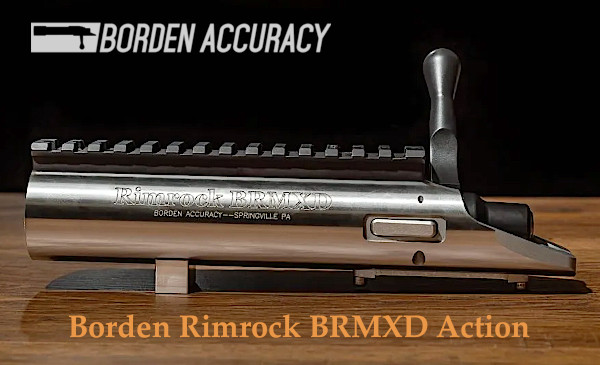
Borden Accuracy/Borden Rifles has been a source for precision benchrest and hunting rifles for many years. Jim started doing his own gunsmithing while competing in benchrest and high power silhouette matches. Jim launched his business in 1987, working nights and weekends while still employed at P&G. The business became full-time in 1995 with Jim and his wife Joan doing the work. The business was expanded in 1999 with the construction of the new Springville, PA facility and the addition of sons Jim Jr. and John to the staff. Son-in-law John Mecca came onboard in January 2000. Now the Borden shop continues to make some of the finest rifles and actions in the world. Joan tells us that the company has seen a significant growth in ultra-high-quality precision hunting rifles in recent years.
Jim and company began making Rimrock benchrest and Rimrock hunting actions in 2001. They added Borden Alpine and Timberline actions in 2006. These actions are made in an advanced manufacturing facility which has three CNC vertical Machining centers, three CNC lathes, three manual lathes, a manual knee mill, a surface grinder, a cylindrical grinder and wire EDM machine. To learn more, visit BordenRifles.com, call (570) 965-2505, or send email to info [at] bordenrifles.com.
Artistry in metal — Engraving has long been used to decorate fine firearms. The examples shown here prove that engraving is not a lost art. There still remain fine craftsman who can engrave beautiful designs into the metal components of pistols, rifles, and handguns. Above is a spectacular Dragon-engraved Korth revolver from Nighthawk Custom — an amazing example. Below are seven beautiful examples of engraved semi-auto pistols, from a tiny Colt .25 ACP to Chuck Yeager’s gold-plated Beretta.
Centennial 1911 from Colt — Marking 100 Years
In 2011, to celebrate the 100th birthday of the 1911 hangun, Colt created a spectacular, fully-engraved “Anniversary Edition” pistol. J.M. Browning’s 1911 pistol was officially adopted by the U.S. Army on March 29th, 1911. (The U.S. Marine Corps and U.S. Navy adopted the 1911 pistol roughly two years later). This Centennial 1911 is pimped to the max, complete with gold inlay and genuine ivory grips.
One-of-a-Kind Fully Engraved Walter Q5
On display at the 2019 IWA Outdoor Classics Show in Germany was this stunning fully-engraved Walther Q5 pistol. Note how even the magazine end plate is engraved. On the slide is an American Eagle and the quote “We the People”. Those rare wood grips are also very eye-catching and handsome. This may be the fanciest Walther pistol on the planet.
The Right Stuff — Chuck Yeager’s Gold-Plated Beretta
Here’s another pistol with a famous owner “The Right Stuff” Pilot, Chuck Yeager, the first human to break the sound barrier. This Beretta has extra value because it was owned by pilot Chuck Yeager. Photo NRA Museum.
Stunning Engraved Trio — Colt, Mauser, and Luger
Here is a matching set of three three beautifully engraved pistols by the late Indiana engraving wizard Ben Shostle — a Luger, a Mauser, and a diminutive Colt. By themselves, these three matching pistols would make a prized handgun collection. Photo courtesy Amoskeag Auction Company.
Smith & Wesson Model 41 — 50th Anniversary Edition
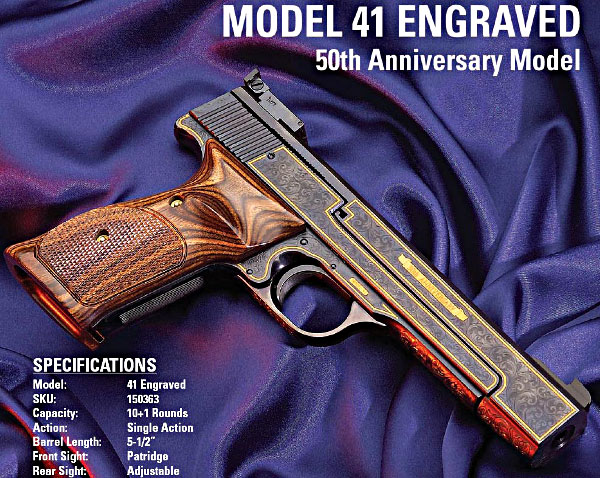
The .22 LR Smith & Wesson Model 41 is one of our favorite rimfire target pistol. First released in 2008, the engraved model 41 combines superior accuracy with stunning appearance.For $1700.00 to $2000.00 you can find the fully engraved, 50th Anniversary Model 41 in presentation case on Gunbroker.com.
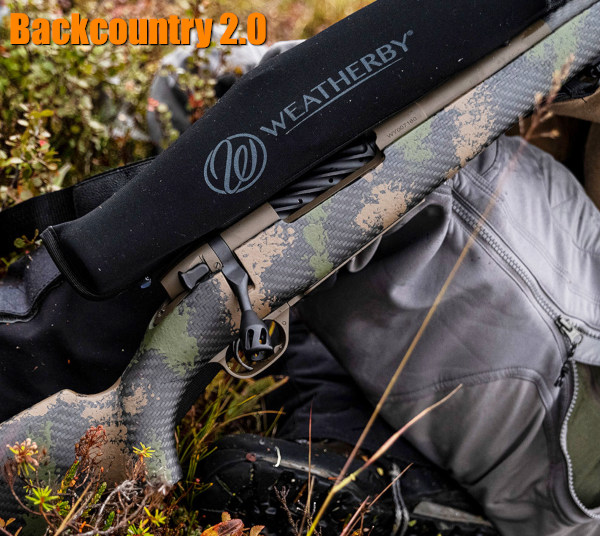
It’s the heart of hunting season in many parts of the country. Game hunters are heading out for their late fall deer hunts. For hunters making long treks in the back-country, reducing carry weight is a big deal. That’s why we’ve seen a trend among rifle-makers to introduce rifles that weigh significantly less. This is accomplished through use of carbon fiber stocks, carbon-wrapped or fluted barrels, and even titanium actions. The Weatherby rifles showcased here feature such lightweight components. For example, the Weatherby Mark V Backcountry 2.0 Ti (Titanium) model comes in at just 4.7 pounds before optics. That’s mighty light for a hunting rifle.
Weatherby Backcountry 2.0 Ti with titanium action, fluted barrel, and carbon-fiber stock, 4.7 pounds.
Light-Weight, Carbon-Stock Backcountry 2.0 from Weatherby
Here is good news for backcountry hunters. Weatherby’s Backcountry 2.0 carbon-stocked hunting rifles weigh well under 6 pounds before optics. There is even one titanium action model series that weighs just 4.7 pounds. The 2.0 series now offers both standard steel receivers or even lighter titanium receivers. And Backcountry 2.0 Carbon models are equipped with a new carbon fiber stock that is the lightest in the industry — weight is a mere 20 ounces for standard actions. For further weight savings, some models feature a tensioned carbon fiber-wrapped barrel. But all that high-tech doesn’t come cheap — MSRP for the Titanium action, carbon-wrapped barrel model is $3849.00!
Ultralight Carbon Stock — Weatherby’s new Blacktooth stock features a Carbon Link™ bedding system which engages the recoil lug and distributes recoil throughout the stock without the weight of a traditional aluminum bedding block. This makes the overall stock lighter and stiffer.
The Backcountry 2.0 Ti Carbon combines a tensioned carbon fiber barrel with the ultra-lightweight Titanium Weatherby Mark V action. This barrel system has shown excellent accuracy, making it a good choice for a long-range hunter. Registering a very low 5.3 lb starting weight, the Backcountry 2.0 Ti Carbon combines a titanium action with the Peak 44 Blacktooth stock — which Weatherby claims is the “lightest production carbon fiber stock on the market.”
Along with the new ultra-light elements, these Weatherbys have premium Mark V features: 54-degree bolt lift for fast cycling, fluted bolts, TriggerTech triggers, and Cerakote finish on metal parts. All the Backcountry 2.0 series rifles have a sub-MOA accuracy guarantee. CLICK HERE for Weatherby Backcountry 2.0 Field Test by Peterson’s Hunting.
Light is Right — Weatherby’s Backcountry 2.0 rifles weigh as little as 4.7 pounds (before optics).
Weights for Backcountry 2.0 Models range with chamberings:
Weight Saving Secrets — How Weatherby Achieved Such Light Weights GunsAmerica Digest reports: “A huge amount of the weight savings comes thanks to the updated carbon fiber Blacktooth stock by Peak 44. This stock uses what they call their Rock Solid Carbon Link bedding system which eliminates the need for a metallic bedding block. The Blacktooth stock weighs less than 20 ounces. The Backcountry 2.0 [series adds] both a carbon fiber stock and either fluted #1 MOD-profile or #2 MOD-profile carbon steel barrels or #4 MOD-profile BSF carbon fiber-tensioned barrel to achieve these light weights.” READ GunsAmerica Review.
To mitigate recoil Weatherby developed its new 3DHEX recoil pad — the gun industry’s first production 3D-printed pad. The 3DHEX’s three-dimensional honeycombed design extends the duration of the recoil pulse — taking away the sharp kick. Weatherby explains: “With the same amount of recoil spread out over a much greater time period, felt recoil is greatly reduced[.]” Backcountry 2.0 rifle recoil is also reduced by factory-fitted Accubrakes, contoured to match barrel profile.
Field Test of Titanium Action Weatherby Backcountry in 6.5-300 Whby Magnum
In this video, Hunter Todd Helms reviews Weatherby’s Backcountry T1 rifle in 6.5-300 Weatherby Magnum. This rifle is meant for fast and light travel in the backcountry. A fluted barrel, titanium action, and carbon fiber stock minimize weight. Todd says the 3DHEX recoil pad really does tame the magnum kick. This model also features a new streamlined muzzle brake.
Preparations Before The Hunt
1. Map Your Hunt and Notify Others — Before your hunt, make a plan and notify friends and family members about WHERE you are going and your intended return date and time. Print out a Google Satellite map and locate landmarks and trailheads. Mark where you plan to park your vehicle and give a copy of this map to friend and/or family members. A hunter may injure himself by falling off a rock, or tumbling in a creek-bed. After that kind of injury the hunter may be confused or unable to walk. If you get stranded in the wilderness, you want trusted persons to know where you are. So, before you leave on a trip, provide a map to a friend or family member. Show them where you will leave your vehicle, and where you expect to be every day of your hunting adventure.
2. Licenses and Permits — Make sure you have a valid hunting licenses and all the necessary tags. Begin this process with ample time before your intended hunt(s). The NSSF adds: “If you are crossing state or national borders, find out about any special considerations you must take care of. Border crossings can mean knowing about firearm transport laws or Chronic Wasting Disease-related regulations.”
3. Work on Your Fitness — On a multi-day hunt you may be trekking many miles. You need to be in good shape. If you are out of shape you may be putting yourself in a precarious situation, particularly if you underestimate the terrain difficulty. As the NSSF says: “Not being able to handle the conditions lessens your chances of success, can turn a great experience into an agonizing one and can endanger your health.”
4. Do Your Homework — Study the area you will be hunting. Talk to other hunters. Look at satellite photos. Get a real sense of the walking and terrain challenges. For a multi-day hunt, MAKE a PLAN. The NSSF states: “Eliminate surprises. Learn as much about where you will be staying, the area you will be hunting, what the weather might be like and what you need to bring[.]”
5. Rifle and Ammo — Make sure your rifle is sighted-in and your ammo is tested. Sight-in your rifle with the ammo you plan to use on your hunt. CLICK HERE for 4-Shot Sight-in Method. After sighting-in from the bench, confirm your zero by shooting from typical hunting positions (kneeling and with forearm supported on a rock or post).
6. Communications and GPS — Bring a GPS if you are in a wilderness area far from civilization. It’s a good idea to bring a cell phone, but you may not have coverage if you’re quite a distance from populated areas. A smart-phone also doubles as a digital camera to record your trophies. For navigation and safety, consider getting Garmin inReach Explorer+. This high-tech handheld unit features interactive SOS, connecting you to the GEOS 24/7 search-and-rescue monitoring center. They also allow you to send and receive text messages, no matter where you are, via advanced inReach satellite technology. Yes you can communicate even if you are miles from the nearest cell tower.
Visit WhereToHunt.org
There’s a great online resource for hunters that will help you find game locations in your state and ensure you have all the proper permits and game tags. WheretoHunt.org features an interactive map of the country. For all 50 states, the NSSF has compiled information about hunting license and permits, where to hunt, hunter education classes, laws and regulations and more. For each state you’ll also find a link for required applications and license forms.
Jim Borden, the very knowledgeable owner of Borden Accuracy, provided an interesting historical insight about barrel fitting and the term “blueprinting”. Jim has posted on his Borden Accuracy Facebook page an explanation of the term “blueprinting” as it originally was used with respect to barrel/shoulder/lug fitting.
Barrel/Shoulder Fit and Blue-Printing
Jim told us: “Something often overlooked on barrel installation is the shoulder fit. Many are so overly obsessed with doing a crank-on fit of threads that the shoulder contact is overlooked. Full, solid barrel shoulder to recoil lug or action face is critical to optimum accuracy and precision.
Many years ago part of the ‘blueprinting’ of an action was the use of Prussian blue to ‘blueprint’ lug fit, thread fit, and barrel shoulder fit. It was a colloquial expression that had nothing to do referring to a blueprint or drawing of the action.” Bet you didn’t know that!
About the photo below, Jim noted: “the fuzzy look on the threads is a liberal coating of Never-Seez thread lubricant.”
Look carefully to see the Prussian Blue applied to the barrel shoulder, plus Never Seez on threads.
Note the owner’s name, “S. Limbourne” was engraved on the bolt release (and trigger guard, see below).
Competition rifles don’t need to be beautiful, as long as they shoot. But who doesn’t like a spectacular figured-wood stock, particularly when it is combined with a superb custom action and a tack-driving barrel. This custom .284 Winchester F-Class Open division rig was crafted by gunsmith Thomas “Speedy” Gonzalez for competitive shooter Scott Limbourne. The handsome Bacote wood stock comes from Cerus Rifleworks, while the action is a polished Borden RBRP BRMXD. Two Brux 1:9″-twist barrels were chambered for the project, both finished at 32″. The stock is also fitted with a R.A.D. Recoil System. This rig has top-of-the-line hardware all around.
Action: Borden BRMXD – Polished
Rail: 20 MOA Polished
Chambering: .284 Winchester
Trigger: Jewell BR – Blueprinted
Barrel: (2x) Brux 32″ 1:9″ Twist
Stock: Cerus F-Open in Exhibition Grade Bacote
Recoil System: R.A.D. System
Extras: Carbon Fiber Tunnel Plate, Custom Engraving Work on Action, Trigger Guard, and Bolt Release.
You’ll find other impressive rigs on Speedy’s Facebook Page. If you’d like a superb custom rifle like this, call Thomas “Speedy” Gonzalez at 972-672-6630, or send email to: speedy.godzilla [at] msn.com.
Rifleshooter.com does some great original research — providing “hard data” you can’t find anywhere else. Here are the eye-opening results of Rifleshooter.com’s 6.5 Creedmoor barrel cut-down test. You may be surprised at the results. Read on…
What do you get when you cut a 6.5 Creedmoor-chambered barrel down to just over 16 inches? A lot more velocity than you might think. Our friends at Rifleshooter.com performed a barrel cut-down test with 6.5 Creedmoor test rifle, shortening the barrel from 27 to 16.1 inches in one-inch increments. Surprisingly, with a 142gr Sierra MK, the total velocity loss (as measured with a Magnetospeed) was just 158 FPS, an average of 14.4 FPS per inch of barrel length. With the lighter 120gr A-Max bullet, the total velocity loss was 233 FPS, or 21.8 FPS average loss per inch of barrel.
Test Procedure
Five (5) rounds of each type of cartridge were fired at each barrel length and the velocity data was recorded with a MagnetoSpeed V3 barrel-mounted chronograph. The rifle was then cleared and the barrel was cut back one inch at a time from 27″ to just over 16″. NOTE: During this winter test, the air temperature was a very chilly 23° F. One would expect higher velocities across the board had the outside temperature been higher.
The photo below shows how the barrel was cut down, inch-by-inch, using a rotary saw. The barrel was pre-scored at inch intervals. As the main purpose of the test was to measure velocity (not accuracy) the testers did not attempt to create perfect crowns.
6.5 Creedmoor vs. Other Mid-Sized 6.5mm Cartridges
The 6.5 Creedmoor is a very popular cartridge with the tactical and PRS crowd. This mid-size cartridge offers good ballistics, with less recoil than a .308 Winchester. There’s an excellent selection of 6.5mm bullets, and many good powder choices for this cartridge. When compared to the very accurate 6.5×47 Lapua cartridge, the 6.5 Creedmoor offers similar performance with less expensive brass. For a tactical shooter who must sometimes leave brass on the ground, brass cost is a factor to consider. Here’s a selection of various 6.5mm mid-sized cartridges. Left to right are: 6.5 Grendel, 6.5×47 Lapua, 6.5 Creedmoor with 120gr A-Max, 6.5 Creedmoor with 142gr Sierra MK, and .260 Remington.
When asked to compare the 6.5 Creedmoor to the 6.5×47 Lapua, Rifleshooter.com’s editor stated: “If you don’t hand load, or are new to precision rifle shooting, get a 6.5 Creedmoor. If you shoot a lot, reload, have more disposable income, and like more esoteric cartridges, get a 6.5×47 Lapua. I am a big fan of the 6.5×47 Lapua. In my personal experience, the 6.5×47 Lapua seems to be slightly more accurate than the 6.5 Creedmoor. I attribute this to the quality of Lapua brass.” Now that Lapua offers 6.5 Creedmoor brass with small primer pockets, the 6.5 Creedmoor is even more attractive.
The creator of Rifleshooter.com also operates a Custom Rifle Building enterprise and gun shop in Long Island, New York: 782 Custom Guns Ltd.. He tells us: “We offer an unparalleled level of gunsmith machine shop services in the Long Island region. From precision rifles (USMC M40A3/A5/A6 XM3 clones) to customized Remington 870 and Mossberg 590 shotguns, and customized 1911s, chances are if you can dream it, we can build it!”
For today’s Sunday GunDay story we showcase seven interesting metal-chassis rifles. While we love the look and feel of wood and fiberglass, metal does have its advantages. It can be crafted very straight and true, and the designs can achieve a very low center-of-gravity without sacrificing rigidity. In addition, a precisioned machined metal chassis tends to track extremely well.
Massive IBS Heavy Gun Milled from Solid Aluminum Billet
This remarkable 70-lb IBS Heavy Gun, was machined from solid aluminum billet, by Bruce Baer. It rests on a G&G Alvey rest split in the middle to comply with rules. This “heavy metal” CNC-machined wonder is a work of art designed for the 1000-yard game in the Heavy Gun class. Wood stocks, and to a lesser extent fiberglass stocks, are more forgiving, offering greater damping and recoil absorption. However, metal stocks offer superior rigidity, and the CNC machining allows tracking surfaces to be perfectly parallel.
Williamsport limits Heavy Guns to 100 pounds. Under IBS and NBRSA rules weight is unlimited. You will see a few massive 200-lb behemoths at IBS matches, but most competitors find that something in the 60-90 pound range works best. Bruce Baer explains, “You can’t stop a gun from recoiling. If it doesn’t recoil it will jump. If it jumps you might as well go home because you won’t shoot a good group. So it is pointless to try to build a gun so heavy as to eliminate all recoil. The more you restrict the rifle’s recoil the more temperamental that rifle will be. The 200-pounders just don’t out-perform something in the 60- to 80-pound range, and I think the optimal weight is 60-70 pounds.”
Bruce Baer likes the 70-lb overall weight for a heavy gun: “Extreme mass is not necessarily an advantage. Watch a locomotive starting up from zero–it will vibrate from one end to another. If the gun is too heavy I think it will vibrate at the start of recoil and that will kill accuracy. I want the gun to start from recoil with very little effort so it will be smooth from start to stop.”
Water-Cooled World Record-Setting Wondergun
We like “outside of the box” thinking. And in the world of competitive shooting, it can’t get more unconventional than this. But this radical liquid-cooled benchrest rig wasn’t just a crazy experiment — it actually delivered the goods. This IBS Heavy Gun, built by Joel Pendergraft, produced a superb 10-shot, 3.044″ group that stood as an International Benchrest Shooters (IBS) 1000-Yard Heavy Gun record for seven years, not being broken until 2016.
Using this water-cooled wondergun, Joel shot the record-breaking group in April 2009 at Hawks Ridge, NC. This monster features a .30-Caliber 12-twist, 4-groove Krieger barrel inside a water-filled sleeve (like on a liquid-cooled machine gun). Joel shot BIB 187gr flat-based bullets in Norma brass, pushed by a “generous amount” of Alliant Reloder 25 and Federal 210M primers. The cartridge was a big custom wildcat Joel listed as “.300 Ackley Improved”.
Pendergraft’s 3.044″ 10-shot group was a great feat, breaking one of the longest-standing, 1000-yard IBS World Records. And Joel’s 3.044″ record stood for 7 years!
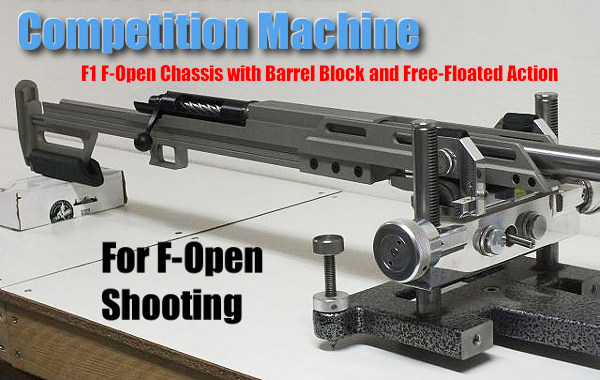
F1 F-Open Chassis from Competition Machine
Along with his famed tube-guns, Gary Eliseo of Competition Machine has designed a modern, low-profile chassis system for F-Open competition. Assembled with Cerakoted aluminum beams, these F1 F-Open chassis systems offer great tracking with an ultra-low center of gravity.
Here is the F1 Chassis with “Marine Corps Red” powder coat finish. Read Full Report.
This F1 aluminum alloy chassis stock features a super-low center of gravity, plus adjustable length of pull, cheek rest, and drop. The stock is available in a wide choice of Cerakote finishes. The current Model F1 chassis features a action block mounting system to fit most actions. There was also an earlier version that had a free-floated action with the barrel in a barrel block, secured with epoxy. Both F1 versions (action block and barrel block) shot great, with excellent performances in competition.
Gen 1 F1 F-Open Chassis System with Barrel Block
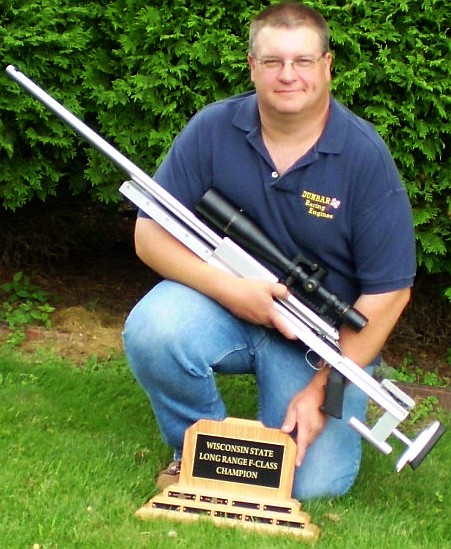
State Championship Win with Home-Built Aluminum Stock
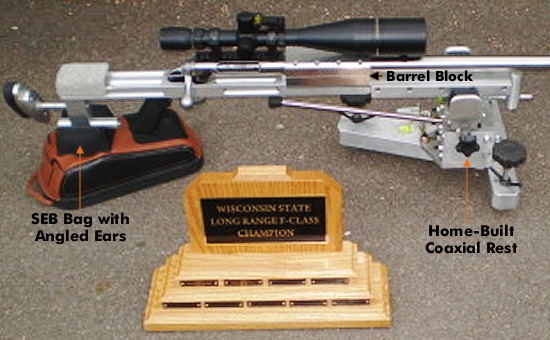
While most of the stocks featured above were crafted by professionals, the properties of aluminum allow it to be used by persons with some basic mechanical skills and metal-working tools. Here’s proof. Back in 2009, Forum Member John Dunbar (aka JD12) crafted his own aluminum F-Open stock. And he used that impressive metal stock to win the Wisconsin State F-Class championship. READ Full Story.
The stock for John’s “home-built” .284 Winchester was mated with a Savage target action. John designed and fabricated the aluminum stock himself. It features a central barrel block clamping a 32″ Brux barrel. Get this — John completed the rifle only 5 days before the match: “I finished machining/assembly on Monday night, did load workup Wednesday and Thursday nights, loaded rounds Friday night, and headed to Lodi at 4:30 on Saturday morning.” John even made his own co-axial front rest (see below)
Richard King’s Radical .223 Rem F-TR Skeleton Rifle
Here’s something exotic from our Gun of the Week archives. We like this rig because it is so radical (we doubt that you have ever seen anything quite like it). Gun-builder Richard King calls this his “Texas-T”, noting that “this is my personal gun, built the way I wanted it. I know it’s radical and some may not care for it. But it works.” The rig was designed to shoot F-TR, but it can also be converted easily to shoot F-Open with a front rest.
Richard reports: “This is pretty much an all-aluminum rifle. The action is a Kelbly F-Class with a Shilen stainless steel competition trigger. The scope is a 1″-tube Leupold 36X with a Tucker Conversion set in Jewell spherical bearing rings. The .223 barrel is 30″ Pac-Nor 3-groove, 1:6.5″-twist mounted in a V-type barrel block. The bipod has vertical adjustment only via a dovetail slide activated by a stick handle. It works like a joy-stick, but for vertical only. I adjust for windage by moving the rear sandbag.”
Richard likes how the barrel block works: “With the barrel block forward, the vibrations should be at a low frequency. Instead of one long rod whipping, I now have two short rods (barrel halves) being dampened. This is my fourth barrel block gun. They work, but so does a good pillar-bedded action. [This rifle] is designed for my style of shooting. It is not meant to be a universal ‘fit all’ for the general public. However, I will say the design is adaptable. I can easily convert the system to run in F-Open Class. I would drop a big-bore barreled action into the V-block, slide on a heavier pre-zeroed scope and rings, add plates on the sides up front to bring the width to 3″, and maybe a recoil pad.”
When Fiberglass Fails, Aluminum Stock Saves the Day
Australian Mark Fairbairn performed a “Quick Fix” during the 2018 Berger SW Nationals. Mark’s F-Open rifle, in a conventional fiberglass stock, was giving him random vertical during one yardage: “I had a bit of a problem with elevation — the stock was hitting somewhere [causing vertical]. I was X-X-X then a shot popped up in the 9 ring with no good reason. So I figured I better put a new stock on it. I got my old aluminium stock I brought from Australia and quickly adjusted it to fit on the Stolle.”
Right on the firing line berm Mark swapped his barreled action into the metal stock of his own design. The clock was ticking… but the story had a happy ending. For the next yardage Mark shot a brilliant 150-7X, not dropping a point. So the “Quick Fix” did the trick. As they say Down Under — “Good on Ya, Mate!”
Home-Built Aluminum Chassis with Innovative A-Arm Bipod
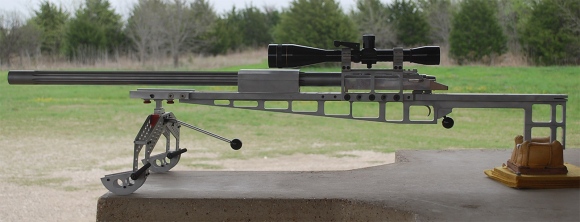
Here is another home-built rig featuring an aluminum chassis mated to a Savage barreled action via a forward-mounted barrel block. This rig was crafted by Forum member Patrick Lundy, who followed the maxim: “If you can’t buy it, then build it.”
Patrick Lundy was so impressed with a fellow shooter’s barrel-block rifle, that he build a similar match gun himself, complete with barrel block and aluminum chassis. Patrick was inspired by a metal stock belonging to Peter Gagne. But he added his own custom touches, including an innovative “A-Arm”-design bipod for shooting in F-TR class. The gun has been very successful in competition. READ FULL Report
Pat told us: “This new stock was a milestone in my shooting career — it was my very first attempt to build a stock. I wasn’t much of a wood worker but I did have a talent for building with metal. The stock was fabricated from 6061 T6 aluminum. With this gun I was able to shoot from a rest or a bipod.”
Pat crafted the bipod from aluminum tubing: “The bipod was a very rigid A-frame design with welded aluminum tubing. I added slippery feet under the pod skis to facilitate smoother recoil. I realized that a wide-stance bipod had to recoil the same on both sides or the group would string horizontally.” Here is the innovative “A-Arm” bipod that Pat Lundy built for his rifle.
If you are looking to acquire a reliable, accurate rifle for a late fall hunt, Howa can be a good choice. Howas feature smooth-running actions with fine two-stage HACT triggers. A Howa barreled action can also be a good basis for a DIY project. But some folks have heard that it may be difficult to find stocks, or to fit an after-market barrel. That’s not true. There are many stock options available, and in this article, Bill of RifleShooter.com shows that it is easy to remove the factory-installed barrel with the right tools. We think a Howa makes a fine basis for a varmint rig or field rifle. Or you can build a tactical rifle as Bill did. You can start with the factory barrel and when you want/need more accuracy, then have a gunsmith install a custom barrel from Krieger Barrels, Lilja Barrels or other quality brand.
The Carbon Stalker is an excellent ultralight factory option, weighing just 4.6 lbs. with Mini Action (before optics). All Howa Carbon Fiber Stalker rifles come with a Sub-MOA Guarantee and Lifetime Warranty.
What You Need to Know About Howa 1500-series Rifles
Tech Feature by Bill, editor of RifleShooter.com
Consider this article the “Howa 1500 Overview”. There has been a lot of interest in Howa rifles and barreled actions imported by Legacy Sports International. In addition to being able to buy a complete rifle from a dealer, Brownells sells barreled actions in a wide variety of calibers and configurations. In this post we are going to take a look at the Howa 1500 series.
Howa Rifles — General Background
Howa is a Japanese heavy machinery company. One of its product lines are firearms, which are imported into the United States of America by two different companies, Legacy Sports International and Weatherby. Legacy sells the 1500 under the manufacturers name while Weatherby re-brands the guns as the Weatherby Vanguard. In general, the finishes on the Weatherby rifles are more refined than the LSI-imported 1500s.
General Evaluation of Howa 1500 Rifles
I’ve found Howa 1500s to be solid, entry-level rifles that are capable of sub-MOA accuracy out of the box. I’ve actually purchased two Howa rifles I’ve tested because I like them so much. The gun below, a Howa Mini-Action in 7.62×39 Russian, is one of my favorite factory guns to shoot.
Check out this three-shot group I drilled at 100 yards with the rifle above and 125-grain Sierras. It took a lot of work and load development to get there, but when it did, it worked well.
Howa 1500 HACT 2-Stage Trigger
Howa 1500s feature the very nice Howa HACT trigger. This is an adjustable, two-stage trigger, set for about 3 pounds (combined stages). Crisp and repeatable, this is an excellent trigger for a factory gun. There is no annoying Glock-style safety lever in the middle of the trigger blade. The 2-stage design and pull weight range works well for a hunting rifle or a rig for PRS competition. Rifleshooter.com says the Howa trigger is “one of the best factory triggers, along with Tikka. I’ve found the Howa trigger superior to a Remington 700 — the Howas doesn’t need to be replaced.”
Writing for the Western Outdoor News, WONews.com, Steve Comus has field-tested the HACT Trigger. Steve writes: “I always liked two-stage triggers, because of the way I could take-up the slack and then actually know when the rifle was going to go off. The take-up on the [HACT] trigger was fast and easy. The crisp, positive release when pressure was put on during the second stage [reminded me] of some of the target rifles I shot through the years.”
Howa Actions — Three Options
Howa offers three action lengths: Mini, Short, and Long. You can see the bolts for the three action lengths in the image below. The Mini-Action has similar external dimensions to the Remington Model Seven, however, the Mini-Action’s bolt does not travel as far to the rear. This is a mixed bag. The upside is you have a quicker action (shorter bolt throw). The downside is you are limited to shorter rounds such as the .223 Remington, 7.62×39mm Russian, and 6.5 Grendel. But if you need a bigger cartridge, just choose the standard or long action Howa variant.
Howa 1500 vs. Remington 700 — Important Differences
Is the Howa 1500 a Remington 700 clone, or some kind of improved Remington 700? No, not really. While the top radius of the Howa 1500 does match the Model 700, and they can both use the same two-piece scope bases, there are a number of differences.
If you look at the Howa 1500 alongside the Remington 700 you’ll note the M700 is a round action, while the Howa is a flat-bottom action. In many ways the Howa’s bottom half reminds me of a push-feed Winchester. This means the chassis and stocks that support a Howa 1500 are not V-block based like you’ll find on a 700, instead they have a flat bottom. While the bolt of the Howa is similar in external appearance to the Model 700, it does offer some improvements, notably an M16-style extractor and a firing pin assembly that can be easily removed without tools.
Howa 1500 action screws are metric and are in a different location from the 700. The Howa 1500 has an integral recoil lug that accepts the front action screw, this means you have more of the front action screw engaging the action. WARNING: If you install it into a poorly-fitted stock or action you may bind it.
Can a Howa Action Be Used for a Custom Rifle Project?
Absolutely! You can either buy a barreled action from Brownells and throw it in a chassis system/stock of your choice or you can use a stripped action to build a custom rifle. If you are in the chassis market, MDT offers a wide variety of chassis in different price ranges. All have worked well for me.
How to Remove Howa Factory Barrel from Action
You may have heard internet grumblings about removing Howa barrels. Some keyboard commandos say they are extremely difficult to remove without a relief cut. Well Bill at Rifleshooter.com demonstrates that Howa barrels can be removed without trouble, provided you have the right tools. Watch this video:
Watch Howa Barrel Removal Video — Quick and Easy (Click Speaker Icon for Audio)
Q: Is it difficult to remove a barrel from a Howa 1500?
A: Not very. I’ve heard from some smiths that worked on Howas (years ago) that the factory barrels are difficult to remove. However of the half dozen or so Howa barrels that I’ve pulled, they’ve been very easy. I use a Brownells action wrench with the top piece for a Rem Model 700 and the flat bottom resting against the flat on the wrench.
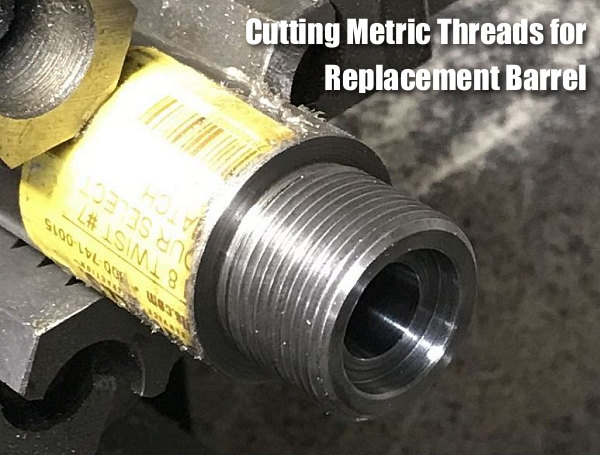
Howa Actions Require Metric Barrel Threads
It’s easy to thread a barrel for a Howa action. You just have to cut metric threads — most lathes out there can cut them. I cut the threads below on a manual lathe using change gears. [Editor: John Whidden cuts metric tenon threads with a CNC lathe. “It’s easy,” John tells us, “No issue whatsoever.”]
Using Howa Actions for Custom Rifles
I have built a few customs with Howa actions. Below is one of my favorite, a .308 Winchester. It consists of a Howa 1500 action, Shilen Select Match Rem Varmint contour barrel\, and Modular Driven Technologies (MDT) ESS chassis. Great rifle and it hammers!
Looking for a superb illustrated coffee table book about guns? Yes there is such a thing, a great book we highly recommend — The Illustrated History of Fireams (2nd Edition). This full-color 320-page hardcover book features more than 1,700 photos compiled by NRA Museums curators Jim Supica, Doug Wicklund, and Philip Schreier. This Second Edition includes 300 photos more than the original, plus dozens of new profiles of important persons who influenced firearms development.
This follow-up to the best-selling original NRA Museums book is loaded with great images, historical profiles, and technical data on old, new, and currently-manufactured firearms that have changed history. Covering the earliest matchlocks to modern match-grade superguns and everything in between, The Illustrated History of Firearms provides a fascinating education on how guns evolved, where they originated and how they worked.
The Illustrated History of Firearms, 2nd Edition
– Authored by the experts at the NRA Firearms Museums
– Published by Gun Digest Books
– 9 ½ x 11 1/2 inches, hardcover with dust jacket
– 1,700 full-color photos
– 320 Pages
– Price: $49.99 (MSRP); $31.57 on Amazon
The Illustrated History of Firearms, 2nd Edition is available from Amazon direct for $31.57. Amazon also lists lightly used versions of the book starting at $22.84 (plus $3.99 shipping) from a variety of other book vendors. You’ll also find the book at major bookstores such as Barnes & Noble, but it’s probably easier to purchase online.
This hefty 516-page book covers “Pistols, Rifles, Revolvers, Machine And Submachine Guns Through History”. This major resource is illustrated with 1100 photographs, and covers the whole spectrum of guns.
Priced at $32.55 on Amazon, this book would make a great gift for a gun collector, and could be a nice addition to a local gun club library. The Illustrated World Encyclopedia of Guns has proven very popular with buyers, earning 83% five-star ratings on Amazon among verified purchasers.
Historic American Arms — Teddy Roosevelt’s Lever Guns
These two lever action rifles, owned by President Theodore Roosevelt, are part of the NRA Museum collection. First is a Winchester 1886 rifle known as the tennis match gun because Roosevelt used winnings from a tennis match to buy it. Below that is a suppressed Winchester model 1894 rifle. Roosevelt liked to shoot varmints around Oyster Bay (Long Island, NY) with this gun so he wouldn’t disturb his neighbors — the Tiffany and Du Pont families.
About the NRA Museums
The NRA opened the original National Firearms Museum at its Washington DC Headquarters in 1935. In 2008 the Francis Brownell Museum of the South West opened at the NRA’s Whittington Center in Raton, NM. Then, in 2013, the National Sporting Arms Museum opened at the Bass Pro Shops store in Springfield, MO. Every year, at these three museum facilities, over 350,000 persons visit to see the impressive exhibits and many of America’s most famous firearms. For more information, visit www.NRAMuseum.org.


 Jim is a talented outdoor photographer who has compiled an impressive portfolio of wildlife and landscape photographs. For this Thanksgiving-eve edition of the Daily Bulletin we are featuring some of Jim’s favorite nature images. We hope readers enjoy them as much as shooters prize Borden’s Rimrock benchrest and Rimrock hunting actions.


 Borden Accuracy/Borden Rifles Success Story








 Barrel/Shoulder Fit and Blue-Printing






 Howa 1500 HACT 2-Stage Trigger