Forum member Keith W. (aka “Cigarcop”) of KW Precision LLC is a talented riflesmith whose projects display outstanding finish work and attention to detail. Keith does some of the best bedding work we’ve ever seen. Here is one of his latest creations. Keith recently completed a stunning F-Class rig for a shooter in Delaware. It’s a beauty, that’s for sure. Keith has posted more details about this rifle in a Shooters’ Forum Thread.
This handsome rifle features a polished Stolle (Kelbly) Panda Action, and two (2) Brux barrels, both chambered for the .284 Winchester cartridge. The real eye-catching component of this rifle is the stunning Cerus F-Open stock. This features multiple laminations with highly-figured Walnut on the sides. This certainly ain’t your “off-the-shelf” laminated stock. This just shows the beauty that can be achieved with carefully-chosen lamination layers (plus 12 coats of clear).
This beautiful F-Open rig features a laminated wood stock with stunning figured walnut on the outside.
Keith of KW Precision LLC is renowned for his bedding work, and this rifle shows why. Keith takes great pride in his work, and his attention to detail is second to none. This bedding job is as good as it gets.
Bringing out the figure in the wood requires multiple finish coats (and careful sanding between coats). But the results are worth it. Shown below is the Cerus stock, BEFORE the finish coats were applied. It took time and effort to transform the “naked” Cerus stock into a true stunner. Keith applied twelve (12) coats of PPG Automotive Clear with wet sanding between each coat.
AR-platform rifles are fun and versatile, but the standard, mil-spec triggers leave much to be desired. They tend to be gritty, with creep and heavy pull weight. One of the easiest, most effective AR upgrades is a trigger group swap. An improved fire control group makes a huge difference. There are many aftermarket trigger options for the AR platform rifles. Choose single-stage or two-stage, either standard trigger assembly or unitized “drop-in” trigger, such as those made by Timney or Triggertech.
When upgraded with a precision trigger and match barrel, AR-platform rigs work great in NRA High Power competitions (Photo from NRA Blog, at Camp Perry).
Two-Stage vs. Single-Stage Triggers
Two-stage triggers have two separate movements. The first stage offers a light, spring-loaded pressure that works against the shooter’s pull until stopping at the second stage – this is called “take-up”. If there is no spring pressure, it is known as “slack”. Should the shooter continue to pull the trigger once he’s arrived at the second stage, the mechanism will operate like a single-stage trigger from there until engaging the sear and firing the gun. Good trigger reset requires the shooter to keep pressure on the trigger, even during reset, to minimize movement of the muzzle.
Single-stage triggers feature no take-up or slack, as they begin engaging the sear as soon as the shooter begins pulling the trigger. Some competitive shooters prefer the two-stage trigger because of the feedback it provides during its first stage, while other shooters, including those using their rifle in tactical scenarios, may want the surety of a single-stage trigger, ready to engage and fire once their finger is inside the trigger guard. Regardless of preference, a good trigger will feature minimal creep and should be free of grittiness, providing a smooth, even break.
Drop-In Trigger Assembly vs. Standard Trigger Group
Once you decide between a single-stage or two-stage trigger, you can choose between standard and drop-in trigger groups. Standard trigger groups feature all the fire control group parts separated, and need to be pieced together and installed much like a mil-spec trigger, while drop-in trigger are pre-assembled and contained within a casing that simply drops in to the receiver and accepts the pins, hence the name.
After-Market Trigger Comparison
Some shooters prefer drop-in triggers due to the ease of installation, while others opt for standard groups so they can access the components individually for cleaning adjustment or replacement. If one piece of a drop-in trigger fails, you’ll need to either replace the entire unit or send it to the manufacturer for repair, whereas you may be able to simply replace the broken component of a standard trigger without needing a whole new trigger set.
Trigger Terminology — “Creep”, “Stacking”, “Overtravel”
“Creep” or “travel” is the distance the trigger moves between the end of take-up and when the trigger breaks to fire the fun. Too much creep can affect accuracy, but no creep can be unsafe, as the shooter may not be prepared to fire. “Stacking” occurs when the trigger weight actually increases during travel — this shouldn’t happen. Lastly, “overtravel” is the distance the trigger continues moving back after the gun fires.
This article is based on a longer story in the NRA Blog.
Our friend, Texas gunsmith Richard King, recently posted some images of a new .50 BMG target rifle he built for a customer. Equipped with a beefy McMillan stock, this rig has shown some impressive accuracy — even during break-in. Check out that target. Using On Target software, we measured this 3-shot group at 0.476″ or 0.454 MOA. Not bad for a beast with some very serious recoil. Do you think you could beat that 0.476″ with your AR15 shooting puny .223-caliber bullets?
Compare the dimensions of that massive 50-Cal action to a Rem 700 action in the middle. When you’re shooting a Fifty, size matters!
On Facebook, some folks were surprised a guy could wring that kind of accuracy out of a monster .50 BMG. One wag posted: “Yikes! He will need flinch therapy after shooting that beast.”
Another Facebooker joked: “When shooting a .50 BMG you say…In your best Crocodile Dundee voice…that’s not a gun, THIS is a gun!”
Richard King responded that this customer has quite a bit of experience with jumbo-caliber rifles: “Remember this is the guy that shot a .338 Lapua in a two-day F-Class match. Recoil might actually be easier on this 50, given the fact that it has more weight and a brake.”
Before this rifle was completed, Richard King showed us the monster 13-lb BAT action at the 2018 Berger SWN. Honestly, the big BAT .50 BMG action was HUGE — with the bolt fully extended it was the size of your forearm (to the finger tips). Richard joked “This weighs almost as much as an F-TR rifle (before optic) all by itself”.
Specialty Tools for the Big .50 BMG
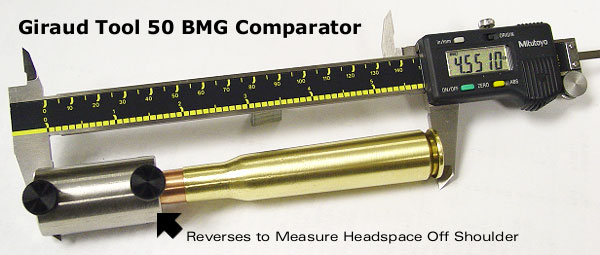
Yes, the .50 BMG is one huge cartridge. Thankfully, there are some special tools for loading the jumbo-size round. Giraud Tool makes a specialty comparator for 50-Cal cartridges. The double-ended comparator is quite versatile. In one orientation you can measure base-to-ogive bullet length and also measure cartridge OAL from rim to bullet ogive. When reversed, you can use the comparator to measure cartridge headspace. The Giraud 50 BMG Comparator gauge is constructed of 303 stainless and fits most any vernier, dial, or digital caliper. CLICK HERE for more info.
Editor: Many new barrels will deliver higher velocities with the same load after 100-150 rounds through the bore. The exact reasons for this speed-up are not 100% certain, and velocity increases (if any) will vary from one barrel to the next. But this “speeding up” phenomenon is common, so be prepared if this happens with your next barrel. If you do experience a significant velocity increase you should probably re-tune your load AFTER the velocity stabilizes at the higher level.
From the Sierra Bullets Blog Article by Mark Walker, Sierra New Product Development Director
In a previous post, I discussed a couple of methods to tune a load to your barrel to help achieve the best accuracy possible. People most often work on load tuning if they get a new rifle or have a different barrel installed. In both instances, the barrel is new and has not been fired very much. According to most competitive shooters, this is the most accurate your barrel will ever be, so getting it tuned and shooting accurately is a priority.
The Speed Up Phenomenon After 100-150 Rounds
Even though after you work up a load and your new barrel is shooting great, a lot of shooters notice that at around 100 to 150 rounds their rifle may stop shooting as accurately. I had this happen to a rifle and I was confused as to why something that worked so well to begin with would all of a sudden quit shooting. I decided to break out the chronograph to do another load work up to see what was going on. To my surprise, the velocity had increased around 80 fps over the original velocity! After performing another ladder test and adjusting the seating depth, the rifle was once again shooting well.
There are several thoughts on why this may happen, however, you can rest assured that it does happen. One thought is that as the barrel breaks in, the tooling marks in the throat of the chamber smooth out and allow less resistance to the bullet as it exits the bore thereby increasing speed. Another idea is that the throat area starts to get a little rough which in turn causes more resistance which increases pressure and therefore more velocity. I’m sure there are some out there who have a better understanding as to why this happens, but it can definitely affect the accuracy of your rifle. So be aware and never be afraid to rework a load to keep your rifle in tune.
Experts Confirm That Barrel Speed-Up Is Common Two respected shooters have observed an increase in velocity with new barrels, typically after 100 rounds. Gunsmith and Hall-of-Fame benchrest shooter Thomas “Speedy” Gonzalez has documented barrel speed-up with testing. Moreover, Speedy’s bore-scope barrel inspections revealed a smoothing of the barrel lands. Jim See, a top PRS competitor, has encountered barrel speed-up many times. Accordingly, he re-tunes his load at 150 rounds.
“Alex Lipworth and I documented this phenomenon about four years ago and I have told all my customers about this. My son Mikee would shoot 100 rounds through all new barrels we planned on shooting before we would begin to do load development. We had a shooting snail that caught all the bullets set up in front of an indoor bench. We called it a wear-in process because upon careful examination of the bore when the ‘Speed Up’ takes place the cut-rifled bore resembles that more of a button-rifled barrels with the lands taking on more the softer look of a buttoned bore.” — Speedy Gonzalez
“Seen it [barrel velocity increase] too many times to count. All my match barrels get a ‘generic round’ loaded for them, which has worked well in barrels historically. After I hit 150 rounds I fine-tune the load and never look back, until the tube starts to slow down at it’s life end.” — Jim See
This shocking photo of destroyed AR-15 bits and pieces was posted on Facebook by William Walter, a firearms instructor. William said this was “The worst AR-15 blow-up I have ever seen. The case head literally atomized …you can see the brass residue on the parts. The bolt was split in two also.”
There’s nothing inherently wrong with AR-platform rifles (well, except that they run dirty). Over the past six decades Eugene Stoner’s semi-automatic design has proven its merits in military and civilian applications. You may not know, but the original AR from 1955 was a .30-caliber. The Armalite AR-10 shot the 7.62×51 cartridge. Later, at the request of the U.S. Military, Armalite created a smaller version that became the M16/AR15. The rest was history. Now there are millions of AR “black rifles” in the hands of soldiers and sportsmen.
With so many ARs in circulation, it’s no surprise that some get used by folks who don’t know how to hand-load or otherwise fail to follow safe gun practices. The AR is actually a pretty sturdy rifle, but when it’s fed bad ammo, or abused, bad things can happen. Very bad things… commonly known as Kabooms.
The American Shooting Journal (ASJ) has compiled a set of particularly extreme AR Kabooms. Compiling the “evidence” from various web sites, ASJ has published nine (9) of the most Unbelievable AR-15 Fails. Here are two of the worst “AR-15 Fails”. CLICK HERE to see them all.
Nothing but busted parts after this catastrophic Kaboom…
Notice the bolt is still stuck in the barrel extension … with the rest of the gun in pieces.
Another view of this sad blow-up…
These catastrophic AR failures are eye-openers, that’s for sure. ASJ cautions: “Any weapon can fail if given the wrong ammunition, faulty reloads or a plugged barrel. Always be aware of what can happen at anytime if you fail to follow common sense and gun safety rules.”
ASJ Sources: Photobucket, Armory Blog, Pinterest, Northeastern Arms, Eric Nestor
We like Do-It-Yourself (DIY) projects. It takes initiative, creativity, and dedication to make your own hardware, and that’s worth acknowledging. For you dedicated DIY guys, here’s a great project that should inspire. Here is an owner designed and crafted F-Open rig, complete with home-built, belt-drive front rest.
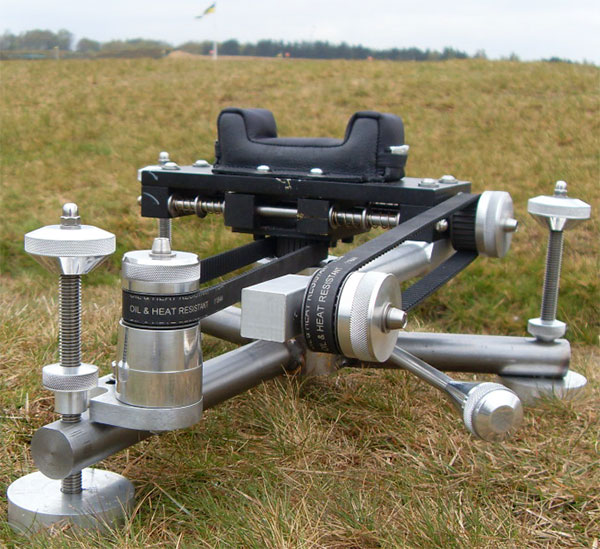
Some of our mechanically-skilled readers chamber their own barrels or bed their own stocks. But these are relatively simple tasks compared to the jobs of constructing an entire rifle plus building an advanced front rest from scratch. Well that’s exactly what Forum member Steve B. (aka Essexboy) did a couple seasons back. He built his own rifle and an impressive twin-belt-drive pedestal rest. (Click photo below for large version). And get this, Steve’s home-made rifle was victorious in its first-ever match. Steve reports: “I shot my first Comp with the rifle … and managed to win with a score of 239-21!” (The match was shot at 300/500/600/1000/1100 with English scoring of 5 points for center bullseye).
Do-It-Yourself F-Open Rig from England
Steve, who hails from Essex in the UK, constructed virtually every component of his skeleton-style rifle except the 28″ HV Bartlein barrel (chambered as a 6mm Dasher) and the Tikka 590 donor action. Steve also did all the design and fabrication work on his one-of-a-kind front rest. Steve tells us: “Over the last year or so, I made this rifle stock and rest. I managed to make it all on a little Myford Lathe, as you can tell I’m no machinist but it saved me a load of money — so far I’ve got about $200 invested plus the barrelled action. The stock is aluminum except for the stainless steel bag runner. The rifle came in at one ounce under weight limit for F-Class Open division.” Steve did get help with the chambering and barrel-fitting, but he hopes to do all the barrel work himself on his next project.
The gun is very accurate. Steve notes: “I have shot the rifle to 1100 yards and it shoots well. Last time out the rifle dropped just one point at 1000 yards and 5 points at 1100 yards [English scoring system]. I know it’s not pretty, but it got me shooting long range F-Class for peanuts.” Message to Steve: Don’t worry how it looks. As another Forum member observed: “Any rifle that shoots well at 1100 yards is beautiful….”
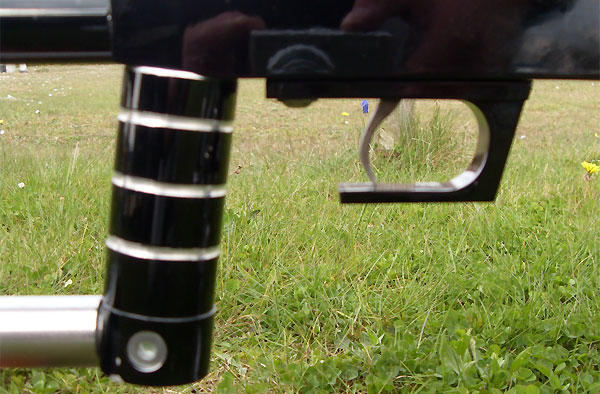
Steve started with a Tikka 590 action: “The whole stock was made on a small (6.5×13) lathe and a vertical slide. This caused a few head scratching moments, figuring out how to hold the T6/HE30 alloy for the milling/turning operations, but it did teach me a few things. The hardest parts were clamping the longer sections (such as the fore-end) and keeping it all square. Due to the short cross-slide travel I had to keep re-setting the parts. I managed to keep all measurements to 0.001″ (one thousandth). I’m most proud of the trigger guard (photo below). This took a full day but came out really well, even if I say so myself.”
Belt-Driven Front Rest
We’re impressed with Steve’s ingenious front rest. Steve explains: “The rest is belt-driven and still in the experimental stage — hence no powder coating or polishing yet. I may have gone over the top as the key moving parts (the pulleys) run on three (3) types of bearings: radial; reamed bush; and a ball race. The main post runs on a radial bearing and the feet even have bearings in them, so when I raise the main body up (for rough height adjustment) the foot stays static.”
Will Steve build another rifle? Steve says he will, and he’s upgraded his tools: “Since building the rifle I have acquired a bigger lathe (Harrison m250) and a milling machine. For the next project I hope to be able to do the barrel work (threading, chambering, crowning) as well.” The next gun might be another Dasher. Steve explains: “After extensive reading on AccurateShooter.com, I chose the 6mm Dasher chambering, as I have a shoulder problem and can’t shoot a rifle with a lot of recoil.”
UPDATE: At approximately 6:00 pm CT, the Brownells YouTube Channel was restored. We don’t know why or how — but apparently protests from Brownells customers many have played a part in getting YouTube to relent. Brownells just issued this statement via Facebook:
PREVIOUSLY…
The Brownells YouTube channel has been terminated (shut down) without warning or notice from either YouTube or its parent company, Google. On June 9, 2018, at roughly 2:00 am, the Brownells channel was pulled from YouTube. This removed ALL Brownells YouTube content, including videos that cover firearms safety, hunting skills, firearms maintenance, and marksmanship. YouTube didn’t simply block Brownells’ gun sales-related videos — it shut down the entire Brownells channel, which had offered nearly 1800 helpful videos. The Brownells channel had acquired over 67,000 subscribers since its launch in January 2007.
History of YouTube Policies on Firearms Content
No specific reason for the Brownells shut-down was provided by YouTube, but this is part of a policy shift by YouTube. For quite some time, YouTube has been de-monitizing firearms-centric YouTube channels. As a result, gun video producers no longer receive advertising revenues, or receive a fraction of what they were once paid. Then in late March, YouTube announced tough new policies limiting the type of firearms content allowed. Gun content producers feared YouTube’s new policies might doom their channels. With the Brownells ban, it appears those fears were correct…
Ars Technica reported: “YouTube is placing more restrictions on weapons-related videos, focusing on guns with new, forthcoming policy changes. According to a Bloomberg report, YouTube intends to ban videos that ‘promote or link to websites selling firearms and accessories’, including bump stocks, beginning this April. The new policy will also prohibit instructional videos that detail how to build firearms. YouTube took similar action after the Las Vegas shooting last year by banning gun-modification tutorials.
‘We routinely make updates and adjustments to our enforcement guidelines across all of our policies,’ a YouTube representative said in a statement to Bloomberg. ‘While we’ve long prohibited the sale of firearms, we recently notified creators of updates we will be making around content promoting the sale or manufacture of firearms and their accessories’.”
YouTube prohibits certain kinds of content featuring firearms. Specifically, we don’t allow content that:
Intends to sell firearms or certain firearms accessories through direct sales (e.g., private sales by individuals) or links to sites that sell these items. These accessories include but may not be limited to accessories that enable a firearm to simulate automatic fire or convert a firearm to automatic fire (e.g., bump stocks, gatling triggers, drop-in auto sears, conversion kits), and high capacity magazines (i.e., magazines or belts carrying more than 30 rounds).
Provides instructions on manufacturing a firearm, ammunition, high capacity magazine, homemade silencers/suppressors, or certain firearms accessories such as those listed above. This also includes instructions on how to convert a firearm to automatic or simulated automatic firing capabilities.
Shows users how to install the above-mentioned accessories or modifications.
The Colt Kit does NOT include barrel, bolt carrier group, charging handle, or magazine.
Thinking of building an AR-platform rifle for varmint hunts or PRS Gas Gun Matches? Here is an interesting option from Colt — a value-priced kit with upper, complete lower, handguard, and Magpul stock. To this, add your choice of barrel and optic. We like this option because the barrel is so important to accuracy and overall performance. This Colt package costs $599.99. Add a match-grade, finish-chambered barrel from Criterion or Krieger, plus bolt carrier group, and you’re in business.
There are some very nice features on this Colt Comp Kit. The Magpul PRS stock features a quick-adjustable cheek-piece and butt-plate — allowing you to easily adapt head position and LOP for your discipline of the day. (You may want a different LOP for prone shooting vs. bench shooting). The Magpul stock works well in a rear bag. In addition the handguard comes complete with Picatinny rails on top and on both sides, affording lots of options. We might move one of the rails to the bottom, however, so it could be used for a bipod mount. The upper receiver has an integral Picatinny rail for optics.
We like the Blackhawk grip which is more comfortable than the typical grips supplied by most black rifle makers. The lower includes a trigger group, but you can later upgrade to a Timney, Geissele, or other aftermarket trigger system.
Add Your Favorite Premium Barrel:
NOTE: This Colt Kit features a Sadlak Low Profile .750 Gas Block and carbine-length gas tube. With longer barrels you may need to adapt a longer tube, but that is an easy change.
Forum member Evan K. (aka “Katokoch”) has crafted a nice rimfire benchrest rig using a Suhl action fitted into a handsome home-built cedar and carbon fiber stock. This shows what a skilled hobbyist wood-worker can create in his garage. Evan tells us: “Here is my Suhl 150-1 with a factory 1:19″ twist barrel, Leupold 36X scope, Harrell tuner, and my handmade cedar/carbon fiber stock. I started working on the laminate blank a couple years ago and finally finished it earlier this year. I’ve been using it in my IR 50/50 matches this summer. I haven’t shot a 250 with it yet but I know the rifle is very capable — as usual, I am the weak link!”
We think Evan did a great job on his stock, though he has limited stock-building experience. Evan explained: “The stock is my first attempt at making a very lightweight laminate and also gluing both vertical and horizontal seams in a blank. The wood is Spanish and Red Cedar and I made the trigger guard and buttplate with carbon fiber too (great use for small scrap pieces). The finish is hand-rubbed spar urethane and the action is semi-glued-in with Devcon 10110 and stainless pillars.”
USRA-IR50/50 is a popular .22 rimfire benchrest discipline with three (3) classes: 13.5 lb., 10.5 lb., and 7.5 lb. (Sporter). The matches are shot at 50 yards and 50 meters.
For this chart, HowMuch.net analyzed data from the NSSF’s 2017 Firearms and Ammunition Industry Economic Impact Report to estimate gun industry output and jobs in each state.
The firearms industry is an important element of our nation’s economy. Manufacturing products for shooting, hunting, and LEO/military applications employs hundreds of thousands of workers and contributes billions of dollars to America’s GNP. The mainstream media demonizes firearms and attempts to ridicule gun-owners, but the fact remains that guns and ammo are an important part of American culture and a key element of our economy.
Guns America recently published an article showing the economic impact of the firearms industry on a state-by-state basis. This features a “money map” of the USA created by HowMuch.net based on data from the National Shooting Sports Foundation. The number one state is Texas, with $3.83 Billion of economic impact and 23,070 jobs. That may not surprise you, as many quality companies such as Shilen are based in the Lone Star state. However, you may be surprised by the number two state, California, given that jurisdiction’s liberal legislature, and anti-gun policies. But there are still plenty of guns, shooting accessories, and ammo produced in California, generating $3.64 Billion in firearms industry economic activity and over 20,000 jobs. Given that job number, perhaps California’s politicians should think twice before they enact more misguided anti-gun laws.
Weatherby is relocating from California to Wyoming, citing California’s high corporate taxes and hostile business regulations.
Here are Top Ten States, ranked in order:
1. Texas: $3.83B and 23,070 jobs
2. California: $3.64B and 20,610 jobs
3. Minnesota: $2.43B and 11,650 jobs
4. Florida: $2.39B and 14,850 jobs
5. Illinois: $2.18B and 10,681 jobs
6. North Carolina: $1.98B and 11,427 jobs
7. Pennsylvania: $1.94B and 12,436 jobs
8. Massachusetts: $1.86B and 7,116 jobs
9. New York: $1.84B and 8020 jobs
10. Ohio: $1.61B and 11,772 jobs
Ranking third overall is Michigan with $2.43 Billion in economic activity, followed by Florida close behind in fourth place with $2.39 Billion. The NSSF’s data reveals some surprising trends, notes Guns America: “While pro-gun states like Texas ($8.83B) boast a large firearms industry that employs thousands of people, states with stricter firearms regulations like California ($3.64B), Minnesota ($2.43B), Illinois ($2.18B), and Massachusetts ($1.86B) also incorporate relatively large gun industries.”
Looking at that list, it is noteworthy that, along with California, another anti-gun state, New York, has made the Top Ten. New York’s Governor Andrew Cuomo has attacked the firearms industry and the NRA, and the N.Y. State Department of Financial Services has pressured Banks and Insurance companies to stop doing business with gun industry firms. One wonders if Governor Cuomo and his minions have considered the full consequences of their anti-gun activism. Guns America observes: “it is notable that gun makers can survive at all in states like New York, California, and Massachusetts. Attacking firearm makers and sellers is one of the most common anti-gun tactics, but some companies still manage to scrape by despite increasing regulations and public hostility.”
Though it has moved much of its production to Alabama, Remington retains production facilities in New York state. The Remington enterprise was founded in 1816 by Eliphalet Remington in Ilion, New York, as E. Remington and Sons. Remington is America’s oldest gun maker and is still the largest U.S. producer of shotguns and rifles.



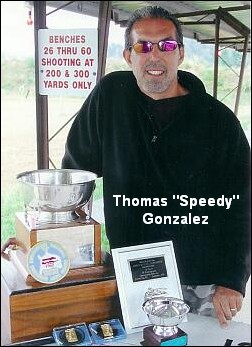 Two respected shooters have observed an increase in velocity with new barrels, typically after 100 rounds. Gunsmith and Hall-of-Fame benchrest shooter Thomas “Speedy” Gonzalez has documented barrel speed-up with testing. Moreover, Speedy’s bore-scope barrel inspections revealed a smoothing of the barrel lands. Jim See, a top PRS competitor, has encountered barrel speed-up many times. Accordingly, he re-tunes his load at 150 rounds.


 The gun is very accurate. Steve notes: “I have shot the rifle to 1100 yards and it shoots well. Last time out the rifle dropped just one point at 1000 yards and 5 points at 1100 yards [English scoring system]. I know it’s not pretty, but it got me shooting long range F-Class for peanuts.” Message to Steve: Don’t worry how it looks. As another Forum member observed: “Any rifle that shoots well at 1100 yards is beautiful….”