Barrel nut system allows “Pre-Fit” barrel installation on a Remington action. CLICK photo to zoom.
REMAGE Project Report by Bill, Rifleshooter.com Editor
Installing a new barrel on your Remington 700 (especially without a lathe) may seem like a daunting task, but thanks to companies like McGowen Precision Barrels, there are easier alternatives. By adopting a Savage-style barrel nut on a 1 1/16″ thread for a Remington 700 receiver, pre-chambered (aka “pre-fit”) barrels can be easily swapped with just a few hand tools. This system is sometimes called a REMAGE conversion (for “REMington savAGE”). With simple tools a “Pre-fit” 6mmBR-chambered barrel was installed on the author’s Remington action — no machining or lathe-work required.
The existing barrel is simply removed from the action (normally the hardest part) and the new barrel is screwed on with the Go Gauge in place. After headspace is verified with the Go Gauge, the barrel nut is tightened against the action and you are off to the range. It takes all of the machine work out of the barreling process.
Note: Because barrel nut has a slightly larger diameter, some stocks may require minor inletting. Also, if you are shooting fired brass from another rifle with the same chambering, you should FL-size the brass before loading it for your new pre-fit barrel. And always check the set-up with a dummy round loaded to normal cartridge length BEFORE you head to the range. With Pre-Fits, the freebore should be adequate for your cartridge, but always check and adjust your seating depth as needed.
Bill has been a serious shooter for over 20 years. A former Marine Corps Sergeant, he’s competed and placed in High Power Rifle, ISPC, USPSA, IDPA, 3-Gun, F-Class, and precision rifle disciplines. In addition to being an NRA-certified firearms instructor and range officer, Bill has hunted big game in North America, South America, and Africa. Bill writes extensively about gunsmithing, precision rifles, and the shooting sports on his blog, Rifleshooter.com.
One recent trend in F-TR competition is the use of low-profile, benchrest-type stocks shot with a light hand-hold and little or no face contact. For this method of F-TR shooting to work, you need the right equipment, and practice a “minimalist” shooting technique. One of the pioneers in this style of F-TR shooting is action-maker John Pierce of Pierce Engineering. Above you can see John shooting one of his F-TR rifles at the 2015 Canadian F-Class Championships. Note the straight-line stock and see how the adjustable bipod is set quite low to the ground (in fact the bipod’s arms are almost straight out).
Members of the Michigan F-TR Team, including Bryan Litz, have used similar rigs with success. Bryan said it took a while to adapt his shooting technique to this kind of rig, but there is a pay-off. Armed with a Pierce-built F-TR rifle, Bryan won his first-ever F-TR Match. Bryan explains the technique he uses when shooting this kind of rifle:
“Coming over from sling shooting, I knew there would be unique challenges to F-TR which I wanted to learn prior to (not during) a major tournament. I learned a new shooting position which doesn’t involve drawing the right knee up. For F-TR I get more straight behind the gun rather than at an angle. I found that the rifle shoots best with very light cheek, shoulder and grip pressure, approaching free recoil. This is how Eric Stecker shot his similar rifle into second place in the SW Nationals [with high X-Count by a large margin]. I learned the rifle’s sensitivity to different bipod and rear bag supports, and found the best buttplate position to allow the rifle to track and stay on target after recoil. This set-up shot best with a mostly free-recoil approach, that means ‘hovering’ over the comb, rather than resting your head on the stock. This took some ‘getting used to’ in terms of neck and back muscle tone. These are the kind of details I think it’s important to focus on when entering a new discipline.”
Bryan’s Pierce-built F-TR rig is a tack-driver: “I can certainly vouch for this set-up! In [a 2015] mid-range State Championship in Midland, MI, I shot my Pierce rifle into first place with a 598-44X (20 shots at 300, 500 and 600). Once you get used to the positioning and way of shooting these rifles, they just pour shots through the center of the target.”
Pierce F-TR Rifles with Scoville Stocks
Shown below are three complete Pierce F-TR rifles, along with a barreled action for comparison. The carbon-fiber/composite stocks are built by Bob Scoville. These Scoville stocks are very light, yet very strong and very stiff.
Here is some eye candy for fans of fine firearms. Made for the 1981 nuptials of Lady Diana Spencer and HRH Prince Charles, this Westley Richards & Co. side-by-side, 12 gauge shotgun was engraved by the Brown Brothers with gold crests and floral accents. The British royal seal and other heraldic emblems of the couple are included in the decoration. This amazing piece is now in the NRA Museum Collection.
Princess Diana’s Westley & Richards Shotgun
It’s not an uncommon practice for people who like firearms to be given one for a big occasion, such as a graduation or a birthday. Today’s GOTD was given to a very special person on a very special occasion that took place 35 years ago today. This 12 gauge Westley Richards side-by-side shotgun was given to Lady Diana Spencer when she married Prince Charles on July 29, 1981. The gun was engraved by the Brown Brothers — Paul and Alan — and features a variety of artistic elements, including the royal seal and the couple’s wedding date.
Need a new barrel for your Rem-actioned hunting or tactical rifle? Here’s a great DIY option for riflemen. McRee’s Precision offers complete, no-gunsmithing re-barreling kits for Remington and Rem-clone actions. These feature a high-quality, pre-chambered “PRE-FIT” stainless barrel from Criterion, a Savage-style barrel nut, a recoil lug, and a special barrel-nut wrench. Most of the Pre-Fit barrels are 24″ long and threaded at the muzzle. CLICK Here for all Pre-Fit barrel specs.
With this system you can easily re-barrel your favorite Remington rifle yourself in less than an hour. You don’t need to pay gunsmithing fees, or wait weeks (or months) for a busy smith to do the job. And the price is under $500.00. Kits are currently available for these chamberings: 6.5 Creedmoor, 6mm Creedmoor, .243 Win, .308 Win, .308 Winchester Magnum. You can buy with confidence — McRee’s Precision offers a Half-MOA Accuracy Guarantee with its pre-fitted barrel kits.
The stainless steel Barrel Nut is set up for 1 1/16 x 16 barrel threads, while the stainless steel recoil lug has a 1/8 inch removable locator pin and is set up for 1.0625 dia barrel threads.
McRee’s Precision sells Rem-action Pre-Fit barrel packages (complete with barrel nut, recoil lug, and wrench) starting at $489.52. Choose from five chamberings: 6.5 Creedmoor, 6mm Creedmoor, .243 Win, .308 Win, and .300 Win Mag. These Pre-Fit barrel kits come ready-to-install. All you need to do is remove your current barrel, place the recoil lug, spin on the new tube, follow the instructions for setting head-space with standard go/no-go gauges, then torque the barrel nut against the lug. NOTE: You may require a barrel vise and action wrench to remove the original barrel. Chambering-specific headspace gauges required. Minor inletting changes may be needed forward of the action.
The folks at McRee’s Precision say their Pre-Fit system offers many advantages: “Remington Pre-Fitted Barrel Kits have become popular over the years. If Savage can do it, why not for our Remingtons? Our [Criterion-supplied] barrels are spec’d to the McRee standard of performance. There are several places to get the tools required to remove your factory barrel correctly. Once you have your barrel removed all you have to do is follow the normal Savage procedure to install your new barrel. We recommend that you contact your local gunsmith for the install. Feel free to call us with any questions.”
Product Tip from Ed LongRange. We welcome readers’ submissions.
Here are the main tools you’ll need to assemble an AR-platform rifle
Planning to put together an AR-platform rifle? Or are you looking to upgrade your AR with a new barrel, stock, or trigger group? Then you should check out the AR-15 Rifle Build DVD from our friends at UltimateReloader.com. This DVD covers all the details of a custom build, using high-resolution video sequences, and helpful supporting graphics.
In this DVD, Ultimate Reloader’s Gavin Gear guides you through the entire process including selecting components, acquiring and using the necessary tools, assembly steps and details for each component, and even mounting a scope. Building an AR-15 can be overwhelming, but with the right guidance and help it’s not difficult and can be very rewarding. With this DVD you’ll be able to build your AR-15 with confidence.
Upper: Barrel / Gas Block / Gas Tube
Upper: Handguard Installation
UltimateReloader.com’s AR-15 Build DVD is available just $9.90 (plus $3.80 shipping/handling). This DVD can pay for itself many times over by showing you how to do your own gunsmithing (and get quality AR components at attractive prices).
Gavin in Action — Seven-minute AR-15 Build
To preview the AR Build DVD, check out this YouTube video from UltimateReloader.com. This 12-minute video shows the basics of assembling a standard AR15 with Del-ton components. Gavin shows how to install the AR trigger group and other parts in an AR-15 lower. You’ll also see the basics of barrel and handguard installation. This video covers the highlights, but we strongly recommend you buy the full DVD before starting your first AR-15 build.
Gorgeous wood stock crafted by Joel Russo: “A customer from Texas commissioned me to make him a one-of-a-kind stock, so I pulled a slab out of inventory, and put it all together.”
One of the most popular items in our Shooters’ Forum is the ongoing “Pride and Joy” thread. Since 2009, Forum members have posted photos and descriptions of their most prized firearms. Here are some of the most recent “Pride and Joy” rifles (and one wheelgun) showcased in our Forum. Do you have a gun you’d like to see featured there? Register for the Forum and you can add your favorite gun to the list.
Above is a nice field rifle built up by a father for his daughter. Forum member FrankZ explains: “This is my favorite rifle and it will become my daughter’s first centerfire. The action is from the first rifle I purchased with my own money 21 years ago (700VSS).” The rifle now sports a 24″ Brux barrel chambered in 6mm Creedmoor, with aftermarket PT&G Bolt and DBM metal.
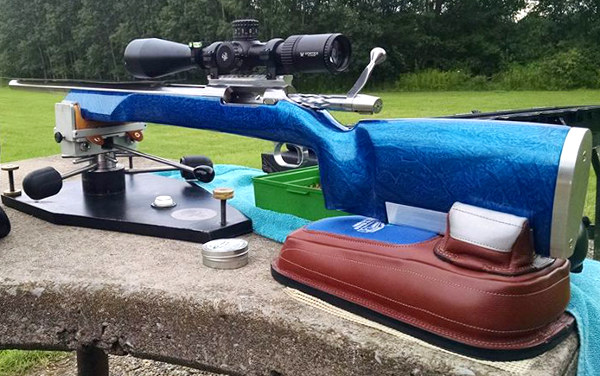
Here is a 6BR Ackley Improved built by Alex Wheeler. This blue marble-painted beauty features a BAT “B” action timed by Alex, fitted with Jewell trigger, and Borden trigger guard. The barrel is a Hawk Hill HV contour finished at 28 inches. The stock is a Deep Creek Tracker with 4″ forearm and rudder system (the toe of the stock adjusts for angle, allowing better tracking). This scope is a Vortex 15-60x52mm Golden Eagle riding in Burris Signature Zee rings.
Forum member Grimstod posted this nice 6BRX in a scenic setting: “Bill Goad at Premier Accuracy crated this fantastic 6BRX. It shoots better then I do.” The rifle features a single-feed Alpin action, with Hart 26″ 1:8″-twist barrel, chambered for the 6BRX (6mmBR wildcat) with .269 neck. Grimstod currently runs 95gr Berger VLDs in Lapua brass. On top is a Leupold 40x45mm scope on a Picatinny rail that Grimstod machined himself. The stock is an HS Precision painted by Premier Accuracy.
Here’s a gorgeous green 6mm Dasher. Forum Member Gunnermhr states: “This is my new 12-lb Dasher for the 1000 Yard Benchrest silhouette matches. My good friend at CRS Custom Rifle Stocks in Aaronsburg, PA made and painted the stock. It’s similar to a Tooley MBR with a few modifications. It still supported on a 3″ forearm and is full length. Hard to imagine it still makes weight with a wood stock and a 36 power Leopold. Crossed the scale at 11.7lbs. The rifle features a BAT “B” Action. The paint is Candy Apple Green, the forearm has a white base-coat, center section is gray base coat and the buttstock is black base coat, all covered with five coats of clear. It’s the new pride of the fleet as it shoots as good as it looks. This gun hammers with 105gr Berger Hybrids.”
Here’s a state-of-the-art Benchrest rifle, finished proudly in bright red. Forum Member JimmyMac posted: “Picked up my new 6 PPC today. This red rig features a Borden B action (Jewell trigger) fitted with a Lederer 1:14″-twist barrel with a Loker tuner. The barrel action rides in a Roy Hunter stock. On top is a Nightforce 42x44mm Competition scope in BAT rights. The rifle was smithed by Dave Bruno.
This impressive rifle features an “antique” 1917 Enfield action chambered for the .338 Win Magnum cartridge. The lovely Maple stock was hand-carved by Forum member Spitfire_ER. He tells us: “I found this piece of wood as a return at a lumber yard about 7-8 years ago. I asked the guy in the yard about it and he said it had been returned because it had too much figure for the job the customer was working on. First thing I thought was, ‘That would make a nice stock’.”
Not a Rifle But Still a Stunner…
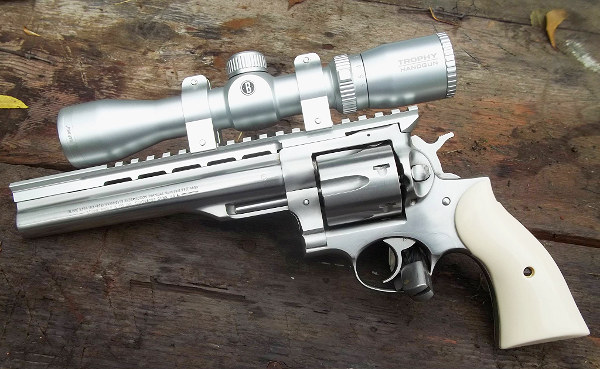
Last but not least is one of the nicest stainless Ruger revolvers we’ve ever seen. Forum member Longcarbine says: “This is not a rifle, but it’s my favorite weapon”. The Ruger is fitted with a custom Picatinny scope rail with matching silver-tone Bushnell Trophy handgun scope, plus handsome faux Ivory grips. This wheelgun is almost too pretty to hunt with…
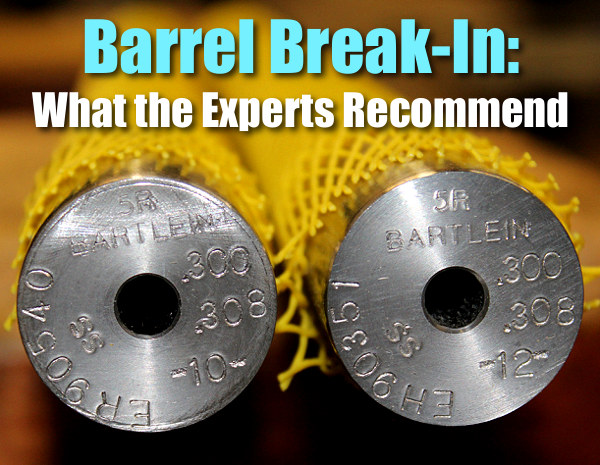
The question of barrel break-in is controversial. Some folks advocate an elaborate, lengthy cycle of shooting and brushing, repeated many times — one shot and clean, two shots and clean and so on. This, it is argued, helps barrels foul less and shoot more accurately. Others say minimal break-in, with patching and brushing after 10-15 rounds, is all you need. Still others contend that break-in procedures are a total waste of time and ammo — you should just load and shoot, and clean as you would normally.
We doubt if there will ever be real agreement among shooters concerning barrel break-in procedures. And one must remember that the appropriate break-in procedure might be quite different for a factory barrel vs. a custom hand-lapped barrel. This Editor has found that his very best custom barrels shot great right from the start, with no special break-in, other than wet patches at 5, 10, and 15 rounds. That said, I’ve seen some factory barrels that seemed to benefit from more elaborate break-in rituals.
What’s the best barrel break-in procedure? Well our friend Eric Mayer of Varminter.com decided to ask the experts. A while back Eric interviewed representatives of three leading barrel manufacturers: Krieger, Lothar-Walther, and Shilen. He recorded their responses on video. In order of appearance in the video, the three experts are:
Do I Need to Break-In a New Rifle Barrel?
Eric Mayer of Varminter.com says: “That is a simple question, [but it] does not necessarily have a simple answer. Instead of me repeating my own beliefs, and practices, on breaking-in a new rifle barrel, I decided to answer this one a bit differently. While we were at the 2016 SHOT Show, we tracked down three of the biggest, and most popular, custom barrel makers in the world, and asked them what they recommend to anyone buying their barrels, and why they recommend those procedures. We asked the question, and let the camera run!” Launch the video above to hear the answers — some of which may surprise you.
Long-Term Barrel Care — More Experts Offer Opinions
Apart from the debate about barrel break-in, there is the bigger question of how should you clean and maintain a barrel during its useful life. Some folks like aggressive brushing, other shooters have had success with less invasive methods, using bore foam and wet patches for the most part. Different strokes for different folks, as they say. In reality, there may not be one solution for every barrel. Different fouling problems demand different solutions. For example, solvents that work well for copper may not be the best for hard carbon (and vice-versa).
“Why worry about a little barrel fouling when the throat is subjected to a brutal 5,600° F volcano at 55,000 PSI? To investigate these and other questions about taking care of a match barrel, we spoke with a dozen experts and share their knowledge in this first of a series of articles.
After listening to folks who shoot, build barrels or manufacture cleaning solvents for a living, we concluded that even the experts each have their own unique recommendations on how to care for a match barrel. But they all agree on one thing — the gun will tell you what it likes best. Because the life expectancy of a match barrel is about 1,500 to 2,500 rounds, the objectives of cleaning one should include: preserve accuracy, slow the erosion, and remove fouling — all without damaging the gun. This article doesn’t claim that one cleaning method is better than the next. Rather, we set out to interject a little science into the discussion and to share some lessons learned from experts in the field.” — Chip Lohman
Sad to say, here’s another example of a large tech enterprise bullying the firearms industry. Some very large credit card processors have refused to process firearms transactions, and we’ve heard reports of business insurers dropping policies for gunsmiths and gun accessory producers, or raising rates by as much as 700%. This is not a good time to be a gun retailer or gun manufacturer. These issues are part of larger battle, with major media, tech, and financial institutions targeting the firearms industry.
Many firearms retailers and ranges may be impacted by a new “Acceptable Use Policy” from Shopify. This policy blocks a wide variety of firearms products from online stores. Many mag-fed semi-auto rifles can no longer be sold, and unfinished lower receivers are also on the “prohibited products” list.
Report by NRA Institute for Legislative Action (NRA-ILA)
Spike’s Tactical, a Florida-based firearms manufacturer and retailer, is just one of the businesses who received an alarming email from its online store management platform, Shopify — a company used by more than 600,000 merchants [for] marketing, inventory management, payments, and shipping.
Cole Leleux, General Manager of Spike’s Tactical, said a three-sentence email from Shopify was the only notice Spike’s Tactical received alerting them to a new change in Shopify’s “Acceptable Use Policy” that will now “restrict the sale of certain firearms and firearm parts.”
According to an article by Ammoland.com, some of the new arbitrarily amended rules in Shopify’s policy “now include banning the sale of semi-automatic firearms that have an ability to accept a detachable magazine and are capable of accepting more than 10 rounds. Additionally, unfinished lower receivers are also prohibited[.] Most of Spike’s Tactical’ s products include AR-15 parts and full rifles, which would fall under those new restrictions.”
“It’s just crazy to go from no firearm policy to no guns overnight,” said Leleux, “We’ve been sitting back quietly while Google stops us from advertising — we can’t advertise on Facebook, we can’t advertise on Instagram. We are a legal business in this country and I can’t use the most popular platforms to advertise.”
Aside from how Shopify’s new policy will affect his business, Leleux says what bothers him most is the hypocrisy… Leleux says Shopify assured him it was firearm-friendly and he would have no problems. Shopify’s about-face came after Leleux spent $100,000 and signed the contract.”
Gun Shops Also Impacted by Shopify Policy Change
Shopify has also restricted a Washington state gun shop and range. Canada-based Shopify recently notified The Marksman, an indoor gun range and retail shop in Puyallup (WA), that it must remove a number of products from its online store, including semi-auto rifles. Shopify’s new Acceptable Use Policy (AUP) no longer allows the sale of many popular (and legal) firearms sold by The Marksman.
The Marksman’s Mike Grabowski explains: “The Marksman has been in business for over 38 years and has always enjoyed great community support by the public and Law Enforcement. We provide a safe place for our community to shoot and learn about safe firearms handling. Over the years we have educated … thousands of people on how to safely handle and use firearms.”
Grabowski says Shopify’s policy change was unwarranted and unexpected: “When we entered into our relationship with Shopify they expressed no concern about the products we sell. We have spent thousands of dollars building and maintaining our e-commerce presence, as well as contributing to Shopify’s income. It is unacceptable to us that they now decided that they don’t like guns and therefore will proceed to terminate their relationship with [us] and many other firearms-related companies.”
Editor’s Comment: It will become increasingly difficult for Americans to exercise their Second Amendment rights, and for hunters and target shooters to pursue their hobbies, if firearms-related enterprises are denied the ability to sell products, collect invoices, insure their facilities, or communicate with the public.
This is a worrisome trend. The example of Shopify and The Marksman is just the tip of the iceberg. Other gun-related businesses are now facing “black-balling” by big companies that handle banking, insurance, and payment processing.
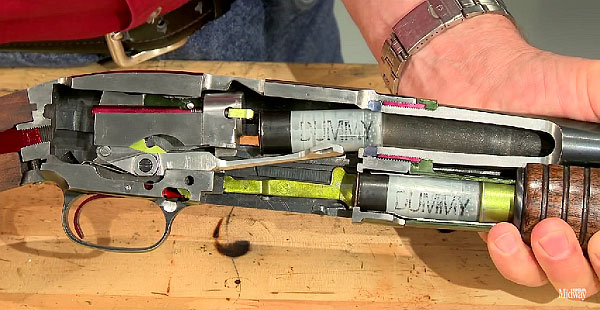
Even wonder how a pump shotgun works? Then watch this fascinating video from MidwayUSA. The operation of a pump-action shotgun is illustrated with a special cut-away version of a Winchester Model 12. The shotgun has been modified to reveal the inner workings. This cut-away Model 12 still loads and ejects dummy shells, but you can see how the lugs, slides, locks, ramps, springs and other internal parts work. You’ll be amazed how complicated this old pump-gun is. (The Model 12, Winchester’s first hammerless shotgun, is one of the most popular scatterguns ever made. Over 2,000,000 were sold.)
Skip Ahead to 3:00 to See Cut-Away in Action
To see how the Model 12 works, you can skip forward to the 3:00 minute mark in the video. The first part of the video shows how the Model 12 was “sliced and diced” to expose the inner workings. Larry Potterfield of MidwayUSA explains that “the factories often used cut-aways as sales tools to show how a specific model operated”. In addition the U.S. Military used cut-aways for training purposes.
Here is the cut-away completed. Even the pump grip has been sliced to reveal the inner workings.
A round has been picked up from the feed tube, and then is lifted into the chamber.
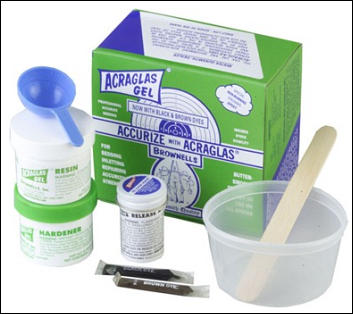
The NRA’s American Rifleman showcased an interesting project this week — an upgraded Ruger American Rifle Predator in 6.5 Creedmoor. The video below shows how a laminated wood stock from Boyds Gunstocks was adapted for the Ruger. A Boyds Prairie Hunter model in gray laminate was selected. This was custom-bedded to the Ruger’s action using Brownell’s Acraglas.
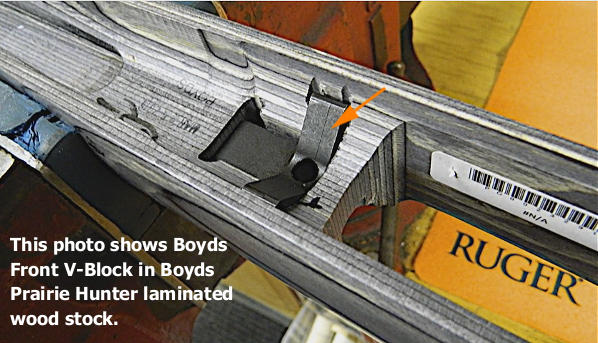
All Ruger American Rifle models employ dual aluminum V-Blocks to support the action. These fit slots in the underside of the action. Boyds makes its own version of these V-Blocks which were installed in the Boyds stock to secure the action.
Project leader Joe Kurtenbach says the size, shape, and geometry of the Boyds V-Blocks is very accurate, so they fit the Ruger action well. To further support the action, Acraglas bedding compound was applied to the inside of the stock, after release compound was applied to the barreled action. With this DIY bedding job, the Boyds laminated stock is definitely an improvement over this original “Tupperware” factory stock.
DIY Bargain Hunter Upgrade
American Rifleman states: “The Ruger American has some great features—hammer-forged barrel, reliable action, crisp trigger — but many would not consider the molded, polymer stock to be among them. Luckily, there are aftermarket options to enhance the rifle’s utility and aesthetics. A durable, attractive stock from Boyds Gunstocks and some DIY action bedding, using Brownells Acraglas, is the next step in the precision-driven hunting rifle build.”
Choice of Gun and 6.5 Creedmoor Chambering
For this project, American Rifleman’s Joe Kurtenbach selected one of his favorite cartridges, the 6.5 Creedmoor. Introduced in 2007 by Hornady, the accurate, flat-shooting 6.5 Creedmoor has proven very popular with both hunters and tactical/PRS shooters. The Ruger American Rifle Predator was chosen for its affordable price, reliable action, and Ruger Marksman adjustable trigger.
In this video, Kurtenback explains how and why the 6.5 Creedmoor chambering and Ruger American Rifle were chosen for the Precision Hunter rifle build project.








 Do I Need to Break-In a New Rifle Barrel?



 All Ruger American Rifle models employ dual aluminum V-Blocks to support the action. These fit slots in the underside of the action. Boyds makes its own version of these V-Blocks which were installed in the Boyds stock to secure the action.