Report by NRA-ILA
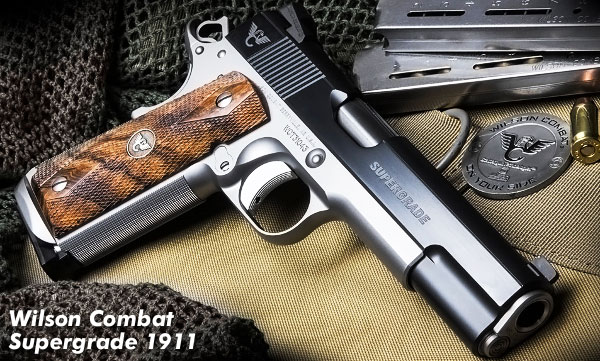
Last week, President Trump signed into law H.R. 2810, the National Defense Authorization Act for Fiscal Year 2018 (NDAA). Included in the law is a provision long sought by collectors of vintage firearms and militaria that would require military surplus M1911/M1911A1 pistols (1911s) to be made available for sale to the American public. The military currently has some 100,000 excess 1911s sitting in storage at taxpayer expense.
A previous version of the NDAA signed into law by then-President Obama in 2015 authorized, but did not require, the Secretary of Defense to transfer up to 10,000 surplus 1911s per year to the Civilian Marksmanship Program (CMP) for sale to the public. Unsurprisingly, no such transfers were ever made while Obama remained in the White House.
The language in the 2018 NDAA effectively establishes a mandatory pilot program under which at least 8,000 (and as many as 10,000) 1911s would be transferred to the CMP for public sale in 2018. The Secretary of Defense must then report to Congress on the outcome of the program. Thereafter, the Secretary would be authorized to continue transferring up to 10,000 [more] surplus 1911s a year to the CMP for further public sales. READ More about CMP Sales of Vintage 1911 Pistols on NRA-ILA.org.
The Process to Acquire a Military 1911 Pistol
Sales of the surplus 1911 handguns will be handled a bit differently than most other CMP firearms transfers for M1 Garands, M1 Carbines and other vintage rifles. All transfers must go through a local FFL in a face-to-face transaction. In addition, there will be two background checks of the purchaser before the gun can be transfered. The first check is done by the CMP prior to shipping the pistol, while a second check is done by the FFL before releasing the pistol to the customer at the FFL’s place of business. Customers will be limited to one 1911 pistol per calendar year.
Additional CMP Requirements
The CMP has a number of “threshhold” requirements for purchase of a surplus 1911. To acquire one of the CMP 1911s, you must be a U.S. citizens, eligible to receive firearms under federal law, and the laws of your city/state. In addition you must belong to a CMP-affiliated club, and able to provide proof of participation in a marksmanship activity.
This article appears in the Cheaper Than Dirt Shooter’s Log.
The passage of the Concealed Carry Reciprocity Act through the U.S. House of Representatives is a step in the right direction, but not a law yet. The U.S. is a patchwork of confusing and cumbersome laws that change the rules of what you can carry, where you can carry, and whether you can possess the firearm, ammunition of magazine at without running afoul of the local laws. Now, if every state was like Vermont, law abiding gun owners could freely travel with their firearms with no worries. Unfortunately, many states have a history of being hostile to traveling gun owners.
The federal “Firearms Owner Protection Act” allows travel through any state as long as the firearm is unloaded, in a locked case, and not easily accessible to the passengers. However, that is not to say that certain states that are less friendly to firearms have not created their own laws that would snare unsuspecting otherwise law-abiding firearm owners. This led us to name the Top 5 States to Avoid while traveling with a firearm this holiday season.
CONNECTICUT
Connecticut does not have any gun reciprocity agreements with other states. This means nonresidents are not allowed to carry handguns in Connecticut under a permit issued by another state.
HAWAII
Every person arriving into the state who brings a firearm of any description, usable or not, shall register the firearm within three days of the arrival of the person or the firearm, whichever arrives later, with the chief of police of the county where the person will reside, where their business is, or the person’s place of sojourn. GET Hawaii Firearms INFO HERE.
MASSACHUSETTS
Massachusetts imposes harsh penalties on the mere possession and transport of firearms without a license to carry. Prospective travelers are urged to contact the Massachusetts Firearms Records Bureau at (617) 660-4780 or contact the State Police. GET Massachusetts Firearms INFO HERE.
NEW JERSEY
New Jersey has some of the most restrictive firearms laws in the country. Your firearm must be unloaded, in a locked container, and not accessible in the passenger compartment of the vehicle. The New Jersey Supreme Court ruled that anyone traveling within the state is deemed to be aware of these regulations and will be held strictly accountable for violations. If you’re traveling through New Jersey, the N.J. State Police website provides information regarding transporting firearms within state lines. GET New Jersey Firearms INFO HERE.
NEW YORK
Use extreme caution when traveling through New York state with firearms. New York’s general approach is to make the possession of handguns and so-called “assault weapons” illegal. A number of localities, including Albany, Buffalo, New York City, Rochester, Suffolk County, and Yonkers, impose their own requirements on the possession, registration, and transport of firearms. Possession of a handgun within New York City requires a New York City handgun license or a special permit from the city Police Commissioner. This license validates a state license within the city. Even New York state licenses are generally not valid within New York City unless a specific exemption applies. Possession of a shotgun or rifle within New York City requires a permit, which is available to non-residents, and a certificate of registration.
More Scary States for Gun Owners
Here are six other jurisdictions (five states and DC) where you need to be wary when traveling. California, for example, treats all handguns in vehicles as “loaded” if there is ammunition loaded into an attached magazine. It’s wise, when in California, to have handguns unloaded in a LOCKED case, with all ammunition or magazines in a separate section of the vehicle. These states (and DC) all have laws that can trap unsuspecting gun-owners. Be wary.
California
Delaware
Dist. of Columbia
Illinois
Maryland
Rhode Island
Hodgdon has just introduced a versatile new Winchester-brand pistol powder with a clean formulation. WinClean 244 is a modern, Winchester-branded propellant “ideally suited to .38 Special, .45 Auto, and 9mm standard loads.” That means WinClean 244 is designed for moderate pressure target loads. That’s good news for hand-loaders who enjoy target shooting with these popular cartridges.
Hodgdon, which markets Winchester powders, says that new WinClean 244 is consistent, and clean burning with a low flash: “The WinClean formulation reduces copper fouling and residue, extending accuracy for longer shooting periods.” It will be interesting to see if this is noticeably cleaner-burning than other popular powders. In pistol barrels we are actually less concerned with copper fouling than with general “sootiness” and carbon.
With its clean-burning qualities, “shooters are really going to like loading handgun cartridges with this powder” said Tim Vaitekunas, vice president of product development at Hodgdon. WinClean 244 powder, in 1-, 4- and 8-pound canisters, should be in stores in January 2018. Load Data is now available right now on the Hodgdon Reloading Data Center.
This Editor used to compete in Action Pistol matches, so I’ve loaded thousands of rounds of pistol ammunition using a wide variety of pistol propellants. I tend to favor Vihtavuori N310/N320 for .45 ACP, and Alliant powders for 9mm Luger, but it will be interesting to see how WinClean 244 works for these chamberings. Many powders work well for .38 Special loads, but new 244’s low flash could be an advantage there too.
Pistol Showcase — Candidates for WinClean 244
The Sig P210 SuperTarget is a modern 9mm Luger pistol with exceptional accuracy and one of the best out-of-the-box triggers you’ll ever try. Winchester WinClean 244 is suitable for a variety of bullet weights in the 9x19mm (9mm Luger) cartridge.
The 8-shot Smith & Wesson Model 627 Pro is an exceptional revolver that balances well and can shoot 1″ groups at 25 yards with tuned handloads. On this particular Model 627, featured on YouTube, the owner added a Hogue Pau Ferro wood grip, Hogue Extended Cylinder Release, and Wilson Combat trigger spring kit. In this kind of wheelgun, you can shoot moderate .38 Special target rounds loaded with new WinClean 244 powder.
Merry Christmas from Guns & Ammo. This publication is making its entire 106-page December 2017 issue available for FREE online from December 12, 2017 through January 9, 2018. To read the entire issue for FREE, go to: GunsandAmmo.com/freepreview.
The free December issue will include the 2017 Guns & Ammo of the Year Awards (page 52) and a first-look at the new Smith & Wesson M&P9 M2.0 Compact, Shield and M360 lightweight revolver. You’ll want to check out the articles about: Winston Churchill’s Mauser C.96 Pistol (page 104), the Dixie Gunworx DOA Shooting Bench (p. 38), and Concealment Furniture (page 18) that hides your home defense guns. We also recommend the NovX ammo review (page 26). NovX is a new kind of ammunition with a hybrid stainless steel and aluminum case, and polymer-coated copper bullets.
If you haven’t seen a copy of Guns & Ammo recently, here’s a chance to sit down and enjoy a large issue at no cost. We found it interesting to see Guns & Ammo’s Annual Award selections (page 52): CZ P-10 C — Handgun of the Year; Barrett Fieldcraft — Rifle of the Year; Winchester SX4 — Shotgun of the Year. To be honest, we found all those choices puzzling…
Guns & Ammo magazine is one of 15 publications from Outdoor Sportsman Group. The publisher claims Guns & Ammo has more than 11 million readers (29.7 readers per copy) — more readers than any other firearms publication. If that’s really true, we wonder, frankly, why the magazine isn’t a whole lot better. With that circulation, and the high percentage of display ads (over 30% of the pages) Guns & Ammo should be minting money. That should allow the Editors to do some pretty exciting stuff. Unfortunately, many of the articles seem little more than sales brochures. And you won’t find much on precision reloading or competitive rifle shooting.
By all means, check out this FREE Issue of Guns & Ammo. After all the price is right. However, we believe you’ll find more reliable, useful information on websites such as ShootingSportsUSA.com, Rifleshooter.com, PrecisionRifleBlog.com, 65Guys.com, UlimateReloader.com, and, of course, our own site AccurateShooter.com. We provide 80-90 features per month on our Daily Bulletin which is always free. We also offer a very active Shooters’ Forum with over 37,500 members. Many top-flight competitive rifle shooters, barrel-makers, and gunsmiths are Forum members. You can learn from their expertise. If you haven’t joined our Forum yet, you should.
Do you shoot a .45 ACP? We love this short, fat cartridge because it is inherently accurate, it makes big, easy-to-see holes in paper, and because it it works so well in the classic 1911 series of pistols. It is hard to beat a good, tuned model 1911 when it comes to trigger pull/reset and natural pointing ability.
Once you get the hang of it, 1911-type pistols are also easy to field strip for cleaning. Here is a video showing how to disassemble and reassemble your model 1911:
Model 1911 Field Stripping and Reassembly
.45 ACP Ammunition Loading Guide
If you “roll your own” .45 ACP cartridges, there are many good powder choices. Our favorites are Vihtavuori N320, AA No. 5, and Hodgdon TiteGroup, but there are many other good choices. You’ll find these three recommended powders (plus seven others) in this .45 ACP Reloading Guide from Nosler:
What do you get for the shooter “who has everything”? How about a custom-crafted, laser-engraved ammo display case. Technoframes produces a series of ultra-sleek Ammo display units, and high-tech pistol racks. The CNC-machined display boxes, fitted to your choice of cartridge, look great. There are many varieties to choose from, including wood, metal, and Plexiglas. We like the fact that many of the boxes are lockable.
Technoframes’ impressive billet-aluminum pistol racks, with magazine-style gun holders (fitted with Neodymium magnets in their bases) put ordinary plastic or wire-framed racks to shame.
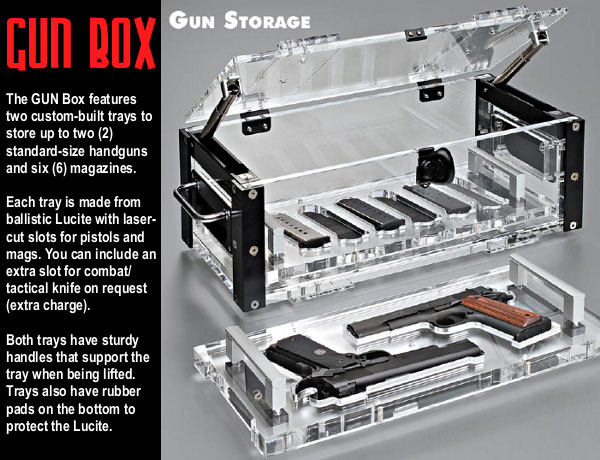
Last but not least, Technoframes also makes a plexiglas-sided gun transport box and a double-tiered, two-pistol/six-magazine gun display box with removable inner tray. These units look like they were produced by “M” for James Bond.
Technoframes is the world’s leading producer of high-end CNC-machined ammo and handgun storage solutions. Along with display cases, Technoframes offers Snap Caps and historical replica ammunition. For more info, visit Technoframes.com.
The U.S. House of Representatives passed the Concealed Carry Reciprocity Act of 2017 (H.R. 38) in a 231-198 vote on Wednesday, December 6th. The legislation will next proceed to the U.S. Senate. If a joint version of the Bill is approved by both House and Senate, the new legislation would then go to the President for signature.
Story Based on Report by NRA-ILA.org
The National Rifle Association applauded House Members for passing the most far-reaching expansion of self-defense rights in modern American history. “This vote marks a watershed moment for Second Amendment rights,” said Chris W. Cox, executive director, National Rifle Association Institute for Legislative Action. “The Concealed Carry Reciprocity Act is the culmination of a 30-year movement recognizing the right of all law-abiding Americans to defend themselves, and their loved ones, including when they cross state lines.”
Next Stop — the U.S. Senate
“This bill ensures that all law-abiding citizens in our great country can protect themselves in the manner they see fit without accidentally running afoul of the law. We now call on the Senate to take up and pass this critical legislation,” Cox concluded.
H.R. 38 — What This Legislation Does and Does Not Do
The Concealed Carry Reciprocity Act of 2017 ensures that those Americans who can legally carry a concealed firearm in one state will legally be able to do so in every other state. It eliminates the confusing patchwork of state laws that have ensnared otherwise law-abiding gun owners.
While the bill allows recognition of concealed firearms permits from one state to the next (reciprocity), it does NOT create a federal licensing or registration system or establish national standards for concealed carry. Moreover, H.R. 38 will NOT override current state laws governing the time, place, and manner of carrying concealed weapons.
The bill also makes improvements to the National Instant Criminal Background Check System, NICS. This bill incentivizes states and government agencies to update the NICS with legitimate records of prohibited persons.
Summary of H.R. 38 — Concealed Carry Reciprocity Act of 2017
This bill amends the Federal criminal code to allow a qualified individual to carry a concealed handgun into or possess a concealed handgun in another state that allows individuals to carry concealed firearms. A qualified individual must: (1) be eligible to possess, transport, or receive a firearm under federal law; (2) carry a valid photo identification document; and (3) carry a valid concealed carry permit issued by, or be eligible to carry a concealed firearm in, his or her state of residence.
Additionally, the bill specifies that a qualified individual who lawfully carries or possesses a concealed handgun in another state: (1) is not subject to the federal prohibition on possessing a firearm in a school zone; and (2) may carry or possess the concealed handgun in Federally-owned lands that are open to the public.
UPDATE (12/7/17): The U.S. House of Representatives on Wednesday, December 6th passed the Concealed Carry Reciprocity Act of 2017 (H.R. 38) in a 231-198 vote. The legislation will next proceed to the U.S. Senate. If a joint version of the bill is approved by both houses, the law would then go to the President for signature.
“This vote marks a watershed moment for Second Amendment rights,” said Chris W. Cox, executive director, National Rifle Association Institute for Legislative Action. “The Concealed Carry Reciprocity Act is the culmination of a 30-year movement recognizing the right of all law-abiding Americans to defend themselves, and their loved ones, including when they cross state lines.”
Vote on H.R. 38 in House of Representatives
The Concealed Carry Reciprocity Act of 2017 (H.R. 38) goes up for a vote in Congress today. The bill is scheduled for a vote in the U.S. House of Representatives on Wednesday, December 6. The NRA-ILA has pushed for passage of this legislation: “Your fundamental right to keep and bear arms should not end at the state line. This bill would ensure that law-abiding citizens do not lose the ability to protect themselves when they travel from state to state. And it would ensure that anti-gun jurisdictions do not harass travelers for exercising their constitutional rights.”
While the bill allows recognition of concealed firearms permits from one state to the next (reciprocity), it does NOT create a federal licensing or registration system or establish national standards for concealed carry. Moreover, H.R. 38 will NOT override current state laws governing the time, place, and manner of carrying concealed weapons.
Summary of H.R. 38 — Concealed Carry Reciprocity Act of 2017
This bill amends the Federal criminal code to allow a qualified individual to carry a concealed handgun into or possess a concealed handgun in another state that allows individuals to carry concealed firearms. A qualified individual must: (1) be eligible to possess, transport, or receive a firearm under federal law; (2) carry a valid photo identification document; and (3) carry a valid concealed carry permit issued by, or be eligible to carry a concealed firearm in, his or her state of residence.
Additionally, the bill specifies that a qualified individual who lawfully carries or possesses a concealed handgun in another state: (1) is not subject to the federal prohibition on possessing a firearm in a school zone; and (2) may carry or possess the concealed handgun in Federally-owned lands that are open to the public.
Trends in Exercise of Concealed Carry Rights
The NRA-ILA states: “The last 30 years have seen a continual expansion of the right to carry concealed handguns for self-defense within the United States, even as the nationwide violent crime rate has plummeted during the same period. Every U.S. state now has a legal mechanism whereby its residents may carry concealed handguns, and 42 states and the District of Columbia broadly recognize a right of law-abiding citizens to do so.
The remaining eight states, however, treat the right to carry for self-defense as a privilege reserved for the elite, the connected, or those who can “prove” extraordinary circumstances to the licensing officials.”
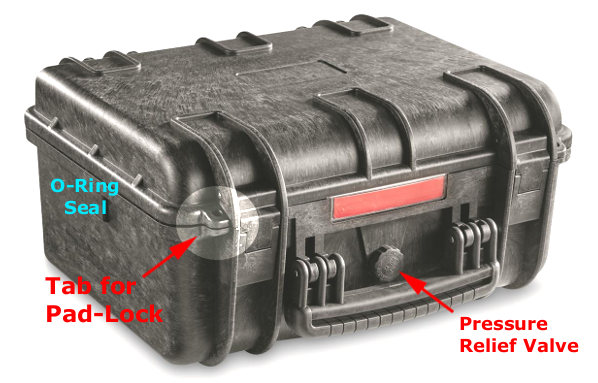
Do you often take multiple handguns to the range? Here’s a large (16″ x 13″ x 8″) handgun hard case that will easily haul your arsenal. The HQ Issue Case can hold up to eight (8) handguns, or six with room for magazines. Since the foam is customizable, you can also use this case to carry cameras, rangefinders, binoculars, Kestrels, or other valuable hardware. While we wouldn’t drop this in the water, the case does have an O-Ring seal for water resistance, and a manual valve for pressure modulation. This case is on sale at Sportsman’s Guide for $39.99, or $35.99 for SG Buyer’s Club Members.
Good Value Compared to Other Hard Cases
This HQ Issue case is a good deal, offering lots of capacity and quality protection for a good price. Consider that a similar but smaller 4-pistol handgun hard case sells on Amazon for $105.00 and customers rate it 5 Stars at that price. Though it is less than half the price, the $39.99 HQ Issue case holds a LOT more than the Amazon alternative. The Amazon case is 14.90″ W x 12″ D x 9.6″ H, compared to 16″ W x 13″ D x 8″ H for the bigger HQ Issue case. With the Sportsman’s Guide case you get more capacity, and the “pluckable” foam can be customized for your handguns. That’s important if you have long-barrel revolvers or short carry pistols. Verified SG purchaser says: “Case exceeds my expectations… the right size for a range trip. I can put 5 handguns, 4 Glock magazines, 3 pf9 magazines and 3 single stack 9mm magazines in it. It is also very sturdy. Very, very happy with the purchase.”
NOTE to READERS: Use foam-lined hard cases for TRANSPORT ONLY. Do not leave your handguns in foam-lined cases. The foam tends to trap moisture, making these a “rust magnet”. We recommend silicone-treated fabric Bore-Stores for storing pistols in your gun safes.
This stunning Westley Richards & Co. shotgun was made for the 1981 nuptials of Lady Diana Spencer and HRH Prince Charles. It is rare, has a unique history of ownership, and is also elaborately decorated.
Jim Supica, Director of the NRA Firearms Museum, has written a trio of articles about gun collecting. If you are thinking of starting your own collection of firearms, you should read Supica’s informative articles. The first talks about the basics of gun collecting, the second explains the five key factors that govern gun values, and the third article explains where to find rare and valuable arms. Today we want to highlight the five factors that contribute most to a gun’s value, according to Supica:
Make and Model, Condition, Rarity, History, Art — These are the five factors that … appeal to collectors and help determine the value of collectible guns.
Make and model tends to be the starting point for evaluating collectible guns for most collectors and will be a basic threshold requirement for those with specialized collections.
Factors here include the quality of a particular manufacturer’s products, the historical usage of the guns in question, and the brand’s aura of romance. As an example of that last (and most intangible) factor, consider that Colt Single Action Army revolvers were for several decades the most prevalent focus for collectors interested in full-size revolvers from the post-Civil War to turn of the 20th Century-era, and there is no question that Colts were widely used during that time. In recent years, there has been a refreshing trend in gun collecting to look at a broader range of guns than the traditional blue chip Colts, Winchesters, and Lugers.
Colt Single Action Army Revolvers remain among the most prized (and collectible) firearm.
2. Condition (and Originality)
Obviously, condition plays a major role in the value of a collectible firearm. The classic advice to new collectors in this regard has always been to hold out for guns in the best condition and pay the extra premium they demand. This condition-emphasis seems to have developed in the 1970s and 1980s. In the early post-WWII years of gun collecting there was more interest in rare variations and history, and fewer collectors to whom a few percentage point difference in remaining original finish was of much concern.
Although the highest-condition guns continue to bring record prices, it seems that the pendulum is beginning to swing back the other way, a trend met with my hearty approval. The appeal of “mint” guns has been largely lost on me, and seems to be more appropriate to coin or stamp collecting than a field in which the possible historic usage of the artifact holds so much interest and significance. There is a definite segment of the collector market that is not overly concerned with perfect condition, so long as the gun is original and has not been messed with in a more recent (and, in my opinion, usually misguided) attempt to enhance its desirability.
3. Rarity
In terms of rarity, the well-worn saying that “just because a gun is rare doesn’t mean it’s valuable” remains true to a certain extent. There may only be five known examples of a particular gun, but if only three people care about it, the market is saturated. However, there does seem to be more interest in cornering the rare variations within established collecting fields. There is a bit of a resurgence of the collecting philosophy of completing a punchlist of models and variations within a specialization, and this lead to vigorous competition for the rarest examples in these fields. In emerging collecting fields, when new research is published revealing the rarity of certain variations there can develop a brisk interest in those guns.
4. History
Individual guns with a known history of ownership by a specific individual or usage in a specific historical event have always captured the fascination of collectors, as well as historians and the general public. This seems to reflect a basic human interest and shows no sign of abatement. A positive trend here seems to be an increase in general understanding of the type of documentation which must accompany a historically attributed firearm to give it the credibility to justify a premium price, and the importance of creating and preserving such documentation.
This Beretta has extra value because it was owned by pilot Chuck Yeager. Photo NRA Museum.
5. Art (Decorative Embellishment)
Fine engraved guns are collected more for their artistic value than for their worth as firearms. Here the market for classic works by the great engravers of the 19th and early 20th Centuries remains strong, as well as for factory-engraved pieces from more recent years. Interest in recent non-factory engraving seems to have diminished, as has… the trend of adding modern engraving to older firearms.
Here is a matching set of three three beautifully engraved pistols by the late Indiana engraving wizard Ben Shostle — a Luger, a Mauser, and a Colt. Photo courtesy Amoskeag Auction Company.
Factory-custom engraving should not be confused with mass-produced, factory-made commemorative firearms, which flooded the market in the 1960s and 1970s. A couple of major manufacturers worked this genre to death, and prices on commemoratives have been stagnant for many years now, although the market for these shows some signs of renewal.
CAUTIONARY WORDS about RESTORATION
With prices for high-condition original finish guns running away from the budgets of many collectors, period-of-use refinished guns and older factory-refinished guns are finding more enthusiastic buyers than they did a few years ago.
The availability of excellent-quality restoration services is another factor that I anticipate may impact collector preferences in the future. The top restoration artists are reworking guns to “as new” condition with such skill that it has become increasingly difficult for even knowledgeable collectors to distinguish mint original finish guns from the best restorations.
When such restoration is disclosed to a prospective buyer (as it ethically should be), the prices the gun will bring are significantly below a similar gun with original finish, and may be less than the original cost of the pre-restoration gun plus the cost of the rework. This creates a mighty incentive for deception by a motivated seller, either by active misrepresentation (a.k.a. “fraud”) or passively by simple failure to mention the modification.


 The free December issue will include the 2017 Guns & Ammo of the Year Awards (page 52) and a first-look at the new Smith & Wesson M&P9 M2.0 Compact, Shield and M360 lightweight revolver. You’ll want to check out the articles about: Winston Churchill’s Mauser C.96 Pistol (page 104), the Dixie Gunworx DOA Shooting Bench (p. 38), and Concealment Furniture (page 18) that hides your home defense guns. We also recommend the NovX ammo review (page 26). NovX is a new kind of ammunition with a hybrid stainless steel and aluminum case, and polymer-coated copper bullets.