In recent years, the ranks of first-time handgun buyers have grown dramatically. Thousands upon thousands of Americans are purchasing their first-ever pistol. With so many handgun options available these days (from derringers to Desert Eagles) many first-time buyers have trouble making a choice.
A close relative recently contacted this Editor. Wanting to get started in handgunning, he sought my advice on purchasing his first handgun. “Should I get a Glock?”, he asked. “No” was my response. “Well how about an M&P?” he inquired. “Better ergos” I said, “but ‘No’ is still my reply.” “OK, how about a KelTec, they’re cheap…” “Absolutely not”, I replied.
I could tell he was getting annoyed, when he said “OK, Mr. know-it-all, so what handgun should I get?” Calmly, I replied: “Get a .22-caliber rimfire revolver. You will never out-grow it. You will learn sight alignment and trigger control. You can practice with inexpensive ammunition. A good .22 revolver will be considerably more accurate than 90% of the self-loading pistols you could buy. If you get a Smith & Wesson, you will keep the gun for the rest of your life and pass it on to your kids. If you or your heirs ever wear out the barrel or cylinder, Smith & Wesson will replace the parts for free, forever.”
First Handgun Choice — A very good choice for a first handgun is a Smith & Wesson .22 LR revolver, such as the S&W model 617. The model 617 is extremely accurate, with a very crisp trigger (in single-action mode), and good sights.
You can learn all the fundamentals with this ultra-reliable handgun, shooting inexpensive .22 LR ammo. The model 617 is rugged, durable, and can give you a lifetime of shooting fun. Once you have mastered the basics of shooting with a .22 LR, you can move on to larger caliber handguns suitable for self-defense. Below is a slide-show illustrating a S&W model 617 ten-shot, with 6″ barrel. S&W also makes a 4″-barrel version of this revolver. (See: Shooting Demo Video with 4″ model 617.)
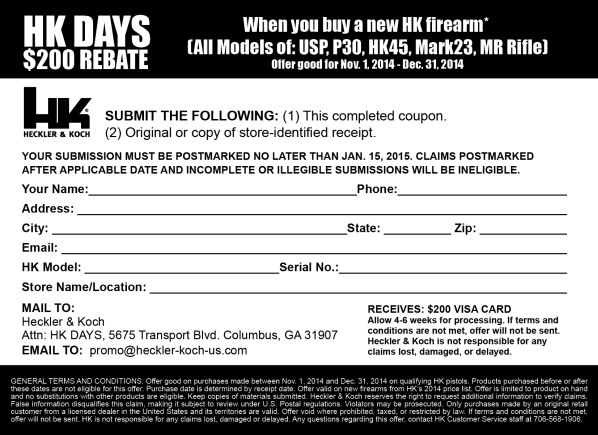
Two Hundred Bucks. A Pair of Benjamins. Now THAT’s a serious rebate. Save now with the HK Days Rebate Program. Here’s how it works. If you purchase a new, qualifying Heckler & Koch firearm, you will receive a Visa Card with $200.00 worth of built-in credit.
Heckler & Koch USA is offering the $200 VISA card with a new HK firearm purchased from November 1, 2014 through December 31, 2014. The offer covers new HK firearm models: USP, P30, HK45, Mark 23 (shown below), and MR rifles. These are very fine firearms. This Editor has owned two HK USPs in .45 ACP. They were both rugged and extremely accurate — accurate as in being able to put an entire magazine into a quarter-sized hole at 10 yards.
How to Get HK Days $200.00 Visa Card
NOTE: The eligible purchase period starts on November 1, 2014 (so you’ll have to wait at bit.) Retail customers need to complete a reply coupon and send it to Heckler & Koch along with a dated copy of their sales receipt. Coupon forms are available at most HK authorized dealers or can be downloaded at http://tiny.cc/HKDays. For more information, contact Heckler & Koch at 706-568-1906 ext. 6551, or send email to: promo [at] heckler-koch-us.com.
Imagine this — your “home security” handgun is stored safely and securely near your bedside. But with the simple swipe of a keyfob, card, or wristband, you have instant access to the gun. Sound like science fiction? Well, this is real. Hornady’s new RAPID Safe uses RFID (Radio Frequency Identification) technology to allow instantaneous access to a firearm using either a special card, an RFID bracelet, or a special keyfob. In addition, the safe can be opened using a programmed keypad or a traditional key lock.
Brownells.com already has this new product in stock. Watch the video to see how the RAPID Safe works. The system runs with 110 volt AC power or internal battery pack. This short video shows various opening modes:
Open your safe in the blink of an eye. Simply place the included RFID bracelet, card, or key fob over the reader, and the RAPiD™ safe springs open to present your handgun.
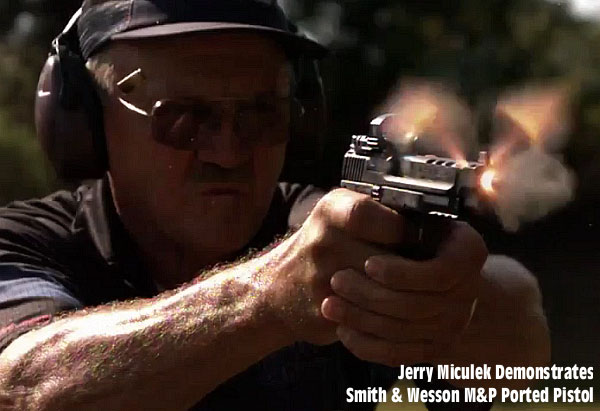
Smith & Wesson is introducing a new series of ported M&P pistols. Chambered in 9mm and .40 S&W, the Performance Center M&P Ported pistols offer a factory-ported barrel and slide. Both 4.25″ and 5″ barrel configurations are offered in each caliber. A special Performance Center sear provides a crisp 4.5-pound trigger pull with faster reset. The 9mm pistol has a 17+1 round capacity while the .40 S&W variant features a 15+1 round capacity. Both handguns (9mm and 40 S&W) have an MSRP of $812 with two magazines.
The ported design should help competitors, says pistol ace Jerry Miculek: “The two biggest advantages of running a ported gun in competition involve reduced muzzle rise and less perceived recoil. This [will] help with shorter split times and more rounds on target — two things every competitor wants.”
The new ported M&P pistols feature a slide-top platform for easy mounting of red-dot optics. These guns also have high-profile iron sights that can be used in conjunction with the optics. The M&P Performance Center Ported models also feature a textured interchangeable back strap. Three palmswell grips are supplied with each pistol, allowing shooters to custom-tailor grip size to their preference.
Video Shows Ported Pistol Features and 3D CAD Views:
The oldest remaining record in international shooting sports was the 581 score in 50m Free Pistol set way back in 1980 at the Moscow Olympics. After thirty-four long years, that record has finally been broken — by South Korea’s Jin Jong-oh. The South Korean, who earned gold medals in both the 2008 and 2012 Olympic Games, has been chasing this record for a long time, and now it is his. Congratulations to Jin Jong-oh. Well done!
Jin Jong-oh Shoots 583 in Free Pistol to Break 34-year-old Record
South Korean pistol ace Jin Jong-oh scored a combined 583 points on the way to winning the 50m Free pistol title in Granada on Tuesday. With his 583 score, Jin broke (by two points) the world record set by Russian Alexander Melentiev at the 1980 Olympics. This was the first individual world title for Jin, who won 50m pistol gold at the 2008 and 2012 Olympics and also added the 10m title at the London Games.
Records are “meant to be broken” they say. This was a long time coming. But Jin Jong-oh, the five-time Olympic medalist from South Korea, finally broke “The Record” — that historical 581-point world record set in 1980 by Alexander Melentiev of the USSR. Melentiev’s 50m mark was the longest-lasting shooting world record. Athletes from all over the world had been chasing that record for 34 years.
Yikes! Emmons’s Smallbore Match Rifles Lost in Paris…
Smallbore rifle events begin Wednesday with the Elimination Matches in Men’s Prone. Ready to compete is three-time Olympic medalist Matt Emmons, 2012 Olympian Michael McPhail, and Air Force Academy cadet David Higgins. A two-time Olympic medalist and three-time World Champion medalist in the event, Emmons arrived in Granada minus his two smallbore rifles courtesy of the Paris Charles De Gaulle airport, which seems to have lost or delayed many guns bound for the World Championships in Spain. Thankfully, Emmons has McPhail’s three-position gun available for the elimination. Emmons is familiar with that type of rifle so, hopefully, this will not be too great a set-back for Matt.
Just when you’ve thought you’ve seen everything… somebody comes up with a see-through revolver. Credit those wacky Brazilians at Taurus for this idea. We’re not sure why anybody needs a see-through side-plate on their carry-gun. Yes, this is innovative, but we suspect the clear-view Lexan® sideplate is more a marketing gimmick than a utilitarian feature.
Taurus Wheelgun Weighs Just Nine Ounces
Once you get over the novelty of the transparent side-plate, the main attraction of this wheelgun is its remarkably light weight. The Taurus 85 View weighs just 9 ounces unloaded. That makes it 40% lighter than a Smith & Wesson Model 642 Airweight Revolver, which weighs 15 ounces unloaded. For comparision, the Ruger LC9 pistol tips the scales at 17.9 ounces empty, while a Glock 19 weighs 23.65 ounces unloaded. So this little double-action-only (DAO) Taurus really is a feather-weight. The Taurus 85 View is offered with a silver finish or (cringe) a Pink Frame, presumably for the ladies.
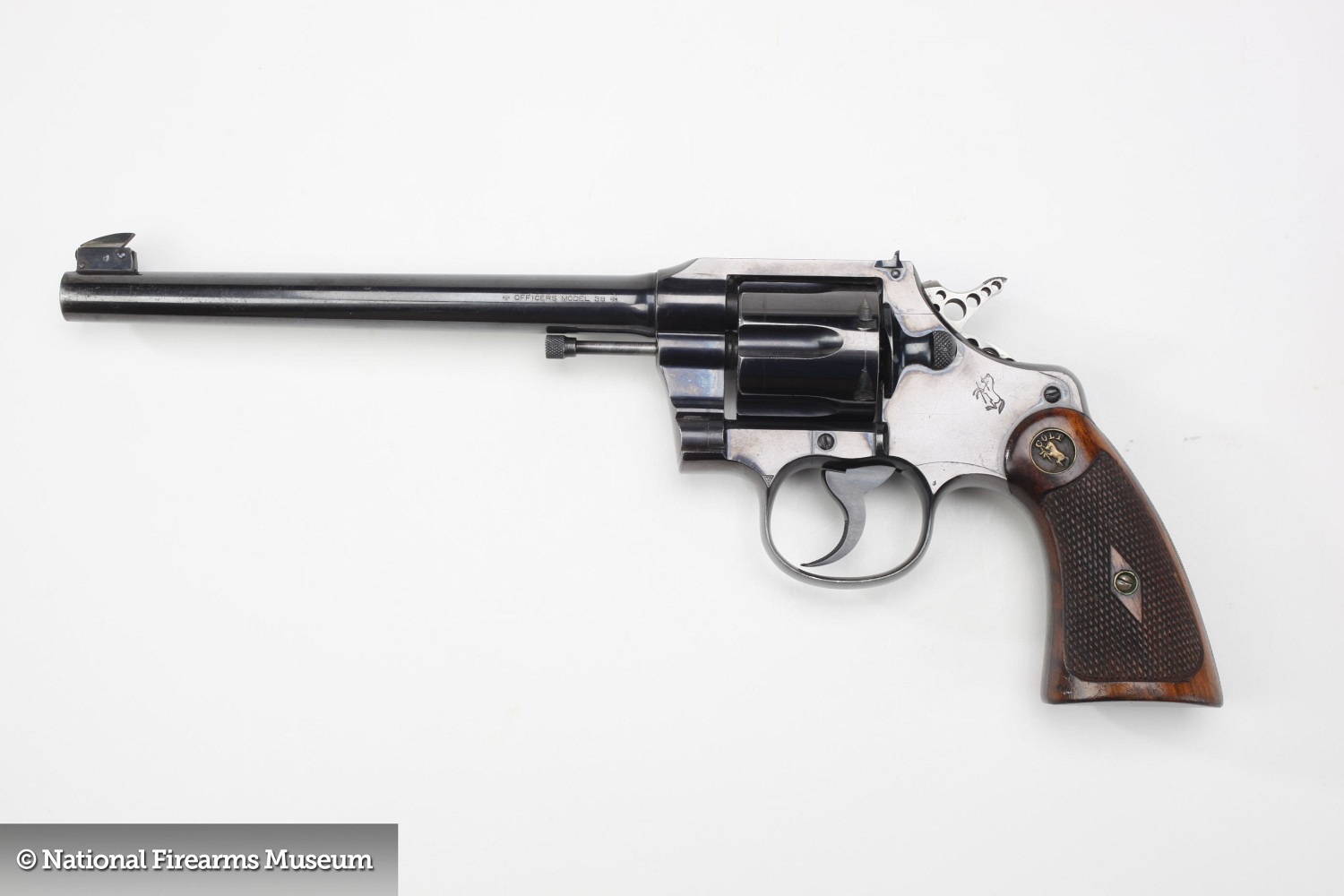
A.P. Lane’s Gold Medal-Winning Colt Revolver
This Colt Officer’s Model revolver, factory-fitted with a skeletonized hammer, belonged to legendary Olympic shooter A. P. Lane, who was known as the “Pistol Wizard”. Lane used this Colt Revolver to win FIVE Olympic Gold Medals — three in 1912 and two in 1920.
A.P. Lane was one of the greatest pistol shooters of his generation. He shot scores that were typically 25-50 points higher than those of his competitors. And he exhibited true Corinthian spirit. At the 1912 Olympics, Lane shared his match ammunition with another competitor who used that ammo to capture the Silver Medal (Lane won the Gold).
This revolver, factory-fitted with a skeletonized hammer, was used by American A.P. Lane in winning five Olympic Gold Medals in the 1912 and 1920 Olympic Games. It’s a .38 caliber, Officer’s Model centerfire revolver from the early 20th century. Olympian A.P. Lane’s Gun can be found in Gallery 13, Firearm Traditions for Today, at the NRA National Firearms Museum in Fairfax, Virginia. The Museum exhibit includes a panoply of Lane pieces – his revolver, his five Gold Medals, and the five Olympic certificates that went along with them.
Maybe the “R” in Remington’s 9mm R51 pistol stands for “recall”, or more accurately “replacement”. Responding to many complaints from pistol buyers (and some embarrassing videos posted on YouTube), Remington has offered to exchange the pistols: “Anyone who purchased an R51 may return it and receive a new R51 pistol, along with two additional magazines and a custom Pelican case, by calling Remington at (800) 243-9700.” The second generation R51 pistols should be available by late October, according to Remington.
So, if your R51 is a lemon, you can get a new one, presumably one that is more reliable. It’s good that Remington is “doing the right thing” for its customers. But one wonders why Remington would sell a product that was clearly “not ready for prime time”. Apparently the early test pistols worked well, but production versions had problems. Remington has issued the following statement:
Remington R51 Exchange
Earlier this year, we launched the innovative R51 subcompact pistol to critical acclaim. During testing, numerous experts found the pistol to function flawlessly. In fact, they found it to have lower felt recoil, lower muzzle rise and better accuracy and concealability than other products in its class.
However, after initial commercial sales, our loyal customers notified us that some R51 pistols had performance issues.
We immediately ceased production to re-test the product. While we determined the pistols were safe, certain units did not meet Remington’s performance criteria. The performance problems resulted from complications during our transition from prototype to mass production. These problems have been identified and solutions are being implemented, with an expected production restart in October.
Anyone who purchased an R51 may return it and receive a new R51 pistol, along with two additional magazines and a custom Pelican case, by calling Remington at (800) 243-9700.
The Original Remington Model 51
The Remington R51 pistol is a much updated version of the Remington Model 51, a 1917-18 design by John D. Pedersen. The original Model 51 was chambered for .380 ACP, and later .32 ACP. It had a very low bore axis, made possible by the Pedersen’s “hesitation lock design”. The Model 51 pointed very naturally, and with its low bore axis, muzzle flip and perceived recoil was less than with other pistols of similar size, weight, and caliber.
Like a blowback pistol, the original Remington 51 has a stationary barrel and recoil spring surrounding the barrel. However, the Remington 51 employed a unique locking breech block within the slide. When the Model 51 is in battery, the breech block rests slightly forward of the locking shoulder in the frame. When the cartridge is fired, the bolt and slide move together a short distance rearward powered by the energy of the cartridge.
When the breech block contacts the locking shoulder, it stops, locking the breech. The slide continues rearward with the momentum it acquired in the initial phase. This allows chamber pressure to drop to safe levels while the breech is locked and the cartridge slightly extracted. Once the bullet leaves the barrel and pressure drops, the rearward motion of the slide lifts the breech block from its locking recess through a cam arrangement, continuing the operating cycle. The Remington Model 51 was the only production pistol to utilize Pedersen’s type of operating system. However a prototype .45 ACP version, the Remington Model 53, was built for testing by the Navy Board.
Commentary by John Buol
The critics say that the M9 pistol (the U.S. military’s version of Beretta’s m92) must go. We’re told that the 9x19mm (aka 9mm NATO) is a poor pistol cartridge. Our Soldiers and Marines are being hampered by an inferior handgun and cartridge — or so the argument goes.
We are told that the military needs a new pistol, to be called the Modular Handgun System (MHS). According to Fox News: “The MHS would replace the Army’s inventory of more than 200,000 outdated M9 pistols and several thousand M11 9mm pistols with one that has greater accuracy, lethality, reliability, and durability.” The MHS will be a “total system replacement — new gun, new ammo, new holster, everything,” reports Daryl Easlick, Army project officer at Fort Benning, Georgia.
Easlick says that the Army, and other services, demand a pistol with a more powerful cartridge that does more damage to the bad guys: “We have to do better than our current 9mm.”
Does the military really need a new pistol, with a different chambering? Maybe not…
Here’s the real problem. Most Marines, Soldiers, police, and gun owners tend to be novice marksmen, especially with handguns. Very few people have trained to shoot a handgun well enough to offer a competent opinion on the matter. To underscore this point, let’s look at some ranges for evidence of typical skill levels.
Army Pistol Qualification Target
As you can see, there is no real trend in hits and the entire barn door (full sized silhouette) has shots sprayed all over it. And these are the shots that actually hit, all of them receiving full value. On this particular Army course, shooters are given 40 rounds to engage 30 targets and are considered qualified if 16 of the 30 targets are hit, somewhere. Soldiers can miss nearly half the time, even with ten extra rounds, and still pass. The “fast” stages of the course allow two seconds per shot and the bulk of the course is slower. Note the base of the target is blocked by the mound protecting the target lifter and that mound is a beaten zone of many very low, errant shots.
The Marines in the peanut gallery are likely chuckling, so let’s look at examples of their ranges.
Marine Pistol Target Bay
Yet Another Marine Pistol Target Bay, Showing Effects of Missed Shots.
The metal carrier behind the block wall holds a silhouette the same size as the Army target and that waist-high wall has taken a healthy beating from bad shots jerked and flinched several feet off target. Of course, the wall only shows shots pulled off target that went low. The rest ended up in the berm somewhere else. As seen closer up, the chewed-up top line of blocks is not made of concrete. That’s to avoid back-splatter towards the shooters from the excessive number of low shots.
REALITY CHECK: These are the results on actual qualification ranges with large targets, generous time limits, fixed courses of fire, and no real pressure. Imagine how much worse the shooting is when the stress and variables of combat are thrown in. Given the users wielding it, is the M9 truly ineffective? Even if it is, are shooters like this capable of a valid opinion on the matter?
Most Marines, Soldiers, police, CCW, and gun owners won’t invest the effort needed to train to a high level of skill and very few public sector organizations will expend the resources needed to make them do so. I’m not casting aspersions, just trying to address reality. If the Department of Defense (DoD) decides on a new pistol, or any other weapon, the results will be similar because the end user isn’t magically more skillful with a shiny new issue item.
About the Author
John M. Buol Jr. began his shooting career in practical competition, earning Master classifications from USPSA and IDPA. After slotting on the Army Reserve Marksmanship Program, he switched to NATO and NRA/CMP events, earning Distinguished Rifleman and Pistol Shot badges and a series of All Army Small Arms Championship wins along the way. He is a published author (Beyond “Expert”: Tripling Military Shooting Skills) and maintains the Firearm User Network Blog at http://FirearmUserNetwork.com
In the real world of self-defense, you can’t stand still like a bullseye target shooter*. You may need to move to cover, go to the aid of a family member, or otherwise move while being able to shoot. We’ve seen a variety of “move and shoot” drills, but most involve walking a few steps, then stopping, then moving again.
Here’s a drill that raises the degree of difficulty to another level entirely. In this video, instructor Dave Harrington engages 24 targets (one with a double-tap), while striding briskly (and continuously) on a powered treadmill. That’s right, Harrington stays on the treadmill for nearly a minute, and goes 25 for 25 with two (2) mag changes. (Shots 7 and 8 are a silhouette double-tap, for a total of 25 shots.) Harrington makes it look easy. But do you think you pull this off with no misses?
Shooting from Treadmill — Firing Sequence Starts at 1:20
Our friend Dennis Santiago, who also is a firearms instructor, says Harrington’s treadmill drill is no mean feat: “OK, this I am impressed by. This is not easy.” Another viewer commented: “That, I assure you, is a whole lot harder than it looks to run it clean like [Harrington] did.” As Harrington notes, a treadmill “is extremely unforgiving … you either possess the skill or the treadmill will take you to school.”
*That’s no knock on our bullseye shooters. They are very skilled. However, self-defense is a different challenge altogether.


 First Handgun Choice — A very good choice for a first handgun is a Smith & Wesson .22 LR revolver, such as the S&W model 617. The model 617 is extremely accurate, with a very crisp trigger (in single-action mode), and good sights.

 Imagine this — your “home security” handgun is stored safely and securely near your bedside. But with the simple swipe of a keyfob, card, or wristband, you have instant access to the gun. Sound like science fiction? Well, this is real. Hornady’s new RAPID Safe uses RFID (Radio Frequency Identification) technology to allow instantaneous access to a firearm using either a special card, an RFID bracelet, or a special keyfob. In addition, the safe can be opened using a programmed keypad or a traditional key lock.

 Video Shows Ported Pistol Features and 3D CAD Views:


 A.P. Lane’s Gold Medal-Winning Colt Revolver