|
|
April 22nd, 2009
The latest CDNN Catalog has some great long-gun bargains. Here are two specials that caught our Editor’s eye. To view the CDNN catalog, visit www.cdnninvestments.com, then click the link to download the 2009-1 Catalog in .pdf format. To place an order, call 800-588-9500.
Winchester 22LR Sporter — $189.99
Looking for a “first rifle” for a young family member? This little Winchester could fit the bill. A friend of ours recently purchased one for his nephew and it’s proven to be a very nice little rifle for the money. NOTE: In the catalog pages the price is listed as $179.99, but the current price is $189.99. That’s still a great deal, and the price includes four magazines.

FN Patrol .308 (with box mag) — $599.00
If you’re looking for a good basic .308 Win rifle for hunting or tactical matches, the FN Patrol is a great value at $599.00. This rifle comes with a Hogue synthetic stock with full-length aluminum bedding block and dual front sling swivels. The action is fitting with a mil-spec Picatinny scope rail on top, and a 4-round detachable box magazine (DBM) is provided. You can select from four different barrel lengths: 18″, 20″, 22″, and 24″. We recommend the 24″ for tac matches. Hunters may prefer a shorter tube to save weight. If you prefer to mount a custom barrel or stock, CDNN is offering FN SPR short actions for just $349.00. This includes trigger group (with safety), Picatinny Rail on top, bottom metal, recoil lug, AND the 4-round box magazine. If you’re looking to build a low-cost custom tactical rig, this could be a great way to go.
April 9th, 2009
All turkey, all the time — that’s the concept behind turkey.realtree.com the new turkey hunting website created by Realtree. This content-rich site contains tons of info for turkey hunters, including gear reviews, hunting reports, video clips, and even a turkey trivia game. The gear archives cover everything a turkey hunter needs: firearms, clothing, footwear, decoys, turkey calls, and shooting accessories.

HD Video Webcasts of Real Turkey Hunts
The new website boasts impressive HD (high-definition) video content on “Turkey Television”. You’ll find multiple high-quality archived hunting videos. Each Friday the “Daybreak” webcast will feature a “semi-live” turkey hunt followed by a segment on the latest turkey hunting guns and gear. You can also download video “podcasts” to your home computer or media player. Topics include: Selecting the Right Turkey Gun, Choosing Turkey Optics, Sighting-In a Shotgun, and Mounting A Scope (or Fiber Optic Sights).
March 28th, 2009
 In an official press release dated March 10, 2009, the National Park Service (NPS) announced its intention to ban all lead bullets, lead-containing ammunition, and lead fishing tackle in the lands under NPS control. National Park Service director Dan Wenk stated: “Our goal is to eliminate the use of lead ammunition and lead fishing tackle in parks by the end of 2010. We want to take a leadership role in removing lead from the environment.” In an official press release dated March 10, 2009, the National Park Service (NPS) announced its intention to ban all lead bullets, lead-containing ammunition, and lead fishing tackle in the lands under NPS control. National Park Service director Dan Wenk stated: “Our goal is to eliminate the use of lead ammunition and lead fishing tackle in parks by the end of 2010. We want to take a leadership role in removing lead from the environment.”
Well, it looks like the NPS was not prepared for a firestorm of criticism. This week it back-peddled, issuing another press release stating that there would be no actual lead ban affecting the general public.
National Park Service Clarifies Lead Ammo Policy
Faced with pressure from groups representing hunters and anglers, and criticism from some politicians, the Park Service has disavowed its stated policy to ban lead ammo and lead fishing tackle by 2010. Now the Park Service is saying that it was “misunderstood”. Last week the Park Service issued a “clarification”, stating that the proposed lead restrictions would only apply to Park Service employees and projects. Duly chastened, the NPS pledged to seek input from hunters, anglers, and other interested parties. No future ban on lead ammo or tackle will be imposed without “public involvement, comment, and review”. Here are the key points in the latest NPS release:
“1. Nothing has changed for the public. We are simply announcing the NPS goal of eliminating lead from NPS activities to protect human and wildlife health.
2. We will work to clean our own house by altering NPS resource management activities. In 2009, we will transition to non-lead ammunition in culling operations and dispatching sick or wounded animals.
3. In the future, we will look at the potential for transitioning to non-lead ammunition and non-lead fishing tackle for recreational use by working with our policy office and appropriate stakeholders/groups. This will require public involvement, comment, and review.”
March 16th, 2009
 In an official press release dated March 10, 2009, the National Parks Service (NPS) announced its intention to ban all lead bullets, lead-containing ammunition, and lead fishing tackle in the lands under NPS control. In an official press release dated March 10, 2009, the National Parks Service (NPS) announced its intention to ban all lead bullets, lead-containing ammunition, and lead fishing tackle in the lands under NPS control.
According to acting National Park Service director Dan Wenk: “Our goal is to eliminate the use of lead ammunition and lead fishing tackle in parks by the end of 2010. We want to take a leadership role in removing lead from the environment.”
The NPS announcement has drawn scathing criticism from groups representing hunters and anglers. The National Shooting Sports Foundation called the decision “arbitrary, over-reactive, and not based on science”. According to the NRA’s Institute for Legislative Action, the NPS lead ban “would needlessly push hunters to use more costly bullets made of tungsten, copper, and steel. The restrictions, set to take affect by the end of 2010, were announced without regard to science and without soliciting feedback from sportsmens’ groups.”
Outdoor groups were blind-sided by the NPS policy change, as the Park Service made no effort to consult hunters and fishermen before instituting the “no-lead” policy. “The NPS announcement demonstrates either complete ignorance or complete arrogance as to the effect that this policy will have on hunters,” said NRA-ILA Executive Director Chris W. Cox. “There is no science to support NPS’s contention that the use of lead ammunition in hunting is causing environmental contamination, having a negative effect on wildlife, or posing a threat to the health of visitors or park staff. This policy, and the lack of communication in advance with the sportsmen’s community, is a deliberate attempt to reduce the number of people who will want to hunt in the 60 parks that are open to hunting.”
With the Park Service lead ban be fully implemented as planned? We’ll have to see whether the chorus of criticism can derail the NPS policy. Jim Shepherd of the Outdoor Wire writes: “When the National Park Service decided to ban lead in fishing tackle and ammunition from properties under their control, they probably thought this was another of their little surprises that would stay under the radar. Instead, they’ve found themselves justifiably pilloried by a wide array of organizations representing the hunting and fishing communities and several state legislatures who find their capricious rule-making more than a little offensive.”
March 9th, 2009
Here’s a pretty cool offer. If you purchase two (2) boxes of CCI rimfire ammo, CCI will send you a FREE T-shirt (well, almost free… you do have to pay $3.95 for shipping). The T-Shirt is a handsome dark green color. On the back is the white outline of a dead prairie dog. Over the outline runs a broad yellow stripe, like the tape that police use to cordon off a crime scene. It’s a clever concept and the graphics are nicely done.

CLICK HERE to Download T-Shirt Offer COUPON.
How to Get Your T-Shirt
You must purchase at least two (2) boxes of CCI rimfire ammunition between April 1 and June 30, 2009. Then you need to fill out a coupon, and send it in, along with your original purchase receipt, and the UPC (universal product code) from the ammo boxes. The coupon, receipts, UPCs, AND $3.95 for shipping must be received by CCI no later than July 31, 2009. Mail everything to the address below. Please allow 4-6 weeks for delivery.
Mail Coupon, Ammo Sale Receipts, UPCs and $3.95 to:
CCI T-Shirt Offer
Dept. 6135
P.O. Box 5009
Stacy, MN 55078-5009
March 9th, 2009
 Interior Secretary Ken Salazar, affirming a decision of the U.S. Fish and Wildlife Service (USFWS), has removed the gray wolf from protection under the Endangered Species Act (ESA). However, this ONLY applies to Idaho, Montana, the Western Great Lakes, and some (but not all) areas of Washington, Oregon, and Utah. Wolves in other parts of the 48 states, including the Southwest states, remain endangered and are not affected by Salazar’s ruling. Wolf hunters should check carefully to ensure that the area(s) where they intend to hunt are not subject to ESA controls. Wolves in Wyoming remain specifically protected. Interior Secretary Ken Salazar, affirming a decision of the U.S. Fish and Wildlife Service (USFWS), has removed the gray wolf from protection under the Endangered Species Act (ESA). However, this ONLY applies to Idaho, Montana, the Western Great Lakes, and some (but not all) areas of Washington, Oregon, and Utah. Wolves in other parts of the 48 states, including the Southwest states, remain endangered and are not affected by Salazar’s ruling. Wolf hunters should check carefully to ensure that the area(s) where they intend to hunt are not subject to ESA controls. Wolves in Wyoming remain specifically protected.
Hunters are advised to wait before planning a hunt. Salazar’s ruling could be stalled by litigation from environmental groups. The Sierra Club has announced: “Aggressive wolf-killing practices, coupled with genetic isolation and plans to institute hunts in Idaho and Montana, could push wolf numbers dangerously low and reverse decades of recovery work. The Sierra Club, along with other conservation groups, plans to challenge the wolf delisting decision in court.”
Praise for Interior Secretary’s Decision
Safari Club International President Merle Shepard hailed the announcement, saying “This decision is the right one and we commend Secretary Salazar for reaching it so quickly. Delisting the gray wolf came about as a result of years of effort involving the states, tribes, landowners, academic researchers, sportsmen and other conservation groups, the Canadian government and many other partners.”
In making the announcement, Secretary Salazar reviewed the numbers behind the decision. “When it was listed as endangered in 1974, the wolf had almost disappeared from the continental United States. Today, we have more than 5,500 wolves, including more than 1,600 in the Rockies,” Salazar said. Gray wolves were previously listed as endangered in the lower 48 states, except in Minnesota where they were listed as threatened. The USFWS oversees three separate recovery programs for the gray wolf; each has its own recovery plan and recovery goals based on the unique characteristics of wolf populations in each geographic area.
March 4th, 2009
Forum regular Aaron H. (aka “6BR”) has been having great success in the California varmint fields with “Orange Crush”, his super-accurate 6BR rifle. Aaron recently posted his experiences with various laser rangefinder (LRF) types, and field binoculars. While there’s plenty of information available on LRFs, including our own Laser Rangefinder Comparison, it’s harder to find good info on binoculars from the perspective of a varmint hunter. Aaron looked at a variety of premium binoculars, and ended up choosing the 15×45 Zeiss Conquest, after careful consideration.

Choosing the Right Binoculars for Long-Range Varmint Hunting
Aaron writes: “[It] was a hard undertaking to pick the right pair. I decided I wanted a high magnification pair of binos in the 10x to 15x range. I narrowed my choices down to Zeiss, Swarovski, Leica, or Nikon. I was sure I was going to buy the Swarovskis when I started comparison shopping. However, I was wrong… I ended up getting a pair of the Zeiss 15×45 Conquests.”
 
Aaron reports: “The clarity of the Zeiss binos is awesome. I am glad I took the time to look through each and every pair before I bought. I was also impressed with the Nikon Monarch ATB; for the price, they are impressive. The Swarovskis were awesome too. However, through my eyes, the Zeiss clarity was better.”
The Zeiss 15×45 Binoculars are fairly expensive. At most places they go for about $1100.00 (see chart below), but you can find some better deals. Aaron tells us: “I had to sell other firearms to be able to afford the Zeiss binos and a Swaro 8×30 LRF. If you decide to shoot varmints, at long range, you’ll find out very quickly how important it is to have quality optics. When you spend a bunch of time looking through binoculars, it can become very hard on the eyes. So the better quality binoculars you have, the more comfortable you’ll be during your varmint hunt. I learned the hard way during the beginning years of long range varminting, and I realized how important it is to have quality optics.”
Nikon Monarch ATB Offers Great Performance for the Price
Aaron was impressed with the Nikon ATBs, given their low cost. But Aaron cautions: “It’s very important to go look through the binos before you buy a pair. Had the Zeiss 15×45 Conquests not been so remarkably clear, I probably would have bought a pair of the Nikon Monarch ATBs. If you need a pair of binoculars and you can’t afford the higher end binoculars, I would highly recommend the Nikon Monarch ATBs, offered in both 10-power and 12-power. I would have to say, and I am not making this up, they were close to the clarity of the higher-end binos. I also looked through a pair of the Leupold Golden Ring binos. They are nice, however, I felt the clarity of Nikons were much better and the price was much cheaper.” [Editor: The Nikon 10x42mm and 12x42mm Monarch ATBs retail for about $290.00 and $330.00 respectively at discount vendors such as B&H Photo.]

Aaron added: “One more thing, I am stating my own opinion on what I think works best for me. Another brand of optics might work better for someone else. I don’t want to offend anybody or imply that other brands are bad, I just wanted to give my experience with what I use and have had success with.”
Tips for Holding Binoculars Steady
Nate Haler, another Forum member, offered this advice about high-magnification binoculars: “Unless you are using a tripod or other mechanical support for a binocular, 15x magnification is too much. Image tremble will be much more problematic when trying to hand-hold a binocular of such high magnification. Furthermore, the exit pupil (i.e. the little circle of light transmitted to the ocular lens) will be only 3mm in a 15×45 binocular, which means 15x magnification and a 45mm objective lens. Exit pupil enables you to see the image better or worse in low light. 7mm exit pupil is about as big as a healthy human eye in a young adult can dilate. Smaller than that, and the image is dimmer.”
Editor’s Comment: Nate makes some very good points, but we would add that you can rest your binoculars on a pack or sandbag, or use an inexpensive tripod or bracket to hold the binoculars steady. Zeiss also makes a 12-power version of the binoculars Aaron favored. This editor has used 12x binoculars in the field without difficulty, but you definitely have to learn to “hold steady”. One technological solution is built-in image stabilization. Canon has a series of image-stabilized binoculars (8x, 10x, 12x, 15x, and 18x), and they work very well. The 15×50 is shown below. Regarding the 3mm exit pupil, yes a bigger exit pupil is better in low light, but 3mm should be adequate for daytime hunting. Keep in mind that a shooter using a 25-power riflescope will be looking through an exit pupil that’s 2mm or smaller.

Geovid All-in-One Option (Rangefinding Binoculars)
The Leica Geovid binoculars are another option for hunters. These combine great glass with a built-in Laser Rangefinder. That way you only need one optic for both game spotting and rangefinding. Aaron considered the Geovid option, but it didn’t offer any money savings compared to purchasing binoculars and LRF separately. Additionally, he felt that his Swaro 8×30 rangefinder out-performed the LRF in the Geovids. “The Leica Geovids are excellent. They are just so darn expensive. I think they start around $2600 for the 8×42 and go up to $3300 for the 15×56 pair. I would still choose the Swaro 8×30 LRF over the Geovids. Why? Because the Swaro out-ranges the Geovids by 300 yards and the Swaro is $1600 cheaper. That leaves a lot of cash left over for good binoculars.”
February 25th, 2009
There are many television shows about hunting. But the Freedom Hunters series, we believe, deserves special recognition. Freedom Hunters arranges “once-in-a-lifetime” outdoor hunting adventures for American military combat veterans. Footage from these hunting trips, along with background stories on the service men and women chosen for the hunt, are packaged into weekly cable broadcasts. Click the image below to visit Freedom Hunters’ Video Archive. There, click on the “PFC Josh Reilly” link to view great clips from a Wyoming hunt.

Freedom Hunters Seeks Female Veteran for Wyoming Pronghorn Hunt
Freedom Hunters is looking to present an all-expense-paid Wyoming pronghorn hunt to a female veteran. Freedom Hunters producers are specifically looking for women who have served in Afghanistan or Iraq. The hunt will be guided by Llano Outfitters (Casper, WY, 307-235-4865), one of Wyoming’s premier elk, deer and pronghorn outfitters. The hunt will take place in late October 2009. Applications must be received by March 15, 2009.
The woman selected to participate in this hunt will receive gifts from product sponsors and will be featured on a future episode of the Freedom Hunters television show. Those interested in applying for this opportunity should apply via the Freedom Hunters’ Application Page on the web.
Freedom Hunters is a 501(c)3 charitable organization serving the American military family. It is dedicated to honoring those who protect our freedoms. For more information about Freedom Hunters Programs, visit FreedomHunters.org or e-mail info [at] freedomhunters.org. Freedom Hunters airs Fridays at 4:00pm MST on the Altitude Sports and Entertainment network.

February 24th, 2009
 On LongRangeHunting.com, you’ll find a good article about wind reading by Shawn Carlock. Shawn Carlock is a veteran law enforcement marksman and the current USPSA national precision rifle champion. Shawn offers good advice on how to estimate wind speeds and directions using a multitude of available indicators — not just your wind gauge: “Use anything at your disposal to accurately estimate the wind’s velocity. I keep and use a Kestrel for reading conditions….The Kestrel is very accurate but will only tell you what the conditions are where you are standing. I practice by looking at grass, brush, trees, dust, wind flags, mirage, rain, fog and anything else that will give me info on velocity and then estimate the speed.” On LongRangeHunting.com, you’ll find a good article about wind reading by Shawn Carlock. Shawn Carlock is a veteran law enforcement marksman and the current USPSA national precision rifle champion. Shawn offers good advice on how to estimate wind speeds and directions using a multitude of available indicators — not just your wind gauge: “Use anything at your disposal to accurately estimate the wind’s velocity. I keep and use a Kestrel for reading conditions….The Kestrel is very accurate but will only tell you what the conditions are where you are standing. I practice by looking at grass, brush, trees, dust, wind flags, mirage, rain, fog and anything else that will give me info on velocity and then estimate the speed.”

Shawn also explains how terrain features can cause vertical wind effects. A hunter positioned on a hilltop must account for bullet rise if there is a headwind blowing up the slope. Many shooters consider wind in only one plane — the horizontal. In fact wind has vertical components, both up and down. If you have ever piloted a small aircraft you know how important vertical wind vectors can be. Match shooters will also experience vertical rise when there is a strong tailwind blowing across an up-sloping berm ahead of the target emplacements. Overall, Shawn concludes: “The more time you spend studying the wind and its effect over varying terrain the more successful you will be as a long-range shooter and hunter.”
February 12th, 2009
Site contributor Chris Long (aka “TechShooter”) has crafted a report about his July, 2007 Prairie Dog Expedition in Wyoming. Ralph and Lenora Dampman of Trophy Ridge Outfitters served as guides for the trip. Trophy Ridge runs ‘Dog hunts near the town of Carlile in the NW range of the Black Hills, near Devil’s Tower National Monument. Primarily big game outfitters, Ralph and Lenora have access to thousands of acres of private ranch land. They run guided prairie dog hunts during their off-season. Chris reports “The terrain is beautiful, a welcome change from the South Dakota prairie, with lots of hills and Ponderosa pine trees. [These] ranch lands are home to some prodigious dog towns.”
Chris continues: “The goal of this trip (besides having a great time) was to get in some long range (1000+ yard) opportunities, and possibly even a shot over 1500 yards, in order to qualify for the VHA 1500 yard certification. I had worked up some really good loads for the 6.5-284 TubeGun and the .260 AI using the new 130 grain Berger VLDs, and wanted to see how they performed at these extreme ranges. I also wanted to see how the trusty 6 Dasher performed as a long range varmint cartridge.”
Chris Long was joined by two friends who came all the way from Virginia. Chris reports, “Our plan was to get in four days of intense, long-range shooting. We were not disappointed! The shooting was from 100 to over 1000 yards, and the dogs were everywhere. There were plenty of targets close in, so there was a lot a variety. It is especially challenging to move in and out in range by these extreme amounts. It gave me a lot of practice estimating range and wind conditions, then seeing if I could get the come-ups and windage right on the scope for the first shot at the new range. By the end of the trip, I was getting it pretty close, with some 1-shot hits out to about 600 yards.”

Chris’s primary long-range rifle was his 6.5-284 Tube-gun (photo above) running 130gr Berger VLDs at 3165 fps. Chris reports the 130s can be shot at 3165 fps with no excessive pressures, and “scary, one hole, 5-shot 100-yard group accuracy.” With a B.C. of about 0.6, the 130s shoot flatter and exhibit less wind drift than the 140gr class bullets at 2950 FPS.
Chris’s second gun was a more conventional bolt-action in a Franklin LowRider stock, set up with both 6mm Dasher and .260 AI barrels. Chris notes: “The Dasher has proven itself in spades as an extremely accurate cartridge for F-Class Open competition, and I was anxious to see how it performed as a varmint cartridge. The performance was excellent, with many hits out past 1000 yards. This rifle is set up as a switch-barrel rig, and is the platform for the 260 AI. I made a portable barrel vise that mounts in the trailer hitch receiver on the Suburban. That, with a rear entry action wrench, makes barrel changes a 5 minute affair. I would shoot until the barrel got a bit hot, then switch and proceed with the other caliber.”
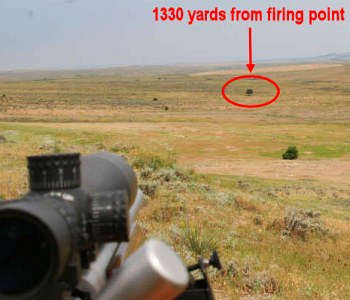
CLICK HERE to read the complete story. It contains more load data, details of hits made out to 1330 yards, and many great photos of the Wyoming scenery. For .260 AI and 6 Dasher tech tips, visit TechShooter’s Shooting Pages.

Photos and quotes copyright © 2007 Chris Long, All Rights Reserved, used by permission.
|


