This impressive war wagon hauls varmint hunters around the Longmeadow Game Resort in Colorado.
When you’re on a varmint expedition in the Western states you can bet, sooner or later, you’ll encounter serious winds. Here’s some advice on how to minimize the effects of cross-winds on your shooting, and easily improve your percentage of hits. In essence, you want to use your ability to change shooting positions and angles to put the wind behind you.
A benchrest or High Power shooter must operate from a designated shooting position. He must stay put and deal with the wind as it moves across the course, from whatever direction it blows.
Put the Wind at Your Back
By contrast, a varmint hunter can move around and choose the spot that provides the most favorable wind direction. In most cases you’ll get the best results by moving your shooting position so the wind is at your back. This will minimize horizontal wind drift. Once you’re in position, use wind flags to direct your fire in line with the prevailing winds. A varminter who calls himself “Catshooter” explains:
The String of Death
I remember the first time I was on a dog town in the Conata Basin, in the Badlands area of southwestern South Dakota. Along with two other guys, I drove out for 21 days of shooting, and I never saw wind like that before. If all four tires of our vehicle were on the ground, the weather man said these were “mild wind conditions”.
After the first four or five days, we got smart. We would park the truck on the up-wind side of the town so the wind was at our back. Then we took a piece of string on a 3-foot stick, and set it in front of the shooters, and let the string point at the mounds that we were going to shoot.
For the rest of the trip, we didn’t have to deal with wind drift at all. We just shot the dogs that the string pointed to. We started calling our simple wind pointer the “String of Death”.
We were hitting dogs at distances that I would not repeat here (with benchrest grade rifles). After the first time out, I always took a wind rig like that.
Benefits of Swivel Benches
In a large varmint field, you’ll want to orient your shooting position to put the wind at your back if possible. If you have a rotating bench such as this, you can further adjust your shooting orientation to work with the wind, not against it. You may also want to position simple flags (posts with colored tape) downrange to alert you to wind changes you may not notice from your shooting positions.
Do you have .20-Cal fever? Do you yearn to see what a 4200+ fps projectile can do to an unsuspecting prairie dog? Well you could go out and purchase a 204 Ruger rifle, fork over the money for a new, complete die set, and hope that the brass is in stock. Warren B (aka “Fireball”) has a more cost-effective solution. If you have .223 Rem dies and brass, all you need to shoot the 20 Practical is a new barrel and a .230″ bushing to neck down your .223 cases. Warren’s wildcat is simple, easy, and economical. And the 20 Practical matches the performance of the highly-publicized 20 Tactical with less money invested and no need to buy forming dies or fire-form cases. Warren’s cartridge was aptly named. Practical it is.
20 Practical Tikka Bolt Action for Varminting
by Warren B (aka “Fireball”) and Kevin Weaver
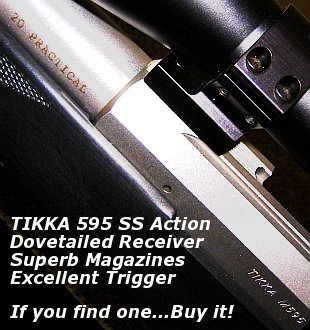
After building my 20 PPC, I wanted to do another .20 caliber, this time a repeater for predator hunting that could also serve as a gopher/prairie dog rifle. I wanted to use a Tikka M595 stainless sporter I had. This rifle is the ultimate repeater with an extremely smooth-feeding cycle from its single-column magazine. Since the Tikka was a .223 Remington from the factory, I first looked at possible case designs that would fit the magazine. The 204 Ruger was a very new round at the time and brass was scarce. I also didn’t care for the overly long case design or the standard throat dimensions of the cartridge. I then looked at the 20 Tactical. It was a nice cartridge but I didn’t like the fact that (at the time) an ordinary two-die Tac 20 set with just a plain full-length die and standard seater were $150. Not only did the costs bother me, but I was accustomed to using a Redding die set featuring a body die, a Type-S bushing neck die, and a Competition seater. To be honest, I also didn’t care for the 20 Tactical’s name–there is absolutely nothing tactical about the cartridge. I didn’t want to adopt a new cartridge based on what I perceived to be a marketing gimmick (that “tactical” title).
Warren B, aka “Fireball”, with his Tikka 595. With its smooth action and phenolic single-column mag, it cycles perfectly in rapid fire.
Simply Neck Down .223 Rem to Make a 20-223 Wildcat
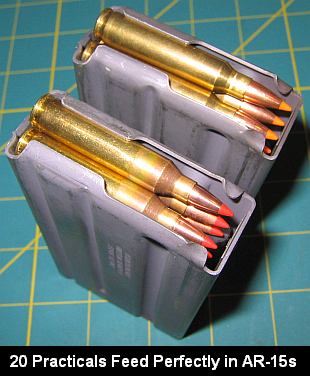
I decided the best thing to do for my purposes was to simply neck down the .223 Rem case and make a 20-223. I already had the dies, the brass, and a rifle that would feed it perfectly. I decided to call the cartridge the 20 Practical because as you will see in this article, it truly is a very practical cartridge. In addition to the generous and inexpensive availability of brass and dies, the 20 Practical is an easy case to create, requiring no fire forming as a final step. Simply neck your .223 Rem cases down, load and shoot.
[Editor’s Note: Over the years, other shooters have experimented with .223 Remington cases necked down to .20 caliber, some with longer necks, some with different shoulder angles. Warren doesn’t claim to be the first fellow to fit a .20-caliber bullet in the .223 case. He gives credit to others who did pioneering work years ago. But he has come up with a modern 20-223 wildcat that involves no special case-forming, and minimal investment in dies and tooling. He commissioned the original PTG 20 Practical reamer design, and he and Kevin did the field testing to demonstrate the performance of this particular version.]
I chose Kevin Weaver at Weaver Rifles to fit and chamber the barrel to my rifle. Kevin does excellent work and is great to work with. Kevin liked the idea of the 20 Practical so much he agreed to purchase the project reamer. (BTW Kevin didn’t even need to purchase a Go/No-Go gauge, he just used an existing .223 Rem gauge.)
Before Kevin ordered the reamer, I talked over the reamer specs with him. My priorities were tolerances on the tight end of the .223 Rem SAAMI specification, a semi-fitted neck with no need for neck-turning, and a short throat so that we could have plenty of the 32gr V-Max in the case and still touch the lands. I also wanted this short throat in case [anyone] wanted to chamber an AR-15 for the 20 Practical. A loaded 20 Practical round will easily touch the lands on an AR-15 while fitting into the magazine with no problem. With its standard 23-degree shoulder, the 20 Practical case also feeds flawlessly through an AR-15.
As for the barrel, I only use Liljas on my rifles. I have had great luck with them. They have always shot well and they clean up the easiest of any barrels that I have tried. I had previously sent my Tikka barreled action to Dan Lilja so that he could program a custom contour into his equipment and turn out a barrel that would perfectly fit the factory M595 sporter stock. There isn’t much material on an M595 sporter stock so the contour had to match perfectly and it did. Dan Lilja now has this custom contour available to anyone who would like to rebarrel their M595 sporter with one of his barrels.
There Are Plenty of Good .204-Caliber Varmint Bullet Options
How to Form 20 Practical Cases — Simple and Easy
Forming 20 Practical cases is very easy. No fire-forming is required. Start with any quality .223 Rem brass. Then simply run the case into your bushing die with the appropriate bushing and call it done.
Project Componentry
My 20 Practical rifle started out as a Tikka Model 595 Stainless Sporter in .223 Remington. Though the M595 is no longer imported, if you shop around you can find M595 Sporters for bargain prices. Mine cost under $500. I think the action alone is worth that! The receiver has a milled dovetail for scope rings plus a side bolt release like expensive BR actions. The bolt cycles very smoothly. Ammo is handled with super-reliable 3- or 5-round detachable single-column magazines (FYI, Tikka’s M595 22-250 mags will feed a 6BR case flawlessly.) We kept the standard Tikka trigger but fitted it with a light-weight spring. Now the trigger pull is a crisp 1.8 pounds–about as good as it gets in a factory rifle. We replaced the factory tube with a custom, 24″, 3-groove Lilja 12-twist barrel. Dan Lilja created a special M595 sporter contour to allow a perfect “drop-in” fit with the factory stock. For optics, I’ve fitted a Leupold 4.5-14x40mm zoom in low Talley light-weight aluminum mounts. All up, including optics and sling, my 20 Practical weighs just under 8.5 pounds.
Test Report–How’s It Shoot?
I sent the barrel and barreled action to Kevin and in a very short time it was returned. Kevin did a perfect job on the rifle. I had asked him to try to match the bead blasted finish of the Tikka when he finished the new barrel. It came out perfect and the only way one can tell it is a custom is the extra two inches of length and the “20 Practical” cartridge designation.
So, no doubt you’re asking “how does she shoot?” Is my “prototype”, first-ever 20 Practical an accurate rig? In a word, yes. Even with the standard factory stock, and light contour barrel, it can shoot 3/8″ groups. Take a look at the typical target from this rifle. This is from an 8.5-pound sporter with a very skinny fore-end and a factory trigger.
Gunsmith’s Report from Kevin Weaver The 20 Practical: Origins and Development
Editor’s NOTE: We can’t say for sure who first necked down the .223 Rem to .20 caliber and chambered a rifle for that wildcat (as opposed to the .20 Tactical). But here is an account from way back in 2006 when the Warren B first came up with the idea of a .20 Practical cartridge, complete with reamer specs.
A year ago I received a call from Warren with a great idea. Warren asked “Why couldn’t we simply neck down the .223 Remington case to 20 caliber and get basically the same performance as the 20 Tactical? This way you can forgo the expensive forming dies that are needed for the 20 Tactical.” The idea made perfect sense to me, and I saw no major technical issues, so we got started on the project. I ordered a reamer from Dave Kiff at Pacific Tool & Gauge (PTG) with a .233″ neck. The .233″ neck should allow for a simple necking-down of the 223 Remington case to produce the 20 Practical in just one step. No fire-forming necessary! Furthermore, the PTG 20 Practical reamer Dave created should work with any available .223 Rem brass, commercial or military.
The first 20 Practical round was launched down range (through Warren’s Tikka) just a few months later. The brass formed as easily as expected. All one needs is a Redding type “S” bushing die with a .230 bushing and with just one step I had a .20 caliber case ready to shoot. Warren is brilliant. [Editor’s Note: We concur. For more details on Warren’s case-forming methods and his tips for adapting .223 Rem dies, read the technical sections further down the page.]
It would be almost six months later until I got around to building a dedicated test rifle chambered for the 20 Practical. I used a Remington 722 action, Remington synthetic semi-varmint stock, and a 24″ Douglas stainless steel XX 12-twist barrel. I formed and loaded about 30 cases using Remington brass in about 20 minutes. I used a .223 Rem seating die to seat the 20 Practical bullets. The .223 seating stem seated the small 20-Cal bullets just fine. The first loads sent the 40gr Hornady V-Max bullets down range at a modest 3500 FPS. I did not shoot for groups. I just wanted to use this load to sight in the rifle and break in the barrel. Load development was painless–I used reduced .223 Rem loads for 40gr bullets and worked up from there. In the table below are some of my preferred loads as well as Warren’s favorite recipes for his 20 Practical.
Bullet Wt.
Powder
Charge Wt.
Velocity FPS
Comments
32GR
H4198
24.1
4025
Warren’s lighter gopher load
32GR
AA2460
27.8
4154
Warren’s coyote/prairie dog load
32GR
N133
26.0
4183
Coyote/PD load, clean burn
33GR
H4198
26.0
4322
Hot Load. Use with Caution!
33GR
N133
27.0
4255
Kevin: 0.388” 5 shot group
40GR
H335
25.0
3583
Kevin’s barrel break-in load
40GR
H4198
24.0
3907
Hodgdon “Extreme” Powder
40GR
IMR4895
26.0
3883
Kevin: 0.288″ 5-shot group
40GR
N133
25.0
3959
Kevin: 0.227″ 5-shot group
Warren’s Load Notes: My pet loads are all with IMI cases, 32gr Hornady V-Maxs, and Fed 205 primers (not match). These are the most accurate loads in my rifle so far. I haven’t even bothered with the 40s as I have the 20 PPC and 20 BR for those heavier bullets. I prefer the lighter bullets in the 20 Practical because I wanted to keep speed up and recoil down in this sporter-weight predator rifle. Also, the 32gr V-Max is exceptionally accurate and explosive. I like N133 the best as it burns so clean. IMI cases are tough and well-made.
Kevin’s Load Notes: I used Remington 223 cases, Hornady V-Max bullets, and Remington 6 1/2 primers to develop the above loads. CAUTION: all loads, both Warren’s and mine, should be reduced 20% when starting load development in your rifle. All load data should be used with caution. Always start with reduced loads first and make sure they are safe in each of your guns before proceeding to the high test loads listed. Since Weaver Rifles has no control over your choice of components, guns, or actual loadings, neither Weaver Rifles nor the various firearms and components manufacturers assume any responsibility for the use of this data.
Comparing the 20 Practical and 20 Tactical
Kevin tells us: “The 20 Practical and the 20 Tactical are almost identical cartridges. There are only slight differences in case Outside Diameter, shoulder angle, and case body length. The neck length on the 20 Tactical is a bit longer, but there is still plenty of neck on the 20 Practical to grip the popular bullets, such as the 32gr V-Max. Here are some specs:
Cartridge
Bolt face to shoulder
Shoulder O.D.
Shoulder Angle
Total length
20 Tactical
1.5232″
.360
30°
1.755″
20 Practical
1.5778″
.3553
23°
1.760″
Both the 20 Tactical and the 20 Practical are fine .20 caliber cartridges. At present, the 20 Tactical is the more popular of the two because it has had more publicity. However, my favorite would be the 20 Practical. Warren’s 20 Practical gives the SAME performance as the 20 Tactical without fire-forming, or having to buy expensive forming dies. So with the 20 Practical you do less work, you shell out a lot less money, yet you give up nothing in performance. What’s not to like? To create 20 Practical cases, just buy a .223 Rem Redding Type “S” Bushing Die set with a .230 or .228 bushing and have fun with this great little cartridge.”
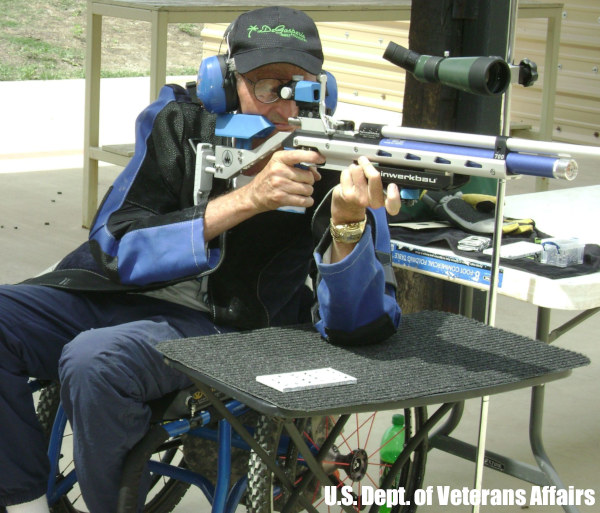
One of the great thing about shooting is that marksmanship is one of the few sports where physically-challenged persons can compete at the highest level — with some provisions for wheelchair access and mobility. For example, in the world of F-Class competition, Matt Schwartzkopf is one of the best in the nation. Matt, a rangemaster at Ben Avery in Arizona, is a double amputee (below the knee). He hasn’t let that challenge stop him. He has been a Top-10 finisher at major F-Class matches, and was chosen to shoot with F-TR Team USA.
F-TR Team USA member Matt Schwartzkopf is a double amputee below the knee, having had his lower legs removed due to a birth defect. That hasn’t held him back. Matt is an inspiration to us all. He told us: “This condition has not held me back from anything.” Jokingly, he added, “I may not have ‘a leg to stand on’, but that doesn’t mean I can’t still shoot 10s and Xs at 1000.” Matt is living proof that competitive shooting is a sport for all individuals — young and old, able-bodied and physically challenged.
Matt isn’t just a talented shooter — he runs range operations at Ben Avery in Arizona. During a major match, Matt can be seen supervising the firing line, organizing pit crews, and posting match results.
New USA Nationwide Adventure Database for Adaptive Shooters
Here’s a great new opportunity for shooters and sportsmen with physical limitations. The NRA has created a nationwide database of hunting and fishing adventures for individuals with disabilities. There are programs throughout the country with 45+ organizations such as Buckmasters, Freedom Hunters, Hope Outdoors, Hunting with Heroes, and Safari Club International.
“Venturing into the outdoors has long been acknowledged as healing for the body and soul”, said NRA National Adaptive Shooting Programs Manager Dr. Joe Logar, PT, DPT. “These benefits can be even more profound for someone experiencing an illness, injury, or disability.”
NRA’s Hunter Services and Adaptive Shooting Programs have maintained a list of organizations offering people with disabilities outdoor opportunities. Now available in a searchable database, any adaptive shooter can easily choose from adventures such as guided whitetail hunts, chartered fishing trips, and accessible hiking trails anywhere across the country. To find a program, visit the NRA Adaptive Shooting Program’s Hunting/Fishing Trip Database.
NRA Resources for Adaptive Shooting Events
The NRA Adaptive Shooting Program also provides information for organizations planning an event to include person with disabilities. Events may be organized by veterans’ groups, rehabilitation facilities, and gun clubs. For more information visit AdaptiveShooting.NRA.org.
Adaptive Shooting Programs in the United Kingdom
Across the pond, the National Rifle Association of the United Kingdom (NRAUK) also has adaptive shooting programs. The NRA.ORG.UK website has a wealth of information for disabled shooters.
The NRAUK states: “There are many different types of target shooting available for people to try in Great Britain. Some of them are readily accessible to disabled people, others less so. Also, shooting clubs and facilities do not all cater for every discipline; some only offer one, whilst larger complexes can cater for many of them. The only place in the country where almost all disciplines can be tried is Bisley Camp in Surrey. Access to the outdoor ranges is being improved all the time, although most are already accessible.
If the disciplines that you particularly fancy are not suitable for your type of disability at the moment, or are not currently available in your area, do not give up hope! The key skills for target shooting are very similar for all disciplines, so you could start with a different but similar option, learn those key skills, and take up your first choice when it is available to you.”
Making Ranges Suitable for Disabled Shooters
The Summer 2019 issue of NRA Club Connections magazine has a feature on Adaptive Shooting. This article explains how range owners can make their lines of fire more accessible with the addition of a simple mat.
Here’s a great YouTube video that shows the creation of a high-end, 22-250 varmint rifle from start to finish. The rifle was crafted by Chad Dixon for O’Neill Ops. Once the build is complete, the video shows the rifle being tested at 440 yards. With the camera filming through the scope, you can even watch the trace, starting at the 2:36″ time mark (this is very cool).
Watch this Video in HD!
Any person with an interest in gunsmithing should watch this video. It shows barrel profiling, tenon-thread cutting, chambering, CNC stock inletting, bedding, and stock painting. This is one of the best short videos of its kind on YouTube.
For this build, Chad Dixon of LongRifles, Inc. teamed up with O’Neill Ops. The video shows the “Coyote Rifle” build, step by step, from the cutting of the tenon threads, to the 440-yard field test at the end of the build. To learn more about this rifle’s components and its performance in the field, contact James O’Neill, www.oneillops.com, (605) 685-6085.
Chad Dixon of LongRifles, Inc.
Chad Dixon’s introduction to firearms began in 1991 as a marksmanship instructor and competitive shooter in the U.S. Marine Corps. Chad began building rifles in 2000 at the Anschutz National Service Center, where he worked with U.S. Olympic shooters. In 2003 Chad took a position with Nesika Bay Precision/Dakota Arms. After leaving Nesika, Chad deployed to the Middle East as a security contractor for the U.S. Dept. of State. On his return to the USA, Chad started LongRifles Inc., a custom rifle-building company.
Dixon-built rifles combine modern CNC manufacturing methods with traditional expert craftsmanship. Chad’s rifles have won major int’l and national level competitions in Smallbore, Smallbore Silhouette, High Power, and Long Range Palma disciplines.
Here’s a cleverly-designed product that adds versatility to any rifle with a front sling swivel stud. This clever Stud Rail Adapter (SRA) allows you to mount a Picatinny Rail on a sling swivel stud. With the SRA in place, you can attach any accessories that clamp to a Pic rail, such as lights, lasers, pistol grips, or rail-affixed tactical bipods. And look carefully — the SRA’s designers included a sling swivel at the inboard end of the unit. That way you can mount Picatinny-rail accessories and still use your carry sling.
Sold by Harrisbipods.com, the SRA Stud Rail Adapter retails for $47.85. This adapter is crafted in the USA by MIM Mfg. from 6061 TG Aluminum with a black anodized finish. This can be used with the RBA-1 and RBA-2 bipod adapters.
This adapter is a useful invention, particularly for those who might want to mount a light or clamp-on bipod to a varmint rifle. Most hunting rifles have a front sling swivel stud and there is now a very wide selection of Picatinny-rail-mounted accessories.
NOTE: HarrisBipods.com is a web retailer. This is NOT Harris Engineering, the manufacturer of Harris bipods. HarrisBipods.com does sell the full line of Harris bipods and most Harris accessories.
Product tip from EdLongrange. We welcome reader submissions.
Since its launch two years ago, The Armory Life website has offered a wide variety of well-illustrated, firearms-centric content. The website features categories ranging from firearms, CCW, survival, tactics, training and much more, delivering in-depth daily content. All the stories feature plenty of photos and many daily features also include informative videos. And now, Springfield Armory will be offering a quarterly PRINT Magazine to complement the digital content — so you get the best of both worlds.
Springfield Armory offers plenty of content online you can read for FREE. Here are six recent Armory Life digital stories we recommend. Click the image to launch each article. CLICK HERE to read hundreds of other articles on TheArmoryLife.com.
Click Each Frame Below to Load Story from TheArmoryLife.com
Springfield Now Offers Quarterly Print Magazine
The Armory Life has launched a new quarterly print publication to complement the daily digital content on TheArmoryLife.com. See Cover at top of this article. This new quarterly magazine provides a new way to consume content. This full-color, 96-page quarterly magazine features in-depth gun and gear reviews, interviews with luminaries in the firearms community, tips and tactics, and much more. These new quarterly magazines complement Springfield Armory’s current Digital Magazines (example at right).
Mike Humphries, editor-in-chief of the new quarterly print magazine states: “With four 96-page issues a year packed with content and closely integrated with the website, this magazine will provide our readers with yet another means of living The Armory Life.”
Print Magazine Features Scannable QR codes Linked to Web Content
The new print magazine integrates closely with its digital sibling, TheArmoryLife.com, via easy-to-use QR codes. Simply open up your camera app on your smartphone and scan the QR code, and you’ll be taken online to expanded content, video segments, and much more. Currently, recipients of The Armory Life print magazine are selected from Springfield Armory warranty registrants. Each will receive a full year’s worth (four issues) of the magazine.
“The Armory Life print magazine represents a bold new means for learning about not only the latest Springfield Armory products, but also what’s going on in the entire shooting community,” says Steve Kramer, Vice President of Marketing for Springfield Armory. “This new publication will be a terrific resource for fans of The Armory Life.”
With the ongoing COVID-19 restrictions, plus the anti-gun rhetoric coming out of Washington, it’s important to have some diversions from the unsettling news. To help get your mind off COVID and the ongoing attacks on the Second Amendment, here are some great FREE BOOKS to read. You can download these to your computer, laptop, or tablet, and read them whenever you like.
Do you enjoy classic hunting adventures from around the globe? Then log on to the NitroExpress.com Forum. There you’ll find links for literally hundreds of vintage hunting stories, and even complete books, such as Teddy Roosevelt’s classic African Game Trails and Good Hunting, plus the wonderful book African Campfires by Stewart E. White, one of Roosevelt’s close friends and hunting companions.
Among the downloadable titles are The Man-Eating Lions of Tsavo (leaflet edition) by Lt.Col. J. H. Patterson, the true tale that inspired the Hollywood movie, The Ghost and the Darkness, staring Michael Douglas and Val Kilmer. The online version of the Man-Eaters of Tsavo book (right) is a shorter, 140-page edition created for Chicago’s Field Museum, which purchased the skins of the lions from Patterson and put them on display.
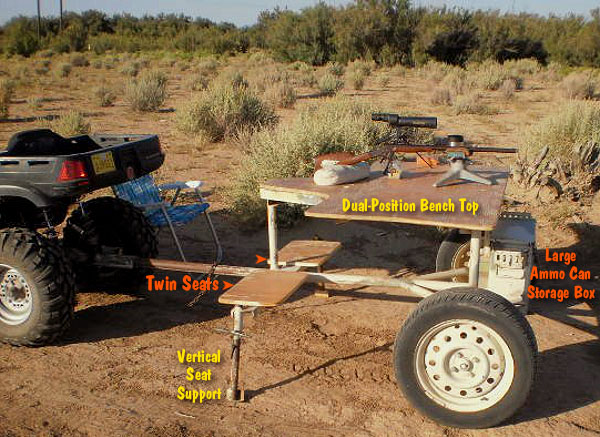
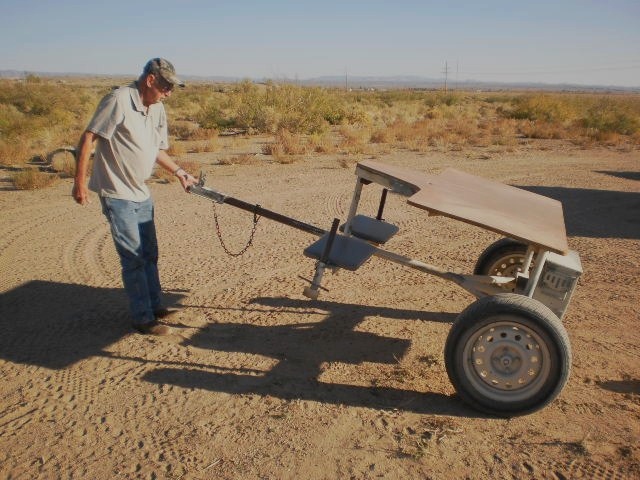
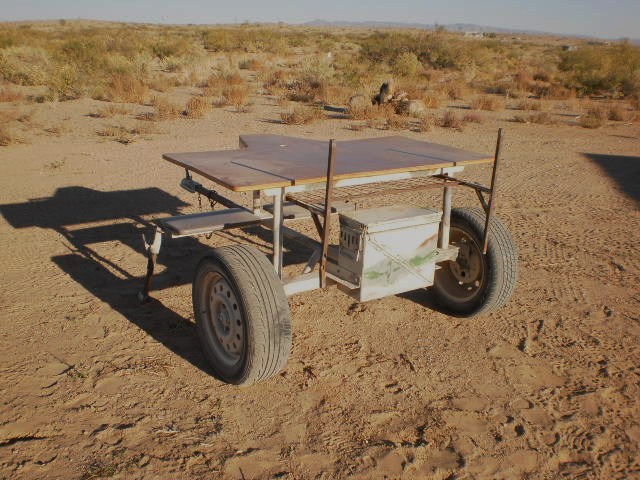
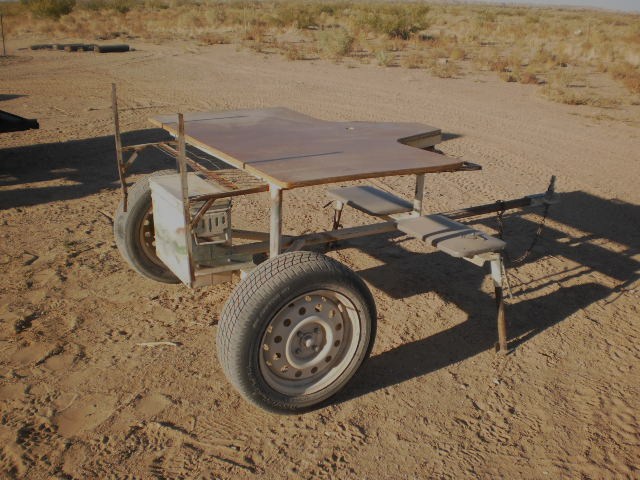
AccurateShooter Forum member John H. of New Mexico (aka “Skratch”) has created an impressive mobile shooting bench that he can haul with his ATV. This trailer-mounted, movable bench is built on a central tubular spine that also serves as the tongue for the trailer, which attaches to a standard hitch. The bench offers two (2) shooting positions so it works for both left-handed and right-handed shooters.
Up front, for storage, a surplus .50-Cal ammo can is secured to the trailer frame. The V-shaped middle section of the wood benchtop looks to be reinforced with a metal stiffener frame on the underside. The front section of the bench is supported by twin tubular uprights attached to the box-section axle housing. The two wooden bench-style seats (on left and right) ride on a cross-tube. At the ends of that cross-tube are adjustable legs for additional support.
Great Rig for New Mexico Varmint Hunting
There are plenty of great varmint hunting areas in Skratch’s home state of New Mexico — you’ll find some huge prairie dog fields there. But to get the best results on a varmint-hunting field session, you need a solid shooting station that can be easily hauled to new locations as needed. It looks like John (aka “Scratch”) has come up with an outstanding “War Wagon” for his New Mexico varmint safaris.
Click on image frames to see full-size photos
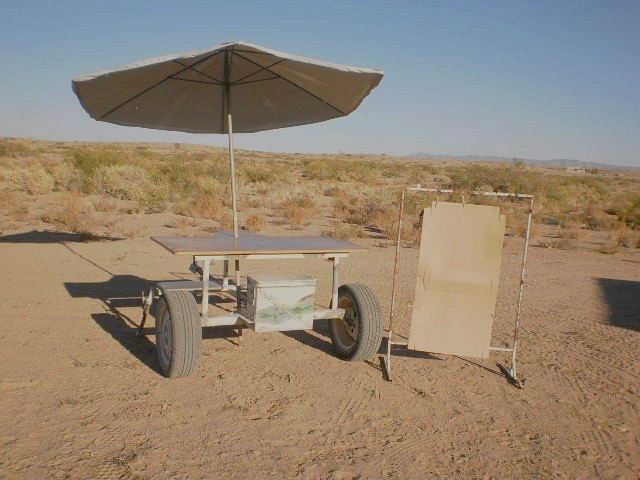
Some readers wanted to know how John’s War Wagon is positioned in the field and if it is ever detached from John’s ATV. John answers: “We do unhook the 4-wheeler for target-checking unless we have an extra along which is usually the case. That way we can level the table front to rear. We have an umbrella from a patio table to provide shade on extra warm days.”
War Wagon Construction Details
John told us: “My brother-in-law and I built this mobile bench a few years ago. The axle, wheels and tire are a tag axle from a small Chevy car, obtained from a salvage yard for about $35-$40 a decade ago. The tubular frame is drill stem, while the bench-top and seats are 3/4′” plywood. Under the plywood we fitted rails so we can slide our target stand under the benchtop for secure travel. The total cost for everything (including storage box) was about $250-$300.”
We set the bench and seat heights so that, with adults, the rifle sets straight level to the shoulder. For the smaller ‘younguns’ we just use a sofa pillow to raise them up. (Yes, adjustable seat heights would be great.) The ammo box holds our rifle rest, sand bags, spotting scope, and miscellaneous gear. Options are a couple of lawn chairs, and a cooler of brew (for after the shooting is done).
When you’re venturing deep into the backcountry on a hunt, every ounce counts. You want to keep weight to a minimum because, along with your rifle, you will be carrying food, water, binoculars/spotter, GPS, and possibly a tripod or shooting sticks. Then, if you are successful, you will be carrying all that gear PLUS the game meat you harvested. Weight definitely becomes an issue — so a low-mass rifle is good.
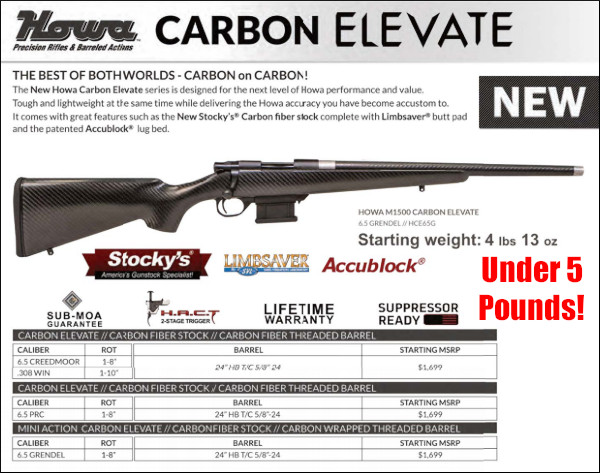
With advances in stock and barrel technology, we are seeing excellent new hunting rifles that weigh under 5 pounds. Such ultralight rifles were once only available to wealthy sportsmen paying $3000 or more. Now that has all changed. Legacy Sports International has introduced a series of very affordable ultralight rifles. These are all on display in Legacy’s new 2021 Catalog.
Legacy offers a number of rifles that weigh well under 6 pounds before optics. The Howa Carbon Stalker starts at 4 lbs. 10 ounces, while the Carbon Elevate is a just a few ounces more, starting at 4 lbs. 13 ounces. These both feature a full carbon-fiber stock from Stocky’s Stocks.
Legacy’s Howa Mini Action models are also lightweight, even with a more conventional stock. These attractively-priced Mini Action models begin at just 6.6 pounds. Shown below is the new “Full Dip” hunting model with full camouflage Hydro-Dip on stock, barreled action, and even the scope. This model is offered with your choice of three different Kryptek camo schemes: Highlander, Kratos, and Yote.
The 6mmBR Norma cartridge has spawned many great variants in multiple calibers: 6mm Dasher, 6BRA, 22 BR, 22 Dasher, 30 BR and others. This article is about a handsome 22 BR Rem-action varmint rig.
Richard Franklin (who operated Richard’s Custom Rifles prior to his retirement), has built scores of varmint rifles, in many different calibers. One of Richard’s all-time favorite varmint rifles is a 1:14″-twist, 22 BR built on his Model 11 stock in laminated Black Walnut and fiddleback maple. Richard says the rifle is versatile and deadly accurate out to 400 yards. Richard uses a Leupold 8.5-25x50mm LRT with varmint reticle.
Richard’s 22 BR Varmint Rifle with Lilja Barrel
Richard tells us: “[Shown above] is my light walking varminter. It’s built on a blue-printed Stainless Steel Remington 700 short action and chambered as a no-turn 22 BR for Lapua brass. The bolt handle is a Dave Kiff replacement and I’ve fitted a Jewel BR trigger with bottom safety. The barrel is a Lilja, 1:14″ #6 contour with a muzzle diameter of .750″. I shoot the 40gr V-Max bullets in the rifle at 4000 FPS. It’s tough on hogs if you don’t try them too far. 400 yards is about the max with it.
Accuracy is outstanding and with Roy, Mike, my grandson and myself shooting this rifle I don’t believe it has missed more than three hogs out of over 100 we shot at one summer. This rifle is carried in a ceiling rack in the truck where it’s handy and is used by the first person that grabs it when a hog is sighted if we are moving between setups. The Varmint reticle on the Leupold (shown below) is nice for quick hold-overs as you change distances.”
At right is a another Franklin Model 11 stock in Birdseye maple. That photo shows the details of the thumbhole stock.
Editor’s Note: We have shot a 1:8″-twist 22 BR in varmint matches and it was very accurate with 80gr bullets. It actually shot flatter out to 500 yards than our 6mmBR running 105-grainers. If we were to build a new long-range, bolt-action varmint rifle it would probably be a 22 BRA, essentially a 22 BR with 40° shoulder. That gives you a very stable cartridge with a bit more capacity. The 22 BRA retains a longer neck compare to the 22 Dasher, which is also an excellent cartridge — versatile and accurate.
22 BR Rivals 22-250 Performance
With bullets in the 40gr to 60gr weight range, the 22 BR gives up very little in velocity to a 22-250, despite burning quite a bit less powder (30-32 grains for the 22 BR vs. 35-38 grains for the 22-250). With a match-quality chamber, the 22 BR will probably have an edge in accuracy over a 22-250, and you should experience longer barrel life. Here are some recommended 22 BR loads for 40-60gr bullets:


 A benchrest or High Power shooter must operate from a designated shooting position. He must stay put and deal with the wind as it moves across the course, from whatever direction it blows.
 Benefits of Swivel Benches
 After building my 20 PPC, I wanted to do another .20 caliber, this time a repeater for predator hunting that could also serve as a gopher/prairie dog rifle. I wanted to use a Tikka M595 stainless sporter I had. This rifle is the ultimate repeater with an extremely smooth-feeding cycle from its single-column magazine. Since the Tikka was a .223 Remington from the factory, I first looked at possible case designs that would fit the magazine. The 204 Ruger was a very new round at the time and brass was scarce. I also didn’t care for the overly long case design or the standard throat dimensions of the cartridge. I then looked at the 20 Tactical. It was a nice cartridge but I didn’t like the fact that (at the time) an ordinary two-die Tac 20 set with just a plain full-length die and standard seater were $150. Not only did the costs bother me, but I was accustomed to using a Redding die set featuring a body die, a Type-S bushing neck die, and a Competition seater. To be honest, I also didn’t care for the 20 Tactical’s name–there is absolutely nothing tactical about the cartridge. I didn’t want to adopt a new cartridge based on what I perceived to be a marketing gimmick (that “tactical” title).
 Simply Neck Down .223 Rem to Make a 20-223 Wildcat
 I chose Kevin Weaver at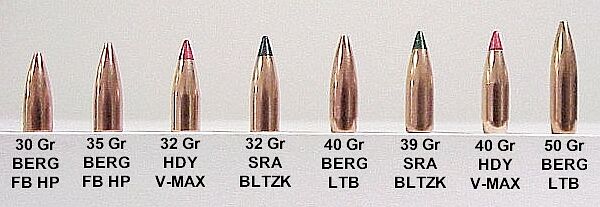
 Project Componentry
 Test Report–How’s It Shoot?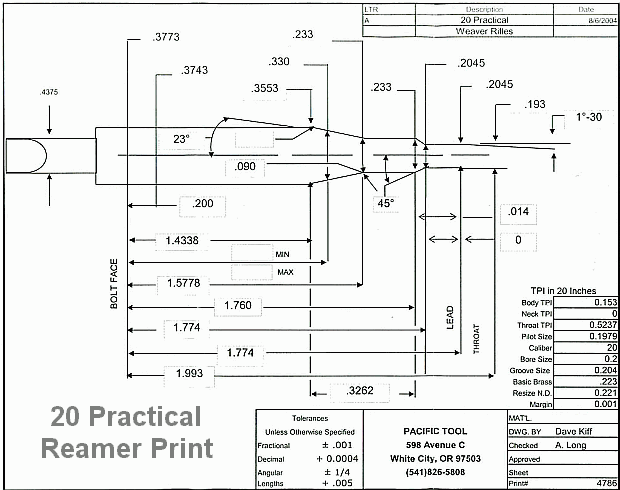
 Comparing the 20 Practical and 20 Tactical

 F-TR Team USA member Matt Schwartzkopf is a double amputee below the knee, having had his lower legs removed due to a birth defect. That hasn’t held him back. Matt is an inspiration to us all. He told us: “This condition has not held me back from anything.” Jokingly, he added, “I may not have ‘a leg to stand on’, but that doesn’t mean I can’t still shoot 10s and Xs at 1000.” Matt is living proof that competitive shooting is a sport for all individuals — young and old, able-bodied and physically challenged.



 Here’s a great YouTube video that shows the creation of a high-end, 22-250 varmint rifle from start to finish. The rifle was crafted by Chad Dixon for O’Neill Ops. Once the build is complete, the video shows the rifle being tested at 440 yards. With the camera filming through the scope, you can even watch the trace, starting at the 2:36″ time mark (this is very cool).


 Among the downloadable titles are





 The 6mmBR Norma cartridge has spawned many great variants in multiple calibers: 6mm Dasher, 6BRA, 22 BR, 22 Dasher, 30 BR and others. This article is about a handsome 22 BR Rem-action varmint rig.
 Accuracy is outstanding and with Roy, Mike, my grandson and myself shooting this rifle I don’t believe it has missed more than three hogs out of over 100 we shot at one summer. This rifle is carried in a ceiling rack in the truck where it’s handy and is used by the first person that grabs it when a hog is sighted if we are moving between setups. The Varmint reticle on the Leupold (shown below) is nice for quick hold-overs as you change distances.”


