Looking for a great price on an excellent hunting rifle? Here is the Tikka Deal of the Decade. EuroOptic.com has received nearly 3,500 Tikka T3 rifles, which will be sold at deep discounts as part of an inventory clearance program by Beretta, Tikka’s parent company. The Tikka T3 is a good, stout rifle with a smooth, 3-lug action, crisp trigger, and quality barrel. Accuracy is typically well under 1 MOA (for three shots). T3 barreled actions also are a good “core” for a tactical build. The strong T3 action handles detachable magazines, and fits a variety of third-party stocks such as McRees Precision G7 and G10 chassis systems.
Our friend Jason Baney of EuroOptic.com tells us: “We have two tractor-trailer loads of Tikka T3 rifles (about 3500 units) dropping here today…and the sale prices are amazingly low. I am sure it will take a day or so to get all the rifles in the system, then they will show in stock. Everything currently showing on our site should either be in stock or coming in stock this week. Feel free to order/backorder through the link below, or give us a shout.”
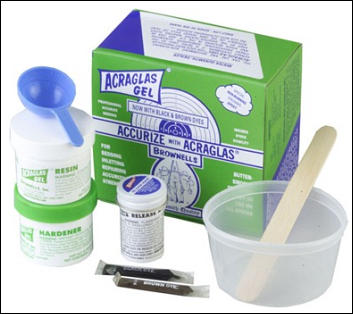
The NRA’s American Rifleman showcased an interesting project this week — an upgraded Ruger American Rifle Predator in 6.5 Creedmoor. The video below shows how a laminated wood stock from Boyd’s Gunstocks was adapted for the Ruger. A Boyds Prairie Hunter model in gray laminate was selected. This was custom-bedded to the Ruger’s action using Brownell’s Acraglas.
All Ruger American Rifle models employ dual aluminum V-Blocks to support the action. These fit slots in the underside of the action. Boyds makes its own version of these V-Blocks which were installed in the Boyds stock to secure the action.
Project leader Joe Kurtenbach says the size, shape, and geometry of the Boyds V-Blocks is very accurate, so they fit the Ruger action well. To further support the action, Acraglas bedding compound was applied to the inside of the stock, after release compound was applied to the barreled action. With this DIY bedding job, the Boyds laminated stock is definitely an improvement over this original “Tupperware” factory stock.
DIY Bargain Hunter Upgrade
American Rifleman states: “The Ruger American has some great features—hammer-forged barrel, reliable action, crisp trigger — but many would not consider the molded, polymer stock to be among them. Luckily, there are aftermarket options to enhance the rifle’s utility and aesthetics. A durable, attractive stock from Boyds Gunstocks and some DIY action bedding, using Brownells Acraglas, is the next step in the precision-driven hunting rifle build.”
Choice of Gun and 6.5 Creedmoor Chambering
For this project, American Rifleman’s Joe Kurtenbach selected one of his favorite cartridges, the 6.5 Creedmoor. Introduced in 2007 by Hornady, the accurate, flat-shooting 6.5 Creedmoor has proven very popular with both hunters and tactical/PRS shooters. The Ruger American Rifle Predator was chosen for its affordable price, reliable action, and Ruger Marksman adjustable trigger.
In this video, Kurtenback explains how and why the 6.5 Creedmoor chambering and Ruger American Rifle were chosen for the Precision Hunter rifle build project.
If you haven’t checked out NormaUSA’s website, you should. There you’ll find Norma’s Cartridge of the Month Archive. This great resource provides a detailed history of popular cartridges, along with a discussion of these cartridges’ hunting and target-shooting uses. There are currently 26 Cartridge of the Month articles, the latest featuring the mighty .500/.416 Nitro Express cartridge.
Also on Norma-USA.com you’ll find information on Norma cartridge brass, bullets, powder and factory ammo. The site also offers a video archive plus links to Norma Reloading Data.
A mild cartridge by modern standards, the 6.5×55 has impressive credentials in both the hunting field and in competition. It was developed jointly by Sweden and Norway in 1894 – one of the very first smokeless, small-bore rounds for military rifles. When Sweden boosted 6.5×55 performance in Mausers, Norway stayed with original loads in the less robust Krag. The 6.5×55 defended Scandinavia for most of a century thereafter. In 1990 the National Rifle Association of Denmark, Norway and Sweden renamed this cartridge the 6.5×55 SKAN and standardized its specifications. Still hugely popular among moose hunters there, it has also excelled in 300-meter free-rifle competition.
The long tenure of this cartridge spanned the post-war wildcatting era. Unfortunately for shooters keen to make something new of the 6.5×55 hull, its head diameter is .01 greater than that of the 7×57 (and the .270 and .30-06). The rim is thicker too. At 2.16 inches, cases mike .15 longer than the .308’s and .08 shorter than those of the 7×57 – though as originally loaded, its overall length (3.15 inches) exceeds that of the 7×57. In fact, it falls just 0.1 inch shy of the finished length of the 7mm Remington Magnum! In my view, the 6.5×55 merits at least a mid-length action, such as on Melvin Forbes’s New Ultra Light rifles. Shorter (typical .308-length) actions require deep bullet seating that throttles performance.
You’ll look hard to find a better deer cartridge than the 6.5×55. Francis Sell, woodsman and rifle enthusiast whose book on blacktail deer hunting has no peer, favored the 6.5×55. Hunters coming of age in a magnum culture might question the round’s bona fides on animals as stout as elk and moose. But at modest ranges, with bullets like Norma’s factory-loaded 156-grain Oryx, it’s a sure killer. Modest recoil makes rifles pleasant to fire (read: accurate in hand!) and fast on follow-ups. In Africa the 6.5×55 – and similar 6.5×54 Mannlicher-Schoenauer – felled much bigger game than moose long before anyone necked down the .375 H&H! While its compact case won’t let the Swede match the likes of the .270 ballistically, it is a fine all-around choice for big game in the Lower 48.
Now there is a new type of “lead-free” rimfire ammo that can be used in areas where lead is prohibited. CCI’s new .22 LR Copper-22 ammunition features hollow-point bullets made from a compressed copper + polymer matrix. This is a speedy round — Muzzle Velocity (MV) is a blistering 1850 FPS, very fast for a .22 LR round. CCI claims accuracy is excellent. We look forward to testing this new Copper-22 rimfire ammo to confirm CCI’s speed and accuracy claims. Running at 1850 FPS, this looks like it could be a very effective varmint round.
Copper-22 Ammo Features & Benefits:
Non-lead bullet suited for plinking, target-shooting and small game hunting.
21-grain hollow-point bullet, with compressed copper-polymer construction.
Legal to use in California and other zones where lead is prohibited.
1,850 FPS muzzle velocity with excellent accuracy.
The Copper-22 projectile is constructed from a unique mix of copper particles and polymer compressed into a potent, 21-grain bullet. This non-lead bullet is suited for plinking, target-shooting and small game hunting. Shipments of this Copper-22 ammo (CCI part No. 925CC) are now being delivered to dealers. For more info, visit www.cci-ammunition.com.
Can you hunt small varmints with an air rifle? Indeed you can. At reasonably close ranges, a .177 pellet has sufficient “knock-down” power, and the near-silent operation of the air rifle keeps your prey from being alerted. Our friends at Varminter.com recently tested the Anschütz 8002 S2 Black Air Hunter, which features an integral, custom-tuned moderator. Overall, this is a very accurate, very high-tech solution to pesky squirrels (and other small furry pests).
Here’s the report: “We spent a couple of hours out in the field with the Anschutz Black Air Hunter, and took seven ground squirrels that NEVER heard the shot. This rifle is unbelievably quiet, and VERY accurate. I simply put the crosshair on the back of the eyeball, touched the super light trigger, and dropped them in their tracks. Tomorrow, we hunt a small orchard near some farm animals, and I think this rifle will really shine. Tom got some decent video, but we need a bit more out in the field for the full hunt report, so there will be more to come!”
The Anschütz 8002 Black Air Hunter is a PCP (Pre-Charged Pneumatic) air rifle in .177 caliber. This nice rig features a very comfortable, ergonomic stock with adjustable cheekpiece and buttplate. Best of all, the Black Hunter is wicked accurate. Varminter.com reports: “It took [just] three shots to sight-in, and proceeded to shoot bug holes at 25 yards the next 10 rounds.”
Anschutz Black Air Hunter Product Description
The new Anschütz 8002 S2 Black Air Hunter is designed for varmint hunters and target shooters who want an accurate, quiet, versatile, and urban-friendly air rifle. Based on the 8002 S2 match rifle, the Black Air Hunter boasts the excellent balance/ergonomics of a world-class 10 meter match rifle. But the Black Air Hunter has other key features you won’t find on typical competition airguns.
The match barrel is fitted with an advanced moderator made by Tactical Solutions. This non-removable unit is smaller, lighter, and considerably quieter than the counterparts from Europe. Tactical Solutions engineered this moderator to control the sharp crack associated with pre-charged pneumatics. And yes, it works — the Black Air Hunter is VERY QUIET.
As shown here with Leupold scope, the rifle weighs just under 10 pounds:
The fully-adjustable beech stock has a moisture-resistant rubberized coating that provides a secure grip in cold or damp conditions. An aluminum accessory rail under the fore-end allows sling or bi-pod mounting. The cheek piece and butt plate offer a wide range of position options, and can also be upgraded or changed to suit the shooter’s preferences.
The Black Air Hunter runs a .177” caliber pellet at 580 fps, which allows for quiet yet precise training and target shooting in an urban environment. There are more powerful air rifles, but they will be noisier and you may have concerns with down-range energy. With its ultra-low noise signature, the Black Air Hunter is well-suited for use in urban settings.
Adam Scepaniak, of The Guns and Gear Store, has written an interesting story about Prairie Dog Hunting in North Dakota. If a P-Dog safari is on your “bucket list”, you’ll want to read the full story in the Sierra Bullets Blog. Adam provides many tips that can help you plan a successful prairie dog adventure.
Prairie Dog Hunting in North Dakota with Sierra Bullets (Excerpt)
It’s that time of year where lots of men and women point their vehicles westward and try to push the limits of their rifles on prairie dogs. I was a part of this group of people just a few days ago while in northwestern North Dakota. CLICK HERE to Read Full Story.
Little Missouri National Grassland
Once my hunting party arrived at the Little Missouri National Grassland in North Dakota we immediately began scouting for prime prairie dog towns. There is a certain amount of strategy involved in choosing a prairie dog town … for several reasons. For one, you should try to always stay “above” the prairie dogs.
Small objects like rocks, cactuses, and prairie vegetation can easily obstruct your view if you’re shooting prone on a level plane. We encountered this in the first small prairie dog town we stopped and shot at. The prairie dog town was very visible while walking and standing, but once we laid down with our rifles on bipods the two-foot prairie grass became a severe obstruction. We shortly moved on because the small town became quick-studies to our shooting.
The second prairie dog town we hunted was at the base of a small ridge with a dried, cattle creek at the bottom. This area offered better shooting opportunities because we were above most of the prairie dog holes, and if we were not above them, a deep ravine separated us from the prairie dogs removing any obstructions from our rifle scopes which was our previous problem. This area had its own disadvantage though because of some other wildlife present. There were approximately fifty head of cattle in our close vicinity grazing, which was to no surprise because many ranchers utilize the National Grassland for grazing. We had to wait for the cattle to leave our area as to not have an incidental hit due to a rare ricochet. As the sun passed over the horizon we decided to return to this spot the next morning, but would change our shooting position to increase our advantage.
This Location Offered a Nice Overlook.
Zoomed Image Shows Individual Prairie Dog Mounds.
My previous varminting best was a 275-yard shot near Mobridge, South Dakota on a separate prairie dog hunting trip. With more experience and better reloading, Here in North Dakota I was able to make a solid hit on a prairie dog just over 400 yards which made me ecstatic! For a central Minnesota, shotgun-raised guy, I was pretty happy that my bullet selection and hand-loading ability produced a 125-yard improvement.
Once we cleaned and cased our rifles for the journey home we had shot a little over 200 rounds of my Sierra® reloads. This was a lot less than previous prairie dog trips I have been a part of, but our hit percentage was substantially higher as well. Traveling into a new area meant a lot more scouting and experimentation for us as a group. In future trips or hunts of your own, it can be very beneficial to schedule an extra day just for scouting[.]
Little Missouri National Grassland is a National Grassland located in western North Dakota. At 1,033,271 acres, it is the largest grassland in the country. Within its borders is Theodore Roosevelt National Park. The Little Missouri National Grasslands was once a part of the Custer National Forest, but is now a part of the Dakota Prairie Grasslands, a National Forest unit consisting entirely of National Grasslands. A predominant feature of the grassland is colorful and beautiful badlands, a rugged terrain extensively eroded by wind and water. It is a mixed grass prairie, meaning it has both long and short grass.
The boundaries of the grasslands on certain maps can be misleading. Within the boundaries of the national grassland are significant portions of state-owned and privately-owned land, much of it leased by cattle ranchers for grazing.
The grassland is administered by the Forest Service as part of the Dakota Prairie Grasslands from offices in Bismarck, ND. There are ranger district offices in Dickinson and Watford City.
Harold Seagroves’ 3-time Hickory Ground Hog Match-Winning Rifle
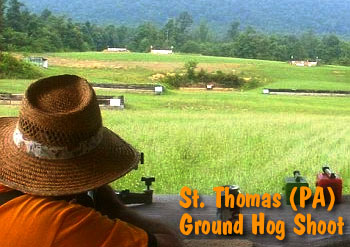
At clubs across the country, varmint fun shoots (also known as “groundhog matches”) are becoming more popular every year. In these matches, usually shot from the bench, you engage paper targets, clay pigeons, steel “critter” silhouettes, or some combination of paper and reactive targets. Shooters like these matches because you can shoot a wide variety of rifles, you don’t have to spend a fortune to be competitive, and there is fun for the whole family. Rules are inclusive — you won’t be turned away because your rifle is two ounces overweight. A large percentage of the match fees usually go back to shooters in the form of cash prizes. And the level of camaraderie is high.
Inclusive Rules Welcome All Shooters
Forum member Danny Reever has explained the appeal of groundhog matches: “We don’t have a governing organization, or have to pay $50 a year membership just to compete in matches. Sure the rules vary from club to club, but you adapt. You build your rifle (or even pistol) to fall within the rules of either the clubs you shoot, or to fit all the clubs rules. If not there still is a class for you to compete in. If your factory rifle doesn’t conform to the rules, it can shoot in a custom class. If your custom doesn’t make weight for Light Custom (usually 17 pounds and under), you shoot it in heavy custom class. If you want to try your Tactical rifle or F-Class rig, bring it out there’s a class you can shoot it in. If you don’t like one club’s rules, you just don’t shoot there. It’s no big deal.
There are no National records, or Hall of Fame points — just individual range records. If you want to shoot in BIG matches (with big prizes), there is the Hickory Ground Hog Shoot among others. If competition isn’t your bag, many clubs offer mid-week fun matches that you can shoot just for fun. You shoot the same targets but with a more relaxed atmosphere with no time limits.
The best part is you don’t have to shoot perfect at every yardage. You always have a chance because in this sport it really isn’t over until the last shot is fired. Typically ALL the entry money goes to the host club, with much of the cash returned back to the shooters via prizes. Junior shooters often shoot for free, or at a reduced rate. That lessens the burden on the family’s wallet (not a small thing in these economic times). The low entry cost also encourages young guys to get involved who don’t have $4000 custom rifles or the money to buy them.
More Fun, Fewer Complications
There isn’t a sea of wind flags to shoot over or to put up and take down. If the range has a couple of flags so much the better, but after all it is a varmint match. No pits to spot shots and slow things down either. If you can’t see your hits through your rifle scope or spotting scope well you are in the same boat as everybody else. That’s what makes it interesting/ sometimes frustrating!
As for calibers, I’ve seen everything from .223 Rem to .338 Lapua and everything in between. Our range record at my club is held by Bill Slattery, who shot a 147 out of a possible 150 with a 22BR 13 months ago. That’s on a target with a 1.250 ten ring at 200/300/500 meters. That record will stand for awhile, and shows you that some very good shooting is done at groundhog matches.
The best part is it’s laid back, everyone gets along, there is no place for big egos here. We who shoot the Ground Hog Matches don’t begrudge the other organizations and shooting disciplines, or those that shoot in them, heck some of us cross over and compete in registered benchrest matches too. Life’s too short, live and let live is our motto so just come out and have fun!”
Fellow Forum members chimed in:
FdShuster: “I’ve competed in our local ground hog matches for several years now, have introduced a number of others to them, and we all enjoy them and more importantly, continue to learn from them. Distances are as close as 100 yards, (with a 5/8″ 10 ring) to as far as 500 meters. With a 2″ 10 ring. Wind, mirage, bullet trajectories, all make them a challenge, and unlike shooting for group, where the group can be anywhere on the paper, in this game they must be very small, but also in the 10 ring. With the different classes — Custom, Factory, Hunter — almost any rifle will fit in somewhere. And Danny is correct about the friendly attitudes. I’ve seen competitors go out of their way, and jeopardize their chances of winning, to help someone else who may have a problem on the line.”
Mike C: “Here in Texas, our version of groundhog matches involves shooting at clay pigeons at 400 yards. We use 60mm, 90mm, and 108mm clay pigeons attached to target boards. You have 10 shots to break 8 clays, with a seven-minute time limit. We have developed a good following at these matches. In past years, a Shooter of the Year Award was given based on the Aggregate score for three of our matches, which are held in Utopia, San Angelo, and Huntsville.”
40X Guy: “I would have to say upon finishing my first year ever of groundhog matches, that the average Joe can grab his Swift, or his 25-06, or his 22-250 and go rip some holes in paper. Everybody is having a good time and its a gathering of like-minded people who have all shot chucks at some point or another. Even if one does not win the match, you can look at your target and say “darn that chuck target has five holes in him at 400 yards and he’s dead” just as well as the next guy shooting a custom bench rifle. Everybody fits in and everybody, 8 to 80, is having fun! It is addictive and will drive you to spend your hard-earned currency for sure!”
Larry Scott, who runs GreatScottShooters.com, has a friend, Ray Mabry, who is a very talented wood-worker and carver. Ray does master-grade decorative work and checkering on gunstocks, and he also carves realistic nature subjects from wood. Larry says: “If you need stock checkering/carving or any wildlife creation, check out a friend of mine, Ray Mabry. His finished products are superb.”
Ray Mabry is a member of our AccurateShooter Forum, and you can see many fine examples of his work in this FORUM Thread. Ray tells us: “I do this work as a hobby. I do checkering and relief-carving on rifles. I also carve out of solid tupelo and bass blocks of wood. Along with rifle stock work, I carve wildlife subjects — I’ve carved eagles, owls, quail, ducks, and even prairie dogs. If you have a project in mind, call me at 270-885-6066 or send email to: rayzr [at] twc.com.”
Are you looking for some summertime reading material? Do you enjoy classic hunting adventures from around the globe? Then log on to the NitroExpress.com Forum. There you’ll find links for literally hundreds of vintage hunting stories, and even complete books, such as Teddy Roosevelt’s classic African Game Trails and Good Hunting, plus the wonderful book African Campfires by Stewart E. White, one of Roosevelt’s close friends and hunting companions.
Among the downloadable titles are The Man-Eating Lions of Tsavo (leaflet edition) by Lt.Col. J. H. Patterson, the true tale that inspired the Hollywood movie, The Ghost and the Darkness, staring Michael Douglas and Val Kilmer. The online version of the Man-Eaters of Tsavo book (right) is a shorter, 140-page edition created for Chicago’s Field Museum, which purchased the skins of the lions from Patterson and put them on display.
For sheer versatility, it is hard to beat the AR-15 platform. An AR can function in a multitude of roles — defending your home, hunting varmints, or competing in Service Rifle or High Power matches. If you’re planning a new AR project, it all starts with the lower. That’s the part that carries the serial number and is logged into the books of your FFL. Once you’ve got your lower, then the fun begins — you choose all the other components: trigger group, stock, handguards, and upper.
Right now, Brownells is running a great deal on stripped lower receivers. You can get an Aero Precision Stripped Lower for just $59.99. It’s hard to beat that price. Aero Precision is a good manufacturer that makes durable and dimensionally-correct lowers. And these lowers are backed by Brownells’ 100% Satisfaction Guarantee.
Aero Precision Lower Receiver Features
This small pin, mil-spec lower receiver is precision-machined from a 7075 T6 aluminum forging. This versatile lower can be the foundation for rifle builds on 5.56/.223, 6.5mm, 6.8mm, 300 AAC Blackout, 9mm Luger, or other chamberings. Holes, inletting and pin locations have been cut to final dimensions and accept standard AR-15 magazines and components. The safe/fire switch position indicators are stamped on the receiver. FFL required for purchase.


 All Ruger American Rifle models employ dual aluminum V-Blocks to support the action. These fit slots in the underside of the action. Boyds makes its own version of these V-Blocks which were installed in the Boyds stock to secure the action.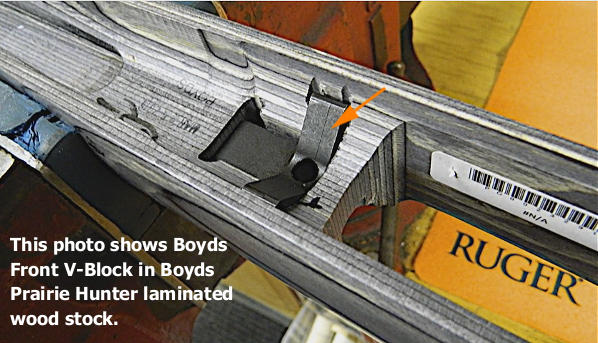


 Little Missouri National Grassland


 Inclusive Rules Welcome All Shooters
 More Fun, Fewer Complications
 Mike C: “Here in Texas, our version of groundhog matches involves shooting at clay pigeons at 400 yards. We use 60mm, 90mm, and 108mm clay pigeons attached to target boards. You have 10 shots to break 8 clays, with a seven-minute time limit. We have developed a good following at these matches. In past years, a Shooter of the Year Award was given based on the Aggregate score for three of our matches, which are held in Utopia, San Angelo, and Huntsville.”


 Among the downloadable titles are


