There is a new player in the field of elite die-makers: Whidden Gunworks. John Whidden’s Georgia-based company is producing outstanding full-length sizing dies and micrometer-top seater dies for 7/8-14 thread presses. The dies look great, work great, and produce very straight and accurate ammo. The Whidden dies are finished beautifully inside and out. They are priced competitively and they are available for popular “extreme accuracy” cartridges such as the 6PPC, 6mmBR, 6mmBRX, 6 Dasher, 6XC, 6.5×47, .260 Rem, .284 Win, and .308 Win (and more). If you are looking for a die set for your new precision rifle, you should definitely check out the Whidden dies. Two-die set, FL Sizer and Micrometer-top Seater, costs $184.99. Sizer die alone is $74.99, while Seater die alone is $109.99.
Many of our Forum members have started using Whidden dies — and they are reporting very positive results. I personally own and use a set of Whidden dies, and I am very, very impressed with them. Here’s my report:
Editor’s Report on Whidden Dies I have a set of Whidden Gunworks dies for my personal 6BRDX (a chambering similar to 6 Dasher but with longer neck). The dies are excellent and they produce very straight ammo. My loaded rounds (made with a Whidden bushing-type FL sizer and Whidden micrometer-top seater) are showing less than .0015″ run-out measured on the bullet, with the majority closer to .001″ run-out. (This is with Lapua Scenar L bullets, which have great jacket uniformity and concentricity.)
One thing I immediately noticed about the Whidden seater die is that there is a very close correspondence between the seater “hash marks” and true changes in seating depth. By this I mean when you dial a value change of 10 on the micrometer scale, you get very close to a .010″ change in seating depth. It is not perfect, but it is definitely more precise than most other micrometer-top seater dies I’ve used (both hand dies and 7/8-14 thread screw-in types).
Cartridges loaded with my Whidden sizer and seater dies have proved very accurate. My 6BRDX is shooting in the mid-ones for five shots at 100 yards. I also have a micrometer-top Wilson inline seater die that was custom-bored with my chamber reamer. As far as I can tell, the ammo loaded with the screw-in Whidden seater is every bit as accurate as rounds loaded with the Wilson die using an arbor press. Additionally, with the Whidden micrometer die, I can hold extremely tight tolerances on base-to-bullet-ogive lengths.
In the past, with my 6mmBR, I favored an inline die because I thought it offered better control over seating depth. But given how well the Whidden seater works, I’m not sure I’d gain anything with my Wilson hand die. At least when used with a quality Harrell’s benchrest press, the Whidden seater gives up little or nothing to the hand die, and that’s big news in my experience.
You will like the look and feel of these Whidden dies. The finish inside and out is very, very good — the dies have a quality feel and run very smoothly. Both the sizer and seater have a fluted section — this offers a better “grip” when you’re screwing in the dies. The outside of the seater has a smooth, gloss-anodized finish — it exudes quality. The markings on the seater’s micrometer ring are crisp and very legible, with large, high-contrast white-on-black lines and numbers.
One other very cool feature of the Whidden sizing dies is that custom-sized tapered expanders will soon be offered. Whidden plans to offer expanders in .0005″ (one-half thousandth) increments. This is great if you have, say, a .265 bushing and a .266 bushing but you want just a little less neck tension than the .265 offers. With the tapered expander, I can use a 0.265 bushing followed by an 0.2655 expander — allowing more precise control of neck “grip”.
Whidden Die Features
Die Dimensions well-matched to PT&G reamers used for match chambers.
Sizing dies spec’d for easy chambering and extraction without overworking brass.
All sizers include shoulder datum collar to measure shoulder “bump” and headspace.
Neck bushing or no-neck bushing configurations.
Bushing dies use standard Redding/Wilson type bushings.
Neck diameter of non-bushing FL sizers can be set to customer specification.
Extended threads on short cartridge sizer dies such as BRs.
Coming soon: custom expander balls (in half-thousandth increments) to adjust neck tension and provide minimum working of the case neck.
Seater: Floating sleeve on micrometer seater enhances concentricity of loaded rounds.
Seater: Large, high-contrast markings for easy adjustment.
Custom Dies for Wildcats or Your Cartridge
Custom-made for your wildcat or standard cartridge.
Can work from fired brass or a chamber drawing to match your chamber exactly.
Neck-bushing die, or no-bushing die with neck diameter bored to customer specification.
Available Die Sets
Here is the current caliber list. Micrometer seaters are available in all calibers listed below except 22BR and 22 BRX.
John Whidden Talks about Sizers, Seaters, and Expanders
There are two sides to our die business. First we are stocking dies in many calibers that are of interest to those who visit this website (such as the 6PPC, 6mm Dasher, 6.5×47 Lapua, .260 Rem, 7mm Shehane, .308 Winchester). These dies are a good fit to the “match chamber” reamers and very few people with these calibers should have to have “Pure Custom” dies made. We have both sizers and micrometer-top seaters ready to go for the many cartridge types listed above. The sizer dies will include a shoulder datum collar that makes it easy to measure shoulder “bump” during the full-length sizing process. This is important to control headspace precisely.
On the “Pure Custom” side, we have a huge amount of flexibility. We can make one-of-a-kind sizers and seaters for wildcats in a short period of time and at an excellent price. We can work with the customer to make full-length sizers, neck sizers, shoulder bump dies, small base dies, or most anything else they can need. We can of course provide micrometer-top seaters for these cartridges as well. We can make non-bushing sizers with specific neck inside diameters tailored to customer specifications.
We will also be offering custom-sized expanders. These expanders will fit our dies as well as Redding dies. Our tapered expanders will be available in .0005” (one-half thousandth) increments for the common calibers. In our shop we have had excellent results using expanders in the dies as long as the expanders provided the correct amount of neck tension and didn’t overwork the brass. Expanders have gotten a bad reputation in recent years but we find them to be excellent tools when the same precision is applied to their use that careful handloaders apply to the rest of their process. Expanders can be most valuable for those who choose not to neck-turn their brass (because the expander pushes neckwall variations to the outside).
One last thing — many gunsmiths with their own wildcats (or “specialty” chambers) have asked us to provide dies for their customers. We gladly do batches of custom dies and encourage gunsmiths to contact us. — John Whidden
McMillan Group International (McMillan) has added three new lines of ammunition: Extreme Velocity ammo (optimized for long range), McMillan Precision ammo (match quality for hunting), and McMillan Tactical ammo. All three new types of ammo are loaded with premium bullets. McMillan claims that its precision cartridge-loading methods ensure: “better concentricity, better uniformity of velocity, [and] better uniformity of pressure”. Along with these three NEW ammo types, McMillan already offers African Dangerous Game ammunition (ADG).
McMillan Extreme Velocity Ammunition — Long Range McMillan’s Extreme Velocity (ExVel) ammunition utilizes high-BC Berger Bullets exclusively. Powders are selected for High FPS and low ES to minimize vertical spread at long range. ExVel ammo was designed with input from Bob Beck of Extreme Outer Limits TV.
McMillan Precision Ammunition — Hunting In its new Precision line, McMillan offers traditional hunting cartridge types. Barnes LRX, TSX, and TTSX bullets with excellent accuracy AND strong terminal performance are used. All critical cartridge measurements are held to precision tolerances and Powders are selected for consistent velocity. Each round is hand inspected.
McMillan Tactical Ammunition McMillan’s Tactical ammunition offers .308, .300 WM, .338 LM, and 50 BMG cartridges loaded to “match-quality standards”. Bullets are carefully selected for mission-specific applications and powders are selected for low ES to minimize vertical spread at extreme long ranges. Each round is hand inspected.
At SHOT Show we checked out the all-new, side-focus 15-55x52mm Competition™ Scope from Nightforce Optics. This comes in both Silver finish and Matte Black. The black version looks like an NXS. The silver looks good but the finish is pretty shiny and contrasts with the black controls (some folks will like that, others won’t). We worked the knobs and side-parallax controls. The clicks are positive and the dial resistance seems just about right (very similar to an NXS). The ED (low-dispersion) glass in the new 15-55X provides high contrast, low chromatic aberration, and 92% light transmission. And this scope is a LOT lighter than the current 12-42x56mm — nearly half a pound less! The new 15-55x52mm sells for $2231.00.
Watch Video to See NF 15-55x52mm Competition Scope (and B.E.A.S.T. sneak preview.)
The big news is that, with a weight of just 27.8 ounces, the new 15-55X Nightforce Competition Scope is 24% lighter than the NF 12-42×56 Benchrest model, and 20% lighter than the NF 12-42×56 NXS. Like the NXS series, the new Competition scope offers side parallax adjustment; and, it will focus from 25 yards to infinity, making it suitable for rimfire and airgun shooting as well as centerfire competition. The turrets provide positive and repeatable .125 MOA (eighth-minute-of-angle) clicks. Each rotation provides 5 MOA of adjustment. And we’re pleased to see that the Competition Scope offers a full 60 MOA of travel — for both windage and elevation. That’s impressive. We’re pleased to see the new scope offers a fast-focus, European-style diopter eyepiece (photo below right). Two reticles will be offered initially: the CTR-1 (fine crosshair with target dot) and DDR (double dot with hold markers). You can see the reticles in the video above.
Thankfully, you won’t have to wait long to get a 15-55x52mm Comp Scope. Nightforce says it will start shipping in mid-February. CLICK HERE for more information.
Does your rear sand-bag get lumpy or lose its shape during transport? Are your bag ears starting to sag or get mis-aligned? Well the clever Italians have a solution for you.
Varide Cicognani, an Italian webstore specializing in competition shooting accessories, offers a cleverly-designed bag transport/storage caddy for rear sand-bags. Cicognani’s Portacuscino Model TFC-P is designed to keep your rear bag “in shape” during transport and storage. The TFC-P features aluminum top and bottom brackets, connected with threaded rods. A wedge under the top bracket fits between the bag ears. The top bracket has a convenient carry handle. The whole unit (not including bag) weighs just 13.4 ounces (680 grams). The price is € 49, or $65.99 at current exchange rates. For more information, visit www.VarideCicongnani.it.
Product Tip by Boyd Allen. We welcome reader submissions.
Gary Eliseo of Competition Machine is now offering a tube-gun chassis kit for the Tikka T3 action. This T3 Chassis Kit is the latest design in Gary’s Light Weight Hunter Series. The T3 kit will initially be right-hand only, and will fit AICS short action magazines. This is a “no gunsmithing” installation — no modifications to the action are required and the chassis kit works with the factory T3 trigger and safety.
Tikka’s T3 action is rigid and robust. It cycles smoothly and has a short 75° bolt lift. The T3 features a Sako-style extractor, with angled-leading-edge bolt lugs for smooth lock-up. The T3 action can be installed in Gary’s Chassis Kit with either a recoil disc (and bolts) or glue-in action mounting. The Chassis Kit is designed to accept AR15 buttstocks.
Eliseo’s current T3 Chassis Kit handles short-action cartridges only — for now. Gary is considering bringing out a version with a long-action-length magwell if there is sufficient demand.
Price is $685.00. This includes a rugged Cerakote finish. Tikka T3 action and AICS 5-round or 10-round magazines sold separately. For more info, visit GotXRing.com, call 714-630-5734, or send email to: spraynandprayn [at] gmail.com . CLICK HERE for order page.
Product Tip from EdLongrange. We welcome reader submissions.
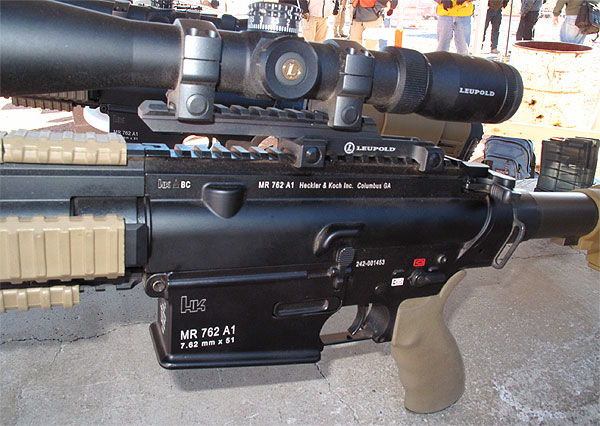
There were many semi-auto “tactical” rifles on display at MEDIA Day 2013, but one that caught our eye was the new MR762A1 LRP from Heckler & Koch (HK). The HK MR762A1 LRP (“Long Range Package”) looks similar to the H&K G28 rifle, Germany’s new Designated Marksman Rifle. But the G28 has a steel upper receiver, unlike the MR762A1, which evolved from the HK 417.
Bedecked with quad rails up front, this black and tan rifle screams “tactical”, yet it is surprisingly comfortable to shoot. The grip is comfortable in the hand and the thick rubber buttpad on the adjustable buttstock did a good job of mitigating recoil. Jason said the trigger was crisp and the gun was very accurate. With a gas-piston system (rather than direct gas impingement), this rifle runs very clean. The proprietary, polymer HK magazine worked perfectly with zero feeding issues. We liked these better than the metal mags we’ve tried on other makers’ AR10-type systems.
The MR762A1 is a direct descendent of the HK416/417 series, only in a semi-automatic rifle configuration developed for civilian users. The MR762A1 LRP employs the same HK proprietary gas piston operating system found on current HK rifles and carbines, using a “pusher” rod in place of the gas tube in the original M16/AR15/AR10 design. According to HK, the op-rod design “virtually eliminates malfunctions common to direct impingement gas systems since hot carbon fouling and waste gases do not enter the receiver area. The MR762A1 stays cleaner, reducing heat transfer to the bolt and bolt carrier, and drastically reducing wear and tear on other critical components.”
The MR762A1 uses the same 10- and 20-round translucent polymer box magazines made for the HK417; a 5-round magazine is also under development. Additional accessories and add-ons for the LRP variant of the MR762A1 include an ERGO Pistol Grip from Falcon Industries, the same Blue Force Gear sling used on the HK M27 IAR supplied to the USMC, and an OTIS cleaning kit. The rifle package, complete with one 20-rd mag and one 10-rd mag, is shipped ready to use with the scope attached in a 42″-long Model 1720 Pelican case.
At MEDIA Day 2013, we checked out McMillan’s interesting hydraulic recoil mitigation system for the TAC-50 tactical rifle. Named the TAC-50 A1-R2, this shock-absorbing device reduces the peak recoil from the 50 BMG cartridge by approximately 90 percent (90%). Additional recoil reduction is provided by the proprietary muzzle brake offered on the TAC-50 A1-R2.
The heart of the new TAC-50 A1-R2 recoil mitigation system is a proprietary hydraulic piston in the buttstock. As the rifle is fired, the piston compresses, softening the recoil by lowering the peak recoil force and spreading out the recoil over several milliseconds. The sensation for the shooter is that of a long push, rather than a violent punch.
Without the R2 recoil mitigation system, the peak recoil from a 50 BMG cartridge is approximately 7,500 lbs. of force. From start to finish, the recoil lasts 1 millisecond in a machine rest. With the R2 system, the peak recoil is only approximately 520 lbs. of force. What’s more, the force is spread out over 6 milliseconds. While the total recoil energy is roughly the same, the hydraulic piston lowers the perception of recoil dramatically for a shooter by lowering the peak force and spreading the recoil out over time.
McMillan developed the new R2 system in partnership with customers using the TAC-50 weapons system. Extensive testing with electronic load sensors and high speed photography documented the recoil mitigation. The result is a 50-Caliber rifle that is significantly more comfortable to shoot.
Story Tip by Ed LongRange. We welcome reader submissions.
At SHOT Show we checked out a versatile and well-designed new tool from Forster Products — the new Datum Dial Ammunition Measurement System. This handy device measures a variety of important dimensions: 1) cartridge headspace from base of case to shoulder datum; 2) cartridge length from base of case to bullet ogive; 3) bullet base to bullet ogive; and 4) bullet bearing surface (requires two tools).
The complete Datum Dial Kit consists of a dial-holder mount and three precision machined dials. The mount clamps to your sliding-jaw calipers. The mount holds a black ring or one of two supplied gold rings. The black ring has 5 precision-diameter holes that let you check headspace (on shoulder datum) for nearly all modern cartridge types.
Swap in one of two available gold rings to measure to bullet ogive index points. The two gold dials (five holes each) give you 10 different bullet diameter choices, covering the vast majority of common pistol and rifle bullet sizes. This lets you measure both base of bullet to ogive and base of cartridge case to bullet ogive. We really like this dual functionality, as it allows you to quickly sort bullets, plus you can measure your loaded rounds as they come out of the seating die. I have found that accuracy is enhanced when you maintain close base-to-ogive tolerances on your loaded rounds.
Watch Video to See Datum Dial Features and Functions
Replace a Bin Full of Comparator Inserts
It is important to understand that the Datum Dial system replaces a comparator body and a complete set of caliber-specific comparator inserts. You no longer need a box full of inserts, with one for each caliber that you load. The Datum Dial Complete Kit includes: One dial-holder mount (which clamps on your calipers), one black headspace dial, two (2) gold bullet diameter dials, and a plastic storage box. The Datum Dial Kit is available right now. MSRP is $157.00, and “street price” should be $20 or so lower. Additional dials or caliper jaw mounts are sold separately.
At SHOT Show we got a “first look” at the new Kahles K-1050, a 10-50x56mm scope with unique, centerline parallax control. This is a very interesting new high-magnification competition scope. Kahles’s patented centerline parallax control allows the marksman to adjust windage, elevation, AND parallax all with ONE HAND. If you’re in prone position, for example, you simply reach forward with your right hand to dial windage, then slide your hand to the central turret to dial elevation and, finally, set the parallax by adjusting a separate concentric ring.
Watch Video to See Kahles K-1050 Features and Centerline Parallax Control
NOTE: The big-diameter metal ring is OPTIONAL. You can remove the big metal ring and still adjust parallax (from centerline) using a smaller, built-in control ring on the top turret.
Designed for benchrest and field target use, this scope has a 30mm main tube, 55 MOA elevation, and 1/8-MOA clicks. There are three (3) total turret revolutions. The turret “Rev Count” is displayed with a clever red-and-white striped “barber pole” button in the center of the top turret. One red stripe indicates REV 1, red + white indicates REV 2, and red + white + red indicates REV 3. It’s simple, but it works.
The new K-1050 also features a nice European-style +/- diopter control on the eyepiece. If you have less that perfect vision, this allows you to get a sharp target image even without eyeglasses.
We liked the scope. The glass was bright and sharp, and the clicks were positive and precise. Competition shooters have shown great interest in the new K-1050, and Kahles plans to bring the new scope to the USA by mid-summer 2013. Price is expected to be around $2800.00 USD.
At SHOT Show 2013, Lapua announced it was expanding its line-up of Scenar L projectiles to include two new 6.5mm bullets and three new .30-caliber Scenar Ls. We applaud this news. This Editor has tested 6mm Scenar L bullets in his own rifles, and they have proven to be some of the most consistent bullets we have ever measured. The Scenar Ls also shot great in 8-twist barrels from Brux, Krieger, and PacNor.
Two New 6.5mm Scenar Ls
Guys with .260 Rem, 6.5×47, 6.5 Creedmoor, and 6.5-284 rifles have been eagerly awaiting the new 6.5mm Scenar Ls. These will be offered in two weights: 120 grains and 136 grains.
Scenar Ls in .30 Caliber
Lapua will release three new .30-Caliber Scenar L bullets. Along with a new 155gr Palma bullet (GB 552), Lapua will offer a 175gr Scenar L (GB 550), plus a 220gr heavy-weight Scenar L (GB 551). In magnum and short magnum chamberings, the 220-grainers should prove very effective in Long Range comps.
What Makes the Scenar Ls So Good
While all Lapua Scenar bullets are made to exacting standards, Lapua “raised the bar” with its Scanar L series. Scenar L bullets feature closer weight tolerances, tighter jacket wall concentricity standards, and greater uniformity in every dimension. Building bullets this good isn’t easy — you have to get everything right — from the gilding metal cup, to the lead wire and jacket forming, core-jacket assembly, and finally boat-tail pressing and nose-tipping. To build L-series bullets to such high standards, Lapua had to adopt new manufacturing procedures, and install proprietary new machines and advanced instrumentation never seen before in bullet production. Lapua also took its already high quality control standards and kicked them up a notch.
New 6.5mm Scenar Ls — First Look
At SHOT Show, Lapua unveiled its much-awaited new 6.5mm (.264 caliber) Lapua Scenar L bullets. There are two (2) new 6.5mm Scenar Ls: a 120gr tangent ogive design and a 136gr multi-ogive design. These are both all-new bullets, though the new 120gr Scenar L bears a “family resemblance” to the current (and very accurate) 123gr standard Scenar. One look at the new 136-grainer, and you can see that this is NOT just a “tweak” of the popular 139gr standard Scenar. The new 136gr Scenar L has a streamlined secant-ogive shape that blends into a more conventional tangent ogive as the bullet approaches full diameter. This dual-ogive design enhances the bullet’s BC, making it more slippery. That should translate to less drop and less drift at long range.
These new 6.5-caliber Scenar Ls should hit the market very soon. Check with Grafs.com for availability. As soon as we can get our hands on Lapua’s new 120s and 136s we will test them in a 6.5×47 Lapua bench gun and see how they perform. The .30-Cal 175gr and 220gr Scenar-Ls should arrive by late spring according to Kevin Thomas of Lapua. Kevin is a member of our Forum and he can answer your questions about the entire line-up of Lapua projectiles, along with Lapua cartridge brass.


 I have a set of Whidden Gunworks dies for my personal 6BRDX (a chambering similar to 6 Dasher but with longer neck). The dies are excellent and they produce very straight ammo. My loaded rounds (made with a Whidden bushing-type FL sizer and Whidden micrometer-top seater) are showing less than .0015″ run-out measured on the bullet, with the majority closer to .001″ run-out. (This is with Lapua Scenar L bullets, which have great jacket uniformity and concentricity.)
 Cartridges loaded with my Whidden sizer and seater dies have proved very accurate. My 6BRDX is shooting in the mid-ones for five shots at 100 yards. I also have a micrometer-top Wilson inline seater die that was custom-bored with my chamber reamer. As far as I can tell, the ammo loaded with the screw-in Whidden seater is every bit as accurate as rounds loaded with the Wilson die using an arbor press. Additionally, with the Whidden micrometer die, I can hold extremely tight tolerances on base-to-bullet-ogive lengths.


 Available Die Sets

There are two sides to our die business. First we are stocking dies in many calibers that are of interest to those who visit this website (such as the 6PPC, 6mm Dasher, 6.5×47 Lapua, .260 Rem, 7mm Shehane, .308 Winchester). These dies are a good fit to the “match chamber” reamers and very few people with these calibers should have to have “Pure Custom” dies made. We have both sizers and micrometer-top seaters ready to go for the many cartridge types listed above. The sizer dies will include a shoulder datum collar that makes it easy to measure shoulder “bump” during the full-length sizing process. This is important to control headspace precisely.

 McMillan’s
 In its new
 McMillan’s

 At SHOT Show we checked out the all-new, side-focus


 Does your rear sand-bag get lumpy or lose its shape during transport? Are your bag ears starting to sag or get mis-aligned? Well the clever Italians have a solution for you.


 Tikka’s T3 action is rigid and robust. It cycles smoothly and has a short 75° bolt lift. The T3 features a Sako-style extractor, with angled-leading-edge bolt lugs for smooth lock-up. The T3 action can be installed in Gary’s Chassis Kit with either a recoil disc (and bolts) or glue-in action mounting. The Chassis Kit is designed to accept AR15 buttstocks.




 The complete Datum Dial Kit consists of a dial-holder mount and three precision machined dials. The mount clamps to your sliding-jaw calipers. The mount holds a black ring or one of two supplied gold rings. The black ring has 5 precision-diameter holes that let you check headspace (on shoulder datum) for nearly all modern cartridge types.


 Designed for benchrest and field target use, this scope has a 30mm main tube, 55 MOA elevation, and 1/8-MOA clicks. There are three (3) total turret revolutions. The turret “Rev Count” is displayed with a clever red-and-white striped “barber pole” button in the center of the top turret. One red stripe indicates REV 1, red + white indicates REV 2, and red + white + red indicates REV 3. It’s simple, but it works.

 At SHOT Show 2013,
 New 6.5mm Scenar Ls — First Look


