At the IWA trade show (European SHOT Show) in Germany, Anschütz introduced a slick new black version of its model 8002 S2 air rifle. The 8002 S2 “Black Air” IWA Special air rifle features an over-molded soft black polymer coating over a base wood stock. Those who were able to handle the stock at IWA came away very impressed. Jason Goldsmith, who runs the PimpMyAirGun.com website, reports: “[The] ‘SoftTouch’ black finish [is] velvet smooth to the touch and a stunner.” Anschütz claims that its “SOFT-Grip stock combines the outstanding vibration-damping and recoil-absorbing characteristics of a naturally-grown wooden stock with the characteristics of an easy-care and weather-proof plastic stock.”
If Anschütz decides to export the Black Air IWA special model 8002 S2 to the United States, it should be available from PyramidAir.com. We expect the price to be about $2,300, but that’s a guess. Current price for a standard wood-stock m8001 is $1599.00, while a m8002 in metal stock is $2,370.
Here’s good news for AR fans who want to add an ultra-accurate Tubegun to their rifle collection. Now you can use many popular AR-specific buttstocks with Eliseo CSS Tubegun Chassis Kits. Gary Elesio has crafted a new adapter that fits between the Tubegun’s action sleeve and the buttstock, allowing the use of the many AR buttstocks which fit an AR buffer tube. The new adapter, priced at $60.00, is a simple, no-gunsmithing installation.
The buffer tube (with buffer removed) simply screws into the female-threaded CSS adapter unit, and then the AR buttstock is secured to the buffer tube (either by set-screws or locking collars, depending on the design). Finally, the whole assembly (AR buttstock plus adapter) slides into the rear of the Tubegun’s action sleeve, where it is secured by a tensioning screw.
Gary Eliseo of CompetitionShootingStuff.com (CSS) explains: “I’ve had lots of demand to support AR buttstocks on my chassis systems. The Lightweight Hunter Chassis will now be supplied with an adapter for mounting an AR buffer tube. This adapter, with an anodized finish, will also be available as an option for other CSS Chassis Kits. The whole system is reasonably light with an AR buttstock installed. With an ACE skeleton-style AR stock (shown in photos) the whole Tubegun weighs right at eight (8) pounds. That was with action in place and a 24″ sporter-weight barrel, but without optics. Some heavy-barrel ARs weigh more than that.” NOTE: The Chassis in the photos is right off Gary’s machines, so it is bare metal. As delivered, CSS Chassis Kits come with an Anodized, Cerakote, or Powder-coat finish, according to buyer preference.
Eliseo’s Light Weight Hunter (photo below) will now be delivered with the AR adapter, rather than a CSS-made buttstock. This gives the chassis purchaser the ability to choose from a variety of third-party buttstock designs, including collapsible stocks. The good news is the price of the CSS Light Hunter Chassis with Cerakote finish will be reduced $90.00 to $685.00. That’s a great deal when you consider most guys can use a buttstock they already acquired for their AR(s). If you have any questions about Gary’s new buttstock adapter, you can post in this Forum Thread, and Gary can give you an answer. Alternatively, email your questions to: order.info [at] competitionshootingstuff.com.
Shown above is Gary Eliseo’s Light Weight Hunter with original CSS-made tubular buttstock. From now on, Light Weight Hunter Chassis Kits will be supplied with an AR buttstock adapter (and no buttstock), so the purchaser can select his preferred buttstock design from a variety of third-party options. This change allowed CSS to reduce the Light Weight Hunter Chassis price to $685.00 (including adapter).
Forum member Marcus Åström from Sweden has come up with a perfect luxury item for style-conscious shooters: bullet-shaped silver cufflinks. Just the thing to impress the guys at your next range session (or corporate board meeting). Who wouldn’t like silver bullets on their cuffs? Silver bullets did the job for the Lone Ranger didn’t they?
Cast from a mold taken from your sample bullet, the silver bullet cufflinks can exactly replicate your favorite projectile, right down to the ballistic tip. For considerably less money, the Swedish jeweler can create a set of cufflinks from an all-copper bullet you supply. A silver T-bar is attached, giving you a two-tone cufflink (see lower photo).
Marcus reports: “Check out these amazing cufflinks I have had made by Sofia Winberg, a jewelery smith in Stockholm. The silver links in the photo above are based on a Hornady 7mm Interbond 139gr bullet. I choose this bullet since it was the one with which I shot my first deer. Here’s how these are made. When Sophia receives your sample bullet, she makes a mold from it and then casts the silver bullet body. If the bullet has a tip, she attaches a small silver cap and shapes it to match the original tip. She can also make links from copper bullets or finish the metal so the bullet-cufflinks appear moly-coated. Sophia can also make cufflinks from cartridge cases. She replaces the primer with one in silver, with or without the firing pin mark.”
Price depends on the design and material options selected by the customer:
Silver Bullet Cufflinks, with or without silver tip, molded from bullet sample: $475 USD
Copper Bullet Cufflinks, with silver tip, molded from tipped bullet sample: $350 USD
Copper Bullet Cufflinks molded from Hollow-point or FMJ bullet sample: $300 USD
Solid Copper Bullet Cufflinks, no molding, with silver T-Bar attached: $140 USD
Cartridge Case Cufflinks: $350 USD
Special materials, jewels, etc.: Request Pricing
Turn-around is roughly four (4) weeks from the time when Sofia (the jeweler) receives the bullet. No payment in advance is needed — the customer gets to approve the product via pictures before making payment. Once payment is received, the item ships. If you are interested, contact: Sofia Winberg Jewellery Design, sofia [at] sofiawinberg.com .
Leica just introduced its latest pocket-sized laser rangefinder, the CRF 1600-B Rangemaster. This unit features built-in angle compensation plus a ballistics solver that can give you either hold-over (in inches or cm) or clicks (from your zero) to put the shot on target at the ranged distance. At the heart of the CRF 1600-B is Leica’s Advanced Ballistic Compensation(ABC™) system, a precision integrated ballistics calculator that combines stored data with analysis of current ballistics parameters. To calculate projectile trajectory, the ABC™ system processes multiple ballistics variables, including measured distance, angle of incline, temperature, and absolute air pressure. The new 1600-B should be available in June, 2012. The “street price” should be the same as the current CRF 1600, $799.00.
There’s a lot of marketing mumbo-jumbo in the product release info, but what you need to know is that the new CRF 1600-B offers three important functions, in addition to ranging distance to target. These functions are: Angle Compensation, Display of Hold-Over, and Click-Value Display.
1. Built-in Angle Compensation
If you are taking an angled shot (whether up-hill or downhill), the 1600-B tells you the true horizontal component distance to the target. Use this number (as opposed to the line-of-sight distance to the target) to set your elevation. The 1600-B figures out the angle through a built-in inclinometer. This is a handy feature for hunters and tactical shooters, but it’s not really that innovative — other rangefinders have have offered angle compensation for quite some time. Still this is a nice feature that allows hunters to dispense with an angle indicator on their rifles, and you won’t have to work out math equations in the field.
2. Hold-Over Values (Inches or CM)
When you range a target, the 1600-B can display the actual hold-over you need (at the ranged distance), either in inches or centimeters. Then you simply place your cross-hairs higher on the target, according to the hold-over value displayed in cm or inches. This works well — so long as you have some idea of the actual size of the target. If you don’t know if your prey is 4-feet tall or 6-feet tall then you can make mistakes. The hold-over display can read in either inches or cm. Holdover values, based on 12 pre-programmed ballistics curves, are given from 100 yards to 880 yards (compared to only 500 yards on the CRF 1600).
3. Elevation Click Values to Correct POI
One very handy feature of the new Leica 1600-B is that it automatically calculates the elevation clicks you need to correct your point of impact (POI) for the target range. First, you must select a matching ballistics curve (based on your muzzle velocity, bullet BC etc.). Then the 1600-B uses its built-in ballistics solver to calculate drop at the target distance, figuring in temperature and barometric pressure automatically. With a click of a button the 1600-B will displays the number of up-clicks you need to have the correct POI at the ranged distance. Available click values are: 1 MOA, 1/3 MOA, 1/4 MOA, 10 mm/100 m, 5 mm/100 m.
CRF 1600-B Rangemaster Specs (and Real-World Ranging Performance)
The new Leica 1600-B features a 7X monocular optic with 24mm objective and 3.4mm exit pupil. The external lenses have AquaDura® coatings. Though it’s packed with computing power, the 1600-B weighs just 8.1 ounces and, measuring 3″ x 1.63″ x 1.25″, it really does fit in a shirt pocket. Along with target distance, hold-over, and calculated clicks, the auto-adjusting red LED display can show Angle of Incline, Temperature, and Air Pressure.
Leica claims the 1600-B will range out to “approximately 1,600 yards”. Yes, in ideal conditions, the unit can nail a large, reflective object (such as a barn) at that distance, but you’ll find real-world performance on deer-sized targets to be quite different.
It is hard to hand-hold the tiny CRF 1600-B with sufficient stability to range small objects at extreme long distance. When testing the current CRF 1600 model we’ve found the practical max range for hand-holding on a deer to be about 800 yards, and even to do that you need very steady hands and a bit of practice. For long-distance ranging, we actually prefer a larger, flat-body design, such as the Zeiss Victory PRF, which can be rested more easily on a pack or sandbag. For the new 1600-B model, Leica claims measuring accuracy of +/- 1.1 yards to 400 yards, +/- 2.2 yards to 800 yards, and +/- 0.5% over 800 yards.
MGM Targets is now the nation’s #1 portable steel target manufacturer. To reward MGM’s customers, MGM is running a year-long “12-for-12″ contest though the end of 2012. Each month a dozen lucky winners are selected among those who have purchased one of the MGM product specials. Prizes worth up to $425 are supplied by a variety of respected manufacturers, such as FNH, DPMS, and Benchmade. MGM has already announced winners for January and February, but you can still get involved for drawings in March and future months. (Purchase of target required for prize eligibility.)
MGM’s monthly prizes include: gift certificates, rail systems, .22LR uppers, gunstocks, safety eyewear, gunstocks, shooting mats, slings, data books, knives, and flash suppressors. Prizes are supplied by well-known manufacturers: Benchmade, DPMS, ESS Eye Pro, FNH, Predator Tactical, Primary Weapons, Safariland, and Seekins Precision. MGM’s Jim Potter noted: “This will be one of the biggest giveaways in the industry in 2012 [with prizes] given away every single month.”
March Specials from MGM
This month MGM features the MGM Flash Target for long-range shooting. The March Special price is $350.00 — $77 off the regular $427.38 price. Along with the Flash Target, for March, MGM is featuring the IPSC Half Size Target for $119.00, marked down from $179.36.
New Remote-Control Running Man Target
Experienced shooters know that moving targets are much harder to hit than static targets. To provide realistic challenges for hunters, tactical shooters, and 3-Gun competitors, MGM has introduced a very cool (and speedy) portable “Running Man Target”. This motorized, cable-drive system boasts adjustable targets speeds from 3 to 22 feet per second, with quick-stop and instant reverse capability. Speed and direction are modulated with a handheld, wireless (radio) remote control effective out to 100 yards. For more info, visit MGMTargets.com or contact Mike Gibson Manufacturing, (888) 767-7371.
If you’re an airgun or rimfire shooter, you need a scope with the ability to focus at short distances, since you’ll typically be shooting at targets from 10 yards to 55 yards (50m). Scopes used for centerfire shooting may not be able to focus sharply at these close ranges. That’s why various manufacturers have developed EFR (Extended Focus Range) scopes.
Add Nikon to the list of EFR scope-makers. Nikon just introduced the ProStaff Target EFR 3-9x40mm riflescope featuring an adjustable objective lens that can focus from 10 meters to infinity. That’s right, Nikon’s affordable ($189.95) new 3-9X EFR scope goes all the way down to ten meters (about 33′). That makes it very useful for Airgun and BB gun shooters.
The waterproof, fogproof, and shockproof EFR boasts Zero-Reset turrets with 1/4-inch adjustments at 50 yards (i.e. 1/2″ at 100 yards). Make note of that — if you are shooting mostly at 100 yards and beyond, you don’t want this scope — it really has been set-up for the short stuff. Total adjustment at 100 yards is 80 MOA; that give you an adjustment range of about 40″ at 50 yards. Nikon’s new ProStaff 3-9x40mm Target EFR scope comes with a matte finish, and retails for just $189.95.
Like all Nikon riflescopes, the Target EFR is optimized for use with Nikon’s Spot On™ Ballistics program. The Spot On program can be purchased for iPhone, iPad and Android or utilized for free at nikonhunting.com/spoton.
Looks like the days of manual target scoring are numbered — at least for airgun shooters. Effective April 23, 2012 (after this year’s Sectionals) the NRA will accept targets digitally scanned and scored with the new Orion Scoring System. Produced by Shooter’s Technology in Virginia, the Orion System exceeds the accuracy standards set by the ISSF, and routinely scores shots within .04mm. Currently the Orion scoring system can work with 5m BB gun targets, 10m Air Rifle Targets, 10m Air Pistol Targets, and 50-foot smallbore (.22LR Rimfire) targets.
50m Smallbore Capability in Development
Orion is working hard on more powerful software that will be able to score 50m smallbore targets — but that’s still many months away.
The makers of the Orion Scoring System claim it can score targets faster, more accurately, and more reliably than scoring by hand using calipers and target plugs. Orion 2.0 will score a 12-bull air rifle target in about 5 seconds — that’s up to five times faster than manual methods. Single-shot accuracy is consistently between .04mm and .10mm, even for low velocity sporter air rifles. Multiple-shot accuracy (when two or more shots overlap on a target) is between .10mm and .25mm.
The Orion Scoring System is a new technology that automates the scoring process. Shooters fire at specially-designed paper targets sourced from Orion. Once each stage of the match is completed, targets are collected and then digitized using commercial scanners. The Orion software reads the target image files, and scores each shot using an image processing algorithm.
Orion’s Dr. Erik Anderson explains how the system works: “Orion’s scoring process uses a computer vision algorithm known formally as ‘Visual Image Scoring’ (VIS). VIS works in a three-step process. First, VIS calculates the precise center of the aiming bull by extrapolating and using the edge of the aiming bull. Second, VIS locates the center of each shot using a similar process using data from the shot hole edge. Finally, the distance between these two locations, called the radial distance, is used to determine the score value. A key to Orion’s accuracy is using the complete shot hole edge. In comparison, manual methods of scoring only look at the inner most edge point and thus have a limited amount of data to determine the shot value.” Anderson says the Orion Scoring System can be as accurate as very expensive electronic targets, though the Orion requires a much smaller investment in hardware. The only special equipment a shooting club needs is a decent flatbed scanner for the targets. Orion says: “most flat-bed scanners manufactured in the last five years are likely to work with Orion.” Another advantage of the Orion System over electronic targets is that a physical copy of the target exists. The match results won’t disappear if someone fries a computer hard-drive.
Orion Match Management and Score Publishing Functions
The Orion Scoring System can generate ranked results and instantly post them online. Once a shooting facility links up to Orion’s Online Results Center, match results (and target scores) can be uploaded for later viewing on the web. If the range lacks a web connection, the Orion score data can be captured on a thumb drive and moved to a computer hooked up to the web.
How Accurate is Orion?
Orion is designed to meet or exceed the accuracy requirements set by the International Shooting Sports Federation (ISSF):
Air Rifle: 0.125mm radial error
Air Pistol: 0.40mm radial error
50ft Rifle: 0.122mm radial error
How Fast is Orion?
The time it takes to score a set of targets depends on scanner speed and computer processing power. On a dual-core 2.6GHz machine, with Canon DR-6010C scanner, Orion will score:
An air rifle 3×20 set of targets in 1 minute 25 seconds
A smallbore 3×40 set of targets in 1 minutes 55 seconds
A 60 shot air pistol course in 2 minutes 30 seconds
Orion is available from three sources: Shooter’s Technology, the makers of the Orion Scoring System, Gold Medal Shooting, and 10.9.com. Orion is licensed on an annual basis. The first year license fee is $398. The fee for the second year (and each subsequent year) is $78. Separate licenses are required for air rifle, air pistol and 50-foot pistol. Both the National Three Position Air Rifle Council and USA Shooting have approved Orion-based scoring for airgun matches.
Story based on report by Kyle Jillson in The NRA Blog.
How’d you like to own the most comprehensive resource on guns ever created, an interactive database with information on over 50,000 firearms? If that sounds intriguing, check out the $39.95 Firearms Guide on DVD (2d Edition) from Impressum Media.
Think of this as a digital encyclopedia of guns — the mother of all gun reference guides. The sheer amount of information is mind-boggling. The Firearms Guide covers over 50,000 models of firearms, airguns, and ammo from 425 manufacturers. Products are illustrated with 27,000 high-res color photos, plus 1,550+ schematics with parts lists for 130 gun-makers. If you’re a gunsmith or armorer, you’ll want to buy this DVD, just to have the searchable schematics with part numbers handy.
If you are a gun collector, or just an information junkie, you’ll find this DVD to be an invaluable resource. The DVD’s scope is truly worldwide, with coverage of gun makers in Western Europe, Eastern Europe, South America, South Africa and Asia as well as North America. With the DVD’s search capability you can search by gun caliber, manufacturer, and key features (e.g. “.223 Rem, Colt, folding stock”). There are 14 different search criteria — this allows you to “drill down” precisely to find the gun you want in seconds. Shown below are typical profiles of listed products:
There are some cool bonus features that significantly enhance the $39.95 DVD:
500 Printable Targets: game animals, silhouettes, crosshairs, sight-ins, fun targets.
FFL Locator – Searchable database of over 60,000 gun dealers in the USA with contact info.
US-EU Ammo Caliber Chart: Cartridge equivalency charts identify the correct domestic equivalent of European ammo.
Editors’ Comment: We were amazed with the sheer volume of data on this disk. It’s nice to be able to view the entire line of guns from major manufacturers (such as Ruger, Sako, Savage, and Sauer), along with products from “boutique” arms-makers. On the other hand, the vast majority of entries are mass production items. You won’t find many of the custom-built precision rifles that readers of this site prefer to own and shoot. Nonetheless, we enjoy being able to quickly see an entire product line, search a particular gun, and then access parts lists for repairs. I’ve got a .22LR Marlin Model 39A with a busted buckhorn rear sight, and I was able to find a replacement sight fixture in a matter of seconds. The FFL directory is handy and, as Gun Blast said in its review of this product: “The DVD is worth the price for the target images alone”.
Disclosure: Impressum Media provided a review copy of the DVD at no charge.
Berger Bullets has released a new 6mm (.243 caliber) bullet for short-range (100-300 yards) benchrest applications. The new bullet (shown below right), is called the “6mm BR Column”. This name does not mean the bullet is designed just for the 6mm BR cartridge. Rather it is designed for all 6mm short-range benchrest (BR) rifles, most of which are 6 PPCs (for group shooting at least). The “Column” in the name comes from the fact that Berger has optimized the height of the lead core column inside the bullet. Testing revealed that bullets which had very uniform core column heights shot more accurately and were also easier to tune. Does the new “Column” bullet work? Well, noted benchrest shooter Lou Murdica has already used them to win a Two Gun Agg in Florida against “big name” competition. Thankfully, you won’t have to wait long to try these bullets out — Berger says the new 6mm BR ‘Column’ projectiles will be available in mid-March, 2012. Call Berger at (714) 447-5422 to order.
Bullet Characteristics — Accurate and Easy to Tune
Berger’s Ballistician and lead bullet designer Bryan Litz says this new ‘Column’ bullet should be less sensitive to seating depth: “We worked very hard to produce a bullet that has a wider ‘tuning window’ for peak accuracy. This means there may be several seating depths where it shoots well. We also expect that it can shoot well at different speed nodes, but this will be dependent on your barrel.” The estimated G1 BC for these bullets is 0.277. The meplat is 0.062″, typical of benchrest bullets in this weight class. There is a small pressure ring in the bullet. Recommended twist rate is 1:13.5″ but the bullet should stabilize in a 1:14″ twist-rate barrel.
Berger’s Eric Stecker tells us: “There have been benchrest bullets in the past which were well-known for achieving consistently small groups over a wide tune range in many rifles and loads. One example of this was the Euber bullet. The seemingly ‘magical’ performance of these bullets has been attributed to special dies, stars aligning, owl feathers, or some other unknown influence. However, Bryan Litz has found that there are specific mass balance and aerodynamic properties which allow a bullet to mitigate dispersion and shoot precisely over a wide range of imperfect launch dynamics.”
Dispersion Mitigation in Bullet Design — Bryan Litz Explains The science of dispersion-mitigating bullets is understood, but until now, no one has ever deliberately designed a bullet that has these specific attributes. There have been other bullets which have accidentally achieved the partial effect and the resulting bullets became very well known. Three key things are required to develop an effective dispersion-mitigating bullet:
1. The knowledge required to design a dispersion mitigating bullet.
2. A bullet-maker with the ability to fabricate the design precisely.
3. The means by which to test the bullets extensively to determine optimal configuration.
Berger’s 6mm ‘Column’ bullet is specifically designed to mitigate the component of dispersion related to alignment. Variables related to bullet/bore axis alignment include tight necks, turning necks, bullet jump, chamber concentricity, powder charge, and so on. These are all variables which will be less critical for the new Berger 6mm ‘Column’ bullet.
To be realistic, these new bullets only mitigate dispersion effects related to axis alignment, NOT aiming error, wind deflection, or poor shooting.
Four Years of Prototype Testing Yields Superior Bullet Design
Using his knowledge of design factors that mitigate (reduce) dispersion, Berger’s bullet designer Bryan Litz went to work creating a bullet design that had a wide, forgiving tune range. This means that the bullet shoots well with a wide variety of loads and seating depths. Bryan came up with three different shapes. Then for each of these three bullet profiles, Berger tested three different core column heights to identify the truly optimal design. Over the next four years, Lou Murdica shot thousands of test rounds in the data capture phase of the project. When testing concluded, one bullet proved to be head and shoulders above the others in its ability to shoot well at the widest variety of loads and seating depths.
The prototype bullet design that shot best in Berger’s tests has entered production as the new Berger 6mm BR ‘Column’. You’ll notice that there is no listed weight. Berger doesn’t list weight because Berger learned that the bullet’s mass is not as important as the overall balance of the bullet, which is achieved with a specific internal lead column height. Due to slight variations in copper and lead material batches, one lot may weigh 64.8 gr while another lot might weigh 65.1 grains or 64.6 grains. Berger says: “So long as the column of lead is the correct height to achieve the desired balance” the bullets should perform, no matter what the average weight of a given lot of ‘Column’ bullets may be. That said, when loading for a match, you’ll want to load all your ammo with bullets from the same lot.
Berger is now accepting orders for the new 6mm BR ‘Column’ bullets. The first lots should be available around March 16, 2012. Call Berger at (714) 447-5422 for pricing info or to place an order.
Choate Machine & Tool, www.riflestock.com, offers an affordable tactical stock design for Remington ADL/BDL long and short actions, and Savage 10,11,12,16 (short) and 110,111,112,116 (long) actions. Choate’s ADL/BDL and Savage tactical stocks sport an 80/20 blend of polypropylene and fiberglass, wrapped around a full-length aluminum bedding block. These stocks come with an adjustable spacer system allowing for .75″ of adjustment in length of pull, a rail integrated into the bottom of the fore-end to mount a bipod, and four swivel studs for customized carry options. The stocks have a wide barrel channel allowing most barrel contours to free-float.
The Choat ADL/BDL tactical stocks have some very nice features. We like the fact that the toe (underside) of the buttstock is relatively straight, and long enough to work well in a rear sandbag. The built-in rail on the fore-arm’s underside allows you to move your bipod fore and aft, plus you can easily mount other accessories. The spacer system is a nice feature in an “economy” stock, which retails for just $221.99 at MidwayUSA.com. The stock is sufficiently well-built and rigid. However, it does have a very thick (wide) pistol grip section, which may be a negative for persons with small hands.
Very Positive Review from Stock Owner CLICK HERE for an an honest, thorough owner’s assessment of the Choate tactical stock for the Rem BDL. Posting on SnipersHide.com, the reviewer, MAX100, provides good photos, including side-by-side comparisons with a $400 HS Precision tactical stock. Max 100 concludes the Choate stock is an excellent performer for the price. Max100 writes: “The New Choate Tactical stock is well-made and offers a lot for the money. It is made of virtually indestructible Rynite polymer. This stock is … built like a tank. I gave the butt of the stock a few good whacks with a hammer with no damage whatsoever. Try that with a fiberglass stock. The lower cost of the stock will offer a good alternative for those on a budget. I feel for the most part Choate did a very good job on this stock.”
Stock Sizing: Choate’s Rem tactical stocks fit Remington short action receivers with 6.50-inch action screw spacing, or Rem long actions with 7.35-inch action screw spacing. The Savage Model 10 version fits the Savage factory detachable magazine actions with 4.4″ action screw spacing, while the Model 110 Choate stock fits Savage actions with 5.062″ action screw spacing.
Choate-Stocked F-TR Rifle Wins World & Euro Championships
We know that some folks scoff at the Choate product line, assuming that a lower price means that Choate stocks can’t perform as well as all-fiberglass stocks that may cost two or even three times as much. Well, to those “sticker-price snobs”, consider this. Britain’s Russell Simmonds won the 2009 F-TR World Championship (at Bisley, England) shooting a .308 with a Choate stock. Russell then went on to win the British League Championship (the second time in a row) AND the European Championship. Russell’s gun features a Barnard action, True-flite barrel, Choate “Ultimate Sniper” stock and 8.5-25×50 Leupold scope.


 Here’s good news for AR fans who want to add an ultra-accurate Tubegun to their rifle collection. Now you can use many popular AR-specific buttstocks with


 Forum member Marcus Åström from Sweden has come up with a perfect luxury item for style-conscious shooters: bullet-shaped silver cufflinks. Just the thing to impress the guys at your next range session (or corporate board meeting). Who wouldn’t like silver bullets on their cuffs? Silver bullets did the job for the Lone Ranger didn’t they?

 Marcus reports: “Check out these amazing cufflinks I have had made by Sofia Winberg, a jewelery smith in Stockholm. The silver links in the photo above are based on a Hornady 7mm Interbond 139gr bullet. I choose this bullet since it was the one with which I shot my first deer. Here’s how these are made. When Sophia receives your sample bullet, she makes a mold from it and then casts the silver bullet body. If the bullet has a tip, she attaches a small silver cap and shapes it to match the original tip. She can also make links from copper bullets or finish the metal so the bullet-cufflinks appear moly-coated. Sophia can also make cufflinks from cartridge cases. She replaces the primer with one in silver, with or without the firing pin mark.”

 1. Built-in Angle Compensation
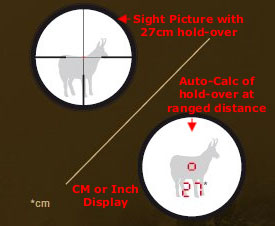 2. Hold-Over Values (Inches or CM)
 3. Elevation Click Values to Correct POI


 Looks like the days of manual target scoring are numbered — at least for airgun shooters. Effective April 23, 2012 (after this year’s Sectionals) the NRA will accept targets digitally scanned and scored with the new


 How’d you like to own the most comprehensive resource on guns ever created, an interactive database with information on over 50,000 firearms? If that sounds intriguing, check out the $39.95


 The science of dispersion-mitigating bullets is understood, but until now, no one has ever deliberately designed a bullet that has these specific attributes. There have been other bullets which have accidentally achieved the partial effect and the resulting bullets became very well known. Three key things are required to develop an effective dispersion-mitigating bullet:
 Four Years of Prototype Testing


