Valentine’s Day is just three days away, so you better start planning how you’ll show some appreciation for the lady in your life. Of course there are the old reliables: flowers, chocolates, and dinner at a fancy restaurant. But if you want to do something really different this year, how about giving your special lady some “pretty in pink” shooting gear. (Don’t forget the flowers though… if you value your life.)
Natchez Shooters Supplies offers a variety of pink products for ladies. How about a set of pink electronic ear muffs from Champion Shooters? A portion of the proceeds from sales of these muffs goes to fighting breast cancer. These muffs only have a 21 NRR (not so great), but they do collapse for easy storage. The Champion Ladies Target Muffs, item CM40975, sell for just $34.95.
Natchez also offers pink cases for both pistols and rifles. The Bulldog-brand 52″ Pink Rifle/Shotgun Case will hold most rifles or shotguns without optics. This would be a great gift for a young girl who shoots trap or who uses an iron-sighted rimfire rifle (such as a CMP H&R M12). The case features a water-resistant outer shell with a soft, scratch-resistant, tricot inner lining. The pink long-gun case costs just $14.75 at Natchez, item JZBD254.
For the Pistol-Packin’ Mama in the family, the Outdoor Connection makes a hot pink, range case. This tough, leather-bottomed bag features padded central compartments for pistols, with accessory pockets on all four exterior sides. There is plenty of room to stow ammo boxes, muffs, trigger locks, and other shooting gear. The great thing about this bag is that it can do double-duty as a general travel case when it’s not being used to haul pistols to the range. Made from heavy 600-denier nylon, the pink Range Bag is On Sale for $21.95 at Natchez.
Last but not least, MizMac.com offers a Pink, Limited Edition 4-Gun Range Cart, that’s perfect for a gal who shots service rifle, High Power, or multi-gun matches. The cart features a steel frame, run-flat tires on chrome spoke rims, and it even has dual rear parking brakes. The Cart can hold four, full-size long guns in a vertical position. It’s also a great cart for shotgunners, as it has a lower storage compartment that will hold 18 boxes of 12ga shells. Just as important as its ammo carrying capacity, the Rugged Gear Cart has a built-in Six-pack Cooler, for those vital liquid refreshments. As sold by MizMac.com, the Rugged Gear Pink Range Cart retails for $389.99.
Effective hearing protection is a must whenever you are shooting firearms or when you are in the vicinity of gun-shots. For ultimate protection, we recommend a good set of tapered foam earplugs, topped by ear-muffs. However, there are situations when you may prefer lighter-weight hearing protection that can be quickly removed. For example, if you are standing well behind the firing line as an observer, or if you are working as a rangemaster or waddie some distance away from the shooters.
In addition to traditional ear plugs and ear-muffs, new band-style protectors provide a third sound-blocking option. Howard Leight, a top name in the sound-protection business, now offers the “Quiet Band”, a device with soft foam plugs attached to a plastic band worn around the neck. This “Quiet Band” product is comfortable, easy to deploy, and surprisingly effective.
Three Quiet Band Models
There are three (3) types of Leight Quiet Band® sound protectors. We prefer the QB2 Supra-aural model (item QB2HYG, NRR 25). As shown in the photos, the NRR 25-rated QB2 positions cone-shaped foam pads next to the ear openings and holds them there with light pressure from the orange-colored band. There is also an Inner-aural version (item QB1HYG, yellow band, NRR 27), and a Semi-aural model (item QB3HYG, red band, NRR 21). Our preferred QB2 Supra-aural (orange band) model is just as comfortable as the QB3 (red band) version, and offers much better protection. The QB1 Inner-aural (yellow band) model requires that you place the ear buds in the ear canal, so it’s not really any easier to use than conventional earplugs. That’s why we like the QB2 Supra-aural model best of all. Other users agree. Here’s what two QB2 owners had to say:
“I first saw these used by Hickok45 on Youtube and he talked positively about them. I got two and gave them a try. At first, I didn’t think they were going to work very well. After some fiddling, I found they work pretty darn good. With my ears, they fit the best if the band starts on top of my head, I insert the plugs then rotate the band behind my head. PRESTO, perfect fit. Shooting the 9mm and 12 gauge out back was comfortable with no ringing afterward. [They are] small and easy to transport — just throw in the range bag. Yet, they are big enough to keep around your neck out of the way[.] I can sit these Howard Leights down on the shooting bench without worrying about them getting dirty since the band is curved, placing the plugs in the air. I highly recommend them to anybody needing banded hearing protection.” — Tom W.
“Great for woodworkers — These are lightweight AND very effective at reducing noise. When not in use the band hangs loosely around your neck, out of your way completely. Very cost effective for a great product!” — Sheri D.
Quiet Band® sound protectors can be purchased from many online vendors for under $5.00 per set, which includes a spare pair of ear buds. Amazon.com has the Leight QB2 (by Sperian) for just $2.50 per set, while Enviro Safety Products currently sells the QB2 for $3.87 per set. Replacement ear buds are available and sold by the pair. Ten-unit Bulk packs are also available for $35.00 with free shipping.
The American Gunsmithing Institute (AGI) has released a new Precision Long Range Shooting DVD. For what it’s worth, AGI guarantees this DVD can increase the hunter or tactical shooter’s accuracy by 37%. We’re skeptical of course, but that’s AGI’s claim. The DVD features gunsmith and long-range shooting expert Darrell Holland who narrates a multi-step course of instruction.
The DVD starts off with hardware — rifle, cartridges, and bullets. Next, ranging and equipment calibration are covered, followed by a discussion of optics and range finders. Shooting techniques are covered from the point of view of both the hunter and tactical shooter. Holland gives tips for bench and field shooting positions. Darrell also demonstrates field-expedient shooting techniques and accessories for optimum accuracy.
The DVD includes filmed demonstrations of precision shooting out to 600 yards. Developed exclusively for AGI customers, this DVD includes a set of tables for calculating aiming points for long-range shots. The AGI Secrets of Precision Long Range Shooting DVD is available at www.americangunsmith.com for $39.95 (Product ID# 322DVD).
Editor: This video is brand new, so we haven’t had a chance to preview it yet. Honestly, we don’t know whether it is worth the money. You probably can learn more in our own Shooters’ Forum for FREE. But there are few video/DVD resources for precision long-range shooting, so we thought this release was worth mentioning. Darrell Holland, the DVD’s featured expert, is a talented gunsmith, who runs highly regarded shooting clinics for long-range hunters. Darrell’s advice is probably going to be sensible and useful. Whether his coaching can actually increase a shooter’s accuracy 37% is for viewers to decide for themselves.
Some High Power shooters on the Forum asked about carts for carrying their gear to the range. You can certainly purchase a factory-made, purpose-built cart that folds up and has all the bells and whistles. The Creedmoor Sports CRC-1 (photo right) is a proven, quality product that works great. You’ll find these used by top shooters at Camp Perry. But the Creedmoor CRC-1 cart costs $499.95.
For a tenth that price ($49.99), plus a few dollars more for do-it-yourself enhancements, you can have a heavy-duty cart that will haul all your gear just fine, though it doesn’t fold up.
Check out the Harbor Freight Welding Cart, item #65939. This cart is ON SALE right now for just $49.99. Overall size is 29-1/2″ L x 20″ W x 49″ H, and width between side rails is 18″. The wheels (with tires) are 20 3/4″ in diameter for smooth rolling. Consider that, if you made your own cart from scratch you could easily pay $30.00 or more just for the large-diameter wheels and axle. Do note — this cart has air-filled tires. Be sure to inflate before you go to the Range!
As sold, the Harbor Freight Welding Cart isn’t quite ready for range use. But it’s easy to add plastic side-panels on the bottom unit, and fit a barrel-holding system on the cross-tube. I also suggest bolting/welding on extra spacers on the most forward underside edge of the bottom so that, at rest, the cart tilts slightly back. This ensures rifles and gear won’t flop forward. (A bit of extra lift also keeps the bottom plate out of the dirt and gravel.)
How to Upgrade Welding Cart for Range Use
Get a block of hard foam rubber. Cut keyhole slots in the rubber to grip the barrel and umbrella/scope stands. Mount the rubber block to the cross piece with self-tapping screws, or drill a horizontal channel in the rubber so the whole block fits over the cross-tube. On the lowest leading edge of the welding cart box (at ground level, front), fit a block of wood 2″ high (you can also fabricate metal extensions). This will make the cart lean back a little more, which helps stabilize the contents on sloping terrain.
You’ll want to enclose the sides of the bottom box area so small items don’t fall out. You can tack-weld aluminum side-plates if you want a fancy appearance. I prefer to just cut sheet plastic from a home improvement store. These plastic panels can be attached with screws or even zip-ties around tubing.
Run the plastic side panels up high enough that stuff like hats and muffs don’t fall out. After transport you can transfer ammo boxes and small items to the upper box (attached to the back side of the cross-tube).
The hardest component to find may be the hard rubber blocks for the barrel keeper, but you can also make a barrel-holding block out of wood, with some carpet to protect the barrels. The nice thing about the rubber is that it can be cut to snap over the barrels so you don’t need straps. Likewise, you can drill a hole transversely through the rubber, then slot it from the bottom and it will slide over the horizontal tubing with no fasteners needed.
Comment: This cart is heavy and it takes up a lot of space. You’ll need a station wagon, SUV or pickup truck to haul it around. But it’s cheap. The money you save on a range cart could pay for a new Krieger or Bartlein barrel, AND some new brass. Those things (new barrel and brass) will likely improve your scores more than having a fancy $500.00 range cart.
Robert Whitley of AR-X Enterprises, LLC builds match-grade uppers for AR-platform rifles. Many of Robert’s favorite chamberings are based on the 6.5 Grendel case necked-down to 6mm. Until 2011, Lapua was the only source for 6.5 Grendel brass. As you’d expect, Lapua’s Grendel brass is truly excellent, but it is also pricey, and sometimes hard to find. Now Hornady is producing USA-made 6.5 Grendel brass. Robert Whitley has worked with the Hornady 6.5 Grendel brass for over a year now and he is able to assess its performance compared to the original Lapua version. Writing in our Shooters’ Forum, Robert reveals: “It’s decent brass but hot loads will loosen the primer pockets fast. With moderate loads you will get good case life and service from the brass and it can deliver excellent accuracy as well. Not Lapua but not bad either.”
Robert reports: “I was able to get my hands on some of Hornady’s 6.5 Grendel brass. My big question was how it would measure up, particularly the loaded necks, and whether it would be compatible with our existing 6mmAR and Turbo 40 die sets. As it turns out, this brass looks like a perfect fit for our existing die sets (and obviously 6.5 Grendel die sets too). Accordingly, folks with existing die sets will be able to use the Hornady brass without any issues.” However, as the loaded neck on the Hornady brass is .001″ (one-thousandth) slimmer than Lapua brass, you may want to try a smaller bushing when sizing Hornady Grendel brass.
The Hornady 6.5 Grendel brass has a LARGE Flash Hole, about .078″ versus .0591″ for Lapua brass. Dimensionally, the biggest difference is the shoulder diameter, with the Hornady brass measuring 0.428″ vs. 0.424″ for the Lapua brass. The Hornady is actually a better fit for 6mmAR chambers which are about 0.432″ at the shoulder. Interestingly, case H20 capacity is virtually identical. Water capacity of new, unfired Hornady 6.5 Grendel brass is 35.1 grains, while new, unfired Lapua Grendel brass holds 35.0 grains of H20. Both brands of Grendel brass increase to about 36.0 grains H20 capacity after firing and full-length sizing.
Here are some of the particulars of the Hornady cases:
Hornady 6.5 Grendel Brass
Lapua 6.5 Grendel Brass
Flash hole diameter: ~ .078″
OAL of brass: Average 1.515″
Weight of cases: 111.7 to 113.0 grains
Web diameter, unfired: 0.4375″
Shoulder diameter, unfired: 0.428″
Loaded neck diameter: 0.2895″
6mmAR loaded neck: 0.270″
Flash hole diameter: 1.5mm (0.0591″)
OAL of brass: Average 1.515″
Weight of cases: 111.0 to 112.5 grains
Web diameter, unfired: 0.4385″
Shoulder diameter, unfired: 0.424″
Loaded neck diameter: 0.290″
6mmAR loaded neck: 0.271″
if you turn your case-necks, here’s a tool from 21st Century Shooting that can can save time, and help you produce better, more consistent turned necks. 21st Century’s Neck-Turning Lathe system, introduced last spring, may revolutionize the way reloaders turn their case necks. Watch the video and you’ll see why. If you’re never turned cases before, you may become a convert after seeing how quickly and easily the new 21st Century Neck-Turning Lathe does the job.
The mini-lathe has unique fittings on the left and right sides that allow both the case-holder and the neck-turning tool to float. As a result this tool maintains near-perfect concentricity during the cut. 21st Century’s John Perkins explains: “The floating design of the neck turner and the case driver allows the case mouth (bore) to run on the arbor absolutely concentric, therefore allowing O.D. to be turned concentric with I.D. The tailstock creates a horizontal inline support for the base of the case. This also allows the operator to keep both hands on the power screw driver or drill, making it very easy to control the feed rate and to produce a very fine, turned finish.” Having the system float at both ends was key, according to John: “By allowing both the turner and the case to float, everything self-aligns. This maintains concentricity and allows the unit to work with very low torque.”
Neck-Turning Lathe is Fast Yet Precise
Using power from a drill or electric screwdriver, this tool will turn necks fast — in a matter of a few seconds. And it produces beautiful, smooth necks that are extremely uniform. Tests show that the lathe, used with the 21st Century Neck-Turning Tool, will hold 0.0002 (two ten-thousandths) neck wall tolerances. And it will do that time after time.
Turn Necks in a Single Pass
Using traditional hand-methods, turning case necks can be time-consuming and fatiguing. Many folks will experience hand pain or cramping after just a dozen cases. Watch the video, you’ll see how fast and easy neck-turning can be with the new mini-lathe. You get an exceptionally good cut in seconds. Very importantly, with this system, you may be able to switch from a double-pass cut, to a single-pass cut. Yes, even if you’re making a deep cut, we think there is a good chance you can turn all your necks in a single pass. That can cut your labor time in half!
Why does the 21st Century Neck-Turning Tool cut so well? First, the Neck-Turning Tool employs ultra-sharp carbide cutters that are custom-ground to fit the shoulder angle of your cartridge. This allows you to make a perfect cut extending down the shoulder 1/32 of an inch. Second, the system aligns the case neck on the arbor (mandrel) so well, and the cutter is so sharp, that very little torque is required. This allows the cutting process to go very smoothly. The case-holder is also unique — it features a O-ring so it holds the case firmly in place without marring or bending the case head. The tailstock case-holder adjusts to accommodate cases from 17 Fireball to a .416 Rigby.
More Case Prep Tools for Lathe in Future
In the near future 21st Century will offer additional case prep attachments for the new mini-lathe. 21st Century plans to provide bullet-pointing system and other options. These will all work with the same lathe “chassis”, and will run with power. John states: “This is a modular system, all parts interchange. So if you have an existing 21st Century Shooting Neck Turning Tool or Bracket, everything will fit.”
The 21st Century Neck-Turning Lathe costs $245.00, complete with Neck-Turning Tool ($85.00 value) and one case-holder driver. The Neck-Turning Tool comes with a carbide cutter with user choice of shoulder angle (Arbors and Mandrels are sold separately). Perkins recommends using the Neck-Turning Lathe with power, but it will also work with an optional hand crank. NOTE: Currently the Neck-Turning Lathe works ONLY with the 21st Century Neck-Turner. It will not work with K&M, Sinclair, or Forster tools. But that’s not a real drawback because the 21st Century tool is certainly one of the best on the market today. You can purchase the Neck-Turning Lathe (complete with Neck-Turner and Case-Holder) through the 21st Century website, or call (260) 273-9909.
Disclosure: 21st Century Shooting advertises with AccurateShooter.com.
Polymer Injection Molding (PIM) of Monson, MA has been awarded U.S. Patent 68,062,736 for overmolding gunstocks coated with a decorative or protective substrate. Overmolding typically is used to enhance synthetic stocks by molding a soft, rubber-like material to gripped areas of a gunstock (fore-end and pistol grip). Sometimes overmolding is applied to the entire stock. Overmolding also is used to decorate stocks with contrasting colors and textures.
Applying overmolding to a decorated gunstock (camo, wood grain, etc.) has proven to be extremely difficult and costly and has not been practiced widely. As a result, overmolded stocks typically have a black, grey, tan or other basic, out-of-the-mold colors. See, e.g. the Hogue Over-Molded stocks. PIM’s patented technology changes all that. Now overmolding can be applied over camo-dipped and other patterned stocks. This is typically done in key contact areas on the fore-arm and on the pistol grip section.
According to PIM President Jim Ryan, “We did our first overmolded stock for a gun manufacturer over ten years ago. It wasn’t long before everybody wanted to camo and overmold the same stock. That proved to be easier said than done. Masking the overmolded part makes a horrible mess and overmolding directly over camo (without our process) has big adhesion problems. We experimented for a long time before coming up with a process that worked. We overmold over camo day-in and day-out without any problem. It looks great and holds up as well as direct overmolding applications”.
Craig Dougherty, PIM’s Marketing Director, echoed Ryan’s comments. “The ultimate added value is to decorate with camo and overmold the grip areas with a complementary color. We’ve done a lot of basic black over camo but overmolded tan, grey and green grips really punch it up. Now that our technology is protected, we expect to be doing more variations”. For more info, visit the PIM website at www.gunvalleymolders.com.
There was a lot of buzz at the Defiance Machine booth at SHOT Show. The new Defiance actions are beautifully made, and they have already been used in some impressive custom rifle builds. Defiance, based in Columbia Falls, MT, has rolled out a line-up of four (4) custom actions: Rebel, Mutant (for tubeguns), Renegade (for .408 CheyTac), and Titan (for 50 BMG). These actions all feature beautiful machining, with Wire EDM-cut lug ways, advanced-design extractors, and a true one-piece bolt. All action materials are pre-hardened before machining to prevent changing tolerances during heat-treating. Southpaws will be happy that both right and left-hand versions of all four actions are offered.
The Rebel actions feature a Remington 700 footprint for ease of inletting and stock compatibility. Notably, the Rebel actions are available in four lengths. Buyers can choose Medium, X-Medium, Long, or X-Long lengths to accommodate all popular factory chamberings and extended-length handloads. Multiple magazine well cuts are available for all of today’s popular magazine types including hinged floorplates, DBMs, or single-shot. For a rock-solid optics installation, Defiance can supply Mil-spec Picatinny rails with various built-in MOA geometry. This stout rail is secured to the action with five pins and 1/4-28 X 1/2″ screws. Base price on a Rebel is $1270.00 (Medium) or $1300.00 (Long), with many available extra-cost options. Defiance says delivery will take at least 60 days from order date.
We were very intrigued by the Mutant action with its integrated recoil lug. Offered in Medium and Long action lengths, Defiance’s new Mutant receiver is made specifically for the Eliseo RTM and RTS Chassis Systems. The Mutant features an extended tenon length for increased barrel thread contact and bedding surface. (Extended tenon is optional on the Rebel). The Mutant’s integral recoil lug adds rigidity and simplifies tubegun assembly. Medium-action Mutants are typically built with a Guardian mag-well cut to accommodate AI and AW magazines, while Long-action Mutants fit AI single-stack magazines and can be of Badger length or the longer CIP length for extended-OAL cartridge loading. The starting price on a Mutant action is $1200.00 (before options), and delivery is at least 60 days out.
The beefy Titan (50 BMG) and Renegade (.408 CheyTac) actions look like they will become very popular with the big-caliber shooters. These jumbo actions share the advanced features of their smaller cousins, but they are sized up significantly to provide additional strength, stiffness, and bedding surface. On both big actions double-plunger ejectors are used in combination with M16 extractors for reliable case ejection. Both Titan and Renegade actions are offered either as a single-shot or repeater. The Titan is currently sold exclusively through Proof Research, while the Renegade is not yet in production. Defiance plans to build 600 Renegade actions later this year, after demand is filled for the Rebels and Mutants. The anticipated price for the Renegade is $1750.00.
OK, we suspect we’ve whet your appetite. For final pricing (with customer-ordered options) and availability call Defiance at (406) 756-2727. For specs, features, and lots more photos, visit DefianceMachine.com. Contact Proof Research, 406-756-9290, with order questions about the 50 BMG Titan action.
BAT Machine in Idaho is now offering some new products, plus some new options for its popular actions. For tactical guys and those who prefer a bigger bolt knob, BAT now sells an optional threaded, tactical-style bolt knob. Cost is $35.00 on top of the regular action price. Buyers of two-lug actions should also note that BAT is now Tig-Welding the bolt handles on two-lug actions.
If you’re building an AR and what a precision-machined barrel extension, BAT has added AR10 and AR15 barrel extensions to inventory. These are completely machined after heat treating in only two setups. According to BAT: “This allows us to manufacture the extension with more consistency and tighter tolerances than others on the market.” AR10 bolt extensions cost $55.00, while AR15 and M4 bolt extensions cost $30.00.
Last but not least, BAT is now offering canon-style (horizontally-ported) CNC-machined precision muzzle brakes in two sizes. The smaller size, for barrels with muzzle diameter between 0.675 and 0.800 inch cost $115.00. The large size muzzle brakes, which fit barrels 0.800 inch and larger in muzzle diameter, run $125.00. For either size, you need to specify caliber when ordering.
Gary Eliseo of Competition Shooting Stuff (CSS) is about to release his new Heavy-Duty (HD) bipod for his CSS tubegun chassis systems. In development for over a year, this unit is very innovative. To place the bipod’s rotational (swivel) axis as close as possible to the bore axis, the bipod actually attaches with a cylindrical bushing fitted to the front tube (handguard). This keeps the center of gravity low and significantly reduces perceived torque, particularly with .308 and larger calibers.
You’ll also notice the large half-spherical leg bases. These have been called “golf-ball” feet or, alternatively, “mushroom heads”. Extensive testing showed that this design works really well, particularly for shooting off an uneven or inclined surface. Because the half-spheres contact the ground in just one point, you can easily adjust your rifle’s angle to the target. By contrast, some of the popular sled-type and ski-type bipod feet will dig one end into the ground if the rifle is angled up or down significantly relative to the ground plane. With the golf-ball feet you can shoot on a steep down-angle hill with no problems.
Gary also found that the spherical “mushroom head”-style feet work real well on a shooting mat, sliding back smoothly on recoil without hopping too much. This is good for those guys who like to allow their rifle to slide back a bit to smooth out the recoil and follow-through. If you prefer to hold hard and brace firmly against the backward push of the rifle, you can screw down pointed spikes from the bottom of the ball feet. These spikes can be planted in the ground to anchor the gun against rearward movement. So, the spherical bases offer a choice of two shooting styles.
Gary explains: “The new CSS HD Bipod is designed specifically for my chassis systems. As you can see, the bipod mounts in the end of the hand guard so the rifle rotates on its central axis. Our testing shows that this mounting system works really well at controlling torque effects. The spherical feet are made of delrin so they slide easy if you want to let the recoil move back on recoil. But the round leg bases are drilled and tapped to accept track shoe spikes so you pre-load the bipod and hold hard if you prefer.”
Both bipod legs are individually adjustable for height with an inner rod sliding in an outer tube on each side. Adjustment is continuous, with height fixed by way of a tensioning knob. It’s fast and easy to adjust height. One or both legs can also be retracted upwards in an arc, so they can be stowed parallel to the barrel (with tips facing either to the front or to the rear). The new Eliseo HD Bipod weighs 1 pound, 10 ounces — reasonably light considering how sturdy these units are. Pricing has not yet been set, but Gary says they should retail for under $200.00. For info, visit CompetitionShootingStuff.com.


 Valentine’s Day is just three days away, so you better start planning how you’ll show some appreciation for the lady in your life. Of course there are the old reliables: flowers, chocolates, and dinner at a fancy restaurant. But if you want to do something really different this year, how about giving your special lady some “pretty in pink” shooting gear. (Don’t forget the flowers though… if you value your life.)


 Three Quiet Band Models
 “I first saw these used by Hickok45 on Youtube and he talked positively about them. I got two and gave them a try. At first, I didn’t think they were going to work very well. After some fiddling, I found they work pretty darn good. With my ears, they fit the best if the band starts on top of my head, I insert the plugs then rotate the band behind my head. PRESTO, perfect fit. Shooting the 9mm and 12 gauge out back was comfortable with no ringing afterward. [They are] small and easy to transport — just throw in the range bag. Yet, they are big enough to keep around your neck out of the way[.] I can sit these Howard Leights down on the shooting bench without worrying about them getting dirty since the band is curved, placing the plugs in the air. I highly recommend them to anybody needing banded hearing protection.” — Tom W.
 The
The 
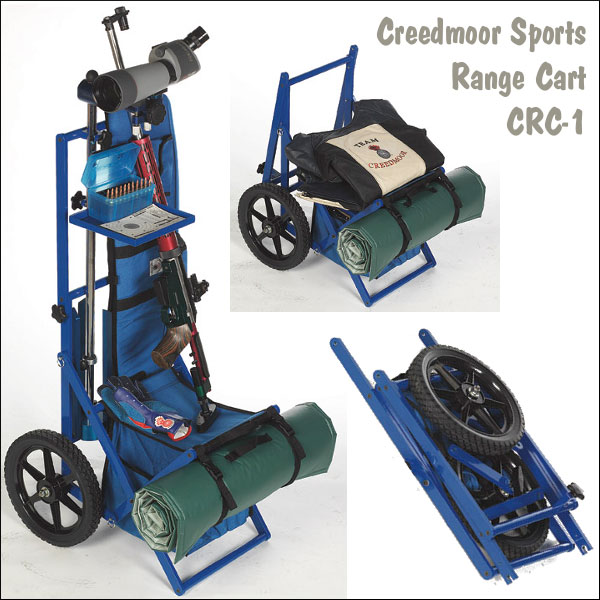 Some High Power shooters on the Forum asked about carts for carrying their gear to the range. You can certainly purchase a factory-made, purpose-built cart that folds up and has all the bells and whistles. The
  Check out the
  You’ll want to enclose the sides of the bottom box area so small items don’t fall out. You can tack-weld aluminum side-plates if you want a fancy appearance. I prefer to just cut sheet plastic from a home improvement store. These plastic panels can be attached with screws or even zip-ties around tubing.


 Turn Necks in a Single Pass
 Why does the 21st Century Neck-Turning Tool cut so well? First, the Neck-Turning Tool employs ultra-sharp carbide cutters that are custom-ground to fit the shoulder angle of your cartridge. This allows you to make a perfect cut extending down the shoulder 1/32 of an inch. Second, the system aligns the case neck on the arbor (mandrel) so well, and the cutter is so sharp, that very little torque is required. This allows the cutting process to go very smoothly. The case-holder is also unique — it features a O-ring so it holds the case firmly in place without marring or bending the case head. The tailstock case-holder adjusts to accommodate cases from 17 Fireball to a .416 Rigby.
 Applying overmolding to a decorated gunstock (camo, wood grain, etc.) has proven to be extremely difficult and costly and has not been practiced widely. As a result, overmolded stocks typically have a black, grey, tan or other basic, out-of-the-mold colors. See, e.g. the


 Both bipod legs are individually adjustable for height with an inner rod sliding in an outer tube on each side. Adjustment is continuous, with height fixed by way of a tensioning knob. It’s fast and easy to adjust height. One or both legs can also be retracted upwards in an arc, so they can be stowed parallel to the barrel (with tips facing either to the front or to the rear). The new Eliseo HD Bipod weighs 1 pound, 10 ounces — reasonably light considering how sturdy these units are. Pricing has not yet been set, but Gary says they should retail for under $200.00. For info, visit


