If you’re looking for a versatile, .308 Win tactical rifle, built with top-quality components, check out G.A. Precision’s new Thunder Ranch Rifle. This rifle comes with the right stuff: Bartlein 5R barrel (22″, 1:11.25″ twist), Manners stock, custom Templar action with one-piece bolt and +20 MOA rail, and full Cerakote finish. What’s more, every Thunder Ranch Rifle comes with a 3/8 MOA accuracy guarantee.
A collaboration between Clint Smith, President/Director of Thunder Ranch (TR) and G.A. Precision (GAP), this rifle was designed to Clint’s specs from the ground up. This is the official TR “house rifle” used in TR’s challenging precision bolt rifle courses. The gun is designed for durability and accuracy, and Thunder Ranch Rifles are as handsome as they are sturdy. Each TR Rifle is finished with molded-in Field Grade GAP Camo, and the exposed metal is all coated with Mil-Spec OD Cerakote, an extremely durable ceramic-based finish. The Thunder Ranch Rifle is available right now at a cost of $3585.00.
This year marks the 100th Anniversary of J.M. Browning’s 1911 pistol, and the classic semi-auto is more popular than ever. If you are looking for the source of “all things 1911″, check out Brownells Centennial (7th Ed.) 1911 Catalog. This richly-illustrated catalog features over 3,000 1911 products, including some 350 new items added just for this special edition.
Alliant is introducing a new extruded powder, AR-Comp. AR-Comp is an advanced re-formulation of Reloder 15, a double-base Bofors powder. There are changes to internal and external chemistry to provide much better pressure/velocity stability across a wide range of temperatures. The main difference between AR-Comp and Reloder 15, is the AR-Comp has a slightly faster burn rate, and AR-Comp is much LESS Sensitive to temperature changes. AR-Comp is a small-kernel, double-base extruded powder like Reloder 15, so it will continue to meter just like Reloder 15. The load density should be the same as Reloder 15.
AR-Comp should be at Grafs.com in a Couple Weeks
Here’s the good news — Alliant will start shipping AR-Comp to Grafs.com later this week. Dick Quesenberry, Alliant Powder Product Manager, told us: “I just received the AR-Comp packaging labels and we hope to send off the first shipments to Grafs this week.” With transit time, expect the powder to be available from Grafs.com by the second week of June. You can go ahead and place advance orders for 1-lb and 8-lb containers of AR-Comp on the Grafs.com website.
AR-Comp Offers Uniform Velocities over a Wide Temp Range
Tests were done with .223 Rem and .308 Win ammo, loaded with AR-Comp and maintained at temps from -20° F to +160° F in a controlled test center. The ammo itself was heated or cooled to targeted temps before testing. Across that entire range of temperature, -20° F to +160° F, the ammo loaded with AR-Comp showed a variation of only 20 fps in muzzle velocity. The primary bullet type tested was a 77gr .224 bullet and the secondary was a 175gr .308 bullet.
Burn Rate Like Varget
Though this is a reformulation of Reloder 15, the burn rate of AR-Comp is slightly faster than Reloder 15. Alliant told us: “Reloder 15 is slightly slower, in burn rate, than Varget. The new AR-Comp, with the enhancements, ended up slightly faster than Reloder 15, so it is now very close to Varget in burn rate”. This is the result of the “tuning” of the powder to be much less temp-sensitive.
AR-Comp First in Series of New Alliant Temp-Stable Powders
AR-Comp will be the first in a series of “new generation” temp-stable powders from Alliant. Quesenberry noted: “Our goal was to provide a powder that offers stable pressures in all temperatures. Shooters want to be able to stay with the same load in winter and in summer, in cold or in hot conditions.” Quesenberry added: “We’ve been working on this quite a while. AR-Comp is the first example and we hope to extend this to other rifle powders. It’s a tough job. You have to balance the performance carefully. We worked very hard to do just that and we think shooters will be impressed with the results.”
Reloder 15 Will Stay in Production
Fans of Alliant’s Reloder 15 don’t need to worry. Alliant will keep Reloder 15 in production. “We don’t drop powder lines”, said Quesenberry.
German Salazar has found some innovative and smartly-engineered new cleaning accessories that can benefit any shooter who wants to maintain the accuracy of his precious (and expensive) barrels. Here’s German’s report on the new Bore Rider Jags and Bore Rider Brush Guides.
Good Stuff: Bore Rider Barrel Care Productsby German Salazar
We see new bore cleaning solvents introduced with some regularity, but cleaning hardware evolves more slowly. I’ve been using some new jags from Don Leidich’s Bore Rider Barrel Care Products for a few months and am satisfied that they are a genuine improvement over anything else I’ve used. Don began making these items for the black powder cartridge shooters as their cleaning needs are serious and frequent. He has now expanded the line to include popular bore sizes for modern centerfire barrels.
Modern Jags and Brush Guides Made from Acetron Polymer
Don’s Bore Rider enterprise makes jags as well as companion Brush Guides for use with bore brushes. These are all made from Acetron® GP, an acetal polymer material similar to Delrin, but with greater lubricity. Bore Rider Jags and Brush Guides minimize any damage that might occur to the crown when the jag or brush exits the bore. With conventional jags and brushes, when brushing or patching your barrel, the cleaning rod shaft falls to the bottom of the bore as the patch or brush exits. Over time, that can result in excessive wear at the lower edge of the bore (6 O’Clock position) in the last few millimeters on the muzzle end. In extreme cases you can even wear a slight groove in the lip of the crown (i.e. the very end of the rifling at the muzzle). Another advantage of Bore Rider Jags over conventional brass jags is that you don’t get “false positive” green/blue patch colorations from solvent reactions with the metal jag itself (as opposed to actual copper fouling in the barrel).
The Bore Rider Jag has an extra-long shank so that when the patch exits, the Acetron (polymer) shank is the only thing that makes contact with the crown. This way you don’t have a metal rod tip riding over the delicate crown. The Bore Rider Jag shank diameter is also a close fit to the bore to avoid uneven wear. The Brush Guide is an Acetron extension that fits between your brush and the end of the cleaning rod. This extension protects the crown when you brush, allowing you to push the brush completely out of the barrel without dragging metal connections over the edge of the crown. [Editor’s Tip: While the polymer material used in the Bore Rider Jag and Brush Guide is “kinder” to crowns, be sure keep the Acetron shanks clean from small particles and debris. These particles can embed themselves in the polymer. Wipe off the Jags and Brush Guides regularly.]
If protecting your barrel’s crown was all that these items did, that would be enough to merit their use. However, what’s more interesting about the jags is that they are made for a very tight fit in the bore and as a result, they truly get the patch working to scavenge the grooves of all the residue possible. The fit is so tight that Don was concerned that not all patches might work properly, as some extra thick ones might not enter the bore at all on this jag. I’ve used the jags with patches from Sinclair, Bruno’s Pro-Shot and a couple of no-name bags and all have worked flawlessly. Also, the jags are designed so that the segments that hold the patch material can never come in contact with the crown while pulling it back into the barrel. My borescope examination of the barrels shows that the job is getting done right.
Source for Bore Rider Jags and Brush Guides
The .223, .243, .264 and .308-caliber jags sell for $15.00 and the Brush Guides sell for $13.00. Other caliber jags start at $22.00 for jags and $18.00 for Brush Guides. These are threaded and chamfered to fit appropriate Dewey rods. The opposite ends on the brush guides have 8-32 female threads. Customers can buy adapters (from other vendors) to fit other brands of cleaning rods. Don can also customize Jags to fit a customer’s rod specifications if you don’t want to deal with an adapter. Don’s custom made Jags and Brush Guides cost $25 and $18 respectively.
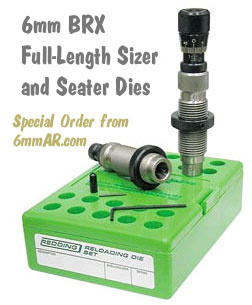
On May 4th we noted that Robert Whitley has commissioned a special run of 6mm BRX dies. We’ve just learned that the dies have arrived — and, according to Whitley, they work great.
Robert offers a Redding Type ‘S’ full-length sizing die that will size the whole case, with bushing control over the neck. Redding 6mm BRX micrometer-top Comp Seaters will also be available. The Type ‘S’ FL Sizer costs $89.95, while a package with Comp Seater costs $199.95. This is a very limited run of 6BRX dies, and Redding is not currently selling them through other sources. If you want a Redding 6BRX Type ‘S’ FL sizer or Comp Seater die, order soon:
Wilson Combat has come up with a new cartridge, dubbed the 7.62×40 WT (Wilson Tactical). Basically it is a .223 Remington necked up to .308 caliber, i.e. a .30-.223 Rem Wildcat. The cartridge is designed to give .30-cal capability to a standard AR15, using the normal bolt assembly and standard AR15 magazines. An AR15 can be converted to shoot the 7.62×40 WT with just a barrel swap. Note: Don’t confuse this new cartridge with the 7.62×39, the Eastern Bloc military cartridge that has been around for decades. The 7.62×40 WT is not derived from the 7.62×39 in any way. The 7.62×39 has a larger rim size, more body taper, and requires a different magazine and bolt. There have been 7.62×39 adaptations for ARs, but most didn’t function well (usually because of magazine issues). Wilson Combat claims the 7.62×40 WT offers the hitting power of the 7.62×39, but with a cartridge design that feeds and functions 100% in an AR15.
The 7.62×40 WT was designed around an optimal overall cartridge length of 2.250” which is a perfect fit for standard AR mags without shoving the bullet too far down in the case. Wilson says that its 7.62×40 WT barrels are optimally throated for the 2.250″ COAL. Therefore, Wilson claims, the “7.62×40 WT does not suffer from the same inconsistent accuracy issues in the AR platform often seen with the 300 Whisper and 300 BLACKOUT.”
Here are comparative Velocity and Energy numbers for the 7.62×40 WT vs. other cartridges with which it will compete.
7.62×40 WT (16″ Barrel)
110 gr: 2450 FPS Muzzle Velocity and 1466 Foot Pounds of Energy
125 gr: 2400 FPS Muzzle Velocity and 1599 Foot Pounds of Energy
150 gr: 2200 FPS Muzzle Velocity and 1612 Foot Pounds of Energy
5.56 NATO (.223 Rem) (16″ Barrel)
55 gr: 3150 FPS Muzzle Velocity and 1212 Foot Pounds of Energy
62 gr: 3000 FPS Muzzle Velocity and 1239 Foot Pounds of Energy
77 gr: 2750 FPS Muzzle Velocity and 1293 Foot Pounds of Energy
7.62×39 (16″ Barrel)
123 gr: 2320 FPS Muzzle Velocity and 1470 Foot Pounds of Energy
6.8 SPC (16″ Barrel)
110 gr: 2550 FPS Muzzle Velocity and 1594 Foot Pounds of Energy
At first it looks like the 7.62×40 WT has more energy than a 7.62×39 and outruns a 6.8 SPC handily. But Wilson omitted some key data for the 7.62×39. Taking load info straight from the Hodgdon Reloading Center, a 7.62×39 can be loaded to 2408 fps with a 125gr bullet, or to 2192 fps with a 150gr bullet at relatively moderate pressures (under 41,000 CUP, or roughly 44,250 psi). A 7.62×39 launching 150-grainers at 2192 fps generates 1601 foot-pounds, virtually the same as Wilson’s 150gr load. So, the 7.62×40 WT has no real advantage (over the 7.62×39).
Is This Cartridge Needed at All?
The “T” in 7.62×40 WT stands for “Tactical”, but we don’t think many police or military units will adopt this round. The 5.56x45mm is too well-established in the AR15/M16 platform and the 7.62×39 is the smart .30-Cal choice for an AK. So what, then, is the real “niche” for the 7.62×40 WT?
We think this round may prove popular with hunters who want to shoot a much heavier bullet out of a standard AR. A 150gr projectile is nearly twice as heavy as the biggest projectile you can shoot from a .223 Rem AR. The bigger bullet should work better on some kinds of game. Wilson Combat says: “Designed for tactical/defense applications as well as hunting for medium-sized game such as deer and feral hogs. For hunting the 7.62×40 WT vastly out performs the 5.56 and is on par with the 6.8 SPC at ranges out to 175-200 yards. The VERY mild recoil of the 7.62×40 WT also makes it ideal for female and younger shooters as well as anyone that’s recoil sensitive.”
Wilson says the 7.62×40 has proven itself as a good hunting cartridge: “A LOT of Texas feral hogs, whitetail deer and predators lost their lives testing the terminal performance of this cartridge! The 7.62×40 WT has proven to be a VERY efficient killer on medium sized game with the 110gr Barnes TTSX, 125gr Nosler Ballistic Hunter and the 125gr Sierra Pro Hunter. Any of these three bullets perform admirably on deer and hogs under 150 lbs. or so, but we recommend the 110gr Barnes TTSX for large hogs. The 110gr Sierra HP is a great bullet in the 7.62×40 WT for varmints and predators, and has proven to be one of the most accurate bullets.”
For home defense, it could be argued that the 7.62×40 WT is better than the .223 Rem because the larger, slower .30-Cal projectile has less penetration (through walls), but that would have to be demonstrated with real-world testing. Moreover, there are frangible .224-cal bullets that minimize the risk of over-penetration indoors.
Some benchresters might even tinker with the 7.62×40 WT in a bolt gun for score competition, but we doubt it would prove competitive with the 30 BR which can push a 120gr bullet at around 3000 fps. Wilson’s cartridge does give a paper-puncher the ability to shoot a .30-caliber bullet from a rifle with a .223 bolt face, and that might be attractive to club shooters in informal score matches.
Wilson Combat will be selling 7.62×40 WT loaded ammunition (with 110gr or 125gr bullets), but it is also supporting the reloading market. Wilson offers 7.62×40 WT brass, Hornady 7.62×40 WT dies, and you’ll find extensive load data on the Wilson Combat website. For those who want to put together a 7.62×40 WT AR, Wilson offers pre-chambered 7.62×40 WT barrels, as well as complete 7.62×40 WT uppers. Barrels start at $249.95, while the 7.62×40 WT uppers retail for $1024.95.
A dedicated iPad version of Ballistic (‘Ballistic’ App), a full-featured ballistics calculator for the iPhone, is available for the growing numbers of iPad users. As with the iPhone version, ‘Ballistic’ App for the iPad is “powered by JBM Ballistics” so it offers very precise solutions — typically, at 600 yards, JBM will get you within two or three clicks, provided you have good bullet BC data and reliable MV from your chronograph.
The ‘Ballistic’ App for the iPhone and iPad features a library of over 3,100 projectiles; the library includes the latest 2010 commercial data and G7 military coefficients from Aberdeen Proving Grounds. Along with calculating bullet trajectories, this software has many extra features. There are several different target cards so you can input shot placement and scoring is calculated automatically. There is also a range log (for recording shooting sessions), a mildot and MOA range estimator, and a convenient load database for storing your reloading recipes.
Special features in the iPad edition of ‘Ballistic’ App include: fully integrated split-screen ballistics, favorites, and range log; full-screen, hi-resolution charts; ballistics calculations update automatically as you edit; larger target sizes in range log; and screens can rotate. The iPad Ballistic App (release 2.3.7) costs $19.99. The standard version for iPhone and iTouch units, costs $9.99. To learn more about this software, visit ballistic.zdziarski.com.
The Drop Port is a great feature for benchrest shooters. You can run a bolt without an ejector, yet your cartridge will extract smoothly and reliably each time you pull the bolt back. Stiller’s Precision Firearms pioneered the Drop Port design, and Jerry Stiller offers this as a popular option with his Cobra, Viper, Python, D-Back, and Diamondback actions. The Drop Port is amazing in its simplicity (watch video below). As you pull the bolt rearwards, the fired case slides downward into a funnel. As it tilts nose-down, the case rotates free of the six-o’clock extractor, falls nose first down the funnel, and finally exits through a hole in the bottom of the stock. Gravity does all the work.
S&S Panda Drop Port Conversion
Until recently, if you wanted a Drop Port, your only option was to purchase a Stiller action or engineer a conversion yourself. Now the owners of Kelbly Panda actions can enjoy drop-port functionality via a conversion performed by S&S Precision Rifles in Texas. The folks at S&S will mill a slot in the bottom of your action, and then install a drop funnel in your stock. The conversion work is done so well you’d think the Pandas were originally made as Drop Ports by Kelbly. Drop Port conversions will be available for popular small match cartridges including 22 PPC, 6 PPC, 6mmBR, 6BRX, 6 Dasher, 6.5 Grendel, and 30 BR (plus other wildcats in the BR family).
Conversion Will Be Costly — New Actions Are Best Candidates
This conversion will not be cheap. Because Drop Ports require a six o’clock extractor, you’ll probably need a replacement bolt for your Panda. S&S is in discussion with Pacific Tool & Gauge to provide these bolts. You can probably resell your existing bolt, but the upfront conversion cost could approach $400 with new bolt and labor. S&S hopes to announce firm pricing in 4-6 weeks. Don “Stick” Starks, S&S’s lead gunsmith, also cautions that this conversion is most cost-effective with Panda actions that have not yet been installed, or which are set up with pillars (as opposed to glue-ins). Stick explained: “If your Panda is already glued in, then we have to remove the action, mill the port, install the funnel, and then re-bed the whole thing. That’s going to substantially increase your cost. It’s more logical to do this on a Panda that has not yet be put in a rifle.”
In the video above, you can watch S&S Precision convert a Stolle Panda action to a Drop Port, and then see how the converted Panda functions. The rifle is a 30BR owned by FORUM member Truckincars, who also created the video.
Ray Bowman of Precision Rifle & Tool LLC (PR&T) has a new stock design, the Low Boy Benchrest, that combines the successful features of PR&T’s F-Class stock with a rear end better suited to shooting from the bench. As you may know, PR&T’s F-Class stock, in the hands of Charles Ballard and others, has been hugely successful in F-Class competition. The new Low Boy Benchrest stock borrows the same low-profile front end, but it is different from the tang rearward.
While the Low Boy F-Class stock is designed so you wrap your thumb around (like holding a pistol), the Low Boy BR stock is designed so you can slip your hand along the side, with thumb rested lightly behind the tang, in a central position. Unlike the F-Class stock, which is designed for full grip “hard-holding”, this stock is designed for shooting with a “light hold” style (or even free recoil). These stocks are very straight dimensionally, so they track well.
We think this stock will work very well for 600-yard and 1000-yard Light Gun Benchrest competition. This Editor likes the stock enough that I am considering using a Low Boy Benchrest stock for a future Light Gun project with a Stiller Viper Drop-Port. The Low Boy BR stocks are affordable — starting at $330.00 for an un-inletted version with a 3″-wide fore-end. Inletting adds just $25.00 to the total. PR&T can also pillar-bed your action in the stock for an additional $225.00.
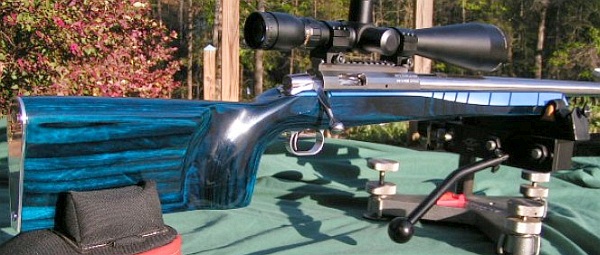
Handsome Bat-Action BRX in Low Boy BR Stock
The blue-stocked rifle in the photos belongs to FORUM member Bo W. (aka “Sighter”). It is a 6BRX with a BAT MB, multi-flat action. The finish and painting work on the PR&T Low Boy BR stock was done by Tuck. Sighter rates the stock highly, but he thinks the standard configuration sits a bit high in the back: “I like the stock and it tracks fine, but I feel the F-Class style height causes it to ride a bit higher in the bags than needed. I talked about this with Ray Bowman [PR&T owner] and have since ordered two more Low Boy BR stocks. With the last two, Ray cut about 3/4″ off the bottom of the stock butt and kept about a .67″ flat so a double-stitch bag will work. It is now more similar to a Tracker.” Shown below is a Low Boy BR stock with the reduced height option.
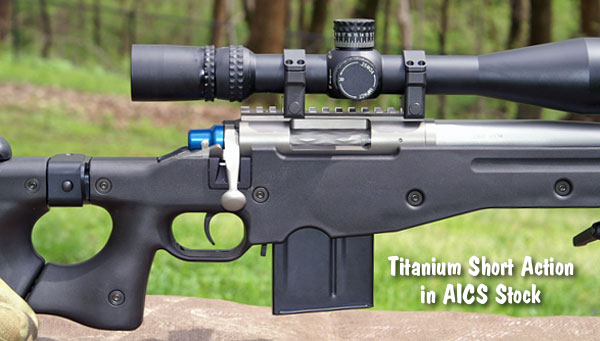
X-Treme Shooting Products now has its new Titanium Short Actions and Long Actions in production. Made from Grade 5 Ti-6Al-4V Titanium, these are the only custom Titanium actions currently manufactured in the USA. The long and short X-Treme Ti actions are available with +20 MOA Taper Titanium Picatinny Scope rails and Titanium Recoil Lugs. The .338 Actions will be coming soon, and will be offered with +20, +25, and +30 MOA Taper rails and integral recoil lugs.
We thought you’d enjoy some views of the short and long Ti actions, fitted in tactical rifles. Shown below is and X-Treme Titanium Short Action in the regular Accuracy International AICS 2.0 chassis stock. This rifle features a Krieger fluted barrel (chambered in .260 Rem), withe an X-Treme 2-stage trigger, and Nightforce 5.5-22×56 NXS scope.
The slide show below features the X-Treme Titanium Long Action in the new Accuracy International AX chassis stock. This impressive beast also has a Krieger barrel, but chambered for the 6.5×284 cartridge. The gun also has an X-Treme 2 stage trigger, and a Nightforce 5.5-22×56 NXS scope.
Story Tip from Edlongrange. We welcome submissions from our readers.
Disclosure: X-Treme Shooting Products advertises with AccurateShooter.com.


 A collaboration between Clint Smith, President/Director of Thunder Ranch (TR) and G.A. Precision (GAP), this rifle was designed to Clint’s specs from the ground up. This is the official TR “house rifle” used in TR’s challenging precision bolt rifle courses. The gun is designed for durability and accuracy, and Thunder Ranch Rifles are as handsome as they are sturdy. Each TR Rifle is finished with molded-in Field Grade GAP Camo, and the exposed metal is all coated with Mil-Spec OD Cerakote, an extremely durable ceramic-based finish. The Thunder Ranch Rifle is available right now at a cost of $3585.00.
 Alliant is introducing a new extruded powder, AR-Comp. AR-Comp is an advanced re-formulation of Reloder 15, a double-base Bofors powder. There are changes to internal and external chemistry to provide much better pressure/velocity stability across a wide range of temperatures. The main difference between AR-Comp and Reloder 15, is the AR-Comp has a slightly faster burn rate, and AR-Comp is much LESS Sensitive to temperature changes. AR-Comp is a small-kernel, double-base extruded powder like Reloder 15, so it will continue to meter just like Reloder 15. The load density should be the same as Reloder 15.
 The Bore Rider Jag has an extra-long shank so that when the patch exits, the Acetron (polymer) shank is the only thing that makes contact with the crown. This way you don’t have a metal rod tip riding over the delicate crown. The Bore Rider Jag shank diameter is also a close fit to the bore to avoid uneven wear. The Brush Guide is an Acetron extension that fits between your brush and the end of the cleaning rod. This extension protects the crown when you brush, allowing you to push the brush completely out of the barrel without dragging metal connections over the edge of the crown. [Editor’s Tip: While the polymer material used in the Bore Rider Jag and Brush Guide is “kinder” to crowns, be sure keep the Acetron shanks clean from small particles and debris. These particles can embed themselves in the polymer. Wipe off the Jags and Brush Guides regularly.]
 Source for Bore Rider Jags and Brush Guides
 On May 4th we noted that Robert Whitley has commissioned a special run of


 At first it looks like the 7.62×40 WT has more energy than a 7.62×39 and outruns a 6.8 SPC handily. But Wilson omitted some key data for the 7.62×39. Taking load info straight from the
 For home defense, it could be argued that the 7.62×40 WT is better than the .223 Rem because the larger, slower .30-Cal projectile has less penetration (through walls), but that would have to be demonstrated with real-world testing. Moreover, there are frangible .224-cal bullets that minimize the risk of over-penetration indoors.
 A dedicated iPad version of
  S&S Panda Drop Port Conversion