|
|
February 12th, 2011
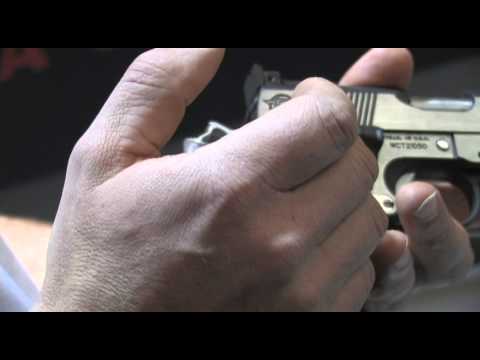
A century has passed since John Moses Browning created the legendary 1911 single-action pistol. In that time a whole sub-industry has developed to supply parts and accessories for 1911-style pistols. Among the myriad grip options available today, we were impressed with the lastest generation of 1911 Lasergrips from Crimson Trace (CT). If you want a laser-equipped 1911 grip, you’re no longer limited to an ugly, spongy rubber grip. CT’s new “Master Series” 1911 Lasergrips come in a variety of materials including Wood, Laminated Wood, Micarta, and the popular G10 compound, a laminated composite of woven glass fabric, carbon graphite fibers and epoxy resin. G10 is impervious to common solvents.

Honey, I Shrunk the Laser
Crimson Trace’s engineers have down-sized the laser module so it can be fitted to normal-thickness, standard-profile 1911 grips. And the smaller laser has been mounted further forward so there is no interference with ambidextrous safeties. We like this upgrade, and we predict these grips will become very popular with 1911 shooters. The new Master Series 1911 Lasergrips will be offered in a range of sizes and profiles to fit Full-size, Commander, Officers’ Model, and Bobtail 1911 frames. CT hopes to have the Master Series Lasergrips on the market in May, 2011, with an MSRP of $359.00.
In the GunsAmerica video below, Top Shot Champion Iain Harrison (now CT’s Media Relations Manager), explains the features of the new Crimson Trace Master Series 1911 Lasergrips:
February 10th, 2011
 The New Gene Clark A2 Upper Receiver
Here is your chance to own an AR15 A2 upper receiver hand-built by the man who has crafted more championship service rifles than any other armorer in history. For the past 25 years Gene Clark has been building rifles for the USA’s dominant military shooting team. His AR rifles have been used to set nearly every current national Service Rifle record. Creedmoor Sports has commissioned Gene to build a limited number of .223 Rem upper receivers, no more than fifteen per month. The first units are due to arrive 2/28/2011.
CLICK HERE to Pre-Order Gene Clark A2 Upper.
Dennis Demille of Creedmoor Sports tells us: “Each receiver will be built to Gene Clark’s stringent specs. Barrels will be chambered using a long-throat reamer designed by Gene himself and currently being used by every member of his team. This improves the accuracy of the heavier 80gr bullets without any negative effect on the lighter bullets.” Only the best components will be used in the Gene Clark uppers:
- Bushmaster upper receiver
- Free Floated barrel/hand guards
- Krieger 1-7.7″ twist barrel w/flash suppressor
- Double-pinned ¼ x ¼ minute rear sight
- 72 t.p.i. windage screw giving you 10 clicks per revolution windage
- Armalite clamp-style front sight
- .062″ ramped front sight post with jam screw under post
Dennis adds: “The Clark-built A2 Uppers, Item# GC-A2, will be priced at $1,215.00, and sold exclusively through Creedmoor Sports. If you’re unfamiliar with the name Gene Clark give us a call at 800-273-3366 and ask for Dennis DeMille. Without approval (pending), there are things in his resume we are not allowed to mention in print. Call to reserve yours now.”
February 10th, 2011
Vortex is an up-and-coming optics maker that has made great strides in recent years. Vortex scopes, spotting scopes and binoculars offer excellent value for the dollar. This year, at SHOT Show, Vortex unveiled its new Viper HS series of scopes, with 30mm tubes and 4X magnification ranges. We checked out the new Viper HS 4-16×50 LR (Long Range) model. This features an exposed elevation turret with Vortex’s CRS zero stop. The 4-16 Viper HS offers 75 MOA of elevation travel (24 MOA per revolution).

 Order Custom-Calibrated Elevation Turret Caps
One thing we really liked about the new Viper series of scopes is the availability of custom elevation turret caps. For about $100.00, Vortex will craft a elevation turret cap with range markings custom-calibrated for the ballistics of your load in your rifle. As explained in the video below, you can go to the Vortex website, and input your MV, bullet BC, altitude and other load variables. Then, using the custom elevation turret cap, simply dial in your target range, and hold ‘dead on’.

New Viper HS 1-4x24mm with TMCQ Reticle
The growing popularity of multi-gun competition has spurred interest in compact, zoom scopes that can switch from a wide-angle, zero magnification view for close work to four- or five-power magnification for long-range stages. Vortex Optics has developed a new scope that should work well for 3-Gun carbines, as well as dangerous game hunting rifles. The Viper HS 1-4x24mm with the TMCQ (Tactical Milling Close Quarter) reticle features a 30mm main tube and built-in illumination with 10 intensity levels with an off position between each setting.

February 9th, 2011
Gear Review: 21st Century Neck Turner
by Germán A. Salazar
A new neck-turning tool with easy adjustments, super-high quality of manufacturing and an ergonomic design sounds like a good thing to me. If you also like good tools and like to keep up with developments in the field, read on (most of the pictures can be enlarged by clicking on them).

I recently received the new Neck-Turning Tool made by John at 21st Century Shooting. I always enjoy seeing John’s work because he really has a good grasp on how a tool should be designed to work effectively and this tool certainly fits that mold. The basic requirements of a good neck turner are: (a) accurate adjustments, (b) good blade design, (c) ergonomic design and (d) a well thought-out system of ancillary items. Let’s look at each of those areas and give the tool a test drive.
 Handy Cut-Depth Adjustment Dial
The 21st Century neck turner has a unique dial adjustment for the depth of the cut which makes small adjustments simple and fast. Each full number represents 0.001″ of cutter movement, and the fine lines in between let you zero in on the exact neck wall thickness that you need. The dial is simply turned in until the desired neck thickness is reached. If you go too far, it’s best to turn it out a full turn, then back in once again; this reduces the effect of any backlash that might exist in the threads. I found the dial easy to use and had no trouble getting to my usual thickness setting of 0.0125″.
 Excellent Carbide Cutter Blade Design
At its core, a neck turner is a cutting tool and good blade design is what sets any good cutting tool apart from the competition. Here, John really shows his ability as a designer and manufacturer. The blade supplied on my tool is carbide and cuts brass effortlessly, however, that’s not the real point of interest. Many neck turners have blades with less than ideal nose radius and create a “threading” effect on the neck unless the tool is fed over the brass at a very slow rate. The 21st Century blade has a good radius at the transition to the shoulder angle which allows for a smooth cut with a reasonable feed rate.
The shoulder angle is another well thought-out feature as it is a very close match to the actual shoulder angle of the case. This allows you to bring the cutter a bit further into the shoulder without weakening it and definitely avoid the subsequent occurrence of the donut of thick brass at the base of the neck. (When ordering, 21st Century lets you specify one of four (4) different cutter shoulder angles to match your particular cartridge: 20°, 30°, 35°, and 40°.) The photo of the case in the cutter shows the cutter making solid contact with the shoulder after a substantial cut on the neck, yet the shoulder was really just lightly touched. I backed the cutter off a bit from this setting for the final adjustment. If you tend to use heavy bullets which extend below the base of the neck, this feature alone makes John’s tool worthwhile.

 Turning necks is tedious, especially if you’re turning a large number of cases as High Power shooters generally do. Accordingly, a design that takes ergonomics into consideration is highly appreciated. Note the slight hourglass shape of the tool, that really lets your hand take a grip that counters the natural tendency of the tool to turn with the rotation of the case, especially when turning with a power case driver. The size of the tool itself also helps; if you’ve used one of the smaller tools on the market, you know just how tired your hand can get from trying to hold on to it after a while! I turned 70 case necks in two sessions with the 21st Century tool and my hand and fingers remained comfortable throughout.
However good the turner may be, it doesn’t work alone. Any neck turner needs a matching expander. The 21st Century expander is a nicely designed unit that allows you to change expander sizes with no tools by simply unscrewing the cap of the die body and dropping in the appropriate expander.
 K&M Arbor Adapters Available
I’ve been using a K&M turner for some years now and have accumulated turning arbors (mandrels) in various sizes. John knows that’s the case for many of us, so he makes affordable adapter bushings for his tool that allow the use of K&M turner arbors. That’s a nice feature that will allow me to save the price of a few arbors and expanders. The adapter for K&M arbors costs $12.00.
Although I use a cordless screwdriver to turn the case, I still like to have a manual option for case turning. Sometimes the cordless driver dies with just a few cases left to go in a session and I know that, one day, when I most need it, it’ll just quit altogether. John’s case handle for manual case turning is another well-designed, ergonomic piece that shows his careful, thoughtful approach to tool design. He even makes a version of it for the .50 BMG if your tastes in cartridges run on the large side!

Neck-Turning Tool and Accessory Order Information
Order the Neck Turner and accessories through www.21stCenturyShooting.com, or call (260) 273-9909. The 21st Century neck-turning tool, by itself, costs $78.00, including a carbide cutter (standard size). You can chose among four different cutter shoulder angles, to match your particular cartridge: 20°, 30°, 35°, and 40°. Additional carbide cutters cost $26.00-$28.00. Caliber-specific turning arbors and expander mandrels are priced at $7.95 each. The standard size Universal Case-Holding Handle (photo above), costs $16.95.
 You can also purchase a complete Neck-Turning Tool Kit from 21st Century. This $112.99 package includes everything you need:
Neck Turning Tool w/cutter
Turning Arbor
Expander Mandrel
Expander Die Body
Loading Die Locking Ring
Neck Turning Universal Handle
Disclosure: 21st Century Shooting, an advertiser on this website, provided a neck turner tool and accessories to German Salazar for testing and evaluation.
February 9th, 2011
Southpaws rejoice. For 2011, Browning has added left-hand versions of its handsome X-bolt Medallion, Hunter, and Micro-Hunter models. All left-hand X-bolts feature a glass-bedded action, left bolt with 60° bolt lift (and top-tang safety), free-floated button-rifled barrel, adjustable trigger (3-5 lbs.), and detachable rotary magazine. These are nice hunting rifles — sleek with some very nice features. The Medallions, in particular, are very pretty rifles — with their Rosewood fore-end tips and pistol grip caps. The X-Bolts are made in Japan by Miroku, a company renowned for high-quality fit and finish (Miroku also makes Browning’s Citori shotguns).

Browning will offer left-hand X-bolts in a wide selection of chamberings: .223 Rem, 22-250, .243 Win, 7mm-08, .308 Win, .25-06, .270 Win, .280 Rem, .30-06 Springfield, 7mm Rem Mag, 300 Win Mag, 338 Win Mag, 300 WSM, 270 WSM, 7mm WSM, 325 WSM.

CLICK HERE for Browning X-Bolt Interactive Page (with Videos).
Details of Browning X-Bolt Safety System

FREE Jacket with X-Bolt purchase
As an added incentive, Browning is giving away a FREE handsome wind-cutter jacket to all purchasers of a new X-Bolt rifle. Here’s how it works…. Purchase any new Browning X-Bolt Rifle at retail between February 1, 2011 and May 31, 2011 and Browning will send you a Special Edition X-Bolt Soft Shell Jacket, valued at $150.00. This zip-front jacket is wind- and water-resistant, with a warm fleece lining, zippered pockets, and a stand-up collar. It’s embroidered with both the Browning Buckmark and X-Bolt logos. Not valid with any other offer or promotion.
Download X-Bolt Free Jacket Promo Coupon

Story Sourced by Edlongrange.
February 8th, 2011
Product Preview by Bryan Litz
I’d like to make everyone aware of a new ballistic solver called the Whiz Wheel. The Whiz Wheel, from Accuracy 1st Development Group (Accuracy 1st) is a non-electronic device that calculates ballistic solutions out to transonic range for any small arms bullet. This device, similar to a circular slide-rule, is in the process of being adopted by several military units as a back-up to the electronic PDAs, and even as the primary ballistic solver since it’s faster to get a solution compared to the PDAs.
Whiz Wheel Solver Features include:
- Density altitude calculator
- Meters/MILS or Yards/MOA output
- Trajectory prediction within 0.1 MIL or 0.25 MOA resolution
- Wind deflection for any speed and direction
- Spin drift
- Leads for engaging moving targets
- Corrections for inclined shooting
- Ability to ‘true’ the solution for variations in MV or BC

Use Different Wheels for Various Cartridges and Loads
The tan colored sleeve is universal, meaning it works with all load-specific wheels. The wheels are interchangeable laser-engraved plastic items. Accuracy 1st offers both “standard” wheels for popular factory-loaded ammo types, as well as custom wheels tailored to your specific bullet, MV, sight height, and twist rate. Each wheel provides a full solution for a single cartridge type and load. Different wheels are required for different cartridges/different loads. This is because the wheel’s solutions depend on bullet BC and muzzle velocity.
CLICK HERE for Whiz Wheel Ballistics Solver Instructions PDF.
How to Use the Whiz Wheel
Finding your come-ups (and windage corrections) with the Whiz Wheel is very simple. Start by solving the density altitude (DA) with the small wheel, or getting it from a Kestrel. Then line up the DA with the range, and the wheel outputs drop. The drop can be corrected for incline via the table on the back of the sleeve. The back of the whiz wheel also calculates the lateral solution elements including wind, spin drift, and moving target leads.
 I was heavily involved in the development of the Whiz Wheel and can vouch for the accuracy of the solutions which are generated with a point mass solver and measured G7 BCs. If you have comments or questions about the Whiz Wheel, you can place those in the comments section for this Bulletin post. I’ll try to respond to your questions, time permitting.
Bryan Litz, author of Applied Ballistics for Long Range Shooting, is the Ballistician for Berger Bullets.
Whiz Wheel Pricing for Standard and Custom Loads
To order the Whiz Wheel go to the Accuracy 1st website. A Whiz Wheel Solver with one (1) custom wheel for your load costs $54.95 for civilians, $44.95 for LEO/Military. Each additional custom solver wheel, set up for your specific load, costs $24.95 for civilians, $19.95 for LEO/Military. If you shoot factory ammo, you can purchase the Whiz Wheel with one standard solver wheel — $49.95 for civilians or $39.95 for LEO/Military. A Standard Ballistics solver wheel (set up for a known production load) costs $19.95 for civilians, $14.95 for LEO/Military. Accuracy 1st also offers a package of Solver Sleeve plus three (3) standard wheels — $69.95 for civilians, $49.95 for LEO/Military.
Accuracy 1st Development Group
310 Indianapolis Rd. Building E-4
Mooresville, IN 46158
Phone: 317-834-5480
E-mail: jeffoverholser [at] accuracy1stdg.com
February 7th, 2011
When conditions are absolutely perfect, you can see 6mm bullet holes (in the white) at 600 yards with a premium spotting scope (with at least 45x magnification). But add some haze and mirage into the mix and all bets are off. This weekend, we tested three top-of-the-line “big name” spotting scopes. All three had at least 60X magnification, all had HD glass, and the average price of the three units was over $2500.00 with eyepiece. Even with all those pricey, state-of-the-art optics, on Saturday we couldn’t see bullet holes at 400 yards because of thick mirage and dust in the air.
Quality Target Cams Can Provide Reliable Viewing from 50 yards to 1000+ yards
What can you do if you want to practice at long ranges, and see your bullet impacts — reliably, every time? There are electronic target systems that plot shot locations with sonic sensors or accelerometers, but these are large, complex, semi-permanent installations costing many thousands of dollars. For most shooters, the only practical, field-deployable solution is a quality, wireless target cam system. You can source the necessary components — video camera, transceivers, antennas, batteries, display screen — or you can purchase a turn-key system. There are a handful of target cam systems now marketed for shooters. We’ve tried a couple that did not perform as claimed. But one system that we can endorse without reservation is the Target Cam System from Pro Security Warehouse (PSW). We purchased PSW’s Long-Range Wireless Target Observation System and have tested it outdoors extensively. With a well-illuminated target, this system will reliably display even .22 caliber bullet holes in the black, at distances out to 1000 yards. In order to see bullet holes in the black you may have to increase the contrast or adjust the brightness — but that’s a simple matter of clicking a couple control buttons. During daylight hours, we could easily see all bullet holes, with the camera displaying an area about two feet by two feet square. When shooting at night, you need to illuminate the target with lights.

 PSW Wireless Video Viewing System Components
The PSW Target Cam System costs $1499.00 but that includes everything you need, even tripod and batteries. The target image is captured by a high-resolution, auto-focus color camera with 22X max magnification and motorized zoom. This can be set as far as 30 feet from the target, but we got the best results with the camera positioned about 10 feet from the target, on one side of the target frame. The camera connects to a digital wireless multi-channel transceiver (with high-gain antenna) clamped to the same tripod that holds the camera. A sealed, rechargeable 12V gel cell battery will run the camera for a full day’s worth of shooting.
Pro Security Warehouse Target Cam System Brochure (PDF).
For the shooter’s station, PSW provides a compact transceiver (the size of a smart-phone), plus a rugged color monitor in a padded carry pack. These are likewise powered by a rechargeable 12V battery. Initially, we suspected the 5.6″ monitor was a little on the small size, but it proved more than adequate in use. With the monitor positioned a couple feet from your rifle (either on the bench or on the ground when shooting prone), you can easily see scoring rings, score numbers, and, of course, bullet holes. You may want to fiddle with the color and contrast controls to create the best definition for viewing bullet holes in the black. The resolution is good enough that we could easily make out “doubles” where two 6mm shots landed virtually on top of one another.

One smart feature is that the target display is set for a short time delay. This allows you to turn your head from sights or scope to the display screen and see the bullet hole “arrive” on paper a few seconds after the actual hit. Being able to actually see the bullet hole appear on the target helps you quickly locate the latest shot even if there is a cluster of bullet holes close together. That’s smart engineering.
The PSW system works really well. We have no negatives to report — everything performed as advertised. Are there any improvements/enhancements we would like? Yes — it would be nice if the receiver could output to a laptop computer, so you’d have the option of a larger display screen and so you could capture video of shot strings. We would like PSW to offer an optional, small solar panel that could trickle-charge the unit during use. Lastly, we would like to see PSW offer a lower-cost system that could be used with a user-supplied video camera. We know many shooters already own small video cameras, and this could reduce the overall “buy-in” cost of the system.
Certainly, $1499.00 for the complete PSW system is not cheap. However, when you consider that the PSW wireless viewing system reliably displays bullet holes at long range in all daylight viewing conditions — something not even a $3500.00 spotting scope can do — the system is worth the money for shooters who practice at long ranges. Interestingly, all four testers who looked through the top-end spotting scopes agreed that they would rather have this $1500.00 target cam AND a $1000.00 spotting scope rather than a $2500.00+ spotting scope alone. To learn more about the PSW Target Cam system visit www.ProSecurityWarehouse.com or call (407) 447-1637.
February 1st, 2011
Here’s a simple device that can help you zero your rifle in two or three shots. The new Click Stick Pro Tool is an L-Shaped ruler marked with scales corresponding to 1/8 MOA, 1/4 MOA, and 1/2 MOA clicks at 100 yards. To zero your rifle at 100 yards, take one shot, then position the tool so the bullet hole is at the elbow of the unit (for 1/8 MOA clicks) or at the slotted elbow (for 1/4 MOA clicks). Then square the tool so it aligns with the vertical and horizontal lines on the target. Finally, read the needed click movement off the tool’s scales. Get the horizontal correction from the horizontal scale and the vertical correction off the vertical scale. This device works great, and is inexpensive. The patent-pending Click Stick Pro Tool is sold in a kit for $19.95, bundled with 10 sight-in targets (red center with heavy black lines — see below).

Sighting-In at 25 Yards or 50 Yards
With a brand-new rifle and scope combination, you may want to sight-in at 50 or even 25 yards. You can still do this with the Click Stick Pro Tool. For a 50-yard sight-in follow the same procedure, but multiply the scales’ click value by two (2X). At 25 yards, multiply the scales’ click value by four (4X).
Tool-less, Simple Sight-In Procedure
While we like the Click Stick Pro Tool, you don’t really need the tool at all if you can hold your gun steady while you click the windage and elevation knobs. First, put the center of your crosshair on the target and take one shot. Then, before you touch the scope knobs reposition the rifle in your bags (or on your rest) so the center of the reticle is on the center of the target. Make sure the rifle is secure in this position (have a friend hold the rifle if necessary).
Now, using your elevation and windage controls (while looking through the scope), simply dial the center of the crosshair to the center of the bullet hole — without moving the rifle. You are moving the reticle on to the bullet hole. Take a second shot. The second bullet hole should now be in the center of the target. Repeat the process if needed with a third shot to confirm your zero. This procedure works at any distance. See our explanation of the Simple Zeroing Procedure.

February 1st, 2011
While at SHOT Show, Dave Kiff showed us some nice bottom metal PT&G crafts for R+D Precision. Designed for tactical rifles with Detachable Box Magazines (DBMs), this R+D bottom metal features dual trigger-finger, quick-release latches (photo below). This permits very quick mag changes. This bottom metal is a product of R+D Precision and can only be ordered through R+D Precision, www.RDPrecision.net, (626) 806-4389. R&D also makes a $24.95 RAD TACLatch retro-fit for Badger bottom metal. The ambidextrous, dual-lever TACLatch allows the shooter to drop the mag with one hand. Note: All rights and patents associated with these items belong to R&D Precision.


January 31st, 2011
Barnes Bullets is introducing a bunch of new bullets for 2011. Precision shooters will be interested in the new Match Burner line of bullets, as well as Barnes’ LRX series of long-range projectiles. For the large-caliber shooters, Barnes has also expanded its line of Banded Solids, in weights from 250 grains (.338 caliber) all the way up to 535 grains (.500 Jeffries).
The new Barnes Match Burner bullets are designed for competitive target shooting. The new Match Burners for 2011, listed below, are slated to ship to vendors in March.

| Caliber |
Weight |
Description |
| 223 Cal |
52-grain |
Flat Base Match |
| 223 Cal |
69-grain |
Boattail Match (1:10″ Twist or Faster) |
| 223 Cal |
85-grain |
Boattail Match (1:7″ Twist or Faster) |
| 6MM |
68-grain |
Flat Base Match |
| 6MM |
105-grain |
Boattail Match |
| 6.5MM |
140-grain |
Boattail Match |
| 30 Cal |
155-grain |
Boattail Palma |
| 30 Cal |
175-grain |
Boattail Match |
New Long-Range X Bullets Based on Tipped Triple-Shock Design
The all-new Long-Range X Bullet® (LRX) line includes four new bullets. Designed after the best-selling Tipped Triple-Shock™ X Bullet® (TTSX), the new LRX bullet design increases B.C. values by increasing ogive and boat tail lengths to improve the bullets’ long-range ballistic performance. LRX bullets are manufactured with the proven 100-percent copper, lead-free bodies. The bullet’s polymer tip initiates expansion, causing the nose cavity to open instantly on contact, doubling the bullet’s original diameter. Barnes claims the LRX bullets allow clean, quick kills even at extreme ranges.

| Caliber |
Weight |
Description |
| 7MM |
145-grain |
Boattail |
| 30 Cal |
175-grain |
Boattail (1:11″ Twist or Faster) |
| 30 Cal |
200-grain |
Boattail (1:10″ Twist or Faster) |
| 338 Lapua |
265-grain |
Boattail |
Solid Bullets with Drive Bands
Barnes Banded Solids are made from free-machining brass. A series of bands cut into the bullet’s shank moderate engraving pressure and help reduce barrel wear. Weight-matched with Triple-Shock X Bullets of the same caliber, Banded Solids can be interchanged with expanding TSX bullets without varying point of impact.
Precision machined from the same tough material, Banded Solid Spitzers deliver maximum concentricity, consistent density and match-grade accuracy. According to Barnes, the Banded Solid Spitzers, provide deep penetration without deformation. Barnes says these bullets can “Kill fur-bearing animals cleanly with minimal damage to valuable pelts”.

| Caliber |
Weight |
Description |
| .338 Cal |
250-grain |
Banded Solid Round Nose |
| 9.3MM |
250-grain |
Banded Solid Round Nose |
| 9.3MM |
286-grain |
Banded Solid Round Nose |
| .375 Cal |
270-grain |
Banded Solid Round Nose |
| .375 Cal |
300-grain |
Banded Solid Round Nose |
| .375 Cal |
350-grain |
Banded Solid Round Nose |
| .416 Cal |
350-grain |
Banded Solid Round Nose |
| .416 Cal |
400-grain |
Banded Solid Round Nose |
| .422″ (404 JEFF) |
400-grain |
Banded Solid Round Nose |
| .458 Cal |
450-grain |
Banded Solid Round Nose |
| .458 Cal |
500-grain |
Banded Solid Round Nose |
| .504″ (505 GIBBS) |
525-grain |
Banded Solid Round Nose |
| .510″ (500 JEFF) |
535-grain |
Banded Solid Round Nose |
|


