|
|
December 15th, 2009
Darrell Jones, a talented benchrest shooter from Tennessee, has launched a new business that will provide a much-needed service for precision shooters. Darrell’s company, DJ’s Brass Restoration Service, will take your old, many-times-fired brass, and help bring them back to life. Darrell first cleans the cases inside and out using an ultrasonic bath. Then Darrell carefully anneals each case, employing temp indicators to insure the correct amount of heat is applied for the proper duration.

Combined Ultrasonic Cleaning and Case Annealing
The Basic Service starts at $20.00 per hundred cases — and that includes ultrasonic cleaning AND annealing. (Flat rate USPS shipping is extra.) Note: very large cases (such as the .338 Lapua) or damaged, dented cases may cost more. In addition to the Basic Service, Darrell offers a 4-Step Full Service starting at $25.00 per hundred cases (plus shipping). Full Service brass restoration includes:
• Uniform primer pockets
• Chamfer case mouths
• Ultrasonic cleaning and polishing
• Anneal case necks

Ultrasonic Muzzle Brake Cleaning
In addition to cleaning and annealing cartridge brass, Darrell offers Ultrasonic Cleaning for muzzle brakes. This removes carbon buildup to restore critical bullet clearance requirements. The price is $15.00 per brake (plus shipping).
Restoring Your Brass Can Save Time and Money
Your match-quality brass represents a significant investment of money and prep/sorting time. With 100 pieces of new premium brass costing as much as $100.00, we think Darrell’s service is a great deal for shooters who want to extend the life of their brass. We expect his cleaning/annealing service will soon be in high demand. (In addition, on a custom-order basis, for an additional fee, Darrell can trim cases to a specified OAL.) Also, if you have spent many hours turning necks or forming wildcat cartridges, DJ’s Brass Restoration can save you the hassle of trimming, sorting, turning and prepping new cases. You have a lot of time invested in those turned necks and fire-formed cases… you don’t want to toss the brass after a few firings.
For more information, visit DJsBrass.com, or call Darrell at (901) 826-1503. As a special benefit for AccurateShooter.com members, Darrell is now offering free return shipping on any order over 500 pieces (limited time offer). IMPORTANT: Contact Darrell for shipping instructions BEFORE sending any brass for processing. ALL BRASS MUST BE DE-PRIMED before you send it.
December 14th, 2009
There are a variety of ballistics programs that can be used with handheld PDAs, and even Apple iPhones. But Bryan Litz, author of the new Applied Ballistics for Long Range Shooting book, has come up with something bigger and better. Employing the powerful Texas Instruments (TI) Voyage 200 graphing calculator, Bryan has created a Mobile Ballistics Solution (MOBALL) that is more sophisticated (and accurate) than typical PDA-based programs.

MOBALL includes TI graphing calculator and ballistics software. Kestrel windmeter NOT included.
Bryan tells us: “The Mobile Ballistics Computer (MOBALL) was created for one purpose: to provide shooters with the most accurate and complete ballistic firing solution possible for application in the field.” MOBALL runs on a TI graphing calculator — a sturdy, stand-alone, non-network device. That means you don’t need long-term cell phone contracts, expensive data plans, or weekly OS “updates” and patches. The TI also delivers long run-time on ordinary AAA batteries. That’s a big advantage over most laptop computers, which run out of “juice” after only 4-5 hours in the field.
According to Bryan, what sets MOBALL apart from other “deployable” ballistics calculators is that: “MOBALL provides a complete ballistic solution, with the ability to account for every major and minor variable affecting a bullets trajectory. In addition to the standard variables like atmospherics, uphill/downhill angles and wind, MOBALL also has the ability to account for more subtle ballistic effects like spin drift, Coriolis effect, and multiple winds in up to 3 zones.”
Importantly, Bryan’s MOBALL device can employ Ballistic Coefficients (BCs) referenced to the G7 standard. Compared to the older G1 BC model, the G7 BC standard better matches the characterics of the long, boat-tail bullets actually used by long-range shooters. Trajectories calculated using the G7 BC are more accurate for long-range bullets because the G7 BC doesn’t vary with velocity like the conventional G1 BC.
 
The difference between G1 and G7 BCs is explained online in the Berger Blog article A Better Ballistic Coefficient. The subject is also discussed in detail in Chapter 2 of Bryan’s Applied Ballistics book.
 At $290.00, MOBALL isn’t the least expensive option for a mobile ballistics device, but that price includes the TI Voyage 200 graphing calculator, worth $180.00 by itself. Bryan adds: “As already mentioned, the feature set is extensive, and the software is much more sophisticated than most ballistics programs designed for PDAs. The solution is VERY accurate (CLICK to download MOBALL Accuracy Report). Also, the TI Voyage 200 is an impressive device itself, capable of solving advanced engineering and math problems. If you’re a high school/college student, engineer, etc, the TI Voyage 200 can be used for many school and work tasks unrelated to ballistics.” At $290.00, MOBALL isn’t the least expensive option for a mobile ballistics device, but that price includes the TI Voyage 200 graphing calculator, worth $180.00 by itself. Bryan adds: “As already mentioned, the feature set is extensive, and the software is much more sophisticated than most ballistics programs designed for PDAs. The solution is VERY accurate (CLICK to download MOBALL Accuracy Report). Also, the TI Voyage 200 is an impressive device itself, capable of solving advanced engineering and math problems. If you’re a high school/college student, engineer, etc, the TI Voyage 200 can be used for many school and work tasks unrelated to ballistics.”
Save $20 on MOBALL and Ballistics Book Combo
As a special Holiday Offer valid through December 31, 2009, you can save money when purchasing MOBALL and Bryan’s Applied Ballistics book together. The book and MOBALL unit are being offered as a Holiday Combo Set for $309.95. That’s a $20 savings over the $329.95 cost of purchasing both book and MOBALL unit separately.
December 12th, 2009
 Midsouth Shooters Supply has a great deal right now on AOSafety (Peltor) 23NRR shooting earmuffs. Now through the end of 2009, you can purchase these comfortable folding muffs for just $3.99! That’s so cheap you can purchase 3 or 4 as extras to have on hand when you go shooting with friends. A club or range can afford to purchase a couple dozen for “loaner” use or rentals. These AOSafety Muffs (made by Peltor) conveniently fold up for storage. They have a 23dB noise reduction rating (NRR) — as good as many muffs costing much more. Midsouth Shooters Supply has a great deal right now on AOSafety (Peltor) 23NRR shooting earmuffs. Now through the end of 2009, you can purchase these comfortable folding muffs for just $3.99! That’s so cheap you can purchase 3 or 4 as extras to have on hand when you go shooting with friends. A club or range can afford to purchase a couple dozen for “loaner” use or rentals. These AOSafety Muffs (made by Peltor) conveniently fold up for storage. They have a 23dB noise reduction rating (NRR) — as good as many muffs costing much more.

Midsouth’s $3.99 price is a STEAL. Northern Tool & Equipment sells these very same muffs for $14.99. If you run a club, place quantity orders before the price goes back up. Note: If Midsouth sells out, CDNN Investments offers these 23NRR muffs (item Pel #90559) for $4.99 — part of a “liquidation sale” in CDNN’s latest 2009-5 catalog (p.121).
December 7th, 2009
Adam Braverman of Nammo-Lapua just confirmed that Lapua, at the behest of the U.S. Palma team, has been quietly developing a NEW version of the .308 Winchester cartridge that has a small BR-style primer pocket. That’s right, this is no joke. Lapua has crafted small primer pocket .308 Winchester brass that will be introduced at SHOT Show in Las Vegas (Jan. 19-22).

The new .308 variant is identical to Lapua’s current .308 match brass with the exception of the primer pocket. The brass will be head-stamped “.308 Win Lapua Palma”.
FLASH HOLES: The flash-hole size for the current pre-production .308 Lapua Palma brass is 1.5mm (.059″), the same as Lapua 6mmBR and 220 Russian brass. Lapua spokesmen were not certain if the flash hole size will change for the regular production brass. Note: if you have a Redding .308 die, you can ask Redding for a smaller decapping rod tip (.057″) to use with the new brass.
Tests Reveal Better ES and SD with Small Primers
Initial tests of the small primer pocket .308 by U.S. Palma team members have been very promising. The small primer pocket case seems to have advantages in both accuracy and the ability to handle high-pressure loads. However, the primary improvement found with the smaller primer is reduced ES and SD. Palma Team members have found that, with almost every brand of primer tested (small vs. large), the smaller version has yielded reduced Extreme Spread and Standard Deviation. This pays dividends in 1000-yard shooting. Also, some testers believe that small primers are more consistent and require less sorting — and that there are more varieties of small primers that seem to work really well in the .308 case. Moreover, the small primer types are more uniform, from lot to lot, than are large primers, according to some testers. More info will follow later today.
December 5th, 2009
 We have confirmed that Lapua will produce and distribute 22-250 cartridge brass starting in early 2010. The official product release will be at SHOT Show in Las Vegas (Jan. 19-22). We don’t have production samples yet, but there are about 1000 pieces of brass in the hands of testers in the United States at this time. This stuff is for real — CLICK THIS LINK for PHOTOS. We have confirmed that Lapua will produce and distribute 22-250 cartridge brass starting in early 2010. The official product release will be at SHOT Show in Las Vegas (Jan. 19-22). We don’t have production samples yet, but there are about 1000 pieces of brass in the hands of testers in the United States at this time. This stuff is for real — CLICK THIS LINK for PHOTOS.
 One of the folks lucky enough to get his hands on the new Lapua 22-250 brass is writer/shooter Steven Boelter, author of the Rifleman’s Guide to Rimfire Ammunition. Steven has measured and inspected the new brass and he says it appears to be “on a par, quality-wise, with Lapua’s 220 Russian and 6BR brass”, which is saying a lot. Steve adds that: “[what I have] is in fact part of a pre-production run, and the main stuff will be ready for second quarter, 2010″. Steven is working on an article for Precision Shooting magazine that will include exact dimensions for the new brass, as well as initial load testing results. An exact release date for Steven’s article has not yet been set, but Boelter hopes the story will come out in January or February. One of the folks lucky enough to get his hands on the new Lapua 22-250 brass is writer/shooter Steven Boelter, author of the Rifleman’s Guide to Rimfire Ammunition. Steven has measured and inspected the new brass and he says it appears to be “on a par, quality-wise, with Lapua’s 220 Russian and 6BR brass”, which is saying a lot. Steve adds that: “[what I have] is in fact part of a pre-production run, and the main stuff will be ready for second quarter, 2010″. Steven is working on an article for Precision Shooting magazine that will include exact dimensions for the new brass, as well as initial load testing results. An exact release date for Steven’s article has not yet been set, but Boelter hopes the story will come out in January or February.
Boelter can’t say much more about the brass prior to publication of the article. But we can confirm that it has a large primer pocket, standard 22-250 rim size, and it is annealed like other premium Lapua brass. Steven has posted a couple photos of the brass on the Saubier.com web site.
We’re always excited when Lapua decides to expand its line of cartridge brass. For 22-250 shooters, who will now have a new ultra-high-quality brass option, the news of Lapua 22-250 brass must be like an early Christmas present.
Link to Lapua 22-250 Brass Photo

Above is a QuickDESIGN diagram of the 22-250 Remington cartridge based on CIP Metrics converted to English units. This is NOT the official print for the new Lapua 22-250 brass, which may vary slightly in dimensions. We suggest you get the actual production brass in hand before ordering new chamber reamers or dies.
December 4th, 2009
Here’s good news for iPhone and iPod owners. There are two new FREE applications (Apps) that let you use your device as a firearms shot timer. It may be a while before we see iPhones used at 3-gun matches, but it’s nice to know that Apple’s smartphones can do double duty as timers. Both Surefire, maker of tactical flashlights, as well as Taurus, firearms manufacturer, offer Shot Timer Apps that can be downloaded, for FREE, from the iTunes store. (Note: you must have iTunes software installed on your computer to download the Shot Timer programs. iTunes software is free, but it is a hefty 90-meg install.)
CLICK HERE for Taurus Shot Timer App Download | CLICK HERE for SureFire Shot Timer FAQ
With either the SureFire ShotTimer or Taurus Timer apps installed, your iPhone/iPod can function just like a dedicated shot timer (such as the PACT Club Timer III), but you no longer need a dedicated unit. All the key functions can be performed with your iPhone or iPod. The screen displays the elapsed time and the split time for every shot fired. You can review time between consecutive shots, shot count, and total firing time. A “start delay” option let you train alone, and you can use the Par Time mode to train “against the clock”.
Once the unit is adjusted, the built-in microphone on an iPhone or iPod should be able to track every shot without fail. Even indoors, anti-echo technology provides reliable shot detection. The software allows you to adjust microphone sensitivity to the unique sound “profile” of the shots. Just tap ‘Adjust Sensitivity’ on the display to raise the sensitivity in 10% increments until the Shot Timer consistently detects all your shots.
 With either the SureFire or Taurus Timer Apps, you can hold your iPhone like a traditional shot timer or use the start delay mode with the iPhone placed on a shooting bench, or held in your shirt pocket. The Shot Timer will display both elapsed time and split time for every shot. You can store practice session results in your iPhone’s internal memory. With either the SureFire or Taurus Timer Apps, you can hold your iPhone like a traditional shot timer or use the start delay mode with the iPhone placed on a shooting bench, or held in your shirt pocket. The Shot Timer will display both elapsed time and split time for every shot. You can store practice session results in your iPhone’s internal memory.
December 3rd, 2009
Weaver Optics, now owned by ATK, offers a new line of tactical riflescopes with First Focal Plane(FFP) mildot reticles, zero-reset turrets, and 5X zoom ratio. Weaver’s 4-20x50mm version (MSRP $994.49), delivers all those features for around $725.00 street price (SWFA.com). The smaller 3-15x50mm Weaver tactical scope (MSRP $890.95) sells for about $650.00 street price (SWFA.com).

These Weavers are attractive new options for tactical shooters. The pricing is very competitive considering these scopes have all the “right stuff” for tactical shooting: FFP, Mildot Reticle, Side Focus, and wide zoom range. We also like the new Weavers’ reset-to-zero turrets.
The new waterproof/shockproof/fogproof Weaver Tactical scopes feature one-piece construction, argon-purged tubes and multi-coated lenses with extra hard exterior coatings. For Tac Comps, the 5 times zoom ratio offers a very wide field of view for close-range or moving targets, yet plenty of magnification is “on tap” for long-range targets. The first focal plane reticle stays constant relative to the target at all magnification levels. This allows targets to be quickly ranged with mildots at any magnification setting.
December 1st, 2009
 The Redfield Gun Sight Company was founded in 1909 by John Hill Redfield. The company’s product line expanded from open sights to include riflescopes, mounts, binoculars, and spotting scopes. In 1998 Redfield closed its doors in Denver, Colorado, marking the end of an era. Redfield changed hands several times until April 2008 when Leupold & Stevens, Inc. purchased the Redfield brand name and associated intellectual property. The Redfield Gun Sight Company was founded in 1909 by John Hill Redfield. The company’s product line expanded from open sights to include riflescopes, mounts, binoculars, and spotting scopes. In 1998 Redfield closed its doors in Denver, Colorado, marking the end of an era. Redfield changed hands several times until April 2008 when Leupold & Stevens, Inc. purchased the Redfield brand name and associated intellectual property.
Leupold has revived Redfield, positioning the new Redfield scope line at the low end of the market. The latest generation of Redfield scopes are priced from $130.00 – $150.00 retail. Revolution™ riflescopes, the first products in the new Redfield line, are American-made at Leupold’s plant near Beaverton, Oregon. Revolution models include 2-7x33mm, 3-9x40mm, 4-12x40mm, and 3-9x50mm models, all with either 4-plex or Accu-Range reticles. The Accu-Range reticle provides hold-over points from 200-600 yards. Other product offerings will include imported Rebel™ and Renegade™ binoculars, Rampage™ spotting scopes and Raider™ rangefinders.
 Editor’s Comment: We’re pleased to see the revival of a storied American optics brand. However, we wonder how much quality and long-term durability Leupold can deliver for $130.00, when Leupold is having trouble with quality control on its high-end scopes which sell for $800 or more. But Leupold & Stevens is a business first and foremost and its bean counters obviously feel there is money to be made in the low end of the market. This is like General Motors saying: “Well, since Cadillac can’t compete with Lexus and Mercedes, let’s sell more Geo Prisms”. We all know how well that strategy worked. Editor’s Comment: We’re pleased to see the revival of a storied American optics brand. However, we wonder how much quality and long-term durability Leupold can deliver for $130.00, when Leupold is having trouble with quality control on its high-end scopes which sell for $800 or more. But Leupold & Stevens is a business first and foremost and its bean counters obviously feel there is money to be made in the low end of the market. This is like General Motors saying: “Well, since Cadillac can’t compete with Lexus and Mercedes, let’s sell more Geo Prisms”. We all know how well that strategy worked.
November 30th, 2009
 On Sunday November 29th, the Ojai Valley Gun Club hosted its first-ever NBRSA-sanctioned, 600-yard Benchrest match. Ojai boasts a beautiful range in the Southern California foothills about 40 road miles from the coast. Many Pala Range regulars from the San Diego area were on hand, and some “big names” turned up for the event including Lou Murdica and 2007 NBRSA 600-yard Champion Don Nielson. In sunny but wildly changeable conditions (ranging from near-calm to 20 mph gusts), Don showed how it was done, winning the match with his 6.5×47 Lapua rifle. On Sunday November 29th, the Ojai Valley Gun Club hosted its first-ever NBRSA-sanctioned, 600-yard Benchrest match. Ojai boasts a beautiful range in the Southern California foothills about 40 road miles from the coast. Many Pala Range regulars from the San Diego area were on hand, and some “big names” turned up for the event including Lou Murdica and 2007 NBRSA 600-yard Champion Don Nielson. In sunny but wildly changeable conditions (ranging from near-calm to 20 mph gusts), Don showed how it was done, winning the match with his 6.5×47 Lapua rifle.
Don finished first in ALL LG and HG categories except Heavy Gun score, where he placed second. In Light Gun class, Don shot a 2.207″ Agg for three, 5-shot targets (1.523″, 2.344″, 2.754″). Mind you this was in conditions where some pretty good shooters were off paper. Don said the secret was to shoot fast: “When it’s switchy, you can’t wait. I pretty much never stopped and never slowed down. Even for the 10-shot Heavy Gun Groups I think I was done in 30 seconds.” Second in Two Gun Overall was Brenda Hill. Brenda has established herself as one of California’s top F-Class and long-range shooters. At Ojai, Brenda was shooting a very accurate 6BRX rifle smithed by Leroy Johnson, jpgrifles [at] yahoo.com. John Crawford, Bruce Duncan, and Lou Murdica also all shot well in the difficult conditions.

On the firing line we found some very interesting equipment. John Crawford of the Bay Area had a beautiful Leonard-stocked gun chambered in 6mm Grendel. John is getting over 2900 fps with his 6mm Grendel, shooting 105gr Berger VLDs. He does have a long throat, but that is still impressive — 6BR velocities from the smaller-diameter Grendel case. Along with its gorgeous wood stock, Crawford’s rifle featured some very cool hardware. The trigger guard was radically skeletonized and anodized black. John’s scope was mounted with 4-bolt integrated scope rings/bases with 20 MOA built-in elevation. Produced by Marvin Pearson in Oregon, (360) 748-3429, these custom ring/bases were beautifully finished with radiused edges. Pearson’s ring/bases are available for 1″, 30mm, or 34mm tubes, with zero elevation “pre-load”, or up to 30 MOA of built-in elevation. Pearson charges $125.00 per set (plus shipping).

Crawford carried his 6mm Grendel ammo in compact 100-round ammo ammo cases from J&J Products. These cases pack big capacity in a relatively small footprint. There is enough clearance for long VLD-style bullets, but not so much extra “headroom” that the rounds can fall out if the box is inverted. John uses a piece of pink foam, cut to box dimensions, to protect his bullet tips when traveling. These 100-round J&J boxes measure 5.375″L x 5.375″W x 2.400″D and cost just $4.88 (J&J item BR-100).
 Match director Barry Bluhm had a very nice ammo caddy that places ten loaded rounds up close to the loading port for fast cycling. Southpaw Bluhm keeps his ammo caddy on the right side, but the design would work equally well when used on the left side by a right-handed shooter. Match director Barry Bluhm had a very nice ammo caddy that places ten loaded rounds up close to the loading port for fast cycling. Southpaw Bluhm keeps his ammo caddy on the right side, but the design would work equally well when used on the left side by a right-handed shooter.
Barry, who shoots a 6-6.5×47 for the most part, deserves a huge amount of credit for organizing this event. He spent many long hours building new target frames, and organized volunteers to man the pits and run the range. Without Barry’s dedication and hard work, this 600-yard match, hopefully the first of many registered events at Ojai, couldn’t have happened.
To learn more about the Ojai Valley Gun Club, or view the schedule of upcoming events, visit www.OVGC.net.

November 21st, 2009
 Remington Arms Co. plans to start selling handguns, perhaps as early as the first quarter of 2010. In his Shooting Wire website, Jim Shepherd has confirmed that Remington is planning to build and market handguns, including a 1911 type semi-auto pistol. Remington recently named Tom Taylor as its new Senior VP for Handgun Marketing and Products. Taylor, formerly Vice-President of Marketing for Smith & Wesson, was hired for his handgun industry expertise. Remington Arms Co. plans to start selling handguns, perhaps as early as the first quarter of 2010. In his Shooting Wire website, Jim Shepherd has confirmed that Remington is planning to build and market handguns, including a 1911 type semi-auto pistol. Remington recently named Tom Taylor as its new Senior VP for Handgun Marketing and Products. Taylor, formerly Vice-President of Marketing for Smith & Wesson, was hired for his handgun industry expertise.
Remington May Acquire Handgun Maker
Shepherd reports that Remington is seeking to acquire an existing handgun manufacturer, although it appears that Remington’s first new pistols will be developed and produced in-house. Shepherd writes: “it has been no secret in the industry that Remington has been ‘shopping’ for a handgun company. Several names have been mentioned, but it appears the first product will be ‘organic’ coming from inside Remington, rather than via acquisition. A 1911 is in first-production testing, and may be ready for introduction at SHOT Show in January”. Shepherd cautions, however, that Remington may move back the launch of its 1911 pistol to ensure all the bugs are worked out, and that the product is 100% reliable.
Will Remington Revive Older Designs?
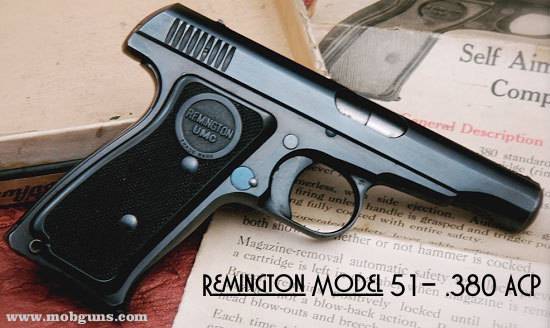
Though Remington is now best known for its long-guns, it does have a rich heritage of pistol-making, going all the way back to the early 1800s. In the Civil War, Remington & Son percussion revolvers were often used by Union calvarymen, many of whom preferred the Remingtons over the standard issue Model 1860 Colt revolver. Remington also produced popular semi-auto pistols in the first half of the twentieth century. Shepherd speculates that “the small, reliable Model 51 might be a candidate for a revival”. A thin, sleek design by John Pederson, the Model 51 (shown below) was offered in .32 ACP and .380 ACP calibers. With some updates — such as improved sights and a shorter, more compact slide and barrel — a modernized m51 design could prove a popular carry piece. No doubt Remington hopes to emulate the commercial success Ruger has achieved with its recently introduced LCP™ compact .380 ACP.
History Lesson — How Remington Arms started
Legend has it that a young Eliphalet Remington II believed he could build a better gun than he could buy, and he set out to craft such a gun on his father’s forge located at Ilion Gulch, New York. In the autumn of 1816, Eliphalet entered a shooting match with his new flintlock rifle, and while he only finished second, his handmade rifle was a success. Orders for new Remington-made rifles and barrels began to accumulate from the many other contestants, and before Eliphalet left the shooting field, he was in the gun business.
Remington Model 51 photo courtesy Mob Guns Inc..
|


