|
|
November 19th, 2009
Hornady Manufacturing has just announced its new line of “Superformance” hunting ammunition. Hornady claims that, “across the board” the new Superformance ammo will deliver “100 to 200 fps higher velocities than any other standard ammunition currently available.” Hornady also claims its Superformance ammo delivers increased velocities “WITHOUT increases in felt recoil, muzzle blast, temperature sensitivity, fouling or loss of accuracy.” Hornady President Steve Hornady says this is “a whole new standard in ammunition performance… We are going to be able to raise the velocity of almost any [hunting] load you’ve ever used… by 100-200 fps.” Surprisingly, the marketing materials even claim that Superformance ammo delivers higher velocities with “no increases in barrel wear” — something that runs contrary to common sense.

Rather amazing claims are being made for this new Hornady ammo. Are such claims to be believed? Well, when AccurateShooter.com tested Alliant Reloder 17 powder last year we confirmed that it could deliver 100-200 fps more velocity than most popular powders, in some cartridges. Presumably, Hornady is employing propellants with technologies similar to Reloder 17. Hornady’s marketing materials state that it is using “ultra progressive” “21st Century” propellants for the new Superformance ammo. Hornady has also brought out a line of GMX® mono-metal bullets that feature two deep cannelures for reduced bearing surface. It is well-established that this kind of bullet design can yield higher velocities, particularly in the big-bore calibers with heavy bullets.
 So… the velocity claims may be bonafied, though we would expect the velocity gains will vary among the cartridges. Some chamberings will benefit from the new propellants more than others. And only half the Superformance ammo line-up features GMX bullets, the other half being loaded with more conventional SST® bullets. So… the velocity claims may be bonafied, though we would expect the velocity gains will vary among the cartridges. Some chamberings will benefit from the new propellants more than others. And only half the Superformance ammo line-up features GMX bullets, the other half being loaded with more conventional SST® bullets.
How about the claims regarding recoil? The claim that Superformance ammo can deliver 100-200 fps more velocity without any more recoil is questionable. Hornady can’t alter the laws of physics. If a bullet of given weight has a higher muzzle velocity, it MUST produce more recoil than the same bullet moving slower — provided that the propellant charge weight (and rifle weight) are held constant. The only way Hornady can achieve higher velocities without increased recoil is by either: 1) reducing bullet weight; or 2) reducing the powder charge (or gas-related recoil). Hornady could hold recoil constant if its new propellants achieve the higher velocities with a reduced powder charge compared to “conventional” loads.
Hornady has issued an 11-page technical report that provides support for many of its marketing claims. Authored by Hornady Senior Ballistician Dave Emary, the report features some interesting test results, summarized in graphs. Regarding the recoil question, Emary argues that “Recoil … has parts to it that are not commonly understood. The fundamental misunderstanding of recoil is that the recoil is over when the bullet leaves the barrel. In truth, the vast majority of recoil occurs after the projectile exits the barrel. By far the greatest percentage of recoil is produced by the force of the gases and propellant residue/ejecta leaving the barrel.” Emary cites test results showing that “approximately 85 – 90% of the recoil happens after the projectile has left the barrel”. If Emary is correct, then Hornady might be able to achieve higher bullet velocities without enhanced recoil, provided the gas-based force is reduced.
We strongly recommend you read Emary’s report. CLICK HERE to download Superformance Ammo Report.
Hornady plans to release a complete line-up of Superformance ammunition for twenty chamberings: 243 Win, 6mm Rem, 257 Roberts, 25-06, 6.5 Creedmoor, 270 win, 7×57, 7mm-08, 280 Rem, 7mm Mag, 308 Win, 30 TC, 30-06, 300 RCM, 300 Win Mag, 338 RCM, 338 Win Mag, 375 H&H, 375 Ruger, and 458 Win Mag. CLICK HERE to review all the available calibers and bullet options for Superformance ammunition.
November 17th, 2009
 Thanksgiving is almost here. At this time of year many Eastern and snow-belt shooting ranges halt operations for the winter. If you’re an avid rifleman who enjoys shooting regularly, the dark days of winter can bring withdrawal pains. The closure of outdoor ranges can mean months of forced inactivity… unless you have an all-weather indoor shooting solution. Thanksgiving is almost here. At this time of year many Eastern and snow-belt shooting ranges halt operations for the winter. If you’re an avid rifleman who enjoys shooting regularly, the dark days of winter can bring withdrawal pains. The closure of outdoor ranges can mean months of forced inactivity… unless you have an all-weather indoor shooting solution.
Some clubs maintain their own indoor air rifle ranges where you can continue to shoot and train throughout the winter. If there are no such facilities nearby, Creedmoor Sports now offers a great solution for those who want to shoot indoors — even in your own basement or garage.
Creedmoor’s patented 10m Air Gun Range provides a target holder and a curtain-type backstop capable of stopping pellets with a muzzle velocity up to 600 fps. The target support poles allow three (3) double target boxes to be positioned with attachment points at the correct heights for prone, kneeling, and standing. Creedmoor says the target boxes provide 100% containment for any pellet passing through the target — so you won’t have pellets scattered all over the floor.
The 10M Air Gun Range is available either in a 3-station configuration for $1279 (item 3AGR), or as a one-station (single-point) range for $295 (item AGR-SINGLE). Creedmoor’s Air Gun Range is a proven, heavy duty product — the only Air Rifle target system ever tested and approved by the U.S. Military. This system is currently being used in more than 600 schools nationwide, as well as the new CMP shooting facility in Alabama. The 3-station range easily dis-assembles for transport and storage, fitting inside a 34″ x 10″ x 8″ carry duffle Creedmoor provides.

November 15th, 2009
Kelblys Inc., long-respected as a producer of benchrest actions and rifles, has expanded its product line. Now Kelbly’s will be offering complete tactical and tactical/hunting rifles. Produced in a wide variety of chamberings from 6.5×47 Lapua all the way up to 300 Win Magnum, these new Kelbly rifles are available as either single shots or as repeaters. To learn more about the new Kelbly rifles, visit Kelbly’s enhanced website.

Shown above is Kelbly’s new Atlas rifle. This rifle’s$2800.00 base price includes premium components: Single-shot Atlas action with 20 MOA or Flat integral scope base, Jewell or Shilen trigger, Krieger or Bartlein Barrel, Kelbly’s HCFB or Hunting stock (with recoil pad and swivels), Double screw rings (30mm or 1″). Available options include: McMillan A5 stock, CDI Magazine w/ 5 round AICS Magazine ($260), 3-Round Blind Mag ($150), Kemper or Vais Muzzlebrake ($185 Installed), Karsten Adjustable Cheek Piece ($75), Barrel Fluting ($120), Long-Action Upgrade ($70), Painted stock ($300), CeraKote Barreled Action ($200).

Kelbly’s new Grizzly II Tactical/Hunting rifle costs $3300.00 before options. Shown above in wood thumbhole stock, this rifle features a single-shot Grizzly II Action with 20 MOA or Flat integral scope base, Krieger or Bartlein Barrel, Jewell or Shilen Trigger, Kelbly HCFB or Hunting stock (with recoil pad and swivels), Double screw rings (30mm or 1″ scope tube). Grizzly II options are the same as for the Atlas model, except that a detachable box magazine is not offered with the Grizzly II. NOTE: The stock in the photo is a prototype wood thumbhole. The production Grizzly IIS will use a Kelbly fiberglass HCFB stock (standard), or McMillan A5 stock (optional at extra cost).
November 14th, 2009
 Sinclair International has a new tool assembly that lets you sort bullets by base to ogive length. The $79.95 Sinclair Bullet Sorting Stand with Dial Comparator (item 59-2000) comes with a heavy black granite base that stays put on your loading bench. The included dial indicator has a quick-release lever allowing easy placement and removal of bullets into the comparator. This lever allow the spring-loaded indicator shaft to pop up out of the way. Sinclair International has a new tool assembly that lets you sort bullets by base to ogive length. The $79.95 Sinclair Bullet Sorting Stand with Dial Comparator (item 59-2000) comes with a heavy black granite base that stays put on your loading bench. The included dial indicator has a quick-release lever allowing easy placement and removal of bullets into the comparator. This lever allow the spring-loaded indicator shaft to pop up out of the way.
The special base comparators used with this tool (see photo), are sold separately for $10.99, and are offered in 22 caliber, 6mm, 6.5mm, 7mm, 30 caliber, and 338 caliber. The sorting stand can also be used with Sinclair multi-caliber hex comparators (item 09-700, $18.25).
Measuring Bullet Bearing Surface with Calipers and Comparators
While we like this Sinclair tool, the same function can be performed with a regular set of calipers, using two comparators with caliber inserts. If you use the Hornady (formerly Stoney Point) OAL system you probably already have a #B2000 comparator body and a caliber-specific insert ($3.99 at Grafs.com).
Buy a second body ($14.39 at Grafs.com) and second insert (of the same caliber) and mount one on each caliper jaw, opposite each other. Tuck the bullet’s boat-tail in one insert and the “pointy end” in the other, and you can quickly measure the bearing surface. It takes a few tries to get the right “feel” of how hard to close the caliper jaws. But if the comparator bodies are set up right, the process should be quite repeatable, and you can probably measure just as fast with calipers as with the Sinclair measuring stand. However, the Sinclair unit should be a bit more precise, if you’re trying to resolve bullet lengths to less than one-thousandth. If you want to measure base to ogive (rather than bearing surface length), just remove one comparator and measure with the heel of the bullet (end of boat-tail) touching one jaw, and the bullet’s “pointy end” in the remaining comparator.

November 13th, 2009
Avid Design has released a new multi-tool designed expressly for rifles and shotguns. The $24.99 Gun Tool combines 18 of the most commonly used long gun tools in a compact package. The Gun Tool boasts three Torx wrenches (T20; T15; T10), two Allen hex drives (3/32″; 5/32″), and four screwdriver blades (1/8″ flat; 3/16″ flat; Phillips 1 & 2). In addition, there is a magnetic 3/16″ driver, a pin punch, and a stainless claw blade useful for opening shipping boxes or trimming target backers.
The most unique feature of the Gun Tool is a stepped, multi-size choke-tube wrench that fits six shotgun bores from .410 all the way up to 10 gauge. For active shotgunners, that provides great versatility in a small package.

Respected gun writer Jim Shepard has reviewed the Gun Tool: “I can honestly say that I’ve been playing with ‘The Gun Tool’ for a couple of days, and I’ve found it to be a pretty promising device that really should find a place in lots of range bags. If you’re a long gun shooter, it has something you’ll eventually need in the way of a tightening/loosening/adjusting tool.” Jim cautions, however, that the claw blade does not lock into place.
Currently, the Gun Tool can be purchased online for $24.99. NOTE: With each Gun Tool you get a FREE set of polycarbonate shooting glasses, complete with handy, lanyard-attached 26 NRR ear plugs. We figure the shooting glasses and plugs are worth at least $6.00, making the Gun Tool a pretty good deal at $24.99. And if you purchase two Gun Tools you get free shipping.
November 8th, 2009
This gear review is by respected prone shooter German Salazar. German recently received the first production version (Serial No. 0001) of the NEW Borden Action espressly designed for Tubeguns. German reports this is “really a great piece of equipment” and it’s affordable at $800 for the single-shot version or $850.00 for the repeater.
NEW Action for the Tubegun Revolution by German Salazar
If you’re a High Power shooter then you know that the Tubegun Revolution is in full swing both in across-the-course and prone matches. For many reasons, including accuracy, availability, cost, delivery time, ergonomics, familiar feel (for AR15 shooters) and more, the Tubeguns are becoming the norm in High Power. I recently built a 30-06 Tubegun for prone matches and have been extremely satisfied with the results, but I had a desire for a better action for it, now that desire is a reality.

While most Tubegun stocks are made to take Remington 700 actions or clone, it has become difficult to get bare Remington actions and bargain priced 700s are non-existent these days. Buying a complete rifle to strip, then blueprinting the action leaves you with about the cost of a custom action invested in the Remington — not the most economically sensible outcome.
Seeing the need for a custom action to fit the Tubeguns at a moderate price, Jim Borden of Borden Rifles is now making a Tubegun Special (TGS) action –- actually six variants of it. The TGS action is made to fit the Tubegun stocks without alteration and has been designed in cooperation with Gary Eliseo (Competition Shooting Stuff) to ensure compatibility and functionality.
Special Features Optimized for Tubegun Installations
The TGS is a full round action, without the scallops of the Borden Alpine/Timberline series and without the flattened rear bridge of the Remington 700. This full round surface presents a much larger surface area for epoxy if you intend to glue-in the action, and simply a better fit if you intend to bolt the action into the tube. Additionally, the TGS has no scope mounting holes or bolt stop since these are not required in a Tubegun stock and their elimination reduces machining costs, helping to keep the retail price competitive with a blueprinted Remington.

Beyond the action profile, there are a few choices in the TGS. You can order it right-handed or left-handed, long action or short action, single-shot or repeater. The single-shot models have a coned bolt as shown in the photos, which helps feeding from the action trough, whereas the repeaters have a flat-faced bolt like a Remington to ensure reliable feeding from a magazine.
The TGS has the familiar Remington-type plunger ejector and a claw extractor similar to the Sako. I have put over 4,000 rounds through my 6BR Borden Alpine with 100% reliability from the extractor. It’s a solid, reliable design. The bolt is nicely fluted in a spiral pattern and the fit and finish of every bit of the action and bolt are first class. It’s almost a shame to epoxy it into the tube, but that’s what it’s meant for!
Borden Accuracy is now a distributor for the CG triggers (X-tremeshooting.com) and can time the action to the trigger before delivery. Other triggers are available from Borden as well and the action takes any Remington-type trigger. Finally, Gary and Jim have standardized locations for the serial number and manufacturer information and the CSS stocks have small windows in the main sleeve to allow those to be seen at all times.

If you’re planning to build a Tubegun, you should take a close look at the Borden Tubegun Special action, it’s a very practical and cost-effective approach with the single-shot actions priced at $800 and the repeaters at $850 as of this writing.
November 6th, 2009
 Electronic scales, even expensive lab-grade units, can be influenced by a wide variety of electronic “emissions”. We’ve seen Chargemasters being affected by cordless telephones and older CRT computer monitors. When stray emissions interfere with digital scales, you can get erractic readings, or the scales can drift with time. The smart thing to do, of course, is to physically isolate your digital scale from the sources of interference — keep them away from computer equipment and wireless base units. If you still have problems with drift or unstable read-outs, thankfully there are some inexpensive accessories that can restore your scale’s reliability. Reader Scott G. found a ferrous (magnetic) filter that attaches to the cord of his digital scale. This inexpensive filter cured his scale’s tendency to drift. Electronic scales, even expensive lab-grade units, can be influenced by a wide variety of electronic “emissions”. We’ve seen Chargemasters being affected by cordless telephones and older CRT computer monitors. When stray emissions interfere with digital scales, you can get erractic readings, or the scales can drift with time. The smart thing to do, of course, is to physically isolate your digital scale from the sources of interference — keep them away from computer equipment and wireless base units. If you still have problems with drift or unstable read-outs, thankfully there are some inexpensive accessories that can restore your scale’s reliability. Reader Scott G. found a ferrous (magnetic) filter that attaches to the cord of his digital scale. This inexpensive filter cured his scale’s tendency to drift.
Scott explains: “I had an issue with a drifting zero on my PACT, which made it unusable. It was happening at my house, but not at other locations, such as my office. The fix for my issue was a ferrous noise filter on the scale’s power supply cord. It is basically a hinged barrel-shaped plastic tube that contains two magnets. Near the scale end of the cord, lay the cord into the slot, wrap it back through, then close the filter around the cord. Before installing the ferrous filters, my scale would drift off as much as 2.9 grains, which was being caused by some type of electronic ‘noise’ in the environment. The PACT is absolutely stable now.”
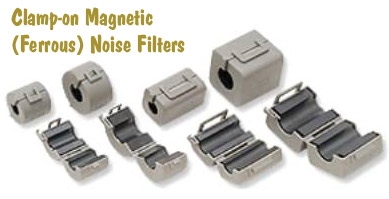
Finding and Installing Magnetic Noise Filters
Scott tells us: “You’ll see a lot of these type filters on the cords for computer acessories. You may have to experiment to find one that works for you. Some have different magnets that have different filtering abilities. My filter cost about $3.00. I purchased it at Randolph and Rice Industrial Electronics in Nashville, TN, item #SF.065.” You should also be able to find these kind of filters at Fry’s, Radio Shack, or other electronics supply stores.

While some magnetic filters require the power cord to run straight through, other designs allow you to loop the cord once around the filter (see photos). Looping the cord actually enhances the performance of the filter. You can also get improved filtration of electronic interference by putting a magnetic ‘noise’ filter on BOTH ends of your scale’s power cord.
November 1st, 2009
For years, Sinclair Int’l has offered a reamer for small, BR-sized flash-holes, product #07-3000. This popular tool features an 0.0625″ cutting tip to uniform the .059″ flash-holes on Lapua 220 Russian, 6mmBR, 6.5 Grendel, and 6.5×47 brass. Sinclair’s tool works from the outside, indexing off the primer pocket. For those people who believe in the utility of reaming small flash-holes (an open question), the Sinclair “outside-in” design may be the best. But until now, there has been no equivalent “outside-in” reamer for cases with large flash-holes.
 Sinclair recently introduced its NEW .081″ large flash-hole reamer, item #07-3081. This $37.50 tool is designed to ream standard flash holes (.080″) to exactly .081 inch, both for small primer pockets and large primer pockets. This tool will remove most burrs left in manufacturing and will uniform the flash-hole diameter of all your brass to ensure consistent ignition. Sinclair recently introduced its NEW .081″ large flash-hole reamer, item #07-3081. This $37.50 tool is designed to ream standard flash holes (.080″) to exactly .081 inch, both for small primer pockets and large primer pockets. This tool will remove most burrs left in manufacturing and will uniform the flash-hole diameter of all your brass to ensure consistent ignition.
Double-Ended Design Works with Both Small and Large Primer Pockets
Sinclair’s all-stainless three-piece tool features a double-ended reamer guide for both large and small primer pockets, a knurled handle for easy turning and a straight fluted .081″ reamer. It is designed for all cartridges (with either small OR large primer pockets) with standard .080″ flash holes.
As one Sinclair customer noted: “This is a tool that has been needed for a long time.” As a result, the .081″ flash-hole reamers have been back-ordered through 12/1/2009. But if you order now you should have yours within 5-6 weeks.
IMPORTANT: We recommend, if you order this tool, that you mic the actual diameter of the cutter tip. We have found that some flash-hole reamers, of ALL brands, arrive with slightly oversized cutter tips. Indeed we’ve seen tip diameters of other brands (not Sinclair) vary by as much as .006″ (six-thousandths). You want to make sure you don’t have an oversize cutter before you ream hundreds of cases.
October 25th, 2009
 Glock has announced that it will introduce a new “Fourth Generation” Glock handgun with an interchangeable grip back-straps and improved ergonomics. The new “GEN-4″ Glock will probably be unveiled at the January 2010 SHOT Show in Las Vegas, though Glock hasn’t commited to a SHOT Show release. According to the Guns, Holsters & Gear Blog, “[GEN-4] Glocks are rumored to have a textured finish that is not nearly as aggressive as the RTF2 introduced at the 2009 SHOT Show. The new finish is said to be rougher than the prior generations, but easier on the hands and clothes than the RTF2.” Glock has announced that it will introduce a new “Fourth Generation” Glock handgun with an interchangeable grip back-straps and improved ergonomics. The new “GEN-4″ Glock will probably be unveiled at the January 2010 SHOT Show in Las Vegas, though Glock hasn’t commited to a SHOT Show release. According to the Guns, Holsters & Gear Blog, “[GEN-4] Glocks are rumored to have a textured finish that is not nearly as aggressive as the RTF2 introduced at the 2009 SHOT Show. The new finish is said to be rougher than the prior generations, but easier on the hands and clothes than the RTF2.”
Glock has been hugely successful selling polymer-framed handguns to the law enforcement, military, and civilian markets. While Glocks enjoy an enviable reputation for durability and reliability, for many handgunners, Glock ergonomics are second rate. This editor has personally trained novice shooters with both a Glock 17 and Sig p226 9mm. More often than not, when the novices switch from the Glock to the Sig, their 10-yard groups shrink from basketball size to softball size — primarily because of the superior Sig grip size and shape. That’s not to say that Glocks are not accurate — they can be very accurate — it’s just that the Glock grip is far from ideal for many shooters.
 For decades Glock has stubbornly refused to redesign or improve the grip on Glock handguns (other than adding finger grooves of questionable utility). Meanwhile, Beretta, Smith & Wesson, and Walther have offered polymer-framed handguns with more comfortable, ergonomic grips fitted with interchangeable grip back-straps. These “swappable” back-straps come in different sizes to provide a better, more custom fit for the shooter. Women with small hands, in particular, benefit from a thinner back-strap. For decades Glock has stubbornly refused to redesign or improve the grip on Glock handguns (other than adding finger grooves of questionable utility). Meanwhile, Beretta, Smith & Wesson, and Walther have offered polymer-framed handguns with more comfortable, ergonomic grips fitted with interchangeable grip back-straps. These “swappable” back-straps come in different sizes to provide a better, more custom fit for the shooter. Women with small hands, in particular, benefit from a thinner back-strap.
The success of Smith & Wesson in securing large police contracts for its adjustable-gripped, S&W M&P pistol has finally prompted Glock to come up with a major grip redesign. Glock has been losing market share as police departments nationwide have traded in their Glocks in favor of the more ergonomic Smith M&Ps.
October 22nd, 2009
 The 2010 edition of the Hodgdon® Annual Manual has just been announced, and should be at newstands in January 2010. Now in its 7th year, the Hodgdon Annual Manual includes over 5,000 rifle and pistol loads, with information on 56 Hodgdon, IMR® and Winchester® powders. The new 2010 Manual features 44 cartridge updates, brand new data for the 6.5 Grendel and 6.5 Creedmoor, and updated propellant burn rate and usage charts. The 2010 edition of the Hodgdon® Annual Manual has just been announced, and should be at newstands in January 2010. Now in its 7th year, the Hodgdon Annual Manual includes over 5,000 rifle and pistol loads, with information on 56 Hodgdon, IMR® and Winchester® powders. The new 2010 Manual features 44 cartridge updates, brand new data for the 6.5 Grendel and 6.5 Creedmoor, and updated propellant burn rate and usage charts.
Extensive reloading information is provided for popular cartridges such as the 17 Remington, 223 Remington, 204 Ruger, 6PPC, 308 Winchester, 338 Federal and more. In addition, the 2010 Manual includes articles by top gun writers like Layne Simpson and Jim Carmichael plus many other resources for shooters and reloaders.
Articles in the 2010 Hodgdon Annual Manual spotlight the new varmint/match powder, IMR 8208 XBR. Test lots of this new powder have shown truly exceptional temperature stability. In addition, IMR 8208 XBR should deliver excellent accuracy in cartridges such as the 6mm PPC, 6BR, 22BR, and .308 Winchester. Lou Murdica and Jim Carmichael have already recorded impressive benchrest wins with prototype IMR 8208 XBR.
The 2010 Hodgdon Annual Manual costs $8.99 and should be available at newsstands and gun dealers by January 2010. For more on the manual contact Hodgdon at 913-362-9455, visit Hodgdon.com, or write to 6231 Robinson, Shawnee Mission, KS 66202.
|


