|
|
September 24th, 2009
North Carolina-based gunsmith Nat Lambeth is one of the gurus of the Savage world. He has built many highly competitive match rifles using Savage actions, employing his special accurizing methods. Nat recently built up a 6 BRX prone rifle using Gary Eliseo’s new S1 Savage Chassis. The 6 BRX, a 6BR improved with 30° shoulder, can be a very accurate cartridge, as demonstrated by Nat’s new rifle. Right out of the gate, this gun shot an 0.290 five-shot group during barrel break-in.

The rifle features a Savage Target action, factory Accutrigger, and a very accurate 32.5″, 8-twist Broughton 5C™ barrel. The load was Lapua 6BR brass hydraulically formed to 6 BRX, 32.5 grains of Hodgdon Varget, Wolf (Russian) SRM primers, and a Berger 105gr VLD bullet.
Nat really likes the 6 BRX chambering in a long-range prone rifle: “The 6mm BRX is like a 6mmBR on steroids. The whole purpose of the 6mm BRX and 6mm Dasher is to make the 6mmBR a better round for 600-1000 yard shooting. The have the advantages of the 6mmBR with a little more velocity. Most folks who shoot a 6mm BRX fire-form their 6mmBR brass by seating the bullets in the rifling and loading the 6mmBR case with a 90% load. The case expands into the larger chamber making a 6mmBR case now a 6mm BRX. [For this gun] I used my new Hornady Hydraulic Forming Die. [Editor: the hydraulic die will form the cases to about 95% of final shape using just the die, a water-filled case, and a mallet.] As you can see, the hydraulic die allowed me to start off with a standard 6mm BRX load from the get go. For optimum accuracy, barrel life, and case life the 6mm BRX seems to have an accuracy node between 3000 fps and 3080 fps.
Another factor is that the Broughton barrels seem to give about 100-150 fps more velocity. Almost every Broughton barrel that I have chambered seem to gain a little velocity after the first 200 rounds. I have chambered the 6mm BRX with most other barrel manufacturers and they all have shot well. This is a very sweet round.”

If you want to check out this rifle, head to the 2009 F-Class Nationals at Camp Butner, Sept. 30 – October 4. Nat explains: “This rifle will be at Butner for the F-Class Nationals and future matches and practices. I will have it and ammo available for those who would like to shoot it during the practice sessions both as a 6mm BRX and .308 Win.” For more info, call Nat Lambeth at (919) 556-0554 (Home/shop — evenings and weekends), (919) 662-6848 (cell), or email NLambeth [at] embarqmail.com.
September 22nd, 2009
Kelbly’s Inc., just annouced that it will produce a new, stainless Rem-clone “Atlas” action that will sell for $700.00 (before options). Notably, it is available with a cone bolt and a trigger hanger. The latter feature means that glue-in installation is feasible. Additionally, a headspace adapter will be offered so you can use chambered barrels that have been headspaced for Kelbly Panda actions. Currently, only two configurations will be offered: right bolt, right port (RBRP), or left bolt, left port (LBLP). The first run of Atlas actions are slated for release at end of October 2009. The new action is named after the Atlas Bear, once found in Morocco’s Atlas mountains. To learn more about the new Atlas action, call Kelbly’s at (330) 683-4674.

 Kelbly’s reports: “The new Atlas action is a Remington 700 clone made to benchrest standards. The action body is made of 416RS stainless steel. Bolts are made of 4140 alloy steel on the body and stainless steel on bolt handle. The Atlas action will come standard as a single-shot with trigger bracket for Rem-style triggers, aluminum bolt shroud, cone bolt on 222, PPC, and 308, flat bolt on .532 bolt face, and top safety cutout. The headspace is .692 without recoil lug. The thread will be 1 1/16 x 18 tpi.” Kelbly’s reports: “The new Atlas action is a Remington 700 clone made to benchrest standards. The action body is made of 416RS stainless steel. Bolts are made of 4140 alloy steel on the body and stainless steel on bolt handle. The Atlas action will come standard as a single-shot with trigger bracket for Rem-style triggers, aluminum bolt shroud, cone bolt on 222, PPC, and 308, flat bolt on .532 bolt face, and top safety cutout. The headspace is .692 without recoil lug. The thread will be 1 1/16 x 18 tpi.”
Options available
Fluted bolt – $60.00
Magazine (extended, requires flat bolt) – $60.00
Ejector – $75.00
Recoil Lug .250 – $35.00
Cera-Kote action body and bolt handle – $100.00
Polish action and bolt handle – $120.00
Stolle 1.115 Headspace washer – $30.00 (Allows installation of Panda-spec barrels on the Atlas action without rechambering.)
Forum Member Al Nyhus observes: “This new action is going to be a winner. One of the big things it has going for it is the use of a hanger for the trigger mounting. Add to that an innovative way to use barrels already chambered for the ‘standard’ headspace Kelbly actions and you’ve pretty much covered all the bases. — Well done.”
September 22nd, 2009
Ruger has just announced the new SR-22, which is a Ruger 10/22 shamelessly tarted up to look like an AR-15. For tactical and 3-gun competitors needing a practice weapon that shares the ergonomics of their AR15 match gun, the SR-22 makes sense. Otherwise, frankly, we lament the addition of the wobbly and poorly-designed AR-style collapsible stock to a firearm that works just fine with a conventional stock. We do like the integrated Picatinny-style rail on top of the action. This allows you to easily mount Red Dot sights or other optics. But does anyone really need rails on the forearm or a Mini-14 flash suppressor on a 22LR? No, but these features will probably sell more rifles. Anything that looks “tacticool” these days seems to sell well.
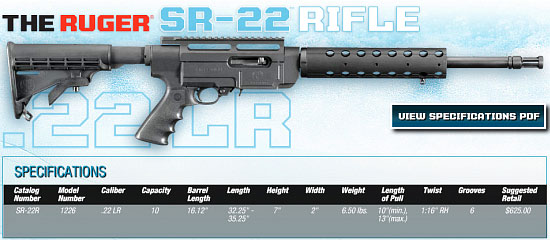
CLICK HERE for SR-22 Specifications Sheet
MSRP for the new SR-22 is $625.00 and we expect street price to be about $575.00. That’s more than twice the price of a standard 10/22 that, frankly, performs pretty well once you’ve upgraded the trigger. Is it worth paying double to get a pistol grip, AR-style buttstock, and Picatinny scope rail? Ruger is banking on the fact that AR devotees will say yes and shell out big bucks for the SR-22.
AR Egonomics with 10/22 Economy and Simplicity
According to Ruger, the “SR-22 Rifle allows shooters to use economical .22 LR ammunition, while still enjoying the look and feel of an ‘AR’. [The gun] faithfully replicates the AR-platform dimensions between the sighting plane, buttstock height, and grip. Like the 10/22, the AR-style SR-22 Rifle also has an extensive array of accessories available, allowing shooters to select a custom configuration that best suits their tastes and needs.”

The SR-22 uses standard SR-22 rotary magazines. Indeed, at its heart, the SR-22 is pretty ordinary. It features a standard 10/22 action inside an aluminum Nordic Components chassis that provides the rail mount, buttstock mount, and AR-style grip mount. The SR-22 ships with a six-position, telescoping M4-style buttstock (on a Mil-Spec diameter tube), plus a Hogue pistol grip. Buttstocks and grips may be swapped out for any AR-style compatible option. The wobbly, collapsible buttstock is the first thing this editor would toss on the SR-22.
Interestingly, the round handguard/float tube is secured with a standard-thread AR-style barrel nut, and the handguard is drilled and tapped for rails at the 3, 6, 9 and 12 o’ clock positions. Picatinny handguard rails are available from Ruger so you can add rail-mounted gizmos to your heart’s content. There is a barrel support V-block in the handguard so you can easily swap barrels or install after-market 10/22 barrels. The SR-22’s 16-1/8″ barrel is capped with an Mini-14 flash suppressor mounted with AR-spec ½”-28 thread.

September 10th, 2009
Premier Reticles has introduced a new 5-25x56mm “Premier Heritage” Tactical scope. This is a proper First Focal Plane (FFP) tactical scope, offering 1 cm/0.1 milrad turret click values matched with an illuminated reticle with cm/milrad hash marks. (27 milrad Double-Turn knobs are standard; 1/4-MOA clicks are optional.) Total elevation is a whopping 31 milrads (107 MOA). This is not a single-rev turret design, but one revolution covers 15 mils or about 51 MOA. For practical purposes, most shooters can get out to 1000 within one revolution if you have an angled scope base. The scope is 16.34″ overall with a beefy 34mm-diameter main tube. The 5-25x56mm Premier weighs 1.1 kg (39 ounces) and lists for $2899.00. Expect the “street price” to be about $2750.00.
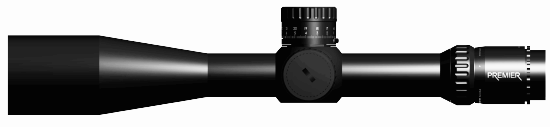
 The new scope has some nice features. First, the new 5-25x56mm Premier has tons of elevation. Total elevation is 31 milrads (equivalent to 107 MOA). As noted there are 15 mils (51 MOA) per revolution. Second, using a patent-pending Lever-Lock™ system, the scope can be zero-locked without tools. Third, the illumination control nests inside the left-hand parallax/focus turret, leaving the 34mm main tube unencumbered by a brightness knob. Finally the scope has a truly useful 5.5-range diopter. That’s enough diopter range to enable many eye-glass wearers to dispense with correction. A lot of smart thinking went into this scope. The new scope has some nice features. First, the new 5-25x56mm Premier has tons of elevation. Total elevation is 31 milrads (equivalent to 107 MOA). As noted there are 15 mils (51 MOA) per revolution. Second, using a patent-pending Lever-Lock™ system, the scope can be zero-locked without tools. Third, the illumination control nests inside the left-hand parallax/focus turret, leaving the 34mm main tube unencumbered by a brightness knob. Finally the scope has a truly useful 5.5-range diopter. That’s enough diopter range to enable many eye-glass wearers to dispense with correction. A lot of smart thinking went into this scope.
CLICK HERE for full Specifications and more photos
• First Focal Plane Illuminated Reticle Gen 2 XR
• Integrated Illumination and Parallax Adjustment
• 31 Milrad (107 MOA) Total Elevation Adjustment*
• 34mm one-piece maintube constructed from 6061-T6 aircraft aluminum
• Quick-focus eyepiece with Locking Mechanism
• Integrated Articulating Lens Covers
• Temperature rated from -40° to +60°C.
• Lifetime warranty
CLICK HERE for Scope Option List
 Big brother to the Premier Heritage 3-15x50mm introduced last year, the 5-25×56 offers excellent brightness, resolution, sharpness and contrast, along with superior color fidelity and light transmission (93% average across all wavelengths). The tactical windage and elevation adjustments on both Heritage scopes feature the patent-pending Lever-Lock™ dial retention for re-zeroing without special tools. Standard turrets have 0.1 milrad (1cm) click values, while “user-swappable” dials are available to change click values to ¼ MOA. Big brother to the Premier Heritage 3-15x50mm introduced last year, the 5-25×56 offers excellent brightness, resolution, sharpness and contrast, along with superior color fidelity and light transmission (93% average across all wavelengths). The tactical windage and elevation adjustments on both Heritage scopes feature the patent-pending Lever-Lock™ dial retention for re-zeroing without special tools. Standard turrets have 0.1 milrad (1cm) click values, while “user-swappable” dials are available to change click values to ¼ MOA.
FFP Reticle Features
Currently, all Heritage scopes come standard with First Focal Plane (FFP) reticle placement for consistent subtension regardless of magnification setting. The Heritage 5-25x56mm comes with Premier Reticles’ own patented illuminated Gen II Gen II XR (extended Range) reticle. The illumination control has 11 brightness settings, a locking illumination dial for “off” storage, and a 6-hour time-out function to preserve batteries.
Strong Demand for New Scope
The first run of the new 5-25x56mm Premier Tactical scope sold out, with high demand by both military and civilian customers. However, Chris Thomas, Premier’s President, tells us that “more 5-25s are on their way. Units should be available in about 6-7 weeks, if you order now”. The Premier Heritage scope comes with a lifetime warranty. Premier Reticles is a 63-year-old optics company with headquarters and manufacturing in Winchester, Virginia and an additional design branch in Germany.

*NOTE: On Premier’s spec sheet, elevation is listed as 30 milrad/103 MOA. That was for the prototype. Production models have more.
September 9th, 2009
We found some interesting, well-designed racks and gunsafe accessories on the ManaboutRacks.com website. First, we were impressed with the 7-slot handgun rack with built-in storage (larger 10- and 12-gun sizes are available). This is the first design we’ve seen that offers organized storage right below the handguns — a perfect place for mags or ammo. There are many different versions, with your choice of drawers, divided compartments, or an open sub-shelf. A 7-gun rack with 4 drawers costs $79.95, while a 7-gun rack with dividers runs $49.95. The 7-gun Greystone rack, with one long shelf below the guns, costs $49.95.

They say “rust never sleeps”. When storing firearms you want to maintain optimal interior temperature and relative humidity inside the safe. By keeping the humidity above the dew point, moisture won’t condense on your guns, leading to rust. Here’s a simple, Digital Humidity & Temperature Monitor that costs just $14.95. With a 3″ x 2″ footprint, it’s small enough to put anywhere in your safe.

Shown below is a slick, battery-powered LED light. The LED lamp holder swivels, allowing you to direct illumination where you want it. This unit, measuring 7.1″ x 1.8″ x 0.9″, is very flat so it doesn’t take up much space. Mounting is easy — the lamp comes with both magnetic and Velcro-type fasteners. Because this lamp uses LEDs rather than incandescent bulbs, the AAA batteries last a long time. This swiveling LED lamp, in either silver or gloss black finish, costs $12.95 on the web and you may find it for less in a large home-supply store.

September 4th, 2009
 We know that a large percentage of our readers own 1911-style pistols. The 1911 platform is the favored choice for bullseye pistol competition, and it remains an excellent choice for IDPA comps, action pistol events, and personal defense. We know that a large percentage of our readers own 1911-style pistols. The 1911 platform is the favored choice for bullseye pistol competition, and it remains an excellent choice for IDPA comps, action pistol events, and personal defense.
One of the first accessories many 1911 owners install on their pistols is a funnel-type magwell base, such as a Smith & Alexander Mag Guide. A magwell base allows you to change mags more quickly and securely. Unfortunately, adding a metal funnel is an expensive proposition that normally requires gunsmithing.
Now you can get the benefits of an expensive magwell base with a polymer, two-piece 1911 grip system from MAKO Security that incorporates a speed funnel at the bottom. Instead of buying an expensive ($70.00+) magazine extension and having to drill into your 1911, simply replace your existing grips with MAKO’s WG1911 grip system.

According to Addy Sandler, MAKO’s CEO: “The WG1911 makes it much, much easier to put a magazine in a 1911 handgun. There is nothing that provides all the features and benefits of the WG1911 on the market today at this price point.” MSRP for the WG1911 grip is $27.20, but you can buy it from Trading Post Supply for just $19.74.
CLICK HERE to learn more about the WG1911 and view more photos.
September 2nd, 2009
Phoenix Precision, based in Elk River, MN, crafts precision target sights for long range target shooters. Known for their outstanding reliability and repeatability, Phoenix rear sights are gaining popularity among competitors in prone, Palma, and High Power disciplines. Some of the top “sling and irons” shooters in the country have switched to Phoenix sights.
Gary LaValley, owner of Phoenix Precision, crafts his rear sights using advanced CNC machinery. The sight housings are anodized, aircraft-grade aluminum. For precise repeatability, the sights feature stainless guide pins and lead screws, plus oil-impregnated bronze guide and thread bushings. The sights offer 70 MOA of elevation, 60 MOA of windage, with 1/4-MOA clicks. Knob rotations for elevation and windage are either NRA match rifle (Counter-CW) or service rifle (CW). Quarter-minute clicks are standard, but on request for the Palma shooters, 1/2-MOA windage detent plates are available at no extra charge. Phoenix sights accept both Anschutz and Gehmann accessories.
 |
 |
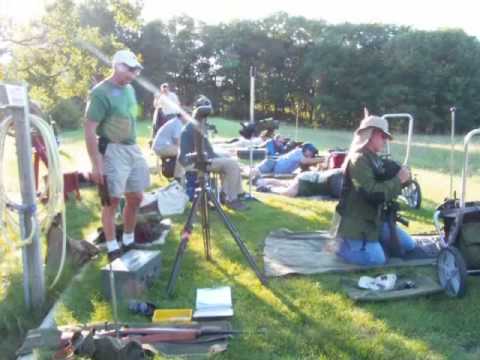
Phoenix Precision micrometer rear sights are offered in two basic models: top mount ($380.00), and side mount ($355.00). Both types are available in either right- or left-hand configuration (no extra charge for lefties). Top mount models are designed for use on rail-equipped AR flattops, tube guns, Tubb 2000s, and Gary Eliseo stocks. Side mount models are most commonly used on bolt action rifles, but they also work on Picatinny or Weaver-style rails with the use of an adaptor. So, if you have both an older-style Palma rifle and a new, rail-topped tube-gun, you can use the sight on both rigs. Many shooters do use the same Phoenix rear sight on multiple rifles, as shown in the video below. In the video, when real competitors talk about their Phoenix sights, you hear two things time and again: “quality” and “repeatability”.
For more information about Phoenix Target Sights and Scope Rails, visit www.PhoenixPrec.com, or call Gary LaValley at (763) 263-3327.
August 31st, 2009
The Indian Army has introduced a new Modern Sub-Machinegun Carbine (MSMC) that shoots an interesting new round, a shortened version of the 5.56×45 (.223 Remington). According to The Firearm Blog, “The [MSMC] chambers a round developed in India called the 5.56×30mm. This round is sometimes referred to as the ‘5.56×30mm INSAS’ after the first gun to chambered the round, the INSAS Carbine.”
This is an interesting cartridge, reminiscent of the 5.56×30 MARS cartridge originally developed by COLT for its Mini Assault Rifle System (MARS) project (see below). The MARS gun never went into full production, and the 5.56×30 cartridge remained an orphan. But it was an interesting cartridge. As designed, using just 16.8 grains of commercial ball powder, Colt’s 5.56×30 cartridge could launch a 55gr FMJ bullet at 2600 fps.

We are intrigued by the new Indian 5.56x30mm cartridge because it would seem very well-suited for varminting, either in .22-caliber form, or necked down to .20 caliber or even .17 caliber. We already have a similar cartridge, of course, the 221 Fireball, but right now there is only one manufacturer of 17 and 221 Fireball brass, namely Remington.

If the Indian 5.56x30mm cartridge is produced in large quantities, perhaps we could see budget-priced 5.56x30mm brass exported for sale in the American market. That would be a boon for high-volume varminters. Also, if the Indian 5.56x30mm is standardized internationally, perhaps one of the European brass manufacturers (Lapua, Norma, RUAG, Wolf?) would consider producing it as an alternative to the 221 Fireball. We can only wish that a 20-cal or 17-cal version of the Indian 5.56x30mm cartridge might be produced some day as inexpensive factory ammo. Many varminters are now looking at centerfire options to the 17 HMR cartridge, as 17 HMR ammo prices continue to climb. A 50-round box of 17 HMR can now cost $14.00 or more.
August 20th, 2009
There is an “arms race” going on now among the top optics-makers trying to grab market share at the high end of the spotting scope field. Prices have climbed into the stratosphere as companies provide ever-bigger objectives with ultra-premium glass. The latest 80+ mm “super-spotters” are running $3000 to $4000 with zoom eyepieces. Last year, Kowa released its superb flourite-lensed TSN-883/4 Prominar at $2905.00 (88mm body with 20-60 zoom eyepiece). Leica followed suit with its Televid 82 APO spotting scope priced at $3995 (82mm body with 20-50 Vario eyepiece, $3195.00 body only). Yep, that’s four grand for a spotting scope — we could buy a nice used truck for that.
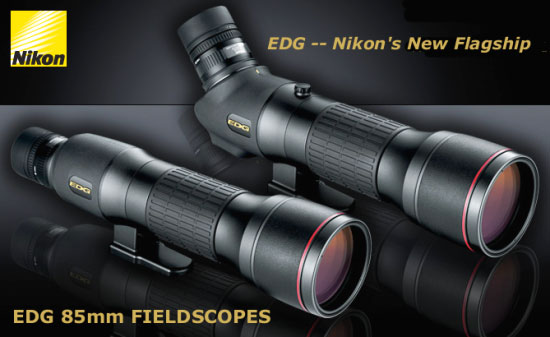
New Nikon EDG 65mm and 85mm Spotting Scopes
Now Nikon has joined the “big-buck-glass” game with its new line of EDG spotting scopes in 65mm and 85mm objective lens sizes. With a 20-60X zoom eyepiece, the larger 85mm Fieldscope retails for $3299.00, a new high for Nikon. But the new Nikon looks impressive. The new EDG Fieldscopes offer the same exclusive ED glass lenses and premium prisms as Nikon’s highly praised EDG binoculars. Nikon says the new ED lenses deliver superior sharpness and color correction (without chromatic distortion), and ultra high contrast. The 85mm objective also provides a wider field of view than most spotting scopes. For enhanced low-light performance, the straight (non-angled) EDG scopes feature what Nikon calls “Dielectric High-Reflective Multilayer Prism Coating”. Hmm… “Dialetric Prisms” — that sounds like something Scotty would use on the Starship Enterprise.

Will the new Nikon EDGs run with the top-of-the-line Kowa, Leica, Swarovski, and Zeiss spotters? We’ll have to wait until comparison testing can be done. But we can say that the new Nikons EDGs are a big step up from past Nikon Fieldscopes. The EDG body is more compact and the unit is better balanced. We like the large focus ring, but would prefer a dual-focus system. The mounting bracket looks very solid, which should reduce wobbles when mounted on a tripod. Early reviewers say that the EDGs are very bright, with outstanding eyepieces.
New, Improved ED Eyepieces
Nikon has also released a whole set of new eyepieces for the EDG scopes. For long-range use, there is a new fixed-power eyepiece that delivers 75X magnification on the 85mm Fieldscope. We’ve used up to 82X magnification on other spotting scopes and we can assure you, 75X is NOT too much when viewing conditions are good. The 75X eyepiece would be a great choice if you’re trying to resolve bullet holes at 600 yards and beyond.

High Power and iron sights shooters will like the new 20X/25X LER (long eye relief) eyepiece. This provides enough power to see target spotters, while offering easy viewing (and a wide field of view), when you are in shooting position and want to take a quick look through the glass. This eyepiece features ED glass, and provides 20X magnification with the smaller 65mm Fieldscope and 25X magnification with its 85mm big brother. All the new EDG eyepieces feature fuully multi-coated lenses, and many offer twist-out eyecups, which are handy for eye-glass wearers.
August 15th, 2009
 If you want to win shooting matches you’ll need to gauge wind speed and direction. While many shooters use the excellent Kestrel line of pocket Weather Trackers, many top shooters are turning to the Windtronic 2, a German-made unit that measures wind speeds from any direction. If you want to win shooting matches you’ll need to gauge wind speed and direction. While many shooters use the excellent Kestrel line of pocket Weather Trackers, many top shooters are turning to the Windtronic 2, a German-made unit that measures wind speeds from any direction.
The Windtronic features rotating cups mounted on a vertical axis. With this design you don’t have to align the unit with the wind, unlike the Kestrel WindMeter or SpeedTech WindMate™ devices. Many users feel the Windtronic’s unique design allows it to read wind speeds more accurately; it certainly can respond to shifting winds more easily. The omni-directional functionality of the Windtronic allows it to be mounted on a stand or tripod and continuously display current wind speed, max wind speed, and average velocity.
The Windtronic 2 doesn’t guage temperature, barometric pressure, humidity, or density altitude, unlike the more advanced (and expensive) Kestrel 4000/4500 model pocket weather trackers. The Windtronic only records wind speeds, but it does that one task exceptionally well.
Made in Germany by Kaindl Electronics, the Windtronic 2 comes with a 2-year manufacturers warranty and normally retails for $99.00 on Amazon.com. Other dealers include Windtronic.us and Windpowersports.com.
|


