|
|
April 15th, 2009
Butch Lambert of Shadetree Engineering & Accuracy has come up with a very impressive new lightweight, break-down front rest base for F-Class shooters. Built primarily of anodized aluminum, the new rest base weighs just about 3 pounds. It can accept a variety of rest tops, including the Shadetree Joystick Top shown below (this omnidirectional top retails for $375.00 plus shipping).
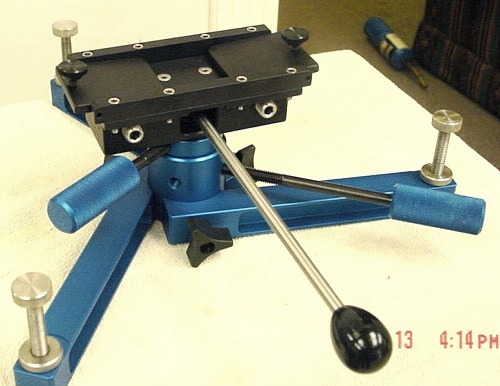

We like this product and we predict it will become popular with F-Classers as well as varminters looking for a solid front rest that is light to carry and easily stowed. The fact that the rest base breaks down into small components is a big plus for shooters who must travel by air. Over the past year, the airlines have imposed very high fees for extra checked luggage–in some cases as much as $120.00 per bag! With the new Shadetree base, you can easily disassemble the unit into smaller parts that could even be stowed in a carry-on bag. Kudos to Butch Lambert for this innovative new design. To learn more about price and availability of the F-Class rest base, call Butch at (972) 524-2247 or email papawlambert [at] starband.net.
April 15th, 2009
With the new AR15 combo tool from American Tactical Imports, you can pretty much take apart an entire AR15 rifle. This all-purpose tool can be used for installing and removing buttstocks, free float tubes, barrel extension tubes, and handguards. It will work with both standard stocks and M4-style stocks. The tool also fits CAR stocks with 3 point castle nut and locking rings.

American Tactical Imports’ AR15 Combo Tool is seven tools in one. In addition to the uses already mentioned, the tool can be used to align barrel nuts to the gas tube. It has a wrench for muzzle brakes (compensators), plus it has a ½-inch drive for socket and torque wrenches.The ATI AR15 combo tool features a matte black, corrosion-resistent, hard-coat finish. Suggested retail price for the tool is $39.95, and that includes a limited lifetime warranty from ATI. With its versatility, we think this tool could be invaluable for owners of AR15s or AR-based “space-guns”.
April 13th, 2009
Kowa spotting scopes are highly regarded, particularly among High Power and long-range prone shooters. You’ll always find many Kowas on the firing line at High Power matches. Many shooters get their Kowas from retired Marine Msgt. Jim Owens, who offers excellent prices on his JarHeadTop.com website.

Kowa is replacing the venerable TSN-821M spotting scope with the newly redesigned TSN-82SV, which will be more compact with upgraded optics. The new TSN-82SV weighs 52.5 ounces, and is just 15.1″ long. The 82SV is waterproof and nitrogen-filled to to help eliminate lens fogging.
The 82SV has a 45-degree angled eyepiece (puchased separately). Four optional eyepieces are offered: TE-9Z, TE-14WD, TE-9WD, and TE-17HD. Specifications are listed in the chart below. Prone shooters will probably prefer the 27x TE-17HD long-eye-relief (LER) eyepiece. It offers a 2.0˚ real field of view (105 feet at 1000 yards), with about 1.25″ of eye relief.

The MSRP for the new TSN-82SV is $805.00 (body only), while the “street price” is currently about $650.00 without eyepiece. See: Eagle Optics, $645. By contrast, Kowa’s larger TSN 881 88mm spotter runs $999.00 without eyepiece.
April 6th, 2009
Leupold has released a new ultra-compact laser rangefinder, the RX-1000. This thing is tiny — not much larger than a pack of cigarettes. The pocket-sized RX-1000 measures 3.8 inches long and weighs just 7.8 ounces. The “street price” for the basic RX-1000 unit is about $350.00 while the TBR® model with built-in ballistics compensation runs about $400.00 (OpticsPlanet.com prices). Both the RX-1000 and RX-1000 TBR units feature an aluminum frame, inside a weatherproof, matte-black, rubber-armored exterior. The RX-1000 TBR is also available in Mossy Oak® camouflage.
Beyond the reduction in size and weight, the notable feature of the RX-1000 is an improved optic with better light transmission. Leupold claims the RX-1000’s 80% light transmission is superior to most other rangefinders. In addition, the RX-1000 features a RED OLED read-out. In low light conditions, the OLED is definitely easier to view that conventional LCD displays.
Leupold claims the RX-1000 has a maximum effective range of 1,000 yards (914.4 meters) on reflective targets. Based on the performance of other Leupold rangefinders, we expect this claim is grossly optimistic and you shouldn’t count on reliable ranging much past 700 yards.
One feature we like about the new RX-1000 are the selectable reticles: a small “Plus Point” crosshair for ranging small targets, a larger outer crosshair, or a combination of the two. This is a feature we’d like to see added to premium rangefinders like the Swarovski laser guide. Choosing a tight reticle lets you aim the device more precisely, which reduces the chance of errant laser returns.
We think it’s wise to pay the money for the TBR model which automatically calculates the shot angle and provides the actual Ballistic Range rather than the straight-line distance to the target. This can be very helpful for hunters shooting at extreme up or down angles in mountainous country. To learn more about the RX-1000, check out Jeff Quinn’s Gunblast.com Review, visit www.leupold.com, or call 1-800-LEUPOLD.
April 2nd, 2009
 Lead by top UK shooter Vince Bottomley, a team of UK gun experts has launched Target Shooter, a new online “e-zine” dedicated to precision shooting. This is a great new offering — you should log on to TargetShooter.co.uk right now to check it out. Vince explains: “Our online magazine will cover target shooting in all its forms, including rimfire and centerfire benchrest, F-Class, classic military rifle, and tactical. We’ll deliver feature articles plus match reports and gear reviews.” Lead by top UK shooter Vince Bottomley, a team of UK gun experts has launched Target Shooter, a new online “e-zine” dedicated to precision shooting. This is a great new offering — you should log on to TargetShooter.co.uk right now to check it out. Vince explains: “Our online magazine will cover target shooting in all its forms, including rimfire and centerfire benchrest, F-Class, classic military rifle, and tactical. We’ll deliver feature articles plus match reports and gear reviews.”
Target Shooter employs a publishing format called “Scribd” that delivers a print-magazine style format over the web. This is actually kind of cool, as you can zoom pages smaller and larger and download the entire “magazine” for off-line reading. A new edition of Target Shooter will be released every month.
Target Shooter Offers Great Content
The debut April 2009 edition, 109 pages long, is truly impressive. It contains many interesting articles including a 2009 IWA (Euro Shotshow) report from Vince Bottomley, a comparison test of budget scopes by Carl Boswell, a detailed F-TR Tubegun review by Laurie Holland and Vince B., and a fascinating discussion of Field-Target shooting by Tim Finley (covering all positions). And that’s not all — the magazine offers a two-month event calendar, plus match reports (check out Gwyn Roberts’ Gallery Shooting Tri-Nations tournament report).
Target Shooter also features many gear reviews and product evaluations. In the April edition, Carl Boswell provides a comprehensive review of the BullzeyePro optical boosters. If you are considering purchasing this product you should definitely read this review — it even includes through-the-lens photos, so you can see the magnification boost with your own eyes.
Overall, the new Target Shooter online magazine is a mighty impressive accomplishment. It is rich with content, the photography is excellent, and the level of technical expertise is high. We were very impressed by the diversity of disciplines covered — this magazine covers much more than conventional benchrest. Any gun enthusiast interested in precision shooting should log on to TargetShooter.co.uk. Not only is it one of the best sources of shooting information available, but it is currently 100% free. You can’t beat that.

March 31st, 2009
Today, after weeks of “teaser” pre-release marketing, Benelli introduces its all-new ‘Vinci’ line of self-loading shotguns. While Benelli’s product launch press releases are understandably self-congratulatory, the new shotgun does have many impressive features. Overall, this is a significant new product — not just another 1960s design in new clothing.

CLICK HERE for more photos, and product specifications.
First, the take-down/assembly procedures are impressively simple — the steel receiver/barrel assembly attaches directly to the front of the buttstock with a simple twist fitting. The receiver is very low profile and the entire bolt and bolt buffer assembly operates along the same axis as the bore. That’s smart engineering that should make the gun more controllable under recoil. Benelli claims that the combination of the all-inline, inertia-driven bolt system with the “Comfortech Plus” buttpad gives the Vinci 72% less felt recoil than other lightweight shotguns. (That’s quite a claim — it would be interesting to see how Benelli substantiates that number.)
We like the fact that the stock is easily adjustable. You can adjust Drop, Cast, Length of Pull and Cheek Height — all without tools. The tubular magazine and forearm can also be quickly removed without tools. Various forearm and stock options allow the Vinci to switch from standard shotgun, to pistol grip turkey gun, or to a pistol grip tactical scattergun. The Vinci is currently offered with either 26″ or 28″ barrels. Colors are matte black, Realtree APG camo, and Advantage Max 4 camo.
CLICK HERE to view Vinci Shotgun Videos.

NOTE: May take a long time to load or stall on slow connections.
March 31st, 2009
 John Parker of the NRA’s Competitive Shooting Division has authored a new brochure on the topic of High Power Rifle competition. It is available from the NRA online store for just $0.50, item CT17000. The booklet covers all the key components needed for High Power shooting. It also includes a special “Getting Started” section. John Parker of the NRA’s Competitive Shooting Division has authored a new brochure on the topic of High Power Rifle competition. It is available from the NRA online store for just $0.50, item CT17000. The booklet covers all the key components needed for High Power shooting. It also includes a special “Getting Started” section.
In the new booklet, Parker covers the following topics: Course of Fire, Rifle, Sling, Spotting Scope, Shooting Coat, Shooting Glove, Eye and Ear Protection, Sight Blackener, Scorebook, and Ammunition. Parker also explains the NRA Classification System and provides basic summaries of popular High Power disciplines: Long Range, Mid Range Prone, F-Class, and High Power Sporting Rifle.
You can order this booklet online at the NRA Program Materials Center, or call 800-336-7402 to place your order over the phone. Visit NRA’s High Power Rifle Competition webpage for more information.
This report comes courtesy of the NRA Blog.
March 30th, 2009
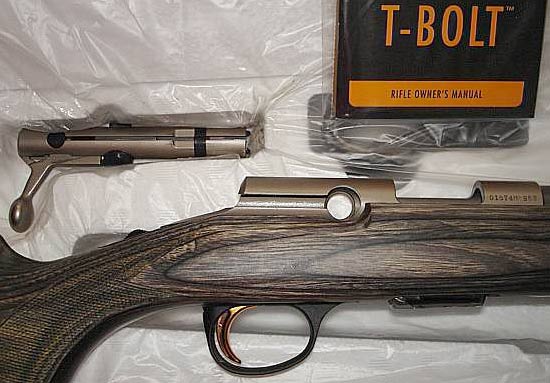
The Browning T-Bolt straight-pull rimfire rifle is an American classic, first produced from 1965 through 1975. In 2006 Browning wisely resumed production of the fast-cycling T-Bolt. We were pleased to see the re-introduction of the T-Bolt, as the unique action is smooth and quick to use. This makes the rifle well-suited for both varminting and the new “Rimfire Tactical” discipline. With enhanced materials and improved manufacturing methods, the new-generation T-Bolt is more reliable and smoother-operating than ever.
Browning Launches Left-Handed T-Bolts
Browning has added twelve new offerings to their T-Bolt rimfire rifle line for left-handed shooters. All the new models incorporate the basic design of the T-Bolt rifle but with the bolt on the left side. There are four new left-hand models in each caliber: .22 long rifle, .22 Winchester Magnum and .17 HMR.

On all T-Bolts (both right- and left-handed), receivers are drilled and tapped for scope mounts. Barrels are free-floated and have recessed crowns. T-Bolts feature a 3-lever, short-travel trigger design. Trigger pull weight is adjustable with an external screw and there is a convenient, thumb-operated tang safety.
Among the new T-Bolt models, we like the heavy-barreled Target/Varmint model. This has a satin finish checkered walnut stock with a Monte Carlo comb and wider fore-end. Suggested retail price for the .22 LR Target/Varmint is $719.00 and $729.00 for the .22 WinMag and .17 HMR guns. There is also a less expensive Sporter Model with a lighter-contour barrel.

March 29th, 2009
Review by LARRY BANEY
The Sightron 6-24×50mm Mildot is the latest in Sightron’s SIII line-up of side-focus, 30mm riflescopes. This follows the hot-selling 8-32×56mm SIII, which we reviewed last fall. While our 6-24x50mm test sample has a Mildot reticle, Sightron’s new 6-24x50mm scope is also offered with a fine cross-hair (FCH) with target dot reticle. Both Mildot and FCH versions are 14.96″ overall with a near-constant 3.6-3.8 inches of eye relief. Clicks are 1/4 MOA (15 MOA per revolution), and total elevation (and windage) adjustment is listed as 100 MOA (50 MOA on either side of center). That’s a class-leading amount of elevation, which should make the new 6-24×50mm popular with long-range shooters.

Shown above is the Sightron 6-24×50mm Mildot, flanked by a Leupold 8-25×50mm LRT and the Sightron 8-32×56mm. The controls on the 6-24 Sightron are identical to those of its big brother, but it is shorter, with a smaller objective. The shorter length and 50mm front objective allow a 2.8 ounce weight savings over the larger model (21.9 oz. vs. 24.7 oz.).

Sightron 6-24x50mm Quick Review
Assistant Editor Jason Baney has been evaluating the optical qualities of the new Sightron 6-24 Mildot scope. Jason also had a chance to test the scope’s real-world performance in a tactical match. Here is Jason’s report:
“When the new 6-24x50mm mil-dot Sightron SIII arrived, it looked like the little brother of the Sightron 8-32x56mm. Controls and “styling” are similar. This family relationship was made clear as my review of its performance progressed. It shared the same ergonomics, same superior glass, and same unbeatable tracking.
 I had a Leupold 8.5-25x50mm LRT for comparison purposes. The Leupold, which is actually 24.3x at max power, is a popular scope with a good reputation for clarity and sharpness. However, the new 6-24x50mm Sightron seemed better in many respects than the Leupold LRT. The Sightron’s glass appeared superior, giving better color rendition, a brighter field of view, and better contrast. I had a Leupold 8.5-25x50mm LRT for comparison purposes. The Leupold, which is actually 24.3x at max power, is a popular scope with a good reputation for clarity and sharpness. However, the new 6-24x50mm Sightron seemed better in many respects than the Leupold LRT. The Sightron’s glass appeared superior, giving better color rendition, a brighter field of view, and better contrast.
Also, with the Sightron, there was no noticeable parallax lash in the side-focus system. There was no need to start the side-focus at a travel stop every time. You could simply dial the side parallax adjustment and get the observed target in sharp focus with minimal parallax. This has been a problem with some Leupolds (i.e. you can’t get minimal parallax and best focus at the same time.) While observing bullet holes in different colored targets at 300 yards, the Sightron also appeared to show slightly better resolution than the Leupold and therefore better ability to locate individual bullet holes in the paper.”
Field Testing at the Allegheny Sniper Challenge (ASC)
In any competition riflescope, precise, repeatable tracking is absolutely vital. When you crank-in elevation and/or windage you want the reticle to move the exact value you dialed. Then you want the scope to repeat exactly when you return to the original zero. To test the Sightron’s tracking, Jason did more than a simple range test. He tested the scope’s tracking in the “real world”, during a two-day tactical comp.
Jason reports: “The 6-24 was thrown into action right away at the Allegheny Sniper Challenge (ASC) in Seneca Rocks, WV in August 2008. This was a team match that I shot with my father. ASC entails interesting weather, and even more interesting shots. In a matter of two days, over 100 shots are expended and a scope’s adjustments are REALLY put to the test. Maintaining zero is very important, because there are no sighters to check your zero. Shots range from less than 100 yards to nearly 1200 yards, and in the end, everyone has clicked their scope up-and-down 40 times or more. This means 40+ up/down repetitions on the elevation knob. This is as tough a test of a scope’s tracking ability as you’ll find.”
Great Tracking Ability, Excellent Value
So how did the Sightron’s tracking rate? The new Sightron 6-24×50 returned from ASC with the EXACT same 100-yard zero as when it started. This scope maintained its zero as well or better than any other scope out there, including those costing $3000.00+. The scope’s great elevation range was also much appreciated. Jason reports: “With 100+ MOA of elevation available and a 20 MOA base on the rifle, I had enough ‘up’ to shoot all the way out to 1200 yards with no problem.”

In Jason’s opinion this scope will be very hard if not impossible to beat in its price range in many aspects. The new Sightron 6-24 certainly rivals the overall optical quality of the Sightron 8-32×56, and that’s saying a lot. But since it is a Mildot scope there is another level of scrutiny needed. This scope is not a purpose-built tactical scope, but it represents a good base on which to build if Sightron offers enhancements in the future. If a shooter wishes only to use the mil-dots for holdover, he will be well served, but a Front Focal Plane (FFP) reticle would be more useful for serious tactical work. An illuminated reticle would also be welcome, and Jason would like to see a different reticle design with half-mil markings.
Also, some tactical shooters would prefer to have mil-based click values, rather than 1/4 MOA clicks. In raising these points, we need to stress that the $800.00 Sightron 6-24x50mm Mildot is affordable and works well as a general-purpose scope with reticle marks that allow hold-overs. This scope was not designed to compete with a $2700.00 Schmidt & Bender PMII. Jason explains: “I just want the serious tactical guys to understand that the Sightron won’t give you all the features of a dedicated FFP mildot optic with mil-based clicks. However, at about $800.00 average retail, the Sightron 6-24x50mm costs less than a third of what you’ll pay for high-end tactical scopes from S&B or U.S. Optics.”
March 22nd, 2009
We know many of our readers shoot the 6 BRX, 6 Dasher, 6mm Rem AI, .243 Ackley and other “improved cartridges” that require case-forming. These wildcat designs move the shoulder forward, or alter the shoulder angle and/or body taper. Traditionally, these cases are fire-formed, i.e. a charge of powder is used to blow the shoulder forward and casewalls out. There are different methods of fire-forming. Some guys use a full load of rifle powder, with bullets seated hard in the lands (setting up a false shoulder helps too). Other shooters successfully fire-form without bullets, using fast pistol powders (and a much-reduced charge). Typically, with this bulletless fire-forming, a filler such as Grits is used, along with some kind of plug or wad to hold the powder in the case.
Fire-forming takes time, and consumes expensive powder, primers, and (typically) bullets. Unless you have a dedicated fire-forming barrel, the fire-forming process can use up a significant amount of your useful barrel life, particularly if you are a varminter needing hundreds of re-formed cases. What if you could form your cases at home, at your reloading bench, without burning powder or wasting barrel life? Well you can…
Hydraulic Case-Forming with Hornady Die
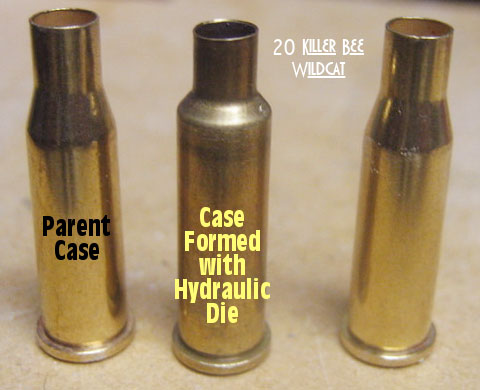
Now, thanks to Hornady, shooters who need to “improve” their cases have a bonafied alternative to fire-forming. Hornady’s custom shop offers a hydraulic case-forming kit that allows you to form cases just using water and a conventional reloading press.

Because fluids, such as water, are not compressible, you can use hydraulic action to change the shape of your brass in a die. As a ram or piston moves the fluid in the die, hydraulic pressure pushes the shoulder and case walls out to match the “improved” case profile machined into the Hornady die. What you’ll get is a re-formed case with a near-perfect neck-shoulder junction, but with slightly rounded edges where the case body meets the shoulder. However, the edges of the shoulder will normally sharpen up once you shoot the brass for the first time with a full load.
Tips for Hydraulic Case-Forming
The process works well… as long as you understand that it will take a final fire-forming stage to fully “blow out” the brass. The hydraulic process gets you 95% of the way there. Lonnie Hummel, technician of Hornady’s Custom Shop, uses a hydraulic forming die himself to produce his wildcat varmint cases. Lonnie recommends using regular water as the hydraulic fluid, but other shooters have used isopropyl alcohol, and some guys have used light machine oil. The different fluid choices have pros and cons. With water, you have to be careful to dry out the forming die so it doesn’t rust. With oil you have to make sure you remove ALL the oil from the case before firing. That’s very important for safety and to ensure you don’t “kill” your primers. Alcohol seems to work well, but again you want to make sure residues are removed, so that any residual alcohol does not contaminate primers or powder.
Ordering a Hydraulic Forming Die
Hornady hydraulic forming dies are produced on a custom basis. You need to supply a reamer print or some “finished” cases that have been fully fire-formed in your chamber. Then Hornady can build a die that matches your improved or wildcat chamber. Also, after heat-treating, each die is custom-honed so there is a super-close fit with the shaft of the hydraulic piston.
How much will it cost? Prices vary depending on the size of the parent cartridge: for cases up to 2.6″, the cost is $165.00; for cases over 2.6″ up to 2.9″ the price is $185.00. These prices are for the complete Hornady Hydraulic Forming Kit, which includes Die Body, Lock Ring, Hydraulic Piston, and a special shellholder (without a center hole).
For more information contact Lonnie Hummel at Hornady. Call (308) 382-1390 and ask for the Custom Shop or email: lhummel [at] hornady.com. NOTE: You will NOT see this product listed or illustrated on Hornady’s website. Hydraulic form dies are special order items.
Photos courtesy Forum member SongDogHunter
|


