|
|
December 26th, 2008
The two-stage CG Universal Match Trigger has proven very popular with High Power and Long-Range Shooters. The CG-Jackson trigger is a Robert Chombart design, like the RPA Quadlock and the Millennium actions. The trigger’s final stage pull-weight adjusts from 10 ounces to over 63 ounces, and both a curved or straight trigger finger is offered. Notably, this new design works with a very wide range of actions, both custom and factory. In addition to a Remington 700 version, for example, there are versions for Barnard, Mauser, RPA, SAKO, Tikka, and Winchester Model 70 actions. That makes this CG Trigger one of the most versatile match triggers ever offered. In Europe, the trigger is sold by Jackson Rifles. In the USA, the CG trigger is solf by Tom Myers, through his company X-Treme Shooting Products.
German Salazar has tested the CG Trigger and written a detailed product review. CLICK HERE for CG Trigger Review by Salazar.

The CG Universal Trigger uses a variety of upper frames to fit each specific rifle action. The upper frame contains the final lever(s) of the trigger. A universal main housing is attached to this upper frame. This ensures similar function, settings and “feel”, whatever action the trigger is fitted to. The CG Universal is a true two-stage trigger, so that (unlike modified direct-pull triggers fitted to some “tactical” rifles), the sear engagement reduces and fully recovers with the first-pull movement of the trigger finger. The CG Universal trigger system was designed by Robert Chombart, who also designed the CG MILLENNIUM, CG INCH and other target rifle actions.
The CG Universal Trigger System works with numerous rifle actions including:
ANSCHUTZ
BARNARD
CG INCH
CG MILLENNIUM
MAUSER 98
MUSGRAVE
PARAMOUNT
PARKER-HALE M85, L81A2
REMINGTON 700
RPA 2000
RPA QUADLITE
RPA QUADLOCK |
SAKO 75
SAKO FINNFIRE
SAKO TRG
SPRINGFIELD
SWING
TIKKA 5xx/6xx
TIKKA T3*
US 1917 – P14
WEATHERBY MK V
WINCHESTER M70 |

December 22nd, 2008
Sierra Bullets has introduced a new .308-caliber MatchKing bullet, the model #2156, 155-grain HPBT Palma. This is an entirely new bullet created for Palma and other long-range shooters. Compared to the older #2155 MatchKing bullet (which will still be available), the new #2156 Palma bullet has a longer, more streamlined 9-caliber ogive, slightly longer OAL, and a pointed meplat. This is the first Sierra bullet to have the meplats “pointed up” at the factory. Sierra points the tips using a special extra die as the last stage in the production process.
Sierra’s new 155-grainer will be offered in boxes of 100 bullets (stock #2156, $38.89 MSRP), 500 bullets (stock #2156C, $180.46 MSRP), or 500 moly-coated bullets (stock # 2156M ,$203.81 MSRP). For more info, contact Sierra at 1-800-223-8799 or email sierra [at] sierrabullets.com.

 Tierney Tests NEW 155gr Palma MatchKing Tierney Tests NEW 155gr Palma MatchKing
Jerry Tierney, Palma shooter and 2008 NBRSA 600-yard Champion, has done extensive testing of Sierra bullet prototypes, including the new #2156. Jerry reports: “The old 2155 is 1.119″ long while the new 2156 is 1.219″ long with the point closed much tighter on the new bullet. The difference in base to ogive length is 0.004″ between the two bullets. In my test rifle, the new 2156 Sierra MatchKing Palma bullet can be shot with the same load and chamber as the old Sierra 155. However, in the interest of safety you may want to reduce your load slightly and then work up.”
Jerry has been testing various Sierra bullet designs for the USA Palma Team. As part of his research, he shot the new 155gr #2156 bullet in an NBRSA 1000-yard match in Sacramento this past summer. Here is Jerry’s field report:
“I loaded the old Sierra 155s, the new pointed Sierra 155s, and the Berger 155.5-grain bullets to shoot one each in the three targets of five- and ten-shot groups. All were loaded with 47.0 grains of Varget (2007 lot), the bullets were loaded to jump 0.018” for the Sierra 155, 0.010″ for the new Sierra 155s, and 0.021″ for the Berger 155.5s in Lapua cases. The MV is in the 3030 fps range.
I shot the bullets in this order: Sierra 155s, new Sierra 155s, and the Berger 155.5s in each of the three matches of light and heavy guns. The total round fired was 45 for score and 37 sighters for a total of 82 rounds. NO ILL effects were seen between the different bullets with no cleaning of the barrel. Temperature range was 73 to 80 degrees under our covered 1000-yard firing points.
Here are the results for the three 5-shot targets:
| Old Sierra 155s |
Group = 19 ¼” |
Vertical = 9 ¼” |
Score = 39-0X |
| New Sierra 155s |
Group = 16 ½” |
Vertical = 6 ¼” |
Score = 43-0X |
| Berger 155.5 |
Group = 9 ¼” |
Vertical = 8 7/8″ |
Score = 44-0X |
The wind changes were such that you could not compare the bullet wind drift, but the vertical showed the new Sierras were very good. The best vertical shot today was with my test rifle. I was first in the Light Gun three-target aggregate for score and third in single Light Gun score and the six-target aggregate score.
The elevation for BOTH the new Sierra bullet and the Berger 155.5 was exactly 3.00 minutes less than old Sierra 155 (#2155) at 1000 yards.”
December 20th, 2008
 John Loh is widely respected for the ultra-high-quality front rests he creates for JJ Industries. These rests exhibit some of the finest machining you’ll find anywhere. John has recently turned his attention to a new product — stainless supports for windflags. John Loh is widely respected for the ultra-high-quality front rests he creates for JJ Industries. These rests exhibit some of the finest machining you’ll find anywhere. John has recently turned his attention to a new product — stainless supports for windflags.
These are not the typical collapsing tripod stands. Rather, they are designed with a strong pointed tip that you drive into the ground. The Loh windflag supports have telescoping segments of stainless rod, with locking collars. This allows you to easily adjust the height of your wind flags, while the telescoping design permits compact storage. You can easily fit three supports under the foam in a hard rifle case (between the foam and case wall) and still have room for your rifle. Built of aircraft-grade stainless steel with TIG-welded joints, these wind-flag supports are extremely rigid and sturdy, despite being relatively compact and easy to store.
John Loh recently introduced his stainless windflag stanchions at Benchrest matches out west. Used by Gary Sinclair, the stands have proven very popular and John sold out his first production run. But he has tooled up to make more, priced at $50.00 each. Contact JJ Industries, (562) 602-5553, info [at] jj-industries.com, for more information or to order. Note, these supports will work well on most terrain, but for some ranges that have very hard or rocky soil, a conventional tripod stand may work better.


December 18th, 2008
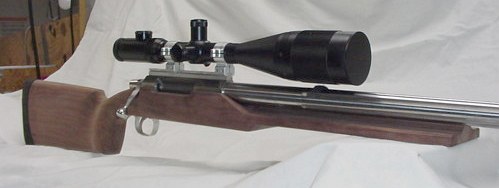
 The Tooley offset stock has been around since mid-2007, but custom gun-builders may not know it’s available. This radical rig employs an offset design to counter the torque associated with large-caliber benchrest guns. Dave Tooley tells us, “the wide, flat fore-end and offset design really tames the big 30s.” The stock is 4″ wide along the fore-end with the barreled action offset 1.5″ from center. From the trigger guard rearward the stock is pretty much the same as a Tooley MBR, with a bottom flat and slight drop from grip to buttplate. In American walnut laminate or maple laminate the stock weighs 3 lbs., 12 oz., the same as a fiberglass Tooley MBR from McMillan. There is also a lighter “Butternut” wood version that weighs 2 lbs., 12 ounces. So making weight in Light Gun Class should not be an issue. The Tooley offset stock has been around since mid-2007, but custom gun-builders may not know it’s available. This radical rig employs an offset design to counter the torque associated with large-caliber benchrest guns. Dave Tooley tells us, “the wide, flat fore-end and offset design really tames the big 30s.” The stock is 4″ wide along the fore-end with the barreled action offset 1.5″ from center. From the trigger guard rearward the stock is pretty much the same as a Tooley MBR, with a bottom flat and slight drop from grip to buttplate. In American walnut laminate or maple laminate the stock weighs 3 lbs., 12 oz., the same as a fiberglass Tooley MBR from McMillan. There is also a lighter “Butternut” wood version that weighs 2 lbs., 12 ounces. So making weight in Light Gun Class should not be an issue.
The stock is legal for NBRSA and IBS 600- and 1000-yard benchrest competition. Dave has shipped many offset stocks to Australia, where they are very popular for the big calibers used in “Fly Shoots” and long-range competitions. For clubs (or disciplines) that may limit fore-end width to 3″, Dave notes that you can simply saw 1″ off the left side (looking from the breech foreward), to make the stock 3″ wide and legal. Dave tells us “the stock still works really well at 3″, it just doesn’t cancel as much torque as it does in a 4″ configuration.” Tests have shown that the 4″-wide stock will effectively soak up 45 inch-pounds of torque, enough to cancel the twisting effect of a 30-caliber rifle shooting 240-grainers at 3100 fps. Dave tells us: “With the offset stock, in competition, you can shoot a 30-caliber the same way you shoot a 6.5-284.” Scott Fletcher, who shot the prototype version with a 338 Lapua Improved, reports the stock “works fantastic. It’s like night and day with a heavy recoiling caliber. It makes a 30-caliber feel like a 6.5. And with a 6.5-284, you can easily shoot the gun free recoil.”
The Tooley offset stock, un-inletted but ready to finish, costs about $350 in walnut or “butternut” laminate. In maple, the un-inletted price starts at $400 and goes up for highly figured wood. Dave notes: “there is no conventional barrel channel so inletting is very easy.” For roughly $800.00 Dave will deliver the stock fully inletted and pillar-bedded for your action, complete with recoil pad. Dave currently has about a half-dozen offset stocks in inventory. Once they sell out, Dave can normally deliver walnut laminates in 2-3 weeks plus shipping time. Upgraded wood stocks will take 3-4 weeks plus shipping time. For more info, email Tooleyrifles[at]carolina.rr.com or call Dave at (704) 864-7525.

December 13th, 2008
It’s twelve days ’til Christmas, there’s snow on the ground and your rifles are packed away for the winter. How do you maintain that competitive edge through the slow winter months? The LaserPower training kit from Anschütz could be the answer. This is a complete system with a Laser-equiped rifle and a 5-target biathlon-style remote target station. “Shoot” the rifle, and if you aim correctly, green lights appear on the target station one by one after each shot. This is a set-up that both adult competitors and juniors can enjoy. If you’re looking for the “ultimate” Christmas gift for your kids, this might be it. The LaserPower rifle kit retails for $763.00 from NealJGuns.com. According to Anschütz, the LaserPower unit is not restricted by any firearms law so it can be used with kids as young as six years old. No FFL is required for purchase.

The unit features a 4.8-lb, laser-equipped rifle, with adjustable iron sights, an ambidextrous (right-hand or left-hand) hardwood stock, and a two-stage model 5066 trigger. In weight and dimensions, the LaserPower rifle is ideal for junior shooters, though it has been used successfully by adult biathletes for training. Below are two videos. The first video shows how the LaserPower system is assembled and operated. The second video shows the LaserPower in use at a European Biathlon training tournament.


LaserPower LINKs
• CLICK HERE for more LaserPower Videos
• Download LaserPower English Language Brochure
• Download LaserPower English Language Users’ Manual
December 13th, 2008
Serious marksmen know the benefits of shooting hats, shooting coats, and shooting glasses, but less thought seems to be given to the rest of the wardrobe — pants. Jeans are OK for bench shooting, but they are less than ideal for prone work or tactical matches. Typical jeans provide little room for anything but loose change, car keys and a thin wallet. They tend to be restrictive in the wrong places, and heavy denim can be too hot in summer weather.
 By contrast, cargo pants or “tactical trousers” offer many advantages for the shooter. Many designs feature a small pocket that’s ideal for a cell phone or Kestrel wind meter. The large lower “bellows” pockets can hold a medium-sized log-book, empty chamber indicator (ECI), digital timer, a small camera, or ammo magazines. The upper slash pockets make it easy to access earplugs, come-up cards, or other small items. Some of the better cargo pants have double knees. This can provide a little more comfort and protection while shooting prone. Overall the cargo pant design is more practical, and in my opinion, more comfortable, than a pair of denim jeans. By contrast, cargo pants or “tactical trousers” offer many advantages for the shooter. Many designs feature a small pocket that’s ideal for a cell phone or Kestrel wind meter. The large lower “bellows” pockets can hold a medium-sized log-book, empty chamber indicator (ECI), digital timer, a small camera, or ammo magazines. The upper slash pockets make it easy to access earplugs, come-up cards, or other small items. Some of the better cargo pants have double knees. This can provide a little more comfort and protection while shooting prone. Overall the cargo pant design is more practical, and in my opinion, more comfortable, than a pair of denim jeans.
This Editor was recently looking to replace a much-used pair of cargo pants that had finally worn out after two years. The cheap “no-name” cargo pants didn’t fit well and the stitching was poor. I looked at the military-style BDUs. They are durable, but I didn’t like the pocket options or the feel of the ripstop-type fabric. In addition, I wanted something “neutral” rather than camo. As I often wear field pants in business settings, such as banks and the post office, I didn’t need Tiger-stripes screaming “urban commando wannabee”.
I checked out various styles ranging from $15.00 to $65.00 and settled on the Propper F5220, 9-pocket “Tactical Pants”. Priced at $29.99, these have a myriad of features I really like. The elasticized waist band eases movement when you’re shooting from a prone or kneeling position. The double knees are great when you’re shooting a tactical match off bare ground. The front “cellphone pocket” is big enough to hold a Kestrel securely. The seat area is double thickness (nice when sitting on wet grass). There’s a clever double-level rear pocket that lets you position your wallet high for easy access or a low for extra security.
I also ride a motorcycle and I found the Propper tactical pants work well on a two-wheeler. Again the stretch waistband is a big plus. The front slash pockets are not cut so low that I have to worry about stuff falling out when riding. The large side cargo pockets allow me to carry checkbook, PDA, and digital camera securely on the sides of my legs. My cellphone is easily accessible and I like the extra D-ring for holding keys on a carabiner while off the machine.

Propper F5220 “Tactical” trousers are made from a durable 65% polyester / 35% cotton canvas blend. They are shrink-resitant and a DuPont Teflon coating makes them stain-resistant. For my purposes, the F5220 pants are every bit as good as Royal Robbins’ 5.11 pants (maybe better), and they cost at least ten bucks (25%) less. Propper F5220s are available in Khaki (tan), Black, Olive and Navy Blue from BDU.com or USPatriotstore.com.
Never heard of Propper? Propper International is a 37-year-old manufacturing company that produces uniforms for the U.S. Armed Services and police agencies. Propper has been ISO 9001-certified since 1996 and operates factories in Puerto Rico and the Dominican Republic.
December 12th, 2008
 In response to increased customer demand and regional lead-free regulation, Winchester introduces new SUPER-X 55gr .223 Rem lead-free ammunition using a patented tin core technology. The new .223 Rem lead-free ammo features a 55gr tin-core bullet loaded to 3050 fps. The new product, item X223RT, will be available in Spring 2009. In response to increased customer demand and regional lead-free regulation, Winchester introduces new SUPER-X 55gr .223 Rem lead-free ammunition using a patented tin core technology. The new .223 Rem lead-free ammo features a 55gr tin-core bullet loaded to 3050 fps. The new product, item X223RT, will be available in Spring 2009.
“Shooters and hunters require lead-free ammunition in various regions of the U.S., and it is our goal to make sure they have a legal, high-performance product,” said Glen Weeks, Centerfire Product Manager for Winchester Ammunition. “Our goal with this new .223 Rem product… is to make sure that shooters have a wide range of Winchester lead-free products available.”
Winchester offers a diverse line of lead-free ammunition in shotshell, centerfire handgun, centerfire rifle (including E-Tip™ ammo for .308 Win, 30-06, 300 WSM, and 300 WM), and new .22 LR and .22 Win Magnum offerings.
New Ultra-Fast 22LR Rimfire Ammo
Winchester has also just announced its new 1,640 FPS 22LR round, called the Xpediter™. The Xpediter, part of the Supreme line, is Winchester’s fastest 22 Long Rifle varmint and small game round. Xpediter ammo features a copper-plated 32gr lead hollow point bullet and nickel-plated shell casing. At 1,640 FPS the Expediter is harder-hitting and flatter shooting than nearly all other 22 LR rimfire rounds. A deep hollow point in the bullet tip allows for maximum terminal effect.
“This ultra-fast bullet is going to be a favorite among rimfire enthusiasts,” said Brad Criner, Winchester Ammunition’s Shotshell and Rimfire Product Manager.
For more information about Winchester Ammunition and its complete line of products, visit www.winchester.com. Recognizing, in part, Winchester’s leadership in providing lead-free ammo, Winchester was named the Ammunition Manufacturer of the Year by the National Association of Sporting Goods Wholesalers (NASGW) at the recent NASGW Annual Expo in Atlanta.
December 8th, 2008
 Right out of the box, the SEB Coaxial Rest is already one of the slickest pieces of hardware in the shooting game. The SEB joystick rest functions smoothly and is beautifully machined. Right out of the box, the SEB Coaxial Rest is already one of the slickest pieces of hardware in the shooting game. The SEB joystick rest functions smoothly and is beautifully machined.
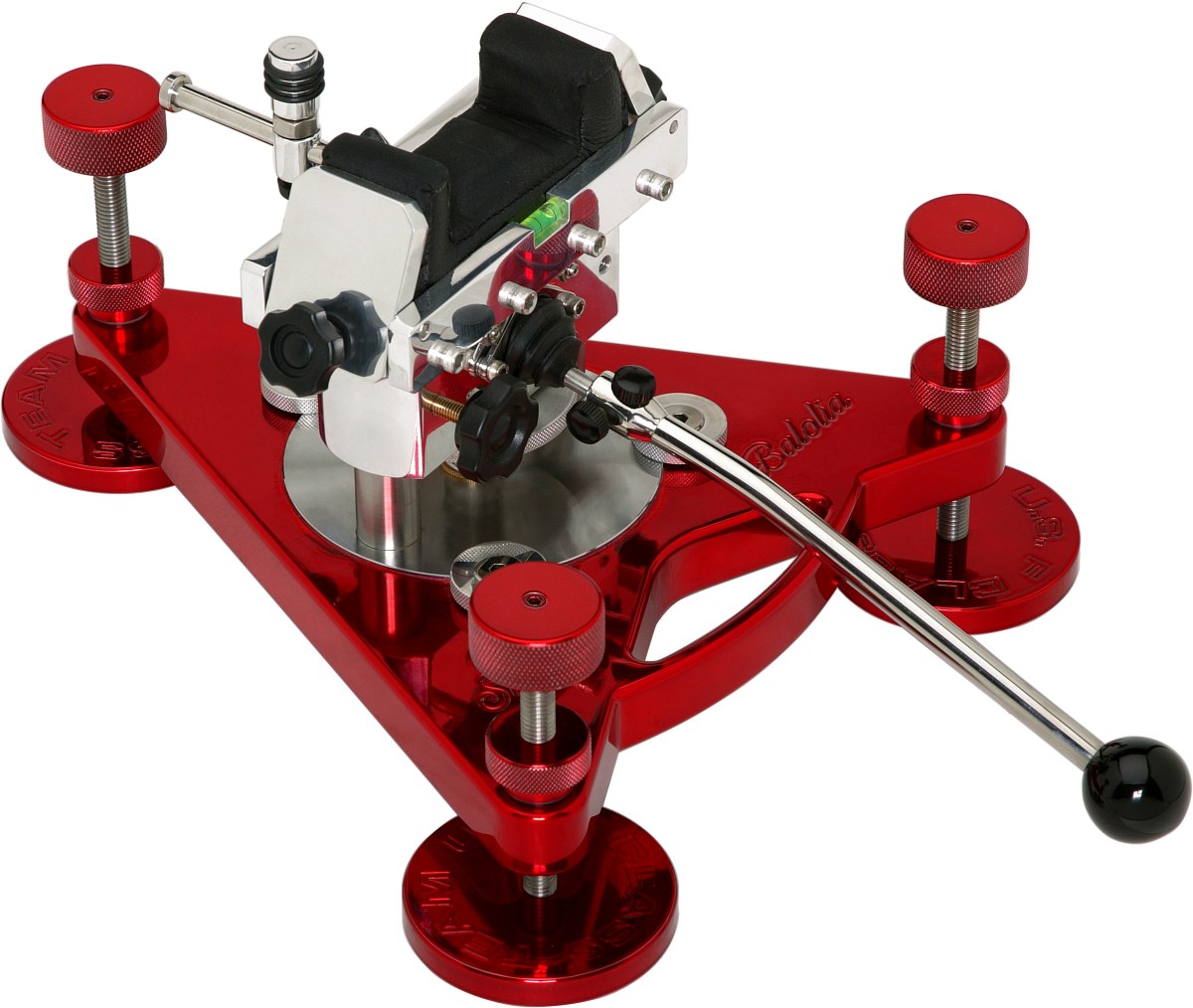
But Americans always like to “hot-rod” their gear, and this SEB rest enjoyed some very special customization by Grizzly Industrial’s Shiraz Balolia. Shiraz, who the Vice Captain of the USA F-Class Open Team, teamed up with Bob Pastor of Viper Rests to create what may be the “Ultimate” SEB rest. This candy-apple-red beauty features a new CNC-machined base with integral carry handle. The base was finished mirror-smooth then treated to a stunning bake-on red finish. The base started as a solid block of aluminum which was milled out on the underside to save a bit of weight. The rest now also boasts large-diameter custom footpads fabricated by Bob Pastor. These aluminum pads feature wide conical “spikes” in the bottom. “US F-Class Team” is engraved in the top of each pad.


The base required many hours of expert machine work by Shiraz to complete. Sorry, for now, the base is a one-of-a-kind, so you can’t buy one. Shiraz says “It would be way too expensive to produce these one at a time.” But, you can get the large-diameter footpads from Bob Pastor. Call Bob at (269) 521-3671 for specs and prices.
December 1st, 2008
This ain’t your grandpa’s Savage… that’s for sure. Gary Eliseo, innovative designer/builder of the B1, R1, R5, and RT10 tubegun kits, has been working on a top-secret, single-shot prone rifle based on the Savage Target Action. The prototype has been finished and tested. Eliseo tells us: “Here’s the S1 prototype stock for the new Savage LR Target action I’m now currently testing. It’s chambered in 6BRX, so far it’s performing very well.”


 The new Eliseo S1 features a drop-in Savage Target Action that bolts to a milled aluminum sub-chassis. The prototype retains the factory Savage Accutrigger, and Savage bolt handle. There is a +20 MOA extended scope rail fitted to the top of the receiver, while a fully adjustable CSS (Competition Shooting Stuff) stock with cheekpiece is attached at the rear. Because the mounting socket for the buttstock is part of the chassis, the S1 will allow very short length of pull, so this rifle would be ideal for juniors as well as adults. The S1 prototype uses a conventional barrel with a shoulder, but Gary says the kit will work with a barrel nut system. This means S1 owners can install “pre-fit” barrels using a barrel nut. The new Eliseo S1 features a drop-in Savage Target Action that bolts to a milled aluminum sub-chassis. The prototype retains the factory Savage Accutrigger, and Savage bolt handle. There is a +20 MOA extended scope rail fitted to the top of the receiver, while a fully adjustable CSS (Competition Shooting Stuff) stock with cheekpiece is attached at the rear. Because the mounting socket for the buttstock is part of the chassis, the S1 will allow very short length of pull, so this rifle would be ideal for juniors as well as adults. The S1 prototype uses a conventional barrel with a shoulder, but Gary says the kit will work with a barrel nut system. This means S1 owners can install “pre-fit” barrels using a barrel nut.
Interested? Better tell Santa soon. Eliseo says he expects to have the first S1 production models ready for delivery “by Christmas time”. The full S1 kit, with CSS buttstock, will cost $925.00 not including action, barrel, or scope. To place an order, call (714) 630-5734, or email order.info [at] competitionshootingstuff.com .
November 30th, 2008
 Powered case prep centers are nothing new. RCBS has offered a little AC-powered unit for years with whirling brushes and chamfering tips. But Hornady has beefed up the concept, adding a drill-press type vertical case trimmer. (Unlike a drill press, however, the case is held in place and the cutter spins below it.) Powered case prep centers are nothing new. RCBS has offered a little AC-powered unit for years with whirling brushes and chamfering tips. But Hornady has beefed up the concept, adding a drill-press type vertical case trimmer. (Unlike a drill press, however, the case is held in place and the cutter spins below it.)
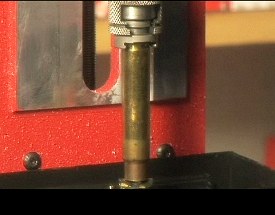
The new Hornady Lock-N-Load™ Power Case Prep Center is a substantial unit, roughly 2 feet high and 10″ wide at the base. With four (4) attachment bolts, it should be very stable on the bench. There are six (6) power take-offs that extend horizontally from the bottom half of the unit. These all spin at the same time so you can quickly switch from one tool to another. Hornady provides the following tools that operate with the horizontal power take-offs: inside neck chamfer, outside neck chamfer, large flash-hole cleaner, small flash-hole cleaner, and a neck brush. An optional primer pocket reamer and an optional flash-hole deburrer can be purchased separately.
 At the middle level of the Hornday unit a case trimming tool is centered in a black plastic tray to catch shavings. The vertical position of the cutter is fixed. You lower the case down on the spinning cutter to trim cases to length. A pivoting handle controls vertical movement of the case which is held by its rim in a shellholder mounted in a chuck. The rotary handle you see in the picture is NOT for power. It is used to adjust the starting height of the chuck/shell-holder assembly. By turning the crank you can move this whole sub-assembly up and down to suit different length cases. At the middle level of the Hornday unit a case trimming tool is centered in a black plastic tray to catch shavings. The vertical position of the cutter is fixed. You lower the case down on the spinning cutter to trim cases to length. A pivoting handle controls vertical movement of the case which is held by its rim in a shellholder mounted in a chuck. The rotary handle you see in the picture is NOT for power. It is used to adjust the starting height of the chuck/shell-holder assembly. By turning the crank you can move this whole sub-assembly up and down to suit different length cases.
The new Hornady Case Prep Center, product No. 050012, is slated for a 2009 release. MSRP is $431.67, with expected “street price” around $300.00. You should definitely watch the Hornady Video linked below, as it shows the case trimmer in action. If our written description of the inline vertical trimmer left you confused, it will quickly become clear once you watch the video.
 Editor’s Comment: If you have hundreds of cases that regularly need trimming, the Hornady Case Prep Center could be a real time-saver, provided that: 1) the cut length can be adjusted with sufficient precision; and, 2) cases can be moved in and out of the holder quickly and efficiently. As for powered case-neck chamfering… we’re a little less enthusiastic about that. It is very easy to ruin cases by over-chamfering. If Hornady really wanted to do this right, it would have the chamfer tool run on the top half of the machine. Then the chamfer depth could be controlled very precisely, with a positive stop, so you couldn’t over-chamfer. Editor’s Comment: If you have hundreds of cases that regularly need trimming, the Hornady Case Prep Center could be a real time-saver, provided that: 1) the cut length can be adjusted with sufficient precision; and, 2) cases can be moved in and out of the holder quickly and efficiently. As for powered case-neck chamfering… we’re a little less enthusiastic about that. It is very easy to ruin cases by over-chamfering. If Hornady really wanted to do this right, it would have the chamfer tool run on the top half of the machine. Then the chamfer depth could be controlled very precisely, with a positive stop, so you couldn’t over-chamfer.
While Hornady’s Case Prep Center can certainly speed up trimming chores, you still have to trim and chamfer in separate steps. Consider that the Gracey Case Trimmer trims-to-length and chamfers (inside and out) all in one operation, processing up to 20 cases per minute. That’s impressive. We do like the powered neck brush on the Hornady unit, however. This could definitely help you prep a large quantity of brass more efficiently.
|