On the day before the official opening of SHOT Show, members of the media were invited to the Orlando Sheriffs’ Range to “test-drive” some of the latest offerings from major manufacturers. As precision rifles are AccurateShooter.com’s primary focus, two new guns from Savage Arms drew the attention of our Asst. Editor (and resident “hot-shot”) Jason Baney. After meeting with Savage Chairman/CEO Ron Coburn, and Marketing Mgr. Bill Dermody, Jason got the chance to try out Savage’s new .308 Palma Rifle, and the radical new, metal-chassis model 10 BAS Tactical rifle.
The handsome Savage Palma Rifle features a gray laminated stock with triple pillars. It boasts an adjustable cheekpiece, and adjustable length of pull (LOP) via spacers. Fitted with the Savage Target action, 30″ stainless barrel, and (4 – 12 oz.) Accutrigger, the gun promises outstanding accuracy. As you can see on the second half of the video below, Jason shot a 1/2″ group at 200 yards with the Savage Palma Rifle. Jason said the stock was ergonomic and the gun balanced well even with the long tube. The Savage Palma Rifle action is drilled and tapped for top or side-mount peep sights, so it can be fitted with either iron sights or scope. Savage is taking orders right now. MSRP is $1798, but the “street price” will be quite a bit less.
Bold & Black — Savage 10 BAS Tactical Rifle
The new 10 BAS is a radical departure for Savage. This wild-looking new bolt-gun features a blackened aluminum modular chassis, top and side Picatinny rails, a detachable box magazine, and not one but TWO adjustable (and removeable) buttstock configurations. One buttstock is similar to an AR15-style collapsing stock, while the other (on the BAS ‘T’ model) features a myriad of adjustments, and a straight, flat keel section on the bottom to ride the bags.
On this T-version stock, the buttplate adjusts for length of pull (LOP) and cant angle and the cheek-piece adjusts both vertically and fore and aft using a rail and a rotary locking knob.
What’s our take on the radical 10 BAS rifle? For police and military applications, the rails offer great versatility. For tactical comps, we liked the ergonomic grip, 10-round detachable magazine, and the easily-adjustable LOP. The 10 BAS will initially be offered in .308 Winchester only. Based on the model 110 action, the 10 BAS comes with a 24″ barrel and a proprietary muzzle brake. It even accepts most AR15 buttstocks. We don’t know of any domestic manufacturer offering a “tactical” bolt gun with all the features found on the 10 BAS. We expect this rifle to cause quite a stir when SHOT Show doors open this morning.
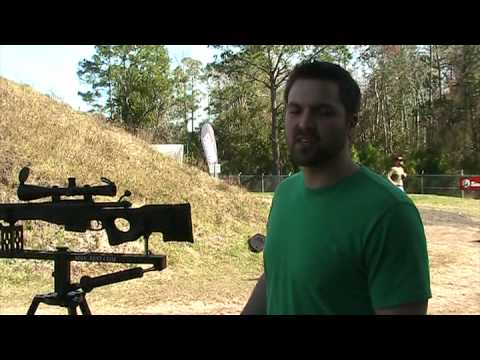
Among the highlights of Media Day were the impressive portable field rests showcased by Lone Star Field Products. Designed primarily for law enforcement and military applications, these rests would also work very well in the varmint fields. The rests are very sturdy yet relatively lightweight. There is a low-profile “Quad Base” version, as well as a “tall” Spec-Rest that sits on top of a tripod. Jason got a chance to try the Spec-Rest with an Accuracy International .308 Win Rifle.
Testing the New Spec-Rest (Tripod and Quad-Base)
Positioned on a tripod, the Spec-Rest swivels 360° and allows a huge range of elevation. The set-up will hold nearly any rifle with its front and rear V-Mounts. According to the FBI, when a gun is firmly mounted, the Spec-Rest will absorb up to 60% of felt recoil with big calibers. The Spec-Rest can be deployed in under a minute without tools. The Spec-Rest is offered in two configurations. With a standing-height tripod and mil-spec carry bag, the Spec-Rest costs $660.00. With a lower quad base, suitable for bench shooting or sitting/kneeling, the Spec-Rest is priced at $575.00.
SHOT Show in Orlando, Florida commences Thursday, Jan. 15th at 08:30 am. AccurateShooter.com will be covering the show, including the preliminary Media Day-at-the-Range on Wednesday the 14th. Our correspondent at SHOT 2009 will be Jason Baney, aided by his wife (who’ll help with cameras and computer stuff).
Jason heads to the show armed with a long list of things to do, from product evaluations to interviews with folks like Jochen Anschütz, David Tubb (Superior Shooting Systems), and Dave Kiff (Pacific Tool & Gauge). We plan to have a look at some new custom actions to be released in 2009, plus the latest optics from Bushnell, Leica, Leupold, March, Premier, Schmidt & Bender, Sightron, Swarovski, and Zeiss.
Help Us Share Your Ideas with Industry Big Shots
Jason will be talking directly to important shooting industry decision-makers and product designers. We would like to share ideas and product feedback from our readership. What do YOU have to say to the guys who build the products you buy?
What would you like us to tell shooting industry professionals representing Hornady, Lapua, Leupold, RCBS, Savage, Sierra Bullets, and other companies? Do you have specific product questions you’d like us to get answered at SHOT Show? You can post your suggestions as a comment to this thread. Or, you can email Jason directly at JB1000BR [at] Yahoo.com.
• Do you have a particular product you want to see covered?
• Do you have suggestions about new products? (For example, what new cartridge would you like to see Lapua produce?)
• Are there questions you’d like to ask manufacturers such as Sierra Bullets, Hornady Mfg., and Hodgdon Powder?
• Do you have feedback on current products and product options? (For example, we know our readers love the new Sightron 30mm scopes, but they want more reticle choices.)
Post your ideas by clicking the “Comments” link at right. >>>>>>>
Virginia’s Bill Myers is recognized as one of the top rimfire smiths in the country. We featured one of his “Spec Rifles” in a recent Gun of the Week story. Built on a blue-printed Suhl 150-1 action, Bill’s Bubinga-stocked benchrest rig proved to be a winner right from the start.
Bill is a creative thinker, and his own exhaustive testing has convinced him that barrel indexing can enhance accuracy in rimfire benchrest guns. Myers does acknowledge that, particularly with a very good barrel, the advantages of indexing may be subtle, and extensive testing may be required. Nonetheless, Myers believes indexing can improve rimfire accuracy.
The Challenge of Barrel Indexing
With a conventional barrel installation, employing a shoulder with a threaded tenon, it is difficult to index the barrel. Even with a cone breech that eliminates the problem of extractor cuts, you’d have to use shims to alter the barrel index position, or otherwise re-set the shoulder each time you screwed the barrel in further.
Bill has come up with a masterful solution to barrel indexing. He designed and built his own prototype custom action that clamps the barrel rather than holding it with threads. The front section of the action is sliced lengthways, and then clamped down with three bolts. A special bushing (the gold piece in photos) fits between the barrel and the action. By using bushings of different inside diameters, Bill can fit any barrel up to an inch or so diameter, so long as it has a straight contour at the breech end. To mount the barrel, Bill simply places the fitted bushing over the barrel end-shank, then slips the “sleeved” barrel into the front end of the action. Tighten three bolts, and the barrel is secure.
Indexing with the Myers’ Clamping Action
To index the barrel, Myers simply loosens the three clamping-bolts and rotates the barrel in the action. Because there is no thread to pull the barrel in or out, the headspace stays the same no matter how much the barrel is rotated. In other words you can rotate the barrel to any position on the clockface and the headspace remains unchanged.
Right now Bill has no plans to start building his own indexable rimfire actions for sale. However, he is involved in serious experimentation with barrel indexing, in cooperation with Gene Beggs and others. Over the course of the next year we may see a “semi-production” action offered that incorporates aspects of Bill Myers’ indexable, barrel-clamping receiver. For more information, contact Bill Myers, wzmyers [at] comcast.net, (540) 778-1782.
Nightforce has unveiled its new NXS 2.5-10x32mm compact scope. Made in the USA, this scope was created to answer the requests of hunters for greater low-light capability in a compact, lightweight optic. The NXS 2.5-10×32 measures 12″ long and weighs just 19 ounces. The new NXS 2.5-10×32 has a larger exit pupil than the 2.5-10×24 NXS. This improves light transmission and allows faster target acquisition. Both compact scopes are bright and rugged. In fact, Nightforce compact NXS scopes were originally created for the U.S. Special Forces for use with night-vision devices.
Shown with optional ZeroStop and windage limiter turrets.
Multiple Choices for Elevation/Windage Click Values
The NXS 2.5-10×32 is available with fully enclosed hunting-style turrets with 1/4-MOA clicks, or exposed target-style turrets with either 1/4-MOA clicks, 0.1 Mil-Rad clicks, or 1.0 MOA elevation + .5 MOA windage adjustments. The target-style turrets include the Nightforce ZeroStop control. This allows quick return to zero regardless of previous elevation adjustments.
New Ballistic Reticles for Compact NXS Scopes
Three new ballistic reticles are also being offered with Nightforce 2.5-10×32 and 2.5-10×24 NXS Compacts. Designed for hunting to 600 yards, the family of reticles are based upon a common NP-1 design, but with three different configurations for high, medium, and low-velocity cartridges respectively. Among the three reticles, you’ll find one that adapts well to most common hunting cartridges.
The ballistic reticles are designed to be sighted-in at 200 yards. Elevation lines are marked in 50-yard intervals to 600 yards, including a 100-yard mark.This gives you the ability to quickly hold-over in known intervals, so you can engage targets at multiple distances without cranking your scope knobs. With the new reticles, windage compensation is also marked in 5 and 10 MPH increments–so you can quickly respond to wind changes by shifting to a hash mark left or right of center. Nightforce claims that this “smart reticle” system has been proven to be up to twice as fast as traditional rangefinding reticles.
For more info, contact Nightforce Optics in Idaho, (208) 476-9814, or visit Nightforceoptics.com. At the 2009 SHOT Show, Nightforce has booth #9381.
Next week, at SHOT Show, Timney Triggers will introduce a new single-stage, drop-in trigger for the popular Ruger 10/22 rimfire rifle. The Timney 10/22 trigger will retail for $149.99 and is available for purchase immediately. Here’s the good news. The trigger should be smooth and crisp, as it features Teflon-nickel coated internals, cut with ultra-precise, state-of-the art EDM equipment. The Timney 10/22 trigger is “Made in the USA” and carries a lifetime warranty.
The bad news? On Timney’s web site, the trigger pull weight is listed at three (3) pounds. Timney has not revealed whether the pull weight can be adjusted down from that level. If not, somebody should send the engineers at Timney “back to the drawing board”.
Disappointing 3-pound Trigger Pull
No matter how “smooth and crisp”, a 3-pound pull is not a huge improvement over a factory Ruger trigger. At $149.99, the new Timney 10/22 trigger costs nearly half as much as a bare-bones 10/22 rifle. Will shooters pay this much for a 3-pound trigger?
Consider that Volquartsen’s HP Action Kit for the 10/22 costs $125.00, and will take the Ruger trigger down to about 2.25 pounds. The Volquartsen unit also features an EDM-machined disconnector and sear, plus a target trigger with overtravel adjustment.
Timney may have “missed the boat” on this one. If we were to market a trigger upgrade for a 10/22 we’d want the unit to adjust down to 1.5 pounds or less. Certainly there may be shortcomings in the 10/22’s basic design that make it difficult to go this low, but why bother to bring out a fairly pricey aftermarket trigger, if 3 pounds is the best it can do?
Other New Trigger Designs for 2009
Since last March, Timney has asked shooters: “What trigger would you like us to build next?” This year’s “Customer’s Choice” Timney Triggers will be Mosin Nagant and Husqvarna replacement triggers. Both will be offered for sale in Spring 2009.For more information on Timney Triggers’ line of over 75 replacement triggers, call 1-866-4TIMNEY, or visit TimneyTriggers.com.
Gary Eliseo of Competition Shooting Stuff has been busy lately. A month ago, we showcased his new S1TubeGun Kit for Savage actions. Gary’s done it again. He’s just started shipping his latest creation, the new RT-10 TubeGun kit, a long-action, mag-fed design that will hold regular or magnum rounds. Gary explains: “The RT10 was designed from the start as the basis for the ultimate tactical/long range precision rifle. It comes finished in super-tough type III hard coat. Employing a 10-round center feed enclosed box magazine with a maximum C.O.L. of 3.33″, the RT-10 can feed the 300 Win Mag but also feeds the .308 perfectly. The hand-guard has four modular accessory rails and is attached very rigidly specifically for use with a bipod.”
Ace prone shooter German Salazar received one of the first RT-10s and he’s impressed. German told us: “Just finished getting this together this morning. My RT-10 features a Remington 700 LH long action and CG trigger. Gunsmith Clark Fay did the barrel work (30-06), trued the action, and did a few other things which I’ll detail in an upcoming article. The magazines hold 10 rounds and will feed any 30-06 or magnum that’s not longer than a 30-06. I’ll mount some sights on it tonight and start shooting it tomorrow!”
Molded polymer stocks are light and inexpensive. However, they tend to be flexy and hard to bed. Savage has engineered a solution to this. The new Savage “AccuStock” employs an aluminum inner section combining a bedding block with a “spine” in the forearm. According to Savage: “With its integral aluminum spine that runs from the action down the length of the forearm, the AccuStock is the most rigid factory polymer stock in the marketplace. No matter how hot the weather or the barrel, the forend stays rock-solid and the barrel remains free-floating.”
The aluminum cradle surrounding the action is more than a conventional bedding block. The AccuStock uses a wedge bolt to push the recoil lug back into the aluminum spine to prevent any movement forward and aft, while the bedding cradle squeezes the action from the sides when the action screws are tightened. That is something new, and it seems like a promising design. Savage explains: “Pillar-bedded and v-block stocks, as good as they are, only apply bedding pressure on one axis, up and down.” By contrast, the new AccuStock is designed to grip the action from the sides as well as the bottom.
The AccuStock bedding block system will be initially offered in just two Savage models, the Model 10 FCP, and the Model 10 Precision Carbine. The 10 FCP comes in .308 Win and .223 Rem, and features a 24″ fluted, heavy barrel, a detachable Box Magazine (DBM), and a new (for Savage), factory muzzle brake. The Model 10 Precision Carbine will also be chamberd in .308 and .223. It will have a 20″ medium-contour barrel, detachable box magazine, but no muzzle brake.
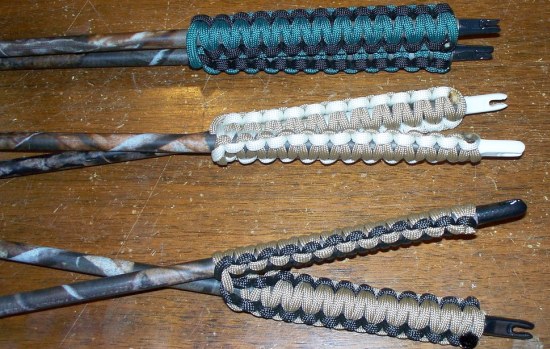
Forum Member and Univ. of Wyoming college student Adam Teeter (aka “Cowboyarcher”) is building sets of ultra-light shooting sticks for hunters and varminters. The shooting sticks are made from camouflaged arrow shafts and 550 para-cord. Adam can build the sticks to your specs with a variety of para-cord colors: white, black, green, olive drab, tan, and dark brown (chocolate). Custom sticks (your choice of colors) cost $27.00 per pair delivered, and he has a few sets already made for $25.00. Buying a set of sticks would be a good way to help a young man finance his college education. Adam is currently studying Rangeland Ecology and Watershed Management.
Adam tell us: “These shooting sticks are custom-built to your specs. Very light, they are great for walking varminters or for big game hunters. I use brand-new arrow shafts and 550 para-cord for the construction. The camouflage sticks are approx. 35” long and the black ones are approx. 32” long. I simply insert the arrows like one would for shooting them and add a field point. I am looking into the possibility of using blunts, or adding a fender washer under the field point for a little floatation. For now, field points will vary some from pair to pair. Since these are custom, I can do any combination of colors you choose, up to two, or cut them to different lengths.” Adam added: “I guarantee these sticks to be of the highest quality and to your satisfaction. If you’re not happy with them, I will make it right. And… I will accept trades. If you’ve got something [interesting], let me know and we’ll see if we can’t work out a trade.”
Colors shown above are: Dark Green/Black, White/Tan, Tan/Black
To order, contact Adam via email: teeteradam [at] gmail.com. Or you can postal-mail your order (with your specs and Postal Money Order) to Adam Teeter, 6011 Southview Rd., Laramie, WY 82070.
Jeff Madison, a Michigan gunsmith, has created a new stock for Anschütz 2000-series actions. This action uses a separate forward barrel block so the entire action floats. The barrel block allows easy barrel indexing (so long as the barrel is fitted with a cone breech.) Interestingly, Madison has fitted his stock with an integral tuner. Jeff wanted to be able to tune his rimfire rifles for improved accuracy. However, he found that the typical large, heavy, rotary tuner at the end of the barrel was not practical for a prone rifle.
So, Jeff came up with an innovative “tuner-in-stock” design. Jeff explains: “The tuner is the ‘knob’ just in front of the trigger guard. With the barrel mounted, the action (receiver) is fully floated. The tuner itself is fixed in the stock and attaches to the Anschütz action. The tuner is a harmonic balancer of sorts and can be adjusted to change the vibration characteristics of the rifle. At first glance the tuner appears to simply be a screw that exerts pressure to the receiver. In actuality it is an eight-piece assembly that incorporates a matched pair of elastomers that can be pre-loaded as a means of vibration control. The ‘in-stock’ tuner accomplishes the same thing as a muzzle tuner, but by using the action (receiver) for tuning, this set-up provides better balance for a prone or 3P shooter.”
Developing a New King of Rimfire Tuner
Madison was inspired by the successful muzzle-mounted tuners used by rimfire benchrest shooters. However, Jeff felt a muzzle-mount design was not optimal for a prone or position rifle. Jeff told us:
“The use of a heavy weight on the muzzle didn’t fit with shooting from the prone position. Putting extra weight so far out caused early fatigue and the balance of the rifle was compromised. After several meetings with Mike Ross of Ross Precision, I learned about ‘barrel indexing’, and came to the conclusion that a properly-indexed barrel could be tuned in a barrel-mounted stock from the receiver end.
Mike graciously donated one of his Ross stocks for me to use for tuner testing and development. After a year of testing with different prototypes, I completed a tuner that could successfully control the vibration. I built two rifles with wood stocks converted to barrel-block mounts with tuners and also adapted the tuner to my ‘loaner’ Ross stock. With all three stocks, the tuners worked and enhanced rifle performance using a variety of ammunition.
It was time to design my own prone stock specifically for the Anschütz 2013 barreled action. I used 6061-T6 aluminum to make the new stock stronger than the original, cast Anschütz 2000-series stock. However, my new design still accommodates the butt, grip, cheek-piece and side panel hardware from the original Anschütz stock. Four stocks were created. One is at my shop for continued tested by me. The second was sent to a national-level competitive shooter who has access to lab testing facilities. The third was sent to Mike Ross for his experiments. The fourth is warming the bench.
Tuned Stock Works with a Variety of Ammo and Barrels
In testing the integral ‘in-stock’ tuner’s ability to improve accuracy, I used a variety of mid-grade ammunition from Eley, Lapua, SK, and Wolf. My tests confirmed enhanced accuracy from all brands and lots of ammunition used. This is not to say the tuner will make cheap ammunition shoot like match grade, but it will extract the best potential from all levels. I have also tested the performance of the stock with several barrels: a modified Anschütz barrel, a 17-twist, 2-groove Benchmark, and a Bartlein 1:16.5″ to 1:16″ gain twist barrel (currently mounted). All barrels and ammunition tested by me were able to shoot quarter-inch (or better) groups at 50 yards. The .250″ criteria is very competitive for a prone shooter, and a number of groups fired were in the mid to high ‘Ones’.
Stock Proves Successful in Competition
The stock that is being tested by a competent, national-level shooter (name intentionally withheld) is undefeated in seven matches to date. Seven matches, seven wins. That shooter has also achieved many ‘personal bests’ with the tuned rifle.
What does the future hold? I plan to build a second design specifically for the 1900 series Anschütz action. The target price for the complete stock, ready to accept a barreled action, is $1,500.00. The stock stem only is targeted at $875.00. The details of the butt and cheek piece hardware along the select wood portions will be finalized shortly.”
Jeffrey Madison is the sole proprietor of M. Werks, LLC located in Traverse City, Michigan. M. Werks, LLC manufactures a limited selection of specialized shooting products. Jeff can be contacted by e-mail at jeff [at] mwerksllc.com.





 Among the highlights of Media Day were the impressive portable field rests showcased by

 What would you like us to tell shooting industry professionals representing Hornady, Lapua, Leupold, RCBS, Savage, Sierra Bullets, and other companies? Do you have specific product questions you’d like us to get answered at SHOT Show? You can post your suggestions as a comment to this thread. Or, you can email Jason directly at JB1000BR [at] Yahoo.com.


 Multiple Choices for Elevation/Windage Click Values
 Next week, at SHOT Show,
  Gary Eliseo of


 Jeff Madison, a Michigan gunsmith, has created a new stock for Anschütz 2000-series actions. This action uses a separate forward barrel block so the entire action floats. The barrel block allows easy barrel indexing (so long as the barrel is fitted with a cone breech.) Interestingly, Madison has fitted his stock with an integral tuner. Jeff wanted to be able to tune his rimfire rifles for improved accuracy. However, he found that the typical large, heavy, rotary tuner at the end of the barrel was not practical for a prone rifle.


