At the request of our readers, we provide select “Deals of the Week”. Every Monday morning we offer our Best Bargain selections. Here are some of the best deals on firearms, hardware, reloading components, optics, and shooting accessories. Be aware that sale prices are subject to change, and once clearance inventory is sold, it’s gone for good. You snooze you lose.
1. EuroOptic and Midsouth — Nikon Scopes Up to 46% Off
Save hundreds right now on Nikon rifle scopes. Midsouth has slashed prices on Nikon’s excellent FX1000-series scopes while EuroOptic has some amazing deals on Nikon’s M-Tactical and P-Tactical optics — zoom scopes from 1-4X power to 6-24X power. The various discounted Nikon scopes should provide pretty much anything a tactical shooter or hunter could need. Here are some of the best deals:
FX1000 6-24x50mm SF Illum. FX-MOA Reticle FFP
Was $799.95, now just $599.95 at Midsouth
FX1000 4-16x50mm SF FX-MRAD Reticle FFP
Was $649.95, now just $449.95 at Midsouth
Nikon M-TACTICAL 4-16x42mm SF BDC-800
Was $449.95, now just $259.95 at EuroOptic
Nikon M-TACTICAL 3-12x42mm SF MK1-MRAD
Was $399.95, now just $199.95 at EuroOptic
2. Palmetto — .308 Win Savage with 3-9x40mm Vortex, $449.99
Here’s a complete .308 Win deer-hunting rig for under $450 with scope! The Savage Apex Hunter XP pairs a Model 110 rifle with a 3-9x40mm Vortex Crossfire II scope that’s mounted, bore-sighted, and ready to hunt. The stock features adjustable length-of-pull. Overall rifle length is 40.25″ with 20″ barrel, and weight is a modest 7.67 pounds complete with optics. This rifle is a .308 Win, but other chamberings are available.
3. Grizzly Industrial — Bald Eagle Slingshot Rest, $129.97
Maybe you’re just getting into F-Class or just need a good stable front rest to shoot from and don’t want to spend a ton of money on one. Don’t worry because Grizzly now has the Bald Eagle BE1129 aluminum slingshot rest for an amazingly low $129.97 Closeout price. Just add your favorite front bag and you’re ready to go with a competition quality elevation adjustable rest. They also have the Bald Eagle BE1209 – Big Fifty Rest on sale now for $202.97, nearly 50% off. With a much wider span and cast-iron legs, the Big Fifty is designed for larger guns up to .50 caliber. Either way, these rests are a great value.
4. EuroOptic — Leica CRF 2400-R Rangemaster, $550 No Tax
For long-range hunters, a compact laser rangefinder (LRF) is a vital accessory — and not just for ranging prey before taking the shot. You can use the LRF to range distant objects to get an idea of how far you’ll need to trek to your desired location. There are many good rangefinders on the market, but we have always liked the handheld Leicas. The CRF 2400-R Rangemaster is a solid value at $550.00. Plus, right now EuroOptic will pay any state sales tax you might owe. That can save you up to $50.00.
5. Midway USA — Lyman 8-Station Turret Press, $135.03
Right now you can get Lyman’s new All-American 8-station turret press for just $135.03. That’s a great price. This high-capacity turret press sells elsewhere for up to $229.99. The Lyman offers more die stations than the 6-station RCBS Turret and the 7-station Redding T-7. It also has a strong rear support that minimizes head flex. NOTE: Priming on the Lyman turret is done in the front; the image above shows the priming station but not the vertical tube which holds stacked primers.
6. Precision Reloading — 10% Off All Frankford Arsenal Products
Now through the end of September you can save ten percent (10%) on virtually all Frankford Arsenal products in stock at Precision Reloading. this includes the great new Intellidropper powder dispenser, Case Prep Center, Wet Tumbling System, Perfect Seat Hand Priming Tool, Precision Scales, Brass Dryer, Powder Trickler, Bullet Trays, Media Separator, and more. See all sale items at PrecisionReloading.com.
7. Midsouth — Frankford Click-Adjust Hand Priming Tool, $61.99
This is a GREAT primer seating tool. It has good feel, plenty of leverage, and the primer feed-from-tray works well. Importantly, it has a click-adjust wheel for precise primer seating depth control. Read our Frankford Primer Seating Tool Product Review by gunsmith Jim See. Now discounted from $72.49 to $61.99 at Midsouth, this is a great product for the price. The tool comes complete with 12 precision shell holders.
8. Cabelas — Garmin GPSMAP 64ST Handheld, $199.99
Hunters who spend considerable time in the wilderness, far from roads and mapped trails, should have a hand-held GPS that can plot their location within a few meters. Right now Cabelas.com has the highly-regarded Garmin GPSMAP 64ST on sale for $199.99. That’s fifty bucks off the regular price. This same handheld Garmin GPS sells for $242.50 on Amazon, so this is a great price at Cabelas.com.
9. Midsouth — Aguila .22 LR Ammo, 500 Rds $17.99
Plinking is fun. Especially when your ammo is really cheap. If you need low-cost .22 LR rimfire ammo for range sessions with friends and family, check out this crazy good deal from Midsouth. You get 500 rounds of Aguila 38gr HiVel .22 LR ammo for just $17.99 (marked down from $32.99). That works out to 3.6 cents ($0.036) per round. We’ve used this stuff. It’s not match-grade, but it’s more than adequate for .22 LR handguns and rifles with fun targets, such as dueling trees and rimfire poppers.
10. Midsouth — 250 Adhesive Precision Targets on Roll, $12.49
Midsouth offers 250 self-adhesive Benchrest Targets on a convenient roll. These stick-on targets are great for load development. The aiming diamond helps align the cross hairs of your scope while the 1/4″ grid pattern makes it easy to eyeball your group size. At the bottom are fields for your load info. Each Target sticker measures 6″ x 4″ with a 4.5″ x 2.5″ printed area. Midsouth sells the 250-target roll for $12.49.
Today’s precision shooter is connected. He or she is likely to bring a number of electronic items to the range, such as a smartphone, tablet computer, Kestrel, LabRadar chronograph, and more. These digital devices all require electricity to operate. Unfortunately, most ranges don’t include convenient charging stations for your gadgets. Therefore you need to bring battery back-up. Here are three good options, with storage capacities from 10200 mAh to 42000 mAh. The first unit is fully weather-proof, so it is good for hunters and tactical shooters exposed to the elements. The largest power pack, with AC outlet, is quite versatile and works well on car-camping trips.
1. FosPower 10200 mAh Waterproof Charger, $29.99
When you’re at the range or on a hunt, it’s smart to have a USB-output battery pack for smart phone, target-cam monitor, even a LabRadar. There are many battery packs available, but most are fairly fragile, with exposed ports. This “ruggedized” FosPower 10200 mAh charger is different. It is waterproof, dust-proof, and shock-proof. (IP67 certified: dust and water resistance for up to 3ft/1m for 30 minutes under water.) It can handle all that a PRS competitor or hunter can dish out. It even has a handy LED light. Right now it’s priced at $29.99 with FREE Shipping (on orders over $25.00).
2. EasyAcc 20000 mAh Battery Pack with Fast Charging, $37.99
If you want to charge multiple devices, such as a tablet and a LabRadar, you need serious capacity. The EasyAcc 20000 mAh battery pack can charge up to four devices simultaneously. Notably, this $37.99 Battery Pack charges faster than most other 20K packs. It has two power input ports, allowing it to fully charge in 6-7 hours. (We have another 20000 mAh battery unit that takes over 16 hours to fully charge!). This unit will charge an iPhone 7 six times, a Samsung S8 four times or an iPad Mini two times. Note, 77% of Amazon purchasers rated this unit Five Stars (with 13% Four-Star reviews).
3. Webetop 42000 mAh USB, 12v DC, 110v AC Power Station, $108.99
Many folks have asked us “How can I use a laptop, chronograph, or electronic powder dispenser that requires 110 volt AC power when I’m at the range?” Sure you can take power from your car’s 12 volt cigarette lighter jack, but you’ll still need a very long cable and a 12 volt to 110 volt step-up transformer. If you run a cable from the parking lot to the bench or shooting bay you’ll have to leave a window open in your vehicle and fellow shooters can trip over the long cord.
A better solution is to get a portable, combo 12 volt + 110 volt power unit. This versatile 42000 mAh Webetop Power Station will drive a 110v device, plus charge a tablet and cellphone, all at the same time. You can run a LabRadar for days with this power-pack. It will also power CPAP machines and other 12V devices. One nice feature is rapid charging. Before your range session or camping trip, plug this into the wall. It will get fully charged in 7-8 hours. It’s a bargain right now for $108.99 on Amazon.
Sightron SIII 45x45mm Competition with ED Glass — Review by James Mock
Sightron has introduced a new, high-magnification Benchrest scope, the SIII SS 45x45mm Competition. This new-for-2019 45-power scope now offers very high-quality glass. In response to consumer demand, for this model, Sightron has upgraded to premium ED (extra low dispersion) glass. This kind of superior glass has been available with other more-expensive premium optics brands, and now Sightron has joined the ED-Glass ranks.
Testing the 45x45MM ED Sightron Benchrest Scope
Most of my shooting is done at 600 yards now. New for 2019, Sightron has introduced an impressive new 45-power competition scope, offered with either a Target Dot (EDTD) or Fine Cross Hair (EDFCH) reticles. I was able to test the target dot model. With this model I can check the ED glass used by Sightron and 45X is certainly enough for the 300- and 600-yard competitions I shoot.
Although this scope lacks some of the new features found on the SVSS models, it is designed for the shooter who wants a quality scope that is light enough to be used in short range Benchrest. It seems that Sightron designed this scope for the short range Benchrest shooters. They skipped all of the frills and designed this scope for PERFORMANCE.
The Sightron SIII 45x45mm has a simple side-focus parallax adjustment that works very well. The ocular focus is like the older models in that it has a locking ring rather than the fast focus. It has a 45mm objective lens. The model that I have features a 1/10th MOA dot reticle while the click adjustments are 1/10th MOA. NOTE that — the clicks are one-tenth MOA, NOT the 1/8th MOA you might expect.
At 20.5 ounces this scope will allow shooters to make most of the weight requirements found in Benchrest shooting. With the superb Japanese ED glass, it equals or surpasses the image quality of scopes of equal magnification costing twice as much.
Although this scope lacks some of the frills, it has the features that serious shooters appreciate. It has 7-layer coating on all lens (termed Zach 7), 1/10th MOA adjustments, 1/10th MOA dot reticle (or fine crosshair), generous eye relief, life time warranty, and 30mm main tube.
Testing Procedure for Sightron SIII 45x45mm
For testing the scope, I mounted it on my BAT/Leonard Benchrest rifle (shown above). The rifle is chambered in 6mm BRAI and I will shoot the rifle at 300 and 600 yards. The 300-yard match consists of three, 10-shot targets on the IBS 300-yard target. The 600-yard match consists of four, 5-shot targets. Both are shot for score only. So far the scope has performed flawlessly and the image is bright and the resolution was superb. One thing that I have dreamed about is a scope that will resolve 6mm bullet holes at 600 yards. Since I have shot this scope only during the summer months in Louisiana I cannot see bullet holes at 600 yards. However, in fairness to the scope, I don’t think the Hubble telescope would resolve the holes in the mirage and heat evident this summer.
I have tested scopes that cost over $3000 and this Sightron (street price $900-$1000) held its own with those higher-priced models and surpassed many of them. I wish that this scope would have been available back when I was shooting short range Benchrest. It is truly a great value for today’s shooter.
The first test performed was “shooting the square” in which I fired five (5) shots in order, cranking the turrets from shot to shot. This scope passed test #1 with flying colors — the fifth and last shot went through the same hole as shot #1. Here’s the process. After Shot One (lower left), I then cranked the scope up 4 MOA and fired Shot Two. For the third shot, I moved the scope to the right 4 MOA followed by a 4 MOA adjustment down. Next, I adjusted 4 MOA left and fired the fifth. If the scope tracts properly, the fifth shot should hit close to the first. In fact, Shot Five went through the same hole as Shot One. Of course one must have the same aiming point and an accurate rifle.
Shown above is the target that I shot at 100 yards. This was shot with my 6 BRAI rifle with 30.4 grains of H4895 and Bart’s 105gr VLD “Hammers” seated .006“ into the lands. This “square” shows perfect tracking and absolute accuracy in both windage and elevation adjustments. (However, note that the target itself was a little crooked as stapled to the backer). Sightron’s ExacTrac turret technologies shown below may be the reason for such great “shooting the square” results:
The above picture was taken from the Sightron catalogue and it illustrates what may be the most important feature for Benchrest shooters. They named it the ExacTrack and it features a cone shaped contact point on the windage and elevation knobs that allow constant and even pressure on the erector tube. In the picture above the left side shows conventional scope erector tube contact (figures 1 and 2). Figures 3 and 4 show how the Sightron system works. This unique system solves the problem of a flat tip pushing a round tube. My tests showed that this scope holds point of aim exceptionally well.
Using the Sightron 45X Scope in Match Conditions
I recently tested the the 45x45mm Sightron in competition for the first time. In preparation for this match, I tried four loads at 200 yards. I was impressed with the positive and accurate adjustments without the “mushy” feel that many scopes with fine adjustments exhibit.
I shot 3-shot groups and the groups measured as follows: 1) 30.0 grains H4895/Fed 205/Bart’s Gungnir = .605”; 2) 30.5 grains H4895/Fed 205/Bart’s Gungnir = .945”; 3) 30.0 grains H4895/Fed 205/Berger 108gr BT = .459”; 4) 30.4 grains H4895/Fed 205/Bart’s Hammer = .309” (this is my 600-yard “go-to” load).
The 300-yard match saw 101° temperatures with light, switching head winds up to 5 mph. The mirage was very noticeable but I was still able to see bullet holes. The scope performed well (although I did not). The click adjustments were precise and positive with both tactile and audible indicators. This is a quality scope.
SUMMARY of Test — Final Impressions
I am more than satisfied with this scope and I believe it represents a great value for competitive shooters. It has great glass, with positive adjustments that hold point of aim. Because of the ED glass, the image has correct color and is sharp to the edges. The scope’s reticle features a 1/10th MOA dot. The turrets use 1/10th MOA adjustments that allow precise aim and point of impact adjustments.
Is there anything that I would change? No, not for short range Benchrest (100/200/300yards), but for 600-yard shooting, I prefer a more detailed reticle with MOA-based hash-marks. With vertical and horizontal hashmarks one can quickly determine the amount of clickes needed to correct impact. Also, a variable power scope is very handy for those days when mirage does not allow precise aiming. Readers should note that Sightron does make a variable power 10-50x60mm ED scope featuring a reticle with MOA-based hash-marks. That should be a good option for shooters who need a high-magnification, variable-power comp scope.
But for those who prefer a fixed-power scope, Sightron’s new SIII SS 45x45mm is a smart option, that is a very good value. If you are in the market for a fixed-power 45X benchrest scope, I can heartily recommend this new offering from Sightron. — James Mock
Short History of “Freezing” Benchrest Scopes
Several years ago, many Benchrest shooters were having trouble with their riflescopes holding point of aim. Cecil Tucker, Jackie Schmidt, Gene Bukys, and Bob Brackney modified some scopes to “freeze” the adjustments. This worked fairly well but it hindered a shooter’s ability to make fine adjustments quickly.
The late Ron Hoehn along with others started using small Delrin screws to stabilize the erector tube. This brought about my first use of Sightron scopes. I contacted Sightron and asked if they would furnish a scope for me to try this procedure and they agreed. A friend and I drilled the two holes and tapped them to apply the Delrin screws. Surprisingly, this system worked well on the Sightron 36X SII model. As a matter of fact, COL Billy Stevens won the Super Shoot using one of those SII Benchrest scopes. There was a drawback however. When one tightened the screw against the erector tube there was a slight point of aim movement. This was not too noticeable in group shooting but hampered the score shooters.
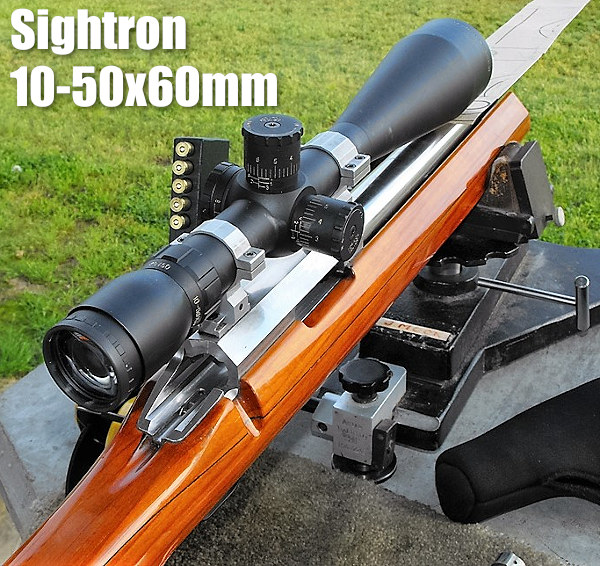
The scope pictured above another Sightron I’ve used, a 10-50x60mm. This medium-priced scope offered excellent value-for-money and it sold very well. It performed superbly for me and in my opinion represents one of the best buys in a long range scope. About two years ago, Sightron decided to put out a more advanced scope. Sightron added locking turrets, 34mm tube, and a few more “premium” features. Of course the price reflected these changes but there was not a severe price increase.
At the request of our readers, we provide select “Deals of the Week”. Every Monday morning we offer our Best Bargain selections. Here are some of the best deals on firearms, hardware, reloading components, optics, and shooting accessories. Be aware that sale prices are subject to change, and once clearance inventory is sold, it’s gone for good. You snooze you lose.
1. CDNN Sports — Winchester XPR .30-06 Rifle with Scope, $299.99 after Rebate
Hunting season is here! If you need a good basic hunting rifle capable of taking game up to Elk size, here is a crazy good deal. CDNN is offering a Winchester XPR .30-06 Spr rifle, complete with 3-9x40mm Weaver scope, for just $349.99. But it gets even better. If you purchase before the end of September, you’ll get $50 back from Winchester. That $50 rebate lowers your net cost to $299.99! You can pay more than that for just a barrel! This same deal is offered for three other chamberings: .243 Win, .270 Win, and .308 Win.
2. EuroOptic.com — Vortex Scopes Close-Out Sale, Save Hundreds
Vortex scopes have become very popular for good reason. Vortex scopes deliver great performance for the price and Vortex offers a rock-solid lifetime warranty. Right now at EuroOptic.com you can save hundreds on Vortex Viper, Razor, and Strike Eagle riflescopes. Six of the deals are shown above, but there are more options on EuroOptic’s Vortex Close-Out Sale Page.
3. ArmorAlly — Lake City Once-Fired 5.56×45 Brass, $37.50/500
This Lake City 5.56×45 NATO brass is true once-fired, Milspec, thick-walled cartridge brass sourced from the U.S. Military. Lake City 5.56 (.223 Rem) brass is popular and reliable, and works great in AR-platform rifles. ArmorAlly includes 1% overage to account for any damaged brass. NOTE: Lake City brass has crimped primers and will need to be swaged prior to inserting a new primer. Lake City 5.56×45 brass is a good choice for varmint rifles that need hundreds of rounds in a weekend. Once you remove the crimp, you should get many reloads with this brass.
Everyone should own a rimfire handgun, and here’s a nice .22 LR pistol for under $200.00. Palmetto State Armory is selling the TX 22 for $249.99. Fill out the paperwork for the Taurus factory rebate, and you get $50.00 Cash Back. That lowers your net cost to just $199.99 — a great price for a fine .22 LR handgun. We like the ergonomics on this pistol and it has a surprisingly good trigger feel. NOTE: To qualify for the $50 rebate, the TX 22 must be purchased between July 1 and September 30, 2019.”
5. Grafs.com — FREE Litz Book with $200 Lapua Product Buy
This is one example. This deal works with $200 of ANY Lapua products purchased from Grafs.com.
Lapua makes great brass, bullets, and ammo. Bryan Litz writes great books. And now you can get both with this promotion from Graf & Sons. Here’s the deal — if you buy at least $200.00 worth of Lapua product at Grafs.com, you’ll get a free Applied Ballistics book authored by Bryan Litz. Mix and match any Lapua products — as long as the order totals $200.00 or more. We know you’ll want Lapua brass, but you should try out the great Lapua Scenar bullets too! NOTE: The book may be one of various Litz titles, such as Modern Advancements in Long Range Shooting or Ballistic Performance of Rifle Bullets. You do NOT get to pick the book title — you get what’s available.
6. Brownells & Natchez — 9mm Ammo Under $17.50 per 100
If you have a 9mm pistol, check out these great deals. because 9x19mm ammo is produced in such quantity, it is some of the cheapest centerfire pistol ammo you can buy. Here are two great 9mm Luger ammo deals for you, with big-name factory stuff for under 18 cents per round. Get either Sellier & Bellot or Fiocchi for under $0.18 per round. Brownell’s Sellier & Bellot $174.99/1000 deal with CODE NCS even includes free shipping. And the Fiocchi at Natchez is just $8.49 for a 50-count box.
7. Home Depot — Low-Profile Muffs + Shooting Glasses, $16.17
Every shooter should have an extra set of shooting muffs and protective earwear. These will provide vital protection for friends/guests you bring to the range. And let’s face it, sooner or later you’ll forget your own muffs, so it’s wise to keep an extra set in your vehicle at all times. This week Home Depot a great deal on Walker’s NRR 22 Muffs + ANSI Z87.1-rated Shooting Glasses. Get both as a Combo Set for just $16.17. Midsouth also has this combo for $19.99.
8. Midsouth — Lyman Cyclone Case Dryer, $52.49
Lyman’s Cyclone Case Dryer is great for those who wet-tumble cartridge brass. The Cyclone’s five, stackable trays let you separate up to five different case types. At full capacity, the Cyclone holds up to 1,000 .223 Remington cases or 2,000 9mm cases. The trays can also be used to dry parts that have been ultrasonically cleaned (such as pistol components). The Cyclone’s built in 3-hour timer lets you “set and forget”. Midsouth is offering a VERY good price– $52.49. The same Lyman case dryer is $64.18 on Amazon.
9. Amazon — Tipton Gun Butler, $19.96
Here’s a handy, portable gun caddy that works well for rifle maintenance chores at home or at the range. Right now the Tipton Gun Butler is marked down to $19.96. The Gun Butler offers a convenient platform for cleaning your gun or doing tasks such as scope mounting. Two removable forks/cradles hold a gun securely in place, while compartments and slots hold solvents, jags, brushes, mops, and tools. The Gun Butler features a convenient carrying handle, and slip-resistant rubber feet. NOTE: The front cradle may not work well with wide benchrest fore-ends.
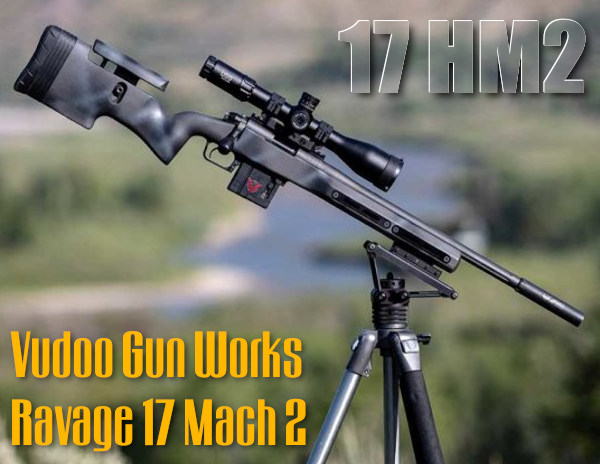
Vudoo Gun Works now offers V22 rifles chambered for the 17 Hornady Mach 2 (17 HM2) rimfire cartridge. The 17 Mach 2 runs 2010-2100 FPS, making it a much more potent than the .22 LR for varminting. It also is much flatter shooting than the .22 LR, making it more fun to use past 150 yards. When you want to go back to the .22 LR for paper punching at 50-100 yards, simply spin on a .22 LR barrel, and use the same action and same magazines. So, you can have one rimfire rifle that shoots two rimfire cartridge types.
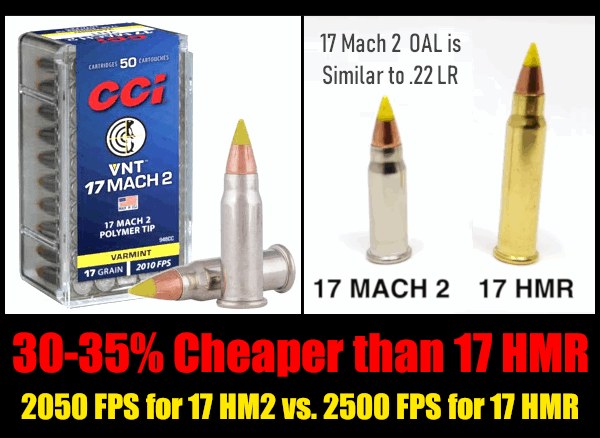
Because the 17 HM2 case shares similar OAL and cartridge diameter/rim sizes as the venerable .22 LR, the 17 HM2 runs perfectly in actions and magazines designed for the .22 LR. Vudoo says: “The dimensional similarities of traditional .22 LR, which the V22 action has been designed around, made the .17 HM2 a natural performer in our rifles. The addition of the .17 HM2 gives our customers access to a wide range of high-velocity projectiles to better suit a variety of sporting applications.”
The 17 HM2 was developed by Hornady and Eley in 2004 to give varmint hunters a high-velocity rimfire cartridge that fits in standard rimfire length actions. With a selection of V-MAX or NTX bullets, the .17 HM2 is capable of taking ground squirrels and prarie dogs at ranges of up to 220 yards. We like this cartridge because 17 HM2 ammo is 30-35% less expensive than 17 HMR ammo. When you’re shooting hundreds of rounds a day in the varmint fields, that price savings adds up.
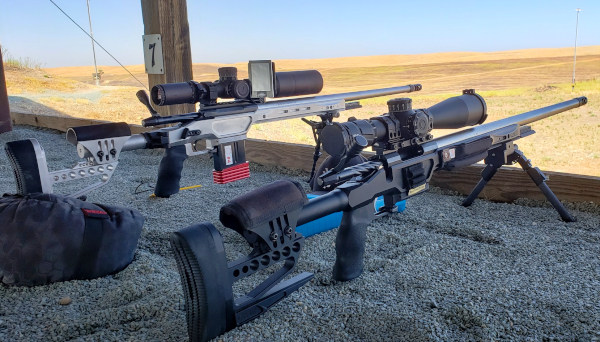
Vudoo Gun Works currently will offer a variety of rifles chambered in 17 HM2. The Ravage model (top photo) has a composite stock with adjustable cheekpiece. For those who prefer a metal chassis, Vudoo offers its V22 barreled action in the MPA Apparition chassis (photo below). Vudoo has lighter, “walk-around stocks” and barrel profiles for hunters. All Vudoo 17 HM2 models use the V22 action and current Vudoo .22 LR magazines.
Vudoo V22 17 Mach 2 Rifle Features
Short action Remington 700 footprint
Magazines fit standard AICS-compatible bottom metal
Large selection of aftermarket triggers
Large selection of aftermarket stocks
V-MAX and NTX bullet options
Nobody wants to fumble around in a dark gun safe. Here’s a very affordable product that will illuminate your safe automatically when you open the door. These magnetic motion-detecting light bars (with 10 LEDs) can be placed on the sidewalls and shelves of your gun safe. As soon as you open the door, the light bars illuminate brightly. When you close the safe door, the LED light bars shut off, saving battery power.
Let there be light. Here’s a great accessory for your gun safe. This “smart” LED lamp turns itself on when you open the door, and off when you close the door. There’s a built-in magnet so you can easily attach the light to the inner walls or “ceiling” of your gun safe. It works, it’’s handy, and it’s inexpensive — just $19.99 for THREE (3) light bars. You even get FREE shipping with orders over $25.00.
Each motion-sensing light bar has 10 LEDs and can provide 12+ hours of light with four AAA batteries (not included). Very versatile, these motion-sensor lamps can also be used in closets, car trunks, trailers, basements, storage sheds — anywhere you need light. This is an “Amazon’s Choice” for motion-sensor lighting.
Motion-Sensing Light Bar With Three Pivoting LED Heads
If you prefer a motion-sensing light system with a black body and dome-type LED lights, consider the Stack-On SPAL-17300. This provides “instant-on” motion-sensor activated illumination with three light heads, which pivot independently for positional lighting. The unit can be mounted via provided mounting plate or Velcro-type panels. This $20.85 SPAL-17300 light system has earned 80% 5-Star ratings.
The New 6GT Cartridge for Precision Rifle Competition
Report by Vu Pham
Earlier this year I was ready to build a 6 Dasher when I saw a lot of buzz on the interwebs about a new caliber George Gardner (Owner of GA Precision) and Tom Jacobs (Owner of Vapor Trail Bullets) designed, the 6GT. After some research and talking to George, I ditched the 6mm Dasher build and had GA Precision build me a 6GT on a GAP Templar action I already had in the safe. The reasons to try the 6GT in a new PRS-style rig were as follows:
1. Push a 110-115 grain class bullet at 2880-2930 FPS safely in the Sacramento heat.
2. Achieve a load that is reliable and predictable. The caliber must be easy-to-tune and predictable from barrel to barrel. I don’t want to spend weeks developing a new load each time I spin on a fresh barrel.
3. Be able to run the same mag in all my guns without having to tweak or use mag kits. The round must feed from AICS and AW magazines without major tweaking or hiccups.
4. Get good barrel life. The barrel needs to go 2200-2500 rounds with match-grade reliability and accuracy.
5. Have a competitive cartridge with the least possible recoil without sacrificing too much performance down range, compared to bigger options like the 6mm Creedmoor.
6GT feeding from un-modified magazines has been flawless in all the rifles we tested. The 6GT feeds so well, I sometimes have to do a press check to ensure there is a round in the chamber.
On paper the 6GT seemed like the perfect cartridge for PRS- and NRL-style competition. It has the low recoil of a 6 Dasher, with good feeding and mag compatibility. With the 6GT, a competitor can push 105gr bullets at 3000+ FPS or run heavier bullets at 2800-2900+ FPS.
Knowing that I would initially have to make my own 6GT brass and do quite a bit of load development, I enlisted the help of Dan Bertocchini with CS Tactical. Dan has a lot more experience with wildcats and is the man when it comes to this type of data gathering. He has been running a 6 Dasher for a few years so I was curious how he would compare the 6GT to his 6 Dasher.
Quick Summary: “I am really digging the 6GT and the capabilities it offers. It can launch 103gr Vapor Trails at 3000+ FPS or lob heavy 115gr DTACs in the low-to-mid 2900s comfortably. I think we will see this cartridge go mainstream in PRS/NRL-style competition in 2020.” — Vu Pham
The new 6GT Cartridge Was Tested in Three (3) Tactical Rifles:
Rifle 1: Vu’s 6GT 1.0
Builder: GA Precision
Action: Left Hand GAP Templar (large firing pin)
Barrel: Bartlein 7.7 Twist finished at 26″ with a 419 Hellfire Brake
Stock: KMW Sentinel
Optic: Vortex Razor Gen II 4.5-27x56mm EBR-7C MRAD
Bi-Pod: Harris
Trigger: Timney Calvin Elite
Magazines: AICS and AW
Support Bag: Wiebad Fortune Cookie
Rifle 2: Vu’s 6GT 2.0
Builder: Rubicon Precision
Action: Impact Precision 737
Barrel: Bartlein 7.0 Twist finished at 27″ with a 419 Hellfire Brake
Stock: XLR Industries Envy Chassis
Optic: Vortex Razor Gen II 4.5-27x56mm EBR-7C MRAD
Bi-Pod: Harris with Henderson Arca adapter
Trigger: Trigger Tech Diamond
Magazines: AICS and AW
Support Bag: Wiebad Fortune Cookie
Rifle 3: Dan’s 6GT
Builder: CS Tactical
Chambered by: Rubicon Precision
Action: Lone Peak Arms Fusion
Barrel: Proof 7.0 Twist finished at 28″ with a Muzzle Brake and More Brake
Stock: XLR Industries Envy Chassis
Optic: Minox ZP5 5-25x56mm MR4
Bi-Pod: Arca Cyke Pod (PRS)
Trigger: Trigger Tech Diamond
Magazines: MDT
Support Bag: Armageddon Gear OG Game Changer, Waxed Canvas
Alpha Munitions Pre-Production 6GT Brass George Gardner was kind enough to send us 50 pieces of Pre-Production Alpha 6GT brass for preliminary testing. Like the cases I formed from 6.5×47 Lapua brass, the Alpha 6GT brass will use a small rifle primer. Price from Alpha Munitions should be $1.15 per case, which is on par with Alphan’s other product line.
The first 7000 pieces of Alpha 6GT brass sold before I could even get my hands on any! The bigger batch of production brass is due later this year. To pre-order the brass, CLICK HERE.
The major difference between 6.5×47 Lapua-formed brass and Alpha 6GT brass is the case capacity. Alpha 6GT brass has 1.5 to 1.7 grains more case capacity. When a piece of 6.5×47 Lapua brass is formed into a 6GT, the walls of the case now become the shoulder and part of the neck. In a normal piece of brass, the shoulder and neck are typically thinner because of the thickness of the brass tapering from the body to neck.
While the cartridge design was optimized for Hodgdon Varget, the extra case capacity of the Alpha 6GT brass opens the door to Hodgdon H4350 (my favorite powder) and Alliant Reloder 16.
Test Results with Alpha Munitions 6GT Brass
Initial test results were as expected from a premium brass-maker. Dan and I both got excellent Standard Deviations and Extreme Spreads over my MagnetoSpeed V3 and his LabRadar. This string below was with 112gr Barnes Match Burners and 33.8 grains of Varget. Can’t complain about a 3 FPS Extreme Spread!
Yes, H4350 Works with the Alpha Munitions Brass
Personally, I prefer running Alpha 6GT brass with H4350 rather than Varget pushing a heavier bullet. H4350 burns slower and cleaner which should equate to better barrel life. The Lapua-formed 6GT cases just do not have the capacity to reach the cartridge’s full capability with the slower burning powders.
Is the 6GT cartridge accurate? Definitely. Here is a 5-shot group at 600 yards shot by Dan. This was Alpha 6GT brass, with Hodgdon H4350 pushing Barnes 112gr Match Burner bullets.
And here is a 4-shot, 600-yard group with reformed 6.5×47 Lapua brass, using Varget powder under a Barnes 112gr Match Burner.
6GT Stress Test — Don’t Try this at Home!
Dan and I also did a “destruction test” to see how the Alpha 6GT brass would hold up when competitors push the cartridge to its limits. Please note that this is PRE-PRODUCTION brass and Dan and I probably exceeded max load for the majority of the duration of this test. Using Varget powder, we pushed 115gr DTACs at 2950+ FPS on a pretty hot day. We ran the charge weight up until the bolt was hard to lift.
Using this very hot charge, we were able to get 14 firings before the primer pocket failed. That is pretty solid considering that this brass was a pre-production sample that Alpha said did not meet its primer pocket design requirements. With these results, I think a shooter pushing 110-115 grain class bullets in the low 2900s will get 16 to 20 firings from a piece of brass.
Is the GT here to stay?
All signs are pointing to “Yes”. Dies are readily available from Hornady, RCBS, and Redding. Chamber reamers are being produced by PT&G and JGS that can be purchased through GA Precision.
Alpha Munitions is hard at work getting quality brass to the shooters. Quite a few people have already chambered up 6GT barrels before they even have brass in hand. I think we will see this cartridge go mainstream in PRS/NRL-style competition in 2020. With Alpha Munitions production brass almost ready to hit the shelves, I think we will see a lot more data come in from the field by the end of this year.
The Verdict — The 6GT Is Looking Great So Far
I am really digging the 6GT and the capabilities it offers. It can launch 103gr Vapor Trails at 3000+ FPS or lob heavy 115gr DTACs in the low to mid 2900s comfortably. George Gardner has texted me some pictures of very impressive groups pushing an 115gr DTAC at 3000 FPS with Alliant Reloder 16 (a very temp-stable powder with a burn rate close to H4350). That being said, if a guy wanted to push that type of speed and bullet weight, the 6mm Creedmoor is a better solution in my opinion. So far my “go to” 6GT load is a 112gr Barnes Match Burner at 2900 FPS. My other favorite load is a Hornady 108gr ELDM at 2970 FPS.
I think the down-range performance of the 6GT over a 6mmBR and the 6BR variants will be valuable on those days where shooting conditions are not as perfect. Recoil is about the same as the 6BR variants (6BRA, 6 Dasher etc.), but noticeably less than a 6mm Creedmoor. The extra energy down range will make a spotter’s job a bit easier when targets extend beyond 800 yards.
Forming GT Brass from Lapua 6.5×47
Before the new Alpha Munitions brass was available, I tested the cartridge using 6GT made from parent Lapua 6.5×47 Lapua brass necked-down and reformed. George Gardner walked me through the process of forming 6GT brass out of Lapua 6.5x47L. The process is time-consuming and is a huge PITA even with the correct tools. More detailed instructions can be found on my 6GT thread on the AccurateShooter Forum. READ Forum Thread HERE.
Here is a photo of what the brass looks like going through the forming/trimming process.
Left to right: 6.5×47 Lapua brass, sized with the 6GT bushing die with a .266 bushing, chopped/trimmed and turned, and fired-formed.
The formed-from-Lapua 6GT brass performed well and is a good option if one has the time and desire, but I’ll be moving over to factory Alpha Munitions brass once it is readily available.
6GT Tested at 1000 Yards
After seeing what Tom Jacobs is doing with his benchrest gun running Alpha Munitions brass, there is no doubt the 6GT is plenty capable out to 1000 yards and beyond. I have a feeling the Benchrest and F-Open guys are going to dig this new 6mm cartridge as well, at least for 600 yards. Note, in this photo it appears Shot #5 is under a paster, but that might just be a Ballistic-X software input error, meaning that this is actually a 4-shot group. Either way it is still impressive.
Our friend Sebastian “SEB” Lambang, creator of the great SEB Coaxial Rests, Joystick Bipods (“JoyPods”), and SEB MINI Coaxial tripod rests, is working on a new front bag design. He has released photos of his new, prototype front bag system for the top-of-the-line NEO Rest.
Seb notes: “We are experimenting with a new bag for our SEB NEO rest, particularly for F-Open Class with the heavy 22-lb rifles. This new bag is sewn down the middle, slick enough for the purpose, and made from a much tougher material. The bottom/horizontal bag has two separate compartments on the left and right sides to prevent sand migration. For the production version I think I will use black instead of silver.”
Do you like the new design? Do you have any suggestions on how it could be enhanced? Seb is looking to get shooters’ feedback on this new bag design. You can post comments on Seb’s Facebook page.
New F-Class and Benchrest Front Bags for SEB MINI
Seb will also be offering a new similar bag for his excellent (and very popular) SEB MINI tripod front rest. There will be a sewn-in-middle F-Class version (see right below), as well as a flat-top, conventional bag for registered benchrest matches. Due to differences in the equipment rules, Seb notes: “The sewn-in-middle front bag can be used for F-CLASS matches. However, be sure to not use the F-CLASS bag (sewn down in the middle) for official Benchrest matches.”
COMMENT: The advantage to the Stitched-in-Middle front bag design is that the bag will never develop a hump in the middle that can cause your stock to rock a little (or sit at a slight tilt). If you are not shooting in restricted competition, Seb’s new bag design could prove beneficial — providing a more optimal front support. We don’t have the dimensions of Seb’s center-sewn front bags, but we suspect a version might fit other brands of front rests, such as Sinclair or Bald Eagle (Grizzly).
This week’s Shooting USA episode has two great features. Part One covers the USPSA Multi-Gun Nationals, a 3-gun match with fast action. A lengthy second sequence covers new guns and gear at the 2019 NRA Convention in Indianapolis, Indiana. This Shooting USA Episode airs Wednesday August 28, 2019 on the Outdoor Channel, at 9:00 PM Eastern and Pacific, 8:00 pm Central.
USPSA Multi-Gun Nationals
If you are a fan of 3-Gun competition, tune in to Shooting USA this week. The latest episode features the 2019 USPSA Multi-Gun Nationals held in Florida. You can see many of the nation’s top 3-Gun shooters attacking some very challenging stages with pistols, rifles, and shotguns.
Multi-gun competition has evolved considerably since it started 30 years ago. The firearms are more sophisticated, the optics are better, and the stage times are much faster. Still, the challenge remains the same: How fast can you shoot multiple targets, with the score determined by speed and accuracy? For the best in the sport, the answer is very fast indeed…
New Products for 2019 — Guns, Optics, Electronics and More
Shooting USA was in Indianapolis for the 2019 NRA Annual Meetings and Exhibits. At the big event, Shooting USA’s teams found some interesting new products, such as Hornady’s pricey new A-Tip bullets ($80 to $90 per 100), and new handguns from Colt, Smith & Wesson, and Volquartsen. Hornady also displayed a new Kestrel 5700 Meter with advanced 4DOF Ballistic Solver.
The Gun Digest 2020 Annual, 74th Edition, will be available very soon. This 560-page resource covers rifles, shotguns, handguns, muzzleloaders, airguns, optics and more. We like the print edition, but there will also be an eBook version releasing later in the year. Both provide hundreds of photos with new product roundups, in-depth product tests, and scores of articles and stories. You can pre-order print versions for $30.69 at Gundigeststore.com. Or you can pre-order Gun Digest 2020 for $35.99 at Amazon.com.
Articles by top writers cover long-range shooting, personal defense, hunting, gun-making, and collecting. Reports from the Field provide details on newest firearms and accessories. There is a cool photo essay showcasing fine custom and engraved guns. Among the many gun feature stories is “Finland’s Finest — Sako and Tikka”. There are also many historical gun articles.
Gun Digest 2020 also includes: Testfire reports, Firearms Catalog by Manufacturer, Optics Buying Guide, and Updated Ballistics Tables.
Other Good Books from Gun Digest Media
Gun Digest Media produces numerous other quality books for rifle, pistol, and shotgun owners. Here are four volumes we recommend. These are offered in both paperback and eBook versions:








 George Gardner was kind enough to send us 50 pieces of Pre-Production Alpha 6GT brass for preliminary testing. Like the cases I formed from 6.5×47 Lapua brass, the Alpha 6GT brass will use a small rifle primer. Price from


