Well it’s about darn time. FINALLY a major gun-maker is bringing the guns to the people — with a traveling road show that lets potential customers sample a variety of rifles. Smart idea, and we hope other manufacturers follow Savage’s lead. The 2017 Savage Trigger Tour is a series of free, open-to-the-public events hosted at ranges across the country. The Trigger Tour showcases several different models, all outfitted with Bushnell optics and fueled by Federal Premium and CCI ammunition. Savage Arms staffers will be on hand to answer firearms questions and help customers.
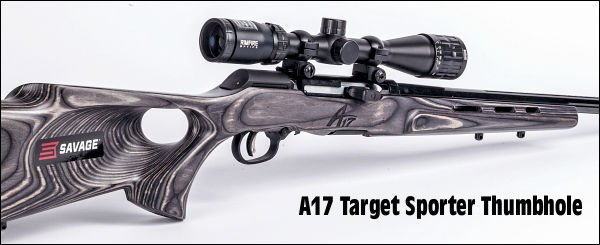
Firearms types will vary with location. The available Savage rifles may include these popular new offerings: 10 BA Stealth (.308 Win/6.5 CM), MSR 15 (AR15 platform), MSR 10 (AR10 platform), A22 .22 LR Rimfire, A17 Target Sporter 17HMR.
The Savage Arms Trigger Tour runs from June through October, starting with events in Louisiana, Arkansas, and Minnesota. Other planned locations are: Alabama, Florida, Michigan, Mississippi, Ohio, Pennsylvania, and South Dakota. CLICK THIS LINK for specific dates and locations. NOTE: Locations and dates may change or be added.
One popular rifle shooters can test is Savage’s model 10 BA Stealth, chambered in 308 Win. or 6.5 Creedmoor. Suitable for PRS factory-class comps, this rifle features a lightweight, modular chassis with adjustable rear section. The 6.5 Creedmoor version of the 10 BA Stealth has shown good accuracy in Defender Blog Field Tests.
Savage’s new AR15-Platform MSR 15 Recon could also be on hand. Chambered in .223 Wylde, the MSR 15 Recon offers a high-performance 16-inch barrel with 5R button rifling and zero-tolerance headspace. The Trigger Tour will also feature the MSR 15’s big brother, the new MSR 10 Hunter. Available in 308 Win. or 6.5 Creedmoor, this purpose-built, compact AR-10 platform is designed for deer hunting and general field use.
Trigger Tour events might also feature Savage’s popular A-Series semi-auto rimfire rifles. The A22 features a straight-blowback .22 LR action, user-adjustable AccuTrigger, thread-in headspace, button-rifled barrel, and composite stock. The A17 Target Sporter Thumbhole features a unique delayed-blowback action that delivers safe, reliable performance with standard 17 HMR loads.
For more information, including specific dates and locations of Savage Arms Trigger Tour stops, please visit www.savagearms.com/events.
Here’s a new product we like — Creedmoor’s extra-long, fitted Cleaning Rod Guides (aka Bore Guides) that offer a port for adding solvent. We like the distinctive bright orange color. That helps you quickly identify your rifle on crowded cleaning bench.
Why a Rod Guide Is Needed for Proper Bore Cleaning
A good Cleaning Rod Guide ensures that your brushes and jags are centered in your bore, so you don’t get uneven wear in your throat. Moreover the guides protect the action raceways, blocking liquids and debris from entering the trigger group. The port helps you add solvent without making a mess or spilling on a fine stock finish.
The orange Creedmoor Cleaning Rod Guides have some nice features. They are long enough so that you can avoid removing larger optics and include a port to apply solvent. The O-ring at the front provides an additional seal for the chamber. These Rod Guides are designed for specific action types and chamberings for proper alignment. Creedmoor’s Bore guides cost $24.95. That’s quite a bit less than some other vendors’ fitted cleaning rod guides. Current offering are:
TIP: When using any cleaning rod guide, you should cover the rear of the stock with a towel to prevent any solvent from touching the stock. Solvents can harm find wood, painted, and hydro-dipped finishes.
Gunsmith/stockmaker Alex Wheeler is a very smart guy. Among his many clever innovations is an adjustable bag-rider that fits on the underside of the buttstock at the rear. Alex calls this a “Rudder” because it allows the shooter to align the tracking perfectly. The rudder assembly can swing left and right using an adjustment bolt. You can also adjust the Rudder’s vertical “angle of attack” with simple shims. Some guys like the Rudder’s 3/4″-wide bottom perfectly parallel with the bore axis. Others prefer a slight angle so the stock slides down a bit during recoil.
Adjustable Rudders Now For Sale
Alex has fitted these innovative, adjustable Rudders in the stocks and complete rifles he sells.And now owners of other stocks can benefit from Wheeler’s invention. Alex is offering the Rudders for sale: “I have made my adjustable Rudders for sale. Price including mounting hardware is $125 shipped. These are the same rudders I install in most ever stock I build. They’re the only way to achieve perfect tracking every time.”
Watch how the Wheeler Rudder works in this video. Alex explains: “If you pull your rifle back in the bags and the cross-hair moves, your stock is not straight. The easiest fix is to use an adjustable Rudder. They come standard on all my stocks. The white box on the 1000-yard target is 4″. With a properly-adjusted rudder it’s easy to obtain less than 1″ of cross-hair movement at 1000 yards.”
Rudder-Equipped Stock In Action (with 1000-Yard Champ Tom Mousel)
This second video shows how well a Rudder-equipped stock performs. This shows IBS 1000-yard Champ Tom Mousel running five (5) shots with his 17-lb Light Gun chambered in 6BR Ackley Improved. Note how perfectly the stock tracks. It runs smoothly straight back then comes right back on target when pushed forward by Mousel. Check it out — this is impressive.
It’s relatively easy to install these rudders on most wood and wood laminate stocks. Alex says: “Just notch the stock, and install the anchors for the adjustment bolts.” In addition, McMillan will soon be offering fiberglass stocks with a notch designed to fit the Wheeler rudder. Based on Alex’s Deep Creek Tracker stock design, these new McMillan stocks with have metals rails in the front also.
New Rudder-Equipped McMillan LRB Stock
Alex explains: “The new McMillan Rudder-equipped stock will be a version of the Deep Creek Tracker, most likely called a Wheeler LRB (Long Range Benchrest). It will feature factory installed 1/2″ wide aluminum rails in the 4″ fore-arm. It will come with the rear notch molded in for the Rudders which I will install on each stock. I will be exclusive dealer on these and hope to see the first one in June. I also have got with Edgewood to make 4″ wide front bags that will fit a standard rest top and will cost the same as their standard 3″ bag. I will have some in stock but anyone can order them direct and not have to pay the $125 price for a custom bag.”
Applied Ballistics is running a big promotion this Memorial Day weekend, to honor those who served their country. There are significant savings on top-flight, category-leading products, such as the Sig Kilo 2400 LRF, and Kestrel Elite. Check out these deals…
Starting Saturday and ending Monday (72 Hours) Applied Ballistics offers these DEALS:
No coupon code is needed, discounts will automatically apply at checkout. Sale pricing while supplies last, NO back-orders.
The folks at Applied Ballistics also asked to note that military and LEO personnel qualify for discounts all the time: “Active Military Members and Law Enforcement (Including Allied Nations) get a 10% discount off MSRP with proof of current active service 365 Days a Year!”
FREE Hazmat Fees at Grafs.com
Now through Monday May 29 at 11:59 pm CST, you can order powder and primers from Grafs.com with no Hazmat fees. To qualify for FREE Hazmat, you must order at least sixteen (16) pounds of smokeless powder. You can add other items to the shipment — up to 50 pounds total of hazmat products. This deal will save you $20.00 if you order this weekend. NOTE: standard $7.95 fixed-rate handling fee applies, and this offer is good for in-stock items only (no back-orders).
FREE Shipping at Bruno Shooters Supply
Now through Tuesday, May 30th at 8:00 am PT, you can get FREE Shipping on all products in stock at Bruno Shooters Supply. This is a great offer because the free shipping applies to everything in stock — actions, stocks, barrels, optics, reloading components, tools and more. But there are some qualifications:
1. Free Shipping requires a minimum order of $150.00, or $299.00 for powder and primers.
2. The Free Shipping offer applies to in-stock items only — no back-orders. Also this does not cover gunsmithing or complete rifles.
3. Hazmat orders will still have a $32 hazmat fee.
Sale Tips from EdLongrange. We welcome reader submissions.
This is a very interesting development. Federal will produce a line of Federal Gold Medal ammunition loaded with Berger Bullets match projectiles and GM Match primers. The new Gold Medal Berger ammo will initially be offered for: .223 Remington, 6.5 Grendel, 6.5 Creedmoor, and .308 Winchester. We expect this ammo to attract the attention of tactical and PRS shooters — Berger projectiles are currently favored by top PRS competitors. Depending on caliber, three different high-BC bullet types will be used: BT Target, Hybrid OTM, or Juggernaut OTM. These all feature a boat-tail design with a high BC for bullet weight. The 6.5 calibers will use Berger’s popular 130gr Berger Hybrid OTM bullet while the .308 Win uses the 185gr Juggernaut.
This new Gold Medal Berger ammo uses Federal Gold Medal match primers, Federal brass, and specially-formulated propellants. All the ammo is well under SAAMI-spec max OALs to function 100% in magazines. Federal says this ammo will “adhere to Federal Premium’s strictest specifications for accuracy, pressure and velocity”. This new GM Berger ammo line could be a match-worthy alternative for guys who don’t want to hand-load. We’re going to try some in 6.5 Creedmoor and see how it performs in terms of accuracy, ES/SD, ballistics, and temp stability. Should be an interesting test…
FEATURES of Gold Medal Berger Ammo:
• Most popular bullets at Precision Rifle Series events
• High ballistic coefficient
• Less wind drift and drop (than typical factory ammo)
• Excellent long-range accuracy
• Gold Medal match primer
Otis has released a new line of advanced, American-made chemicals designed to bring next-generation protection to any kind of firearm. Featuring a broad variety of cleaners, lubricants, protectants and CLPs, the Otis Smart Chemical product line offers formulas for any kind of shooter — from 3-Gun competitors to hunters and tactical professionals to gun collectors.
Video Covers All Otis Smart Chemicals — Cleaners, Lubricants, Protectants:
Formulated to the exact specification of Otis engineers and designed with intelligent application in mind, most Otis Smart Chemicals are biodegradable and available in liquid or aerosol form (as well as in grease and CLP wipes). A precision applicator pack is compatible with all liquid formulas to deliver a greater level of precision during the application process. Visit www.otistec.com/cleansmart to explore the full line or buy your Otis Smart Chemicals online.
For cleaning tasks, Otis offers a specific series of dedicated cleaning products. These combine excellent cleaning capabilities with biodegradable chemistry.
Report by Kristina Holden
Even with a bit of snow left on the ground, some great long range shooting took place up in Montana recently. March 25th, 2017 was opening day for the first 1000-yard IBS match of the year at Montana’s Deep Creek Shooting Range, just outside of Missoula, Montana. With temperatures during both matches at a consistent low to mid 40s and winds blowing at a slight 2-4 mph from the south, the weekend was sure to produce some excellent results.
Framed by forested hills, the Deep Creek Range is a beautiful place to shoot.
Fifteen (15) shooters braved the cool Montana spring weather for what would turn out to be a very competitive match. On Saturday, both Richard Schatz and David Torgerson made the first Light Gun (LG) shoot-off, posting two-inch groups, with Richard taking the win (check out his targets above). David and Richard made it into the Heavy Gun (HG) shoot-off as well, this time with David taking the win. Leo Anderson took the LG score crown with a 47, while Shawn Williams took the HG title with a perfect 100.
Here Scott Stanko sets up his Light Gun. Scott won Sunday’s LG shoot-off.
Sunday’s conditions were even better and the shooters took advantage of them. Once again, some truly excellent groups were shot by Tom Mousel and Scott Stanko, both making the LG shoot-off with 2 inch groups. Scott, shown above, prevailed in the shoot-off. Richard Schatz, once again, made his way into the shoot-offs and took the HG win from Tom Mousel with a 4.889″. Jeff Reed took the HG score win over Leo Anderson with a 96. In the LG Score shoot-off, Jim Williams nailed a real stunner of a group, taking the Score win with a 2.018” – 49. Check out the group below. That sure would have helped his Aggs if it happened in the relay!
Jim Williams with his 2.018″- 49 group. That works out to 0.19 MOA — amazing accuracy at 1000 yards.
New Cartridge Debuts — the 6mmBR Ackley Improved (6mm BRA)
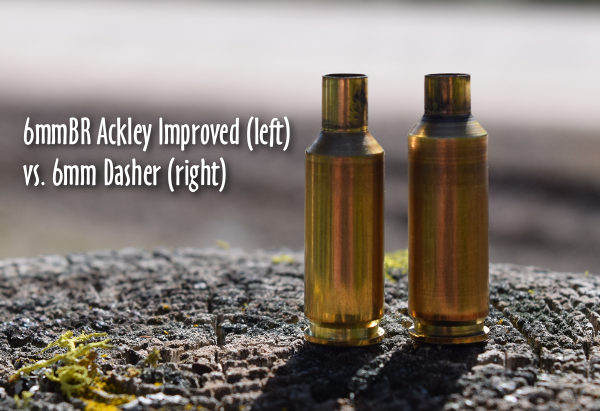
The 2017 season has brought some new gear/cartridge developments and many shooters were able to put them to good use in the first match of the year at Deep Creek. Leo Anderson and Tom Mousel were both shooting the new 6mm BRA (6mmBR AI), a 6mmBR Norma with a reduced body taper and a 40 degree (40°) shoulder. Fire-forming is as simple as turning the necks and shooting, as the factory 6mmBR case will headspace in the AI chamber. Sizing with a 6mm Dasher die with .080″ turned off the bottom is the ticket. Tom Mousel, reigning IBS 1K Champ, “believes this case to have a little wider tune window and far less throat wear”. That means this case might be easier on barrels. For Tom’s 6mm BRA with 28” Krieger barrel, the accuracy node is about 2980-2990 fps, so this gives up only 30-50 fps compared to typical Dasher velocities. Both of Tom’s HG groups held in the 3s for vertical, proving the 6mmBR Ackley’s accuracy potential.
Vapor Trail Bullets and Deep Creek Tracker Stock
Tom Jacobs at Vapor Trail Bullets has been working with a new die for his excellent 6mm 103gr Vapor Trail bullet. Four of the weekend’s competitors were shooting bullets off the new Vapor Trail die. The new die seems to be producing a bullet every bit as good as the old die, maybe even better. Several groups in the 2s (two inch) were shot this weekend. As well as Richard Shatz’s impressive 3.671″ 10-shot group in Heavy Gun (see top of this article).
Finally, the new Deep Creek Tracker 4″-wide stock is becoming a favored option, with half of the competitors at the match shooting these stocks from Wheeler Accuracy. That extra inch in the stock’s fore-end seems to be provide more stability and less rocking on the front rest when opening and closing the bolt. Also, the adjustable tracking rudder makes for perfectly parallel tracking surfaces, an absolute “must have”.
The weekend ended with the sun finally breaking through the clouds. Competitors enjoyed some great grilled Polish dogs with all the fixings prepared by Mark and Angie Candau; who also shot in the match. There were plenty of smiling shooters with awards/prizes for their efforts. It was a great opening match of the season!
Here are the Top Guns at the match: Dave Torgeson, Jim Williams, Jeff Read, Shawn Williams, Richard Schatz, Leo Anderson, Lonnie Anderson, and Tom Mousel.
Deep Creek is one of America’s best 1000-yard shooting centers — many records have been set here.
We have always liked Tikka actions, and now there is a great re-barreling option for Tikka T3 owners. Criterion Barrels Inc. (CBI), makers of “pre-fit” barrels for Savage, Remington, and Rem-clone actions, will soon be offering Tikka pre-fits. These pre-chambered barrels for Tikka T3 actions will be headspaced with a barrel nut, just like a Savage.
Click image for full-screen version
The new Tikka T3 pre-fit barrels will be sold through Solid Accuracy, a respected Texas-based outfit that sells high-end scopes, stocks, barrels and other rifle components. Criterion tells us: “The Solid Accuracy barrel nut and wrench design has been finalized, the prototype barrels tested and the barrel nuts are now going through production (with an expected ETA of 2-3 weeks). All orders for these pre-fits barrels are currently heading out to the shop floor for production. Orders placed this week can expect a conservative estimated lead time of 14-16 weeks.”
The accuracy has been impressive with Solid Accuracy’s test rifle, which features a Tikka T3 action mounted in a KRG X-Ray chassis. This prototype rifle is chambered in 6.5 Creedmoor. The group below was shot with a stout load of H4350 and Sierra 140 grain MatchKings seated .009″ in the lands.
The folks at Criterion are excited about the Tikka pre-fit project: “We’re looking forward to getting these barrels out the door and on to some custom rifle builds.” One of Criterion’s staffers was so impressed with the initial test results that he is building his own T3 project, with a Criterion pre-fit of course…
Pat Reagin of PMA Tool took some cool new products to the range this past weekend. Look carefully at the photo above. That’s not a standard bag-holder on the SEB NEO rest, and that stylish black rear bag doesn’t look anything like an Edgewood or Protektor. The rifle is also sporting the new-generation Weaver 46x48mm T-Series XR Side-Focus Scope.
Lenzi Rear Sand Bag
Pat tells us: “We are now carrying rear bags made by Italian benchrester Alberto Lenzi. Made in Italy, these Lenzi bags are AWESOME! They are available for short range and one that is slighty taller for long range.” The Lenzi rear bags feature a big, 8″x6″ footprint with a thick, slightly concave base that sits very flat on the bench top. Lenzi bags are very stable with a reassuring “dead” feel on the bench. Guys who have tried this bag really like it. Pat says: “I can’t explain it, but the bag seems to absorb energy/recoil better than other bags — the gun tracks a little better and I get back on target really well.” CLICK HERE for more information: Lenzi Long Range Rear Bag | Lenzi Standard Rear Bag.
– Black leather with Cordura at stock contact points with blue stitching.
– 1/2″ flat between medium ears.
– Heavy 8″x6″ base with built-in “donut”.
– Weight about 15.5 lbs filled with heavy sand in bottom & white sand in ears.
Lenzi Replacement Top for SEB NEO Front Rest
A common complaint about the SEB NEO rest is the rest top, specifically the three-piece bag. This rest top made by Alberto Lenzi (an Italian benchrest shooter) addresses the issue by replacing the entire rest top. The rest top features a more conventional design and includes a traditional style front bag that conforms to IBS and NBRSA rules.
The Lenzi Top with Super-Slick Bag is $269.95, while the bag alone is $79.95. You can also get the Lenzi NEO Replacement Top with an Edgewood bag for $275.95. Finally there is a new Lenzi Cordura style bag that fits this system — you can special request that.
Weaver 46x48mm T-Series XR Benchrest Scope
Weaver’s new 46-power T-Series XR scope features a 30mm main tube with side parallax adjustment. Clicks are 1/8 MOA, with 44 MOA windage and elevation travel. Pat Reagin reports: “It’s clear enough. The clicks are a little mushy, but positive. Eye relief is great.”
Available reticles are Fine Crosshair (FCH) and 1/16 MOA Target Dot. Current “street price” is around $900. Amazon currently has the Target Dot Version for $898.99 with free shipping.
How good is .22 LR rimfire ammo you just bought? Well, until now, you had to just cross your fingers and do your own testing (unless you could make the journey to the Eley or Lapua test centers). Now that’s changed. In a matter of seconds, you can access tons of test data for Eley rimfire ammo, seeing how any given lot has performed, and how consistent it has proven. You can view a wealth of data, including group size, percentage of shots within tenths of inches from center, velocity and more. There’s even a 50-shot consolidated group display that conveniently reveals large sample accuracy in a glance. With ELEY’s new web-based Lot Analyzer, you can easily compare various lot numbers, choosing the one that shows the best test results.
With the ELEY Lot Analyzer, simply enter any ELEY lot number into the online database. You’ll then see a heap of information including 10-Shot Groups, 50-Shot Groups, Average Velocity, Ballistics Coefficient, Shot Distribution graphs, and even the Eley Coin Test — the percentage of this lot capable of hitting a dime at 54.7 yards (50m). We believe the ELEY Lot Analyzer delivers the most comprehensive lot-specific ammo performance information ever provided by any ammunition manufacturer.
ELEY is to be commended for making this information available. Shown below are some of the data views available for ELEY Force ammo Lot 3H16-30356:
Try It Yourself with Lot Number 1016-02107
To see how the ELEY Lot Analyzer works first-hand, CLICK HERE and enter this lot number 1016-02107 (be sure to include the dash).
Lot Analyzer Data Available from 2015 Forward
We think the ELEY Lot Analzyer is great for the consumer. It is now possible to select a box of ammo from a store shelf, enter the ELEY lot number, and instantly see the performance of the ammunition. Get together with fellow shooters and compare your ELEY ammo. This service will be available for all ELEY lot numbers in the USA from 2015 forward. You can find the year of your ammunition by the third and fourth numbers in the lot. For example, if your lot number is 3016-30xxx, it is from the year 2016.
EDITOR’s NOTE — Test Center Performance vs. the Real World:
Our staff has tested rimfire ammo in both the ELEY and Lapua Test Centers, and then shot that same ammo later in competition at outdoor ranges. We learned something in the process. First, ammo can do well in a test tunnel, with a clamped test fixture, yet perform very differently outdoors on a real range. Likewise, ammo may shoot superbly in one rifle, yet perform so-so in another rifle, even when the barrels are from the same manufacturer.
We commend ELEY for providing the Lot Analyzer — this really does offer invaluable information to the consumer. This represents a big step forward. That said, you need to understand that factory test results cannot necessarily be duplicated in the real world. And we can confirm that some ammo which was less than stellar in the test tunnel actually shot superbly in real rimfire benchrest competition. LESSON: Even with the ELEY Lot Analyzer, you still need to do your own testing, with your own rifle, to verify .22 LR ammo performance.