The COVID-19 Pandemic claims another victim — the 2021 CMP Western Games. The CMP announced that the 2021 CMP Western Games at Ben Avery in Phoenix, Arizona have been officially cancelled. Judy Legerski, CMP Board Chairman, stated: “Due to the severely limited number of participants allowed at the Ben Avery facility imposed by the State of Arizona, it is not feasible to hold an event at the facility”. The Games had been slated for March 12-21, 2021.
Arizona health restrictions allow only 10 persons per building regardless of building size, and allow no more than 50 people on the Highpower rifle range (including range officers/staff) despite the outdoor venue. That would make it very difficult to conduct the major Western Games matches. In addition this year no ammunition or rifle sales would be allowed. (The CMP marketplace was a big draw for Western Games participants each year.)
“These restrictions leave us no choice but to withdraw from the event”, Legerski said. “We had planned a full slate of events in Arizona, including CMP Games Rifle, EIC Service Rifle, multiple pistol matches, Vintage Sniper Rifle, Rimfire Sporter Rifle, and a series of rifle and pistol training courses.”
TALLADEGA SPRING CLASSIC (March 16-21) WILL REPLACE WESTERN GAMES THIS YEAR
To replace the 2021 Western Games, the CMP will host a series of rifle and pistol matches at the CMP Talladega Marksmanship Park in Alabama. The March 16-21 2021 Spring Classic event at Talladega will include a pistol 2700, a mid-range 3×600 rifle match, long range rifle clinic, and pistol Marksmanship 101 course. Many of these are new events not held before at Talladega. CLICK HERE for full details.
This Talladega Spring Classic will provide an opportunity for competitors to shoot a variety of new matches. Mrs. Legerski stated: “We are sorry that we cannot hold the Western Games this year. We look forward to returning to the great Ben Avery Range in Arizona in 2022.”
The 2021 SHOT Show in Las Vegas was cancelled this year, due to the COVID Pandemic. But Brownells is hosting 5-day virtual event called the “NOT-SHOW” on January 18-22, 2021. The Brownells NOT-SHOW kicked off this morning. will feature new product introductions and special discounts on a wide variety of merchandise (not just the new releases). In addition the Brownells NOT-SHOW will have Daily Product Giveaways from January 18-22, 2021.
The Brownells NOT-SHOW has five main sponsors: AeroPrecision, CMC Triggers, Hornady, Stag Arms, and Magpul. New products from these five companies will be showcased in the NOT-SHOW event, along with many other companies’ offerings. There will be a wide variety of products featured, including optics, reloading tools, and more.
Everyone knows that Magpul makes excellent rifle magazines for ARs, as well as AICS-type mags for bolt guns. But Magpul also produces many other quality product including rifle stocks, AR buttstocks, bipods, rifle sights, pistol mags, and sling accessories. Here are Magpul products at Brownells.
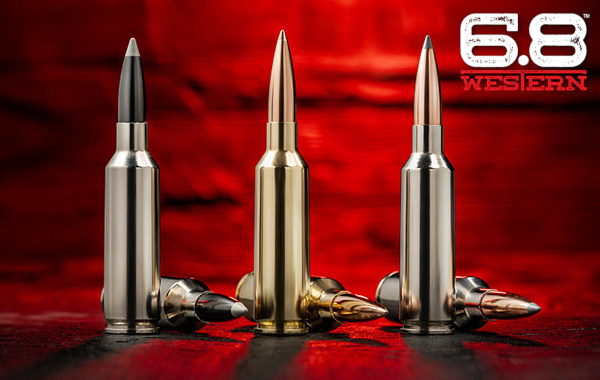
Winchester and Browning have introduced the new 6.8 Western, a new .277-caliber cartridge designed for long-range hunting. The new 6.8 Western is a high-capacity cartridge with a modern 35-degree shoulder, optimized for a conventional short action. The 6.8 Western is VERY similar to the existing .270 WSM. It shares the same 0.535″ rim diameter, and the same 0.277″ bullet diameter, however the 6.8 Western’s case length is slightly shorter. The .270 WSM has a 2.100″ case length, while the new 6.8 Western has a 2.020″ length. That’s just 80 thousandths shorter. Both cartridges, the 6.8 Western and .270 WSM, share a 35° shoulder, so in fact, the 6.8 Western is VERY close to the existing .270 WSM, just .080″ short. With a 1:8″ twist, the 6.8 Western should be able to shoot bullets up to 175 grains.
In designing this new cartridge, Winchester wanted WSM performance in a slightly shorter case: “The key feature… was to shorten up that shoulder, shorten up the OAL of the cartridge so we could get longer, sleeker, heavy-for-caliber bullets to really drive the G1 BC higher and higher, to get the flattest possible trajectory.” Winchester claims that the 6.8 Western is the “largest [cartridge] on the market to fit into lighter, short-action rifles like the Winchester Model 70, Winchester XBR, and Browning X-Bolt Pro”. That’s a bit deceptive, since the .300 WSM, with a 0.2100″ case length, will fit in many of those rifles with most bullets. Oh well — there’s always some marketing hype.
6.8 Western — High-BC Bullets, Good Knock-Down Power, Tolerable Recoil
What is the real advantage of the new 6.8 Western? Fundamentally it can be loaded with heavier, higher-BC bullets than a 6.5 PRC, while having less recoil than a .300 WSM (with most bullets). (But the same can be said of the older .270 WSM.) WideOpenSpaces.com states that with the 6.8 Western “recoil is much lower than the .300 Win Mag, .300 PRC, and the .300 WSM cartridge. At the same time, the 6.8 is said to deliver more energy to the target than a 6.5 PRC [or] 6.5 Creedmoor[.]” Winchester is even claiming more downrange energy than a 7mm Remington Magnum.
This video, with lots of field footage, explains the main features of the new 6.8 Western:
This video has great cartridge illustrations, with 3D Animations and comparative energy tables:
“When people think of the perfect long-range rifle cartridge, they want many key features — good precision, flat trajectory, large down-range energy, and manageable recoil.” — Keith Masinelli, Winchester
This video shows loaded ammo. Direct comparison with .270 WSM at 8:55 minute time mark.
Why Develop a New Hunting Cartridge So Similar to the .270 WSM?
With interest in long-range hunting growing rapidly, engineers at Winchester and Browning sought a solution that could offer magnum performance with a modern high-BC projectile, yet chamber in a short action rifle for shorter bolt-throw and less weight. The 6.8 Western was “designed to be capable in any big-game hunting scenario and a great fit for those who enjoy long-range target shooting”. For the 6.8 Western, the designers basically shortened the .270 WSM case to allow for longer bullets (with the same cartridge OAL limits), and possibly make the case a bit more efficient.
The First 6.8 Western Rifles from Browning and Winchester
Browning X-Bolt Pro in 6.8 Western
Browning will release a light-weight, X-Bolt Pro rifle chambered for the 6.8 Western. This will have a 26″ barrel with 1:7.5″-twist, so it should be able to shoot all the high-BC .277-caliber bullets. With a carbon-reinforced stock, this rifle is relatively light-weight — just 6 lbs., 12 ounces before optics. The rifle has a 3-lug bolt with 60° bolt lift. Trigger adjusts from 3-6 pounds, fine for a hunting rifle. According to Wide Open Spaces, the barrel and receiver are finished with Tungsten Cerakote to protect the rig in harsh weather conditions. On Browning’s website, the Browning X-Bolt in 6.8 Western has a $2,469.99 MSRP. At that price, it may make more sense to buy a used X-Bolt rifle and re-barrel it.
“The 6.8 Western cartridge brings a new perspective to long-range hunting and shooting,” said Ryan Godderidge, Senior VP of Sales, Marketing, and Firearms for Browning. “It provides magnum-level performance in our short action rifles, giving the shooter highly effective down-range energy, even at longer ranges, while allowing for a lighter-weight platform.”
Winchester Model 70 in 6.8 Western
Winchester will release a Model 70 chambered for the 6.8 Western. It will have a 24″ stainless barrel, stainless action with 3-round hinged floor-plate internal magazine. Wide Open Spaces reports: “Right now, it appears the Model 70 Extreme Weather MB is the first 6.8 Western that will roll off their factory floors. The stock is composite with a Pachmayr Decelerator recoil pad. At 44.25″ overall, this rifle is shorter than the Browning X-Bolts, but weighs slightly more at seven pounds even.” Listed MSRP is $1,599.99 for this new 6.8 Western Model 70.
On January 15, 2021, the National Rifle Association (NRA) announced it was filing for Ch. 11 Bankruptcy. This is part of a strategic re-organization that will see the NRA abandon New York State and, hopefully, reincorporate in Texas. It is not clear how this move will impact the current legal action brought by New York Atty. General seeking to dissolve the 150-year-old organization, which was founded in 1871. The New York Times reports: “The bankruptcy filing could delay the resolution of the Attorney General’s case while the matter is litigated in Bankruptcy court.” And a lawyer for the NRA, Wm. Brewer III, stated: “Under this [reorganization] plan, the Association wisely seeks protection from New York officials who it believes have illegally weaponized their powers against the NRA and its members.”
In a letter to members, NRA CEO and Executive VP Wayne LaPierre posted: “We are DUMPING New York, and we are pursuing plans to reincorporate the NRA in Texas.” To facilitate the restructuring, the NRA and a subsidiary have filed Ch. 11 petitions in the U.S. Bankruptcy Court for the Northern District of Texas, Dallas Division. LaPierre continued: “The NRA is pursuing reincorporating in a state that values the contributions of the NRA, [that] celebrates our law-abiding members, and will join us as a partner in upholding constitutional freedom. This is a transformational moment in the history of the NRA.”
“The plan allows us to protect the NRA and go forward with a renewed focus on Second Amendment advocacy”, added current NRA President Carolyn Meadows. “We will continue to honor the trust placed in us by employees, members, and other stakeholders[.]” The NRA also announced Marschall Smith will serve as Chief Restructuring Officer. A former Senior VP and General Counsel of 3M Company, Smith has more than 35 years of legal and business experience.
Important Points for Current NRA Members:
1. The NRA is Not Closing Operations — The organization will continue providing services to its members even during the Bankruptcy Proceedings. NRA Leader LaPierre’s letter states: “We will continue to train Americans and teach them firearm safety. We will continue to teach hunter safety” and “We will continue to publish and deliver your magazines.”
2. NRA Memberships Remain in Full Effect — As far as we know, the NRA does NOT plan to nullify or cancel any current NRA memberships through the bankruptcy or re-organization. LaPierre’s letter states: “Importantly, our plans do not impact your membership at any level. NRA supporters will continue to enjoy all their full member benefits – from new members to Life Members to Benefactor Members.
3. The NRA Will Keep HQ in Virginia — The NRA does NOT plan to abandon its current headquarters in Fairfax, Virginia. However, NRA officials state they might open additional executive offices in Texas.
4. The NRA Will Continue to Use Membership Funds for Operations — LaPierre’s letter to members states: “All membership dues and financial donations will be fully dedicated to supporting our operations and public advocacy. This plan actually improves our business. It protects us from costly, distracting and unprincipled attacks from anti-2A politicians aimed at attacking the NRA because we are a potent political force.” There is no discussion in the LaPierre letter about changes to executive compensation and benefits, or efforts to replace top leadership. The use of NRA funds by Wayne LaPierre and other high-ranking NRA officials has been challenged by forces both inside and outside the organization. Including special pension benefits it has been stated that LaPierre received over $2.15 million in compensation in 2018.*
*In 2019 the Washington Post reported LaPierre had total 2018 compensation of about $2.15 million after a 57% pay raise. In previous years, he had a lower base salary, but was eligible for large pension payouts. According to Celebrity Net Worth: “Wayne LaPierre’s NRA salary starts at $985,000 per year. In most years he also typically earns a bonus of roughly $150,000. Outside of base salary and bonuses, Wayne participates in the NRA’s employee retirement plan. In 2015 he became old enough to receive a $3.7 million distribution from his retirement account. So in that one year, he earned a bit over $5 million, but in most years his salary is closer to $1 million.”
McMillan Fiberglass Stocks (“McMillan FS”) has been sold. This notable company, the number 1 name in fiberglass stocks for decades, was started by Gale McMillan and then run by his able son Kelly McMillan. Under Kelly’s leadership, the company expanded its product line, producing outstanding stocks for benchrest shooters, F-Class competitors, sling shooters, hunters, and military marksmen. McMillan also has a modern Mc3 (“McCubed”) division which produces outstanding molded stocks using a state-of-the-art polymer called Zenolite.
McMillan Sold to Bob Beck Group
McMillan Fiberglass Stocks has been sold to Bob Beck of Extreme Outer Limits, MOA Rifles, and Rugged Ridge Outdoor Gear. Beck is a longtime customer and friend of Kelly McMillan. Bob’s plan is to continue the success of the legendary brand Kelly and the McMillan family built. He is committing resources to reduce delivery times and maintain McMillan’s dominance as the premium brand for fiberglass and synthetic rifle stocks on the market.
The new owner promises to maintain the advanced designs and top quality of McMillan stocks: “With former President of Berger Bullets Eric Stecker as General Manager, and McMillan’s highly experienced staff staying with the company, [we] will carry on the McMillan brand legacy well into the future. We have many exciting plans and new products coming that will appeal to all long gun enthusiasts.”
Over the years McMillan Fiberglass Stocks supported competitive shooting in a major way — providing sponsorship for individual competitors as well as teams. McMillan was a major sponsor of F-Class Team USA. We want to thank Kelly McMillan and his company for being such a strong supporter of the shooting sports. The success of F-Class Team USA in international competition was aided immensely by the support of Kelly and his company.
Kelly McMillan at the 2018 Berger SW Nationals.
About McMillan Fiberglass Stocks
Gale McMillan, founder of the McMillan companies, began producing stocks in 1973 for himself for the demanding benchrest matches in which he competed. Fellow competitors, always in search of the next competitive edge, asked the inventor to produce some stocks for their rifles. From these roots, the McMillan family of companies has grown into one of the most well-known and respected brands in the firearms industry.
McMillan Fiberglass Stocks manufactures custom rifle stocks and accessories. Product areas include Tactical, Competition, Benchrest, Hunting & Sport, and Ultralight. Customers include shooters, military, law enforcement, government agencies, custom gunsmiths, and OEM rifle manufacturers.
There will be a new NRL competition series in 2021 — NRL HUNTER (NRLH). This will complement the popular NRL tactical series and NRL22 rimfire series. For its inaugural (first-ever) 2021 season, NRL HUNTER will host nine regional hunting matches, followed by the NRL HUNTER Championship — the Grand Slam Finale. The Season Championship will take place August 2-8, 2021 at the Cameo Shooting Complex in Grand Junction, Colorado. The championship match will be directed by NRL HUNTER developer Scott Satterlee and the NRL’s Director of Match Operations.
NRL HUNTER 2021 Series Schedule (Ten Events):
1. Nehawka, Nebraska – February 19-21, 2021
2. Farmington, New Mexico – March 5-7, 2021
3. Arbuckle, California – March 26-28, 2021
4. Mount Pleasant, Tennessee – April 16-18, 2021
5. Laramie, Wyoming – April 23-25, 2021
6. Dupuyer, Montana – May 6-9, 2021
7.Hammett, Idaho – May 21-23, 2021
8. Dalton, New Hampshire – June 25-27, 2021
9. Price, Utah – July 23-25, 2021
10. NRL HUNTER Grand Slam Season Championship
Grand Junction, Colorado – August 2-8, 2021
The first-ever NRL HUNTER match will take place in Nebraska, February 19-21, 2021:
NRL HUNTER, a division of National Rifle League (NRL), is a series of competitions for hunters by hunters. It provides a competitive format for new and seasoned hunters to learn about their skills, gear, and local hunting terrains. To participate in matches, hunters must purchase a $100 Annual NRLH membership ($75.00 for Young Guns). For more information, visit NRLHUNTER.org.
There will be three gear-based Classes: Open Heavy, Open Light and Factory. In addition there will be separate Ladies and Young Guns divisions.
NRL HUNTER’s founders state: “Hunting isn’t merely a hobby or pastime; it is our way of life. For us, it is about community, education, and a strong foundation of ethical harvesting. It is the desire to be the most proficient hunter possible, it is the passion that has driven NRL to develop the NRL HUNTER series[.]”
Bushnell will be the Title Sponsor of the 2021 season of NRL HUNTER. “We are truly honored to have Bushnell on board as our Title Sponsor for the NRL HUNTER Series,” stated Travis Ishida, NRL President. “This is a terrific partnership in which both groups share the same vision and passion for the hunting community.” Since 1948, Bushnell has offered a full line of products for hunters. Bushnell now sells riflescopes, binoculars, rangefinders, spotting scopes, and trail cameras.
The International Benchrest Shooters (IBS) will hold its Annual Meeting this month. It will be a virtual meeting, done via the Zoom internet service. The 2021 IBS Annual Meeting will be held online, via Zoom, on Saturday, January 16th at 9:00 a.m. Eastern. Outgoing President Jeff Stover tells us “This is an IBS meeting but anyone [with an interest in benchrest competition] can get on the Zoom virtual meeting.”
To participate in the meeting, you’ll need to Register with Zoom. Here is the link to register:
Jeff Stover notes that members can send in questions for the meeting: “Participants can use [email] to send in questions which I (or someone) hope to be able to answer online. The email address for questions will be sent out (via email) to those who register. Also there will be a ‘raise hand’ feature and chat with the administrator function.”
There will also be specific agenda items to be discussed at the meeting. These agenda items will be voted on, by the membership, on-line after February 1, 2021.
After the meeting outgoing President Jeff Stover, who has ably served as IBS president for 12 years, will turn over his position to new President David Matthew of North Carolina. And IBS Treasurer Bill Gebhardt will retire after 28 years of service. The new Treasurer will be Sally Bauer of Kansas.
The IBS anticipates that some of the IBS Shooter of the Year winners will participate, and perhaps share some of their secrets of success.
The Civilian Marksmanship Program (CMP) is running a new Smallbore Postal Competition this spring. The event, open to both Adults and Juniors, will feature 3-Position and Prone matches, fired from a distance of 50 feet. Individuals and clubs can register and fire in both events. There are two (2) specific events:
3-Position (3×20, Kneeling, Prone, Standing) – USA 50 Foot Target
Prone (60 Shots – Sling and F-Class) – USA 50 Foot Target
The CMP will print customized targets for each registered competitor and mail them to the club or individual. After firing, your targets shall be returned to the CMP or you may opt to score your own targets using the Orion Scoring System and send results to the CMP electronically. The cost for each competitor is $5.00 per event. Payment must be received before targets are mailed.
What’s a Postal Match? The concept is that shooters compete in different locations and then “mail in” their targets, hence the term “postal match”. Of course these days the results can also be transmitted electronically, but the concept is the same — shooters around the country complete a specific course of fire and then the results are tabulated, with final rankings based on scores. Competitors can compete individually or in groups, at the location of their choice. Competitors can shoot the targets at a time of their choosing, but all targets must be RECEIVED by the CMP no later than April 16, 2021.
“The CMP has a lot of experience with conducting postal competitions, and with everything going on in the world today, running a smallbore postal seems like a logical step for our program,” said Brad Donoho, CMP smallbore manager. “We’re happy to be able to provide a place for smallbore athletes everywhere to continue their growth on the range.”
Smallbore shooter Lauren Phillips won the Junior Olympic Shooting Championships in 2014.
Important Dates for the CMP Smallbore Postal Competition:
January 11, 2021 – Online Registration Begins
March 23, 2021 – Online Registration Ends
April 16, 2021 – Targets must be received by CMP
April 19, 2021 – Preliminary Results Posted
April 23, 2021 – All results are final
Savage Arms has just introduced the new Impulse series of straight-pull bolt rifles. This is the first American-designed and crafted straight-pull centerfire rifle. The new Impulse features an innovative Hexlock bolt-locking mechanism with six spherical bearings that move radially outward into a ring in the barrel extension, thereby locking the bolt in place. That barrel extension is held in the receiver assembly by four cross-bolts on the lower front section. Ahead of the barrel extension is a conventional recoil lug and a familiar Savage barrel nut.
Savage Impulse Straight-Pull Rifle — Overview
Savage claims the new system offers the cycling speed of a semi-auto, with the accuracy of a bolt-action. There have been some initial field tests, and it looks like the performance has been good. However, based on the videos that Savage has posted, the cycling of the Impulse’s straight-pull bolt does not seem to be as smooth as some European straight-pulls, such as the Blaser R8, Merkel RX Helix, and Strasser RS 14. We’ve tried those Austrian/German rifles and you really can cycle them very smoothly. From the video the Savage Impulse appears to require somewhat more muscle and effort. Watch below. The video will launch at the 15-second mark for a comparison between the Impulse and a conventional Savage bolt-action:
Savage Speed Comparison — Impulse vs. Regular Bolt Action
Savage says: “Conventional bolt-actions require four steps to cycle the bolt. Impulse simplifies the process with a simple back-and-forth motion.”
Advantages of Straight-Pull Cycling System
What is the advantage of a straight-pull system? You should be able to cycle faster, and (ideally) maintain your cheek-weld and target view. Savage says: “The smooth bolt throw allows a shooter to cycle rounds intuitively, without the need for the standard four changes-of-direction common to a conventional bolt’s path-of-travel. Impulse reduces split times and allows a shooter to manipulate the bolt without losing [his] cheek weld. The bolt travels out and back and shooters don’t have to take their eyes off the target.” Sounds good, but if you watch the above videos, it’s not as wonderful as claimed. That said, if one slows down a bit, a straight pull should allow the shooter to maintain his cheek weld.
Savage’s Impulse “will redefine the way you think about straight-pull rifles”, said Al Kasper, President/CEO of Savage Arms. These new Impulse rifles are built for speed — faster bolt cycling while maintaining ones cheek-weld. This increase in speed can help a hunter make effective follow-up shots.
When the bolt is closed, the Hexlock system holds it in place instead of conventional lugs. With the Hexlock, six (6) hardened steel bearings lock the bolt in place inside the receiver’s barrel extension. Savage says “As pressure increases, Hexlock’s hold tightens, ensuring that there can be no rearward movement of the bolt. Once the round has left the barrel, the pressure subsides, and the action can safely open again with the straight pull of the bolt handle.”
Savage Impulse — Hexlock System (Bolt Locks in Barrel Extension)
The cleverly-designed, modular Impulse bolt can be disassembled without tools. And the bolt-handle can be moved to either side easily. NOTE: In this diagram it may appear that the barrel does not have threads on the chamber end. Actually, Impulse barrels DO have threads on that end, which are used by the barrel nut. However, these threads are covered by a barrel extension which is held in the action/receiver by a lower-side four-bolt barrel clamp.
To design and craft the Savage Impulse, Savage employed advanced engineering with computer modeling. Savage also uses advanced, computer-controlled machinery to build these rifles The video below shows the design/engineering process by which Savage brought the Impulse from concept to finished product in just two years — a very short time by firearms industry standards.
This Video Shows How the Savage Impulse Was Engineered
Savage Impulse — Ambidextrous, Adjustable Angle Bolt Handle
One of the key features of the new Savage Impulse is an ambidextrous bolt handle that can be quickly and easily moved from one side to the other. This allows Impulse rifles to work for both left-handed and right-handed shooters. In addition, the angle of the bolt handle can be adjusted by simply pushing a spring-loaded pin and removing a side coverpin. This is demonstrated in the video below.
Savage Impulse Models: Predator, Big Game, Hog Hunter
Savage currently offers three Impulse models, all equipped with Savage AccuStock, Accufit, and AccuTrigger. All Impulse actions feature a Picatinny rail on top along with a central safety. Because the bolt handle can be placed on either side, all Impulse rifles are essentially ambidextrous — good for lefties as well as righties. There are both short-action and long-action versions of the Impulse rifle. Seven different chamberings are offered, from .22-250 to .300 Win Magnum.
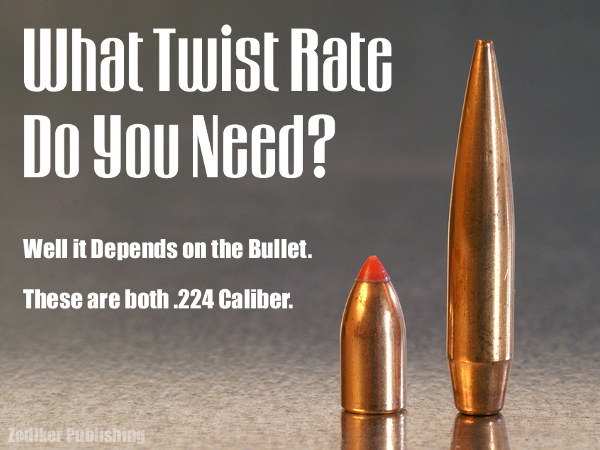
Here’s an extreme range of .224-Caliber bullets: 35gr varmint bullet and 90gr match bullet. Of course, along with bullet length/design, you need to consider MV when choosing twist rate.
Even with the same caliber (and same bullet weight), different bullet types may require different rates of spin to stabilize properly. The bullet’s initial spin rate (RPM) is a function of the bullet’s muzzle velocity and the spin imparted by the rifling in the barrel. You want to ensure your bullet is stable throughout flight. It is better to have too much spin than too little, according to many ballistics experts, including Bryan Litz of Applied Ballistics. The late Glen Zediker provided some basic tips concerning barrel twist rates and bullet stability. These come from his popular book, Top Grade Ammo.
Choosing the Right Twist Rate
I’d always rather have a twist too fast than not fast enough. Generally… I recommend erring toward the faster side of a barrel twist decision. 1:8″ twist is becoming a “new standard” for .224 caliber, replacing 1:9″ in the process. The reason is that new bullets tend to be bigger rather than smaller. Don’t let a too-slow twist limit your capacity to [achieve] better long-range performance.
Base your next barrel twist rate decision on the longest, heaviest bullets you choose to use, and at the same time realize that the rate you choose will in turn limit your bullet choices. If the longest, heaviest bullet you’ll shoot (ever) is a 55-grain .224, then there’s honestly no reason not to use a 1:12″. Likewise true for .308-caliber: unless you’re going over 200-grain bullet weight, a 1:10″ will perform perfectly well.
Bullet Length is More Critical than Weight
Bullet length, not weight, [primarily] determines how much rotation is necessary for stability. Twist rate suggestions, though, are most usually given with respect to bullet weight, but that’s more of a generality for convenience’s sake, I think. The reason is that with the introduction of higher-ballistic-coefficient bullet designs, which are longer than conventional forms, it is easily possible to have two same-weight bullets that won’t both stabilize from the same twist rate.
Evidence of Instability
The tell-tale for an unstable (wobbling or tumbling) bullet is an oblong hole in the target paper, a “keyhole,” and that means the bullet contacted the target at some attitude other than nose-first.
Increasing Barrel Length Can Deliver More Velocity, But That May Still Not Provide Enough Stability if the Twist Rate Is Too Slow
Bullet speed AND barrel length have an influence on bullet stability, and a higher muzzle velocity through a longer tube will bring on more effect from the twist, but it’s a little too edgy if a particular bullet stabilizes only when running maximum velocity.
My failed 90-grain .224 experiment is a good example of that: I could get them asleep in a 1:7″ twist, 25-inch barrel, which was chambered in .22 PPC, but could not get them stabilized in a 20-inch 1:7″ .223 Rem. The answer always is to get a twist that’s correct.
These tips were adapted from Glen’s newest book, Top-Grade Ammo, available at Midsouth. To learn more about this book and other Zediker titles, and read a host of downloadable articles, visit ZedikerPublishing.com.




 In a


 McMillan Sold to Bob Beck Group





 Increasing Barrel Length Can Deliver More Velocity, But That May Still Not Provide Enough Stability if the Twist Rate Is Too Slow


