Let it not be said that Gun Guys aren’t creative. Some of them have considerable artistic talent — witness this unique wall map of Ohio created from used ammunition boxes. This one-of-a-kind wall decor was created by Forum member “MrBottleneck”.
Here’s the story behind the Ohio Ammo Box Map:
“My son and I have been just goofing around creating wall art (if you consider it that). We shoot every weekend and when we see pristine discarded ammo boxes in the trash we have been saving them.
The range officers thought we were funny (or possibly nuts). We originally just had enough to make a square. However, after a few months of scrounging, we finally had enough boxes to expand our square into the state of Ohio as planned. The Ohio Map now proudly hangs in the man cave downstairs, and goes well with our rifle/ammo hobby. I think it’s pretty cool and it cost zero to make.” — MrBottleneck
Another Ohio-based forum member, Adam, found his location on the map: “Hey, I live at the top right corner of the Remington box on the right side.”
MrBottleneck’s Ohio map inspired Forum member JohnB to create something similar. John, who lives in New York State, says: “That is very cool indeed, now maybe I can make one in the shape of New York minus New York City.” Yes, John, that would be a vision of New York we Gun Guys could appreciate.
6.5 Creedmoor (right) shown with .308 Win (left) and .243 Win (center) for comparison.
Though most popular for competition applications (PRS and XTC), the 6.5 Creedmoor is also a capable hunting cartridge. This month Norma spotlights the 6.5 Creedmoor cartridge and outlines the game-harvesting capabilities of Norma 6.5 Creedmoor factory ammunition.
Origins of the 6.5 Creedmoor
Dave Emary, senior engineer at Hornady, asked fellow competitive shooters about their “wish list” for a mid-sized round with long-range potential. It needed to offer efficiency, good ballistics, fine accuracy, and reliable feeding from a magazine. To achieve these goals, Emary necked the .30 T/C to .264 caliber (6.5 mm). The shoulder on this case is well to the rear, so long bullets with high ballistic coefficients can be used in short actions. The efficient Creedmoor case and its modest powder charge deliver hard hits on big game while keeping recoil modest. The case runs well in magazines sized for the .308 Winchester, and because it is efficient, the 6.5 Creedmoor delivers velocities very close to the .260 Remington (which is basically a 6.5-308 Win) with less powder. The 6.5 Creedmoor cartridge has shown excellent accuracy in PRS competition, though the 6mm Creedmoor has proven more competitive, given its reduced recoil.
Hunting with the 6.5 Creedmoor
by Wayne van Zwoll
I learned about the 6.5 Creedmoor by way of a rifle from Todd Seyfert at Magnum Research. The Remington 700 action wears a carbon-fiber barrel with a Krieger stainless core. GreyBull Precision added a stock and a modified 4.5-14X Leupold scope. Its 1/3-minute elevation dial is calibrated specifically for 130-grain boat-tail spitzers at Creedmoor velocities. “Spin the elevation dial to the distance in yards, and aim dead-on.” said GreyBull’s Don Ward. Prone with a sling, I was soon banging steel at 500 yards.
By the charts, the 6.5 Creedmoor is a superb cartridge for deer-size game. But I caught only a late elk season with this new rifle. The 6.5×55 and .260 had taken elk for me; surely the Creedmoor would as well. Alas, the close shot I’d wanted, to ensure precise bullet placement, didn’t come. When on the final evening Don and I spied a bull far off, there was no approach. “Your call,” he shrugged. “The air is dead-still.” I snugged the sling, prone, and dialed to the yardage. Ribs spot-lit by a sinking sun, the bull paused. Craaack! The animal spun, sprinted and fell. That shot was twice as long as any I’d ever attempted at elk.
Whitetail hunting with a Ruger 77, then a trip to sub-Saharan Africa with a T/C Icon, kept the 6.5 Creedmoor in my ammo pouch. The T/C dropped a Vaal Rhebok at 250 yards, in stiff wind (photo below). Shorter pokes on a variety of game produced consistently quick kills. I found the Creedmoor’s limit with an eland.
A high ballistic coefficient helped a Creedmoor bullet slice stiff wind 250 yards to this Vaal Rhebok.
Since then, I’ve seen several animals brought to bag by the 6.5 Creedmoor. And I’ve used it in a variety of rifles on paper and steel targets to 1,200 yards. It has become one of my favorite cartridges for deer-size game. Its mild report and recoil make it easy to shoot accurately. It seems an inherently accurate cartridge too. I’ve punched half-minute groups from production-class rifles. The proliferation of hunting loads for the 6.5 Creedmoor includes none better than Norma’s 130-grain Scirocco. This sleek, polymer-nose bullet, with its 15° boat-tail and a G1 ballistic coefficient over .550, flies very flat. In expansion and penetration tests, it opens reliably down to 1,750 fps, and drives straight and deep. A bonded bullet, it stays in one piece after high-speed impact, routinely retaining more than 80 percent of its original weight.
Shoot 101 Quiz
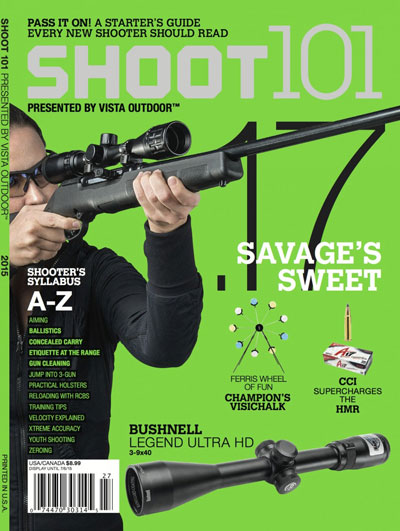
How much of an expert are you when it comes to firearms and ballistics? Test your knowledge with this interactive test. Vista Outdoors (formerly ATK Sporting Group) has launched a new multi-platform media campaign called Shoot 101, which provides “how to” information about shooting, optics, and outdoor gear.
On the Shoot 101 website, you’ll find a Ballistics Quiz. The questions are pretty basic, but it’s still fun to see if you get all the answers correct.
You don’t need a lot of technical knowledge. Roughly a third of the questions are about projectile types and bullet construction. Note, for some reason the layout doesn’t show all the possible answers at first. So, for each question, be sure to scroll down using the blue scroll bar on the right.
How’d you like to locate any rifle range in North America in a matter of seconds? That’s now possible with the Where To Shoot Mobile App, available FREE for both iOS (Apple) and Android devices. The iOS App is designed for both iPhones and iPads.
The Where To Shoot App quickly locates shooting ranges near you, drawing on North America’s most comprehensive directory of shooting ranges. Users can search by current location, state, or zip code and find specifics about each range, including shooting activities offered. Once you locate a range, you can get driving directions to the range.
The app is modeled after NSSF’s popular WhereToShoot.org® website and is updated frequently with range information in every U.S. State and Canadian province. Once you’ve location a place to shoot, the App helps you get directions to the range. The App also includes video tips for shooters, news, and firearm-safety information. Download the app via the links above or by visiting wheretoshoot.org on your mobile device.
The NSSF’s Where To Shoot mobile App has topped 140,000 downloads. The app, which rose to No. 4 on the Apple App Store’s list of free sports Apps, has been a hit with target shooters and gun owners nationwide.
The 146th National Rifle Association (NRA) Annual Meetings and Exhibits will be held at the Georgia World Congress Center in Atlanta, Georgia from April 27-30, 2017. This four-day event will be attended by over 80,000 patriots, feature 800+ exhibitors, and include a jam-packed schedule of seminars, workshops, special events and celebrity meet and greets. In and around the convention hall there will be 15 acres of firearms, shooting and hunting gear, and other exhibits. There will also be an on-site airgun range. For more information, including event tickets, visit www.nraam.org.
If you haven’t attended the NRA Convention before, this 2016 video offers a preview:
There will be nearly 700 Exhibitors displays products at the 2017 NRA Annual Meetings and Exhibits. You can see products from big name companies such as Berger Bullets, Leupold, Nightforce, Nosler, Redding, Remington, Ruger, Savage, Smith & Wesson, and Winchester. You can also meet with top hunting guides and outfitters.
The National NRA Foundation Banquet will be held April 27th in the Thomas Murphy Ballroom, Georgia World Congress Center Building ‘B’. The NRA-ILA Leadership Forum is slated for April 28th in Hall A3, Georgia World Congress Center. With the recent changes in the American national leadership, the ILA Forum should be popular this year.
Hank Williams Concert
Lifetime NRA member and multi-Platinum hit-maker and outdoor enthusiast Hank Williams Jr. will take the stage at the 2017 NRA Annual Meetings and Exhibits Saturday, April 29th! This is always a sell out event, so don’t wait to buy your tickets.
Location of NRA Annual Meetings in Atlanta:
Firearms Policy for the 2017 NRA Annual Meetings
During the 2017 NRA Annual Meetings & Exhibits, lawfully carried firearms will be permitted in the Georgia World Congress Center and the Omni Atlanta Hotel at CNN Center in accordance with Georgia law. However, firearms are not allowed in the remainder of the CNN Center, including the food court and shops. When carrying your firearm, remember to follow all federal, state and local laws.
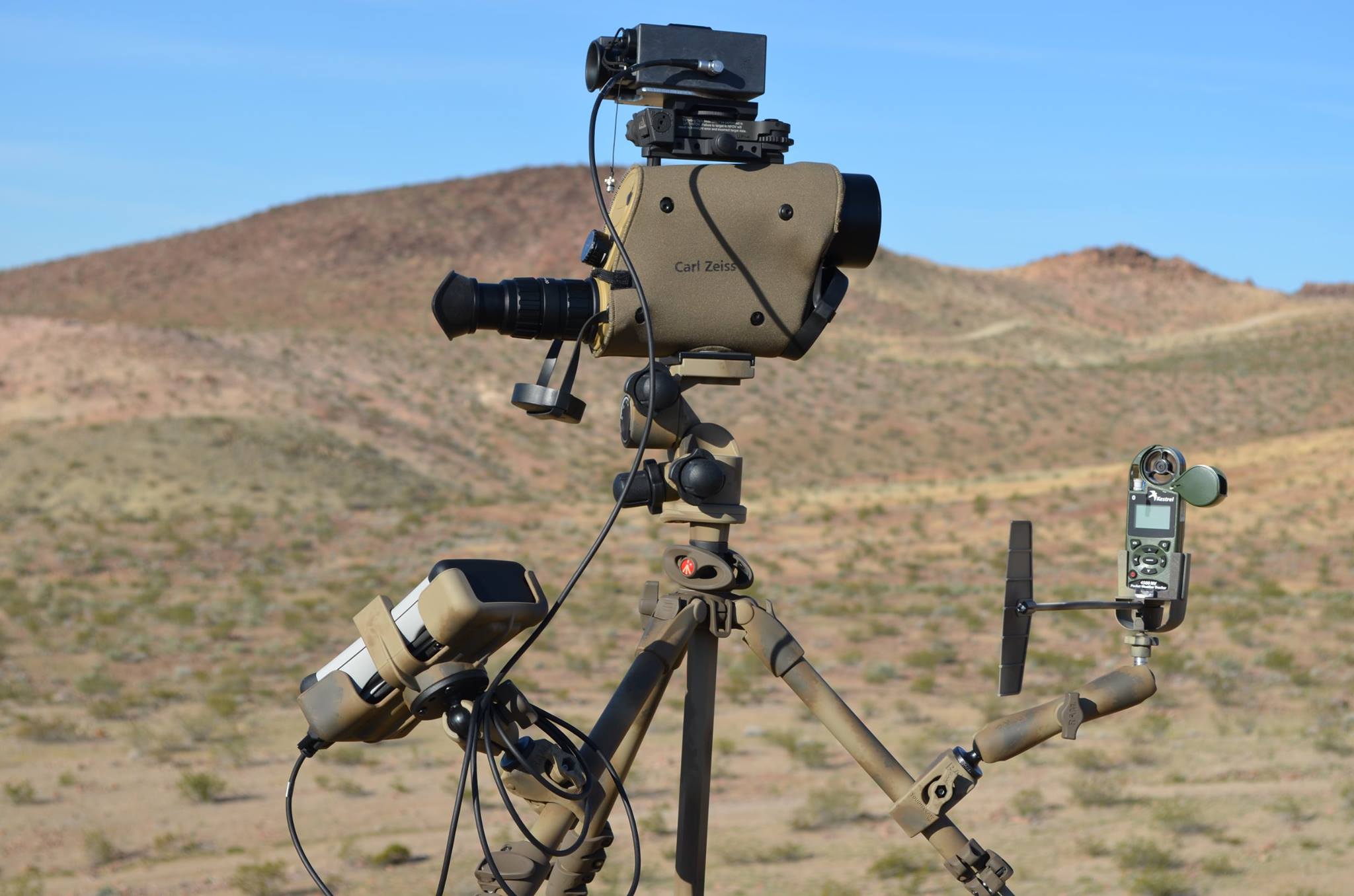
Here’s a triple-threat hardware package for long-range shooting. This cool set-up combines a folded-path spotting scope with a Laser Rangefinder (LRF) and a Kestrel Wind Meter. The LRF is mounted directly to the Hensoldt-Zeiss spotting scope ($4330.00 retail) so the two units stay aligned at all times. That makes it easy to spot and range your target quickly. LRF and weather data is piped into a PDA which automatically generates a firing solution (providing windage and elevation adjustments). That’s slick. Feeding the range and weather data directly into the Ballistics solver eliminates human input error and allows rapid updates to the ballistics solution.
Ashbury Precison Ordnance sent us these photos, noting: “The ingenuity of APO customers never ceases to impress us! This rig has a co-located LRF adjustable for azimuth and elevation, a Kestrel weather station (Bluetooth?) and Trimble NOMAD RPDA. Firing solutions are updated as data is transmitted to the PDA from the LRF and weather station. That Hensoldt Spotter 60 is a nice piece of glass for shooting at extremely long distances.” The spotting scope is mounted on a Manfrotto 410 3-axis geared head.
Newly-Appointed IBS Executive VP Josh Shrum was IBS 2016 Score Shooting Rookie of the Year.
The International Benchrest Shooters (IBS) organization has appointed Mr. Josh Shrum of Whitney, PA to be its Executive Vice-President (EVP), effective March 1, 2017. Josh will work with the IBS Executive Board to promote the IBS, expand IBS membership, boost match attendance, and grow Benchrest shooting in general.
“With Josh on-board, we will take IBS to new levels to achieve visibility, results and growth that a group of volunteers simply cannot achieve.” said IBS President Jeff Stover. While Josh’s EVP position is part-time, Josh will bring a full-time amount of energy and a passion for Benchrest shooting in all its disciplines. Working under the direction of the President and IBS Board, Josh will complement the existing IBS staff of webmaster Dick Grosbier and recording secretary Joan Borden.
Josh will greatly expand IBS’s association with the AccurateShooter.com website. In recent years, the IBS partnered with this popular precision rifle shooting site which draws over 500,000 unique visitors per month, a very large audience focused on rifle accuracy. “By far, Accurateshooter.com is the world’s largest stage for accuracy shooters. The IBS needs to take full advantage of this opportunity to grow Benchrest.” added Stover.
You can expect to see Josh shooting in all the disciplines: Score, Group, 600 and 1000. In 2016, he was IBS Score Shooting Rookie of the Year and solidified his benchrest shooting bona fides by snagging a 25X 100-yard aggregate in his first full year of shooting.
Josh, just 31 years old, brings a youthful perspective to the IBS. For his “day job”, he manages a 1,600-acre estate owned by the Benedictine monks of St. Vincent College in Latrobe, PA. He holds a degree in History and English from St. Vincent College. “I am excited and looking forward to working to promote the IBS. I already have a list of ideas to present to the Board” Josh said after hearing of his selection.
International Benchrest Shooters (IBS) was formed in 1970 to foster uniform competition to achieve the ultimate accuracy in firearms, ammunition, components, equipment and shooting methods. Benchrest disciplines contested include group and score at 100, 200 and 300 yards. The Long Range program is especially active with competitions at both 600 and 1000 yards. IBS Registered matches are held from Maine to Missouri and from Montana to Georgia.
In the near future, there could be changes in the way the Bureau of Alcohol, Tobacco, Firearms, and Explosives (ATF) treats sound suppressors (aka “moderators” or “silencers”). An official government White Paper, dated 1/20/17, was recently leaked to the press and revealed by the Washington Post.
The ATF White Paper makes some key points about suppressors:
1. 42 States currently allow silencers.
2. Silencers are not a threat to public safety, and are rarely used in criminal activities.
3. The inclusion of suppressors in the NFA is “archaic” and should be reevaluated.
4. The definition of regulated suppressor components should be narrowed, so that only key items are regulated as opposed to “any combination of [silencer] parts”.
5. A change in Federal law removing silencers from regulation under the NFA would save resources, allowing the ATF to focus on reducing actual gun-related crime.
Here is the operative text of the ATF White Paper:
Current Federal law requires ATF to regulate silencers under the NFA. This requires a Federal tax payment of $200 for transfers, ATF approval, and entry of the silencer into a national NFA database. In the past several years, opinions about silencers have changed across the United States. Their use to reduce noise at shooting ranges and applications within the sporting and hunting industry are now well recognized.
At present, 42 states generally allow silencers to be used for sporting purposes. The wide acceptance of silencers and corresponding changes in state laws have created substantial demand across the country. This surge in demand has caused ATF to have a significant backlog on silencer applications. ATF’s processing time is now approximately 8 months. ATF has devoted substantial resources in attempts to reduce processing times, spending over $1 million annually in overtime and temporary duty expenses, and dedicating over 33 additional full-time and contract positions since 2011 to support NFA processing. Despite these efforts, NFA processing times are widely viewed by applicants and the industry as far too long, resulting in numerous complaints to Congress. Since silencers account for the vast majority of NFA applications, the most direct way to reduce processing times is to reduce the number of silencer applications. In light of the expanding demand and acceptance of silencers, however, that volume is unlikely to diminish unless they are removed from the NFA. While DOJ and ATF have historically not supported removal of items from the NFA, the change in public acceptance of silencers arguably indicates that the reason for their inclusion in the NFA is archaic and historical reluctance to removing them from the NFA should be reevaluated.
ATF’s experience with the criminal use of silencers also supports reassessing their inclusion in the NFA. On average in the past 10 years, ATF has only recommended 44 defendants a year for prosecution on silencer-related violations; of those, only approximately 6 of the defendants had prior felony convictions. Moreover, consistent with this low number of prosecution referrals, silencers are very rarely used in criminal shootings. Given the lack of criminality associated with silencers, it is reasonable to conclude that they should not be viewed as a threat to public safety necessitating NFA classification, and should be considered for reclassification under the [Gun Control Act] (GCA].
If such a change were to be considered, a revision in the definition of a silencer would be important. The current definition of a silencer extends to “any combination of [silencer] parts”, as well as “any part intended only for use in” a silencer. Compared to the definition of a firearm, which specifies the frame or receiver is the key regulated part, any individual silencer part is generally regulated just as if it were a completed silencer. Revising the definition could eliminate many of the current issues encountered by silencer manufacturers and their parts suppliers. Specifically, clarifying when a part or combination of parts meets a minimum threshold requiring serialization would be useful.
This custom war wagon hauls varmint hunters around the Longmeadow Game Resort in Colorado.
If you’re planning a spring Prairie Dog adventure, it’s time to load up a big supply of ammo. On a 4-day varmint safari you can easily shoot 800 rounds or more in a prime P-Dog location. To save on ammo costs for high-volume shooting, it makes sense to buy components in bulk. Here’s a super deal on bullets for your .224-caliber varmint rig.
Right now Midsouth Shooters’ Supply is running a special on Varmint Nightmare XTreme Bullets. Available in both hollow point (HP) and lead-tip soft point (SP) styles, you can get these bullets for under $50.00 for 500. The .224 55gr Flat Base Soft Point variety is on sale this week for just $42.92 for 500 bullets (that works out to just $8.58 per hundred). We’ve loaded these in .223 Rem, 22 Dasher, and 22-250 cartridges and they worked well (considering the really low price).
Powder Suggestion for High-Volume Varmint Loads
For high-shot-count varmint safaris, you want a clean-burning powder that minimizes barrel fouling. While there are many great powders for the .223 Rem, we like Hodgdon CFE 223 for our high-volume varmint loads. This powder really seems to keep barrels cleaner. Originally developed for U.S. rapid-fire military systems, CFE 223 incorporates a proprietary chemistry named “Copper Fouling Eraser”. Based on tests with extended shot strings, Hodgdon claims that, by using CFE™223, match shooters, varmint hunters, and AR shooters can maintain accuracy for longer periods, with less barrel-cleaning time. You may want to check it out.
The Precision Rifle Series (PRS) for tactical bolt guns has become hugely popular. Capitalizing on that success, the PRS has approved a new Gas Gun series for semi-auto rifles such as AR15s and AR10s. Since the launch of the PRS a few seasons back, Gas Gun shooters have wanted to play. Recognizing the interest among semi-auto shooters, the PRS ran two “prototype” Gas Gun matches last year.
PRS Director Shawn Wiseman Explains New Gas Gun Series in this Video:
Based on positive feedback from the 2016 test matches, PRS founders approved a full 2017 Gas Gun series which kicks off this week. The 2017 PRS Gas Gun Series opener will be held February 17-19, 2017 at the CORE Shooting Solutions range in Baker, Florida. Here’s a video showing CORE’s facility:
For the new PRS Gas Gun Series, rules and scoring procedures needed to be developed. Accordingly, a committee of top PRS shooters, Multi-Gun shooters, and Match Directors was assembled to develop the PRS Gas Gun Series Rule Book. Highlights of the Rules are listed below.
Last month, Shooting Sports USA interviewed PRS President Shawn Wiseman. In a Question and Answer session, Wiseman outlined key elements of the new “Gasser” PRS series. Here are samples from that interview:
SSUSA: What will be the format of the 2017 PRS Gas Gun Series matches?
Wiseman: The matches will be a two day format with 8 to 10 stages per day. No more than 50 percent of the stages can be unlimited round count and 25 percent of the targets must be 2 MOA or smaller. The scoring will be overall time plus penalties with the winner being the shooter with the fastest time including all penalties. There are three Divisions; Tactical Light for 5.56x45mm NATO/.223 Rem. rifles, Tactical Heavy for 7.62x51mm NATO/.308 Win., and Open for everything else up to .30 cal. The maximum distance will be 800 yards.
SSUSA: What guns do you expect to be popular?
Wiseman: In the Open Division, I expect to see a lot of 6.5 Creedmoors for two main reasons; it’s an inherently accurate cartridge and Hornady makes great ammo for the folks that aren’t into reloading. I think the Tactical Light Division will probably be the most popular. It is hard to say specifically what rifles will be the most popular but there are a few AR companies that are known for the accuracy. Armalite, GA Precision, LaRue and Seekins will all be very popular rifles in this Series. I think we will continue to see high-end optics with 5 to 6X zoom range on the rifles. Bushnell, Kahles, Leupold, Nightforce and Vortex will continue to be the most popular.
PRS Gas Gun Series Rules
For the new PRS “Gasser” Competition, the PRS developed rules on gun types, scoring, match timing, penalties, safety and other key topics. CLICK HERE for Full PRS Gas Gun Series Rules.
Scoring and Penalties
The Gas Gun Series utilizes a time plus penalty-based scoring system for all match scoring. This means the score is the shooter’s total combined time on all stages plus any penalties accrued.
Penalties are as follows:
30 seconds for any rifle targets not engaged or neutralized.
15 seconds for any pistol targets not engaged or neutralized.
15 seconds for hitting a “No Shoot” target.
No more than 50% of the stages at a match can utilize an unlimited round count. At least 25% of the targets in Gas Gun Series match must be 2 MOA or smaller. Maximum distance is 800 yards.
Open Division: The Open Division rifles will not exceed a caliber of .30 or a velocity of 3,200 fps. A match DQ will result any rounds over the speed limit of 3,200 fps (+/- 32 fps for environmental factors and equipment discrepancies). Match Officials may request at any point during a match that a competitor fire their rifle through chronograph. If the bullet exceeds the 3,200 fps speed limit, the shooter will receive an automatic match DQ.
Tactical Light Division: Intended to allow competitors the opportunity tocompete using traditional military and law enforcement caliber. This promotes Active Duty military and law enforcement competitors use of their Service and Department-issued rifles. Tactical Light Division rifles are restricted to 5.56 NATO/.223 Remington calibers only. Bullet weight cannot exceed 77 grains and muzzle velocity cannot exceed 3,000 fps.
Tactical Heavy Division: Intended to allow competitors the opportunity to compete using traditional military and law enforcement caliber. This promotes Active Duty military and law enforcement competitors use of their Service and Department issued rifles. Tactical Heavy Division rifles are restricted to 7.62 NATO/.308 Winchester calibers only. Bullet weight cannot exceed 178 grains and muzzle velocity cannot exceed 2,800 fps. No modified wildcat rounds permitted to shoot in the Tactical Divisions Anyone discovered violating this rule will receive an automatic Match DQ. Tactical Division shooters will shoot the exact same COF as Open Division shooters.


 Shoot 101 Quiz

 How’d you like to locate any rifle range in North America in a matter of seconds? That’s now possible with the Where To Shoot Mobile App, available FREE for both iOS (Apple) and Android devices. The iOS App is designed for both iPhones and iPads.