Friday at the Ben Avery Range in Phoenix, hundreds of competitors shot the individual Palma Match, a three-yardage (800/900/1000) day-long event. Competition was tough. The first four F-Open competitors didn’t drop a single point, all finishing with 450-point “cleans”. In F-TR it was equally close. Phil Kelley won with 447-23X, but the next three finishers were just one point behind at 446. In the sling division, John Whidden topped a very strong field with his 449-31X score, showing why he is the reigning National Long-Range Champion. But the next four Sling competitors were just one point behind at 448 points.
Top Five Competitors in Each Class
SLING
John Whidden, 449-31X
Anette Wachter, 448-26X
Randy Teissedre, 448-24X
Robert Stekette, 448-23X
Allen Thomas, 448-22X
F-OPEN
David Gosnell, 450-38X
Keith Glasscock, 450-34X
Danny J. Biggs, 450-32X
Jay Christopherson, 450-25X
Gilber Lucero, 449-27X
F-TR
Philip Kelley, 447-23X
Donald Erpenbach, 446-21X
Richard Dixon, 446-20X
Alan Barnhart, 446-16X
Daniel Lentz, 445-16X
Berger SW Nationals DAY THREE Highlights Video:
The match can’t happen without the dedicated folks doing pit duty — it’s all part of the experience.
Aussie Tim Lawrence’s stock was custom-built from Rosewood in New South Wales, Australia.
The state of the art in F-Open rifles is very high indeed. Check out this handsome F-Open rig with a Speedy-designed Shurley Brothers ARK series wood stock.
Four F-Open Competitors All Shot Clean
Remarkably, the four top F-Open Competitors all shot “clean” 450s, not dropping a single point. That’s mighty impressive for a 45-shot match at three yardages. AccurateShooter’s Systems Manager Jay Christopherson, who finished fourth, said: “Shooting clean today doesn’t suck. Shooting clean and still taking 4th place is a little harder to accept. Extremely tough crowd of competitors, as always.”
Checking the wind at the beginning of the day. Dawn at Ben Avery is beautiful. (Photo by Steve Fiorenzo).
Interview with Multi-Time Champions David Tubb and John Whidden
We had a chance to chat with David Tubb and John Whidden. Between the two of them, David and John have won 21 National Rifle Championships. David has 11 National High Power titles plus 6 Long-Range titles. Reigning National Long Range Champion John Whidden holds 4 Long-Range titles, having won his latest LR championship in 2016. David is truly a living legend in the world of competitive shooting and John is one of the best sling shooters in the game today, a man capable of winning any match he enters. In fact he did win Friday’s match in the Sling division, topping the field with a 449-21X.
Berger SW Nationals Gallery of Competitors
At the Berger SW Nationals we have the opportunity to meet old friends from all over the country and make new friends. Here are some folks we saw at yesterday’s match.
Here’s Friday’s Sling Class winner John Whidden (449-31X) buckling up right before his relay.
Noma Mayo, one of our great senior shooters. She’s always smiling and helping others…
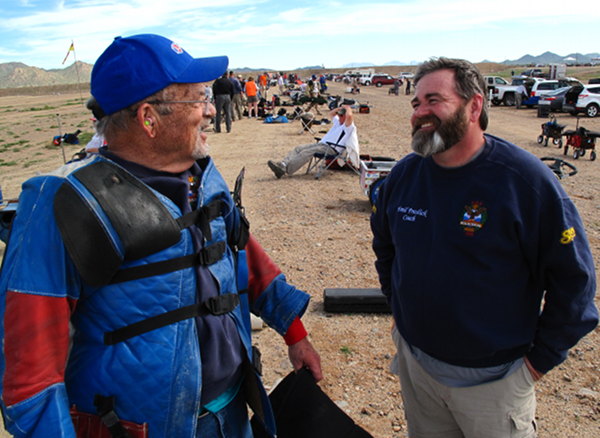
Tom Whitaker (left) chats with Emil Praslick III (right), one of the best wind coaches in the world.
Like father, like daughter. This smiling twosome is from Texas. Father David, an Accurateshooter Forum member, tells us: “Claudette turned 15 on the day we drove out, Tuesday, and this is her first Berger SWN match. She and my son Royse (17) have won Texas junior championships, but this match is the largest we’ve attended.”
We caught past F-Open National Champion (and past SWN winner) Larry Bartholome logging his score at the 900-yard line. Larry is one of the greatest F-Open shooters ever. Larry posts in our Forum as “LBart”.
And here’s the man who started it all, Walt Berger himself. Without his dream to build better bullets, and his hard work over many decades, there wouldn’t be this wonderful match each year. The popularity of this event is testimony to Walt’s dedication and passion for the sport. Walt still competes in Benchrest matches.
Thursday was TEAM DAY at the Berger Southwest Nationals (SWN). In the Sling, F-TR, and F-Open classes, dozens of 4-person teams shot under coaches at 800, 900, and 1000 yards. The key difference between the team game and individual competition is that (for the most part) shooters function as trigger pullers only. Wind and elevation calls are typically made by the coaches, who sometimes even dial clicks for the shooters. In the above photo Bryan Litz is just about to click his shooter’s elevation turret.
This year the Scottish Thistle Team won the Sling division, lead by a strong 449-27X performance by Angus McLeod. The Hayes Rays of Sunshine Team finished second, six points back. In the highly competitive F-TR class, North by Southwest took the team title, with Da Bulls in second.
In the F-Open class, the Cluster Ducks (clever name) took the win, edging out second place The Longshots by a single point. Third in F-Open was Tex-Mex #1. Kudos to AccurateShooter’s own Jay Christopherson, our site systems manager, who lead 4th Place Team Lapua/Brux with a strong 448-25X. Jay keeps our servers running smoothly — and he’s a great shooter in his own right.
Here’s Team Krieger (foreground) getting ready on the 1000-yard line.
Anette Wachter (in chair) shot a 450-36X in the Team Match — not dropping a single point. Outstanding!
TEAM EVENT TOP THREE in SLING, F-OPEN, and F-TR
SLING
1st Place — Scotland Thistle 1786-100X
Angus McLeod, 449-29X
Sandy Walker, 447-27X
Ian Shaw, 445-24X
Michael Barlow, 445-21X
2nd Place — Hayes Rays of Sunshine 1780-97X
3rd Place — Sabine 1775-88X
NOTABLES: Annette Wachter, 450-36X (4th Place Team High)
F-OPEN
1st Place — The Cluster Ducks 1789-100X
James Laney, 450-27X
Kevin Shepherd, 448-24X
Norman Harrold, 448-21X
Joe Meyer, 443-28X
2nd Place — The Longshots 1788-103X
3rd Place — Tex-Mex #1 1781-93X
NOTABLES: Jay Christopherson, 448-25X (4th Place Team High)
F-TR
1st Place — North by Southwest 1773-74X
Daniel Lentz, 445-22X
Ian Klemm, 445-17X
Daniel Pohlabel, 443-18X
Ken Klemm, 440-17X
2nd Place — Da Bulls 1770-81X
3rd Place — Michigan F-TR Team 1764-85X
NOTABLES: Mike Plunkett 447-16X (4th Place Team High)
NEW F-OPEN TEAM Record: The Cluster Ducks set a new National Team Record for 800/900/1000 yards with their 1789-100X Score. In fact, the second-place Longshots also broke the previous 1786-104X record, set by Team Grizzly in 2014. Because the Cluster Ducks edged The Longshots by one point the Ducks will go down in the record books. But both teams can rightfully say they broke the then-current 1786-point F-Open record. Well done shooters!
Team Thunder-Struck from the Land Down Under brought along an inflatable mascot.
GUNS and GEAR HIGHLIGHTS
Interesting Competition Hardware at Ben Avery
Eliseo F-Class Chassis with Two-Piece Barrel Block
Christine Harris was shooting a new prototype Eliseo F-Class stock with a two-part barrel block. This is similar to the Eliseo F1 stock but the bolt-together barrel block allows easier exchange of barreled actions.
Stunning F-Open Rig from Cerus Rifleworks Cerus Rifleworks showed us a jaw-dropping new F-Open rifle. This is an amazing combination of beauty and advanced performance. The CNC-milled stock is stiff and straight, with tolerances that put most wood stocks to shame.
A Lady Soldier’s Coat and Rifle
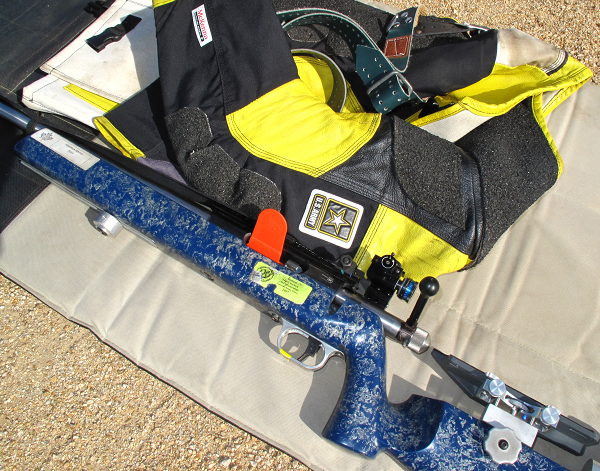
This Monard shooting coat belongs to SSG Amanda Elsenboss, a shooter with the USAMU Team. The rifle features a Barnard action in what appears to be a classic Robertston Composites H&H-style prone stock. Nice hardware for a talented lady soldier.
Pair of ‘Pods
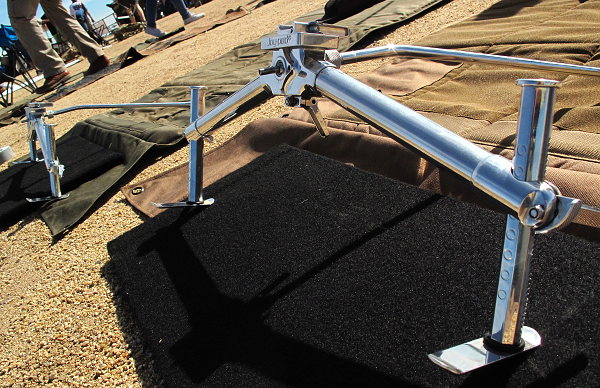
We saw many SEB Joy-Pods on the front end of F-TR rifles. These light-weight bipods offer quick and easy aiming via a joystick-controlled coaxial head. The large flat feet allow the rifle to move back smoothly on recoil, and then slide right back on target.
Gear-Hauler for Many Seasons
This cart has seen countless matches over the years. Those stickers are markers in time, recording decades of shooting matches in many venues. How many stickers can you identify?
Distinguished Rifleman’s Spotting Scope
The stories this old spotting scope could tell — how many targets has it seen over the years? The most important sticker, “Distinguished Rifleman”, bears witness to its owner’s skill and commitment to the sport.
Nightforce Optics Competition Scopes
Nightforce, a major sponsor of the Berger SW Nationals, had a variety of scopes mounted on viewing rigs. You could quickly compare one scope vs. another. We’d like to see more optics makers demo their scopes at major matches.
At the Berger SW Nationals this week many of the nation’s top sling shooters will be competing in the Palma (full-bore) class. You’ll see a scores of .308 Win Palma rifles on the firing line in Phoenix. However, we doubt any of those Ben Avery rigs will be more eye-catching than this Barnard-actioned beauty in an stunning Turkish Walnut stock…
In our Shooters’ Forum, there’s a long-running thread entitled Pride & Joy Rifles. There you’ll find dozens of fine firearms — from hunting handguns to long-range benchrest rigs. A while back, Forum member John L. (GunDog64) posted this handsome Palma rifle, built by Chad Dixon.
John reports: “Here is my new ‘Pride and Joy’ Palma rifle. The action is a chrome-moly Barnard supplied by MT Guns. The gun is set up for switch-barrel use with two Medium Palma-contour Bartlein barrels, one chambered in 6CM, the other in .308 Winchester. Both barrels feature 5R rifling. Up front is a Riles 30mm front sight, while the rear sight is a Warner. The stock was crafted from a superb Turkish walnut blank supplied by Luxus Gunstocks in Mt. Orab, Ohio.
Gunsmithing by Chad Dixon — Stock Finish by Owner
All gunsmithing and assembly work was performed by Chad Dixon at Long Rifles Inc., Sturgis, South Dakota. Chad designed the trigger guard, handstop rail, recoil lug, and cheek-piece adjuster. John, the rifle’s proud new owner, completed the finish work on the stock. John reveals: “This project was a year in the making but well worth the wait”.
Alliant’s Powder for 50-Caliber Applications
In 2009 Alliant unveiled Reloder 50, a new powder designed for long-range, 50-caliber rifle shooters. According to Alliant, the burn rate is “a little slower than Winchester 860″ and the powder is showing excellent lot-to-lot consistency. Load density is optimized for the 50 BMG and similar cases. Like Reloder 17, Reloder 50 employs a process which penetrates the kernels with the burn-rate-controlling chemical. This should allow a longer, flatter pressure curve, yielding more velocity than conventional powders can deliver. Alliant says that Reloder 50 offers “superior velocity and the ability to burn cleaner (with less residue).” Reloder 50 comes in both 1-lb (#150527) and 8-lb (#150528) containers.
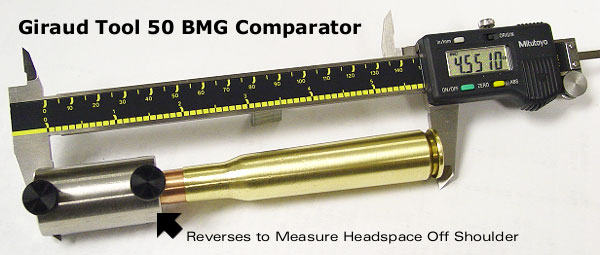
Giraud 50 BMG Case/Bullet Comparator Giraud Tool makes a comparator for 50-Cal cartridges. The double-ended comparator is quite versatile. In one orientation you can measure base-to-ogive bullet length and also measure cartridge OAL from rim to bullet ogive. When reversed, you can use the comparator to measure cartridge headspace. The $30.00 Giraud 50 BMG Comparator gauge is constructed of 303 stainless and fits most any vernier, dial, or digital caliper. CLICK HERE for more info.
Forster 50 BMG Trimmer
50 BMG enthusiasts asked for a dedicated 50 BMG case trimmer, so Forster created a trimmer specifically for that cartridge. Forster’s cutter tip is much sharper than the cutter on the Lyman 50 Cal. AccuTrimmer. However, with the Forster tool you will pay more for that superior cutting ability — Forster’s 50 BMG trimmer costs $95.99 at Sinclair International. Yes, Lyman also makes a dedicated 50 BMG Case trimmer ($66.49 at MidwayUSA), but the Forster cutter head is much sharper, and we prefer the Forsters collet-style case-holder. Bottom line — the Forster gets the job done more quickly, with less effort, so it’s worth the extra money.
The competition phase of the Berger SW Nationals kicked off today with a 600-yard match for Palma, F-TR, and F-Open rifles. Today’s star was Lester Bruno, who drilled a 200-23X with a 6mm BRX F-Open rifle he built himself. This rifle features a BAT Action, Krieger barrel, and presentation-grade Bastogne Walnut stock. Loaded with Berger 105gr Hybrids, Varget Powder, and Federal 205m Primers, this rifle absolutely hammered at Ben Avery on Wednesday — Lester put 23 shots in a row in the half-MOA X-Ring at 600 yards. Under NRA rules, if you shoot all Xs through the designated string of fire (here 20 shots), you are allowed to keep shooting until one shot falls outside the X-Ring. Lester drilled three extra Xs after shooting all Xs for his designated 20-shot string.
Lester Bruno Sets Pending National 600-yard Record with 200-23X in F-Open Division
Lester was excited to set a pending National record, breaking the previous 600-yard record by one X: “Conditions were in my favor, and it was a lot of fun.” However, Lester revealed the record string was nerve-wracking: “I was nervous after I shot 20 and they told me I could keep shooting to try to break the record. I had no knowledge I was able to do that.” Lester took his time, watched the conditions, and shot carefully: “I held off probably at least half of my shots but never held out of the X-Ring. It depended on the condition. A left to right condition was pushing the bullet down so I was holding a little high but when it went right to left I held a little low. I was very patient.”
Lester was all smiles after his 200-23X performance this morning. He told us: “This will be my first record in this discipline though I’ve set records in short-range benchrest.” (Lester is a member of the Benchrest Hall of Fame).
How’d You Like a Rifle That Can Shoot 200-23X
NOTE: If you want a rifle that shoots like this, you may be lucky. Lester says this is a working prototype of a new line of match rifles he’ll be offering for sale through Bruno’s Shooter Supply. These will be high-end rifles for guys who want the very best. The Bastogne wood for Lester’s own gun cost over $1500.00 (that’s just for the blank), but it’s a beauty.
Calm Conditions — But You Needed to Watch the Mirage
Conditions were very good most of the day, with very little wind. However, there WERE subtle directional changes you need to monitor. Bryan Litz, who won both mid-range and long-range F-TR National Championships here at Ben Avery in 2015, said that he did have to hold one side or the other though the wind was very calm. With the mirage roiling and distorting the view through his scope, Bryan said the Bullseye looked like a Medusa head rather than a concentric circle.
F-TR competitor Ian Klemm also had a Mid-Range match for the ages, dropping just one point for the whole day, to finish at 599-38X, and win the F-TR class. We’re told this 599-38X was also a new National F-TR record. Ian was shooting a new McMillan XiT stock.
Here are the Top Five Competitors for Each Divsion:
SLING (Palma)
Allen Thomas, 600-40X
Benjamin Lucchesi, 600-37X
Erik Rhode, 599-49X
Anette Wachter, 599-45X
Trudie Fay, 599-39X
F-Open
Dwayne Draggoo, 600-44X
Danny Biggs, 600-43X
Dan Bramley, 600-35X
Todd Hendricks, 600-34X
Don Nagel, 599-37X
F-TR
Ian Klemm, 599-38X (New Record)
Phil Kelley, 599-32X
James Crofts, 598-41X
John Moreali, 598-28X
Bryan Litz, 597-33X
Note: Results are prelminary, subject to final tabulation.
Watch Highlights from the SWN Mid-Range Match:
Ben Avery Bling — Stunning Paint Job and New SEB Mini
Jay Christopherson, AccurateShooter’s Systems Manager, had a stunning metallic flame paint job on his F-Open rifle. Up front, that beautiful stock is resting on the new SEB Mini coaxial pedestal rest. This looked very stable and Jay said the joystick works perfect. Jay is very impressed with this new coaxial front rest. We expect to see more Minis on the line in future F-Open matches.
Sling Shooters in Palma Division
There were many Eliseo tubeguns in the hands of the sling shooters. For the Palma division, the cartridge of choice is the .308 Winchester. This old cartridge is still capable of extreme accuracy. Never underestimate a skilled sling shooter with a good Palma rifle.
Wickenburg High School Rifle Team
While most of the competitors at this match shooters were middle-aged or older, it was nice to see a youth contingent from Wickenburg High School in Arizona. These young folks shot well — Ben Avery is their “home range”, so they felt confident with the conditions.
Disaster Averted by British Ingenuity
British competitor Tom Rylands had his rear sight break during the middle of a string. Undaunted, Tom secured the sight with some electrical tape and finished the string with a good score. We applaud Tom’s “never say die” attitude. Have tape, will travel…
Ladies Love Ben Avery…
The T-Shirt says it all — there were many female competitors at the mid-range match, including some “all-girl” teams. There were some great lady shooters competing on Wednesday, including Nancy Tompkins and Trudie Fay.
First Lady of Shooting — Nancy Tompkins
It was great to see Nancy Tompkins on the firing line. A strong argument can be made that Nancy is the greatest female long-range competitive shooter in the history of the sport. We chatted with Nancy between relays. She revealed she had not shot sling “in quite a while” so she need to readjust some items on her gun. So… even the great ones need to tweak their gear now and then.
The True Spirit of Competition
The team at the Berger SW Nationals encourages all participants, even those with disabilities. Here competitor Bob Depp shoots from a bench because he cannot hold his rifle normally, due to injuries sustained while serving as a U.S. Marine Corps Scout Sniper in Vietnam. It’s all about participating.
The Smell of Victory…
With the wind flags hanging straight down most of the day, perhaps the best wind indicator of all was the smoke coming from the Barbeque pit. You have to love the Berger SW Nationals at Ben Avery — where else can you get delicious, hot BBQ on the 600-yard line?
Long-Range Matches Run Thursday through Sunday
All the relays Wednesday were held at 600 yards. Starting Thursday, the shooters will compete at 800, 900, and 1000 yards. If conditions hold similar to today (with very little wind), we could see some impressive performances at the longer yardages. But as with any shooting venue, things can change quickly at Ben Avery. We’ve seen morning calms followed by afternoon gales. Good luck to all the competitors.
For you guys competing at the Berger SW Nationals this week, we’re repeating an excellent article by Steven Blair on wind reading. Steven, a top F-Class shooter, talks about mirage, topography effects, tail winds, and other subtle factors that can cause frustration for shooters. Steve explains that wind effects can be complex — there’s more going on than just velocity and angle. You need to notice things like berm locations and effects of temp changes over the course of the day.
Wind Reading Tips for Competitive Shooters by Steven Blair, 2012 California State Long Range F-Open Champion
Assess the Terrain and How the Wind Will Interact with It
Before you begin a match, take a few minutes to look around the range at the terrain, any obstructions, range topography (berms and backstop), and trees, buildings or structures that could affect wind flow over the range. Imagine what might happen if the wind was from the left or right, headwind or tailwind. Depending upon the direction, significant effects may be seen on range. A head or tail wind may ripple across the berms, causing elevation changes, both high and low. A tall side berm, like the east side berm at Ben Avery, may cause turbulence when the wind comes from that direction. Blocking features might shield most of the wind but a break along the range can funnel strong gusts through the gap with no other indications. Take a few notes about the effects of different wind directions and refer to them if the prevailing direction changes. (Tip courtesy Tony Robertson.)
Use a Spotting Scope, Even When Shooting a Scoped Rifle
A good spotting scope can “see” mirage much more clearly than even an expensive rifle scope. Take your spotting scope to the line and position it as sling shooters do, close enough to use without much movement. Focus the scope approximately 1/3 of the way down range or where the most significant wind effects are likely to occur. Take a quick look while waiting for pit service, glance at the flags and compare to your scope sight picture. I often see ambiguous indications at the target through the rifle scope, but see a clear indication of wind direction and speed through the spotting scope at the shorter distance. When shooting the Arizona Palma Championship at Ben Avery last weekend, I was scoring while the wind was coming from the east. Shooters up and down the line were out to the left, losing points. Mirage at the target looked moderate and the flags weren’t indicating strong wind. As I focused the spotting scope back, the mirage suddenly looked like it was flowing twice as fast around 500 yards than it was closer or farther. It wasn’t until I realized that the access road cut through the berm there that I understood what was happening. (Tip courtesy Gary Eliseo.)
Don’t Over-React to Something That May Be an Anomaly
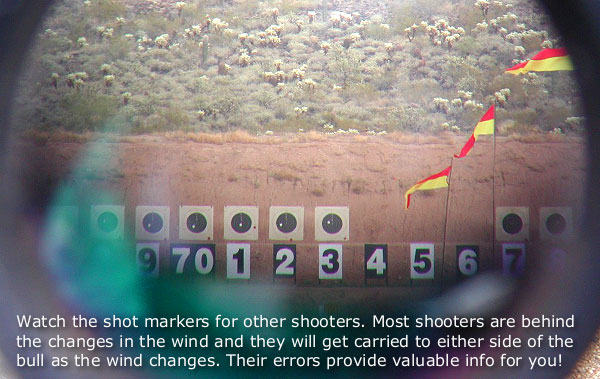
On ranges with sizable berms, a headwind or tailwind can cause significant elevation problems. It is generally not possible to see or predict when this will occur. When the conditions exist that cause elevation changes and other competitors are experiencing the same problem, the best strategy is to ignore it. Certainly, avoid shooting when the head or tail wind is gusting, the same as you would in a crosswind. But, if you react to random, range-induced elevation changes, the only likely result is to make it worse. Whether the problem is caused by range or ammunition, maintain your waterline hold until you have evidence that something has fundamentally changed.
My .284 Shehane will usually require a click or two down during a string as the barrel warms. That is normal and manageable. But, if your shots are just bouncing up and down in the 10 ring, leave it alone. The same is also true of an occasional gust pushing a shot into the 9 ring. If the conditions have not changed and one shot just went out, it may be the result of a random occurrence that was not predictable. (Tip courtesy “School of Hard Knocks”.)
Adjust Spotting Scope Focus and Magnification as Needed to View Mirage vs. Target Details
In F-Class we only need to see mirage, spotters, and scoring disks. That does not take a lot of magnification. My scope is a Nikon 25-75x82mm ED. It is a superb scope for the money and makes it trivial to see minor variations in mirage. It is good to have the high magnification available, and it can always be reduced if necessary. I use different power settings for different situations.
Setting Magnification Levels
During a match, in very good viewing conditions, I set my spotting scope at 75X, full power. The mirage is more subtle in the morning and greater magnification is needed.
During a match with heavy mirage I set my spotting scope at about 40X. I have no problem seeing mirage, even at this magnification.
When practicing at 300 yards or closer I set my spotting scope at max power (75X) so I can see the little 6mm holes from my 6BR rifle. I usually need to focus back and forth between shots to see both bullet holes and mirage.
Steven Blair, 2012 California State Long Range F-Open Champion, has been shooting since childhood and competing for over 30 years. Before retiring, Steve spent 16 years in Engineering and IT with General Atomics. He has held Engineering and Marketing positions with several firearms companies and worked on projects from pistols to 155mm howitzers.
The latest 7th Edition of the Firearms Guide is now available as a handy USB Flash Drive, as well as DVD. In addition, you can access the information on the web via an online subscription. (NOTE: the DVD Edition is FREE in combo with a 1-Year Online Database subscription.)
“We listened closely to the market,” says Firearms Guide editor Chris Mijic, “and saw that our online users still want to have a tangible backup copy of Firearms Guide. A lot of them like the DVD Edition which is free with the Online Edition but some of them don’t have a DVD drive in their new computers any more so we created a super-fast USB Flash Drive edition for them.” The Firearms Guide 7th Edition is also published on DVD-Rom for Windows and there is an online subscription service at www.firearmsguide.com.
Choose Multiple Options
USB Flash Drive Edition comes in combo with a 1 Year Online Edition with free updates for only $39.95.
1-Year Online Edition with free updates is only $29.99.
DVD Edition is FREE in combo with a 1-Year Online Edition.
The Firearms Guide 7th Edition represents the world’s largest, fully-searchable firearms, air guns and ammo database, covering 920 manufacturers from 50 countries. Published since 2009, the Firearms Guide covers over 64,000 antique and modern guns, with gun values, photos, and high-resolution gun schematics and blueprints. The Firearms Guide allows up to 14 different search criteria: caliber, year, country, manufacturer, stock, action, price, and more.
The amount of imagery is amazing — there are tens of thousands of photos and over 6300 schematics, which help you work on a firearm or identify key components/parts. Guns and ammo are presented with prices, specifications, features, ballistics, and up to 12 high-rez zoom-able color pictures.
GUN VALUES are provided for dealers and gun collectors. You can access thousands of printable and zoom-able GUN SCHEMATICS (diagrams or exploded views) with parts lists and blueprints for professional gunsmiths.
H.R. 788 will help States build and maintain shooting ranges with Federal funding assistance.
Federal Legislation has been introduced that will help build and maintain shooting ranges. H.R. 788, the Target and Marksmanship Training Support Act of 2017, was introduced in Congress by Rep. Duncan Hunter (R-CA) and a bipartisan group of 23 co-sponsors. The provisions of H.R. 788 will help States fund public shooting ranges with Federal Firearms Excise tax revenues.
“This legislation [H.R. 788] would provide state fish and game agencies more flexibility to use Pittman Robertson excise taxes dollars raised from the sale of firearms and ammunition to enhance existing public shooting ranges and to build new ones to meet the growing need for additional places for target shooters to participate in their sport,” said Lawrence G. Keane, NSSF Senior V.P. and General Counsel. “Public shooting ranges provide hunters a place to sight-in rifles and shotguns before hunting seasons, for people to take firearm safety and hunter education courses, and for recreational target shooters to enjoy their sport.”
Since 1937 almost $11 billion has been raised for wildlife conservation through the Pittman-Robertson excise tax on the sale of firearms and ammunition. States are permitted to use some of those funds for hunter education courses and for public shooting ranges under a restrictive formula that has largely discouraged state agencies from building and enhancing public shooting ranges. H.R. 788 will help states use Pittman Robertson revenues by increasing the limit on Federal funding of shooting ranges from 75 to 90 percent. This means states could begin work on range facilities with 10 percent State-supplied funding, instead of the current 25 percent. It would also allow Federal Excise funds to be made available and accrue for five years for land acquisition or range construction.
In addition, the legislation would limit frivolous lawsuits arising from the use of Federal land for target practice and encourage Federal agencies to cooperate with state and local authorities for maintenance of ranges on federal lands.
Story by NRAHuntersRights.org and NRAblog.com
Shown above is the Belfast Wildlife Area rifle range in Kindards, SC. Belfast was the first public, unmanned shooting range opened and paid for completely with funds raised by NRA Grants and the Wildlife and Sportfish Restoration Program … an act made possible through Pittman-Robertson grants. Several other state Natural Resource Departments have followed suit.
Legislative History: The Target and Marksmanship Training Support Act was previously introduced as H.R. 2406, the SHARE Act (Title II), and the Bipartisan Sportsmen’s Act in the last Congress, as well as a stand-alone bill H.R. 2463 in the 113th Congress.
Photo Credit: Top photo shows Mainville Sportsman Club (PA) and Union Co. Sportmen’s Club (PA), both sites of IBS Matches.
The 45th Annual Safari Club International (SCI) Convention is underway now at the Mandalay Bay Resort and Casino in Las Vegas, Nevada. The big event opened February 1st, and concludes Saturday the 4th. Over 20,000 hunters and sportsmen are expected to attend this year.
$10 Million in Auction Items This Year
The SCI show is famed for its fund-raising auctions. At this year’s Convention, over $10 million worth of exotic firearms, once-in-a-lifetime hunts, and fine collectibles will be auctioned. Net proceeds from the auctions are used by SCI to promote conservation and game management efforts worldwide. Here’s a past auction item, a Krieghoff Double Rifle valued at $84,000. This ‘Legends of the Hunt’ double rifle, chambered in .470 Nitro Express, is custom engraved by master engravers Michael Oke and Andreas Scholz. The stock is exhibition-grade Turkish walnut with ebony pistol grip and fore-end tip. There are gold barrel bands and gold accents on the express sight blades and double triggers.
Over 1000 Exhibitors from 33 Countries
This is a huge event, with over 1000 exhibitors from 33 countries and six continents. Notably, hundreds of top guides and outfitter services are showcased in the Outfitters Hall. The SCI convention also features many firearms manufacturers and custom gun builders. In the Gun Maker’s village prestigious European gun makers and engravers display their work.
The SCI convention boasts “the largest display of wildlife art at one venue anywhere in the world” according to Ammoland.com. The work of 55 artists and 110 taxidermists will be on display.
Hunt of a Lifetime — What Would You Hunt and Where?
A couple seasons back, Sierra Bullets asked its staffers about their dream hunting destinations. The Sierra techs, all avid hunters, were polled about their favorite hunting venues. Here are their answers to the question: “If you could hunt anything, anywhere in the world, where would you go and what would you hunt?”
Africa topped the list of “dream hunting locations” by a landslide. Canada and Alaska were both picked twice, with other destinations each favored by one staffer:
Africa 6 votes (Kudu, Eland, Cape Buffalo, Leopard, Lion, Plains Game)
Canada 2 votes (Moose, Black Bear)
Alaska 2 votes (Dall Sheep)
Wyoming 1 vote (Antelope)
US Rocky Mountains 1 vote (Elk)
Argentina 1 votes (Doves)
Australia 1 vote (Non-specific)
Carroll Pilant (Ballistics Technician): “Back to Africa for kudu and eland.”
Rich Machholz (Ballistic Technician): “African Cape Buffalo with my longtime friend Lloyd in Zimbabwee.”
Tommy Todd (Chief Ballistician): “Free Range African plains game”
TacticalWalls.com, producers of home security/concealment products, has introduced a new line of furniture with hidden gun storage. Tactical Walls’ new Coffee Table, End Table, and Night Stand provide “hidden in plain sight” solutions for defensive firearms. These tables all feature a clandestine metal gun compartment that can be instantly accessed via RFID card.
At first glance, the TacticalWalls tables appear to be nothing more than quality wood furniture pieces. (Each unit is made from hardwood and crafted in Shenandoah, Virginia.) But what’s special are the remote-activated hidden gun bays. By swiping a pre-programmed RFID card supplied with each unit, the hidden compartment underneath the table-top is unlocked, giving instant access to your handgun, shotgun, or rifle.
These products are nicely crafted, and RFID access is a smart use of modern technology. However, the TacticalWall tables are pretty expensive. The Coffee Table (49″L x 24″W x 19″H) costs $795.00! That will buy a pretty big gun safe. The two smaller units, the Night Table (above left, 23″L x 23″W x 31″H) and End Table (above right, 23″L x 23″W x 25″H) each cost $495.00. For that kind of money you have a variety of gun storage choices. Still, this could be a nice “instant access” bedroom option. You could keep your pistol right at your bedside, close at hand, but still completely secure.









 In our

 Alliant’s Powder for 50-Caliber Applications




 Setting Magnification Levels


