TV Shopping networks typically sell jewelry, housewares, and clothing items. Now there’s a new TV shopping network that will sell firearms and shooting accessories. GunTV recently launched with shows airing on cable and satellite networks (and streamed live on GunTV.tv on the web). This video unveils GunTV’s mission and explains how guns and shooting sports merchandise will be sold:
GunTV presentations combine studio sessions with range time. The hosts begin, in studio, talking about a gun’s features. Next the show may feature range footage demonstrating the firearm. Then it’s back to the studio for the sales pitch. Finally, viewers can bid on the featured item(s). Non-firearms items may ship directly to buyers. However, all actual firearms are sent to an FFL dealer, which performs background checks and handles the required paperwork.
30 Cal Gal on GunTV
One of GunTV’s hosts is our friend Anette Wachter, creator of the 30CalGal.com website. Anette, a top-level Palma and multi-gun competitor, will be testing and reviewing products, as well as selling her signature 30CalGal line of custom jewelry.
Safety is emphasized in GunTV broadcasts. The show’s creators state: “GunTV offers education, information and safety regarding firearms in America[.] GunTV is proud to offer its consumer audience an exciting mix of unique content, a wide range of firearms and related products and services, educational information, resources and entertainment, all delivered via live broadcasting on satellite and cable systems and streaming on the Internet.”
Promotional Opportunities for Manufacturers
GunTV makes money two ways. First it takes a share of sale proceeds from items sold. In addition, it gets promotional fees from product makers. If you have a shooting-related product you want to see featured, you can advertise on GunTV. You can apply online using the Product Submission Application form. GunTV charges fees for its airtime segments and advertising spots and advertising spot production services.
Guns are big money. In the past seven years, the dollars generated by the production and sales of guns and ammo have more than doubled. In fact, total economic impact of the firearms and ammunition industry in the United States increased from $19.1 billion in 2008 to $49.3 billion in 2015, a 158% increase. Meanwhile the total number of gun industry full-time jobs rose from approximately 166,000 to almost 288,000, a 73% increase in that period, according to a report released by the National Shooting Sports Foundation (NSSF), the industry’s trade association. Read NSSF Report HERE.
On a year-over-year basis, the industry’s economic impact rose from $43 billion in 2014 to $49.3 in 2015, a nearly 15 percent increase while total jobs increased from approximately 263,000 to almost 288,000, a 9 percent increase in the same period.
“Our industry is proud to be one of the truly bright spots in our economy as an unprecedented number of Americans have chosen to exercise their fundamental right to keep and bear arms and to safely enjoy the shooting sports,” said Stephen L. Sanetti, NSSF president and CEO. “We have increased our direct workforce by about 21,000 in the last two years alone, adding jobs that pay an average of more than $50,000 in wages and benefits.”
The Firearms and Ammunition Industry Economic Impact Report: 2016 provides a state-by-state breakdown of job numbers, wages and output covering direct, supplier and induced employment, as well as federal excise taxes paid. Access the full report here.
The latest digital edition of Shooting Industry Magazine offers a run-down of hot products at SHOT Show 2016. In this FREE April edition, you’ll find a SHOT Show in Review article, a “Show Stoppers” guide to Buyers’ favorites, a list of products you may have missed, as well as a 2016 New Product Showcase. For anyone interested in new shooting products, you really should read this special April issue cover to cover. This year’s SHOT Show, held January 19-22 in Las Vegas had more than 1600 exhibitors, with a record number of new products on display.
Show Stoppers from Las Vegas
One of the Show Stoppers highlights was a quad-barrel AR Kit. The new Multi-Caliber System (MCS) from Windham Weaponry offers plenty of bang for the buck. The kit comes with four different barrels: .223 Rem, 7.62x39mm, .300 Blackout, and 9mm Luger. The gun’s modular design makes it easy to change calibers by swapping barrels and magazine wells. (That’s right, you change the magwell to fit the caliber — a smart idea. That way you can run proper AK-style 7.62×39 magazines). One dealer stated: “You can get all four conversion kits in a hard-sided case at a decent prices. The fact you can change calibers so quickly is going to make this a big seller.”
New Product Showcase
Along with the Show Stoppers Guide, this April issue of Shooting Industry Magazine featured “Products You May Have Missed At SHOT Show” as well as a New Product Showcase. The Showcase highlights interesting new products from Benelli, Browning, Colt, Kimber, Nikon, McMillan, Nosler, Polycase, and many other leading brands.
What can you do with $12,215.00? Well, you could buy a new Polaris RZR ATV, a really nice bass boat, 234 shares of Verizon, or 643 bottles of Jack Daniels Old #7. Or, if you are the U.S. Army, you can buy one (1) semi-auto sniper rifle, plus some spare parts. The U.S. Army announced recently that it will replace its M110 Knights Armament-made sniper rifle with a new, lighter 7.62×51 semi-auto rifle from Heckler and Koch. H&K will supply a slimmed-down variant of its G28 Rifle called the Compact Semi-Automatic Sniper System (CSASS). The potential max contract value is $44,500,000 for up to 3,643 rifles (and spare parts). That works out to $12,215.21 per rifle*. At that price, it better be good.
The military says the G28 system is lighter and more compact than the 15.3-lb M110 produced by Knights Armament Company (KAC). The G28 is certainly more compact, given its 16.6″ barrel. But somebody seems to have forgotten that velocity is lost with a shorter barrel. A longer barrel will deliver significantly higher MV for better long-range ballistics. Nevertheless the Army thinks portability trumps ballistics: “Compared to the M110, the CSASS will be easier to carry, handle and maneuver in close-quarters combat. It will lighten the load for carrying over rough terrain for the longer-range ridgeline to ridgeline fight. These improvements will not sacrifice existing performance, accuracy or reliability.”
Hmmm… “Not sacrifice existing performance”? We’re not sure how that can be the case. The current KAC M110 Sniper Rifle (shown below) has a 20″ barrel. The basic G28 has 16.6″ (421 mm) barrel). Perhaps the final CSASS production version of the G28 will be fitted with a longer barrel?
Here’s what various sources report: “On 1 April 2016, the Army announced it had awarded Heckler and Koch a contract with a maximum value of $44.5 million as winner of the competition to replace the KAC M110. H&K is to produce 3,643 rifles. A goal of the effort was to give snipers a weapon that didn’t “stick out” as a sniper rifle; with a suppressor, the current M110 is 46.5″, that’s 13″ longer than the M4 carbine. A minimum of 30 CSASS units will be used for production qualification testing and operational testing over 24 months. H&K later confirmed that a modified G28 had indeed been selected as the CSASS rifle. The G28 is nearly 2.5″ shorter and 3 pounds lighter than the M110 (unloaded and without a suppressor) and will cost about $12,000 per rifle.”
Comment: We’re not so sure about this deal. $12.2K is a lot of money for a souped up AR10. The KAC M110, by all accounts, has performed well in combat and has a good reputation with sniper teams. When introduced, the M110 Semi-Automatic Sniper System (SASS) won a U.S. Army award as one of the “Best 10 Inventions” of 2007. The M110 is highly acclaimed for its battlefield performance. If the military wanted a shorter rifle, it simply could have fitted a shorter barrel and a collapsible buttstock on existing M110s. That would have saved millions of dollars. But saving money is, apparently, not one of the Pentagon’s priorities these days.
* This HK firearm is sold as a CSASS system. Typically, the price per system unit will include optics, attachments, fitted hard case, and spares.
On Saturday, April 16, the American Suppressor Association (ASA), in partnership with Brownells, will host the Iowa Suppressor Rally, a public suppressor shoot at the Big Springs Shooting Complex near Searsboro, Iowa. The event will celebrate the enactment of Iowa House File 2279, which legalized firearm suppressors in Iowa on March 31st. Rally organizers will provide all firearms, ammunition, and, of course, suppressors.
The rally is free and open to the public. All guns and ammo will be provided at the rally; attendees are asked to leave personal firearms at home or in their vehicles. The Rally will allow Iowans to sample firearms equipped with suppressors from Advanced Armament Corporation (AAC), Dakota Silencer, Gemtech, Sig Sauer, Silencerco, and Yankee Hill Machine.
“After three years of hard work alongside the Iowa Firearms Coalition and the NRA, Iowans will finally be able to use suppressors to protect their hearing while enjoying the shooting sports,” said Knox Williams, President and Executive Director of the ASA. “This rally [will] show the people of Iowa why we have all fought so hard to legalize suppressors in The Hawkeye State.”
“Iowans can now enjoy the same freedom as those in many other states and countries,” said Brownells CEO Pete Brownell. “I suffer from hearing loss myself. Being able to dampen the noise associated with firearms will help protect the hearing of all Iowans who shoot, including future generations of Iowa gun owners.”
Suppressors (obtained in accordance with Federal law) are now legal to own in the vast majority of American States. CLICK HERE to learn more about obtaining a suppressor.
We first ran this eye-opening story two years ago. We’re republishing it today as a reminder that safety should always be a shooter’s #1 concern at the range. Avoid distractions and always check your barrel for obstructions before you chamber a round or pull the trigger. A moment of inattention can result in a catastrophic kaboom …
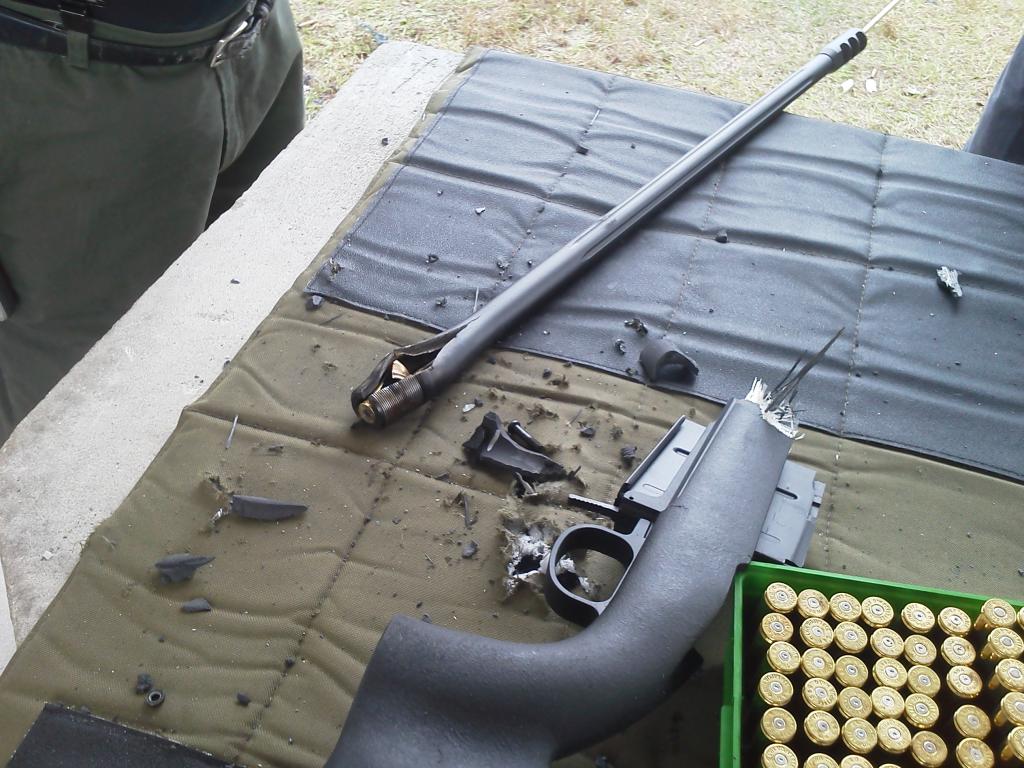
Discharging a .338 Lapua Magnum round with a cleaning rod in the barrel — that’s a recipe for disaster. What happens when a fired .338 caliber bullet and a cleaning rod try to occupy the same place at the same time? Well you get a catastrophic kaboom, with metal pieces flying all over the place, and a shooter very lucky to escape without serious injury. This incident occurred recently in Manatee, Florida, as reported by Sniper’s Hide member Queequeg. We thank SnipersHide.com for granting permission to publish these revealing images in the Daily Bulletin.
This story should serve as a chilling reminder to follow proper safety practices whenever you are at the range. Always check to make sure there is no obstruction in the bore BEFORE loading a live round.
.338 Lapua Magnum + Cleaning Rod + Inattention = Kaboom!
Kaboom at Manatee!
A while back, Sniper’s Hide member Queequeg published shocking photos of a catastrophic kaboom involving a .338 Lapua Magnum (Savage action). The action was blown off the rifle, shrapnel went through the roof, and the barrel split at the tenon before taking an excursion downrange. The action did crack in the front but the lugs remained engaged so the bolt did not slam to the rear (luckily for the shooter).
Here’s the report: “This happened [January 20, 2014] at the Manatee Gun and Archery Club. Al, Ren and myself were there with a couple other folks. Ren was at bench 12, I was at 13. The fellow at 11 was running a Savage .338 Lapua. He had a very bad day! He damn sure could have killed himself and quite likely Ren as well.”
Queeqeg added: “After the boom, I heard Ren ask ‘Are you alright’ and then turned to look in time to see the fellow reacting in total shock — literally stunned. Ren and I went over to him and could not see any major injuries. Ren was uninjured as well but had a lot of fiberglass splinters on him. The barrel nut is what I presume punched the two holes in the roof. The shooter is a regular there[.] He had been having a problem with sticky cases though he said he was certain the loads were mild. That’s why he was content to knock the sticky ones out with the rod. He simply forgot to remove the rod after knocking out the last stuck case. You can see what happened next.”
The Important Lesson Here
What did the .338 LM shooter do wrong here? You will say — “Well that’s obvious, he left a cleaning rod in the barrel and then shot a round.” Yes, that was a potentially fatal error. But that was his second mistake — one that occurred only because he made a more fundamental judgment error first.
The FIRST mistake was not acknowledging the problem with his ammo. Had he heeded the warning signs, he would still have a rifle (and an unsoiled pair of trousers). When he first observed that he was having problems with extracting cases, a warning light should have gone off in his head. Presuming his extractor was not broken (and that the chamber was cut properly) he should have been able to extract his brass if he was running safe loads. The lesson here we all need to learn is that if you observe a serious ammo-related issue, it is time to stop shooting. Don’t try to invent work-arounds just to extend your range session, when there are clear signs that something is wrong, very wrong.
This past Saturday, April 2nd, the Hickory Groundhog Shoot was held in Vale, North Carolina. One of the nation’s most popular varmint competitions, the Hickory Shoot offers a host of valuable prizes. Here’s a report from Jonathan Trivette, who attended the Hickory Shoot for the first time this year.
A First-Timer’s Experience at the Hickory Shoot, by Jonathan Trivette
The Bullseye Groundhog Shoot, aka The Hickory Shoot, is one of the most unique groundhog shoots that I have ever attended. This event, held the first Saturday of April every year, is very well-organized — it runs like clockwork. This year was my first time attending this Shoot and I was impressed. There were 215 shooters and the match was over by 1:00 pm. After the main match they sell chances to shoot at an egg at 500 yards. Shooters that hit the egg receive a cash award and get their name on the Egg Hall of Fame Perpetual Trophy.
The shoot starts at 8:00 am and you are allowed to sign up the day prior and that morning until the match starts. The range is open the week prior to the match for practice so you can get familiar with the venue. The match has two classes: Custom (Open) and Factory. Entry fee is $25.00 per gun. The Custom Class permits any gun and caliber you would like to use and you can use most any type of rest. Some of the Custom Class guns can weigh 40 pounds or more. The Factory Class is limited to factory guns, and the only rest(s) you are allowed are bi-pods and sandbags. This year Clifton Odell won the Custom Class with a 95 score while Kevin Philbeck won the Factory Class with a 75 Score.
The scoring is done in a different fashion than what I am used to but it works and eliminates any debate as to shot score value. A shot must fall completely inside a scoring ring in order to count as that score — it cannot touch the next farther ring at all. [Editor: The Hickory employs “worst-edge” scoring, meaning if you cut a scoring line you get the next lower score.]
Back in 2010, father and son Terry Brady (L) and Chris Brady (R) topped the Custom Class:
The Hickory Groundhog and Egg Shoot is the richest varmint shoot East of the Mississippi. The 36th annual Hickory Shoot was held this past weekend. The event is hosted the first Saturday of April each year by Larry Willis of Bull’s Eye Sporting Goods, (704) 462-1948.
In years past over $7,000 worth of prizes and cash has been awarded. The normal course of fire consists of three sets of paper groundhog targets at 100, 300, and 500 yards, and NO Sighters. Shooters can also compete in an Egg Shoot for cash and other prizes. The basic entry fee is just $25.00 per gun. That’s cheap for a chance to win a bundle of cash, plus valuable prizes such as Shehane stocks and Nightforce optics.
Hickory Shoot Course of Fire
The course of fire is three (3) shots at the groundhog target from the prone position at three different distances, 100, 300, and 500 yards. They do have a bench for handicapped shooters that can not get down in the prone position. Most competitors will shoot at the head at 100 yards because the points are higher. The other two distances that are normally shot are 300 yards and 500 yards.
Relays Run Like Clock-Work
The shoot is run very smoothly with one relay shooting while the next relay waits outside the shooting area, ready to go. Once a relay is done, shooters grab their items and exit on one end of the shooting platform while the next relay comes in from the other end. You must quickly set up and get ready because as soon as the target pullers get back they are ready to shoot. When the fire command is given you have two minutes to get your three shots off at that distance. When the cease fire is called you quickly grab your gear and get off the shooting platform because the next relay is coming in.
Acknowledging the Winners
At the prize ceremony Larry Willis presents the awards to the top shooters. He also acknowledges the Junior Shooters and even gives out prizes for best-looking male and female shooter and who drove the farthest. I had a chance to speak with Larry after everything was over on Saturday and you could tell that he really enjoys being able to put on this event for his fellow shooters. So whether you are looking to kick off your groundhog season or your summer shooting season, if you find yourself looking for something to do the first Saturday of April next year, make the trip to Vale, North Carolina for the annual Groundhog Shoot. The range is located at 8216 Will Hudson Road, Lawndale NC 28090.
Nielsen-Kellerman (NK), makers of Kestrel® Weather Meters, has launched a new website, www.KestrelBallistics.com. The new mobile-friendly site features a Schoolhouse section with a wide range of information for long-range shooters of all skill levels. There you’ll find “How-To” guides and technical articles by respected ballistics and firearms experts. Along with the Schoolhouse, and a resource section offering free downloads of technical manuals, NK’s new Ballistics website will feature a webstore where customers can purchase long-range shooting accessories such as scopes, range finders, weather vanes, and Kestrel weather/ballistics meters. Along with Kestrel products, the eStore will offer Bushnell optics, MagnetoSpeed chronographs, and Accuracy 1st Ballistic Solvers.
The Schoolhouse resource offers articles from Kestrel’s own experts as well as Kestrel’s industry partners Applied Ballistics and Accuracy 1st. The purpose of the Schoolhouse section is to provide up-to-date information about industry advances and new techniques, as well as to provide comprehensive, detailed “how-to” guides for owners of Kestrel Weather Meters and Ballistics Calculators. Shown below is the Schoolhouse section that explains how to set up a Kestrel.
“As Kestrel has progressed in the long-range shooting space, we have seen that there is a real thirst for knowledge among long-range shooters. Just as we never ship a product without ensuring that it will provide accurate, reliable information, we will ensure that KestrelBallistics.com only contains articles, advice and products that customers can rely on. We are truly enjoying expanding our customer offering in this area.” stated Nielsen-Kellerman CEO, Alix James. NK’s new Ballistics site provides information and resources that can benefit all long-range shooters, whether they are primarily interested in hunting, competitive, or tactical shooting.
Federal Ammunition is releasing a new line of range ammunition with polymer-encased projectiles. American Eagle Syntech is the first range-specific factory-loaded ammunition designed to reduce fouling and extend barrel life with a high-tech polymer bullet coating plus specially-formulated clean-burning powders. The potential for reduced wear and fouling is real — when tested against conventional FMJ ammunition, Federal claims Syntech produced an average of 12% less barrel friction and 14% less heat. Also, since Syntech bullets lack a metal jacket, there is less chance of ricochets on steel targets. Initially, three (3) types of Syntech ammo will be offered: 9mm Luger (115 grain); 40 S&W (165 grain); and .45 ACP (230 grain).
For years this Editor has loaded his .45 ACP and .44 Mag handguns with polymer/moly matrix-coated bullets from Precision Bullets in Texas. Those poly/moly-encased lead bullets shot VERY accurately and I found that my barrels fouled much less than with conventional lead bullets. Likewise, there was much less cylinder fouling on my revolvers. If the American Syntech bullets work as well as those Precision bullets, I think the Syntech line will be a winner. Syntech bullets should benefit any shooter who frequents a range where lead ammo is not allowed.
Features & Benefits
• Polymer-encapsulated Syntech bullet prevents metal-on-metal contact in the bore, eliminating copper and lead fouling, while extending barrel life.
• Exclusive primer formulation provides reliable, consistent ignition.
• Clean-burning propellants minimize residue and fouling.
• Significantly reduces the required frequency of cleaning.
• Absence of a copper jacket minimizes splash-back on steel targets.
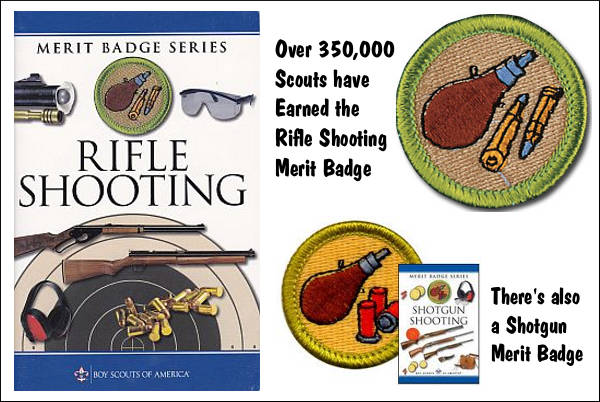
Last year 43,196 young Americans earned a very special marksmanship distinction. Can you guess what that was? Here’s a hint — the award helps a young person become an Eagle Scout. That’s right, last year 43,196 Boy Scouts earned the Marksmanship Merit Badge for rifle shooting. This is one of the toughest badges to earn, according to Scouting leaders, but it is still one of the most popular badges among Scouts — it fact it is the second most earned elective merit badge. Since 1910, over 350,000 Scouts have earn Rifle Shooting Merit Badges. Millions more have participated in Boy Scout Shooting programs. Merit badges are offered for both Rifle Shooting and Shotgun shooting.
Mark Keefe, editor of the American Rifleman explains: “According to Scouting magazine, the Rifle Shooting Merit badge was number two of the non-required badges earned by all Boy Scouts cross country last year with 43,196 Rifle Shooting merit badges sewn on sashes. Since 2009, again according to Scouting, nearly 350,000 Rifle Shooting merit badges have been earned. That’s a lot of merit badges — and a lot of .22 Long Rifle downrange.”
The Marksmanship Merit Badge has been offered by the Boy Scouts of America (BSA) since the first Boy Scout Handbook in 1910. Keefe explains: “Back in 1910 to earn the ‘Marksman’ Badge of Merit, you had to ‘Qualify as a marksman in accordance with the requirements of the National Rifle Association.’ And NRA and the BSA of have had a strong partnership for more than a century, and both organizations remain committed to teaching firearms safety and marksmanship.”




 Acknowledging the Winners