In one of the closest margins of victory ever, Gene Bukys won the Two-Gun Overall Aggregate at the Kelbly’s Fireams Industry Super Shoot (FISS). Gene’s final Two-Gun Agg was 0.2728, with Jeff Gaidos just .0001 behind at 0.2729. That’s about as close as it can get, and other shooters were not far behind. In third place, at 0.2765, was Jeff Summers, followed by Tony Boyer (0.2827) and Larry Costa (0.2924). Looking at the numbers, only 0.0196 separated the Top Five in the Two-Gun.
Two-Gun Overall, Top 20
1. Gene Bukys, 0.2728
2. Jeff Gaidos, 0.2729
3. Jeff Summers, 0.2765
4. Tony Boyer, 0.2827
5. Larry Costa, 0.2924
6. Bob Scarbrough, Jr., 0.2943
7. Wayne Campbell, 0.2989
8. Lou Murdica, 0.3020
9. Steve Theyes, 0.3078
10. Larry Sharnhorst, 0.3104
11. Ken Hottenstein, 0.3111
12. Joe Hynes, ).3121
13. Dave Coots, 0.3123
14. Cristian Rando, 0.3140
15. Bud Welsh, 0.3193
16. Jeff Graves, 0.3253
17. Geoff Esterline, 0.3254
18. Dean Ekstrom, 0.3315
19. Dave Bruno, 0.3326
20. Bob Brushingham, 0.3339
Conditions were very challenging throughout most of the Super shoot, with strong and often fast-changing winds. Jerry Sharrett posted: “We had some interesting conditions. By the ends of the aggs many of the tails were caught up in the Daisies. For example, during the HV 200 in bench 9 the last three flags were bound up and useless. And many of the front flags, [were the] same way, especially on the right end.” Here is an audio recount of Days 1 through 3 by Ian Kelby (right click to “save as”):
Fellow Shooters Praise Winner
Here are some comments posted on Benchrest Central.com:
“Congratulations to all of you guys in the top 20, especially to the Grand Master from Texas. Special congrats to my friend Dr. Cristian Rando from Buenos Aires, Argentina, shooting his Argentine CGM1 Thunderbolt, made by gunsmith Carlito Gonzalez.” — Pascal Fischbach
“Congratulations to the great Gene, this guy understands the [wind] conditions and rifle tuning better than anybody.” — Carlos Gonzalez
“A close margin of victory in any sport is a true indicator of the level of competition. In Track and Field,it would be called a ‘photo finish’. The best effort won a hard-fought match. It will be remembered because the margin was so close: 0.0001.” — G. Chism
“I ran the Blue Bonnet match earlier this month and from the range officer’s seat, was fortunate to observe Gene at his best. He just sits and waits for his preferred condition and then just rips off five in about thirty seconds. From his past performances in the last few years, he continues to cement a great legacy in the benchrest world.” — Virf
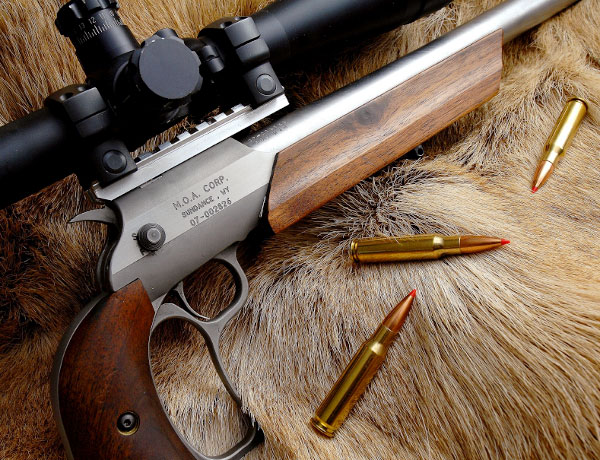
The 7th Annual MOA Cold Turkey Long Range Handgun Match will be held June 20-22 in Sundance, Wyoming. This is a 3-day Specialty Handgun competition with targets at 500, 750, and 1,000 yards. On the firing line, you’ll find a variety of precision handguns including the Remington XP-100, Savage Striker, MOA Maximum, Freedom Arm’s New Single-shot, as well as numerous custom and semi-custom rigs (typically set up with a 14″ to 18″ barrel, and muzzle brake). Popular cartridges include .243 AI, 6×47 Lapua, 6mm-284, and 6.5-284 Win. While many shooters use pistol scopes, in recent years, many competitors have switched to igher magnification rifle scopes. Sundance-based lead sponsor MOA Corporation is a respected maker of Specialty Handguns for hunting and target shooting.
Over the years, the MOA Specialty Handgun event has expanded to include new disciplines. There is now an IHMSA-style Freestyle pistol event, shot for group at 500 yards with categories for both iron (metallic) sights and scoped optics. In addition there is a popular “Roving Field Course” competition. This is a hunting-stalking-tactical style event shot on steel at distances generally from 300 to 600 yards. This Roving Field Course event is open to both individual and two-man shooter/spooter teams. You can use ANY handgun or optics type and any technologies to range targets and gauge wind speeds.
Two-Day Prairie Dog Shoot Before MOA Handgun Match
In conjunction with the MOA Shoot, on June 17-18, Ernie Bishop will host a two-day Prairie Dog shoot near Gilette, Wyoming. Located on a private ranch with a large prairie dog population, this shoot will afford a target-rich environment that is only occassionally hunted. This is open to pre-registered, paid participants for the MOA Long Range Handgun Match. The donation of $50 per shooter (covers both days) goes entirely to the landowner, as our token thank you for his generosity in allowing us access for this 2-day event. This is a fraction of what it would cost to go on a two-day PD Safari with a professional guide service. For more info, send email to ernieemily[at]yahoo.com or call Earnie at (307) 257-7431 (9:00 am – 6:00 pm Mountain Time).
To celebrate its 90th anniversary, Lapua invited six of its shooting team members to visit the firm’s ammunition factory in Lapua, Finland. The team members hailed from six countries around the world: Kevin Nevius (USA), Eva Friedel (Germany), Josselin Henry (France), Charlotte Jakobsen (Denmark), Kim-Andre Lund (Norway), and Peter Sidi (Hungary). Watch the video to follow these six shooters as they tour the Lapua ammo factory, and then compete in a 100m/600m fun match at Lapua’s test range.
See Lapua Ammunition Factory from the Inside
After being greated by Nammo Lapua CEO Raimo Helasmäki, the six lucky shooters got to tour production facilities, visit the old cartridge factory museum, and share ideas with Lapua R&D engineer Tommi Tuuri. The engineer observed: “No matter how much you calculate, there are always some surprises — things you can only know from the test runs.”
Competition at 100m and 600m
The trip finished with a friendly “bragging rights” match at Lapua’s own Ampumarata Shooting Range. These six champions had to quickly master two very different rifles, a Panda-actioned 6PPC benchrest rig for 100m and a SAKO TRG-42 in .338 Lapua Magnum for long range (600m). Kim-Andre Lund from Norway won the benchrest match with a 0.157″ (3.98mm) group. Not bad for a position shooter not familiar with this kind of gun, or this rest configuration. Kim observed: “I think maybe I’m in the wrong discipline, maybe benchrest is the thing for me”. Check out his target at right.
The USA’s own Kevin Nevius posted the top score with the big .338 LM. Kevin had a great time: “I’m a bonafied gun nut… so to come to a factory that manufactures ammunition is a dream come true.”
This video features a factory walk-through showing bullet-making, cartridge forming, and bullet packaging. Near the end (at 5:40 time-mark) is a fascinating sequence showing the high-speed robotic arms that pick loaded ammunition from the assembly line.
Beautiful Lapua 6.5-284 brass awaits packaging and shipping.
Hornady has received an inaugural Gold Predator Xtreme Readers’ Choice Award for its Superformance® Varmint™ 17 Hornet Rifle Ammunition. The 17 Hornet is currently available in 15.5gr NTX® and 20gr V-MAX™ offerings.
Hornady’s 17 Hornet employs Hornady Superformance® propellant technology. Hornady claims that, in the 17 Hornet, its Superformance powders can deliver 100 to 200 fps more velocity than other commercially-available propellants. As a result, Hornady’s Superformance® Varmint™ ammunition shoots flatter, drifts less in the wind, and retains more energy out to a practical range of 300 yards. And many varminters have praised Hornady’s low-recoil 17 Hornet, saying this new cartridge is economical, accurate, and fun to shoot. 17 Hornet ballistics are far superior to the 17 HMR, as you can see:
Hornady’s 17 Hornet was derived from the 22 Hornet parent case. Claimed velocity with 20-grainers is 3650 fps — an impressive number considering the 17 Hornet uses about half the powder of the 17 Remington. The 17 Hornet is based on the rimmed .22 Hornet case. However, the case is not just necked-down from .22 caliber. The case designers reduced body taper, moved the shoulder, and changed the shoulder angle to 25°. This effectively modernizes the old .22 Hornet case, improving efficiency while retaining the max OAL, so that the 17 Hornet can work in any action big enough for the .22 Hornet.
Predator Xtreme Readers’ Choice Award
The Predator Xtreme Readers’ Choice Awards, sponsored by Predator Xtreme magazine, honors the best new products for varminters and predator hunters. A Gold award is the highest honor bestowed in a number of shooting categories. Products are chosen for award recognition based on surveys of magazine readers, so this is truly an “people’s award”.
The 2013 MidwayUSA NRA Bianchi Cup is in the books. Congrats to the Top Guns of the men’s division: Doug Koenig First Place (center), Carl Bernosky Second Place (left), and Bruce Piatt Third Place (right). Though Koenig finished on top, we have to credit Carl for his versatility. Bernosky is the reigning (and 10-Time) NRA High Power Rifle National Champion. Few humans can rival Carl’s skills with a rifle, and he’s just proven that he is one of the very best with a pistol as well.
54 county sheriffs in Colorado are leading the fight to overturn anti-gun legislation recently passed in Colorado, filing a federal lawsuit in the U.S. District Court for Colorado. The NSSF, the Colorado Outfitters Association, Magpul Industries, and firearms retailers have joined the Sheriffs in a broad-based legal challenge to Colorado’s recently enacted gun-control laws. Notably, all but 10 of the state’s 64 sheriffs, who are elected officials, have joined the suit as plaintiffs.
“From the perspective of the sheriffs this legislature had an agenda rather than good public policy in mind when they rushed these bills through and in this rush to pass new laws they didn’t bother listening to the people charged with enforcing them,” explained Weld County Sheriff John Cooke.
“In addition to Constitutional infringements and unenforceable requirements regarding magazine capacity, as the sheriffs have pointed out, we believe it will be impossible for citizens to comply with mandated firearms ‘transfers’ through federally licensed retailers,” said Lawrence G. Keane, NSSF Senior Vice President and General Counsel. “Colorado’s federally-licensed firearms retailers are being asked to process these transfers as if they were selling from their own inventory and to monitor both seller and buyer through a state-administered check process that can take hours or even days. They will not be able to recoup the actual cost of providing the service, which is capped at $10, but they will be liable for paperwork errors and subject to license revocation. For this reason and the many others detailed in our joint action with our fellow plaintiffs, these laws need to be struck down,” Keane said.
Another long-range benchrest record was set recently — this time at the Williamsport Range in Pennsylvania. On Saturday, May 18, 2013, Paul Martinez shot a fantastic 3.505″ 10-shot group at 1000 yards. It was nicely centered for a 99-6X score as well. Paul’s 3.505″ group should be a new 10-shot record for the 17-lb Light Gun Class under Williamsport Rules. The previous best was a 3.746″ (99-1X) group shot by Scott Weber at Williamsport last summer. Congrats to Paul for some great shooting!
Paul’s 17-lb Light Gun was chambered as a .300 WSM and Paul was loading heavy-weight .30-caliber Berger bullets. Paul’s rifle was smithed by Eric Springman of Springman Rifles in Allenwood, PA. Paul’s record-setting rifle featured a Borden action, Krieger barrel, McMillan MBR Tooley stock, and Nightforce Benchrest model scope (we don’t know if this was the old BR scope or the new-for-2013 version). Eric Springman notes: “This was not a fluke — Paul has shot several small groups with this gun and has shot under 4″ at 1000 yards before.”
Under Williamsport Rules, the Light Gun Class shoots 10-shot groups at 1000 yards. Under IBS and NBRSA Rules, Light Guns shoot 5-shot groups at 1000 yards, so there is no comparable IBS or NBRSA 10-shot record for the 17-lb class. However, IBS and NBRSA Heavy Guns DO shoot 10-shot groups at 1000 yards. The current IBS Heavy Gun 10-shot record is 3.044″, shot by Joel Pendergraft in 2009. The NBRSA 10-Shot Heavy Gun record is 4.322″ by Dave Tooley, posted in 2006. Looking at those numbers, Paul Martinez’s 3.505″ beats the existing NBRSA HG record by 0.817″ and Paul’s group is just 0.461″ off the IBS HG record. Any way you look at it, that is great shooting with a 17-lb rifle.
The 2013 35th Annual NRA Bianchi Cup National Championship kicks off today, May 22nd in Columbia, Missouri, and runs through May 25th. This prestigious event draws shooters from all over the world. Along with the USA, competitors have come from Australia, Canada, Germany, Italy, Japan, Luxembourg, Netherlands, New Zealand, Russia, and Switzerland.
Categories include: Open Division, Metallic Sights, Service Pistol, and Revolver. In addition there be awards for the top shooters in specific classes: Law enforcement, Women, Junior, International, Newcomer, Senior, Grand Senior. One of the favorites in the Women’s Division this year is Jessie Duff, shown competing with one of her Bianchi Cup custom rigs. Jessie’s pistol sports special brackets to help steady the gun during barricade shots.
Bianchi Cup — Classic Four-Stage Course of Fire
The MidwayUSA/NRA Bianchi Cup is a combination of Speed and Accuracy. Competitors shoot from both standing and prone positions and are also required to shoot with both strong and weak hands at various stages. Stages may combine stationary and moving targets. As conceived by former police officer and holster-maker John Bianchi, the Bianchi Cup originated in 1979 as a Law Enforcement Training match. The Course of Fire consists of four separate matches:
The Practical Event: From the appropriate shooting line, the shooter fires at distances from 10 yards to 50 yards under varying time limits.
The Barricade Event: From within shooting boxes and behind barricades, a shooter fires at targets on either side of the barricade at different distances and under varying time limits.
The Falling Plate Event: From the appropriate shooting line, the shooter fires at 8 inch round steel plates arranged in banks of six at distances from 10 to 25 yards under varying time limits.
The Moving Target Event: From within shooting boxes at distances ranging from 10 to 25 yards, the shooter fires at a target moving from left to right with the target being exposed for only 6 seconds.
From now on, California will require all new-model semi-automatic handguns to be manufactured with microstamping technology (aka “ballistic imprinting”). This requirement went into effect on May 17th, when the California Attorney General’s office declared that technical and patent barriers to the implementation of microstamping had been removed.
To make a firearm compliant, firearms manufacturers must now engrave a gun’s make, model, and serial number on two distinct parts of each gun, including the firing pin, so that, in theory, this data is imprinted on the cartridge casing when the pistol is fired. If the microstamp on the end of the firing pin wears out, then the gun is considered “unsafe” under California law, and the owner may not sell or transfer the gun.
California’s microstamping law was enacted way back in 2007. However, by its terms, the law did not go into effect until the technology was mature and patent rights were resolved. With the State government claiming that microstamping is now practical, new gun models must have microstamping capability in order to be approved for civilian sale in California. This will, eventually serve as a de facto ban on new-model semi auto handguns in California. Brandon Combs, Executive Director of the Calguns Foundation, explains: “Manufacturers are not going to create a special run of firearms with all of these very burdensome manufacturing technologies just so they can comply and produce firearms for one market.” At present, as far as we can determine, no major gun-maker currently offers a microstamping-capable, semi-auto handgun for sale in the United States — not a single one.
Current “California-Approved” Semi-Auto Pistols Can Still Be Sold — For a Time
The “activation” of California’s microstamping requirement does NOT mean that semi-auto handguns currently on the California “approved” list can no longer be sold. The current inventory of “approved” handguns are “grandfathered”, so they may be sold so long as the manufacturers continue to pay annual handgun roster registration fees to the State of California. However, any new-model semi-auto pistol — even one with a minor design change from a previous version — will be blocked from sale in California unless it has the microstamping feature. If a manufacturer stops producing a particular handgun, replacing it with a newer, upgraded version, that newer model cannot be sold in California unless it is microstamp-capable. (We should add that the microstamp requirement does not apply to handguns sold to law enforcement agencies.)
What we can expect is that, in time, as handgun manufacturers replace old models with new models (or make modifications to existing models), fewer and fewer new semi-auto pistols will be offered for sale in California. If, for example, Glock updates its Glock 17, the new model could not be sold in California unless Glock outfits it with microstamping capability.
NRA Plans Legal Challenge
NRA Attorney C.D. Michel says that microstamping is a flawed and impractical technology: “This is not going to help solve crimes. [Microstamping] is easily defeated… and can be used to lead police down false alleys.” Michel notes that criminals can easily defeat the microstamp by filing the tips of firing pins. Overall, Michel believes, microstamping will not reduce crime, but it will cut off the supply of handguns available to Californians. He stated the the NRA plans a legal challenge to the implementation of microstamping in California.
While there is virtually no “real world” evidence that microstamping has ever solved actual crimes, there are many important criticisms of the “ballistic imprinting” technology:
Stamped casing can only be traced to the last registered owner, not to the person who used the gun when the casings were stamped. In the case of a stolen gun, as is the case for most firearms used in crime, the stamped case would not lead to the criminal.
Criminals could collect discarded brass from a firing range and salt crime scenes with microstamped cases, thereby providing false evidence against innocent people and increasing the workload for investigators.
Microstamping is easily defeated. Inexpensive files will remove microstamping. Firing pins are normally replaceable and can be changed with simple tools or without tools. Firing a large number of rounds will wear down the microstamp.
Microstamping is an immature technology, and has not been subjected to sufficient independent testing. Transfer of microstamped marks to the cases is less reliable than proponents claim.
Many readers will be driving across multiple states this summer to attend competitions. Other shooters will be heading out of state for a game hunt or prairie dog safari. For $13.95 you can purchase a state-by-state Traveler’s Guide to firearms laws. This book can help ensure you comply with all state laws during your trip. Highways Magazine states: “If you carry a weapon in your rig, you need this book.” This 68-page guide covers all firearms types and all 50 states. It even has info for Canada and Mexico. The latest edition of the Traveler’s Guide, updated with 50 changes for 2013, is now shipping.
The Traveler’s Guide to the Firearm Laws of the Fifty States has sold more than 950,000 copies since it was first released in 1996. The book’s author, Attorney J. Scott Kappas, has written numerous magazine articles and has appeared on television, explaining the unexpected pitfalls that shooters may encounter when traveling with firearms. Along with being an attorney, Mr. Kappas serves as a director on the Board of the Kentucky Firearms Foundation, and Kappas is a Class III firearms dealer.
The Traveler’s Guide is especially useful for shooters traveling in RVs and motorhomes. The American Rifleman Magazine declared: “This book is a must-have for truck drivers, motor home enthusiasts, campers and other travelers…easy to read and understand, well-organized and concise….” One reader from Texas adds: “I used to think that my RV was the same as my home when it came to gun carry….the Traveler’s Guide set me straight. Now I know my motorhome is subject to the same laws as any vehicle when it comes to guns.”




 Competition at 100m and 600m


 Hornady has received an inaugural Gold Predator Xtreme Readers’ Choice Award for its Superformance® Varmint™ 17 Hornet Rifle Ammunition. The 17 Hornet is currently available in 15.5gr NTX® and 20gr V-MAX™ offerings.


 54 county sheriffs in Colorado are leading the fight to overturn anti-gun legislation recently passed in Colorado, filing a federal lawsuit in the U.S. District Court for Colorado. The NSSF, the Colorado Outfitters Association, Magpul Industries, and firearms retailers have joined the Sheriffs in a broad-based legal challenge to Colorado’s recently enacted gun-control laws. Notably, all but 10 of the state’s 64 sheriffs, who are elected officials, have joined the suit as plaintiffs.


 The 2013 35th Annual NRA Bianchi Cup National Championship kicks off today, May 22nd in Columbia, Missouri, and runs through May 25th. This prestigious event draws shooters from all over the world. Along with the USA, competitors have come from Australia, Canada, Germany, Italy, Japan, Luxembourg, Netherlands, New Zealand, Russia, and Switzerland.
 Categories include: Open Division, Metallic Sights, Service Pistol, and Revolver. In addition there be awards for the top shooters in specific classes: Law enforcement, Women, Junior, International, Newcomer, Senior, Grand Senior. One of the favorites in the Women’s Division this year is Jessie Duff, shown competing with one of her Bianchi Cup custom rigs. Jessie’s pistol sports special brackets to help steady the gun during barricade shots.
 From now on, California will require all new-model semi-automatic handguns to be manufactured with microstamping technology (aka “ballistic imprinting”). This requirement went into effect on May 17th, when the California
 Many readers will be driving across multiple states this summer to attend competitions. Other shooters will be heading out of state for a game hunt or prairie dog safari. For $13.95 you can purchase a state-by-state
 The Traveler’s Guide to the Firearm Laws of the Fifty States has sold more than 950,000 copies since it was first released in 1996. The book’s author, Attorney J. Scott Kappas, has written numerous magazine articles and has appeared on television, explaining the unexpected pitfalls that shooters may encounter when traveling with firearms. Along with being an attorney, Mr. Kappas serves as a director on the Board of the Kentucky Firearms Foundation, and Kappas is a Class III firearms dealer.


