The latest edition of the CMP’s On The Mark magazine contains a good article on firearms safety. While this story was written primarily for junior shooters, it offers good advice for shooters of all ages and skill levels. Here are some of the key recommendations:
1. Self-Discipline and Focus. Gun safety is not a matter of learning safety rules and then assuming you will always be safe with guns. Gun safety requires that you consciously practice safe muzzle control, check for open actions and keep your fingers outside of the trigger guard every time you handle a gun. That requires self-discipline and focus. You must discipline yourself to always pay attention to safety — for yourself and for those around you.
2. Everyone Is a Safety Officer. In an emergency when a safety hazard occurs or when someone in your presence does something unsafe with a gun, you can and must become an “Emergency Safety Officer.” If you see someone close the action on a gun or fail to open the action of a gun while handling it, it is necessary for you to step in and make sure the action is opened.
3. MAT — Muzzle, Action, Trigger. An easy way to remember the Rules for Safe Gun Handling is to use the key word MAT. MAT stands for Muzzle-Action-Trigger. Whenever you handle a rifle always start by controlling the MUZZLE. Next think about the ACTION — when handling any rifle or firearm, the action must be open with a CBI (Clear Barrel Indicator), ECI (Empty Chamber Indicator) or OBI (Open Bolt Indicator) inserted. Finally remember “T” for TRIGGER. Keep your finger off of the trigger until after placing the gun in the shooting position and preparing to fire a shot. It is especially important to keep the finger outside of the trigger guard when loading the gun and placing it in the shooting position.
Other CMP Safety Instruction Resources:
Junior Shooter’s Guide to Air Rifle Safety, NLU # 741. This 20-page booklet is written for
junior air rifle shooters, but it provides safety rules, procedures and guidelines that can be
used by youth or adult shooters in any range firing situation.
CMP Rifle Safety Guide, NLU #744. This 32-page booklet is written for owners of CMP rifles. This guide includes safe gun handling rules and safety guidelines, explains how the rifle operates, range safety rules, how to deal with special problems, tips for accurate shooting, proper care of your rifle and CMP Programs for new rifle owners.
Rifle Safety & Marksmanship Training CD-ROM, Item # 772. This CMP produced CDROM is designed for use by coaches, instructors and youth who are teaching or learning target rifle shooting. It presents a complete basic rifle marksmanship course plus an impressive array of additional resources. Order through the CMP eStore.
How to Receive On The Mark On The Mark is published quarterly by the Civilian Marksmanship Program. A typical issue of On The Mark includes 16-24 pages of new junior shooting program information as well as news about junior events, instructional tips and coaching information. One free On The Mark subscription is provided to each CMP-affiliated junior club, JROTC unit with marksmanship programs, and 4-H Shooting Sports Club. Individual subscriptions to On The Mark are available for $8.00 per year. To subscribe, download the OTM Order Form.
The state of New York has activated its online registration service for owners of semi-automatic firearms that have been re-classified as “Assault Weapons” under New York’s SAFE Act. We put that term in quotes because the same firearms, such as AR-platform rifles, are legal to own, with few restrictions, in most other U.S. states. New York owners of newly-restricted semi-automatic rifles, pistols, and shotguns have one year from today to register their firearms. Failure to register a newly-defined “assault weapon” by April 15th, 2014 is punishable as a Class A Misdemeanor, with forfeiture of the firearm(s).
If you are a New York gun owner with firearm(s) that may be covered by the SAFE Act, you should read the statute carefully and possibly consult with an attorney if you have questions about your legal obligations. There are many confusing provisions in the new law, but primarily the law requires registration of any auto-loading firearm (pistol, shotgun or rifle) that takes a detachable magazine and has any one or more “evil” features, which are separately enumerated for pistols, rifles, and shotguns. Click these links to read the exact list of banned features.
New York has issued a non-exhaustive list of rifles classified as “assault weapons”. However, even if you don’t see your rifle on this list, it may still be restricted. Under the SAFE Act, ANY semi-automatic rifle “capable of receiving a detachable magazine” is considered an “assault rifle” if it has any ONE or more of these “military characteristics”:
Grenade Launcher
Folding Stock
Thumbhole Stock
Protruding Pistol Grip
Second handgrip or “protruding grip that can be held by the non-shooting hand”.
Bayonet Mount
Flash Suppressor
Muzzle Brake
Muzzle Compensator
Threaded barrel “designed to accommodate” Brake, Suppressor, or Compensator.
In addition to the new registration requirement, the sale and/or transfer of newly-defined “assault weapons” is banned within the state, although sales out of state are permitted. Possession of the newly-defined “assault weapons” is allowed only if they were possessed at the time that the law was passed, and they must be registered with the state within one year (of today) by the owner. The SAFE Act grandfathers the prior ownership of “assault weapons”, but requires that they be registered with the NY State Police by April 15, 2014 — plus they must be recertified every five years. More information can be found at www.Renzullilaw.com.
Bigger is Better?
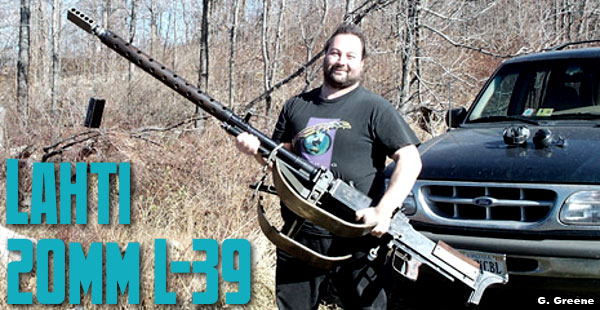
Yes, size matters — at least when it comes to gun safes. Is your current safe bursting at the seams with your ever-growing firearms collection? Perhaps you need a little more vertical clearance for your Lahti L-39 or favorite Punt Gun? Well Superior Safe Co. has a solution for you — a humongous safe that stands 10-feet tall and weighs more than a pick-up truck. For reference, the young man in the picture, Greg from Pyramyd Air, is an honest 6’3″ tall.
Sized Right — For a 7-Footer
Now if you’re not an NBA center, the lock placement on this jumbo safe is not very practical. We note that the keypad is a good foot above Greg’s head, making access somewhat difficult for the “vertically challenged” customer. We’re not sure what Superior Safe hand in mind there — unless this mega-safe was really created for Shaquille O’Neal or Yao Ming. Still, Americans love big stuff — big cars, big houses, and, of course, big guns. At least if you purchase one of these monsters, you’ll have the peace of mind that a smash-and-grab thief can’t roll it away on a hand dolly. Superior Safe, which displayed this yellow giant at last year’s NRA Annual Meeting & Exhibits, explains that this is a “custom model” not on the normal price list — face it, if you need to ask about the price, you can’t afford it. Joking aside, if you really need this kind of capacity for a firearms collection (with a punt gun or Lahti), you’d be wise to consider a custom walk-in vault, built into a room in your house. (Safe photo courtesy Pyramyd Air.)
What is a Punt Gun? A punt gun is an extremely large shotgun used in the 19th and early 20th centuries for shooting large numbers of waterfowl for commercial harvesting operations and private sport. Punt guns could have bore diameters exceeding 2 inches (51 mm) and fire over a pound of shot at a time. A single shot could kill over 50 waterfowl resting on the water’s surface. Punt guns were too big to hold so they were often mounted directly on the punts (boats) used for hunting, hence their name. Generally the gun was fixed to the punt, requiring the hunter to manuever the entire boat to aim the gun. Firing the gun often propelled the punt backwards from recoil. Sometimes fleets of punt gun-boats were used together. In the United States, this practice depleted stocks of wild waterfowl and by the 1860s most states had banned the practice. In the United Kingdom, a 1995 survey showed fewer than 50 active punt guns still in use. UK law limits punt guns to a bore diameter of 1.75 inches (1 1/8 pounder). Learn more at Wikipedia.com.
Lahti L-39 photo, courtesy Gordon Greene, originally appeared in The Gun Zone.
The 2013 17th Edition of the CMP Competition Rules for Service Rifle, Service Pistol and As-Issued Military Rifle shooting are now available in digital and print formats. The new rules went into effect last month.
Substantive rule changes from the 16th Edition and any new rules are underlined so that they can be readily identified. The new rulebook can be downloaded from the CMP website. Printed copies of the new rules, can also be ordered from the CMP for $3.00 each. To order, contact:
CMP Competitions Department
P.O. Box 576
Port Clinton, Ohio 43452
Phone: (419) 635-2141, ext. 1505 or 1115
Fax: (419) 635-2573
Email: competitions@thecmp.org
Two Rulebooks. For many years, CMP Competition Rules have included rules for Service Rifle and Service Pistol as well as for the CMP Games events such as the As-Issued Military Rifle Matches and the Vintage Sniper Rifle Team Match. To make it easier for match officials and competitors to apply the correct rules for each of the CMP disciplines, the rulebook was divided into two rulebooks. Now each discipline will have its own rulebook: The 17th Edition CMP Competition Rules for Service Rifle and Service Pistol and the 1st Edition Competition Rules for CMP Games Rifle and Pistol Matches.
Modern Military Rifle Events. The new Competition Rules for CMP Games Rifle and Pistol Matches provide full recognition for a new Modern Military Rifle event. Many CMP-affiliated clubs are now conducting these matches. The rules provide for firing Modern Sporting Rifles (M-16 type or AR-platform rifles) or a broad second category for Modern Military Rifles of most other types. Weight limits are specified for each type of rifle so that heavy-barreled competition rifles cannot be used in these matches.
Vintage Sniper Rifle Team Match. A new target mounting system is specified that eliminates the need to prepare separate 300 and 600-yard target frames. Match sponsors are given the option of dividing the two-person teams into Semi-Auto and Bolt-Action Rifle team categories.
As-Issued Military Rifles. The new rules allow shooters to modify the internal diameter of rear apertures on rifles like the Garand, Springfield, M1917 and Krag. Weight limits are now listed for the Garand (9.5 lbs.), Springfield (9.0 lbs.) and Carbine (6.1 lbs.).
Age Groups. Match sponsors now have the option of using two additional age groups, one for Sub-Juniors (age 14 and below) and one for Grand Seniors (age 70 and above). The Sub-Junior age group is intended primarily for Rimfire Sporter Matches, but the Grand Senior age group offers a chance for many older As-Issued Military Rifle competitors to earn awards.
Service Rifle and Service Pistol Rules. The 2013 edition of the CMP Competition Rules for Service Rifle and Service Pistol remains essentially unchanged except for the removal of all CMP Games event rules. The new rules contain several rule clarifications, but no significant changes from previous Service Rifle and Service Pistol rules.
Pennsylvanian Deanna Binnie is the newest USA Shooting National Junior Team member after winning the Three-Position event, as competition in women’s rifle concluded as part of the 17-day National Junior Olympic Shooting Championships (NJOSC). Binnie, who will enroll at Ohio State Univ. this fall, led from beginning to end in her two relay events. She shot the two highest scores (586, 578) in qualifying to give her a 10-point cushion heading into the 8-person final. Despite not shooting well in the Finals (96.1), she held on to win. Binnie’s 2013 victory was impressive given the fact that she only finished 19th in 2012.
Rachel Martin (who will attend Nebraska) also earned National Junior Team distinction after finishing second. Rachel was in a tight battle with Minden Miles. Both ladies shot a 99.3 in the final with Martin earning the silver medal given her two-point lead over Miles after qualification. The 16-year-old Miles was the only competitor in the field to have made two event finals and recorded the two highest final scores in the process.
Qualifying for the National competition begins at the state level as State Junior Olympic Championships included competition in 47 states utilizing 80 different USA Shooting clubs. The 2013 competition consisted of over 2,200 individual participants in rifle and pistol events. State champions and those who qualify via high scores are invited to Colorado Springs to compete in the NJSOC
The competition takes place over a three-week period with over 500 of the finest junior shooters in attendance. The top-two finishers in each event earn a spot on USA Shooting’s National Junior Team. The 17-day event features shooting matches in Men’s and Women’s Pistol (Air/Sport) and Rifle (Air/Smallbore). The NJOSC wraps up next Friday with the best male youth rifle shooters descending on Colorado beginning Sunday as they get ready to test themselves in three events (air, smallbore prone and three-position).
The new 34th Edition Blue Book of Gun Values has just been released, and is available now for $29.38. The Blue Book of Gun Values, by S. P. Fjestad, is the top-selling book in our AccurateShooter Bookstore which operates through Amazon.com. The 34th Edition of the Blue Book has 2,408 pages, easily making it the highest page count of any firearms book currently in print. This resource includes nearly 1,500 gun manufacturers, almost 20,000 gun model descriptions, and over 175,000 prices!
Updated Products and Prices
New 2013 domestic and imported makes and models have been included. All gun values have been thoroughly updated for both modern and antique firearms, including the recent paramilitary style guns. Other features include the 80-page color Photo Percentage Grading System (PPGS) and serialization and proofmark sections to help in identifying firearms. The Blue Book of Gun Values is the firearm industry’s most trusted reference book with over 1.5 million copies in print.
NEW!! CD-ROM and Online Version of Blue Book
The Blue Book’s Publisher now offers a CD-ROM version of the Blue Book of Gun Values. Priced at $34.95, this contains all the information from the printed version of the 34th Edition Blue Book of Gun Values as well as over 3,500 color images packed on an easy-to-use disc.
The Blue Book of Gun Values is now available as an online subscription for $34.95. The online subscription contains the entire database of the current Blue Book of Gun Values, but it also has many features not available with the printed version, including quarterly updates, over 2,500 firearm images, complete search abilities, and inventory capabilities. You can also get a combo package of book and online data access. If you purchase the book directly from the publishers for $44.95, for an additional $5.00 you can get a one-year online subscription. You must use discount code 34GUNSUB5 at checkout to receive the $5 subscription.
Learn About Blue Book of Gun Values NEW Online Database:
Nine-Part Video Guide for Blue Blue Users
To assist Blue Book readers, Blue Book Publications has created a nine-part instructional video series on YouTube. Part 1, the Introduction, provides an overview. Each of the other eight (8) short videos explains a key feature of the Blue Book of Gun Values and how to best utilize it. Watch one or more videos, according to your interests.
On April 25-27, many of the nation’s best multi-gun shooters will compete at the 2013 Tarheel 3-Gun Challenge in New Hill, North Carolina. Over 250 shooters will compete for monetary prizes and other awards totaling over $100,000. This is the biggest match of the year for Tarheel 3 Gun, an established 3-gun organization operating in the Triad area of North Carolina. In 2012, Tarheel 3-Gun’s regular monthly matches attracted over 100 competitors per match. “We’re proud to partner with the Tarheel 3-Gun again this year,” said Carlos Martinez of Bushmaster Firearms. “The sport of 3-gun has quickly become the fastest growing shooting sport in America.”
To learn more about the Tarheel 3-Gun Challenge and monthly matches visit Bushmaster.com or Tarheel3gun.com. Tarheel 3-Gun is now in its fourth year of holding organized 3-Gun matches. Bushmaster sponsors the monthly series as well as the Tarheel 3-Gun Challenge.
Lotus Gunworks of Jensen Beach, FL, has built a vast “double-decker” indoor shooting range featuring a two-story-high steel funnel bullet trap. Nicknamed the Lotus 8/11 for the number of steel panels used to create it (eight panels on the bottom slope and 11 panels on the top slope), this version of Action Target’s Total Containment Trap is the first of its kind. “No one has ever seen a range like this before*,” Lotus Gunworks’ Director of Operations Robbie Abell said. “We’re truly making industry history.” The official range Grand Opening is slated for next weekend, April 19-21 2013.
Why build a two-story gun range? Abell came up with the concept when it became clear that the new Lotus building in Jensen Beach was not wide enough for two side-by-side ranges AND a gun store. Necessity was the mother of invention… Lotus wanted at least two ranges, so the only option was to make a double-decker range where both levels shot into the same bullet trap.
The double-decker range required clever engineering. Bullet-trap maker Action Target “Super-Sized” its Total Containment Trap, scaling up the system from 8 feet high to a whopping 19 feet high. Then steel cross beams were fitted to support a Mancom Touch ‘N’ Go target retriever system.
Indoor ranges require ventilation to remove potentially hazardous dust and lead particles. The sheer size of the double-decker range presented a unique challenge, but Carey’s Small Arms Range Ventilation installed a system that can completely replace all the range air every 80 seconds. The old air is drawn out, and replaced with fresh filtered and refrigerated air. “The air flow in the upper level was the best I have seen on any range, and the airflow on the bottom was also very good,” said Carey’s technician Mark Hanson.
Dutch Double-Decker Range
While the Lotus Range may have the first two-story bullet trap, it’s not really the first-ever double-decker indoor shooting range. Other twin-level “double-decker” ranges exist, they just don’t have the giant bullet trap. Check out Schietsportvereniging (SSV) Katwijk, a great twin-level range in Holland featuring electronic targets with displays at each shooting station (on both levels):
This August the U.S. National and World F-Class Championships will be held in Raton, New Mexico. The U.S. F-Class Open Team has been working hard to prepare for the Worlds in Raton. This will be the fourth F-Class World Championship and first time it is being held in the USA. Team Captain Shiraz Balolia and his team-mates hope to successfully defend “home turf” this summer. The F-Class World Championships will run August 23 to 27, 2013. Preceding the World Championships, the U.S. F-Class National Championships will be held from August 18 to 22, 2013.
Team Members and Selection Process The US F-Class Open Rifle Team consists of the top F-Open shooters in the United States. Some members were on previous teams, but Team Captain Shiraz Balolia explains: “Our try-out process was very stringent and above board, which removed the notion of an ‘old boys club’ and allowed a lot of new blood to try out for the team”.
The selection process was straightforward. Each participant had to have placed in the top 20 of a National Championship or in the top 3 of a regional championship to be able to try out. After that, they had to participate in at least three try-outs over a two-year period. There were about a dozen try-outs at various venues (Houston, Lodi, Raton, Phoenix, Sacramento) which allowed shooters from all over the country to participate. Shooting during all try-outs were conducted at 1000 yards.
The scoring system was based on “Vertical” Score where the goal of the shooter was to hold good vertical elevation with regards to the X-Ring. All try-outs were shot with coaches and the wind calls were the responsibility of the coach. The shooters were not penalized for wide shots if they were on the waterline. The targets had horizontal lines drawn on them and points were deducted for high and low shots.
The targets were photographed and published for the try-out participants to view so everyone knew exactly where they stood. Shiraz notes: “This actually worked really well to raise the overall standard of the team as it increased competitiveness among the shooters”.
From the initial group, the first cut was made to select the Development Team (DT). These DT shooters then continued further try-outs in 2012 with a similar process. The DT group was then culled to the final team members listed below.
Captain: Shiraz Balolia; Head Coach: Bob Mead; Other Coaches: Trudie Fay, Rick Hunt, Emil Praslick
Shooters (alpha sort)
1. Charles Ballard
2. Danny Biggs
3. David Gosnell
4. David Mann
5. Dean Morris
6. Don Nagel
7. Emil Kovan
8. Herb Edwards
9. Jim Murphy
10. John Dunbar
11. John Gaines
12. John Myers
13. Ken Dickerman
14. Kenny Adams
15. Larry Bartholome
16. Mark Walker
17. Rick Jensen
18. Robert Bock
19. Tony Robertson
F-Class Insights: Q&A with Team Captain Shiraz Balolia
We did a Q&A session with Shiraz Balolia, F-Open Team Captain. Shiraz offered candid answers to “hot topic” questions of interest to F-Class shooters. He also observed that his team is working very, very hard in preparation for the World Championships. After being beaten by the Brits in 2009, Shiraz says: “We have a score to settle….”
Q: The F-Open Team has switched calibers. What was the thinking behind that move?
Shiraz: After we lost to the Brits in 2009, it became a foregone conclusion that we needed to shoot a 7mm cartridge. Charles Ballard and Jim Murphy were among the first guys in the USA to recognize the virtue of the 7 mm (.284) caliber. The choices we had within the .284 family were: straight .284 Win, .284 Shehane, 7 RSAUM, or 7 WSM variant. After much experimentation and thought we decided on the 7 RSAUM and 7 WSM family of casings which allowed us velocities of around 3000 FPS with a 180gr bullet. With the advent of new 180gr bullets from Berger and Sierra, we were able to get extremely flat-shooting groups (tight vertical) with the velocities that we needed.
Q: Foreign teams won the last two F-Class World Championships. How are you going to beat the Brits and South Africans in 2013?
Shiraz: In the previous World Championship (at Bisley in 2009), the Brits had a huge advantage. Almost all of their shooters lived within a few hours of the Bisley range. The coaches they used knew that range inside out and they were able to practice as a team many times on that range before the World Championships. Plus, they were ahead of us in terms of caliber selection and were shooting 7mm cartridges, as were the South Africans. By contrast, our team came from all over the USA and we had very little time together as a team. Things are different this time… yes, our shooters are still from all over the USA, but the amount of training we have done as a unit, a whole team, is much better than last time around. We have a lot of depth in our team. In other words, our worst shooter is not that far behind our best shooter. I do not believe that there has ever been a long range U.S. Team that has trained this hard and this many times as a unit. We are ready to take on the Brits or any other country!
Shiraz notes: “We did a lot of training on the range as well as in the ‘classroom’ setting with power point presentations. We had numerous sessions like these…. The behind-the-scenes work to deliver ‘same-day’ power-point results (just hours after the scores were shot) provides immediate feedback.”
Q: How Does Successful Team Shooting Differ from Individual Shooting?
Shiraz: In individual matches, you are responsible for making all the wind calls, corrections on the scope and paying attention to all conditions before taking a shot. Sometimes the condition can change between the time you review the flags and the mirage, make an adjustment and take a shot.
In a team setting, the shooter is responsible for making a really good shot. He/she must be a really good trigger puller who has good equipment, good ammo, and who can follow directions. The coach makes all the calls, he often makes adjustments on your scope and all the shooter has to do is make the shot when asked by the coach. Shooters who second-guess a coach or think they can read the wind better than the coach did not make the team!
Q: Will Team USA Enjoy a ‘Home Court Advantage’ at Raton, NM?
Shiraz: Other than Trudie Fay, one of our coaches, we do not have any team members from the Raton area. We are a very large nation, in size, and our shooters come from all four corners and everywhere in between. Raton is not exactly “home court”, but we have trained there as a team several times. The Brits and the South Africans are no slouches either. The Brits spent a whole week in Raton last year in August to get a feel for the range, the temperature, the wind etc.; the Brits also tested loads for their team members. The South Africans came to shoot against us in September last year at the Stars and Stripes match and also shot at the US F-Class Nationals. The competition is certainly stiff and we can not let our guard down or be over-confident.
Q. Are there special skills and capabilities needed to be a successful team shooter?
Shiraz: To be a really good team member, the shoooter must have all these qualities:
1. He must be able to think in terms of what is best for the team rather than himself.
2. He must have really good equipment. That means a really good barrel, a smooth, trouble-free action, good optics, trigger, rest, etc.
3. He must have superior reloading skills, and be capable of producing really good ammo with bullets that perform consistently shot after shot.
4. He must possess the ability to take direction and put himself at the disposal of the coaches. What we look for in a shooter is consistency over a long period of time, not just a flash in the pan.
The shooters we have on our team have passed all the tests we have put them through and what we have today is, without a doubt, the best United States F-Open Team ever put together.
Support Need for Team Expenses
The U.S. F-Class Open Team may be about $3000.00 short on funds. Any donation will help. Please endorse checks to “US F-Class Open Rifle Team” and mail to P.O. Box 3110, Bellingham, WA 98227.
The rifle phase of the National Junior Olympic Shooting Championships (NJOSC) commences this week at the Olympic Shooting Center in Colorado Springs, CO. Women’s matches start on Tuesday April 9th, while the men commence their rifle competition on Monday, April 15th.
Pistol matches were held this past week, and National Junior Team member Starlin Shi scored an impressive win. Starlin still handily defeated her opposition to capture a third straight NJOSC Women’s Sport Pistol title. In the 10m Air Pistol events, USA Shooting Junior National Team members Wyatt Brown and Alana Townsend both secured national titles (in the men’s and women’s divisions respectively). In the men’s 25m Sport Pistol division, Robert Wells took top honors.
Rifle Shooting Starts Tomorrow
Women’s Rifle competition begins Tuesday (April 9) in Colorado Springs as the 17-day NJOSC competition moves on to its second of three weeks. The competition takes place over a three-week period with over 500 of the finest junior shooters in attendance. The top two finishers in each event earn a spot on USA Shooting’s National Junior Team. The 17-day event features shooting matches in Men’s and Women’s Pistol (Air/Sport) and Rifle (Air/Smallbore). More information can also be found on the USA Shooting website. For scores visit USA Shooting’s Match Results Page


 The latest edition of the CMP’s On The Mark magazine contains a good article on firearms safety. While this story was written primarily for junior shooters, it offers good advice for shooters of all ages and skill levels. Here are some of the key recommendations:
 3. MAT — Muzzle, Action, Trigger. An easy way to remember the Rules for Safe Gun Handling is to use the key word MAT. MAT stands for Muzzle-Action-Trigger. Whenever you handle a rifle always start by controlling the MUZZLE. Next think about the ACTION — when handling any rifle or firearm, the action must be open with a CBI (Clear Barrel Indicator), ECI (Empty Chamber Indicator) or OBI (Open Bolt Indicator) inserted. Finally remember “T” for TRIGGER. Keep your finger off of the trigger until after placing the gun in the shooting position and preparing to fire a shot. It is especially important to keep the finger outside of the trigger guard when loading the gun and placing it in the shooting position.

 Bigger is Better?

 A punt gun is an extremely large shotgun used in the 19th and early 20th centuries for shooting large numbers of waterfowl for commercial harvesting operations and private sport. Punt guns could have bore diameters exceeding 2 inches (51 mm) and fire over a pound of shot at a time. A single shot could kill over 50 waterfowl resting on the water’s surface. Punt guns were too big to hold so they were often mounted directly on the punts (boats) used for hunting, hence their name. Generally the gun was fixed to the punt, requiring the hunter to manuever the entire boat to aim the gun. Firing the gun often propelled the punt backwards from recoil. Sometimes fleets of punt gun-boats were used together. In the United States, this practice depleted stocks of wild waterfowl and by the 1860s most states had banned the practice. In the United Kingdom, a 1995 survey showed fewer than 50 active punt guns still in use. UK law limits punt guns to a bore diameter of 1.75 inches (1 1/8 pounder). Learn more at


 Qualifying for the National competition begins at the state level as State Junior Olympic Championships included competition in 47 states utilizing 80 different USA Shooting clubs. The 2013 competition consisted of over 2,200 individual participants in rifle and pistol events. State champions and those who qualify via high scores are invited to Colorado Springs to compete in the NJSOC


 NEW!! CD-ROM and Online Version of Blue Book
 On April 25-27, many of the nation’s best multi-gun shooters will compete at the 2013 Tarheel 3-Gun Challenge in New Hill, North Carolina. Over 250 shooters will compete for monetary prizes and other awards totaling over $100,000. This is the biggest match of the year for


 The double-decker range required clever engineering. Bullet-trap maker