As the National Governing Body (NGB) for the sport of Olympic-style shooting in the United States, USA Shooting (USAS) welcomes the dialogue created by the recent article in the Wall Street Journal by Mark Yost titled: Taking Aim at an Old Debate: Can female athletes compete against men?. In shooting, yes — but not in the Olympics. In this article, Yost points out several interesting facts and observations about our sport. This dialogue allows us to engage the shooting community, expand our thinking and establish pathways for bettering our sport for the future.
You will get little argument from many of today’s top shooters, both male and female, as to the shooting abilities of women throughout USA Shooting’s ranks. The success of the collegiate programs like TCU and many intercollegiate programs in the U.S. only echo these beliefs as do some of the sport’s elite shooters like Kim Rhode, a four-time Olympic medalist in trap and skeet shooting, or Katy Emmons, a three-time Olympic medalist from the Czech Republic who is married to [U.S. Olympian] Matt Emmons.
“I am a born competitor and whether it is men or women I want to win,” said Jamie Gray, a 2008 Olympian in Rifle. “In a sport that is equal between men and women I would most definitely enjoy the competition. I started out only knowing that men and women compete against each other. It wasn’t until I learned shooting was an Olympic sport that I realized men and women didn’t compete against each other. It is exciting to me that there are still sports out there that men and women can be equal, however for other reasons it may be better that there are different categories for each.”
From 1968 through the 1980 Olympic Games, Olympic shooting events were mixed, with opportunities for women and men to participate regardless of gender. At the 1980 Games in Moscow, there were six shooting events contested. At the upcoming Games in London, there will be 15 events contested. Opportunities for women to compete in Olympic shooting have not shrunk with the dissolution of “mixed” events, but rather have grown as a result not only in our brand of shooting but across all platforms of the shooting sports. In Olympic competition, 14 women got the opportunity to compete in shooting at the 1980 and 1976 Olympic Games combined. Since that time, the numbers have risen from 77 in 1984 to 145 female competitors at the 2008 Olympic Games in Beijing.
Shan Zhang Won Gold in 1992
Recent history also suggests that woman can perform alongside men in shooting competitions. At the 1992 Olympic Games in Barcelona, female competitor Shan Zhang of China became the Olympic gold medalist that year in mixed-event skeet, topping a field of both men and women. Over two days of competition she produced a score of 373 out of 375, a new Olympic and world record. She also became the first woman in the history of the Olympic Games’ shooting competition, to beat all the male shooters in her event. Since that time, no mixed events have been held in an Olympic shooting competition.
“As a proud American female citizen, participating in a sport where gender-specific characteristics are not advantageous, I would overwhelmingly favor a chance to compete in a mixed event — or at least a women’s event with an equal number of targets as the men,” said Kelsey Zauhar, a USA Shooting National Team member in Shotgun.
“I think that anytime you have competition where size or strength is not a factor, females can absolutely compete with the males,” said USA Shooting National Team Pistol shooter and USAS Board member Sandra Uptagrafft. “The fundamentals of executing a good shot work the same regardless of gender, size or age. The question of why females no longer compete with males or why we have differing number of shots in the same events comes up often when I explain our sport to new people. It does seem sexist, but the fact that we have separate events from males in the Olympics actually is a good thing since more females can compete this way. There can only be so many people on the shooting line at one time. I personally am just happy to have a sport like shooting in which I can excel.”
FACTOID: Research by the National Sporting Goods Association shows female participation in target shooting grew by 46.5% between 2001 and 2010. And an October 2011 Gallup Poll found 23 percent of women own a gun. According to the National Shooting Sports Foundation, from 2001 to 2010, female participation in hunting grew by almost 37 percent.
In today’s economy, Free is good. Here’s a list of older shooting books that can be downloaded for FREE from Google Books. This list, created by German Salazar, includes many classic treatises on marksmanship that still have value for today’s competitive shooters. In addition, we’ve included illustrated firearm histories, such as Townsend Whelen’s fascinating book, The American Rifle, and The Gun and its Development (9th Ed.), by William Wellington Greener.
In the list below, the title link will take you to the Google Books page for each book. You can read the entire book online, or you can download it to your computer as a PDF file* and save it (or print it). You can also create your own Google Library and save the books there for access from any computer.
*To download a book, first click the title from the list above. Then, once you’re at the Google book site, look for the icon that looks like a gear in the upper right-hand corner. Click that and a pull-down menu will appear. Select “Download PDF” from the menu — this will bring up a security question to make sure you are a human. Respond to the security question correctly and your normal download prompt will appear. Choose a location to hold your new e-book, and click “save”.
Effective immediately, Leupold & Stevens, Inc. (“Leupold”) has appointed Jim Clark as Chairman of Leupold’s Board of Directors. In addition, Dr. Don R. Kania and Dennis Spindler were appointed as new Board Members. Jim Clark was appointed board chair following the retirement of Don Gobel, who served on Leupold’s board for 16 years, the last four as chairman. During Gobel’s tenure, Leupold’s gross sales more than doubled.
A sales and marketing expert, Jim Clark has 20+ years of executive experience for small and large corporations with a strong outdoor recreation focus. For many years he served as CEO of Yakima products. Clark has been involved in numerous outdoor organizations, and he has served on Leupold’s Board of Directors since 2007.
Dr. Kania has been appointed to the Leupold & Stevens board to fill the position vacated by Clark’s appointment. Dr. Kania is the president and chief executive officer of FEI Company, an Oregon-based manufacturer of electron and ion beam microscopes, and instruments used in nano-scale applications in many industries.
Dennis Spindler comes to Leupold after retiring from Big Rock Sports, where he was the senior vice president of purchasing and merchandising. Spindler provided key merchandising and purchasing leadership in his time at Big Rock, and during his tenure company sales more than doubled. He is widely known throughout the sports optics and fishing industries.
Based on their showings in 10m Air Rifle Olympic trials, four athletes have been nominated to the U.S. Olympic Team. The Men’s 10m Air Rifle nominees are two-time Olympic medalist Matt Emmons and 2011 Pan American Games silver medalist Jonathan Hall. The two women nominated to the U.S. Olympic Team are Sarah Scherer and 2008 Olympian Jamie Gray. Olympic Team selection was based on the aggregate of four courses of fire and two best finals. All athletes nominated to the 2012 U.S. Olympic Team must now be approved by the U.S. Olympic Committee.
Matt Emmons, already nominated for Men’s 50m Rifle Three Position, led the selection with a total of 2587.7 points. Matt note: “I’m happy to earn another nomination to the team and shoot another event at the Olympics. At the same time, I know the scores that I shot throughout Trials are not going to be competitive at the Games and I know what I need to do to get there.” Close behind Emmons, Jon Hall finished the 2012 Trials with 2586.7 total points. Hall, a senior at Columbus State University in Georgia, finished third in the 2008 U.S. Olympic Airgun Trials, barely missing the team in 2008. Hall said that making the 2012 Olympics team is “a relief and an exciting moment — I’ve been working towards this my whole life.”
In Women’s 10m Air Rifle, 21-year-old Sarah Scherer and 2008 Olympian Jamie Gray received nominations to the 2012 U.S. Olympic Team. Scherer is now the second member of her family to earn an Olympic berth. Scherer’s brother, Stephen, was a member of the 2008 Team, and passed away in 2011. “Honestly, thank you Lord. Without him I could not have made it through this match,” said Scherer who battled a severe head cold throughout the weekend. “The only thing that I had left in my shooting that was still me was my focus and concentration. I couldn’t hear or see as well as normal and my heart rate was all over the place. I’m just so thankful that I made it through.”
Gray, already nominated to the 2012 U.S. Olympic Team for Women’s 50m 3P Rifle, is “looking forward to shooting two events [in London].” Jamie, the wife of USAMU SSG Hank Gray, will continue her training at the USAMU’s ranges in Fort Benning, GA, as well as the U.S. Olympic Training Center in Colorado.
Airgun Course of Fire Explained
In airgun competition, male and female competitors shoot 60 and 40 shots respectively during a single course of fire at electronic targets 10m (32.8 feet) down range. The maximum number of points available is 600 for men and 400 points for women with 10 being the highest score possible per shot. Athletes qualify for the finals by placing in the top eight after an aggregate match score. The final for both events consists of ten shots. The scoring in the finals is unique because decimals are counted, so the maximum number of points a competitor can earn is 109 points with 10.9 being the highest score possible per shot.
In related news, two 10m air pistol shooters secured Team nominations at the Olympic Trials held at Port Clinton, Ohio this past weekend. Now set to compete with Team USA are three-time Olympian SFC Daryl Szarenski, and 2008 Olympic bronze medalist Jason Turner. SFC Szarenski is the 2011 Pan-American Games Men’s 10m Air Pistol gold medalist. Daryl came into the weekend with an 18-point advantage over his nearest competitor and finished atop the standings with 2537.4 total points.
Hornady Manufacturing has recalled seven lots of 500 S&W 300 grain FTX® Custom™ pistol ammunition. Hornady ballisticians have determined that some cartridges from Lot numbers 3101327, 3110256, 3110683, 3110695, 3110945, 3111388, 3111885, may exhibit excessive chamber pressures. These lots were shipped between September 9, 2010, and October 17, 2011. Use of this product may result in firearm damage and/or personal injury.
Recalled Lot Numbers: 3101327, 3110256, 3110683, 3110695, 3110945, 3111388, 3111885. The Lot number can be found printed on the lower portion of the box label.
If you own any of these Lot numbers or have any questions regarding this recall, Call Hornady at 800-338-1242 right away. Hornady Manufacturing Company will make all arrangements associated with the return and replacement of this product.
Last week in Ottawa, Canada’s House of Commons voted to nullify a long-gun registry law that had been in place since 1995. The bill still needs to be ratified by the Canadian Senate. However, because Conservatives hold a majority in the Senate, most experts believe the repeal of the Registry is a “done deal” as soon as the repeal legislation goes up for final vote in the Canadian Senate.
The Chronicle Herald reports: “The vote effectively puts the registry on life support; all that remains is for the Senate to pull the plug. Since the Conservatives enjoy a commanding majority in the upper chamber as well, the Registry’s fate is sealed.” Liberal Senate leader James Cowan conceded: “They’ve got the majority and unless something extraordinary happens, it will pass.” Unfortunately, the Calgary Herald also predicted that Liberals might try to delay the Senate vote for weeks or even months.
If the Conservatives succeed in dismantling the Registry, tens of thousands of Registry records would be deep-sixed. That idea is popular with critics of the Registry: “the Harper government’s further directive to destroy all the data is a mammoth victory of the people over Big Brother” (Calgary Sun). Public Safety Minister Vic Toews said of the registry, “It does nothing to help put an end to gun crimes, nor has it saved one Canadian life. It criminalizes hard-working and law-abiding citizens such as farmers and sport shooters, and it has been a billion-dollar boondoggle left to us by the previous Liberal government.”
With Copper Exchange prices edging towards $4.00/lb, cartridge brass in any condition is worth saving. (Prices reached $4.50/lb last year!) Even worn-out, split, or Berdan-primed brass with negligible value to reloaders can be worth real money given current scrap metal prices. People commonly leave .22 LR casings on the ground because they can’t be easily reloaded. Nowadays, it may be worth saving brass of any kind. In California, scrap metal dealers are paying $1.75 a pound for used cartridge brass — including buckets of used .22 LR casings.
Of course, if you have good pistol and rifle brass that’s worth reloading, don’t take it to a scrap dealer. You should be able to get more money selling the brass to reloaders via Forum Classifieds or Gunbroker.com. However, if you’ve got buckets of old, split, tarnished brass, .22 LR casings, or Berdan-primed cases and you don’t want to take the time to clean, inspect, and sort your cases… maybe you should just sell ‘em for scrap. For someone with hundreds of pounds of miscellaneous brass, current scrap prices can be attractive. In the past, at ranges, we’ve seen scores of milsurp Berdan-primed cases left on the ground since they are not easily reloadable. Now, we predict those cases will be collected and sold for scrap.
Fire up your VCRs boys, this is the episode of Shooting USA you don’t want to miss — the 2012 SHOT Show Special. Shooting USA’s hour-long 2012 SHOT Show Edition airs on the Outdoor Channel Wednesday February 15 at 3:00 PM, 8:00 PM, and 12:00 Midnight (Thurs) Eastern Time. (Check local listings for other time zones.) In this 60-minute special, the Shooting USA team checks out the latest and greatest guns and gear. Host Jim Scoutten and assistants John Scoutten, Mike Irvine and Jay Gilmore trek through the Sands Convention Center in Las Vegas reporting on new products for 2012.
Here’s a 4-minute-long Preview of the SHOT Show Special:
While you’re tuned in to the Outdoor Channel to view the SHOT Show Special, you may want to catch this week’s Impossible Shots show as well. This week the trick shooters run Col. Jeff Cooper’s speed challenge, the El Presidente, using single-action six guns. In addition, the legendary Jerry Miculek engages multiple targets using both rifle and revolver. Impossible Shots airs Wednesdays at 6:30 pm and 11:00 pm Eastern Time.
Report by German Salazar
The 2012 Berger Bullets Southwest Long Range Nationals fired last week at Phoenix’s Ben Avery Shooting Facility left competitors from all over the US and Canada smiling and ready to return for next year’s event. With over 200 competitors from 40 states and several Canadian provinces, this was truly a national level event and the scores reflected that intensity. However, it wasn’t just about the shooting; as at any large rifle match, renewing old friendships, seeing friends from the AccurateShooter Forum and enjoying time and a few meals with them are just as important.
The week began on Tuesday with a wind reading clinic by Mid Tompkins who knows more about how air moves across a rifle range than just about anyone. Next in line was Wednesday’s 600-yard match, a nice warm-up for the long-range shooting to come. Thursday we got down to business with a Palma team match. The sling winners were the US National Team composed of Trudie Fay, Bryan Litz, Justin Skaret and Peter Church. In F-Open, the winning team was Team Norma/Berger composed of Larry Bartholome, John Brewer, Danny Biggs, and Jim Murphy. The winning F-TR team was the Arizona State Rifle & Pistol Assn. squad, with Warren Dean, John Chilton, Steve Lockwood and German Salazar.
Individual shooting resumed on Friday, Saturday and Sunday as well as one more team match at 1000 yards. Conditions throughout the week were picture perfect as cool mornings gave way to afternoons in the mid 70’s. One of the Canadian shooters mentioned that it was 35 below at home on Saturday while we were in shirt sleeves! The wind was challenging without ever being as vicious as it can be on certain days in Phoenix. More than one Eastern shooter was heard to comment that they had never seen wind as switchy as this. Overall, it tested one’s ability without reaching a level of frustration — just perfect. Trudie Fay was the overall winner in the sling category, Jim Murphy in F-Open and James Croft in F-TR, but many other shooters won cash and bullets from our generous sponsor Berger Bullets as well as many door prizes at the barbeque from Nightforce, Krieger, Leupold, Sierra and many others.
Put this match on your list for next year, it’s well worth the effort. We have 100 firing points (check out the photo below) and we’re ready to put them all to use!
All-Star Instructors Lead Clinic A training clinic was held on Feb. 7th (Day 1), with a true all-star cadre of instructors. The clinic started with Nancy Tompkins instructing sling shooters on proper position/shooting style, while Darrell Buell and Larry Bartholome did the same for F-TR and F-Open shooters. Mid Tompkins then conducted a lengthy wind clinic which featured a series of drills at 1000 yards to observe specific wind trends. Many shooters commented on the benefits of the exercise as well as the opportunity to get some ‘trigger time’ before the main event. Finally, Bryan Litz (photo right) gave a class on long-range ballistics.
Rodrigo Rosa is a rising star in the world of High Power shooting. Though he’s been shooting competitively for only four years, he is already a top contender at the national level. In 2011, the young marksman, who now lives and works in New Hampshire, was right up with the leaders at the NRA National High Power Championships. At Perry, Rodrigo finished second in the Across-the-Course phase and finished third in the Long Range National Championship. He was also on the winning 2d Amendment match team with Norm Houle. Over the last couple of years, Rodrigo has lead the field at New England High Power events. He was New Hampshire State Champ in 2010 and 2011, Massachusetts State Champ in 2011, and Mid-Range (and Across-The-Course) Vermont State Champion in 2009. Rosa is also a two-time NE Regional Across-the-Course Champion, winning titles in 2008 and 2011. That’s an impressive shooting resume for a young man who shot his first High Power match in 2008, and had to borrow money to get his first real match rifle.
Rodrigo tells us: “I had a good year in Camp Perry in 2011. My goal was only to perform well in the across-the-course event, so taking second place after Carl Bernosky by only 3 points and taking third place in the Long Range event was a real treat.”
What was the “secret” of Rosa’s meteoric rise from rookie shooter to podium performer at Camp Perry? Rodrigo replied: “Key factors? I would have to say dry-fire practice, and working on consistency and the ‘mental game’. I spent many hours dry-firing last winter, particularly working on my off-hand position. Despite such training my technique was still flawed at the beginning of the year. I could dry-fire very well but the results did not show on target. I believe that my ability to finally build a mental sequence that allows me to perform the same movements time-and-time again, on demand, made the greatest difference on my results.”
Interview with Rodrigo Rosa — Born to Shoot
We had the opportunity to chat with Rodrigo. He told us how he got started in competitive shooting. He then discussed his shooting techniques and his reloading methods. At our request, Rodrigo offers some tips for new sling-shooters. Rosa also revealed his preferences in hardware and shooting gear.
AccurateShooter: Rodrigo, tell us about your background. How did you get involved in shooting?
Rosa: I grew up on a farm in Brazil. When I was about 11 years old my mom bought me an air rifle, and I later inherited my grandpa’s Winchester .22LR. I hunted many rabbits and ducks with that rifle until I was 17 years old when my studies became more important. I traveled to the USA in late 2004 to finish my Veterinary clinical training at Cornell University, where I met my wife-to-be. We got married in 2005 and moved to California for internships. It wasn’t until early 2007 when I decided to buy a rifle and join a gun club. All I could afford was a simple .308 hunting rifle. With the .308, I tried (with limited success) to hit small metal silhouettes at 600 yards. Despite my limited success I decided to educate myself about the shooting sports, predominantly by reading books by David Tubb and Nancy Tompkins, as well as foreign publications.
My wife Kate and I moved to New Hampshire in 2007, when I decided to take a personal loan to buy a better rifle, suited for High Power competition. I joined the Nashua NH Fish and Game Association and started to work on my skills. In late 2010 I met Norm Houle who became a good friend and gave me extra motivation to stay in the game.
AccurateShooter: What are your strengths and what are the areas where you need improvement. What training methods do you use to improve those weak points?
Rosa: My strengths are my ability to concentrate, attention to detail and perseverance. The areas I tend to work on the most are my mental systems. I know I am able to shoot a perfect score in any yard line and shooting position, so I spend most of my time coming up with ways to make my shooting sequence as meticulous and repetitive as possible. I believe I still have a lot of work to do….
AccurateShooter: What are the best and worst things about competing at Perry?
Rosa: 2011 was my second year competing in Perry (I also started the match in 2009 but had to leave early for a family issue). I had one of the best weeks of my life! Perry is a wonderfully beautiful and challenging range, and the friends I had the pleasure to share my time with were the highlight of the trip. From previous experience, I would say that the heat and humidity are the worst things
about Perry, but 2011 gifted the competitors with amazingly pleasant weather.
AccurateShooter: Rodrigo, do you have any tips for novice High Power shooters?
Rosa: Start by investing in good equipment — buy quality and you will buy it only once. Seek the advice of successful shooters. All truly good shooters will be glad to share their “secrets”, for it is only worth winning when all competitors can shoot their best. Develop a safe, reasonably good load for your cartridge and quit messing with it! If you already have an accurate rifle your time is much better spent working on your hold than on developing loads. Be ready! Develop checklists, plans, mental sequences. The less you can worry about, and the more prepared you are for adverse situations at the firing line, the better your chances will be.
AccurateShooter: Speaking of load development, tell us what load you shoot, and what methods you use to create accurate ammo.
Rosa: I shoot the 6mmXC cartridge Across-the-Course and Long-Range (except for Palma, of course). I use Federal 210M primers, Norma brass, Hodgdon 4350 powder, Sierra 70gr bullets for 200 yards and DTAC 115gr bullets from 300 to 1000 yards. My loads are: 39.5 grains H4350 with the Sierra 70gr; 37.5 grains H4350 with DTAC 115gr for 300 yards; and lastly, for Mid-Range and Long-Range, I use a stout H4350 load with the DTAC 115s. (Editor: Start at 37.0 grains H4350 and work up with the 115s; Rodrigo’s long-range load is near max).
The most important steps of my reloading are accurate load weighing (I weigh ALL loads) and bullet selection. I select all the bullets I shoot from 600 to 1000 yards by bearing surface and length. I do not spend any time doing elaborate load testing (and re-testing). All I care about is having a reasonably accurate load that functions smoothly in my rifle.
AccurateShooter: Tell us about your shooting coat and sling. Do you have any advice concerning coat fit and sling adjustment?
Rosa: I currently wear a Monard shooting coat. Proper fit is fundamental for anyone who wishes to be competitive in any category of position rifle shooting, and the folks at Monard certainly have got that down. My advice to anyone who is going to invest hard-earned money in a coat is to make sure that the maker uses at least 15 different measurements of his/her body. Anything less than that is not acceptable in my opinion. I also prefer the stiffness and coolness of canvas over leather. Leather tends to mold better to ones body but softens and shrinks when wet. Since High Power shooters must often shoot in the rain I believe that canvas is a more durable and stable material. For a sling I always used the Superior Shooting Systems Heart Breaker Sling. This is an extremely well-made sling crafted to last many decades. It is important to cut the new sling to fit one’s arm diameter so that the “hinge” is located between the arm and the hand. I did not know this important “trick” for the longest time until David Tubb called my attention to it at Perry last year.
AccurateShooter: You shoot a Tubb 2000 match rifle. Tell us the features of the T2K you really like, and explain how you set up the sights and buttstock for different positions.
Rosa: The Tubb 2000 rifle is the only rifle I have ever shot Across-the-Course. It is an extremely user-friendly gun that truly allows the shooter to extract all that a competitive target rifle can offer. I used to have only one buttstock and was therefore forced to make adjustments between shooting positions. Now I have three buttstocks individually set up for each position — a major asset in my opinion. My off-hand buttstock is probably the least orthodox of the three. It has a good deal of added weight to help balance the gun and a very narrow buttplate. I like the narrow buttplate because it fits my small shoulder better. This plate is, however, kept mostly flat (very shallow curvature) in order to comply with NRA rules (less than 1/2 inch depth).
Canting — I truly enjoy the ability to cant the T2K rifle to fit my body. Anyone who watches me shooting seated will notice that I use a great amount of canting in that seated position. Canting is a major asset and can greatly improve most shooter’s position by increasing comfort. The key thing with canting is you must be consistent with the amount of cant you use (hint: learn how to use a bubble level).
Forearm — I have shortened the tubular handguard/fore-end of my rifle in order to improve balance as well. People occasionally ask me: Didn’t you get nervous about cutting such an expensive rifle? (I had taken a loan to buy the rifle and it wasn’t even paid for yet). My answer was “Not at all!” My philosophy is that if something does not fit you or does not do the job for which it was intended, then you MUST act on it. It is pointless to have a rather costly piece of machinery if it does not lead to 10s and Xs.
Sights — I use a Warner #1 rear sight and a “Right Sight” in the front. I currently use the “Houle Tube” sight extension tube (bloop tube) made by Norm Houle. This bloop tube has been a major improvement. It lets me have a short, balanced gun for off-hand and a long gun for sling-supported positions. I must admit that I did not believe these extension devices would repeat zero until I tried one. The Houle Tubes are incredible. These extensions come in 2″, 4″ and 6″ lengths and repeat zero flawlessly every time.
Gunsmithing — Dick Beaudoin from Derry, NH has done most of the customization work on my rifle. I want to give him credit. His patience and attention to detail has made all the difference.
Editor’s Comment: We thank Forum member Rodrigo Rosa for taking the time to share his knowledge with our readers. He is a very talented, yet humble young shooter who works diligently on his game. We have no doubt that one day we will see Rodrigo standing on top of the podium at Camp Perry. Boa sorte Rodrigo, we wish you 10s and Xs and continued success…


 Shan Zhang Won Gold in 1992
 “I think that anytime you have competition where size or strength is not a factor, females can absolutely compete with the males,” said USA Shooting National Team Pistol shooter and USAS Board member Sandra Uptagrafft. “The fundamentals of executing a good shot work the same regardless of gender, size or age. The question of why females no longer compete with males or why we have differing number of shots in the same events comes up often when I explain our sport to new people. It does seem sexist, but the fact that we have separate events from males in the Olympics actually is a good thing since more females can compete this way. There can only be so many people on the shooting line at one time. I personally am just happy to have a sport like shooting in which I can excel.”
  In today’s economy, Free is good. Here’s a list of older shooting books that can be downloaded for FREE from Google Books. This list, created by German Salazar, includes many classic treatises on marksmanship that still have value for today’s competitive shooters. In addition, we’ve included illustrated firearm histories, such as Townsend Whelen’s fascinating book, The American Rifle, and The Gun and its Development (9th Ed.), by William Wellington Greener.

 Effective immediately, Leupold & Stevens, Inc. (“Leupold”) has appointed Jim Clark as Chairman of Leupold’s Board of Directors. In addition, Dr. Don R. Kania and Dennis Spindler were appointed as new Board Members. Jim Clark was appointed board chair following the retirement of Don Gobel, who served on Leupold’s board for 16 years, the last four as chairman. During Gobel’s tenure, Leupold’s gross sales more than doubled.
 Based on their showings in 10m Air Rifle Olympic trials, four athletes have been nominated to the U.S. Olympic Team. The Men’s 10m Air Rifle nominees are two-time Olympic medalist Matt Emmons and 2011 Pan American Games silver medalist Jonathan Hall. The two women nominated to the U.S. Olympic Team are Sarah Scherer and 2008 Olympian Jamie Gray. Olympic Team selection was based on the aggregate of four courses of fire and two best finals. All athletes nominated to the 2012 U.S. Olympic Team must now be approved by the U.S. Olympic Committee.
 In related news, two 10m air pistol shooters secured Team nominations at the Olympic Trials held at Port Clinton, Ohio this past weekend. Now set to compete with Team USA are three-time Olympian SFC Daryl Szarenski, and 2008 Olympic bronze medalist Jason Turner. SFC Szarenski is the 2011 Pan-American Games Men’s 10m Air Pistol gold medalist. Daryl came into the weekend with an 18-point advantage over his nearest competitor and finished atop the standings with 2537.4 total points.

 Last week in Ottawa, Canada’s House of Commons voted to nullify a long-gun registry law that had been in place since 1995. The bill still needs to be ratified by the Canadian Senate. However, because Conservatives hold a majority in the Senate, most experts believe the repeal of the Registry is a “done deal” as soon as the repeal legislation goes up for final vote in the Canadian Senate.
 Fire up your VCRs boys, this is the episode of


 A training clinic was held on Feb. 7th (Day 1), with a true all-star cadre of instructors. The clinic started with Nancy Tompkins instructing sling shooters on proper position/shooting style, while Darrell Buell and Larry Bartholome did the same for F-TR and F-Open shooters. Mid Tompkins then conducted a lengthy wind clinic which featured a series of drills at 1000 yards to observe specific wind trends. Many shooters commented on the benefits of the exercise as well as the opportunity to get some ‘trigger time’ before the main event. Finally, Bryan Litz (photo right) gave a class on long-range ballistics.
 Rodrigo Rosa is a rising star in the world of High Power shooting. Though he’s been shooting competitively for only four years, he is already a top contender at the national level. In 2011, the young marksman, who now lives and works in New Hampshire, was right up with the leaders at the NRA National High Power Championships. At Perry, Rodrigo finished second in the Across-the-Course phase and finished third in the Long Range National Championship. He was also on the winning 2d Amendment match team with Norm Houle. Over the last couple of years, Rodrigo has lead the field at New England High Power events. He was New Hampshire State Champ in 2010 and 2011, Massachusetts State Champ in 2011, and Mid-Range (and Across-The-Course) Vermont State Champion in 2009. Rosa is also a two-time NE Regional Across-the-Course Champion, winning titles in 2008 and 2011. That’s an impressive shooting resume for a young man who shot his first High Power match in 2008, and had to borrow money to get his first real match rifle.
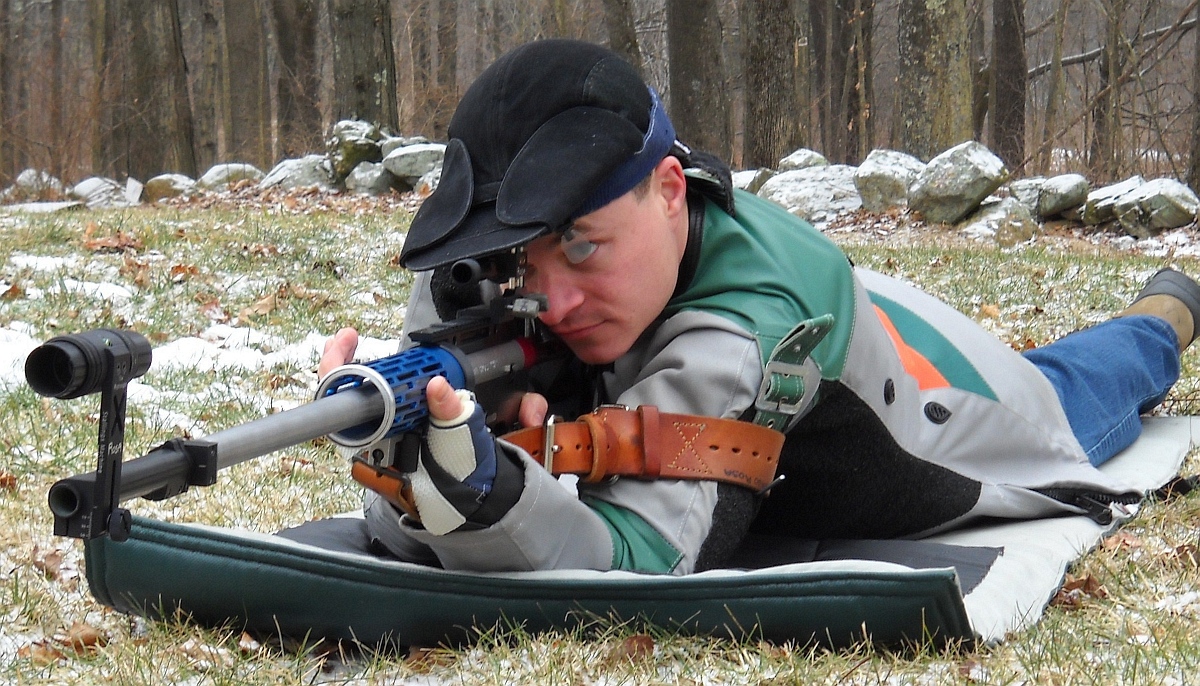


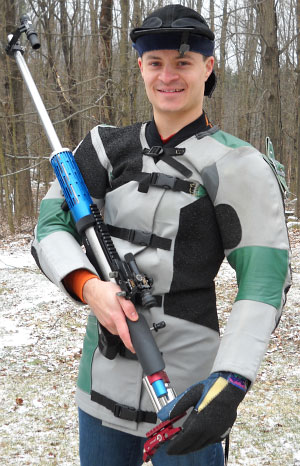 AccurateShooter: Tell us about your shooting coat and sling. Do you have any advice concerning coat fit and sling adjustment?


