Florida-based Tactical Rifles has just released its new “Chimera” series of 30mm Titanium Tactical Rings. Precision machined from advanced billet alloys and titanium, these sturdy, wide-body rings offer 50% increased surface area, with no fewer than twelve (12) 8-32 torx screws per set.
Though the Titanium Chimera rings weigh just 2.6 ounces each, they are rugged and durable, and provide a secure mount for even the heaviest tactical riflescope. Three different exterior colors are offered: Desert Tan, Matte Black, and Olive Drab. The Black finish is hard anodized, while the tan and olive colors are a moly epoxy finish. (NOTE: Prototype rings are shown in the photos; the interior section of production rings will be anodized matte black.)
Each ring set is serial numbered as a matched pair, and are available for pre-orders now. Suggested retail price is $229.00 per set, your color choice. For more information, visit TacticalRifles.net or call 1-877-811-GUNS (811-4867).
We thought we’d seen the upper limit of riflescope magnification with the new 10-50x60mm Sightron SIII, the 12-50x56mm Schmidt & Bender PMII, and the 10-60×52mm March variable. Now March has raised the magnification bar — with a zoom scope boasting Eighty times (80X) magnification at max power.
That’s a lot of magnification for a spotting scope, much less an optic designed to sit on top of a rifle. We wonder how useful the 80X max power will really be. At 80-power the exit pupil is a tiny 0.7 mm — what we consider the very lower range of usability. A very small exit pupil makes the viewer’s head position ultra-critical; you’ll need to get your head aligned just perfectly. Still, the extra power may prove useful for ultra-long-range shooting or at middle distances when conditions are ideal (no mirage).
The new March 8-80x56mm Tactical/Long Range scope features 1/8 MOA clicks, a 34mm maintube, and 60 MOA of elevation. Weight is a reasonable 29.8 ounces (845 grams), while scope length is 16.0″ (shorter than many 40-power scopes). Five (5) different reticles are offered: 1/8 dot, 3/32 dot, 1/16 dot, MTR-1, and MTR-2.
In addition to the new 8-80x56mm, March will offer another tactical scope with a 10 times zoom range. The new March 5-50x56mm also has 1/8 MOA clicks, 60 MOA of travel, and comes with the same five reticle choices. At 15.67″ OAL and 29.3 ounces, the 5-50X is slightly smaller than its 80-power big brother.
.
We’ll learn more about the new March ultra-zooms at SHOT Show next week, when we visit the Kelbly’s booth. We’ll try to get a good look at the 8-80×56 and let you know how all that power works in the real world. Stay tuned for our SHOT Show reports staring January 19th.
Sightron has released photos and specifications of its entire 2010 scope line-up. This includes the new (and much awaited) 10-50x60mm SIII Long-range scope.
With a “street price” under $995.00, the Sightron 10-50 could become hugely popular in 600/1000-yard benchrest and F-Class shooting. The big new zoom features a jumbo 60mm objective, 30mm maintube, and 1/8 MOA clicks. Nearly 17″ long and weighing 28.9 ounces, make no mistake, this is a BIG piece of glass. If the new 10-50x60mm SIII Sightron is as good as the 8-32x50mm LR SIII we tested in 2009, this should be a fantastic scope for the money.
When will we have test results for the new 10-50? Very soon, hopefully. Sightron has promised to send the first available 10-50x60mm SIII production-model scope to AccurateShooter.com for testing and evaluation. We’ll share our findings as soon as we can put the new 10-50 through its paces in the field.
Consumer Survey on Reticle Choices
Currently the new 10-50x60mm scope is offered with two reticle options: a Fine Cross Hair (FCH) and a Fine Cross Hair with Target Dot (TD). The first shipment contains roughly an equal amount of each. However, Sightron’s product planners want to learn YOUR favored reticle choice. Consumer preference will influence the future production allocation between FCH and TD models. So, if the majority of you folks want a particular reticle, that’s what Sightron will try to provide in future shipments. Please respond to the POLL below with your reticle choice.
If you use mass-production ring sets, other than Burris Signature Rings or SAKO Optilock Rings (which both feature polymer inserts), you can benefit from lapping your scope rings. Lapping your rings, when done properly, with the right tools, can improve the fit of the rings, reducing bending forces and stress on the scope. Properly-lapped rings are also less likely to leave prominent marks on your scope tubes.
Forum member Boyd Allen is a strong advocate of ring lapping for factory-produced ring sets. He’s tried various lapping tools and he believes that the Kokopelli system is one of the best available. Custom crafted in Kalispell, Montana by John Werre, the Kokopelli lapping system combines a specially-machined lapping rod with patented flat-ended scope alignment bars.
Kokopelli Lapping Tool
John Werre, Kokopelli’s owner, explains why his lapping tool works better than most others: “No one was making a lapping bar that would lap anything more than the bottom half of the rings and they were made of rolled stock and only a very short stroke was possible, rapidly wearing out the bar due to the limited area of use. I did something entirely different. I designed the bar to be used with the top halves of the rings in place and utilizing a long stroke thereby distributing the wear over the entire 12″ length of the bar. Why just do half a job?”
John adds: “Another problem was that the lapping compound would readily scrape off the bar, slide around and wear the bar out as fast as the rings. I added the spiral groove to stop the scraping off of the compound and later changed to a much softer steel and put a very rough, but carefully designed, finish to accept the lapping compound, actually allowing the grit to be driven into the surface of the bar. The nasty, scruffy rough finish is full of grooves and valleys of a depth designed to ‘catch’ the very sharp lapping compound, imbedding it into the bar. You then will wear out what you’re trying to lap rather than wear out the bar at the same time. The spiral grooves also cannot catch on the edge of the scope rings as can one which has annular grooves cut perpendicular to the axis of the bar in separate rings. I have very good reasons for every unique feature of my tools. Every aspect has a valid design behind it.”
Kokopelli Scope Alignment Bars
Kokopelli’s patented scope alignment bars have flat ends and work differently than alignment bars which use pointed tips. Kokopelli came up with a flat-ended design because alignment bars with pointed tips can yield a “false positive”, meaning the points can touch when the scope rings are out of alignment. To demonstrate, try this simple experiment. Take two ordinary pencils. With one pencil in each hand, hold them parallel with the pointed (lead) tips touching. Now simply move the outboard end of each pencil, while keeping the tips touching. You can see instantly that the tips can touch even if the pencils are way out of alignment. The same thing can be true of scope alignment bars.
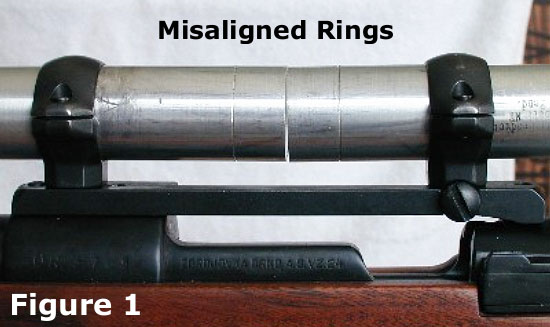
With the Kokopelli scope alignment bars, each bar is an exact cylindrical projection of the interior of each ring. When you bring the bars together, if they don’t mate perfectly, i.e. if there is any gap between the flat ends when the bars are touching, then you know you have an alignment problem. Kokopelli claims that misalignments as small as .002″ can be detected. John Werre explains: “The bars actually are a three-dimensional projection of each ring ‘hole’. You’re looking at a solid representation of the hole through the ring. Put one bar in each ring and you can then compare the axial alignment of the ‘ring holes’ to each other. If the ends match and are flat together you have reconstructed the bars into one [cylinder] and the alignment is PERFECT.” Below, in Figure 1, you can see rings that are out of alignment. In Figure 2 you can see rings that are properly aligned. Interestingly, the misalignment illustrated in Figure 1 did NOT show up with pointed ring alignment bars. This amount of misalignment can create up to 3/16″ of scope tube bending (depending on ring spacing).
The function of the Kokopelli lapping tool and alignment bars are described in greater detail on the Kokopelli website. The lapping tool and alignment bars are sold separately, or as part of Kokopelli’s complete Accurizing Kit shown below. The kit, which combines Scope Alignment Bars, Lapping Bar, pointer rod, and lapping compound in a fitted box, costs $84.50 for 1″ rings, or $91.00 for 30mm rings. For more info, contact John Werre at Kokopelli Products, 3820 Foothill Rd., Kalispell, MT 59901; phone (406) 755-3220. NOTE: Kokopelli has maintained the same prices since 2003. However, due to increased costs of materials, John Werre plans to raise his prices by mid-January, 2010. You can get current pricing by ordering soon.
MidwayUSA is running a clearance sale on “factory sample” Sightron Big Sky SII 6-24x42mm riflescopes with duplex reticles. The price has been knocked down to $468.32, a $146.01 savings over the regular price!
In addition, MidwayUSA has the “factory samples” of the newer Sightron Factory SIII 3.5-10x44mm riflescopes. These feature a 30mm tube, side focus parallax adjustment, and a Mil-Dot reticle. Clearance price is $547.42, marked down from $720.29.
Speaking of Leupold scopes, Midsouth Shooters Supply is running a big sale on genuine Leupold scopes, 2008 modelsr. A wide selection of these 2008-vintage Leupolds are discounted 30%. Note: These are new, full-warrantied scopes, not factory refurb or “blemished” models. All 2008 close-outs are being sold at 30% off to make room for the 2010 inventory.
The CMP has made a special purchase of a limited number of KOWA TS-501 20X spotting scopes, specifically designed for Rimfire and Air Rifle usage. These 20-power scopes are available for $280.00 plus S&H (or $250.00 for CMP-Affiliated clubs) through the CMP online E-Store. See item 832 under the “Equipment & Accessories” tab. You can also purchase the Kowas at the CMP’s two “brick and mortar” stores.
Kowa 20×50 Spotting Scope – Item ID: 832
TS-501 Offset 45 Degree, gray body
50mm objective lens and a built-in 20X eyepiece.
Focusing Range: 19.68 to Infinity
Scope Length: 9.6 inches
Scope Weight: 14.8 oz
Specifically designed for Rimfire and Air Rifle usage.
Weaver Optics, now owned by ATK, offers a new line of tactical riflescopes with First Focal Plane(FFP) mildot reticles, zero-reset turrets, and 5X zoom ratio. Weaver’s 4-20x50mm version (MSRP $994.49), delivers all those features for around $725.00 street price (SWFA.com). The smaller 3-15x50mm Weaver tactical scope (MSRP $890.95) sells for about $650.00 street price (SWFA.com).
These Weavers are attractive new options for tactical shooters. The pricing is very competitive considering these scopes have all the “right stuff” for tactical shooting: FFP, Mildot Reticle, Side Focus, and wide zoom range. We also like the new Weavers’ reset-to-zero turrets.
The new waterproof/shockproof/fogproof Weaver Tactical scopes feature one-piece construction, argon-purged tubes and multi-coated lenses with extra hard exterior coatings. For Tac Comps, the 5 times zoom ratio offers a very wide field of view for close-range or moving targets, yet plenty of magnification is “on tap” for long-range targets. The first focal plane reticle stays constant relative to the target at all magnification levels. This allows targets to be quickly ranged with mildots at any magnification setting.
The Redfield Gun Sight Company was founded in 1909 by John Hill Redfield. The company’s product line expanded from open sights to include riflescopes, mounts, binoculars, and spotting scopes. In 1998 Redfield closed its doors in Denver, Colorado, marking the end of an era. Redfield changed hands several times until April 2008 when Leupold & Stevens, Inc. purchased the Redfield brand name and associated intellectual property.
Leupold has revived Redfield, positioning the new Redfield scope line at the low end of the market. The latest generation of Redfield scopes are priced from $130.00 – $150.00 retail. Revolution™ riflescopes, the first products in the new Redfield line, are American-made at Leupold’s plant near Beaverton, Oregon. Revolution models include 2-7x33mm, 3-9x40mm, 4-12x40mm, and 3-9x50mm models, all with either 4-plex or Accu-Range reticles. The Accu-Range reticle provides hold-over points from 200-600 yards. Other product offerings will include imported Rebel™ and Renegade™ binoculars, Rampage™ spotting scopes and Raider™ rangefinders.
Editor’s Comment: We’re pleased to see the revival of a storied American optics brand. However, we wonder how much quality and long-term durability Leupold can deliver for $130.00, when Leupold is having trouble with quality control on its high-end scopes which sell for $800 or more. But Leupold & Stevens is a business first and foremost and its bean counters obviously feel there is money to be made in the low end of the market. This is like General Motors saying: “Well, since Cadillac can’t compete with Lexus and Mercedes, let’s sell more Geo Prisms”. We all know how well that strategy worked.
Carl Zeiss Sports Optics has launched a 2009 Holiday Promotion, offering rebates on select binoculars, riflescopes, and rangefinders. Customers who purchase select ZEISS optics from authorized dealers between November 1, 2009 and December 31, 2009 can save up to $250.
Rebates will be offered on the following ZEISS optics products: All Victory FL Binoculars ($250 rebate); Conquest 10×40 Binoculars ($200 rebate); Conquest 8×30 Binoculars ($100 rebate); all Victory Compact Binoculars ($75 rebate); Victory 8×26 T* PRF Laser Rangefinder ($50 rebate); and all Victory Riflescopes ($100 rebate).
“This is our holiday gift to hunters, birders and outdoor enthusiasts who want to own the finest optics but may be hesistant to make such a purchase in this challenging economy,” said Erik Schumacher, president of Carl Zeiss Sports Optics. “Hopefully the savings we are offering on a wide selection of award-winning ZEISS optics will make it possible for many to upgrade their optics.”
All rebate submissions must be completed within 30 days of the purchase. Rebates will be issued via a Carl Zeiss prepaid VISA card. You’ll find promotion details and a list of authorized ZEISS dealers at www.Zeiss.com/sports.


 Florida-based Tactical Rifles has just released its new “Chimera” series of 30mm Titanium Tactical Rings. Precision machined from advanced billet alloys and titanium, these sturdy, wide-body rings offer 50% increased surface area, with no fewer than twelve (12) 8-32 torx screws per set.
 .
.




 Speaking of Leupold scopes,


 The Redfield Gun Sight Company was founded in 1909 by John Hill Redfield. The company’s product line expanded from open sights to include riflescopes, mounts, binoculars, and spotting scopes. In 1998 Redfield closed its doors in Denver, Colorado, marking the end of an era. Redfield changed hands several times until April 2008 when
  Editor’s Comment: We’re pleased to see the revival of a storied American optics brand. However, we wonder how much quality and long-term durability Leupold can deliver for $130.00, when Leupold is having trouble with quality control on its high-end scopes which sell for $800 or more. But Leupold & Stevens is a business first and foremost and its bean counters obviously feel there is money to be made in the low end of the market. This is like General Motors saying: “Well, since Cadillac can’t compete with Lexus and Mercedes, let’s sell more Geo Prisms”. We all know how well that strategy worked.
 “This is our holiday gift to hunters, birders and outdoor enthusiasts who want to own the finest optics but may be hesistant to make such a purchase in this challenging economy,” said Erik Schumacher, president of Carl Zeiss Sports Optics. “Hopefully the savings we are offering on a wide selection of award-winning ZEISS optics will make it possible for many to upgrade their optics.”


