|
|
October 21st, 2009
Here’s a new product for shooters who need to make rapid zoom changes with their optics. The MGM Switchview is a small, lightweight lever that clamps around the power adjustment ring of variable power scopes. Made from anodized 6061/T6 aluminum, the Switchview allows the user to quickly adjust the scope’s power setting with a push or pull of the lever, without taking your head off the gun. That should help 3-gun competitors who must rapidly switch from near to far targets and back again.

The MGM Switchview works with short, tactical optics as well as high-magnification long-range scopes. Only slightly taller than most target style turrets, the lever is easy to use, even while wearing gloves or in slippery or wet conditions. The manufacturer says that: “Whether you are glassing a large area for a target and then zooming in to make the shot without loosing your sight picture, or you need to transition from far targets to [close] targets in a hurry, the MGM Switchview will get to the magnification setting you need quickly and easily.”
The MGM Switchview is now available for a variety scopes, including the Burris XTR, Leupold CQT, Leupold Mark IV (illum. reticle), Millet 1-4x24DMS, and Nightforce NXS. And soon MGM plans to build Switchviews for the IOR Valdada 1-4 and 1.4-8, Leupold VXII and VXIII, and Nightforce NXS Compact.

MGM Switchview zoom levers cost $59.95 and come standard in anodized black. However, the levers can be special ordered in custom colors for an extra $12. (Add 3 weeks delivery time for custom color orders.)
For more info, visit MGMswitchview.com. To order, call 208-454-0555 or 888-767-7371 (toll free), or email travis [at] mgmtargets.com. You can also contact Mike Gibson Manufacturing, 17891 Karcher Rd., Caldwell, ID 83607 .
October 17th, 2009
The Editor Speaketh: For the past two and a half years, every day I’ve prepared new Daily Bulletin postings for you guys. Rain or shine, without a single day off — 956 days in a row to be precise. But today’s my birthday, and, well, I decided to take a day off and go shooting.
Don’t fret — so dedicated readers don’t go through Bulletin withdrawal, here are quick links to some of our “Greatest Hits” from 2009 — the coolest videos and the most interesting stories. For each item, click the blue link to read the full, original story. NOTE: when you get to the bottom of the page, click “Older Posts” for even MORE Greatest Hits!
As for me … I’ll be sending some lead downrange.
Greatest Hits: Anschutz Photo Shoot Video — Babes ‘N Arms”
Great-looking blond handling state-of-the-art German firearams. What’s not to like?

October 17th, 2009
LINK: March 33-55x52mm ‘Eyepiece Zoom’ Scope
This is a revolutionary new high-magnification scope, with the zoom in the eyepiece. It provides all a BR shooter could want… from 100 to 1000 yards.

October 17th, 2009
LINK: Hensoldt Zeiss 6-24x72mm SAM
This 6-24x72mm Hensoldt may be the most advanced rifle scope on the planet. With a price of $11,979.95, it is certainly one of the most expensive. Take a 360° tour with this cool video from Hensoldt Zeiss.
Please enable Javascript and Flash to view this VideoPress video.
October 17th, 2009
LINK: Nightforce NXS vs. Benchrest Model Compared
OK, what really are the differences between Nightforces NXS and Benchrest models… beyond the obvious? In this informative video, Nightforce Exec Kyle Brown provides definitive answers.
October 6th, 2009
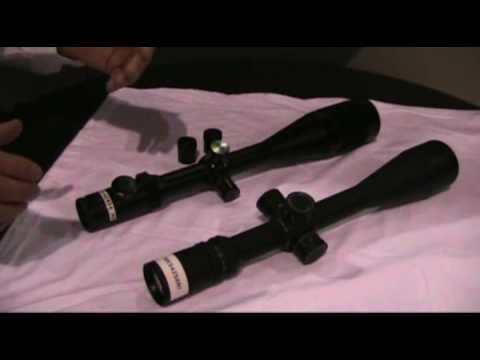
Vortex Optics of Middleton, Wisconsin has introduced the impressive new Razor HD 5-20x50mm tactical scope. With HD objective glass, this new scope is very bright and very sharp. It also has a ton of vertical and horizontal adjustment. Advanced design and a fat, 35mm maintube give the Razor 5-20×50 a whopping 125 MOA (36 milrads) of total adjustment (combined above and below center) for both elevation and windage. 125 MOA of adjustment is huge. That’s enough vertical for ultra-long-range shooting with almost any modern cartridge.

Impressive APO and HD Glass on new 5-20×50 Razor
The optically-indexed lenses are precision-ground from XD optical glass and coated with Vortex’s XR coating for enhanced resolution, clarity, and edge-to-edge brightness. The Vortex also boast a multi-element apochromatic (APO) objective lens that virtually eliminates chromatic aberration across the entire field of view.
 Ranging is simplified with Vortex Optics’ proprietary new EBR-2 milrad reticle. Laser-etched and placed in the first focal plane, the reticle enlarges and shrinks with the target when zoomed so the scale remains constant at all magnifications. In addition, the subtensions on the EBR-2 milrad reticle match the 0.1 milrad turret clicks for simpler ranging and adjustments. Ranging is simplified with Vortex Optics’ proprietary new EBR-2 milrad reticle. Laser-etched and placed in the first focal plane, the reticle enlarges and shrinks with the target when zoomed so the scale remains constant at all magnifications. In addition, the subtensions on the EBR-2 milrad reticle match the 0.1 milrad turret clicks for simpler ranging and adjustments.
Vortex’s RZR (Rapid Zero Return) Zero Stop mechanism employs a rotational-blocking steel design. Vortex claims this patent-pending system is “mechanically more reliable and accurate than other systems that block the vertical movement of the turret”. The RZR Zero Stop delivers precise return to zero without the need to count clicks.
The 5-20x50mm Razor features waterproof/dustproof/shockproof construction and boasts a full 3.9″ of eye relief through the entire 5-20X range of magnification. This impressive new tactical scope has an MSRP of $2499.00, while “street price” is about two grand. For $1999.95, SWFA.com offers the 5-20×50 HD with 0.1 milrad clicks and EBR-2 reticle (item RZR551), or with 1/4 MOA clicks and EBR-1 reticle (item RZR550).

Vortex Optics and Unconditional Lifetime Warranty
You may not have heard about Vortex Optics yet, but this American-owned company is putting out some very good scopes these days. Vortex backs its products with its unconditional, transferable, lifetime warranty. That warranty is as good as it gets.
October 1st, 2009
The 2009 F-Class Nationals are underway right now at Camp Butner, NC. While riflescopes are allowed in both F-Open and F-TR classes, many competitors use a spotting scope as well. With a low-mounted spotting scope placed near the shooter, you can keep your riflescope trained on the target, then quickly check wind flags or mirage by looking through the spotter.
Here’s a smart product from Ray-Vin.com that lets F-Class and prone shooters mount their spotting scopes in the ideal viewing position. Ray-Vin’s patented MKII F-Stand is solid and sturdy, and “floats” the scope close to the shooter’s head without interfering with the placement of a front pedestal rest or ultra-wide bipod. The base can sit off the shooter’s mat.

How much? The entire F-Stand package costs $310.00, including 8″ bottom for prone, two 24″ extensions, Ray-Vin 360 Head, and Take-Off Knob. But if you don’t need the extensions, you can purchase components separately.
 The F-Stand is shown with Ray-Vin’s $85.00 Scope Head. This head allows the shooter to adjust scope height, rotation (around the stand shaft), scope angular elevation, and eyepiece orientation, all with one control. Some other scope heads, though more expensive, require you to use multiple knobs or friction adjusters. Conveniently, most of the adjustments can be done easily with one hand, using the black adjusting handle. Smart engineering we’d say. The F-Stand is shown with Ray-Vin’s $85.00 Scope Head. This head allows the shooter to adjust scope height, rotation (around the stand shaft), scope angular elevation, and eyepiece orientation, all with one control. Some other scope heads, though more expensive, require you to use multiple knobs or friction adjusters. Conveniently, most of the adjustments can be done easily with one hand, using the black adjusting handle. Smart engineering we’d say.
You can see that the F-Stand places the spotting scope right where the shooter wants it, yet the legs do not interfere with the shooting position. A heavy-duty milled metal bracket clamps the base stud and scope rod securely. The F-stand will hold even heavy 80mm spotting scopes without flexing.

CLICK HERE to Read Reports from F-Stand Owners.
September 30th, 2009
Now through the end of October, 2009, Cabela’s is running a major Sale on Swarovski Optics. You’ll find significant savings on Swarovski products. Many Swaro spotting scope models are $200.00 off, and Swaro binoculars have been discounted by as much as $250.00.

To get Cabela’s best discounts on Swarovski products, click the sale icon below:

September 14th, 2009
Here’s a very good deal if you’re looking for a quality zoom optic for a varmint rifle. Natchez Shooters Supply currently has the Sightron SII 6.5-20X42mm zoom scope on sale for just $299.99. While not the “latest or the greatest”, this is a good optic that has reliable tracking and precise front parallax/focus control. For most daylight conditions, even at 20-power, the 42mm objective will give you a nice, bright picture, though the exit pupil will be smaller than on a scope with a 50mm or larger front objective.

The Sightron SII 6.5-20×42, Natchez product SH200198, weighs just 2.11 lbs, and comes with a standard duplex reticle. Click values are 1/8-MOA. We’d prefer 1/4-MOA clicks for a varmint scope, but this does give you extra-precise adjustments. The nitrogen-filled SII scope body is waterproof, fogproof, and shockproof. A screw-in sunshade is included, and the scope is covered by the Sightron Lifetime Warranty.
September 10th, 2009
Premier Reticles has introduced a new 5-25x56mm “Premier Heritage” Tactical scope. This is a proper First Focal Plane (FFP) tactical scope, offering 1 cm/0.1 milrad turret click values matched with an illuminated reticle with cm/milrad hash marks. (27 milrad Double-Turn knobs are standard; 1/4-MOA clicks are optional.) Total elevation is a whopping 31 milrads (107 MOA). This is not a single-rev turret design, but one revolution covers 15 mils or about 51 MOA. For practical purposes, most shooters can get out to 1000 within one revolution if you have an angled scope base. The scope is 16.34″ overall with a beefy 34mm-diameter main tube. The 5-25x56mm Premier weighs 1.1 kg (39 ounces) and lists for $2899.00. Expect the “street price” to be about $2750.00.
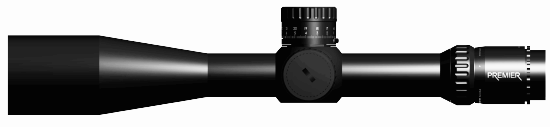
 The new scope has some nice features. First, the new 5-25x56mm Premier has tons of elevation. Total elevation is 31 milrads (equivalent to 107 MOA). As noted there are 15 mils (51 MOA) per revolution. Second, using a patent-pending Lever-Lock™ system, the scope can be zero-locked without tools. Third, the illumination control nests inside the left-hand parallax/focus turret, leaving the 34mm main tube unencumbered by a brightness knob. Finally the scope has a truly useful 5.5-range diopter. That’s enough diopter range to enable many eye-glass wearers to dispense with correction. A lot of smart thinking went into this scope. The new scope has some nice features. First, the new 5-25x56mm Premier has tons of elevation. Total elevation is 31 milrads (equivalent to 107 MOA). As noted there are 15 mils (51 MOA) per revolution. Second, using a patent-pending Lever-Lock™ system, the scope can be zero-locked without tools. Third, the illumination control nests inside the left-hand parallax/focus turret, leaving the 34mm main tube unencumbered by a brightness knob. Finally the scope has a truly useful 5.5-range diopter. That’s enough diopter range to enable many eye-glass wearers to dispense with correction. A lot of smart thinking went into this scope.
CLICK HERE for full Specifications and more photos
• First Focal Plane Illuminated Reticle Gen 2 XR
• Integrated Illumination and Parallax Adjustment
• 31 Milrad (107 MOA) Total Elevation Adjustment*
• 34mm one-piece maintube constructed from 6061-T6 aircraft aluminum
• Quick-focus eyepiece with Locking Mechanism
• Integrated Articulating Lens Covers
• Temperature rated from -40° to +60°C.
• Lifetime warranty
CLICK HERE for Scope Option List
 Big brother to the Premier Heritage 3-15x50mm introduced last year, the 5-25×56 offers excellent brightness, resolution, sharpness and contrast, along with superior color fidelity and light transmission (93% average across all wavelengths). The tactical windage and elevation adjustments on both Heritage scopes feature the patent-pending Lever-Lock™ dial retention for re-zeroing without special tools. Standard turrets have 0.1 milrad (1cm) click values, while “user-swappable” dials are available to change click values to ¼ MOA. Big brother to the Premier Heritage 3-15x50mm introduced last year, the 5-25×56 offers excellent brightness, resolution, sharpness and contrast, along with superior color fidelity and light transmission (93% average across all wavelengths). The tactical windage and elevation adjustments on both Heritage scopes feature the patent-pending Lever-Lock™ dial retention for re-zeroing without special tools. Standard turrets have 0.1 milrad (1cm) click values, while “user-swappable” dials are available to change click values to ¼ MOA.
FFP Reticle Features
Currently, all Heritage scopes come standard with First Focal Plane (FFP) reticle placement for consistent subtension regardless of magnification setting. The Heritage 5-25x56mm comes with Premier Reticles’ own patented illuminated Gen II Gen II XR (extended Range) reticle. The illumination control has 11 brightness settings, a locking illumination dial for “off” storage, and a 6-hour time-out function to preserve batteries.
Strong Demand for New Scope
The first run of the new 5-25x56mm Premier Tactical scope sold out, with high demand by both military and civilian customers. However, Chris Thomas, Premier’s President, tells us that “more 5-25s are on their way. Units should be available in about 6-7 weeks, if you order now”. The Premier Heritage scope comes with a lifetime warranty. Premier Reticles is a 63-year-old optics company with headquarters and manufacturing in Winchester, Virginia and an additional design branch in Germany.

*NOTE: On Premier’s spec sheet, elevation is listed as 30 milrad/103 MOA. That was for the prototype. Production models have more.
|


