|
|
July 25th, 2008
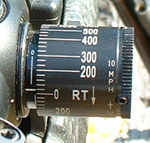 Here’s something that can save you lots of time and aggravation on a varminting trip. This little $70 gizmo is great for varmint hunters and any one who needs to make a quick shot in shifty wind conditions. Instead of the traditional 1/4-MOA hash marks, the Kenton windage turret features markers corresponding to the wind drift your rifle will encounter at various distances. Here’s something that can save you lots of time and aggravation on a varminting trip. This little $70 gizmo is great for varmint hunters and any one who needs to make a quick shot in shifty wind conditions. Instead of the traditional 1/4-MOA hash marks, the Kenton windage turret features markers corresponding to the wind drift your rifle will encounter at various distances.
Kenton Industries’ Tuned Windage Compensator (TWC) has built-in windage marks for 10 mph cross-winds at 100-1000 yards. How do they do that? Well the knobs are calibrated either for specific calibers/loads, or they can make custom knobs using your observed field data. The knobs can compensate for various wind speeds (2-20 mph) and angles (15°- 90°), by applying some simple conversion ratios. As a general rule, with a “full-value”, i.e. 90°, crosswind, the wind drift will go up or down in direct proportion to the change in windspeed. That means, for example, at a given distance, a 10 mph crosswind will push the bullet twice as much sideways as a 5 mph crosswind.
Two versions of Kenton’s TWC knobs are offered. The $69.95 TWC #1 features calculated ballistics for your caliber and barrel length. The $79.95 TWC #2 or #3 feature customized windage settings based on bullet BC, environmental conditions, elevation, and ballistic information you provide.
Kenton also makes an elevation-compensating TTC knob, that can be customized to your rifle. With this elevation turret, yardages are marked in 50-yard increments, and you can literally just “dial in your distance”. However, to work effectively the TTC knob must be tailored to a particular load (velocity and bullet). Moreover, actual bullet drop will differ with changes in altitude, temperature, and shooting angle — so it’s not as simple as it sounds, and you may need multiple knobs if you shoot a variety of loads.
July 24th, 2008
Sightron just delivered to Jason Baney an SIII 6-24×50 Mildot, the latest in the new SIII line-up of side-focus, 30mm Sightron scopes. This follows on the hot-selling 8-32×56, which was the subject of our recent Scope Test. Jason will be testing the scope’s optical qualities soon and using it in an upcoming tactical match.
The new 6-24×50 scope is also offered with a fine cross-hair with target dot reticle. Both mildot and FCH versions are 14.96″ overall with a near-constant 3.6-3.8 inches of eye relief. Clicks are 1/4 MOA (15 MOA per revolution), and total elevation (and windage) adjustment is listed as 100 MOA (50 MOA on either side of center). That’s a class-leading amount of elevation which should make the new 6-24×50 popular with long-range shooters.

Shown above and below is the Sightron 6-24×50 Mildot, flanked by a Leupold 8-25×50 LRT and the Sightron 8-32×56. The controls on the 6-24 Sightron are identical to those of its big brother, but it is shorter, with a smaller objective. The shorter length and 50mm front objective allow a 2.8 ounce weight savings over the larger model (21.9 oz. vs. 24.7 oz.).


Below are reticle specs for Fine Cross-Hair + Target Dot Version

July 16th, 2008
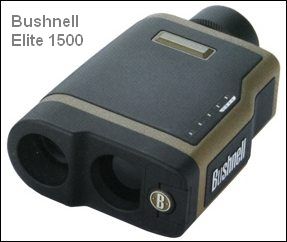
 The U.S. Army has awarded Bushnell Outdoor Products a multi-year, multi-million dollar contract for a special military version of the Elite® 1500 Laser Rangefinder. Bushnell will begin shipping the units in August 2008. According to Bushnell’s Director of Military Sales, the Army was impressed with the Elite 1500’s multiple targeting modes and rugged, waterproof construction. The U.S. Army has awarded Bushnell Outdoor Products a multi-year, multi-million dollar contract for a special military version of the Elite® 1500 Laser Rangefinder. Bushnell will begin shipping the units in August 2008. According to Bushnell’s Director of Military Sales, the Army was impressed with the Elite 1500’s multiple targeting modes and rugged, waterproof construction.
The Elite 1500 is capable of ranging distances from 5 to 1,600 yards, though in our own tests, maximum effective range on deer-sized objects is about 700 yards. The elite has a 7-power, 26mm objective, with a special twist-up eyepiece that’s handy for eyeglass wearers. The eyepiece also boasts a +/- 2 diopter, a very good feature not found on some other rangefinders.
In addition to the standard ranging mode with automatic scan, users can select from the BullsEye™ or Brush™ modes for more precise ranging to targets. In the BullsEye mode, it’s easy to acquire smaller targets and game because if more than one object is acquired by the laser, only the closer of the two objects is displayed on the internal LCD. While using the Brush mode, closer objects tree branches are ignored so that the distance to background objects are displayed. The Bushnell also offers Angle-Range Compensation (ARC) in one of its civilian 1500 models. It’s unknown whether the military version will have this feature.

Rangefinder Comparison Review
AccurateShooter.com has an extensive multi-product Rangefinder Comparison Review. Before choosing a Laser Rangefinder (LRF) you should read that article. It compares the Bushnell Elite 1500 to LRFs from Leica, Leupold, Nikon, and Swarovski. In our comparison test, the Elite 1500 was praised for its speed, its diopter eyepiece, and its waterproof housing with Rainguard® lens coatings. Users said the “Brush” setting worked well, filtering out “false returns” from short range. On the downside, Bushnell’s beam divergence is greater than Swaro or Leica, so long-range performance suffers. Bushnell’s own Product Description describes its ranging performance as: “Reflective–1600 yards; Tree–1000 yards, Deer–500 yards, Flag–400 yards”. The optics are a grade below Swaro, Leica, and Nikon, and retailers have reported higher rate of return (10+%) than other brands.
June 30th, 2008
AccurateShooter.com has been testing one of the new Sightron SIII 8-32×56 target scopes. In Part One of our Sightron Test, Jason Baney reviewed the optical qualities and characteristics of the scope — what you see through the lens.


Sightron Test PART TWO — Mechanical Tracking
Now, in Part Two of our test, Jason took the scope to the range to test how well it tracks, and how repeatable the clicks are. Jason did a variety of tests, including a “box test” at 100 yards, and multi-cycle elevation tracking tests at both 100 yards and 300 yards.
In the box text, Jason zeroed his gun, a 6.5×47 Lapua, then put two shots in the lower left corner of a large sheet of paper. He then clicked up 72 clicks (18 MOA) and fired two more shots. Then he added 60 clicks (15 MOA) right, and fired two shots. Next he went back down 72 clicks (18 MOA) and fired two shots in the right corner. Finally he went back 60 clicks left (15 MOA), and fired two shots in the lower left.


Box test results were impressive. The last set of shots were virtually in the same place horizontally as the first two, just slightly over one bullet diameter below the “start” group. Jason noted: “The ‘last corner of the box’ vertical could easily be mirage, barrel heating, or my hold.” Jason noted that both the left and right vertical legs of the box, measured from group center to center, were exactly 19.8″. The top horizontal side of the box measured 16.375″ while the bottom horizontal was 16.25″. Jason notes: “The horizontal legs were within 0.125″. That difference could have easily been wind.”
Jason made 264 total clicks during the box test. His final two shots were just slightly below the first two — close enough that mirage could explain the difference. Jason concluded: “I think the Sightron showed excellent tracking. I noted that the vertical ‘side leg’ measurements were exactly the same. I didn’t end up in exactly the same spot, but it was really close. The slight shift in elevation could be caused by mirage or barrel heating.”
UP/DOWN Tracking Cycle Tests
To further test the vertical tracking repeatability, Jason shot a five-round group at 100 yards. Before EVERY shot he cranked in 120 clicks (30 MOA) of vertical, then cranked back down 120 clicks (30 MOA). As you can see from the target, the Sightron tracked beautifully. Though there is some horizontal (from wind), the total vertical spread for all five shots is about 0.1″, and that’s as tight (or tighter) than Jason’s rifle can normally shoot, as we explain below. Jason notes: “The group at 100 yards shows about 0.1″ vertical…can’t ask any better than that. So, the scope’s adjustments were obviously not adding any vertical component to the group.”

Test Gun: 6.5×47 Lapua, 123 Scenar, Reloder 15
Test Conditions: 100 yards, 90° F, 50% RH, 0-3 mph wind
Test done with 1/3 MOA Rifle
Jason conducted the test with a 6.5×47 rifle. This is a very accurate gun, and Jason is a great trigger-puller, but this is no rail gun. Repeatable group size for this rifle is typically mid-threes. The Sightron exhibited tracking repeatability inside the normal group vertical spread of this rifle (when no elevation clicks are made). We can conclude then, that the actual vertical tracking shift (after five 30 MOA up/30 MOA down cycles) is negligible.
 300-Yard UP/DOWN Tracking Test 300-Yard UP/DOWN Tracking Test
To supplement our findings at 100 yards, Jason repeated the 30 MOA up/30 MOA down cycle test with five (5) shots at 300 yards. He ended up with 5 shots with a total vertical of 1.5″ or 1/2 MOA. Again, given the limitations of the rifle and its typical vertical spread at 300 yards, this was very good. Note that three of the five shots went into about 1/2″ of vertical. Jason believes the shot low left was “driver error” or mirage. If that shot is excluded, the total vertical was 0.734″ or 0.234 MOA — which is about as tight as this gun can shoot at 300 yards. Jason concluded: “If you exclude the low left shot, which was probably me or mirage, we have a quarter-MOA vertical group. I’m not sure the gun can do better. In fact, 1/3 MOA is more typical. If scope tracking error was inducing vertical I would have expected the vertical spread to have been much larger. Here’s a situation where we can’t really overcome the gun (and shooter’s) inherent precision limits. I’ll give the Sightron a thumbs up here. If it was even two clicks off after all that cycling, the group would have shifted 1/2 MOA (about 1.5″) up or down, and that didn’t happen.”

Working the Turrets–Mechanical Feel
Jason said the turrets offer a good feel: “The effort needed to rotate the turrets is minimal, but the clicks are very smooth and positive. Overall, the feel is very good for both horizontal and vertical controls. The feel of the side-focus parallax is also good, and the side-focus did not display any lash or focus problems that we’ve observed on some other brands of optics.”
June 16th, 2008
Your editor wins the dunce of the week award, but he learned an important lesson. This weekend I shot the Varmint Silhouette match at Ojai, California. In preparation for the match, I (wisely) went to a range on Thursday to chronograph my match load and confirm my 100-yard, no-wind zero. All went well there, and after three sighters I put three rounds into 0.260″ right at point of aim. So far, so good.
| Editor moves his scope AFTER zeroing. End result? Zero shifts 2 MOA up and 11.5 MOA right. Yikes! |
 But, while testing, I noted that the scope, having been positioned for prone shooting, was much too far forward. It needed to be moved back about an inch for comfortable shooting at the bench. But, while testing, I noted that the scope, having been positioned for prone shooting, was much too far forward. It needed to be moved back about an inch for comfortable shooting at the bench.
No problem I think… I take the gun home, get my Leupold Torx wrench and loosen the rings. Now, I use Burris Signature rings, the ones with the plastic inserts that provide elevation preload: +10 in the rear and a -10 in the front. These are net values, created with pairs of +05 (thicker) and -05 (thinner) half-ring inserts. In the back the thicker +05 insert is on the bottom and thinner -05 on top, while in the front the thicker insert is on the top with the thinner on the bottom.
First thing I note when moving the scope is that it was hard to set the inserts in exactly the same spot (though I tried). I also note that the inserts seemed to flatten out or squeeze down more when I re-tensioned the ring bolts.
I figured I might have to make a minor correction to my zero at the range, so I wasn’t too concerned. Boy was I wrong.

Windage off Six Feet at 600 Yards
At the match, I dialed in my 600-yard come-up and aimed at a steel gong we use for sighter shots. Normally I can “certify” my 600-yard zero in three shots. This time, my spotter couldn’t even see the hits. “WTF”, I think… Then another shooter notes that my bullets are impacting about SIX FEET to the right of the Gong and about a foot too high.
I had to dial in 46 clicks (11.5 MOA) of left windage to get back on the Gong. At 600 yards, one MOA is 6.282 inches. My 600-yard Point of Impact had shifted 72″ to the right — a full six feet! That’s huge. That’s like being off a foot at 100 yards.

LESSON LEARNED: If you make ANY change to your scope, you should re-zero.
SIGNATURE RING LESSON LEARNED: If you are running the Burris Signature Rings, with plastic inserts, the change in POI when you move the scope can be extreme — way more than you’d expect with conventional rings. The plastic inserts take a different “set” each time you tension the rings, even if you do your best to maintain the inserts’ orientation in the rings. No matter how careful you are, those plastic inserts aren’t going to hold the scope in exactly the same place.
So, if you don’t want to win the Dunce Award like I did, make sure you re-test your scope’s zero AFTER you move the fore-and-aft position, and EVERY time you re-tension Burris Signature Rings. It’s worth noting that the ring set in question is five years old and it held zero perfectly until I decided to move the scope back. This was done because my club recently built benches at the 600-yard line so we now shoot from the bench rather than prone, F-Class style.
June 12th, 2008
High-magnification scopes allow shooters to aim more precisely and to see their targets better at long ranges. Recent years have seen an “optics arms race” in benchrest shooting. It used to be thought that 36-power was plenty for 100- and 200-yard BR matches. Now, top shooters are running 40- or 45-power optics, and some competitors are even using 50X and 60X scopes.

Perils of Too Much Magnification
Extra magnification comes with a price, however. With equal-sized front objective lenses, the view through a 50-power scope will appear darker than the view through a 35-power optic, and the 50X will have a much smaller exit pupil. The exit pupils on some scopes are under 1mm. An exit pupil that tiny makes your head position ultra-critical — move your head very slightly and you’ll lose the circle of light entirely. Small exit pupils are more fatiguing, causing more eye strain. Higher magnification can, in some conditions, also make it more difficult to cope with mirage. Many shooters prefer a zoom scope so they can dial down the magnification when the mirage is extreme.
Advantages of Variable-Power Scopes
So how much magnification do you really need? That comes down to your personal preferences and your budget. Since a good zoom scope, such as the Nightforce BR 12-42×56 or the new Sightron SIII 8-32×56, lets you “back off” your power, there’s really no reason NOT to go with a high-power scope on a target rifle, provided you can make weight.

A Formula for Scope Resolving Ability
From an optics standpoint, how much power do you need to resolve a bullet hole at a given distance? There is a handy online Scope Resolution Calculator that lets you do this. Just type in the bullet diameter and distance, and the calculator will tell you how much magnification you need, at a MINIMUM, to resolve that particular size bullet hole. This calculator assumes perfect viewing conditions and the highest grade lenses. In reality, as viewing conditions get bad, all bets are off. A bullet hole that could be resolved at 30-power in perfect viewing conditions, might not be resolved even at 80-power when conditions are bad. Nonetheless, it’s fun to play with the calculator, created by Twin City Rod & Gun:
CLICK HERE for Bullet Hole Resolution Calculator

June 11th, 2008
While shooting at the Pala Varmint Silhouette Match recently, we had a chance to test drive John Adams’ Pentax PF-80ED Spotting Scope. It’s a great scope, fitted with outstanding lenses. We tried both the 20-60 power zoom and the superb Pentax XW-10 wide angle/extended eye relief lens, which provides a fixed 52X image. The XW-10 is the most user-friendly spotting scope eyepiece I’ve ever tried–ultra-bright, with nearly an inch of eye relief.

One thing that made the Pentax such a pleasure to use was the mounting set-up. John has his PF-80ED set on a sturdy Manfrotto tripod with a special geared tripod head, the Manfrotto model 410. The geared head allows you to make very fine, precise movements in vertical or horizontal planes. You don’t have to unscrew a clamp, fiddle around to re-position the scope, and then struggle to lock it in place again without altering the position. This unique, compact head offers precise gear movement in three directions: pan (horizontal movement left to right), elevation, and angular rotation around TDC (horizon tilt).
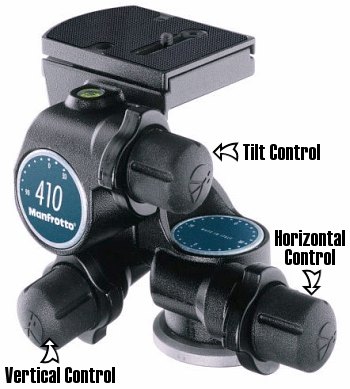
The Manfrotto 410 geared head was superb. While spotting at 600 yards, I could easily move up or down a few inches on the target with just a quick twist of a knob. If I wanted to move down the line to a sighter plate, it was just as easy to pan a few feet horizontally, without disturbing my vertical setting at all. I don’t know how Manfrotto does it (the gearing system is patented), but very little effort is required to turn the knobs in any direction, and there is plenty of travel.

If you want to make large adjustments, as when moving your view from a 1000-yard target bay back to the 100-yard line, you can disengage the gear drives and manually move the entire head. The Manfrotto 410 incorporates a unique feature that allows you to instantly disengage the gears and rough position the camera by hand, then instantly reengage them for precise final alignment. The model 410 head supports up to 5 kg (11 pounds), and is also suitable for 35mm SLR and medium format cameras. The head incorporates a quick release camera plate system.
So what does this superior technology cost? The Manfrotto model 410 costs about $210.00 at large camera outlets, but you can sometimes find one for about $180.00 on sale. Is it worth it? If you’re on a very tight budget–spend your money on a barrel first. But, if you have an $800+ scope that’s used quite often, the geared head is worth the investment. Others seem to agree — three other Pala shooters added geared heads to their tripods after trying John Adams’ rig. The gearing makes it much, much easier to move the scope in very small increments while spotting at extreme ranges. But what about resale? These geared heads are also extremely popular with commercial photographers, so they hold their value well.
The Manfrotto 410 was previously sold as a “Bogen-Manfrotto 3275/410″ and you may still find older versions listed that way. Manfrotto also makes two other geared heads, the model 400 ($680.00, 22 lb. rating) and 405 ($385.00, 16 lb. rating), but these are much more expensive, and designed for very heavy cameras.
Pipe and Post Level
To get the best results from any tripod when using a spotting scope (or chronograph), you need to make sure the base for your scope is set level to the horizon. Deluxe heads, such as the Manfrotto geared heads, have built-in bubble levels, which make it easy to level the scope. If you don’t have a level on your tripod, but it has a telescoping center shaft, you can use a simple, inexpensive Pipe and Post Level. These attach with an elastic band around the vertical shaft and provide bubble levels in both horizontal and vertical planes. You can purchase these levels for under $5.00 at hardware stores and home supply outlets.

Good, Inexpensive Tripod
If you want for a good, solid tripod that will hold a heavy 80+ mm spotting scope at a bargain price, look for a used Davidson Star-D on eBay, or one of the optics forums.
 The Davidson Star-D tripod is a solid, all-metal rig that is sturdy enough to be used for movie cameras. Star-Ds feature convenient rotary cam (collet) leg height adjustments and all-metal tilt and pan controls that lock solidly. The center post is clamped with a big locking ring that adjusts for tension. The rugged, machined-aluminum Star-D tripods are no longer in production but you can find good “previously-owned” models for sale on eBay. This tripod is ideal for use with a chronograph or spotting scope (for viewing in sitting or standing positions). You’ll see a variety of Star-Ds on eBay. What you want are the newer Star-Ds with all-silver heads and cam-locked legs. You can often pick them up for under $25.00. Look for the latest versions, as shown in the picture. The Davidson Star-D tripod is a solid, all-metal rig that is sturdy enough to be used for movie cameras. Star-Ds feature convenient rotary cam (collet) leg height adjustments and all-metal tilt and pan controls that lock solidly. The center post is clamped with a big locking ring that adjusts for tension. The rugged, machined-aluminum Star-D tripods are no longer in production but you can find good “previously-owned” models for sale on eBay. This tripod is ideal for use with a chronograph or spotting scope (for viewing in sitting or standing positions). You’ll see a variety of Star-Ds on eBay. What you want are the newer Star-Ds with all-silver heads and cam-locked legs. You can often pick them up for under $25.00. Look for the latest versions, as shown in the picture.
June 11th, 2008
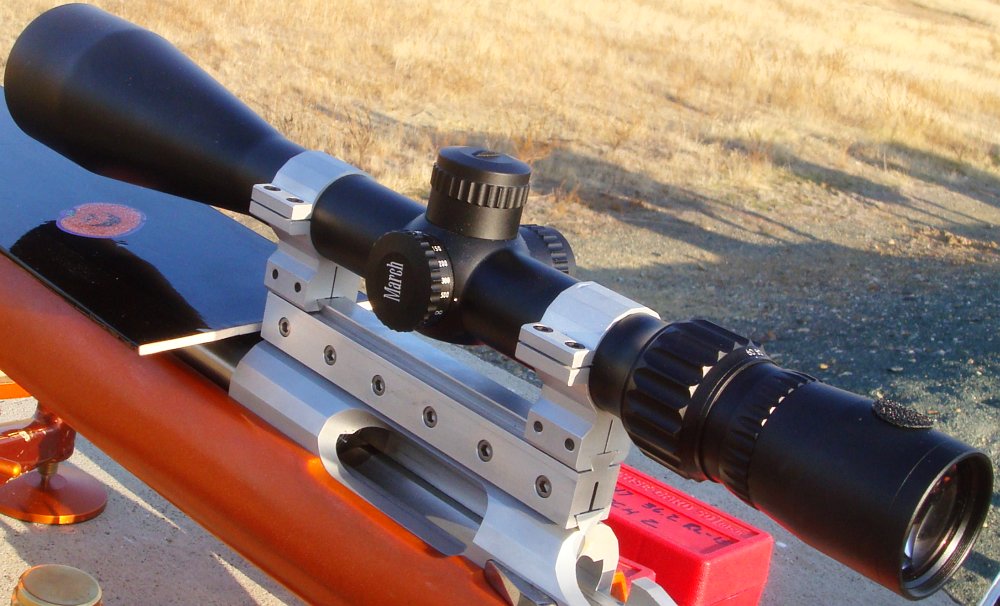
Right now the March line of scopes represent the “state of the art” in high-magnification Benchrest scopes. They are unexcelled for brightness, sharpness, and perhaps most importantly, shot-to-shot reliability. Many top short-range benchrest shooters, who can’t tolerate even a tiny shift in the scope’s reticle moving the point of impact a few hundreths of an inch, are using the March 40X, 50X, and 60X, and now the new 10-60X Zoom.
CLICK HERE for complete MARCH SPECIFICATIONS


March scopes are made in Japan by DEON. In the USA they are sold exclusively by Kelbly’s. Jim Kelbly reports: “Some 40s and 50s are in stock now. The 10-60X zooms will be in stock in about two months unless the back order list gets longer as it is everyday. If you want a March scope you should not wait till they are in stock. We have a waiting list and you should get on it if you would like one in next two months.”
Current March Scope pricing:
40×52, 50×52, and 60×52 fixed focal length: $2100.00
10-60×52 Zoom: $2400.00


May 22nd, 2008
Jon Jackoviak of The Optic Zone reports that his first shipment of Bushnell Elite 6500 4.5-30×50 scopes has arrived. These come with a Fine Multi-X reticle and 1/4-MOA clicks, and are priced at $739.00. (A mildot reticle version may arrive in a few weeks.) Other dealers may be stocking this scope soon.

These scopes have been anxiously awaited, ever since they were announced at SHOT Show earlier this year. The 6.5x magnification range is the widest in the industry, and the scope’s 30mm main tube and side-focus parallax adjustment puts it in the running with Leupold’s 8-25×50 LRT. The new scope also features Bushnell’s patented, Rainguard® hydrophobic (water-repellant) lens coating. This coating prevents fogging by causing condensation to bead up into much smaller droplets.
The question mark remaining about the new Bushnell 6500 is the actual elevation range. The Optic Zone (and some other vendors) are claiming 80 MOA each of Windage and Elevation Adjustment, but the Bushnell website says there are only “50 inches” total Elevation on the 4.5-30×50. Right now we’re betting on Bushnell’s lower number, which is significantly less than the 75 MOA offered by the new Sightron 8-32×56, which we have confirmed.

May 15th, 2008
Creedmoor Sports has a new promotion for scope buyers. If you purchase a Nightforce NXS or Benchrest Model scope at regular price, Creedmoor will give you a $75.00 gift cerficate that can be applied to other Creedmoor Sports merchandise. (Note: The certificate can NOT be applied to the original scope sale, or the purchase of another Nightforce product.)

|