|
|
May 14th, 2008
Just this week, Sightron sent us one of the new Sightron SIII 8-32×56 LR D rifle scopes for evaluation. This new optic features a 30mm main tube and weighs 24.7 ounces. Clicks are set in 1/4-MOA increments. The reticle is a fine cross hair with 1/4-MOA dot. The scope comes with a 3″ sunshade, turret covers, and rubber-connected, see-thru lens caps. Jason Baney had a chance to test the scope and give his initial impressions of its optical qualities. We will follow this “First Look” report with more extensive testing of the scope’s mechanical tracking and long-range resolution.

Overall, Jason was extremely impressed with the new scope. It was very bright, with excellent color rendition and contrast. The image remained bright and sharp out all the way out to the edges, with no shadowing or distortion. Compared to a Nightforce 12-42×56 BR scope set at 32-power, Jason thought the Sightron had better contrast and more vivid colors. Jason concluded: “At this point, the new Sightron seems like a good value, and compares well with the Nightforce BR model.”
Parallax and Focus
Importantly, the Sightron’s parallax control worked perfectly. There was no lash issue and Jason was able to attain minimal parallax with the target at maximum sharpness. With some other scopes, if you set the scope to have the target in best focus, you’ll still have too much parallax.

Elevation and Windage
This is a scope you can use to 1000 yards. Jason ran the adjustments top to bottom and recorded 75 MOA of both Elevation and Windage, based on the stated 1/4-MOA click Value. (That’s 75 total MOA available from one extreme to the other.) The target knobs have 15 MOA per turn and operate VERY smoothly and positively. Jason said the clicks “feel similar to Nightforce NXS clicks, but the Sightron clicks engage with a slightly softer feel, with less resistance.”
 Resolution Tests Resolution Tests
Jason used two resolution charts, the USAF 1951 Optical Chart, and a line-width/text size chart. To judge resolution, Jason did a comparison test of the new Sightron 8-32×56 and a Nightforce 12-42×56 BR, with both scopes set at 32x with their sunshade attached. Jason looked through both scopes at the resolution test targets at 100 yards, and then at target frames, grass, and flowers at 300 yards. Viewing was done late in the day, with some shadows on the range. Keep in mind these were less than ideal conditions for viewing.
The test charts have incrementally smaller focus lines and text. Both scopes were able to resolve down to the same line/text level on the two resolution charts. The new Sightron showed comparable, but VERY slightly less resolution than the NF. Both could identify the same size of text, but the NF saw it just a bit more crisply. Jason reports: “I could go to the same resolution level with both scopes, but the last line was just a touch more crisp with the Nightforce. Still, the Sightron is very close in resolution.”
Contrast and Color Fidelity
The Sightron was the winner in this category. In fading light, the Sightron delivered better contrast. Green, yellow, red, and white colors showed more differentiation and all the colors were more vivid. Weathered target backer boards also showed more contrast through the Sightron. Jason checked this several times nearing dusk, and the Sightron always seemed more vivid and showed more contrast looking at a patch of grass and colored vegetation. In terms of color temp, the Nightforce has a more whitish tone, whereas the Sightron seemed “warmer” with more vivid colors.
Brightness/Light Transmission
Along with its superior color and contrast, the Sightron seemed to be consistently brighter through the fading light. We note, however, that manufacturers’ published light transmission factors are nearly identical for the Sightron 8-32 and the Nightforce 12-42. The greater brightness of the Sightron is Jason’s subjective perception, but he said “the Sightron definitely seemed brighter.”
View to Edge
With many zoom scopes, at high magnification, the center of the “circle of light” is bright and sharp, but the edges are faded or shadowy. The brightness attenuates (fades out) on the edges. In addition, you sometimes see some image distortion or focus loss at the edges. The Sightron showed none of these issues. At SHOT show, this editor looked through a prototype 8-32 Sightron and it was bright and sharp all the way out to the edges. Jason observed the same thing: “The Sightron was noticeably clear edge to edge, where the Nightforce showed some fading or darkening at the edges. This point was quite surprising to me.” Jason also noted that the Sightron had about a 3-4″ wider field of view at 100 yards.

Fringe Effect with Highly Reflective Subjects
With the Sightron, when looking at extremely bright, reflective objects, such as a car’s chrome trim, Jason did observe some minor fringing–what he called a “thin halo”. This also appeared around the edge of a white target paper viewed in bright light. A through-the-lens photo appeared to show edging colors (purple fringe), so this may be Chromatic Aberration*. It wasn’t a major issue and it did not affect the sharpness or contrast of the viewed object itself. This was visible only on the periphery of very bright objects.
Conclusion–Impressive Optics for $825.00
We only were able to comparison-test one sample of each scope, Sightron vs. Nightforce. As noted, the performance was very close, and it is possible that different samples might perform slightly better or worse in each optical category. In this test the Nightforce had a very slight edge in resolution, while the Sightron was brighter. We plan to do more testing, with bullet-hole targets set at long ranges. That should give us a better sense of how the Sightron can resolve bullet holes and target lines out past 300 yards. Jason will also do a box-test to check the tracking and repeatability of the Sightron. Based on what we’ve seen so far, however, the Sightron, with a “street price” of about $825.00, is a very good value. Jason concludes: “Given the 8-32 Sightron’s price point, I’d say most people will feel it is a great scope for the money.”
*Chromatic aberration occurs in a riflescope when white light, bent by the objective lens, separates into different colors (wavelengths), each color bending at a slightly different angle. When that occurs, the colors don’t focus at the same point. This most often appears as a deep blue/purple or yellow edge on the image, particularly straight black and white edges.
May 8th, 2008
Newcon Optik, based in Toronto, Ontario, Canada, produces many optics products for the Canadian military including laser rangefinders, image stabilizers, and night-vision gear. Newcon Optik also sells a line of laser rangefinders for consumers. Newcon claims that its rangefinders offer performance comparable to Leica, but at a much lower cost. The Newcon Optik LRM2000 Pro is designed to function out to 2000 meters, with a “reliable, all-conditions range” of at least 1500 yards. The LRM2000 Pro sells for $499.95 at SWFA.com, making it considerably cheaper than comparable models from Leica and Swarovski.

AccurateShooter.com has not been able to field test the LRM2000 Pro ourselves. For that reason it was not included in our Review of Laser Rangefinders done in 2007. However, we’ve handled the unit at SHOT Show and there are many features we like. First, it has a selectable reticle, offering a choice between a small rectangle and a cross-hair. By contrast, the $890.00 Swarovski Laser-Guide only offers a rather large aiming circle. Some hunters have complained the Swaro’s reticle is just too big for deer-sized animals out past 600 yards or so.

FEATURES
1 – Measurement result
2 – Units of measurement (Yards, Meters, Mils, Degrees)
3 – Low battery indicator
4 – Over 100m indicator (LRM 2500, LRM 2500CI Models only)
5 – Laser active indicator
6 – Target quality indicator (optional)
7 – Reticle (cross or rectangular selectable)
We also like the Newcon Optik’s shape and ergonomics. Sized 4.72″ x 4.8″ x 2.36″, the Newcon is flat and easy to hold, with non-slip rubber grip sections on both left and right sides. You can hold the brick shape securely with two hands, horizontally, like using binoculars.
 By contrast, Leica went to an ultra-compact, vertical design for its latest CRF1200 rangefinder. The CRF’s small size makes the Leica easy to carry, but it is more difficult to hold the Leica stable when precise aiming is needed. With the Newcon Optik, you can set it flat on top of a case or rucksack and it’s easier to maintain a solid grip. The LRM2000 Pro also offers a built-in digital compass, a nice feature for anyone in the outdoors. By contrast, Leica went to an ultra-compact, vertical design for its latest CRF1200 rangefinder. The CRF’s small size makes the Leica easy to carry, but it is more difficult to hold the Leica stable when precise aiming is needed. With the Newcon Optik, you can set it flat on top of a case or rucksack and it’s easier to maintain a solid grip. The LRM2000 Pro also offers a built-in digital compass, a nice feature for anyone in the outdoors.
In the video below, Alex Rudi of Newcon Optik explains the features of the LRM2000 Pro model:

CLICK HERE to watch NEWCON OPTIK VIDEO
How do the Newcon Optik rangefinders perform in the field? Do they live up to the claims of Leica-class performance? We invite our readers who own or use Newcon Optik rangefinders to add their comments.
CLICK HERE for LRM2000 PRO SPECS SHEET (.pdf file)
April 3rd, 2008
Alan Orr at Sightron tells us that the much-awaited new Sightron scopes, including the 6-24×50 MilDot and 8-32×50 Target models, are scheduled to arrive in the first week of May. You may want to place orders with vendors soon to be assured of getting one from this shipment.


The new 6-24×50 SIII is an all-new 30mm scope that rivals the Leupold 8-25 LRT in design and performance. Available in target dot or mil-dot reticle, the 6-24x50mm offers a full 100 MOA of windage and elevation in a relatively compact (14.96″) scope weighing 21.90 ounces. Clicks are 1/4 MOA .
NEW 8-32x56mm with 70 MOA of Windage + Elevation
For long-range shooters, the most exciting new offering from Sightron is the SIII 8-32x56mm. This scope has more magnification and a larger front objective than the Leupold 8-25×50 LRT, but with an $825.00 estimated “street price”, the Sightron costs less. Initially, the Sightron 8-32×56 will be offered with 1/4 MOA clicks, and just one reticle, a target dot. Sightron has indicated that other reticles might be offered in the future.
CLICK HERE for Scope SPEC SHEET (MS Excel File)
March 17th, 2008
Here’s a good deal on a scope suitable for deer hunting and general field use. The magnification range is sensible for an all-around hunting rifle. SWFA is offering the 3-9×40 Team Primos Riflescope for just $199.00 (item 8435). That’s $150.00 off SWFA’s normal price, and $40-$50 cheaper than the best prices we’ve found at other vendors.

Weighing just 13 ounces, the Nikon offers near-constant 3.6-3.7 inch eye relief and 95% light transmission with full-coated lenses. The nitrogen-filled scope is 100% Waterproof/Fogproof/Shockproof and features a one-piece main body tube. Nikon offers a full, lifetime warranty.
The scope features Nikon’s BDC (Bullet Drop Compensating) reticle designed and calibrated to provide fast, simple aiming points for various shot distances. This system has a series of small “ballistic circles”-each subtending 2″ at 100 yards.

Nikon’s BDC is designed to be used with most standard centerfire cartridges with typical bullet weights, providing aiming points out to 500 yards, with a 100-yard sight-in. With Magnum cartridges and typical bullet weights, the same scopes with BDC reticles offer aiming points out to 600 yards, with a 200-yard sight-in.
March 13th, 2008
Currently, Natchez Shooters Supply has the highly regarded Steiner 8×32 Predator binoculars on sale for $199.00, marked down from $249.00. The versatile, rubber-armored Predator 8×30 is small enough to carry easily and fit into a coat pocket, while offering both power and brightness. The Steiner 8x30s provide 20mm of eye relief and a 390-foot-wide field of vision at 1,000 yards. Weight is 18 ounces. The waterproof Predator 8x30s come with Auto-Focus System, wrap-around eye cups that fold down, objective lens covers, binocular case and strap. Steiner offers a 10-year warranty on this model.

This is a very good deal. We did a quick price search on the web. Cabela’s.com has the same 8×30 Steiners for $260.94, while OpticsPlanet.com is charging $249.00.
CLICK HERE to read Steiner Binocular reviews from Cabela’s Customers.
March 4th, 2008
Lou Murdica captured the Two-Gun title at this weekend’s Cactus Classic benchrest match in Phoenix, AZ. Lou’s Two-Gun .2715 Aggregate placed him ahead of runner-up Mike Ratigan (.3177). Lou also won the Heavy Varmint (HV) Grand Agg (with a .2209), and won the HV 200 on Sunday in wicked conditions described as “horrendous” and “a tornado”. In the HV 200, Lou shot an impressive .2209. The next best score was Larry Costa’s .3457. Match Director Gary Ocock called Lou’s HV 200 performance a “Monster Blow Out Win–it was like Lou was shooting on another range.”
Mike Ratigan also did very well in Phoenix. Mike finished second in the Two-Gun, while winning the Light Varmint (LV) Grand with a .3076. Mike also won the LV 200 on Sunday with a .3976. (This was a 4-target Agg because the LV 200 match was cut short by wind and time problems). Larry Costa finished third in Two-Gun with a .3303, and won the HV 100 on Saturday with an impressive .1972 average.

Don Nielson reports: “Lou did not shoot a tuner on either of his guns. He shot a prototype, modified BAT 3-lug action in a Larson wood stock in Light Gun, and a Grizzley in a John Maxon walnut stock in HG.” Both of Lou’s rifles had Bartlein cut-rifled barrels chambered by Don Nielson. One was a 14-twist, while the other had a 1:13.5″ twist. Lou used Bart’s .790 jacket, 65gr boat-tail bullets.
As did most of the top shooters, Lou used March scopes on both his rifles. Lou ran a 40X on the HV, and a 50X on the LV. Both scopes featured a special raised reticle. This has the intersection of the crosshairs well above center. This allows Lou to see more flags in his scope while he’s aiming. Lou noted: “That reticle gives me a quick edge I think. I can see four flags in the scope. When a flag moved, I could pick that up instantly. That really helped me do well on Sunday.”
DaveB, posting on Benchrest Central, noted: “I can’t express how impressed I was with the preformance Lou put on for both Saturday and Sunday. He had time to talk with whomever wanted to ‘chat’ … and still keep his focus to shoot small in every condition imaginable. This was no turkey shoot guys. The best and toughest competitors were there. Lou not only kicked our butt, but made it look easy and was gracious about it.”
Here are Overall Match results, courtesy Gary Ocock:
| HV Grand |
LV Grand |
Two-Gun |
1. Lou Murdica .2209
2. Larry Costa .2715
3. Bart Sauter .3067
4. Herman Hefta .3242
5. Mike Ratigan .3278 |
1. Mike Ratigan .3076
2. Bill Summers .3092
3. Gary Sinclair .3190
4. Lou Murdica .3221
5. Roy Damron .3383 |
1. Lou Murdica .2715
2. Mike Ratigan .3177
3. Larry Costa .3303
4. Bill Summers .3426
5. Gary Sinclair .3431 |

Interestingly, in our Jan. 29th Bulletin, we published Lou Murdica’s advice on Benchrest shooting along with the results of Lou’s testing of turned vs. no-turn necks. Lou certainly demonstrated he’s on top of the game right now. Lou told us:
“Since 1991 when I was on the winning team at the 1st World Shoot in France, I started to experiment and shoot every weird thing I could find or build. I tried more crap, bought and built more guns and while doing this I tried to shoot every shoot I could across the country. I took Tony Boyer’s class three years back, and the first thing he told me was pick a couple of guns out of all of them and shoot 6 PPC and nothing else for the next couple years. He told me to spend my money on barrels for those guns. Well, I did as he suggested and boy, it made a difference in my shooting.
What I’m trying to say to all the guys that have been shooting benchrest for a while and are starting to travel to the bigger matches is, stick with proven goods that have dominated for years, like the 6 PPC, with turned necks. You can try the weird stuff in practice.”
February 28th, 2008
Quite a few of our hunter friends have praised the DedNutz scope mounting system. This is a unitized one-piece base AND ring system. Because the rings are integral with the scope base, you won’t encounter any potential misalignment between the front and rear base. You also eliminate the need to keep the rings torqued securely to a separate base. The rigid DedNutz design has no moveable parts between the firearm and the scope.

Made of milled, anodized aluminum, the one-piece DedNutz scope mounting system is one-third the weight of most other one-piece base and ring mounts and it can’t rust. For target rifles with a Weaver or Picatinny-style base, we still advocate the use of Burris Signature Zee rings. However, if you are looking for a sturdy, more rugged scope-mounting set-up, the DedNutz system fits the bill. It would be a good choice for a walk-around varminter or a deer rifle. Because the front and rear rings are precision CNC-machined, DedNutz says that it’s not necessary to lap the rings. We still recommend you inspect the ring edges and lightly debur as necessary. If you choose to lap the rings, do it gently as the inside should be very concentric already and you don’t want to grind through the anodizing.
One DedNutz user, writing on huntingnet.com, comments: “I bought a pair of DedNutz for a Browning A-Bolt and a pair of Talley Lightweights for the same gun. I have to tell you that I think these DedNutz rings are some of the most rugged rings I have seen and yet are very lightweight. If you saw the length of the cap screws and the size of the base screw heads you would be amazed. The [DedNutz] have a superior finish to the talley lightweights … and they are better machined. I put a lapping bar on both and the talleys needed it but not the DNs.”

DedNutz scope mounts are available to fit dozens of different hunting rifles. They are offered in 1″ and 30mm sizes, in matte silver, matte black, or Realtree Camo finishes. DedNutz scope mounts start at about $50.00 and can be purchased from MidwayUSA.com, or direct from DedNutz.com.
CLICK HERE to watch VIDEO

February 19th, 2008
German optics-maker Schmidt & Bender has recently released comprehensive information on the new 12.5-60×56 PMII scope. The spec sheets are found on S&B’s German-language website. (The USA website has not been updated yet.) We’ve handled this new scope at SHOT Show and it is very impressive to say the least. While our auto-translation from the German isn’t perfect, (and some of the published info appears to be incorrect), here are key specs we’ve discerned:

Weight: 21.52 ounces (610 grams) HOWEVER 1100 grams may be more accurate*
Overall Length: 16.38″ (416.5 mm)
Main Tube: 34mm
Click Value: 1 cm per click OR 1/4 MOA (two versions)
Reticle: P3 (Others may be available later)
CLICK HERE for Schmidt & Bender 12.5-50 Scope INFO
Note: S&B also lists an exit pupil size range of 13.3 to 3.3 mm. The smaller number doesn’t seem right, unless S&B has achieved a major breakthrough in optics design. At max 50X power, with a 56mm front objective, we calculate the minimum exit pupil as 1.12 mm.
*We also question the stated weight of 610 grams. The 12.5-50X56 S&B Field Target Scope, which is similar in size and features, is listed at 1150 grams or 40.56 ounces.
The scope description states: “The sight is alternatively available with foreseeing in the 1st plane or 2nd plane.” By this we think it means BOTH first-focal-plane reticle and second-focal-plane reticle versions will be offered. On a variable power scope, a first-focal-plane reticle increases or decreases with the power setting, so the reticle always appears the same size relative to the target. When the reticle is in the second focal plane, the reticle stays a constant size as the image increases or decreases in size with the power setting.


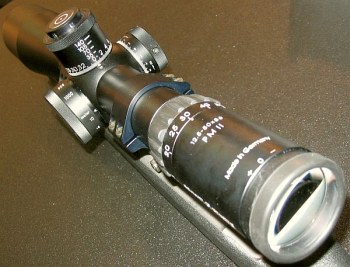
We still have no concrete information on scope price or availability in the USA. We’ve heard the figures $2700-2900 tossed around, but S&B representatives won’t give out hard numbers. Keep in mind that the 12.5-50 is NOT illuminated so it could actually be a little cheaper than the 5-25×56 PMII with illuminated reticle.
February 16th, 2008
The March 40X target scope has already made a big splash in benchrest competition. Many of the top shooters have replaced their Leupold Competition scopes with the March. This editor has shot with a March 40X and I can affirm it is brighter than the Leupold Comp 40X, and the March is sharp and bright all the way out to the edges. There are none of the side-focus parallax lash problems sometimes encountered with the Leupold. In competition so far, the March scopes have shown superior tracking and repeatability.
Based on the successful 40X format, March has introduced two new fixed-power target scopes, a 50X and a 60X. (In addition, there is a new 10-60X zoom–but that will be the subject of a later report.) Lou Murdica has been using the 50X in recent matches and he reports “it is outstanding. Even at 50X it is plenty bright. Visually you won’t notice the difference between the 40 and the 50 except you get more power, of course.”
The new 50X and 60X are the same size and weight as the March 40X. All three versions are 14.29 inches long, and weigh 599 grams (21.04 ounces). That’s about 12 ounces lighter than a Nightforce 12×42 BR. Front objectives are 52mm and the main tube is 30mm. All three fixed-power March scopes feature 72 MOA of total elevation and 50mm of windage. Clicks are 1/8th-MOA for 40X, 50X, and 60X.
The primary optical difference (other than magnification), is the size of the exit pupil. (A scope’s exit pupil is the actual diameter of the tiny cone of light that your eye perceives. A large exit pupil is more “user friendly”. With a very small exit pupil, it becomes more difficult to pick up the white circle of light–the position of your head becomes ultra-critical.) In optics there is no “free lunch”. Holding the front objective diameter constant, if you increase magnification, the exit size will get smaller. The March 40X has a 1.3mm exit pupil, the 50x measures 1.04mm, and the 60X has a 0.87mm exit pupil. We think the very small exit pupil on the 60X may undercut the practical utility of the higher magnification.

In the USA, March Scopes are sold exclusively by Kelbly’s. Call Hobie Bond at Kelby’s for current pricing and availability. We expect the 50X and 60X to run about $2200.00.
CLICK HERE for MARCH 50X and 60X SPEC SHEET
February 10th, 2008
 If you’ve ever used a borescope to inspect a rifle barrel, you know how valuable these tools can be. No other device lets you see the true condition of your barrel’s lands and grooves, from the throat all the way to the crown. For many of us the question isn’t whether we want and need a borescope, but whether we can afford one. Luckily, MidwayUSA has made it easier to acquire a quality Hawkeye borescope. Currently, MidwayUSA is offering a special 17″ Hawkeye Borescope “Limited Edition Kit” for just $639.99. That’s about $110.00 less than the regular price for the Deluxe Kit. The more expensive model comes with a fitted aluminum case while the Limited Edition Kit ships in a cardboard box. If you’ve ever used a borescope to inspect a rifle barrel, you know how valuable these tools can be. No other device lets you see the true condition of your barrel’s lands and grooves, from the throat all the way to the crown. For many of us the question isn’t whether we want and need a borescope, but whether we can afford one. Luckily, MidwayUSA has made it easier to acquire a quality Hawkeye borescope. Currently, MidwayUSA is offering a special 17″ Hawkeye Borescope “Limited Edition Kit” for just $639.99. That’s about $110.00 less than the regular price for the Deluxe Kit. The more expensive model comes with a fitted aluminum case while the Limited Edition Kit ships in a cardboard box.

Standard features of the economical Limited Edition are a 17″ precision stainless steel optical tube with advanced fiber optics, 25x magnification, high intensity (H.I.) light source with batteries, and 90-degree mirror tube, which provides a full 360-degree view of the bore’s interior. This borescope accommodates 17 caliber and larger with the standard mirror tube, and 22 caliber and larger with the 90-degree mirror tube. Optional accessories are a 90-degree eyepiece, and a rechargeable Nova light source which is 8 times brighter than the standard H.I. light source. NOTE: the Limited Edition Kit does have a 90-degree mirror, but not the 90-degree viewing eyepiece. You don’t want to confuse these two components.
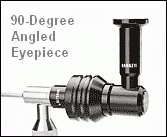 MidwayUSA has the Deluxe Hawkeye Borescope Kit on sale for $719.99 through the end of February. This is $30.00 off the normal $749.99 price. The components are similar to the Limited Edition Kit, but the Deluxe Kit includes a high-quality, lockable aluminum hard-case. The 90-degree angled eyepiece, Midway item 181455, costs an additional $274.95, and fits both Deluxe and Limited Edition models. MidwayUSA has the Deluxe Hawkeye Borescope Kit on sale for $719.99 through the end of February. This is $30.00 off the normal $749.99 price. The components are similar to the Limited Edition Kit, but the Deluxe Kit includes a high-quality, lockable aluminum hard-case. The 90-degree angled eyepiece, Midway item 181455, costs an additional $274.95, and fits both Deluxe and Limited Edition models.
|


