|
|
February 5th, 2008
We’ve been working the floor of SHOT Show to bring you the latest info and precision shooting products from action, barrel, bullet, optics, and rifle-makers. On a separate page, our daily Shot Shot Reports feature many large photos and video clips with knowledgeable smiths and technicians. Topic Highlights of the SHOT reports will be posted here in the Bulletin.

Click HERE for Part Two of our SHOT Show reports. Here are the highlights from our second installment:
Hornady’s Senior Ballistician discusses new 6.5 Creedmoor Cartridge.
Sightron unveils impressive new 8-32x56mm SIII Target Scope.
Glen Harrison, founder of Nesika Bay, reveals production plans (and tech features) of his new line of custom action.
Schmidt & Bender showcases much-anticipated 12.5-50 Target scope–and it’s amazing.
SKB’s new line of roto-molded heavy-duty rifle transport cases.
Chris Hodgdon summarizes new 2008 powder offerings, including Hybrid 100V and Win 780 Supreme.
February 1st, 2008
The new Bushnell 6500 series of riflescopes has been much anticipated. Today, Bushnell announced that its new 6500s, with 6.5x zoom range, will start shipping to vendors in March 2008. Bushnell claims the 6500 series delivers the highest resolution and widest field of view in its lineup of rifle scopes.

Three models are offered: 2.5-16x42mm, 2.5-16x50mm and 4.5-30x50mm. All three models feature side parallax adjustment, 30mm main tubes, and multi-coated optics with RainGuard®. The 2.5x models can be adjusted from 10 yards to infinity while the 4.5x model adjusts from 25 yards to infinity. Suggested retail prices are: 2.5-16x42mm – $699; 2.5-16x50mm – $779; and 4.5-30x50mm – $899. Expect “street prices” to be about $75 – $100 less for each model, once sufficent supplies reach the marketplace.
Our readers will probably be most interested in the 4.5-30X version. It has a 30mm main tube, 50mm objective, and weighs 21 ounces. The 4.5-30x offers 80-MOA of elevation and windage with 1/4-MOA clicks. Only two reticles are currently offered, a “Multi-X” fine-plex and a mil-dot.
The new 6500 Elite 4.5-30x50mm competes head to head with Sightron’s new 6-30x56mm SIII scope. At SHOT Show we’ll get a look at both new optics and then post our impressions. For target shooters, the Sightron appears to have the edge–as it offers a larger front objective, and target turrets standard.
CLICK HERE for more info on Bushnell 6500 Scopes.
January 9th, 2008
Sightron has provided AccurateShooter.com with these exclusive new photos of the “next generation” Sightron SIII scopes to be released very soon. Four new 30mm scopes join the Sightron line-up for 2008. There will be two new 3.5-10X scopes, one with a 44mm front objective and Mil-Dot reticle, the other with a large, 56mm objective and IR4A reticle for enhanced low-light performance. Both 3.5-10X scopes feature 1/4 MOA clicks plus 120 MOA of windage AND elevation. The 56mm version boasts constant 3.6-inch eye relief–a nice feature for hunters.


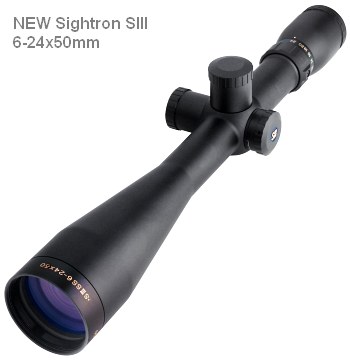
Next in the line-up is the new 6-24×50 SIII. This is an all-new 30mm scope that rivals the Leupold 8-25 LRT in design and performance. Available in target dot or mil-dot reticle, the 6-24x50mm offers a full 100 MOA of windage and elevation in a relatively compact (14.96″) scope weighing 21.90 ounces. Clicks are 1/4 MOA and eye relief is near-constant, varying from 3.6-3.8 inches throughout the magnification range.
NEW 8-32x56mm with 70 MOA of Windage + Elevation
For long-range shooters, the most exciting new offering from Sightron is the SIII 8-32x56mm. This scope has more magnification and a larger front objective than the Leupold 8-25×50 LRT, but with an $825.00 estimated “street price”, the Sightron costs less. Importantly, the Sightron 8-32X offers 70 MOA of both windage AND elevation. This outclasses other domestic 8-32 power zoom scopes. With a weight of 24.70 oz., the new Sightron 8-32×56 is 2.7 oz. heavier than a Leupold 8-25 LRT, but the Sightron is nearly 3/4 of a pound lighter than the Nightforce 8-32×56 BR model. That’s a big difference, considering that the Sightron matches the Nightforce’s 56mm front objective size.

Initially, the Sightron 8-32×56 will be offered with 1/4 MOA clicks, and just one reticle, a target dot. Sightron has indicated that other reticles might be offered in the future. No word on 1/8 MOA click values though. Overall, we’re impressed with the specs on the new 8-32 Sightron. It offers much more elevation than the Burris, Bushnell or Nightforce BR 8-32s, yet weighs little more than an 8-25 Leupold. We just wish Sightron offered a 1/8 MOA click option.

Sightron SIII 30mm Side-Focus Scopes for 2008
| Scope |
Objective |
Clicks |
Eye Relief |
OAL |
Weight |
Street Price |
| 6-24X |
50mm |
1/4 MOA |
3.6-3.8″ |
14.96″ |
21.9 oz. |
$785 |
| 8-32X |
56mm |
1/4 MOA |
3.6-4.0″ |
15.35″ |
24.7 oz. |
$825 |
CLICK HERE for Scope SPEC SHEET (MS Excel File)
January 6th, 2008
Here’s a great deal for you “Factory Class” Shooters needing a 10-power competition scope. Natchez Shooters Supply currently has matte black Weaver T-10 scopes on sale for just $229.99, marked WAY down. The T-10 (item SN849811) features a 40mm front objective, front parallax adjustment, and target turrets. The reticle is a Fine-Crosshair with 1/8th-MOA Target Dot. As with other Weaver T-series scopes, the T10 ships with a screw-in sunshade plus screw-in metal lens caps. If you need a 10X target scope, you may want to jump on this deal. Other web vendors are selling new T-10s for as much as $375.00. (Note: For Hunter BR competition you are limited to 6-power optics).

January 3rd, 2008
In its OpticsTalk.Forum, leading optics retailer SWFA.com provides advance info on new products for 2008.
New optics of interest to our readers include the 4.5-30×50 Elite 6500 scope from Bushnell, and a 6-24 power Zeiss Diavari with a massive 72mm front objective and new Fluoride Ion Glass. With a suggested retail price of $899.00, the new Elite 6500 features a 30mm main tube and an industry-leading 6.67 zoom range (from 4.5 power to 30 power). Two reticles are listed, a Mil-Dot and “Fine Multi-X”. Chris Farris of SWFA says the 4.5-30s are not shipping yet, but they should be available soon, and “SWFA will be the first to get them”.
Bushnell Elite 6500

The big 72mm Zeiss has been around for a couple years, but for 2008 it has been updated with Fluoride Ion (FL) lenses with new lens coatings, and RapidZ ranging reticles. The RapidZ reticles employ horizontal hash marks calibrated for popular calibers to allow ranging and hold-over functions. The 6-24x72mm costs a small fortune — vendors are selling it for $3,400. CLICK HERE for more info on Zeiss RapidZ reticles.

December 22nd, 2007
 If you’ve been saving up your pennies for a new high-magnification scope, you may want to wait a few more weeks. Sightron just gave us this exclusive report. If you’ve been saving up your pennies for a new high-magnification scope, you may want to wait a few more weeks. Sightron just gave us this exclusive report.
Sightron will introduce two new 30mm-tube target/varmint scopes early in 2008. The first new optic is a side-parallax 6-24x50mm with 100 MOA of total elevation (50 MOA either side of center). It will be available in a variety of reticles, including at least one reticle with ranging features. Sightron expects the street price to be around $775-$790.
The second scope, and this is big news for long-range shooters, will be an 8-32x56mm side-parallax scope with 70 MOA of total elevation. The 8-32 will initially be available only with a 1/4-MOA target dot reticle, but other reticle options may be offered later in the year. The 8-32 should have a street price in the $825.00 range. This means it will cost less than a Leupold 8-25×50 LRT, but have more magnification and a larger front objective (56mm vs. 50mm). Sightron has tested its new 8-32 against the Leupold LRT and Sightron’s engineers believe the 8-32 compares favorably in terms of clarity, resolution, and tracking. This new Sightron 8-32 may even lure some buyers away from the much more expensive Nightforce line.
Sorry, no photos yet. There are only a handful of the new scopes in the country, but Sightron’s Alan Orr has promised full specs and photos in a few days. Stay tuned — we’ll run the pix in the Daily Bulletin as soon as we receive them. And Sightron will be sending us test samples of both the new 6-24 and the new 8-32.
December 16th, 2007
Our initial report on Schmidt & Bender’s centerfire version of its 10-50×56 Field Target scope generated quite a bit of interest. But in recent weeks folks have been emailing us, asking “Is this thing for real?” and “When will it reach the States?” Well, we can confirm that Schmidt & Bender definitely is putting a 12.5-50X56 PMII zoom scope into production, and part of the early production is reserved for the U.S.A. market.
What will the new scope look like? Well Vince Bottomley has seen an early prototype in Europe. He reports: “The overall size is the same as the Schmidt & Bender 5.5-25 model so it’s smaller than a Nightforce but boasts more magnification.” Here is a “spy photo” from Vince:

Schmidt & Bender still hasn’t published final specs on its website, but Mark Cromwell, head of Schmidt & Bender’s North American division, hopes to have them on display at Shot Show in February in Las Vegas. With the rapidly eroding U.S. Dollar, prices are subject to change, but Cromwell expects the scope to run about U.S. $2700.00 – $2800.00, but it could be more. Cromwell says “the current spec sheet for the 12.5-50 indicates it is NOT illuminated. Reticle illumination is normally a $300+ added cost for Schmidt & Bender, so it is possible the 12.5-50 PMII long range could cost LESS than the 5-25 PMII which IS illuminated.”

December 14th, 2007
Here’s a sweet deal for you game hunters out there. SWFA is offering a FREE Garmin eTrex hand-held GPS with the purchase of a Burris Fullfield II scope. We’ve checked around the web and the Garmin eTrex, by itself, runs about $95.00. SWFA’s promo price on the Burris 3-9×40 Fullfield II Rifle Scope with GPS is $209.95, so that means your effective cost for the optic is just $115.00. Not bad for a scope with fully-coated lenses and the Burris No-BS “Forever” warranty.

SWFA is also offering a Garmin eTrex GPS with the purchase of a Burris 4.5-14×42 Fullfield II rifle scope. The package price for the 4.5-14×42 model and GPS is $339.95. Both Burris scopes (3-9 and 4.5-14) feature 1/4-MOA clicks and a Ballistic Plex reticle. This reticle design has vertical hash marks to help with holdover at long range.

The Garmin eTrex GPS is considered a rugged classic. It is compact and light weight at mere 5.3 ounces with batteries, with the buttons positioned on the side for easy, one handed operation. The casing is rugged and waterproof to IPX-7 standards. The eTrex will operate for about 15 hours on two AA batteries.
November 27th, 2007
I know most of this site’s readers on this site would spend their last dime on bullets and powder. But sometimes, you do have to purchase other essentials such as winter clothing and outdoor gear. Plus it’s the holiday season again, and that means gifts for the family.

Today we’re featuring Sierra Trading Post. This is a solid company that provides a wide variety of products for the outdoorsman, at sometimes spectacular prices. This editor has personally shopped with Sierra Trading Post for years, and just today I purchased two items, a Windstopper® Base Layer Shirt (item 12991) for winter motorcycling, and a set of Kenyon Polarskins polypro long johns (item 13854) for snow sports. At $16.95, the Polarskins are half the price I’d pay for a similar product from most outlets.
Sierra Trading Post is now running a huge promotion, with every item at least 50% off retail. Here are some products of interest to shooters and hunters:

I’ve got one of these LED lamps. It is much lighter than most other “headband lamps” and the battery lasts a long time. I use it for camping, reading, and even in the reloading room in the evening for extra illumination.

For $39.95, this Blaze Orange/Khaki Winchester Upland hunting jacket is a great bargain, though it’s not waterproof. What I really like is that it comes with TWO fleece inner liners–a vest and a full-sleeved inner jacket, both of which can be worn separately. It even has cartridge holders in the front and a game pouch on the back. Here’s what one purchaser has to say: “Have worn this in thick bushland, stands up to abuse, and with blaze orange built in, no need for extra items of [hunting] clothing. Very adaptable with warm vest that can be removed if too warm”.

If you want a pair of armored binoculars that will last a lifetime, these 7×50 Waterproof Steiners are a great deal at $274.50. Even at “ultra-discount” warehouse stores, 7×50 Marine Steiners sell for $300-320.00. These binoculars are based on the rugged Steiner mil-spec 7×50 unit used by the U.S. Army. Steiner’s fully-coated lenses are legendary for their clarity and resolution.
Sierra Trading Post isn’t all just camping and outdoor gear. There is a wide selection of other suitable gift items for the wife, kids, and relatives — wool sweaters, silk underwear, travel accessories, ski goggles… you name it.
November 25th, 2007
Check out our enhanced VIDEO VAULT. We have added streaming digital video in Flash Format. You’ll find a slick new Flash Player that lets you watch videos with just one click. There are over 35 Videos in the collection, and we’ll be adding new Videos every week. Flash Videos are highly compressed, so they stream in real time if you have a fast internet connection–no more waiting for long downloads.

Using YouTube technology, we’ve built a playlist with lots of entertaining videos. And, we can add videos from our readers to our Video Vault. Just send your videos to Mailbox [at] 6mmBR.com, or upload your videos directly to YouTube.com and email us the link.
Create Your Own Videos Easily
If you have a recent digital “point and shoot” camera, chances are you can shoot your own videos and add them to the site. It’s pretty simple. Select the “Video” setting, usually indicated by a movie camera icon on the mode dial or menu. Then depress your shutter release (just like taking a still picture) to start the video. Click the shutter release a second time to stop the video. You upload videos to your computer the same way you do for stills. Windows users can then use the FREE and easy Windows Movie Maker software to edit the video or add titles or soundtracks. Here are some resources that can help you make your own videos.

An inexpensive digital still camera, such as this Canon A550 ($140.00), can take excellent video, complete with sound. Try it–you’ll get great results!
How to Take Video with Your Digital Still Camera
Note, this video tells you to upload your video to Vimeo.com. That’s not necessary. Just send your video to us (keep it under 6 megabytes), or upload directly to YouTube.com.
How to Use Windows Movie Maker
Move-Maker Basics
|


