|
|
November 23rd, 2007
As part of its “Christmas Flyer” Promotion, Midsouth Shooters Supply has cut the price on 1″ Burris Signature and 1″ Signature Zee (Weaver style) rings. We recommend these ring sets because Signature Rings have plastic inserts to hold your scope. The inserts prevent binding or misalignment so you don’t have to lap your rings. They also keep expensive scopes looking like new since the inserts leave no marks on the scope body. You can also order offset inserts that let you “pre-load” elevation and windage in the rings.

The Signature models are just $21.88, while the Signature Zees are marked down to $24.84. CLICK HERE to download Midsouth’s 16-page 2007 Christmas Flyer in .PDF format.
November 12th, 2007
We’ve looked through many different types of spotting scopes. Initially we thought angled was the only way to go. This lets a shooter mount the spotting scope at his side and easily glance through the lens with the scope body rotated 90°. However, at matches where you spot for a partner, the straight scopes seem to work better. You don’t have to bend your neck down or remove your hat and your “free” eye can scan downrange for wind changes. When spotting for your partner (while seated or standing), a tripod-mounted straight scope was definitely the most “user-friendly” set-up.
Straight (in-line) Spotting Scope
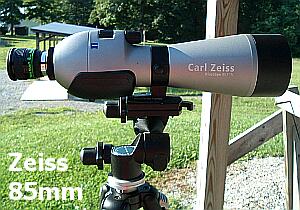
Danny Reever, author of our Spotting Scope Review, tell us: “Straight vs. angled? Man, that’s a tough call! Having used both personally for over a year I’d have to say this: I feel the straight gives you a clearer, sharper image. One less mirror to contend with. If you have a dealer that can give you a side-by-side look at a couple of hundred yards the difference is apparent. That’s one reason Chip Allen chose the straight Zeiss over the angled. On the other hand the angled gives you more options in the way of setup which can be a bonus between cramped benches, when you’re spotting for yourself. I don’t shoot prone, but I think the angled would be the way to go for a solo prone shooter, again more setup options. Another benefit of the angled is that you can keep the tripod lower, a plus on a windy day. The 100MM scopes like the Pentax and Optolyth do not offer an angled body option–maybe there are some engineering issues, or perhaps that’s just to control costs.”
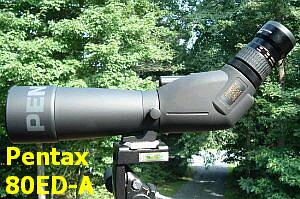
Angled Spotting Scope
November 4th, 2007
Sightron, Inc., has joined forces with the NRA to assist with the largest NRA membership drive in history. Shooters who purchase any Sightron scope (excluding SI models) will receive a free 1-year membership to the National Rifle Association. Current NRA members will receive a 1-year renewal with purchase. “With 2008 being a critical election year, all of us here at Sightron are concerned about attacks against our right to bear arms and future generations having the same rights we have enjoyed,” said Sightron’s President, Scott Helmer. “We are proud to do our part to help the NRA defend our Second Amendment rights.” To learn more about Sightron’s complete line of products, visit www.Sightron.com.

FREE SHIPPING on Sightron Scopes
Lock, Stock, & Barrel, www.LockStock.com, offers excellent prices on all Sightron Scopes. What’s more, Lock Stock & Barrel even provides Free Shipping on Sightron Scopes.
October 30th, 2007
 With the price of some premium scopes edging to $2500.00 (and beyond), it’s more important than ever to provide extra protection for your expensive optics. ScopeCoat produces covers that shield scopes with a layer of neoprene rubber (wetsuit material) sandwiched between nylon. In addition to its basic covers, sold in a variety of sizes and colors, ScopeCoat has released two new heavy-duty products that provide added security. With the price of some premium scopes edging to $2500.00 (and beyond), it’s more important than ever to provide extra protection for your expensive optics. ScopeCoat produces covers that shield scopes with a layer of neoprene rubber (wetsuit material) sandwiched between nylon. In addition to its basic covers, sold in a variety of sizes and colors, ScopeCoat has released two new heavy-duty products that provide added security.
The XP-6 Flak Jacket™ is specifically designed for extra protection and special applications. The 6mm-thick layer of neoprene is three times thicker than the standard ScopeCoat. XP-6 Flak Jackets are designed for tall turrets, with sizes that accommodate either two or three adjustment knobs (for both side-focus and front-focus parallax models). To shield an expensive NightForce, March, or Schmidt & Bender scope, this a good choice. XP-6 covers come in black color only, and are available for both rifle-scopes and spotting scopes. Shown below is an XP-6 Flak Jacket™ on a Leupold Spotting Scope.

The newest ScopeCoat product is a 6mm XP-6 cover with ZIPPER. This is designed for removable optics that need protection when in storage. The full-length, zippered closure goes on quick-and-easy and provides more complete protection against dust, shock, and moisture. Suggested Retail Price is $30.

Photo Courtesy Shooting USA.
October 29th, 2007
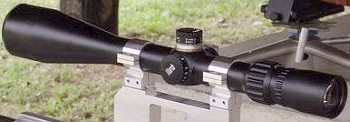
Here it is folks, the March 10-60x52mm, the most powerful premium zoom rifle-scope ever offered to the public. There are three prototypes now in the United States. One is on Don Nielson’s 6.5×47 Lapua Bench gun. He shot that rifle this weekend in Sacramento at a 600-yard match in Heavy Gun class (though the rifle is light enough to shoot in Light Class). Don’s results speak for themselves–Don finished first in HG Agg., LG Agg., HG Score (283-3X), 2-Gun Score (421-3X), and 2-Gun Aggregate (3.0xx”). The HG score, 2-Gun score, and 2-Gun Agg are all new NBRSA records for the new target with its tiny 1.2″ X-Ring.
Yep, that’s a pretty good showing for a scope in its first-ever match (and yes, you have to credit Don’s great shooting as well). The March showed itself to be very reliable and repeatable. The big question we had “can it resolve 6mm bullet holes at 600 yards?” was answered with a resounding “Yes!”. Don tells us that, with the 10-60x March “he could see bullet holes very well in the white.” In the light blue section of the target, holes were harder to see but Don could still clearly see where his group was forming up.
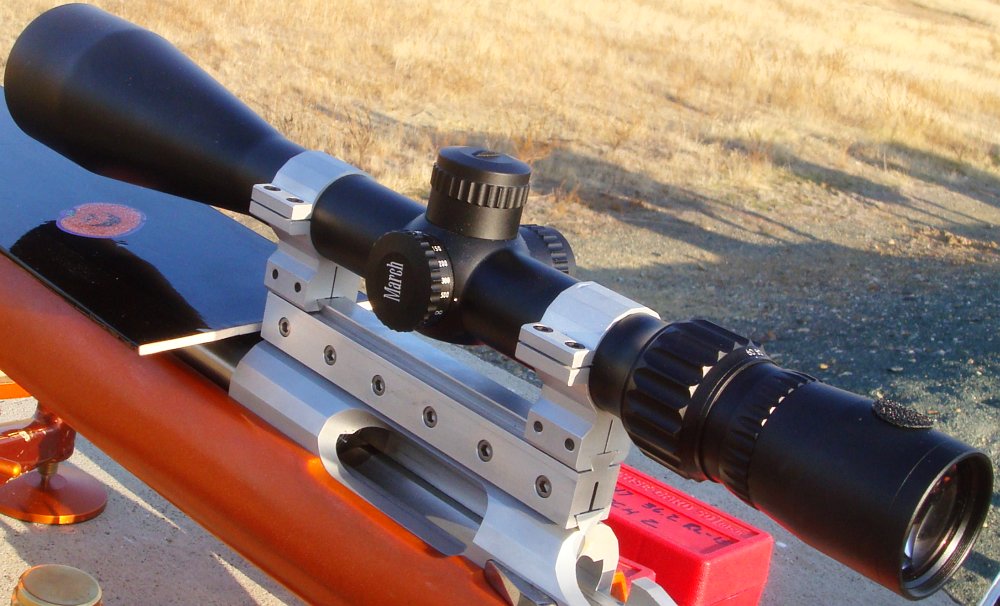
We’re pleased to see that the zoom March offers 60 MOA of elevation–good enough for 1000 yards. The scope has a 52mm objective, 30mm main tube, 40 MOA of windage, and weighs 24.8 ounces (704 grams). It has a side-focus parallax control, 1/8-MOA clicks, and focuses from 50 yards to infinity. Currently, the only reticle choice is a 1/16-MOA dot, but that could change with production models. Apart from its anticipated $2500-$2600 price, the only negative concern we have with the new March scope is the exit pupil. Even with a generous 52mm front objective, the exit pupil is under 1mm at 60-power. That’s very small and will make head/eye position very critical when using the March at full magnification. The top photo below shows the March on Don’s trademark orange rifle.
CLICK HERE FOR LARGE PHOTO.


October 16th, 2007
People have already started asking about the U.S. Optics scope on Rob Hunter’s “BriTactical” rifle featured as the current Gun of the Week. This is no ordinary optic. It is a special “supersized” version of U.S. Optics SN3 T-PAL series, custom-built for Robert. The SN3 is offered with 30mm, 34mm, or 35mm main tubes. This is the big boy, 35mm, with matching U.S. Optics anodized rings. The front objective is upsized from the standard 44mm to a whopping 58mm. This provides enhanced low-light and twilight performance. The reticle is U.S. Optics’ own Mil Scale, allowing Robert to range-find targets reliably to 1000 yards and beyond. This is very critical because Robert will be using the scope in a Police/Military competition where he must engage multiple targets at unknown distances–and no laser rangefinders are allowed.

The big knob on top is one of U.S. Optics’ signature features. This is the EREK elevation turret. It allows Robert to run through his entire range of 1/4-MOA clicks in just two turns. If that’s not handy enough, a one-turn EREK knob is also available, but with wider click values. Like most U.S. Optics scopes, this unit is ruggedized and highly weatherproof. It features an illuminated reticle, handy side-focus parallax adjustment, and beefy metal construction. How much does one of these 5-25 power SN3 T-PALs cost? Well if you have to ask, you probably can’t afford it. Complete, with all the upgrades, the scope costs over $2800.00.
October 7th, 2007
Natchez Shooters Supply, is now offering a wide selection of quality Zeiss Conquest scopes at deeply discounted prices. The Zeiss Conquest 6-20×50 scope is one of our favorite 1″-diameter optics for target shooting and varminting. Natchez is now selling the 6.5-20 Conquest with lower (hunting) turrets at $669.99. That’s a great deal–over $200.00 less than most retailers charge. Zeiss Conquests have clear, sharp optics and very positive windage and elevation adjustments. Contact Natchez soon — availability of discounted scopes is limited.

September 26th, 2007
We heard from our friends at SWFA.com that Leica’s current 62mm and 77mm Televid spotting scopes are being discontinued. Now we know why. Bigger and better models will be available in early 2008. These are completely re-designed, with larger objectives, more advanced glass, and special new AquaDura™ coatings that shed raindrops.

A new, very compact 65mm Televid will replace the current 62mm model. Leica’s top-of-the-line unit has jumped up to 82mm from 77mm. Even with their bigger objectives, Leica claims both new scopes will be the most compact premium spotting scopes in their respective classes. The new Televid 65 and 82 also now sport full rubber armor.

The big news is the glass. Both the new 65mm and the 82mm will come with flouride glass, with optional (extra cost) APO (apochromatic) lenses for reduced chromatic distortion. Leica claims the optical performance of the new spotting scopes is significantly better than the preceding models. The use of specialty fluoride glass yields improved contrast without altering natural color tones. The Leica Televid 82 and Televid 65 spotting scopes are both available with straight or angled eyepiece housing, with either HD or APO glass. The new APO versions feature redesigned apochromatic lenses for high contrast viewing free of color aberrations. The High Definition (HD) versions use specialized glass in a newly designed lens arrangement for improved clarity and contrast.

The new Televid spotting scopes come complete with quality Leica zoom eye-pieces. Televid HD versions come with a Leica VARIO 20-60x eyepiece, while the Leica APO-Televid versions sport the new high performance wide-angle Leica VARIO 25-50x WW ASPH eyepiece. Leica claims this is the first premium zoom eyepiece to offer a field of view comparable to wide-angle fixed-power eyepieces.

As noted above, the new Televid 65 and Televid 82 both feature AquaDura™ lens coatings. This is a Leica proprietary coating technology used on all exterior glass surfaces. This AquaDura coating repels moisture, causing raindrops to cleanly drip off from the lens surface. Additionally, fingerprints and dirt can be easily removed.
For more information, visit www.leica-camera.com.
82 mm APO Brochure (.pdf) | 65 mm APO Brochure (.pdf)
September 16th, 2007
There’s a new high-magnification zoom scope in development that will offer precision shooters “more power” than ever before. Lou Murdica, who has been working directly with Deon Optical/Koto Precision in Japan, makers of the March 40x BR scope, is getting a new prototype variable-power March that tops out at 60-power. That’s some serious magnification ladies and gentleman.
In addition to the 60X magnification, the new March promises best-in-class resolution and, importantly, ultra-reliable tracking. We’re pleased to see that the zoom March offers 60 MOA of elevation–good enough for 1000 yards. The scope has a 52mm objective, 30mm main tube, 40 MOA of windage, and weighs 24.8 ounces (704 grams). It has a side-focus parallax control, 1/8-MOA clicks, and focuses from 50 yards to infinity. Currently, the only reticle choice is a 1/16-MOA dot, but that could change with production models.

Lou hopes to use the March 10-60×52 at 200 yards next week in the NBRSA Nationals hosted at the Kelbly’s Range (Ohio). Here are the remaining specs for Lou’s new scope:
March 10-60×52 Zoom Riflescope
| Feature |
Minimum |
Maximum |
| Magnification |
10x |
60x |
| Exit Pupil |
0.86mm |
3.06mm |
| Eye Relief |
88-99mm 10x |
96-101mm 60x |
| Focus Range |
50 yards |
Infinity |
| Elevation Range |
– |
60 MOA |
| Windage Range |
– |
40 MOA |
| Length |
– |
418mm (16.46″) |
| Weight |
– |
24.8 ounces |
September 15th, 2007
Now through December 31, 2007, Weaver Optics is offering a “Upgrade” promotion on Weaver Grand Slam and Classic Extreme scopes. If you purchase one of these Weaver scopes, send in an old scope (any make or model, 1″ or 30mm), and fill out a form, Weaver will send you a $50 check. Or, you can still get a $25 rebate check if you mail in the redemption form with proof of purchase without sending in an old scope. Click HERE for more details and to obtain the mail-in Rebate Form.

|