Do you neck-turn hundreds of cases annually? Then you deserve this outstanding tool. This innovative neck-turning system is truly a game-changer. The 21st Century Shooting Powered Neck-Turning Lathe is quite simply the best system ever created for quickly and precisely uniforming (and reducing) the neckwall thickness of cartridge brass. We have the original manual 21st Century neck-turning lathe, and can attest that it works great. But with the new powered system you can turn necks faster and more efficiently, with less effort. This is like going from a stick shift to an automatic transmission. The cases feed very smoothly and the results are beautiful. Once you’ve tried the Powered Neck-Turning Lathe you won’t want to use anything else. Watch this video to see how it works:
Power is activated by the red button on the end of the blue, horizontal feed handle:
Click the Speaker Button on video frame to play with sound (audio).
The Powered Neck-Turning lathe is a modular system. Swing the bar from right to left to feed the case. The power head (with case holder) glides on stainless steel rails for smooth movement. This allows very precise feed rate. Power is supplied via a button that is built into the end of the feed handle. Push the red button to make the case spin. It’s as simple as that.
The folks at 21st Century Shooting explain why the system works so well: “The floating design of our Neck Turner and Case Driver allows the case mouth (bore) to run on the arbor absolutely concentric. This, therefore, allows the outside diameter to be turned concentric with the inside diameter.”
Here is another video that shows how the lathe system operates:
Click the Speaker Button on video frame to play with sound (audio).
Complete Powered Neck-Turning Lathe System
The powered neck-turning system comes with everything you need, starting at $679.00. This includes: Motor Assembly, Lathe Base, “L” bracket, Neck-Turning Tool, Cutter, Case Holder, Driver, Turning Arbor, Expander Die Body, and Expander Mandrel. 21st Century currently offers a choice of nine popular calibers: .17, .20, .22, .243 (6mm), .264 (6.5mm), .270, .284 (7mm), .30, and .33. The case holders are appropriately sized for the common rim sizes in that caliber. Choose either stainless arbor and mandrel or Titanium Nitride-coated arbor and mandrel (for $20 more). Some of the larger calibers cost a bit more.
On our main Accurateshooter.com website, you’ll find a comprehensive review of the STM system for cleaning cartridge brass with stainless media. To clean brass with stainless media, start with five pounds of small stainless pins sold by StainlessTumblingMedia.com. Place these along with a gallon of water, a little liquid cleaner, and two pounds of cartridge brass in a rotary tumbler, and run the machine for one to four hours.
Forum Member Tests STM System
Our reviewer, Forum member Jason Koplin, purchased the STM media and a new Thumler’s Tumbler. He then tested the STM cleaning procedure on his own brass, including some extremely dirty and tarnished “range pick-up” brass. Jason was thoroughly impressed with how well the STM process worked — as you can see from the “before and after” photos below. Brass which looked like it was ready for the scrap heap was restored to “like-new” appearance. Check it out:
Works Great on Both Rifle Brass and Pistol Brass
The process works equally well on both rifle brass and pistol brass (see below). Jason observed that one surprise benefit of the STM cleaning procedure is a big reduction in noise in his reloading room. Jason said the water-filled rotary tumbler was much quieter than his vibratory tumblers.
You’ll want to read Jason’s full review which shows more before and after images. The full article features a “how-to” video created by Forum member Cory Dickerson, the young man who pioneered the stainless tumbling process and founded STM. The video shows how to load brass, media, and cleaner solutions into the tumbler, and how to separate media from brass once the tumbling is done.
Need powder or primers? Or want to lay in a supply of the hard-to-find stuff — such as H4350 — for a rainy day? Well you’re in luck. With these promotions you can get FREE (or virtually free) hazmat charges for powder and primer purchases. These Hazmat deals can save you $25-$40 on your order. Don’t dawdle — these deals expire soon!
Natchez Shooters Supplies is offering FREE Hazmat on purchases of $99.99 or more. This deal runs now through July 27, 2018 (Friday) at 11:59 PM EST. Use Code FH180725.
MidwayUSA is offering Free Hazmat on $150.00+ orders of CCI Primers. Note: This promotion does NOT apply to ANY powders at all or any other brands of primers. It is good for CCI primers only, now through July 31, 2018 at 11:59 pm CST. Use Code CCI201807.
At the request of our readers, we provide select “Deals of the Week”. Every Monday morning we offer our Best Bargain selections. Here are some of the best deals on firearms, hardware, reloading components, optics, and shooting accessories. Be aware that sale prices are subject to change, and once clearance inventory is sold, it’s gone for good. You snooze, you lose.
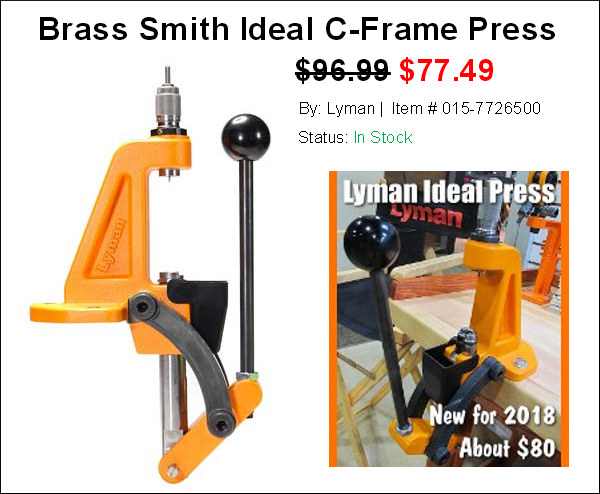
1. Midsouth — Lyman Brass Smith Ideal Press, $77.49
Lyman’s new Ideal compact press works great as a second, lighter-duty press. It also is a good choice for loading at the range. It can easily be mounted to a range bench with C-clamps. With its cast-iron body, this C-Frame press is stronger than other presses in its price class. If you are looking for a secondary press for decapping, bullet-seating and other tasks not requiring heavy leverage, this is an excellent choice. The Lyman Ideal costs just $77.49 at Midsouth Shooters Supply.
2. Grizzly.com — Bald Eagle Rests $139.95 – $199.95
Bald Eagle (by Grizzly) offers one of the best value-priced front rests on the market. We’ve seen F-Class shooters win matches with the Bald Eagle Slingshot Windage Rest, which costs less than a fifth of a premium co-axial rest. For a new shooter, this is a very cost-effective solution. One Forum member purchased the Bald Eagle for his young grandson, deciding it was the best rest under $300.00. All three rests shown offer a cable (with large knob) for easy windage adjustment. The Slingshot model, in cast iron or aluminum, has an elongated front leg for added stability. This also brings the Windage knob within easy reach. The basic aluminum, triangle rest is compact and easy to carry. Note: Front sandbag sold separately.
3. Graf & Sons — Sightron Scope + 1050 Rds .22LR Ammo, $99.99
NOTE: This is for Phone orders only. Repeat: You must order by phone to get this offer!
Here is a stunning deal. Get a 3-9x32mm Sightron scope — adequate for a basic hunting rifle. Then Graf’s will knock $50 off the price, for a net cost of $99.99. But there’s more. When you CALL in this order, Graf’s will give you TWO (2) 525-round boxes of Federal .22 LR Ammo, a $49.98 value. That’s a heck of a deal. But act soon. This is a limited time offer. And remember, this is for PHONE ORDERS ONLY — call Graf & Sons at 800-531-2666.
4. Midsouth and Powder Valley — Hodgdon H4350 on Sale
For a long time Hodgdon H4350 powder has been very hard to find. Now some of our favorite online retailers have H4350 in stock now, in both 1-pound and 8-pound containers. Midsouth Shooters Supply has Hodgdon H4350 8-lb jugs for $191.45 and H4350 one-pound containers in stock for $26.45. Powder Valley has one-pound containers of H4350 in-stock now for $26.55 and the 8-pounders for $189.75. That’s an excellent price. If you want an 8-pounder, we suggest you act quickly.
Bushnell’s highly-regarded Elite 4500 Series scopes offer very good performance and reliability for the price. Here’s a great deal on a Bushnell 6-24x40mm Elite 4500 with Multi-X Reticle, 1/4-MOA clicks, and 1″-diameter main tube. Right now this fine optic is just $359.99 — nearly $240 off the regular price. This would be a good choice for a varmint rifle. Hard to find better glass at anywhere near this price. Verified buyer states: “Great scope. Clear, tracks correctly, and is repeatable. Great glass, to my eyes better than Leupold VX3 and Weavers.” Get FREE Shipping with code FS180723 through 7/24/18.
6. CDNN — Walther Creed 9mm Pistol, $269.99
The Walther Creed offers excellent ergonomics, good accuracy, and well-designed controls at a killer price — $269.99 at CDNN Sports. This gun, designed to be a value-leader, emulates Walther’s more expensive PPQ model (MSRP $649.00) at a much lower price. The Creed’s frame size and shape is the same as the PPQ, but the Creed lacks interchangeable backstraps. Slide and trigger are very similar. The Creed features a snag-free bobbed hammer. Testers have praised the new Creed, saying that, despite the bargain price, it “sacrifices little to nothing in… ergonomics, accuracy, and reliability.”
7. Grafs.com — Magnetospeed Sporter $178.99
If you have been waiting to get a Magnetospeed… wait no longer. Priced at just $178.99 at Grafs.com, the Magnetospeed Sporter model costs less than half as much as Magnetospeed’s V3 models. This chronograph attaches directly to your barrel so you don’t have to go downrange to position tripods and set up skyscreens. For most people the Sporter Model contains all the features they need. Using Magnetospeed’s XFR adapter (sold separately), data can be transferred easily from the display module to your mobile device. READ Magnetospeed Sporter Review.
8. Brownells — 9x19mm Ammo, $9.99 per 50-round Box
The 9mm Luger (aka 9x19mm) is the world’s most popular centerfire handgun cartridge. Now you can purchase quality, big-name 9mm ammo for under $10 per 50-count box. Choose either the aluminum-cased Federal Champion ammo (115gr FMJ), or the brass-cased Sellier and Bellot ammo (124gr FMJ). We’ve shot both types of ammo and they both functioned well in SIG, Glock, and S&W pistols. Order by the box, or buy 1000 rounds of the Federal 115gr FMJ for $174.90, just 17.5 cents per round.
9. Amazon — Jialitte Scope Bubble Level, $11.99
If you shoot long range, you need a scope level. This nicely designed Jialitte Scope Bubble Level is fully CNC-machined to close tolerances for a good fit. It features a 30mm milled inside diameter, plus an inner insert ring so it will also fit 1″-diameter main tubes — that dual-diameter versatility is a nice feature. We also like the way the unit is nicely radiused, and has a low profile in the middle. User reviews have been very positive. You could easily pay $35.00 or more for a 30mm scope level. Purchasers have praised this product — almost all verified buyers have rated this five stars.
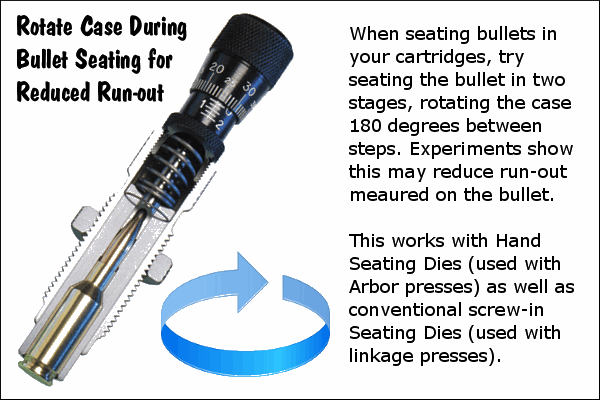
Here is a simple technique that can potentially help you load straighter ammo, with less run-out (as measured on the bullet). This procedure costs nothing and adds only a few seconds to the time needed to load a cartridge. Next time you’re loading ammo with a threaded (screw-in) seating die, try seating the bullet in two stages. Run the cartridge up in the seating die just enough to seat the bullet half way. Then lower the cartridge and rotate it 180° in the shell-holder. Now raise the cartridge up into the die again and finish seating the bullet.
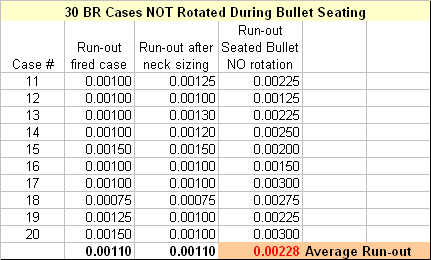
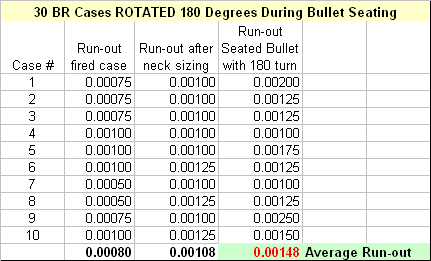
Steve, aka “Short Range”, one of our Forum members, recently inquired about run-out apparently caused by his bullet-seating process. Steve’s 30BR cases were coming out of his neck-sizer with good concentricity, but the run-out nearly doubled after he seated the bullets. At the suggestion of other Forum members, Steve tried the process of rotating his cartridge while seating his bullet. Steve then measured run-out on his loaded rounds. To his surprise there was a noticeable reduction in run-out on the cases which had been rotated during seating. Steve explains: “For the rounds that I loaded yesterday, I seated the bullet half-way, and turned the round 180 degrees, and finished seating the bullet. That reduced the bullet runout by almost half on most rounds compared to the measurements from the first test.”
Steve recorded run-out measurements on his 30BR brass using both the conventional (one-pass) seating procedure, as well as the two-stage (with 180° rotation) method. Steve’s measurements are collected in the two charts above. As you can see, the run-out was less for the rounds which were rotated during seating. Note, the change is pretty small (less than .001″ on average), but every little bit helps in the accuracy game. If you use a threaded (screw-in) seating die, you might try this two-stage bullet-seating method. Rotating your case in the middle of the seating process won’t cost you a penny, and it just might produce straighter ammo (nothing is guaranteed). If you do NOT see any improvement on the target, you can always go back to seating your bullets in one pass. READ Forum Thread..
The AutoTrickler/AutoThrow system dispenses powder with 1-2 kernel accuracy in just 10-12 seconds.
Review by Craig Arnzen of Area419.com
Guys in the PRS world are finally ready to admit — the more accurate we want to be, the more we should borrow practices from the F-Class and Benchrest worlds. There are no better examples of this that have popped up in the last year than the widespread adoption of highly accurate powder dispensers and high-end annealing techniques.
I’ll talk about the annealers another time, but today I want to introduce you to the powder dispenser contraption that is popping up on reloading benches everywhere — the AutoTrickler plus AutoThrow running with an A&D FX-120i magnetic force restoration scale.
The setup is priced firmly between the standard RCBS Chargemaster and the high-end $3,800 Prometheus powder dispensers. Depending on how you outfit it, and where you buy it, an AutoTrickler/AutoThrow setup will cost between $900 and $1,200. Figure $500-$525 for the A&D scale, $399.00 for AutoTrickler + AutoThrow (for A&D), and up to another $300 for Area 419 accessories.
The AutoTrickler V2 by itself is $229-$269 (depending on scale model), while the AutoThrow is $199.00 purchased separately. Current AutoTrickler owners can add the AutoThrow as an upgrade. It’s worth it — the AutoThrow speeds up the dispensing process dramatically. Watch this video with the smart guy who invented the AutoTrickler and AuthoThrow systems, Adam McDonald:
AutoTrickler Inventor Adam McDonald Demonstrates the AutoThrow System:
How the AutoTrickler + AutoThrow System Works
The “brain” of this system is a micro-processor that controls the motors on the AutoThrow powder dispenser and the AutoTrickler, taking more than 100 readings per second from the scale. The process starts with the AutoThrow first dropping 90% of the charge directly into the pan via a vertical drop tube. Then the AutoTrickler finishes dispensing the charge with super precision, using its horizontal tube. This two-stage process allows the system to throw powder within a kernel or two of your target weight every time — in just 10-12 seconds.
Powder is dispensed onto an A&D FX-120i scale (other models, including a Sartorius Entris 64-1S can also be used) that is able to detect and register the weight of individual kernels very quickly, providing data back to the “brain”. The initial powder drop from the AutoThrow gets you within about 2 grains and then the AutoTrickler finishes in just a few seconds with amazing accuracy. When set up right, this system can weigh repeatably to within one or two kernels of powder.
Area 419 Accessories for AutoTrickler and AutoThrow
The system can also be outfitted with milled aluminum accessories from Area 419, adding adjustability, stability, and ergonomics to the process. We sell a base for the AutoTrickler that adds weight (to reduce movement when the stepper motor runs) and has adjustable feet to help tune the powder flow, a larger cup with handle (to reduce powder splashing when dumped from above) and upgrades for the auto-throw that enhance powder capacity and reduce noise and vibration.
All in all, this is one of the most popular new ways to throw powder of the last year, and these systems are becoming common enough that we think they are here to stay. This video review by the 6.5 Guys offers some tips for setting up your AutoTrickler System with Area 419 base.
AutoTricker with Billet Base and AutoThrow Review by 6.5 Guys:
At the request of our readers, we provide select “Deals of the Week”. Every Monday morning we offer our Best Bargain selections. Here are some of the best deals on firearms, hardware, reloading components, optics, and shooting accessories. Be aware that sale prices are subject to change, and once clearance inventory is sold, it’s gone for good. You snooze, you lose.
1. Creedmoor Sports — Shooting Coats $50 and $100 Off
Hard-holders and position shooters, this deal is for you. Creedmoor Sports has long offered some of the very best American-made shooting jackets. Creedmoor coats have been worn by legions of top shooters including Smallbore, Service Rifle, and High Power National Champions. Now you can enjoy big savings on Custom and Off-the-rack Creedmoor shooting coats. Custom shooting coats are $100 off, while the Original Hardback and Deluxe Hardback are $50 off.
2. CDNN — Colt Competition AR15 Kit, $549.99
The Colt Kit does NOT include barrel, bolt carrier group, charging handle, or magazine.
This affordable Colt AR15 Kit includes upper, complete lower, handguard, and Magpul stock. To this, add your choice of barrel and optic. We like this option because the barrel is so important to accuracy and overall performance. This Colt package costs $549.99. Add a match-grade, finish-chambered barrel from Criterion or Krieger, plus bolt carrier group, and you’re in business. The Magpul PRS stock features a quick-adjustable cheek-piece and butt-plate — allowing you to easily adapt head position and LOP for your discipline of the day. The straight-toe PRS stock works great in a rear bag. This is a good platform for a PRS Gas Gun Division rifle.
3. Grafs.com — Lyman Summer Sale, 10-22% Off Select items
Lyman has brought out some fine products in recent years, tools that offer excellent performance for the price. Now you can get a serious discount on a variety of Lyman products, including the popular Lyman BoreCam, and the Lyman Trigger Pull Gauge, our “go-to” tool for measuring pull weights. Here are some of the best Lyman Summer Sale deals at Grafs.com now:
4. Smith & Wesson — Summer Savings Program, Save $30-50
Not you can save up to $50.00 on new Smith & Wesson revolvers and semi-auto pistols. Now through September 2, 2018, S&W is offering cash back rebates (via prepaid Mastercards). These deals are available from Brownells and other leading online retailers, as well as S&W authorized dealers nationwide. To qualify, submit rebate form via Smithandwessonrebates.com before October 1, 2018. Proof of purchase required.
1) $50.00 Rebate for new M&P Pistol or Performance Center M&P Pistol in calibers 9mm, 40 S&W, or 45 Auto only (excluding M&P SHIELD Pistols). 2) $30.00 Rebate for new S&W or Performance Center Revolver (excluding M&P BG38). 3) $25.00 Rebate for any new SD or SDVE pistol.
5. Grafs.com — Free Precision Mount with Nikon FX1000 Scope
Nikon has a summer promo for its FX1000 scope series. Order a 4-16x50mm or 6-24x50mm FX1000 optic and get a free precision mount. NOTE: This applies to both MOA and Mil versions, regular and illuminated. Even without the free precision scope mount, these FX1000 scopes are a very good value. At $799.99, 6-24x50mm FFP MRAD model is a solid choice for PRS competition. With good glass, lifetime warranty, nice controls, and good reticle options, the FX1000 optics compete well with scopes costing hundreds more. This offer runs through August 26, 2018. OFFER DETAILS HERE. Other vendors may offer this promotion along with Grafs.com.
6. Brownells — Howa Barreled Actions on Sale, Starting at $259.99
Right now, Brownells is running a big sale on Howa Barreled Actions, in a wide variety of chamberings. You may want to pick up one of these barreled actions, which start at $259.99. We like Howa actions — they are smooth, and they feature an excellent two-stage trigger. Howa also offers a unique Mini Action, which is great for a small-caliber varmint rig. Here are some of the Howa Barreled Actions currently in stock at Brownells. NOTE: This is just a partial sample — there are many other varieties:
.223 Rem, 20″ Heavy Barrel, $399.99
6.5 Grendel, Mini Heavy Barrel, $389.99
6.5 Creedmoor, 24″ Heavy Barrel, $399.99
6.5 Creedmoor, 26″ Heavy Barrel, $429.99
7mm-08, Std Cerakote, $579.99
7.62×39, Mini Light Barrel, $259.99
.308 Win, 20″ Heavy Barrel, $289.99
.308 Win, 24″ Heavy Barrel, $299.99
.30-06 Sprg, 22″ Sporter Barrel, Cerakote, $349.99
.300 Win Mag, 24″ Heavy Barrel, $279.99
7. EuroOptic.com — Leica CRF 2000, $399.00
This may be the best deal we’ve seen on the Leica 2000-B Laser Rangefinder (LRF) with 7-power optic. This unit is rated out to 2000 yards on reflective objects (in real-world use it will laze a deer well past 800 if you can hold steady). The Leica 2000-B features air pressure and temp sensors, on-board inclinometer, plus angle Angle correction with the true hold-over displayed in both MILs and MOA. The compact Leica CRF 2000-B weighs just 6.5 ounces and measures 4.5″ L x 2.25″ H x 1.25″ W. Here’s a verified buyer’s report: “Was torn between the SIG Kilo 2200MR and the Leica. Compared the Leica and a SIG. Leica’s glass blows the SIG Kilo out of the water. Got readings on everything the SIG would read. I’d recommend it.”
8. Amazon — Signature Zee High Rings (with Pos-Align Inserts)
Burris Signature Zees are our “go-to” rings for use with benchrest rifles. Right now Amazon has the 1″-diameter High Sig Zee rings on sale for $37.69 (Black) or $37.39 (Nickel) with FREE shipping. Burris also offers medium height 1″-diameter Sig Zees. The 30mm Signature Zee rings are somewhat more expensive (about $54.00), but still well worth the price in our view. This Editor uses 30mm Signature Zee Rings for his personal 6mmBR rifle. The polymer inserts allow you to pre-load elevation, and also eliminate the need to lap your rings.
9. Amazon — Howard Leight MAX NRR33 Earplugs, $8.22/50 Pairs
20 Pairs
50 Pairs
These Howard Leight NRR33 Max plugs are your Editor’s favorite foam earplugs. Between shooting, motorcycling and mowing lawns, I probably have Max plugs in my ears 2-3 days a week. This is a very good price for a bulk pack of 50 pairs. And if you act soon, you can get free shipping to boot.
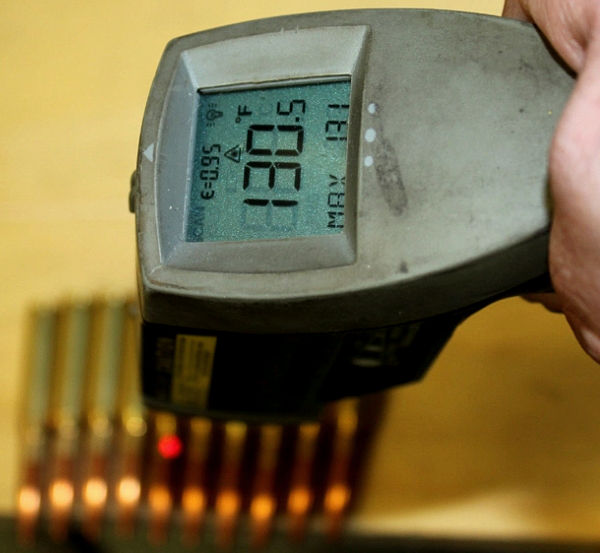
In this .308 Win test, 70° F ammo shot 96 FPS slower than ammo heated to 130.5° F. And the 130.5° ammo was 145 fps faster than ammo right out of the freezer (at 25.5° F). That’s a huge difference…
EDITOR’s NOTE: The Sierra tester does not reveal the brand of powder tested here. Some powders are much more temp sensitive than others. Accordingly, you cannot extrapolate test results from one propellant to another. Nonetheless, it is interesting to see the actual recorded velocity shift with ammo temperature variations in a .308 Win.
Written by Sierra Chief Ballistician Tommy Todd This story originally appeared in theSierra Bullets Blog
A few weeks ago I was attending the Missouri State F-Class Match. This was a two-day event during the summer and temperatures were hot one day and hotter the next. I shot next to a gentleman who was relatively new to the sport. He was shooting a basically factory rifle and was enjoying himself with the exception that his scores were not as good as he hoped they would be and he was experiencing pressure issues with his ammunition. I noticed that he was having to force the bolt open on a couple of rounds. During a break, I visited with him and offered a couple of suggestions which helped his situation somewhat and he was able to finish the match without major issues.
He was shooting factory ammunition, which is normally loaded to upper levels of allowable pressures. While this ammunition showed no problems during “normal” testing, it was definitely showing issues during a 20-round string of fire in the temperatures we were competing in. My first suggestion was that he keep his ammunition out of the direct sun and shade it as much as possible. My second suggestion was to not close the bolt on a cartridge until he was ready to fire. He had his ammo in the direct sunlight and was chambering a round while waiting on the target to be pulled and scored which can take from a few seconds to almost a minute sometimes.
This time frame allowed the bullet and powder to absorb chamber [heat] and build pressure/velocity above normal conditions. Making my recommended changes lowered the pressures enough for the rifle and cartridge to function normally.
Testing Effects of Ammunition Temperature on Velocity and POI
After thinking about this situation, I decided to perform a test in the Sierra Bullets underground range to see what temperature changes will do to a rifle/cartridge combination. I acquired thirty consecutive .30 caliber 175 grain MatchKing bullets #2275 right off one of our bullet assembly presses and loaded them into .308 Winchester ammunition. I utilized an unnamed powder manufacturer’s product that is appropriate for the .308 Winchester cartridge. This load is not at the maximum for this cartridge, but it gives consistent velocities and accuracy for testing.
I took ten of the cartridges and placed them in a freezer to condition.
I set ten of them on my loading bench, and since it was cool and cloudy the day I performed this test I utilized a floodlight and stand to simulate ammunition being heated in the sun.
I kept track of the temperatures of the three ammunition samples with a non-contact laser thermometer.
The rifle was fired at room temperature (70 degrees) with all three sets of ammunition. I fired this test at 200 yards out of a return-to-battery machine rest. The aiming point was a leveled line drawn on a sheet of paper. I fired one group with the scope aimed at the line and then moved the aiming point across the paper from left to right for the subsequent groups.
NOTE that the velocity increased as the temperature of the ammunition did.
The ammunition from the freezer shot at 2451 fps.
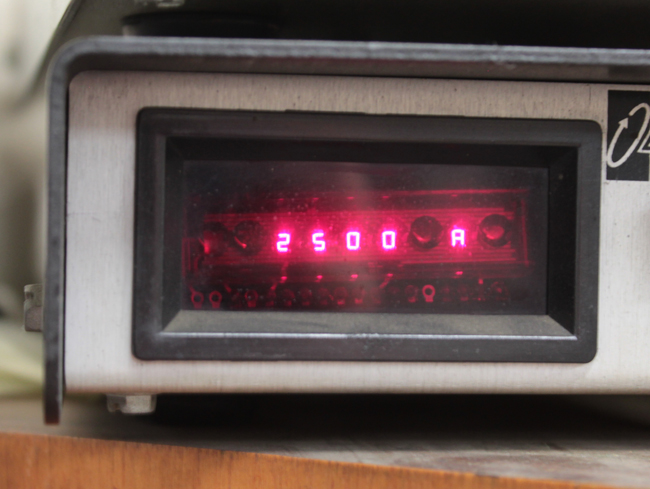
The room temperature ammunition shot at 2500 fps.
The heated ammunition shot at 2596 fps.
The tune window of the particular rifle is fairly wide as is shown by the accuracy of the three pressure/velocity levels and good accuracy was achieved across the board. However, notice the point of impact shift with the third group? There is enough shift at 200 yards to cause a miss if you were shooting a target or animal at longer ranges. While the pressure and velocities changed this load was far enough from maximum that perceived over pressure issues such as flattened primer, ejector marks on the case head, or sticky extraction did not appear. If you load to maximum and then subject your ammunition to this test your results will probably be magnified in comparison.
This test showed that pressures, velocities, and point-of-impact can be affected by temperatures of your ammunition at the time of firing. It’s really not a bad idea to test in the conditions that you plan on utilizing the ammo/firearm in if at all possible. It wouldn’t be a bad idea to also test to see what condition changes do to your particular gun and ammunition combination so that you can make allowances as needed. Any personal testing along these lines should be done with caution as some powder and cartridge combination could become unsafe with relatively small changes in conditions.
This article, from the USAMU Facebook Page, concerns reloading safety. In the relentless quest for more speed and flatter ballistics, some hand-loaders load way too hot, running charges that exceed safe pressure levels. Hint: If you need a mallet to open your bolt, chances are your load is too hot. Stay within safe margins — your equipment will last longer, and you won’t risk an injury caused by over-pressure. In this article, the USAMU explains that you need to account for bullet shape, diameter, and bearing surface when working up a load. Don’t assume that a load which is safe for one bullet will be safe for another even if both bullets are exactly the same weight.
Today, we continue our handloading safety theme, focusing on not inadvertently exceeding the boundaries of known, safe data.
Bullet manufacturers’ loading manuals often display three, four, or more similar-weight bullets grouped together with one set of load recipes. The manufacturer has tested these bullets and developed safe data for that group. However, seeing data in this format can tempt loaders — especially new ones — to think that ALL bullets of a given weight and caliber can interchangeably use the same load data. Actually, not so much.
The researchers ensure their data is safe with the bullet yielding the highest pressure. Thus, all others in that group should produce equal or less pressure, and they are safe using this data.
However, bullet designs include many variables such as different bearing surface lengths, hardness, and even slight variations in diameter. In fact, diameters can occasionally range up to 0.001″ by design. Thus, choosing untested bullets of the same weight and caliber, and using them with data not developed for them can yield excess pressures.
This is only one of the countless reasons not to begin at or very near the highest pressure loads during load development. Always begin at the starting load and look for pressure signs as one increases powder charges.
Bullet Bearing Surface and Pressure
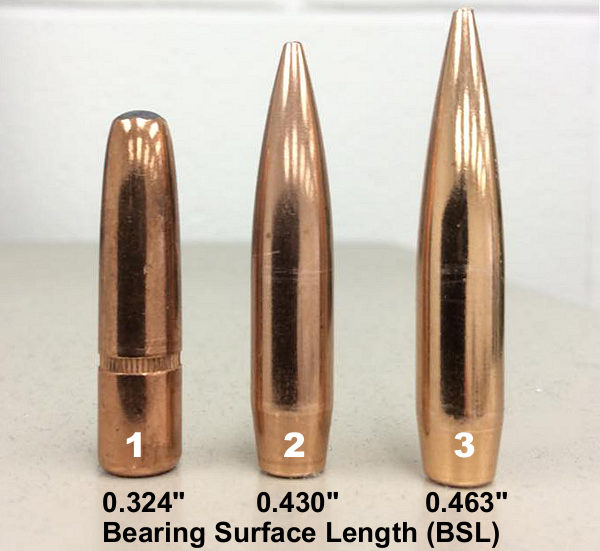
Bullet bearing surface length (BSL) is often overlooked when considering maximum safe powder charges and pressures. In Photo 1, note the differences in the bullets’ appearance. All three are 7 mm, and their maximum weight difference is just five grains. Yet, the traditional round nose, flat base design on the left appears to have much more BSL than the sleeker match bullets. All things being equal, based on appearance, the RN/FB bullet seems likely to reach maximum pressure with significantly less powder than the other two designs.
Photo 1: Three Near-Equal-Weight 7mm Bullets with Different Shapes
Due to time constraints, the writer used an approximate, direct measurement approach to assess the bullets’ different BSLs. While fairly repeatable, the results were far from ballistics engineer-grade. Still, they are adequate for this example.
Bullet 1 (L-R), the RN/FB, has a very slight taper and only reaches its full diameter (0.284 inch) very near the cannelure. This taper is often seen on similar bullets; it helps reduce pressures with good accuracy. The calculated BSL of Bullet 1 was ~0.324″. The BSL of Bullet 2, in the center, was ~0.430″, and Bullet 3’s was ~ 0.463″. Obviously, bullets can be visually deceiving as to BSL!
Some might be tempted to use a bullet ogive comparator (or two) to measure bullets’ true BSL for comparison’s sake. Unfortunately, comparators don’t typically measure maximum bullet diameter and this approach can be deluding.
Photo 2: The Perils of Measuring Bearing Surface Length with Comparators
In Photo 2, two 7mm comparators have been installed on a dial caliper in an attempt to measure BSL. Using this approach, the BSLs differed sharply from the original [measurements]. The comparator-measured Bullet 1 BSL was 0.694” vs. 0.324” (original), Bullet 2 was 0.601” (comparator) vs. 0.430” (original), and Bullet 3 (shown in Photo 2) was 0.602” (comparator) vs. 0.463” (original). [Editor’s comment — Note the very large difference for Bullet 1, masking the fact that the true full diameter on this bullet starts very far back. You can use comparators on calipers, but be aware that this method may give you deceptive reading — we’ve seen variances just by reversing the comparators on the calipers, because the comparators, typically, are not perfectly round, nor are they machined to precision tolerances.]
Thanks to the U.S. Army Marksmanship Unit for allowing the reprint of this article.
Here’s something that may benefit pistol shooters, especially those who shoot steel and often shoot at indoor ranges. Federal Syntech bullets are now available as reloading components in 9mm, .40 Cal (10mm), and .45 Caliber. These bullets feature a total synthetic jacket (TSJ) polymer coating. The potential for reduced wear and fouling is real — when tested against conventional FMJ ammunition, Federal claims Syntech produced an average of 12% less barrel friction and 14% less heat. By eliminating the conventional bullet jacket, the Syntech design greatly lessens bullet “splashback” when shooting steel. Note, however, Syntech bullets still have a conventional lead core. This means they may not be allowed in ranges with lead restrictions.
Syntech Bullet Features & Benefits
• Polymer-encapsulated Syntech bullet prevents metal-on-metal contact in the bore.
• Eliminates copper and lead fouling.
• Decreases heat and friction, extending barrel life.
• Significantly reduces the required frequency of cleaning.
• Absence of a copper jacket minimizes splash-back on steel targets.
For years this Editor has loaded his .45 ACP and .44 Mag handguns with polymer/moly matrix-coated bullets from Precision Bullets in Texas. Those poly/moly-encased lead bullets shot VERY accurately and I found that my barrels fouled much less than with conventional lead bullets. Likewise, there was much less cylinder fouling on my revolvers. If the American Syntech bullets work as well as those Precision bullets, I think the Syntech line will be a winner. Syntech bullets should benefit any high-volume pistol shooter, particularly competitors who shoot steel.


 On our main