Vihtavuori markets a full line of quality, European-made powders for rifles and pistols. Finland-based Vihtavuori is operated by the same parent company, Nammo, that owns Lapua and Berger Bullets. If you haven’t tried Vihtavuori powders yet, you may be pleasantly surprised. For loading .45 ACP, our favorite powder is VV N320 — it burns clean and is very accurate. Likewise, VV makes excellent powders for rifle applications — from small varmint cartridges to large magnums.
New Reloading Data Released Vihtavuori offers free reloading data on its website, and through a free Mobile App. And now those resources are even more complete…
Last week, Vihtavuori added new reloading data for ten different cartridge types, including some of the most popular pistol and rifle cartridges. You’ll find new pistol data for 9mm Luger and .45 ACP, and extensive new load data for .223 Rem, .260 Rem, .308 Win, and .30-06 Springfield (among others). Overall the 2018 data update features over 20 new bullets, with more than 140 new lines! All new data is also available in FREE Vihtavuori Reload App for iOS and Android. The updated online information supplements Vihtavuori’s Reloading Databases, which have dedicated sections for Rifle Cartridges, Pistol Cartridges, and Cowboy Action.
New Reloading Data is available for these TEN cartridge types:
by Sierra Bullets Ballistic Technician Paul Box
One thing that plays a major role in building an accuracy load is neck tension. I think a lot of reloaders pretty much take this for granted and don’t give that enough thought.
So, how much neck tension is enough?
Thru the years and shooting both a wide variety of calibers and burn rates of powder, I’ve had the best accuracy overall with .002″ of neck tension. Naturally you will run into a rifle now and then that will do its best with something different like .001″ or even .003″, but .002″ has worked very well for me. So how do we control the neck tension? Let’s take a look at that.
First of all, if you’re running a standard sizing die with an expander ball, just pull your decapping rod assembly out of your die and measure the expander ball. What I prefer is to have an expander ball that is .003″ smaller than bullet diameter. So for example in a .224 caliber, run an expander ball of .221″. This allows for .001″ spring back in in your brass after sizing, and still gives you .002″ in neck tension. If you want to take the expander ball down in diameter, just chuck up your decapping rod assembly in a drill and turn it down with some emery cloth. When you have the diameter you need, polish it with three ought or four ought steel wool. This will give it a mirror finish and less drag coming through your case neck after sizing.
Tips for Dies With Interchangeable Neck Bushings
If you’re using a bushing die, I measure across the neck of eight or ten loaded rounds, then take an average on these and go .003″ under that measurement. There are other methods to determine bushing size, but this system has worked well for me.
Proper Annealing Can Deliver More Uniform Neck Tension
Another thing I want to mention is annealing. When brass is the correct softness, it will take a “set” coming out of the sizing die far better than brass that has become to hard. When brass has been work hardened to a point, it will be more springy when it comes out of a sizing die and neck tension will vary. Have you ever noticed how some bullets seated harder than others? That is why.
Paying closer attention to neck tension will give you both better accuracy and more consistent groups.
Most shooters realize that significant changes in temperature will alter how powders perform. That’s why you want to keep your loaded ammo out of the hot sun, and keep rounds out of a hot chamber until you’re ready to fire. But there are other factors to be considered — HUMIDITY for one. This article explains why and how humidity can affect powder burn rates and performance.
We’ve all heard the old adage: “Keep your powder dry”. Well, tests by Norma have demonstrated that even normal environmental differences in humidity can affect the way powders burn, at least over the long term. In the Norma Reloading Manual, Sven-Eric Johansson, head of ballistics at Nexplo/Bofors, presents a very important discussion of water vapor absorption by powder. Johansson demonstrates that the same powder will burn at different rates depending on water content.
Powders Leave the Factory with 0.5 to 1.0% Water Content
Johansson explains that, as manufactured, most powders contain 0.5 to 1% of water by weight. (The relative humidity is “equilibrated” at 40-50% during the manufacturing process to maintain this 0.5-1% moisture content). Importantly, Johansson notes that powder exposed to moist air for a long time will absorb water, causing it to burn at a slower rate. On the other hand, long-term storage in a very dry environment reduces powder moisture content, so the powder burns at a faster rate. In addition, Johansson found that single-base powders are MORE sensitive to relative humidity than are double-base powders (which contain nitroglycerine).
Tests Show Burn Rates Vary with Water Content
In his review of the Norma Manual, Fred Barker notes: “Johansson gives twelve (eye-opening) plots of the velocities and pressures obtained on firing several popular cartridges with dehydrated, normal and hydrated Norma powders (from #200 to MRP). He also gives results on loaded .30-06 and .38 Special cartridges stored for 663 to 683 days in relative humidities of 20% and 86%. So Johansson’s advice is to keep powders tightly capped in their factory containers, and to minimize their exposure to dry or humid air.”
Confirming Johansson’s findings that storage conditions can alter burn rates, Barker observes: “I have about 10 pounds of WWII 4831 powder that has been stored in dry (about 20% RH) Colorado air for more than 60 years. It now burns about like IMR 3031.”
What does this teach us? First, all powders start out with a small, but chemically important, amount of water content. Second, a powder’s water content can change over time, depending on where and how the powder is stored. Third, the water content of your powder DOES make a difference in how it burns, particularly for single-base powders. For example, over a period of time, a powder used (and then recapped) in the hot, dry Southwest will probably behave differently than the same powder used in the humid Southeast.
Reloaders are advised to keep these things in mind. If you want to maintain your powders’ “as manufactured” burn rate, it is wise to head Johannson’s recommendation to keep your powders tightly capped when you’re not actually dispensing charges and avoid exposing your powder to very dry or very humid conditions. The Norma Reloading Manual is available from Amazon.com.
Real-World Example — “Dry” H4831sc Runs Hotter
Robert Whitley agrees that the burn rate of the powder varies with the humidity it absorbs. Robert writes: “I had an 8-lb. jug of H4831SC I kept in my detached garage (it can be humid there). 43.5-44.0 gr of this was superbly accurate with the 115 Bergers out of my 6mm Super X. I got tired of bringing it in and out of the garage to my house for reloading so I brought and kept the jug in my reloading room (a dehumidified room in my house) and after a few weeks I loaded up 43.5 gr, went to a match and it shot awful. I could not figure out what was going on until I put that load back over the chronograph and figured out it was going a good bit faster than before and the load was out of the “sweet spot” (42.5 – 43.0 gr was the max I could load and keep it accurate when it was stored in less humid air). I put the jug back in the garage for a few weeks and I now am back to loading 43.5 – 44.0 gr and it shoots great again. I have seen this with other powders too.”
If you have two jugs of the same powder, one kept in a room in your house and one somewhere else where it is drier or more humid, don’t expect the two jugs of the same lot of powder to chrono the same with the same charge weights unless and until they are both stored long enough in the same place to equalize again.
At the request of our readers, we provide select “Deals of the Week”. Every Monday morning we offer our Best Bargain selections. Here are some of the best deals on firearms, hardware, reloading components, optics, and shooting accessories. Be aware that sale prices are subject to change, and once clearance inventory is sold, it’s gone for good. You snooze you lose.
1. Natchez — Bushnell Scopes, Deep Discounts Plus 30% Rebate
Natchez Shooters Supply is running a big sale on Bushnell riflescopes right now. You can save $60 to $110 off the normal prices. Plus, through the end of March, Bushnell will rebate an additional 30% of the item’s purchase price (in the form of a prepaid credit card). Shown above are four great Bushnell scope deals, but there are many more. Plus the 30% rebate also applies to Bushnell binoculars and Laser Rangefinders, in addition to riflescopes.
2. Brownells — Howa 1500 Barreled Actions, Starting at $279.99
Howa makes excellent, smooth-running actions, and the Howa HACT 2-stage trigger is WAY better than most domestic factory triggers. Right now you can save big bucks on Howa 1500 barreled actions, complete with HACT trigger and trigger-guard, starting at $279.99. Both regular actions and Mini Actions are offered. Available chamberings include 6.5 Grendel, 6.5 Creedmoor (back-ordered), 7.62×39, .308 Winchester, and .300 Win Mag. Some of these barreled actions come with a rugged Cerakote finish, while others have a blued finish. You can also get FREE Shipping with Code MDV during checkout. But note, this item requires delivery to an FFL-holder.
3. Grafs.com — Rock Chucker Supreme Reloading Kit, $226.99
Everything you see above can be yours for just $226.99, after RCBS $100.00 Rebate. Hell of a Deal. Right now, Grafs.com is selling the Rock Chucker Supreme Master Reloading Kit for $326.99. But check it out — this Master Reloading Kit now qualifies for a $100.00 RCBS Rebate (“Buy Green, Get Green”). That lowers your net cost to just $226.99. That an amazing deal considering all the hardware you get: Press, Primer Tool, Scale, Powder Measure, Loading Tray, Reloading Manual and more. Heck, the Rock Chucker press alone is worth $160.00+. NOTE: To qualify for the $100 Rebate you must purchase on or before March 31, 2018. The $100 Rebate is for products costing $299.99 to $499.98.
4. Amazon — NRR 31 Muffs and Eyewear Kit with Case, $29.99
Here is a great combo package that offers complete eye and ear protection for shooters at the range. The Ear Muffs feature a 6-piece noise filtration system that effectively blocks low, mid, & high range frequencies, giving them an impressive NRR 31 noise reduction rating. The muffs ship with a nice zippered case that also holds the supplied safety eyewear. This kit also comes with ten (10) NRR 33 foam earplugs. You can order the kit with either clear eyewear or smoke-tinted lenses.
This Norma Match-22 ammunition is good stuff. In many rifles it shoots as well as $8/box products from other makers. But now you can get Match-22 for the equivalent of $4.00 per 50-round box. MidwayUSA is selling 1500 rounds (three 500-round cases) plus an ammo can for just $124.99 with FREE Shipping. That works out to just 8.3 cents per round. If you can’t use that much you can also get 500 rounds for $39.99 (i.e. $4/box), also with FREE shipping. We think you’ll be happy with this ammo. It is a good choice for tactical cross-training, rimfire silhouette, and fun shooting.
6. Grafs.com — Lapua 6.5 Creedmoor SR Primer Brass, $99.99/100
Here’s an excellent value from our friends at Grafs.com. Lapua 6.5 Creedmoor cartridge brass with Small Rifle Primer and Small Flash-hole is on sale for $99.99 per 100 cases. This is quite simply the best 6.5 Creedmoor brass in the world. It will hold higher pressures, deliver more velocity, and hold up to more reloading cycles. Chances are you will also see more accuracy with this Lapua brass than with other brands. If you shoot a 6.5 Creedmoor, you may want to grab some now. Other vendors are charging a lot more. For example, this very same Lapua brass is $124.99 at MidwayUSA right now.
7. Amazon — Jialitte Scope Bubble Level, $12.49
CHANGE ART NUMBER
All serious rifle shooters need a scope level. This nicely designed Jialitte Scope Bubble Level features a 30mm milled inside diameter, plus an inner insert ring so it will also fit 1″-diameter main tubes — that dual-diameter versatility is a nice feature. We also like the way the unit is nicely radiused, and has a low profile in the middle. Price is just $12.59 with free shipping. User reviews have been very positive. You could easily pay $35.00 or more for a 30mm scope level. Purchasers have praised this product — nearly all verified buyers rated this five stars.
8. Amazon — Neiko Digital Calipers, $17.85
Even if you have a good set of calipers, you may want to get one of these Neiko 01407A Digital Calipers. The #1 best-selling digital caliper on Amazon.com, this Neiko tool features a large LCD Screen and measures up to 6.0 inches. With over 3000 customer reviews, this product has earned an overall rating of 4.4 out of 5 stars. It’s hard to go wrong for $17.85, even if you just use these as a spare set for measuring group sizes and case trim lengths.
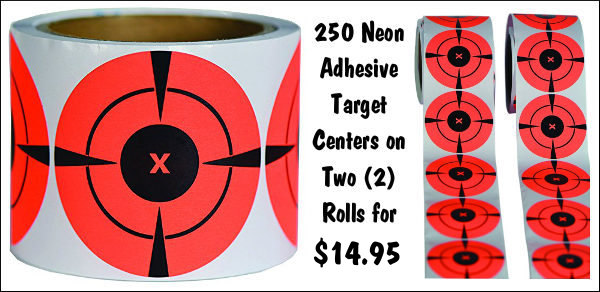
9. Amazon — Two Rolls of 3″ Neon Target Stickers, $14.95
We like these bright, Neon 3″ target stickers. They are big enough to see easily at 600 yards, giving you a 1/2 MOA target center at that distance. For $14.95 at Amazon.com, you get 250 3″-diameter self-adhesive centers (125 targets per roll) that stick to almost any surface The high-contrast fluorescent red/orange color provides an excellent HI-VIZ aiming point, along with good contrast for bullet holes that fall within the 3″ circle. To help line up your reticle cross-hairs, the target centers feature black markers at 3, 6, 9, and 12 0’Clock. NOTE: These stickers may qualify for FREE Shipping with combined orders over $25.00.
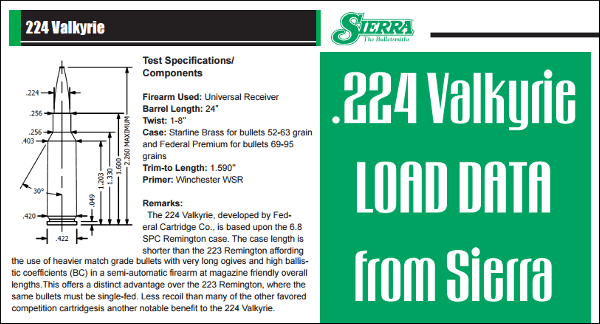
If you own an AR, you’ve probably heard of the hot, new .224 Valkyrie cartridge. Basically a 6.8 SPC necked down to .22, the Valkyrie has a shorter case than the .223 Remington (and 5.56×45 NATO). This allows you to load the longest, heaviest .224-caliber bullets and still feed reliably from an AR15-type magazine. With Sierra’s remarkable new 95-grain MatchKing, this gives the little Valkyrie long-range performance that can rival some much larger cartridge types. Sierra Bullets states: “The [Valkyrie] case length is shorter than the 223 Remington affording the use of heavier match-grade bullets with very long ogives and high ballistic coefficients. This offers … super-sonic velocities at ranges greater than the .223 Remington and the 6.5 Grendel can achieve at magazine length”.
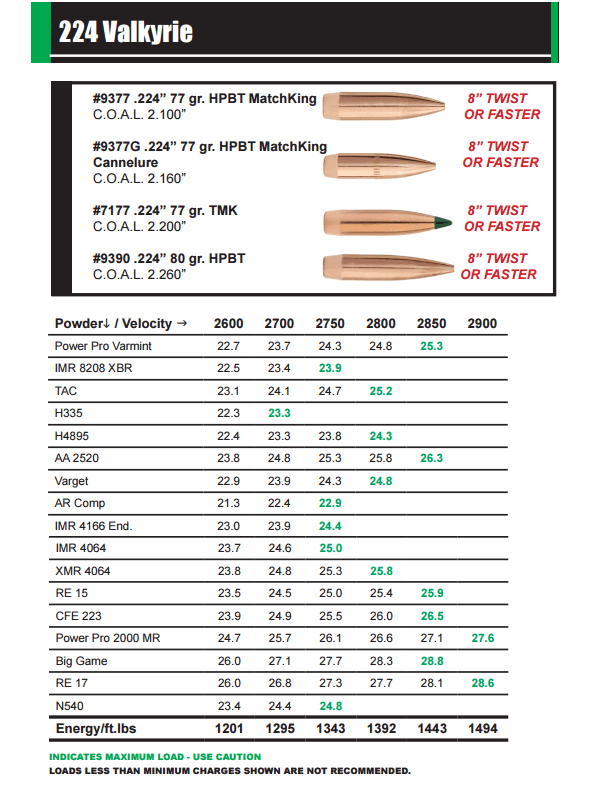
If you’re considering a .224 Valkyrie, you’re in luck — Sierra Bullets has just released comprehensive LOAD DATA for this new cartridge. Sierra has published loads for a broad range of bullet weights from 52 grains all the way up to 95 grains. Loads for 20 bullet types and 22 powders* are listed.
Shown below is Sierra’s load data for bullet weights from 77 grains to 90 grains. Values in green indicate MAXIMUM loads — use CAUTION. NOTE: This is only a partial sample, less than a third of the data Sierra has published. Download Sierra’s Full 4-page PDF to view all the data, including load information for Sierra’s new 95gr .224-caliber MatchKing with claimed 0.600 G1 BC.
The new .224 Valkyrie was introduced late last year as a Hot Rod cartridge that will work in AR15s. Designed to rival the .22 Nosler while still running well in ARs, the new .224 Valkyrie offers excellent long-range performance when loaded with modern, high-BC bullets. We expect some bolt-action PRS shooters might adopt the .224 Valkyrie. Why? Reduced recoil. With the 90gr SMK, the .224 Valkyrie offers ballistics similar to the 6.5 Creedmoor but with significantly less felt recoil. Check out this chart from Federal showing comparative recoil levels:
* All the following powders were tested, but not all for each bullet weight: Accurate 2520, Accurate XMR 2495, Accurate 4064, Hodgdon AR Comp, Hodgdon Benchmark, Hodgdon CFE 223, Hodgdon H335, Hodgdon H380, Hodgdon H4895, Hodgdon Varget, IMR 4064, IMR 4166, IMR 8208 XBR, Power Pro 2000 MR, Power Pro Varmint, Ramshot Big Game, Ramshot TAC, Reloder 10X, Reloder 15, Reloder 17, Vihtavuori N540, Winchester 760.
For a few years now, Lyman has offered the Case Prep Xpress, an all-in-one case prep center that chamfers necks (inside and out), cleans and uniforms primer pockets, brushes the inside of case-necks, and uniforms flash holes. The unit can also ream out the crimps on military brass. However, the Lyman Case Prep Xpress does NOT trim cases.
The Lyman Case Prep Xpress comes with all the necessary tools (listed above), so you don’t have to purchase extra accessories. The five (5) gear-driven heads on the unit are powered by a high torque, low-speed motor ideal for case prep operations. Lyman’s Case Prep Xpress features handy storage areas for accessories, a removable brass shavings dump pan, and a handy clean-up brush.
Sinclair Int’l video clearly illustrates all case prep functions. Worth watching.
In the 5 years that this product has been on the market it has been a strong seller. If you’re prepping hundreds of cases, this unit will save considerable time and reduce hand/finger fatigue. While the Case Prep Xpress is not as sturdy as the metal-bodied Hornady prep center, the Lyman unit offers a lot of functionality for the money ($115-$125 normal price, and sometimes around $100 on sale).
Lyman Case Prep Xpress Pros and Cons
GOOD Features
Quite Affordable (under $120)
Compatible with RCBS and Redding Tool-heads
Removable Bin for Shavings
Four Brush Sizes: .25, .30, .38, .45
Compact Footprint
Not-So-Good Features
Tool-heads Not Particularly Sharp
No Case Trim Function
No Flash-hole Uniformer
No Top Dust-Cover
Only 1-Year Warranty
Reviews by Verified Purchasers
“Case prep is the most tedious and boring aspect for hand loading in my opinion. The process center makes all the steps in prepping the case very quick and with consistent results. It has reduced the time required to do these steps with separate tools by easily 50% if not more. Highly recommended.” — Brandon G.
“Quiet and capable. Worth every penny. I adapted a Lee Cutter and Lock Stud, to cut case lengths, and I can fly through my brass. I can do so much more brass without getting the sore, cramped-up hands.” — Dean Ellis
“This unit has plenty of torque, and my unit is very quiet. This unit will also work with tools made by RCBS and Hornady, or anything else with 8-32 threads. My Redding tools (specifically, my primer pocket uniformers) do in fact fit on this machine. This unit is certainly worth the money, and will revolutionize the way you reload by saving you massive amounts of time and wear on your hands/fingers.” — Mule
“A simple machine to perform complex solutions. I was up and running in about 10 minutes flat. This thing has made my life of reloading so much easier. I do wish there was a trimmer included, but I have a manual one from L.E. Wilson.” — Richard Niles
You can find Lyman’s Case Prep Xpress for under $100.00 at Amazon and under $120.00 at Brownells, making it much less expensive than the larger Hornady Case Prep Center, which runs over $450.00. The Hornady unit is beefier, and will trim cases. However, we think the compact Lyman unit makes sense for guys who already have a good case trimmer, such as a Forster or Wilson. The Lyman Case Prep Xpress is hundreds of dollars less than the Hornady prep center. The money you save will buy lots of bullets and brass.
Case Prep Xpress $99.99 at Amazon
The Lyman Case Prep Xpress is sold by most of the big vendors. The best current price we found was at Amazon, which sells the Lyman unit for $99.99, with free shipping.
Gear Review Tip from Edlongrange. We welcome reader submissions.
We are sad to report that long-time Forum member Frank S. (aka fdShuster) passed away in 2015. Frank was a very knowledgeable shooter who was always willing to help others. Here is one of Frank’s smart inventions. He devised a way to measure the length of a rifle’s chamber using a fired cartridge case. Frank’s system works by cutting a “collar” from part of the case neck. This then slips over a bullet seated in a case loaded without powder or primer. As you chamber the dummy round, the collar will move back to indicate the full length of the chamber. (Make sure the bullet is seated well off the lands so the dummy round can chamber fully.)
If you’re using a body die or a full-length sizing die, try using Ballistol (in the aerosol can) as a lube. It works GREAT without the tacky or gooey residue left by most case lubes. It will also clean off carbon residues on the neck as you lube the case. Just spray a little on a cotton patch (or your fingertips) and wipe each case before you run it up into the die. If you are using a steel neck bushing, be sure to wipe the neck as well. You can usually do a half-dozen BR-sized cases before you need to re-apply Ballistol on the patch. Ballistol is non-toxic, bio-degradeable, and will not harm your skin. It is very slippery, but can easily be removed with a rag or paper towel. Try it–you may retire your One-Shot. Ballistol can also be used to protect wood stocks.
Note, for heavy case-forming or necking up case necks, we still recommend a thicker lubricant, such as Imperial Die Wax. But for normal case sizing, after your neck has been expanded, Ballistol will do the job, and you won’t need to tumble the brass afterwards. All you need is a very thin layer of Ballistol, and this easily wipes off with a paper towel.
For Neck-Turning, Try STP Blend or Assembly Lube
For lubing the neck-turning tool mandrel while turning case necks, many folks use a blend of STP® Oil Treatment and Mobil 1 lube. Chuckw2 reports: “Try STP and Mobile 1 Synthetic oil in a 50/50 mixture. Very slick, you will need to tumble your cases after turning.” STP is a very thick lubricant, that flows and clings almost like honey. Jason reports the STP blend comes off easily in an ultra-sound bath, using a bit of detergent. STP is also now available in a convenient 7-ounce tube, so you don’t have to buy a large bottle.
Another even cheaper option is assembly lubricant. For turning his case necks, RStreich uses assembly lube from an auto parts store. He notes: “The brand I have is reddish in color and kind of sticky like honey. It’s far better than the Imperial die wax I was using before.” There are a variety of types, both with and without moly additive, and you can select the viscosity you prefer if you sample a few brands. Be sure to clean out any lube residue from the inside of your necks when you have completed your neck-turning.
If you don’t own a good portable press yet, you should get one. A quality portable press lets you load precision ammo at the range, streamlining the load development process. In addition, a small portable press can serve as a second, light-duty press in your main loading room. For example, you might dedicate the compact press to de-capping duties or bullet seating.
There is a new portable press on the market, the EVO, crafted in the UK. Our English friend Vince Bottomley got one of the first EVO presses and he found it impressive. Comparing it to the respected Harrell’s Precision Compact Press, Vince found that the EVO has some advantages. The EVO is definitely beefier and has some upgraded elements, such as a bronze ram bushing and steel linkage arms.
EVO Press Notable Features
1. The EVO press ram column moves in a bronze bushing. By contrast the Harrell’s ram runs through the CNC-machined body of the press.
2. The EVO’s mounting system (where it clamps onto the bench) is an integral part of the press-body, rather than a separate screw-on unit with the Harrells press.
3. The EVO press features sturdy, steel connecting arms. The Harrell’s compact press has aluminum linkage arms. That said, the aluminum is more than adequate — Vince notes his Harrell’s press has served him well for over 20 years.
We recommend you read the full review on TargetShooter.co.uk. Vince provides many more photos which show the EVO press components in detail. See Bushing Photo.
EVO Press Handles Wide Range of Cartridge Types
When viewed from the side, you can see that the new EVO is beefier than the Harrell’s press throughout the press “body” and lever arm base. The EVO is bigger and stronger. On the other hand, the Harrell’s press is lighter and easier to pack, and the clamping system can be detached.
Vince tells us: “The EVO is a ‘one size fits all’ press that will do a .308 Win or larger case (that’s a .284 in the photo)”. Vince concludes the EVO may be more versatile than the Harrell’s press. The Harrell’s Compact Reloading Press comes in three different sizes: “a really small one (left above) specifically for the benchresters’ 6PPC cartridge, a medium one for .308-sized cases, and a larger version which will take a 2.9 inch Magnum case”.
Though it has the capacity to run larger cases, Vince cautions: “please, don’t think of using your little benchrest press for all your re-sizing — stick to a Rock Chucker or what have you for your general reloading and keep the EVO for on-range reloading or as a secondary bench press.” The EVO press is available from Fox Firearms for just under £200 (about $280 USD). You can contact Fox Firearms via email: irvingfox1234 [at] aol.com.
The Harrell’s Compact Press is smaller and less expensive than the $280.00 EVO. It can also be purchased in three different sizes.
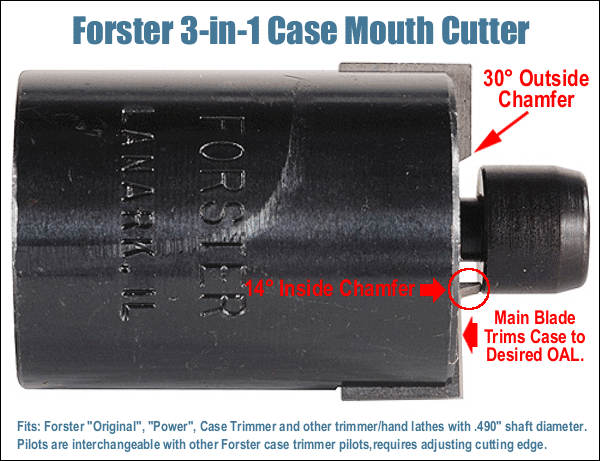
We know many of you guys have a Forster case trimmer (hand lathe) sitting on your reloading bench. This tool does a good job of trimming cases to length. But did you know that an inexpensive accessory will allow your Forster case trimmer to chamfer while it cuts? Here’s the skinny on the 3-way head for the Forster case trimmer.
Tool Cuts Brass to Length, and Chamfers Inside and Outside
Forster’s 3-in-1 Carbide Case Mouth Cutter works with all existing Forster case trimmers. This unit does three jobs at the same time. It trims the case to length, it puts a 14-degree chamfer on the INSIDE of the neck, AND (last but not least), it cuts a 30-degree chamfer on the OUTSIDE of the neck. It does this all quickly and efficiently — in a matter of a few seconds. We tested the new tool ourselves on a few cases. The tool is solid and well made. The carbide cutting tips do perform a very clean cut. Be aware, however, if you have turned your necks already, you may have to reset the blade positions before you start trimming your brass.
Forster’s CFO, Robert Ruch, demonstrates the 3-in-1 case trimming/chamfering tool in the video above. As you can see, the tool turns very smoothly (no chatter). The actual cutting time, per case, is just a few seconds. The tool has an MSRP of $88.00, but it sells for around $65.00 to $70.00 at major vendors. Forster’s 3-in-1 Carbide cutting tool works with all existing Forster case trimmers and other hand lathes with a .490″ shaft diameter. The unit fits over the cutter shaft and secures with one set screw. The 3-in-1 cutter is available for five (5) calibers: .224, .243 (6mm), .264 (6.5mm), .284 (7mm), and .308.


 Vihtavuori offers free reloading data on its website, and through a free Mobile App. And now those resources are even more complete…


 Tests Show Burn Rates Vary with Water Content




 You can find Lyman’s Case Prep Xpress for

 If you’re using a body die or a full-length sizing die, try using Ballistol (in the aerosol can) as a lube. It works GREAT without the tacky or gooey residue left by most case lubes. It will also clean off carbon residues on the neck as you lube the case. Just spray a little on a cotton patch (or your fingertips) and wipe each case before you run it up into the die. If you are using a steel neck bushing, be sure to wipe the neck as well. You can usually do a half-dozen BR-sized cases before you need to re-apply Ballistol on the patch. Ballistol is non-toxic, bio-degradeable, and will not harm your skin. It is very slippery, but can easily be removed with a rag or paper towel. Try it–you may retire your One-Shot. Ballistol can also be used to protect wood stocks.
 For Neck-Turning, Try STP Blend or Assembly Lube
 Another even cheaper option is assembly lubricant. For turning his case necks, RStreich uses assembly lube from an auto parts store. He notes: “The brand I have is reddish in color and kind of sticky like honey. It’s far better than the Imperial die wax I was using before.” There are a variety of types, both with and without moly additive, and you can select the viscosity you prefer if you sample a few brands. Be sure to clean out any lube residue from the inside of your necks when you have completed your neck-turning.