Right now Midsouth Shooters Supply is running a Spring Inventory Clearance Sale. Everything in the Clearance Sections just got marked down 10% below the previous sale pricing. There are a lot of great bargains here — everything from big name optics to reloading dies to loaded ammo and much more. Hundreds of items are on sale, even top-quality items such as Sierra MatchKing bullets and Norma brass. If you need a scope or dies, you should definitely check out the sale. Likewise if you want factory ammo for a hunting rig, you’ll find some great bargains.
Here’s Some of the Cool Stuff on Sale, at Very Low Prices:
Sierra 7mm and .308 MatchKing Bullets
Federal Primers
Lyman Sonic Cleaning Machine
Hornady Reloading Tools
Norma 22 PPC Brass
Leupold Scopes
Leupold Binoculars
Burris Scopes
Vihtavuori N310 and N350 Powder
Redding Competition Dies
Redding TiN Neck Bushings
RCBS Reloading Dies
Nosler .260 Rem and 300 WSM Ammo
Leica CFR Rangefinders
Weatherby/Howa stocks
Handgun Holsters and Gun Cases
Clearance Sale Tip from EdLongrange. We welcome reader submissions.
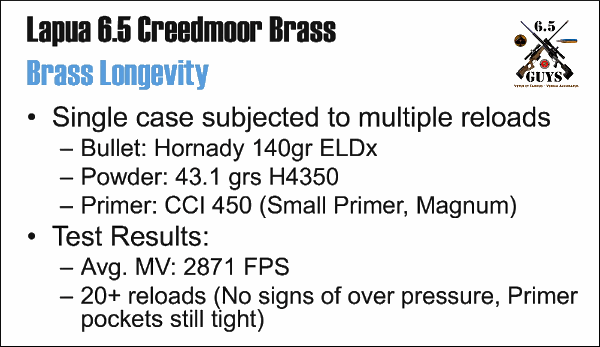
The verdict is in — Lapua’s new 6.5 Creedmoor brass is ultra-tough and very consistent. So sayeth the 6.5 Guys, who recently field-tested the brass, loading it to very stout levels. Even after 20 reloadings, the Lapua 6.5 CM brass held up extremely well. This brass, with its small primer pocket and small flash hole, really does out-perform other 6.5 Creedmoor brass offerings. Yes the Lapua brass is pricey, but it outlasts the alternatives, and, if the 6.5 Guys test is any indication, you can run higher velocities with this brass compared to other brands. Watch the 6.5 Guys Lapua brass test in this video:
If you have a 6.5 Creedmoor rifle, or are considering getting a gun chambered for this cartridge, we strongly recommend you watch the full 6.5 Guys Video. Ed and Steve spent a lot of time conducting this test, and the video includes helpful summaries of their findings.
The Evolution of the 6.5 Creedmoor
Over the last few years the 6.5 Creedmoor cartridge has become increasingly popular among precision rifle enthusiasts. However, availability of brass cases was limited to only a few manufacturers. In early 2017 Lapua introduced to the market its own 6.5 Creedmoor case with a unique twist — the case has a small rifle primer pocket and small flash hole — like the 6mmBR Norma and 6.5×47 Lapua.
Lapua 6.5 Creedmoor Brass — Test Protocol
The 6.5 Guys tested a box of Lapua 6.5 Creedmoor cartridge brass supplied by Graf & Sons. The project involved two phases. First the 6.5 Guys weighed and measured the cases to assess weight uniformity and dimensional consistency (which was impressive). Then came phase II — the “torture test”. The 6.5 Guys loaded the brass with a very stout charge of H4350 pushing 140gr Hornady ELD bullets*. The brass was loaded and shot over 20 times. This durability test was conducted to see how many repeated firings and resizing/reloading cycles the brass could handle. Remarkably, after 20+ loadings, the brass was still holding up — no “blown-out” primer pockets. This stuff is tough. The 6.5 Guys note: “You can go at least 20 reloadings without a split neck…but brass spring-back may be another issue.”
After 20 Load Cycles — Going to the Extreme
Once the Lapua cases had been shot 20+ times, the 6.5 Guys tried something more extreme. They stuffed the brass with a very hot load — a powder charge weight well beyond a sensible maximum. Even with this “beyond max” load, the Lapua brass held up but there was some evidence of pressure on the primers: “You do see some cratering on the primer with a Remington 700 that you don’t see with a Defiance action, but nothing to indicate a potential pierced primer.”
WARNING: The 6.5 Guys deliberately used a very stout load for testing. Do not attempt to duplicate. This load was shot in a faster-than-average barrel with a chamber set up for long 140gr bullets. You may not be able to achieve similar velocities — maybe not even close. As with all hand-loading, always start low and work up charges in small increments.
6.5 Creedmoor vs. 6.5×47 Lapua — Battle of the Middle-Weights
With this new brass, does the 6.5 Creedmoor enjoy an edge over the 6.5×47 Lapua? The 6.5 Guys answer: “That’s hard to say. From a market share standpoint, the 6.5 CM is more popular in the USA. From a technical perspective, 6.5×47 Lapua offers near identical performance with better barrel life. But from our tests, you can drive a 140-grain bullet much faster with 6.5 Creedmoor than you ever can (safely) with a 6.5×47 Lapua. That’s our non-answer answer….”
The 6.5 Guys concluded that the 6.5 Creedmoor will enjoy a velocity advantage: “We’ve had a number of discussions with RBros and other folks about this. It appears that 6.5×47 still has the edge as far as barrel life. But it also looks like you can push a 140gr bullet pretty fast with the 6.5 CM — speeds that are not obtainable with the 6.5×47 Lapua.”
* Why were the Hornady 140gr ELDs chosen for testing? The 6.5 Guys wanted a bullet in the 140gr weight range. Beyond that, the choice was fortuitous. Ed explained: “Our bullet selection was quite scientific — we sat down at my reloading bench and looked around. Saw the Hornady 140 ELD Match and decided to roll with that.”
At the request of our readers, we provide select “Deals of the Week”. Every Monday morning we offer our Best Bargain selections. Here are some of the best deals on firearms, hardware, reloading components, and shooting accessories. Be aware that sale prices are subject to change, and once clearance inventory is sold, it’s gone for good. You snooze you lose.
This is a very good, thickly-padded mat, with unique features — twin side wings for gear. Sale priced at $44.99 at Cabela’s, this offers great value for the money. With 1/2″-thick padding, this mat is comfortable, and the large side wings keep your gear off damp, mucky, or dusty ground. The left wing has a zippered compartment while the right wing has a large pouch that can hold ammo box, rangefinder, or other gear. Up front is a handy bipod stop. Deployed, the mat is an ample 73-1/2″ long x 35-1/2″ wide. The mat rolls up into a convenient package complete with adjustable shoulder strap. With a Lifetime Guarantee, this mat has earned very positive user reviews — 4.8 out of 5 stars. One owner declared: “This is a great shooting mat … rivals many other mats in a much higher price range. The added wing area has plenty of room for ammo, elbows and miscellaneous gear. It has two sewn-in bipod stops and the padding is just right. It is very well built, love it!” — LHeffy.
2. CDNN Sports –$1.50 Safety Eyewear and $10.00 Muffs
CDNN is selling off all its remaining inventory of Safety Eyewear and Hearing Protection. Accordingly, you can purchase ANSI-Z87.1-Rated Eyewear for $1.50, and a set of NRR25 Muffs for just $10.00. At these prices, you can outfit the whole family, or donate a few sets to your local youth program. We’ve learned it’s always good to have spare eye and ear protection — keep extra sets in your range bags and vehicle glove boxes.
Thinking of putting together an accurate AR for the new PRS Gas Gun series (or 3-Gun matches)? Here’s a good place to start. Aero Precision now offers a $193.49 kit with stripped Upper and Lower Receivers — both with a durable Flat Dark Earth (Magpul FDE) Cerakote finish. Just add barrel, buttstock, trigger group, controls, and your bolt carrier group. Note: This Kit will work with the .223 Rem and similar-length, larger-caliber cartridges such as the 6mmAR and 6.5 Grendel. If you want to shoot a 6.5 Creedmoor, you’ll need an AR10 platform rifle.
4. Midsouth — GECO .22 LR Bolt Action Ammo, $42 for 500 Rds
This a very good deal on quality, European-made GECO .22 LR rimfire ammunition. This is optimized for use in bolt-action rifles. Test lots have proven reliable with much better than average ED and SD and solid accuracy. GECO is a good brand, part of the Swiss RUAG family of companies. The price, $42.00 for a 500-round Brick (10 boxes), is just 8.4 cents per round. Though still very affordable, this GECO .22 LR ammo is way better than typical domestic “bulk pack” rimfire ammo.
5. Grafs.com — Sightron SIIB Scope Clearance Sale, 46-47% Off
We like the 4-16x42mm Sightron SIIB with adjustable front objective for just $329.99. That’s 47% off the regular price. The 15X is enough power for most prairie dog shooting and there’s absolutely nothing wrong with an adjustable front objective — these systems are very positive and “dead nuts” reliable.
6. CDNN Sports — Ruger 17 HMR American Compact $279.99
With ballistics far superior to a .22 LR, the 17 HMR is ideal for Prairie Dogs and small varmints out to 180 yards or so. Now you can get a reliable, name brand 17 HMR rifle for a very attractive price. That’s right, CDNN Sports is selling the 17 HMR Ruger American Rimfire Compact, with 18″ barrel, for just $279.99. That includes two (2) comb units and a FREE padded carry sling. FFL required.
7. Amazon — Plano Double Rifle Case with Wheels, $113.99
This Plano Double Scoped Rifle Case is an Amazon Best Seller for good reason. It offers the functionality and durability of an SKB-type hard case for HALF the money. This is under $115.00, while the equivalent SKB is around $240.00, so you can buy two Planos for the price of one SKB. The 51.5″ interior will fit most scoped competition rifles up to about 29″ barrels (measure your own rifle to make sure). The handles are convenient and beefy and the wheels make this case easy to move through airports and parking lots. This is a very tough, roomy case for the money (plus there’s Free Shipping for Prime Members).
We use 1″-diameter Target Spots for sight-in and practice at 100-300 yards. These bright red/orange self-adhesive dots are easy to see. At 100 yards the high-contrast black diamond centers provide precise aiming points. We found this 10-pack of target spots on Amazon at a rock-bottom price. You get 630 total stick-on dots for just $9.65 with FREE Shipping. You can also get 360 Birchwood Casey 1″ dots from Midsouth for just $3.15, but shipping is extra. If you’re already ordering something from Midsouth, you may want to add the dots to your order.
Got patches? Here’s a great deal on 100% cotton flannel patches. There are many sizes available, starting at $9.99 for 800 one-inch “17 Cal” patches. For 6mm rifles, we actually like the 1.25″ round “22/223″ sized patches priced at $11.99 for 800. Choose either round patches or square patches in most sizes. We generally like round patches for use with spire-tip jags, but some shooters prefer to wrap their patches around a jag or brush and square patches work better for wrapping. The large, 2″-square .30 Cal patches cost $17.99 for 800. These prices include FREE Shipping for Prime Members.
10. Amazon — Leight MAX NRR33 Earplugs, $7.45 for 50 Pairs.
These Howard Leight NRR33 Max plugs are your Editor’s favorite foam earplugs. They seal out noise better than any others I’ve tried. Between shooting, motorcycling and mowing lawns, I probably have Max plugs in my ears 2-3 days a week. This is a very good price for a bulk pack of 50 pairs (100 plugs). And if you act soon, you can get free shipping to boot.
Forty-five bucks for a 25-round reloading tray? No this is not a late April Fool’s Day story. The CNC wizards at MK Machining in Missouri have created what may be the world’s most high-tech tray. Milled from billet aluminum, these trays will last a lifetime, and they offer one big advantage — any powder over-spill simply fills the open gap between the top and bottom plates. That way you don’t have stray powder kernels collecting in the bottom of the cartridge holes.
The MK Reloading Trays come in four colors: Red Anodized ($44.99), Blue Anodized ($44.99), Black Anodized ($39.99), and Silver (Clear) Anodized ($34.99). The holes are sized for .308 Win-diameter cases, so they’ll work for 6mmBR, 6.5×47 Lapua, 6.5 Creedmoor, .243 Win, 7mm-08, and the entire .308 Win family. As shown below you can buy a Red and Blue pair and simply re-assemble them in a Red/Blue Sandwich style. We think that looks pretty cool.
For more information, or to order MK Reloading Trays, visit MKMachining.com.
To be honest, the $6.99 Sinclair Polymer Loading Blocks are good enough for most reloading applications — and the larger, 50-round Blocks ($10.99 at right) can hold twice as many rounds as the MK trays.
However, the MK Machining Loading Tray definitely has more “bling appeal” and there are some advantages to the sandwich design. The aluminum is certainly more heat resistant than polymer. For guys who want a “Cadillac” tray on their bench, the MK Machining Trays may be worth the investment. We also think these might make nice prizes for a shooting match.
We’ve told fans of Hodgdon H4350 to give Alliant Reloder 16 (RL16) a try. In our tests, Reloder 16 has proven a very promising rival to H4350 for accuracy, low ES/SD, and temp stability.
Now you can get the advantages of Reloder 16 in a slower powder formulated for magnum cartridges — Reloder 26 (RL26). Alliant says RL26’s burn speed falls between that of Reloder® 22 and Reloder® 33. That means it’s slower than H4831 but faster than powders that would suit the .338 Lapua Magnum. Reloder 26 has a high bulk density that allows larger powder charges, and high velocities. RL26 also provides a consistent, controlled response to temperature changes.
We are hearing very good things about RL26 from friends and Forum members who are testing it with big calibers for Long Range applications. Accuracy is good and velocities are impressive. Alliant says RL26 “incorporates EI® technology to produce extremely high velocities in magnum cartridges”. In big magnums, shooters have reported gaining 100+ fps with RL26 compared to H1000 or Retumbo. And to our surprise some guys have even tried replacing H4350 with RL26 (in smaller cartridge types) and they have picked up meaningful velocities. We don’t think Alliant ever intended RL26 as a substitute for H4350, but if you’ve got the case capacity… it may be worth a try.
Alliant Reloder 26 Features
EI® technology delivers high velocities in magnum cartridges
Contains proprietary de-coppering additive
Controlled temperature stability
Excellent lot-to-lot consistency
Formulation contains no DNT or DBP
Made in Switzerland for Alliant Powder
Alliant’s Tech Expert Talks about Reloder 26
What are the characteristics of Reloder 26? That question was answered recently by Paul Furrier who works for ATK, the parent company of Alliant Powders. Posting in our Shooters’ Forum, Paul writes:
“Reloder 26 is produced in Switzerland by our extremely capable partner Nitrochemie. I have seen it stated that they [it is] made by Bofors, so that is incorrect. I have also noticed people are equating … Reloder 26 to Reloder 25. Reloder 26 is definitely slower burning than Reloder 25, so there shouldn’t be any confusion there either.”
Speed and More Speed with RL 26
Think of Reloder 26 as a high-velocity powder for big cartridges. Furrier explains: “Reloder 26 is produced with Nitrochemie’s latest generation EI® process technology. This is the same impregnation coating process used to produce Reloder 17, Reloder 33, and Reloder 50 for us, and it is fantastic. Reloder 26 [offers] great ballistic efficiency, high bulk density so you can get more of the slow powder into the case to harness the energy, and decent, predictable extreme temp response. Reloder 26 is not as flat at temps as the TZ or Australian materials, but it is very manageable, usually in the 0.5 fps/°F range (depending on the application). Just as important, the pressure increases at hot are very manageable. We are using quite a bit of this RL26 powder in our Federal factory ammo due to the fantastic ballistics and accuracy.” — Paul Furrier, ATK
While “naked” bullets are just fine for most applications, some shooters like to put a friction-reducing coating on their projectiles. Coating bullets can benefit guys who run very high round counts between barrel cleanings. Reader Mike Etzel has come up with a simple, cost-effective way to apply HBN, Moly, or Danzac (WS2) coatings to your bullets. And you won’t need any expensive gear other than your regular vibratory tumbler and some small plastic containers.
Mike explains: “For a number of years I have been using a very convenient way of coating my projectiles with DANZAC in a tumbler. Instead of using a separate tumbler filled with DANZAC and stainless steel balls for coating applications, use small resealable plastic cake or pudding cups filled with stainless balls and DANZAC. Each cup will accommodate between 20 to 70 projectiles depending on caliber once the polishing balls and DANZAC are added. When I need to polish some cases, I insert the sealable plastic container(s) into the polishing material in the tumbler, add cases to the media, and in the process clean cases and coat the projectiles simultaneously in one tumbler. This does two operations in one session, saving on time and resources.”
While Mike uses DANZAC (Tungsten DiSulfide or WS2), you can use the same impact-tumbling method to moly-coat your bullets, or to apply HBN (Hexagonal Boron Nitride).
TIPS for COATING your BULLETS, by GS Arizona
1. Start with Clean Bullets. This is simple enough, but some people overlook it and others overdo it. Get the bullets out of the box, wash them with warm water and dish soap and dry them. No need for harsh chemicals, after all, we’re only removing some surface dirt from shipping and maybe some left over lanolin from the forming process. Don’t handle them with bare hands once they’re clean, your skin oils will contaminate them.
2. Get Everything Hot — Real Hot. This is probably the single most important element in producing good-looking moly-coated bullets. I put the tumbler, the drum and the bullets out in the sun for at least 30 minutes before starting and then do all the tumbling in direct sunlight. On a summer day in Arizona, everything gets to the point that its uncomfortably hot to handle. If you are tumbling in the winter, you should heat the bullets in some form, a hair dryer can be useful, but they will cool off in the drum if you’re tumbling in cold temperatures. Your best bet is to plan ahead and do your coating in the summer. I coated about 3000 bullets in a couple of days recently to see me through our winter season (we’re a bit reversed from the rest of the country in terms of shooting season).
At the request of our readers, we provide select “Deals of the Week”. Every Monday morning we offer our Best Bargain selections. Here are some of the best deals on firearms, hardware, reloading components, and shooting accessories. Be aware that sale prices are subject to change, and once clearance inventory is sold, it’s gone for good. You snooze you lose.
1. Midsouth — Labradar Chronograph and Accessories
Midsouth Shooters Supply is now carrying the advanced Labradar chronograph. This unique unit allows you to measure your shots without having to set up a tripod and skyscreens downrange. When you start using a Labradar, you’ll never want to go back to old-style chronographs. You can also purchase the Labradar from Bruno Shooters Supply. Price is $559.95 from either vendor. NOTE: Very soon Labradar plans to offer Bluetooth functionality, allowing you to control the machine remotely with your mobile device. This functionality will come via new software — the Bluetooth transceiver is built-in to all current Labradar units, so you can buy one now and use Bluetooth later (when the software is released).
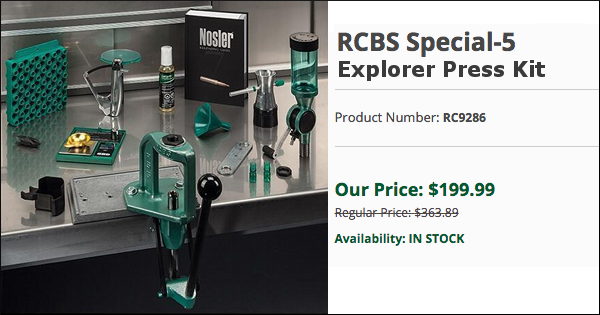
2. Natchez — Special 5 Reloading Press Kit, $199.99
This RCBS Kit has everything a new reloader needs: single-stage press, powder measure, scale, powder trickler, priming tool, cartridge tray, “rocket” chamfer tool, case lube and more. This is an excellent entry-level reloading kit, on sale for just $199.99 at Natchez Shooters Supplies. We like the relatively compact Special 5 press for most reloading duties. Eventually you may want to add an additional, large heavy press, but this will get the job done. For the combined package, with all the tools one needs to hand-load quality ammo — this is a stunningly good deal at $199.99.
3. CDNN — Browning Maple X-Bolt Medallion, $849.99 with Rebate
CDNN Sports has some of the nicest modern Browning rifles we’ve seen. These deluxe Maple-stocked X-Bolt Medallion Rifles are now on sale for $899.99, marked down from $1519.99. Plus, through March 31st, you can get another $50.00 off with a Browning Rebate. The machine-engraved receiver features a polished blued finish, and is glass bedded into the stock. The free-floating barrel is high-gloss blued, hand-chambered and finished with a target crown. The bolt has a 60° lift and the trigger is adjustable. The stock is a high gloss AAA maple with rosewood fore-end and pistol grip cap. These are very nice rifles that any shooter would be proud to own. This Editor has ordered one as a gift to a family member — that should say something.
4. Amazon — Ammo Can/Gun Case/Range Bag System, $44.99
This Plano 1612 X2 Range Bag System combines a plastic ammo can-type container with a two-pistol hardshell case, both enclosed in a durable, padded fabric cover with many pockets. This handy system lets you keep pistols in a separate locked compartment while still accessing ammo, muffs and other gear from the main compartment, which can also be secured with a padlock. This is a clever, versatile design, and owner reviews have been very positive:
“The perfect range bag. It comes with a nice gun case, more pockets than shown, plenty of storage for earphones, several boxes of ammo and room to spare. Would buy again!” — Nate K
“The problem with most range bags is that they are range ‘bags’. This is an ammo can with pockets for all your other gear. No more ‘saggy baggy’!” — MPowers
5. Sportsman’s Guide — 1000 Rds 9mm Ammo, $204.99 delivered
Everyone can use a 1000-round case of 9mm Luger Ammo. This Sellier & Bellot 124gr FMJ brass-cased ammo feeds and functions well. We’ve checked around and this $204.99/1000 price is one of the best deals on brass-cased 9mm ammo this week (for SG members, the cost is $194.99). Plus you can get FREE shipping with CODE SH2656 at checkout. We have shot this ammo in Glock, H&K, Sig Sauer, and S&W pistols. Rated at 1080 fps, this 9mm ammo was very reliable, and the boxer-primed cases are reloadable.
6. Cabelas — Simmons 20-60x60mm Spotter, $49.99 with Rebate
Let’s be realistic — this 20-60x60mm Simmons is NOT a great spotting scope. The sharpness is nowhere near as good as you’d get with a $1000+ spotter. However, you can now get this unit for under fifty bucks with manufacturer’s rebate. Cabela’s Sale Price is $59.99 and Vista Outdoor is offering a $10 Rebate. For basic work, such as viewing pistol targets, or spotting hits out to 250 yards, this bargain basement Simmons should suffice. Read the owner reviews — they have been surprisingly good. This scope will also work for general recreational use. Hard to beat for fifty bucks.
7. Amazon — 34 dB Noise Rating Ear Muffs, $17.45
These 34 dB NRR earmuffs provide excellent sound protection without being too heavy and bulky. At at $17.45, they are a great bargain. The lower section of the muff is trimmed for a narrower profile — that helps with rifle and shotgun stocks. The headband is adjustable and has comfortable padding. These Pro For Sho Muffs have earned a 4 1/2 star consumer rating, with over 1,600 Amazon customer reviews. NOTE: These fit pretty tight. If you have a very large hat size you might want a different brand.
Here’s a good deal on the new Lyman 50th Ed. Reloading Manual. Our Forum members have rated this as the best Loading Manual for starting hand-loaders. This 50th Edition, the first to be produced in full color, includes more load data, and covers more cartridges than ever before. New Cartridges Include: 17 Hornet, 6.5 Grendel, 6.5 Creedmoor, 6.5-284, 26 Nosler, 28 Nosler, 300 Blackout, 300 RCM, 338 RCM, 450 Bushmaster, 458 SOCOM, 50 Beowulf. Amazon has the Softcover version for $19.99 and Hardcover for $23.99. Notably, Lyman donates $1.00 to the NRA for every Lyman 50th Edition Reloading Handbook sold during the first year of publication.
9. Amazon — Neiko Digital Calipers, $16.45
Even if you have a good set of calipers, you may want to get one of these Neiko 01407A Digital Calipers. The #1 best-selling digital caliper on Amazon.com, this Neiko tool features a large LCD Screen and measures up to 6.0 inches. With over 2300 customer reviews, this product has earned an overall rating of 4.4 out of 5 stars. It’s hard to go wrong for $17.74, even if you just use these as a spare set for measuring group sizes and case trim lengths.
Wouldn’t it be great if you could quickly and easily adjust shoulder bump during the full-length sizing process, without struggling to move die lock-rings by trial and error (or fiddle with shims). Well you can. The PMA Micro Die Adjuster is a brilliant little device that replaces the lock ring on your FL sizing die. It allows you to move the die up and down in precise, tiny increments. The tool has .001″ index marks, but you can easily set your die between the marks to achieve .0005″ (half-thousandth) adjustments.
To see how the PMA Micro-Die Adjuster works, watch this video by our friend Boyd Allen:
Many of our Forum members now use the PMA Micro Die Adjuster, and they give this specialty tool high praise. Here are actual reviews by Forum members and other verified tool buyers. Read more comments in this AccurateShooter Forum Thread.
PMA Micro Die Adjuster User Reviews
“No more ‘close enough’ for headspace[.] With this tool set-up it’s easy to put headspace exactly where you want it, then repeat it exactly for subsequent batches for the same cartridge.” — JohnF
“I have four of these Micro Adjuster rings and all I can say is that it works and it is repeatable. I bump my brass .0005″-.001″ and this die lock ring will do it without issue.” — TrapperT
“I size brass for four different 6.5×47 rifles (chambered with three different reamers) using a single die, set in the PMA Adjuster. I have to say… I should have bought one sooner. Adjusting it is very quick and repeatable to well under .001.” — /VH
“I’ve been using PMA’s lock ring for some time now and find it to be very easy to adjust to within .0005″ on a single piece of brass. Very quick to do as well. One thing I have found is that if you still need that half-thou adjustment I will run the brass once more at the same setting before I make that .0005″ adjustment and 50 percent of the time that does the trick. The marked increments are in .001″ scale so if you go half way in between there’s your half-thousandth.
PMA Micro-Adjuster vs. Shims
Many hand-loaders have abandoned shims after trying the PMA Micro Die Adjuster:
“Shims [require] you to completely remove the die. That gets old rather quickly after having used the PMA adjustable lock ring.” — Patch 700
“Great product. Shims used to drive me crazy, put a .002 in and get .0035 of change. With this if you want .0015 set it and that’s what you get.” — John B
“I like mine — adjustments are easy and it will adjust very fine. I used to use .001″ shims. Now can adjust my bump as fine as I want.” — Joe139
Product Description from PMA Tool
The PMA Tool Micro Die Adjuster (MDA) replaces your existing lock ring and can be used with nearly any 7/8-14 full length sizing die. We successfully used this tool with sizing dies from Redding, RCBS, Hornady, Lee, Harrells Precision and those made from Newlon Precision die blanks. It allows you to easily make adjustments to your “shoulder bump” as fine as .0005″. The engraved marks on the MDA are equal to approximately .001 inches (true adjustment .000992″) of adjustment to the shoulder bump. Splitting the engraved marks is therefore approximately equal to .0005″. The design of the MDA does not allow it to work with the Forster Co-Ax press. Some custom dies for very short cartridges may require the use of an extended shellholder. Micro Die Adjuster shown in use installed on Custom Newlon/Scott 6mm PPC Die and Harrells Precision Compact Press.
Each Wednesday, the U.S. Army Marksmanship Unit publishes a reloading “how-to” article on the USAMU Facebook page. This past week’s “Handloading Hump Day” article, the latest in a 7-part series, relates to chronograph testing and statistical samples. We highly recommend you read this article, which offers some important tips that can benefit any hand-loader. Visit the USAMU Facebook page next Wednesday for the next installment.
Chronograph Testing — Set-Up, Sample Sizes, and Velocity Factors
Initial Chronograph Setup
A chronograph is an instrument designed to measure bullet velocity. Typically, the bullet casts a shadow as it passes over two electronic sensors placed a given distance apart. The first screen is the “start” screen, and it triggers an internal, high-speed counter. As the bullet passes the second, or “stop” screen, the counter is stopped. Then, appropriate math of time vs. distance traveled reveals the bullet’s velocity. Most home chronographs use either 2- or 4-foot spacing between sensors. Longer spacing can add some accuracy to the system, but with high-quality chronographs, 4-foot spacing is certainly adequate.
Laboratory chronographs usually have six feet or more between sensors. Depending upon the make and model of ones chronograph, it should come with instructions on how far the “start” screen should be placed from one’s muzzle. Other details include adequate light (indoors or outdoors), light diffusers over the sensors as needed, and protecting the start screen from blast and debris such as shotgun wads, etc. When assembling a sky-screen system, the spacing between sensors must be extremely accurate to allow correct velocity readings.
Statistics: Group Sizes, Distances and Sample Sizes
How many groups should we fire, and how many shots per group? These questions are matters of judgment, to a degree. First, to best assess how ones ammunition will perform in competition, it should be test-fired at the actual distance for which it will be used. [That means] 600-yard or 1000-yard ammo should be tested at 600 and 1000 yards, respectively, if possible. It is possible to work up very accurate ammunition at 100 or 200 yards that does not perform well as ranges increase. Sometimes, a change in powder type can correct this and produce a load that really shines at longer range.
The number of shots fired per group should be realistic for the course of fire. That is, if one will be firing 10-shot strings in competition then final accuracy testing, at least, should involve 10-shot strings. These will reflect the rifles’ true capability. Knowing this will help the shooter better decide in competition whether a shot requires a sight adjustment, or if it merely struck within the normal accuracy radius of his rifle.
How many groups are needed for a valid test? Here, much depends on the precision with which one can gather the accuracy data. If shooting from a machine rest in good weather conditions, two or three 10-shot groups at full distance may be very adequate. If it’s windy, the rifle or ammunition are marginal, or the shooter is not confident in his ability to consistently fire every shot accurately, then a few more groups may give a better picture of the rifle’s true average.
Sometimes everything comes together — a great barrel, the right load, good bullets, and, of course, a gifted trigger-puller. Check out this target from Forum member Mike Ezell. That’s five (5) shots at 100 yards from Mike’s 30 Major benchrest rifle. When this group was shot a while back, Mike reported: “I fired a few groups in the great weather. No surprises — it did VERY well! My little wildcat, the 30 Major, has always been a shooter. That target was not a fluke — I shot a few groups today and Agg’d a high One.” Mike is a Kentucky gunsmith who builds his own rifles.
30 Major is Based on 6.5 Grendel
What’s a “30 Major” you ask? This is Mike’s own wildcat, a 6.5 Grendel necked up to .30 caliber. Mike writes: “The 30 Major is essentially a .070″-long 30 PPC. With the great 6.5 Grendel brass available from Lapua, all you need to do is neck-up and turn the necks to prep the brass.” Mike says it is very much like a 30 BR, but you just start with 6.5 Grendel brass instead of 6mmBR brass.
The cartridge has one major benefit — it utilizes a PPC-diameter bolt face. That makes it easy to convert your group-shooting 6 PPC to shoot score with .30-cal bullets. Mike explains: “If you have a PPC, to shoot score, all you have to do is chamber up a [.30 caliber] barrel and screw it on your PPC.”
From 7.62×39 Russian to 30 Major — Full Circle
Arms expert Neil Gibson has an interesting perspective on the lineage of the 30 Major. He reminds us that this wildcat has returned to its roots: “Start off with the 7.62×39 Russian [cartridge]. The Russians then modify it, necking it down to .223 for deer hunting. The U.S. benchrest guys then modify that, necking it up to 6mm and blowing the case out making the 6mm PPC. Someone takes that case, necks it out to 6.5 mm, making the 6.5 PPC. Alexander Arms takes that and makes the 6.5 Grendel. Then finally Mike Ezell takes the Grendel and necks it up to 30 caliber, making the 30 Major. From 30 caliber, back to 30 caliber. OK, the original uses .31 caliber bullets, but the bore is still .300. Talk about almost coming round full circle!”
7.62×39 Russian
v
.220 Russian
v
6mm PPC
v
6.5 PPC
v
6.5 Grendel
v
30 Major
The 7.62×39 Russian was the Grand-Daddy of the 30 Major…
Great Accuracy Restored after Solving Mystery Problem
To get his 30 Major rig shooting this well, Mike had to solve a mysterious problem that cropped up last year. Mike explains: “Two years running, I have finished in the top 15 in IBS points shooting [the 30 Major], but last year’s benchrest season was tough.” Mike was having some accuracy issues that defied explanation. But he figured it out: “The front action screw was bottoming out against the barrel extension – just barely. A simple fix brought the gun back to life. It’s a Stiller Viper Drop Port. The action is screwed and glued into the stock, so I was a bit surprised … especially after having checked for [that issue] while looking for the problem. I’m just glad to have found the trouble so I can begin to re-instill some confidence in the gun and myself, after last year.”




 While “naked” bullets are just fine for most applications, some shooters like to put a friction-reducing coating on their projectiles. Coating bullets can benefit guys who run very high round counts between barrel cleanings. Reader Mike Etzel has come up with a simple, cost-effective way to apply HBN, Moly, or Danzac (WS2) coatings to your bullets. And you won’t need any expensive gear other than your regular vibratory tumbler and some small plastic containers.
 2. Get Everything Hot — Real Hot. This is probably the single most important element in producing good-looking moly-coated bullets. I put the tumbler, the drum and the bullets out in the sun for at least 30 minutes before starting and then do all the tumbling in direct sunlight. On a summer day in Arizona, everything gets to the point that its uncomfortably hot to handle. If you are tumbling in the winter, you should heat the bullets in some form, a hair dryer can be useful, but they will cool off in the drum if you’re tumbling in cold temperatures. Your best bet is to plan ahead and do your coating in the summer. I coated about 3000 bullets in a couple of days recently to see me through our winter season (we’re a bit reversed from the rest of the country in terms of shooting season).