|
|
December 21st, 2014
 Here’s a valuable web resource our readers should bookmark for easy access in the future. ShootForum.com offers a vast Bullet Database, which includes over 3900 bullet designs in all. We counted nearly 200 different 6mm bullets! The bullet info comes from the makers of QuickLOAD Software. Access to the online database is FREE. Most database entries include Caliber, Manufacturer, Stated Bullet Weight, True Bullet Weight, Length, Sectional Density (SD), and Ballistic Coefficient. In many cases multiple BCs are provided for different velocity ranges. Here’s a valuable web resource our readers should bookmark for easy access in the future. ShootForum.com offers a vast Bullet Database, which includes over 3900 bullet designs in all. We counted nearly 200 different 6mm bullets! The bullet info comes from the makers of QuickLOAD Software. Access to the online database is FREE. Most database entries include Caliber, Manufacturer, Stated Bullet Weight, True Bullet Weight, Length, Sectional Density (SD), and Ballistic Coefficient. In many cases multiple BCs are provided for different velocity ranges.
The coverage of the Bullet Database is amazing. Manufacturers in the database include: A-Square, Barnaul, Barnes, Berger, Brenneke, Calhoon, CDP, CheyTac, ColoradoBonded, CT, DAG, David Tubb, Delsing, DEWC, DKT, DTK, DYN, Federal, Fiocchi, FMJ, FN, Fortek, FP, Freedom, Frontier, GECO, Gian-Marchet, GPA, GS-Custom, H&N, Hawk, HeviShot, Hirtenberger, Hornady, HP, Igman, IMI, IMI-Samson, Impala, JDJ, JLK, Klimovsk, Lapua, LEADEx, LEE, Lehigh, LIMA, LostRiver, LYM, MEN, Mil, Norinco, Norma, NorthFork, Nosler, PMC, PMP, Powell, PrviPartizan, Rainier, RCBS, Reichenberg, Remington, RN, RNFP, RUAG, RWS, Sako, Sellier-Bellot, Shilen, Sierra, Sinterfire, Speer, Stoklossa, SWC, Swift, Swiss, The Gun Haus, TMJ, WestCoast, Winchester, WM-Bullets and Woodleigh.
The database is great if you’re looking for an unusual caliber, or you want a non-standard bullet diameter to fit a barrel that is tighter or looser than spec. You’ll find the popular jacketed bullets from major makers, plus solids, plated bullets, and even cast bullets. For those who don’t already own QuickLOAD software, this is a great resource, providing access to a wealth of bullet information.

December 19th, 2014
The RCBS Rock Chucker is a rugged, classic design that can last a lifetime. If you are looking to get started with hand-loading, or just need another press for your reloading room, the Rock Chucker is a great choice. And now it’s easier than ever to purchase a Rock Chucker. Right now, Bullets.com has slashed the price on its RCBS Rock Chucker Supreme presses. As part of an inventory reduction sale, Bullets.com is now offering the RCBS Rock Chucker Supreme (with full RCBS warranty) for just $99.95. Act soon — this offer is limited to supplies on hand.

More Savings — $10.00 Rebate from RCBS
Getting a great press for under one hundred bucks is hard to beat. But get this — RCBS is currently offering a $10.00 rebate with any qualifying RCBS product purchase of $50.00 or more made before December 31, 2014. So… if you buy this press before the end of 2014, you can get a $10.00 RCBS rebate. That lowers your effective cost to $89.95 for the Rock Chucker Supreme. That is one amazing deal. CLICK HERE for REBATE INFO.
December 11th, 2014
 The 6.5 Guys, a dedicated duo of Pacific NW rifle shooters, have created an interesting series of shooting-related videos on their 6.5 Guys YouTube Channel. In this video, The 6.5 Guys set up and demonstrate the Bench-Source cartridge brass annealing machine. The video explains how to set up the machine, how to attach and adjust the torches, and how to “fine tune” the flame and dwell time to achieve best results. The 6.5 Guys, a dedicated duo of Pacific NW rifle shooters, have created an interesting series of shooting-related videos on their 6.5 Guys YouTube Channel. In this video, The 6.5 Guys set up and demonstrate the Bench-Source cartridge brass annealing machine. The video explains how to set up the machine, how to attach and adjust the torches, and how to “fine tune” the flame and dwell time to achieve best results.
Read Full Annealing Article on 65Guys.com.
To complement this video, the 6.5 Guys (aka Ed and Steve) have published an Annealing Tech Talk article on 65guys.com. If you own an annealing machine, or are getting started with cartridge annealing, you should read that article. It covers basic annealing principles, and gives useful tips on temp control, dwell time, and frequency of annealing. After the video, we feature highlights from this article.
Temperature Control
We use 750° Tempilaq applied inside the case neck to indicate that the proper temperature has been achieved. If you turn off the lights, you will notice that the brass just barely starts to turn color. As you go beyond the 750° mark we observed that the case mouth will start to flare orange — you can see this with the lights on. From our research, we understand that this is the result of zinc burning off. We adjust the time on our machine between the point that the Tempilaq turns liquid and the flame starts to turn orange. In other words, if the flame is starting to turn orange reduce the time. We let the cases air cool — we don’t quench them in water.
The case starts to flare orange here, during a set-up test. Dwell time was then reduced slightly.

Read Full Annealing Article on 65Guys.com.
Flame Orientation
We aim the flame at the neck-shoulder junction. Some folks like to aim it at the neck and others the shoulder. When you see how the two flames meet and spread out vertically, it probably doesn’t make that much of a difference.
Here you can see the flame points aimed at the neck-shoulder junction.

Case Coloration
Cases will turn color after annealing, but the degree of color change is not a reliable indicator. We have noticed that the appearance of cases will vary depending on brass manufacturer, brass lot, light source, and how long ago the case was annealed.
How Often Should You Anneal?
Some shooters anneal every time while others choose a specific interval. We noticed work hardening around five firings that resulted in inconsistency in shoulder setback and neck tension, so we choose to anneal every three firings. Your mileage will vary depending on how hot your loads are and how aggressively you resize.
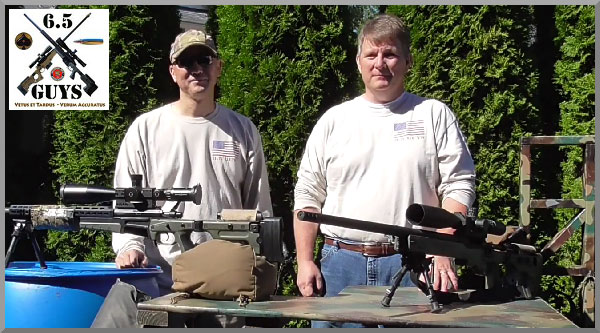
Who are the 6.5 Guys? They are Ed (right) and Steve (left), a pair of avid shooters based in the Pacific Northwest. They have released 22 Videos on the 6.5 Guys YouTube Channel.
December 11th, 2014
What do you hope Santa delivers this Christmas? Our friend Gavin Gear over at UltimateReloader.com has some gift ideas that hand-loaders can add to their “wish lists”.

READ Christmas Gift Ideas
for Reloading Enthusiasts
on UltimateReloader.com.
Special Tools — My Dad used to say: “You’ve got to use the right tool for the job”. I agree, and some times that means having a collection of special tools. There’s nothing more satisfying to me than the efficiency, effectiveness, and precision of having the right tool.
Here are some of my most frequently used “reloading special tools”:
▶ COL Gauge (case sizing, bullet seating depth)
▶ Case Neck-Thickness Gauge (shown below)
▶ Bullet Concentricity Gauge
▶ Vibratory primer-tube filling tool

General Items — There is no shortage of “reloading things” to ask for. Here are some additional ideas:
▶ Extra 6″ Digital Calipers (good idea to have spare calipers)
▶ Industrial Ziplock Plastic Bags (for brass storage)
▶ Tumbling Media (pet stores have ground walnut shells)
▶ Reloading Manuals
▶ Ammo Boxes (bulk styrofoam with cardboard boxes are great.)
▶ Digital Scale for sorting bullets and brass (jeweler’s scales from Amazon will work)
There’s some ideas for you. Get your “wish lists” sent off while there’s still time for your presents to get ordered and shipped!

December 6th, 2014
Next time you have a barrel fitted, consider having your gunsmith create a “stub gauge” from a left-over piece of barrel steel (ideally taken from your new barrel blank). The outside diameter isn’t important — the key thing is that the stub gauge is created with the same reamer used to chamber your current barrel, and the stub must have the same bore diameter, with the same land/groove configuration, as the barrel on your rifle. When properly made, a stub gauge gives you an accurate three-dimensional model of the upper section of your chamber and throat. This comes in handy when you need to bump your case shoulders. Just slide a fired case (with spent primer removed) in the stub gauge and measure from base of case to the end of the gauge. Then, after bumping, re-measure to confirm how much you’ve moved the shoulder.
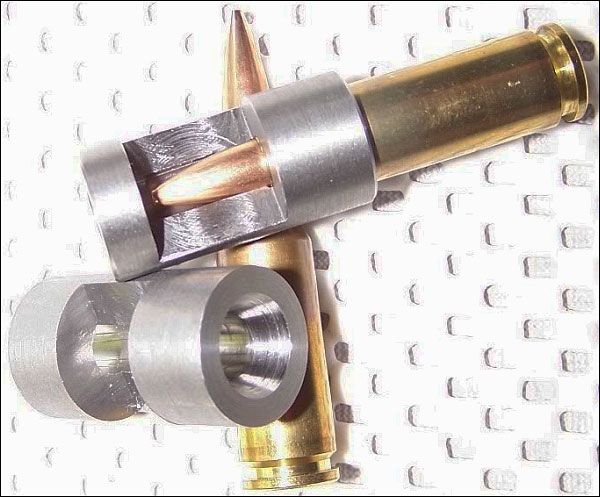
In addition, the stub gauge lets you measure the original length to lands and freebore when your barrel was new. This gives you a baseline to accurately assess how far your throat erodes with use. Of course, as the throat wears, to get true length-to-lands dimension, you need take your measurement using your actual barrel. The barrel stub gauge helps you set the initial bullet seating depth. Seating depth is then adjusted accordingly, based on observed throat erosion, or your preferred seating depth.
Forum member RussT explains: “My gunsmith [makes a stub gauge] for me on every barrel now. I order a barrel an inch longer and that gives him enough material when he cuts off the end to give me a nice case gauge. Though I don’t have him cut that nice-looking window in the side (as shown in photos). That’s a neat option. You can tell how much throat erosion you are getting from when it was new as well. For measuring initial seating depths, this is the most useful item on my loading bench next to calipers. Everyone should have a case gauge made by there smith if you have a new barrel put on.”
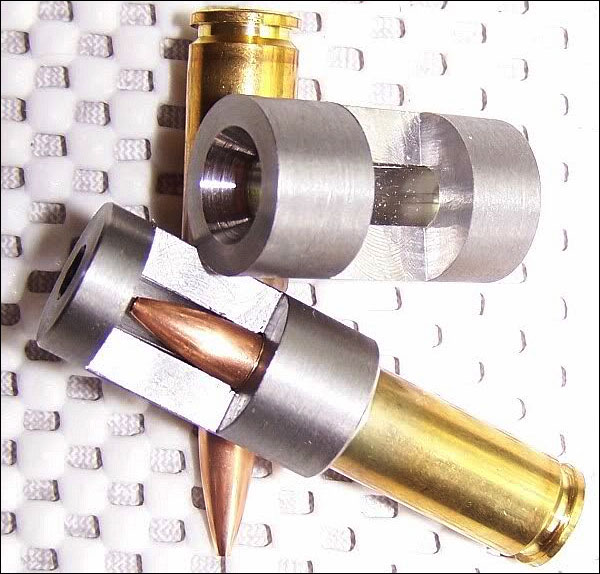
Forum member Lawrence H. has stub gauges made with his chamber reamers for each new barrel. He has his smith cut a port in the stub steel so Lawrence can actually see how the bullet engages the rifling in a newly-cut chamber. With this “view port”, one can also see how the case-neck fits in the chamber. Lawrence tells us: “My stub gauges are made from my barrels and cut with my chamber reamers. With them I can measure where my bullets are ‘touching the lands’ and shoulder bump dimensions. This is a very simple tool that provides accurate information.” To learn more about stub gauges, read this Forum Thread. The photos above and below show Lawrence’s stub gauges:
December 5th, 2014
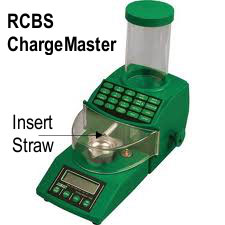 Here’s a clever, easy modification for your RCBS ChargeMaster electronic powder dispenser. Many folks use a McDonald’s straw to smooth kernel flow out of the dispensing tube. Forum member Mike S. (aka in2deep) found that, even with a straw in place, he sometimes got clumps, which dropped 5-6 kernels at once, throwing off his dispensed weight. Here’s a clever, easy modification for your RCBS ChargeMaster electronic powder dispenser. Many folks use a McDonald’s straw to smooth kernel flow out of the dispensing tube. Forum member Mike S. (aka in2deep) found that, even with a straw in place, he sometimes got clumps, which dropped 5-6 kernels at once, throwing off his dispensed weight.
Mike looked at the situation and ingeniously decided to trim the straw into little v-shaped arms or prongs. This helps to break up the clumps, so the kernels flow out the end of the tube more consistently during the dispense cycle. Mike writes:
Soda Straw Modification
This is a further tweak of the popular soda straw modification as the original mod would still allow Varget powder to collect in the straw and dump sometimes as many as 6 or 8 or even more extra kernels in the pan. It would sometimes signal an overcharge, but even when it didn’t there could be as many as 6+ kernels too high or too low (total spread of 12+).
The little arms (prongs) on the straw tend to separate the kernels into groups of 1 or 2 or 3 and prevents piling and many times the throw is now within 1 or 2 kernels of the desired weight.

Straw Cutting Tips — Mike found the shape/angle of the “arms” is very important. If the cuts are too fine or too course it allows the kernels to collect almost like before but the illustrated angle seems to allow an average of only 2 or 3 kernels per trickle input from the machine. This means that more charges are much closer to the actual desired weight and max kernel variances will be cut in less than half and there will be almost no overthrows.
Credit Boyd Allen for sourcing this tip.
December 4th, 2014
 The 2015 Hodgdon Annual Manual (the 12th Annual Edition) has been released. The 2015 Hodgdon Manual now contains over 5000 loads — more load data than you’ll find in any other annual reloading resource. The 2015 Manual has updates for numerous rifle and pistol cartridges. Featured in the 2015 Manual are the new IMR Enduron™ powders such as IMR 4166, IMR 4451, and IMR 7977. Enduron powders feature a built-in copper fouling reducer, along with small kernels for easy metering and good load density. IMR also claims that Enduron powders are not sensitive to ambient temperature changes. It appears IMR 4166 may be a viable alternative to Hodgdon’s popular, but hard to find, Varget powder. The 2015 Hodgdon Annual Manual (the 12th Annual Edition) has been released. The 2015 Hodgdon Manual now contains over 5000 loads — more load data than you’ll find in any other annual reloading resource. The 2015 Manual has updates for numerous rifle and pistol cartridges. Featured in the 2015 Manual are the new IMR Enduron™ powders such as IMR 4166, IMR 4451, and IMR 7977. Enduron powders feature a built-in copper fouling reducer, along with small kernels for easy metering and good load density. IMR also claims that Enduron powders are not sensitive to ambient temperature changes. It appears IMR 4166 may be a viable alternative to Hodgdon’s popular, but hard to find, Varget powder.
Along with comprehensive load data, the 8 1/2″ by 11″ magazine-style Hodgdon Annual Manual offers authoritative articles by top gun industry writers. You can purchase the 2015 Manual at news-stands (and gunshops) for $8.99. In a few weeks, you should also be able to purchase the manual from Hodgdon’s online store. For more info, visit Hodgdon.com or call 913-362-9455.
December 2nd, 2014
Useful reloading gear does not have to be costly. Here are ten handy (and very inexpensive) items that belong on your loading bench or in your range kit.
|
 • Magnifying Glass – We use a flat, 2″x2″ pocket 4x-8x magnifier. This folds up on itself. Very handy, we use it to inspect bullets and brass. Use this to check your flash holes for burrs, and check the meplats of your bullets before loading. • Magnifying Glass – We use a flat, 2″x2″ pocket 4x-8x magnifier. This folds up on itself. Very handy, we use it to inspect bullets and brass. Use this to check your flash holes for burrs, and check the meplats of your bullets before loading.
• Clear 35mm Film Cannister – Use this to transfer the thrown powder charge to the little measuring cup that sits on your scale. That way you don’t get any kernel splash. Also if the charge weight is obviously off, it’s easy to dump back in the measure. A film canister works pretty well as a trickler too.
• Compressed Air in a Can -- Get these at office supply stores. Use the can (with tube attached) to blow crud out of cases after cleaning the neck with a brush, and blast loose debris out of primer pockets.
• Pin Vise – A simple $7.00 pin vise with a #53 bit is perfect for deburring Lapua PPC and BR flash holes without reaming the flash-holes any larger. The Lapua PPC/BR flash-hole diameter is 1.5 mm, or 0.059″. eHobbyTools.com sells a 1.5mm pin vise bit. Other vendors offer a #53 pin vise bit that measures .0595″ or .060″ (depending or source). You can find pin vises and bits at hobby stores.

• Bounce Dryer Sheets – The common dryer sheets will eliminates “static cling” on your plastic reloading parts such as powder measure cylinders, powder funnels, and reloading press plastic bins. Thanks to Doc76251 for this tip.
 • Ballistol Aerosol – Try using this versatile lubricant/solvent for full-length sizing. Spray some on a patch and you can wipe the carbon of your case necks. Then, continue to apply a very small amount of Ballistol on the case bodies — just thin sheen is all you need. Ballistol is super slippery, and easy to remove. For general full-length sizing (on small cases) it works great and doesn’t leave a gooey, waxy, or chalky residue. For heavier case-forming jobs, we recommend Imperial Die Wax. • Ballistol Aerosol – Try using this versatile lubricant/solvent for full-length sizing. Spray some on a patch and you can wipe the carbon of your case necks. Then, continue to apply a very small amount of Ballistol on the case bodies — just thin sheen is all you need. Ballistol is super slippery, and easy to remove. For general full-length sizing (on small cases) it works great and doesn’t leave a gooey, waxy, or chalky residue. For heavier case-forming jobs, we recommend Imperial Die Wax.
• Shotgun Mop – Stick this in the chamber when using Wipe-Out foaming bore cleaner. This will seal off the chamber so the foam doesn’t flow into your action. For long chambers screw on one section of cleaning rod to aid extraction.
• Colored Sharpie Marking Pens – Mark your bullets ahead of the bearing surface, and the color transfers to the target. This way you can shoot multiple loads at the same point of aim and discern which load shoots the tightest. (Recommended for 300 yards and beyond). With colored bullet tips you can test multiple loads “round robin” to equalize wind effects. When testing seating depths for example, you can mark the longer-seated set of bullets red and the shorter-seated set green and shoot them during the same sequence. Just look at the colored marks on the target to see which grouped better.

• Thin Latex Gloves – You should keep a box of inexpensive, disposable latex gloves (the kind doctors use) in your loading room. These will prevent contamination of primers or powder kernels that you handle directly. Also, use the gloves when handling fine blued tools or firearms to prevent transfering body oils and salts that promote rust.
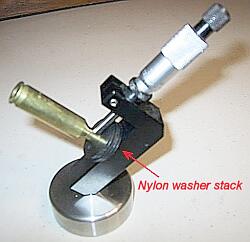
• Plastic Washers for Neck Mic – If you use a Sinclair Neck-wall Micrometer Gauge with integral stand, you can use thin plastic washers to adjust the height of the case on the mandrel. This makes it much easier to measure the same point on the case neck every time. Thanks to MikeCR for this tip (and photo).
|
November 29th, 2014
All right boys and girls — if you haven’t already spent every last red cent of your disposable income (not to mention your children’s inheritance) purchasing useless gadgets and gewgaws on Black Friday, here’s your chance to get some really important stuff — reloading tools and supplies.

Sinclair Sale Through 12/1/2014
Yes, Sinclair International, purveyors of reloading supplies and shooting accessories, is having a big sale right now. You can save big bucks on shooting rests, tools, bullets, and more. Plus, you can get 10% OFF all orders over $150.00 with PROMO CODE J2Y. Don’t delay — this 10% Savings Offer expires Monday, December 1, 2014 at 11:59 pm CT. So, you have a couple days left to pile on the savings.
Here’s a sample of the good deals to be had this weekend at SinclairIntl.com:

Sale Tip from EdLongrange. We welcome reader submissions.
November 29th, 2014
Many shooters prefer to deprime their fired cartridge cases before other operations (such as neck-sizing and full-length sizing). In addition, when cleaning brass with an ultrasonic system, it’s not a bad idea to remove primers first. That way the primer pockets get cleaned during the ultrasonic process.
To deprime cases before sizing or cleaning you can use a Depriming Die (aka “decapping die”). This pushes out the spent primer without changing the neck or body of a case. Such decapping dies work fine, but they do require the use of a press.
New Handheld Primer Removal Tool From Frankford Arsenal
Here’s a new tool that allows you to deprime cartridge cases without a press. This new hand-tool from Frankford Arsenal will deprime (and capture primers) conveniently. You can deprime your cases while watching TV or relaxing in your favorite chair.

This handy depriming tool is very versatile. With a universal, cylinder-style cartridge-holder, the tool can deprime a wide variety of cartridge types from .20 caliber up to .338 caliber. Spent primers are captured in a removable spent primer catch tube. With die-cast metal construction, this tool should last through many thousands of depriming cycles. MSRP is $54.99.
Will This Tool Work with Small Flash Hole Brass?
This new depriming tool will be introduced at SHOT Show in January 2015. We have not been able to measure the decapping shaft diameter, so we do not know whether this hand tool will work with small flash-holes found on Lapua benchrest brass (such as 220 Russian and 6mmBR). We’ll try to answer that question at SHOT Show. This tool is so new the specs are not yet listed on Frankford Arsenal’s website.
Product find by EdLongrange. We welcome reader contributions.
|


