Grafs.com is having a big sale on certain Hornady reloading products. The Lock N Load Auto Charge Scale/Powder Dispenser is now just $199.99, marked down from $224.99. Reports on this unit have been generally positive. This sale makes the Hornady scale/dispenser much less expensive than an RCBS Chargemaster, which typically sells for about $330.00.
Next, the price of the Hornady Lock N Load Ultrasonic Cleaning Machine has been knocked down to $84.99 from $99.99. That makes the machine cheaper than “no-name” alternatives sold on eBay. This is similar to the machine we used for our original ultrasonic cleaning tests. It should do the job, unless you have large quantities of brass, in which case we recommend the larger Hornady Magnum Sonic Cleaning Machine, which has twin transducers and a larger immersion bay.
Grafs.com has also slashed the price of the Hornady Concentricity Gauge from $94.99 to $79.99. This tool can measure bullet run-out, and it has the capacity to straighten bullet alignment in the neck. Be aware, however, that because this tool supports a cartridge at both ends (like holding the two ends of a jump-rope), you will typically get a different run-out reading than with a traditional tool, such as the Sinclair Concentricity Gauge, which supports the case body only (without touching the bullet tip). Both tool designs give meaningful results, but the read-outs will not normally be the same.
Hornady Reloading Handbook $10.00 with Bullet Purchase
In addition to the tool sales, Grafs.com is now offering the lastest Hornady Reloading Handbook for just $10.00 if you purchase five (5) boxes of in-stock Hornady Bullets. If you could use the book, we recommend Hornady’s V-Max bullets for varmint hunters, and the new BTHP match bullets for target shooters. The new BTHP match bullets feature AMP (Advanced Manufacturing Process) jackets for greater dimensional uniformity.
SUMMARY: This review gives high marks to GemPro 250 scale from My Weigh. It offers 0.02 grain resolution, good enough to trickle kernel by kernel. At just $165.49, the scale is quite affordable. The GemPro 250 comes with a lifetime warranty for American buyers. As this scale weighs more precisely than popular digital powder scale/dispensers, you can use the digital dispenser to throw a “close” charge and then fine-tune your load with the GemPro, kernel by kernel.
by Bill Schnauffer (aka Cover Dog) The Importance of Precise Loads for Long-Range Shooting
The reloading scale is the life blood of anyone’s loading bench. It’s used for everything from weighing powders to cases or bullets and yes even primers. I would have never considered weighing primers but that is one of the many things I learned the weekend of May 20-22, 2011 at The Original Pennsylvania 1000-Yard Bench Rest Club’s Bench Rest Instructional School. All aspects of reloading for 1000-yard BR have to be identical. Your brass, bullets, powder and primers all have to weigh the same, for all your sighters and your 10 record shots, if you want any chance of being competitive. This can only become a reality if your scale is up to the task. Everything you do when shooting at 1000 yards is magnified 10x and your scale needs to be above all else, accurate and repeatable.
I thought that a scale accurate to 1/10th of a grain was good enough. Not so in the long range BR game. Scales need to be accurate to at least 5/100ths of a grain or better if you can afford it. This prompted my search for such a scale.
GemPro Is Half the Price of Denver Instrument MXX-123
I have read reviews for several of the better scales used for reloading including the Accu-Lab VIC 123 (Accu-Lab ceased operation Dec. 31, 2010) and its predecessor the Sartorius AY-123. The scales are identical just repackaged and with a new name and color. The scale is accurate to 2/100ths of a grain, but is also a scale that many felt was affected by RF interference and the slightest air movement made it drift. This was due in part because of the strain gauge technology that is used in the manufacture of this scale. And with parts not readily available, the lead time for one is you want it is over 20 weeks. The Denver Instrument MXX-123 also had a good review but like the others above, it’s into the $320 price range. And this is out of reach for many reloaders.
This now brings me to the My Weigh GemPro 250. It uses True-Division German HBM sensors and professional components in the manufacture of this scale. It has a 50 gram weight capacity (771.72 grains) and accuracy down to 2/100ths of a grain. It features seven (7) weighing modes as listed below. And with a retail price in the $165.00 range, this is a scale that most reloaders could afford for their reloading bench. And you won’t be pressed for room on that bench. The scale is very compact, measuring 5.25″ X 3.75″ X 2.5″.
NOTE: There is also a GemPro 500 which has a weight capacity of 100g (1543 grains) but only has accuracy down to 5/100ths of a grain.
Testing and Evaluation
I decided to give the GemPro 250 a try. Several days after I placed my order, Big Brown arrived. As I started to unpack the scale my heart started to sink and the first words out of my mouth were “boy is this thing small, hope it wasn’t a mistake”, only time will tell.
Included with the scale was a plastic travel case that housed the accessories. They consisted of an AC power supply, ASTM class F2 calibration weight, weighing pan, plastic tweezers and a vibra-kill pad. The scale also has a built in circular bubble level, four leveling feet, hinged protective windscreen and a stainless steel weighing platform. If you load at the range, you’ll be glad to know that it also runs on four AAA batteries. Information sheets that came with the scale stated it takes the load cell one hour to come up one degree in temperature when plugged in and turned on. Instructions recommend giving the unit a 24-hour warm-up before use.
Scale Calibrates Rapidly
After leaving the scale on for 24 hours (my scales are always up and running), I placed the ASTM class F2 20g calibration weight on the scale after setting it to calibrate. After about 3 seconds it stopped its calibration and read 20.000g exactly what the calibration weight was supposed to weigh. When converting grams to grains you need to multiply by 15.4324 or with this scale you can just scroll through the seven weighing modes until you come to grains. Its actual weight is 308.65 grains but since this scale only reads to 2/100ths of a grain the 100ths digit must always be an even number, so it reads 308.64 grains.
For the next several minutes I started weighing everything I had in front of me. Bullets, brass, loaded rounds all were gathered up and weighed so I could get the feel for the GemPro 250.
I set the calibration weight on the scale between every one of the 30 loads I weighed. Only once did it vary from the 308.64 grain reading when it moved up to 308.66 grains.
I wish I had at my disposal a scale more sensitive than the GemPro 250 to double check its accuracy. Scales that read to 1/100th of a grain are out of my price range, and cost from $2000 for the Citizen CX265 to $4065 for the A&D Phoenix GH252. I purchased a PACT Digital Scale in late 1994 and to this day it has been my “go to” scale. In 2002 I sent it back to PACT to have the infrared port installed so I could purchase PACT’s infrared powder dispenser. I have used the PACT Scale/Dispenser as a team for the last 10+ years for all my reloading needs. So now with the GemPro 250 on my bench it was time to see how “accurate” my reloading with the PACT combo has been.
Editor’s Note: In this review, the GemPro 250 is used to confirm the weight of powder throws from a PACT digital dispenser. However, the reviewer did not have a laboratory-grade scale to test the displayed weights from the GemPro 250. We have another GemPro 250 on order from Amazon.com. When it arrives we will do a comparison weighing test, using a Denver Instruments lab scale as the control unit.
REAL WORLD TESTING Double-Checking PACT Dispenser with GemPro 250
For the first test I used Reloder 15 (RL15), a course, long-kernel powder. After calibrating both the PACT scale and the GemPro 250 I set the Pact Dispenser to throw a charge of 27.7 grains. During the throws, if the PACT scale read 1/10th over/under, I didn’t make any correction. I just waited until it stopped dispensing and the transferred the charge in the pan to the pan in the GemPro 250.
Below are the results of those 10 thrown charges:
27.76 | 27.94 | 27.80 | 27.84 | 27.92 | 27.88 | 27.76 | 27.88 | 27.78 | 27.78
Note: As measured by the GemPro 250, none of the PACT throws hit the 27.7 grain mark exactly — all throws were slightly high. The total spread from lowest (27.76) to highest (27.94) throw was 0.18 grains and the spread from the 27.7 target weight to the highest dispensed charge was 2.4 tenths of a grain HIGH. I’m sure this could cause a little vertical at 1000 yards.
For the next round of tests, I used IMR 8208 XBR. Compared to RL15, the kernels of 8208 are shorter in length and smaller in girth. Using the same parameters as with the RL15, here are the results of 10 thrown charges with IMR 8208 XBR:
.
27.78 | 27.80 | 27.78 | 27.82 | 27.78 | 27.84 | 27.80 | 27.74 | 27.78 | 27.74
Once again, not one of the 10 dispensed charges were right on the mark according to the GemPro. Again, all thrown charges were slightly hight.The range from target weight to the highest was 1.4 tenths of a grain, and the total variance from 27.70 grain target weight was 0.14 grains.
The final powder tested was HS6. This is a spherical powder which, by most accounts, meters very well. With the same procedures in place here are the results for HS6 weighed on the GemPro 250:
As expected HS6 did very well in getting close to the 27.70 target and hit it on several throws. The total variance from the 27.70 target Averaging 26/100ths over for the 10 charges thrown
PACT Performance Re-Evaluated
Only able to read to 1/10th of a grain, the PACT dispenser looked to be nearly perfect with the HS6 powder. But when checked with a precision scale capable of reading to 2/100th’s of a grain, I found that the PACT still threw loads that were higher than what was programmed. I will still use my PACT to dispense my loads one grain short and then trickle in the last few kernels with the scale pan sitting on the GemPro 250.
CONCLUSION The GemPro 250 is small, compact, portable and able to deliver repeatable accuracy to 2/100ths of a grain, time after time. That is all that one can ask of any scale. There is one last important thing to mention. The GemPro 250’s express warranty is LIFETIME (for domestic buyers) or 30 years for International Customers. A lifetime warranty is unheard of in the electronics business. I guess the people at My Weigh know what they have and are willing to stand behind it. If it should ever need servicing the My Weigh service center located in Phoenix, AZ will repair your scale and have it back to you in two business days.
RCBS has launched a completely updated RCBS.com website. The new site features videos, a Step-by-Step Reloaders Guide, a Frequently Asked Questions (FAQ) section, a Glossary of Reloading Terms, a list of current Promotions and Rebates, a comprehensive parts inventory, plus all the RCBS product info you’d expect. Users can also download the 2011 RCBS Product Catalog. Along with its updated main site, RCBS has launched a companion reloading forum site, www.ReloaderHub.com. There you can post pictures and videos, share reloading recipes, and discuss reloading techniques.
Much good information is to be gleaned from the reloading videos available on RCBS.com. Hosted by RCBS Gen. Manager Allen Jernigan, these clips cover important reloading procedures, such as case prep, cartridge priming, and how to measure case run-out (eccentricity). Click the image below to go to the RCBS Video Archive.
If you read our 2011 Super Shoot Report by James Mock, you’ll see that Vihtavuori N133 powder is the overwhelming choice of top short-range benchrest shooters for loading their 6PPCs. Other Vihtavuori powders, such as N135, N150, and N550 are also very popular for other match and hunting cartridges.
If you currently use a Vihtavuori (VV) powder, or you plan to try a Vihtavuori powder in the near future, visit www.Lapua.com soon. Load info on Lapua’s Vihtavuori Reloading Data Page has been updated (or added) for the following calibers: .222 Remington, .223 Remington, .223 WSSM (new caliber data), .22-250 Remington, 6.5 Grendel, 6.5×47 Lapua, and 7.62x53R. In the updated tables, you’ll find VV powder recipes for a wide variety of bullets from Hornady, Lapua, Nosler, Sierra, Speer and other bullet-makers.
Though these recipes are fairly conservative, always start low and work up gradually when using a new powder for the first time. Likewise, you should back off your load if you change ANY component or if you have fitted a new barrel to your rifle.
Vihtavuori N100 Series
The N100 series powders are single-base powders used mainly in rifle calibers. There are ten N100 series powders with different burning rates and suitability from the .17 Remington up to the .458 Winchester Magnum and two special powders for .50 BMG.
N500 Series
The N500 series powders are impregnated extruded rifle powders with Nitroglycerol added as extra energy component. If higher loading densities and more energy are needed, N500 series powders are competent alternatives for the N100 series powders. N500 series High Energy powders are available in five different burning rates.
Story tip by EdLongrange. We welcome submissions from our readers.
With top-quality cartridge brass approaching $1.00 per case, it’s more important than ever to get maximum life from your match brass. Annealing can extend the useful life of your brass, and ultrasonic cleaning allows you to eliminate carbon build-up inside cases that have been fired numerous times. You can certainly do annealing and ultrasonic cleaning yourself, but to get the best (and most consistent) results, you’ll need to invest in quality equipment and spend a good deal of time and effort learning how to use it properly. Likewise, turning case necks requires expensive tools, and it takes time and practice before you’ll get perfectly-turned necks.
DJs Brass Offers Annealing, Cleaning, and Neck-Turning
If you don’t have the resources to purchase annealing and ultrasonic cleaning machines, or if you don’t have the time to neck-turn hundreds of cases — don’t fret, there is an affordable option. DJsBrass.com, run by benchrest shooter Darrell Jones, offers annealing, ultrasonic cleaning, neck-turning, and complete brass prep services (including OAL trimming) at very reasonable rates. Darrell will anneal 100 cases for $15, and he’ll neck-turn your cases (any caliber), starting at $30.00 per hundred. Even if you’re a skilled neck-turner, if you just acquired a new caliber, it might make sense to send the work to Darrell, instead of purchasing new expander mandrels and turning arbors.
False-Shoulder Forming for Wildcats
Do you shoot an “improved” short-necked wildcat like the 6mm Dasher? Want your fire-forming to go without a hitch? Darrell can take your parent brass and create a false shoulder so you get a good crush fit in the chamber. If you’re running a tight-necked chamber he can create a false shoulder AND turn the top half of the neck to fit your chamber.
Video Shows Annealing Process
In the video below, Darrell explains the wide variety of brass restoration services he offers. Darrell says he can “bring your brass back to life” and we have found that to be true. We had some 6mmBR brass with no-turn necks that started to lose their “competitive edge” after just 7-8 loadings. The neck tension had become inconsistent from case to case, and bullet seating force (measured with a gauge-equipped K&M arbor press) varied widely. We were seeing unexplained flyers, and ES had nearly doubled compared to when the brass was fresh. Annealing the cases really made a difference. The neck tension was much more consistent and bullets seated more uniformly with less “spiking” of seating force. Paying $15 for annealing is a lot cheaper than buying a new box of brass for $80.00 or more!
Darrell offers a variety of services at affordable rates. To order work by Darrell, visit DJsBrass.com, or call (205) 461-4680:
Case Annealing Only
Cost: $15.00/100 for standard cases; $20.00/100 for magnum cases.*
Combination Service (Cleaning and Annealing)
Ultrasonic Cleaning, Check for split necks, Anneal case necks.
Cost: Starting at $20.00/100 standard and $25.00/100 for magnum cases.*
Full Service (Case Prep, Cleaning, Annealing)
Uniform primer pockets, Chamfer, Ultrasonic cleaning/polishing, Anneal case necks.
Cost: Starting at $30.00/100 and up.*
Neck Turning or Trim-to-Length Custom Order Service
Cost: Starting at $30.00/100 for standard cases.*
(Darrell can also resize necks or false shoulder your cases. Call for quotes.)
*Add USPS flat-rate return shipping. Call (205) 461-4680 for quotes on miscellaneous, military bulk brass or high volume discount. Note: Prices subject to change.
Norma has updated and enhanced its website at www.norma.cc/en/ (the ‘en’ is for English version). Among the many new site features is Norma’s “Ammo Academy”, a technical resource that provides information on: Ballistics, Powder Storage, Barrel Wear, and Bullet Expansion. In addition, the Ammo Academy now links to Norma’s Reloading Data Center, where you’ll find loads for nearly 70 cartridge types including: .223 Rem, .22-250, 6mmBR Norma, 6XC, 260 Rem, 6.5-284, 6.5×55, 7mm-08, .270 Win, .284 Win, .308 Win, .30-06, 300 Win Mag, .338 Lapua Mag and dozens more.
The Ammo Academy’s Ballistics section contains some fascinating technical facts:
After the trigger is pulled, it takes around 0.005 seconds before the firing pin reaches the primer.
From the firing of the primer it takes 0.0015-0.002 seconds until the bullet exits the muzzle.
When the bullet leaves the muzzle, the hot gases surround and overtake the bullet, continuing the acceleration for a few centimeters.
Because the barrel is always angled slightly upwards, the bullet’s flight starts about 3-5 cm below the line of sight.
Norma also offers some good advice about Powder and Cartridge Storage:
To maintain the product quality for as long as possible, you have to keep the powder in a suitable place under suitable conditions. Where possible, store the powder at a constant temperature, ideally between 12 and 15°C (54°F to 59°F), and a relative humidity of 40–50%. If the air is too dry, it will dry out the powder, which will cause the pressure to be higher, thus affecting performance. Also make sure that you close the powder container properly afterwards. Cartridges should be stored under the same ambient conditions to maintain their quality.
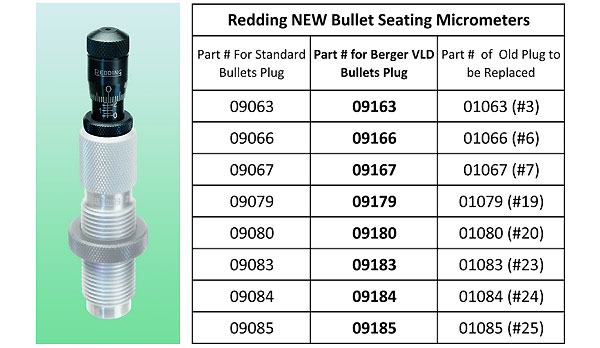
Well folks, the new Redding Micrometer Seating Stems for standard Redding seating dies are finally shipping. Robin Sharpless, Redding’s Executive VP, confirmed that “these Seating Stems started shipping this month, by the hundreds. MidwayUSA, Grafs, Midsouth — all the major vendors are getting inventory.” We confirmed that MidwayUSA now has, in stock, the Micrometer Seating Stems for .204 Ruger, .223 Rem, 22 PPC, 22-250 Rem, .243 Win, .308 Win, .284 Win, .30-06, and .338 Lapua Magnum, plus many other calibers. (One model Seating Stem can often work for multiple cartridge types of the same caliber.) MidwayUSA is charging $42.99 for both the regular and VLD-style seater stems.
Micrometer Seating Stems Retro-Fit to Redding’s Standard Seating Dies
The big advantage of these new Seating Stems is that you can get the additional control and precision of a micrometer top by simply upgrading your existing dies at about half the cost of a new, complete Competition Seater Die. NOTE: the Seating Stem assemblies are a component of the bullet seating die. These are not the dies themselves. It is the top portion of the die that contains the plunger, which pushes the bullet into the case. The micrometer is graduated in increments of 0.001″ to assure precise seating depth control. The Seating Stems feature a dead stop on the threads allowing full repeatability even if changed from one die to another. NOTE: These Micrometer seating stems are direct replacements for the original stems. To comfirm die compatibility,the stem numbers match the numbers stamped on the tops of the original seat plug which was shipped with your standard seating dies.
The new Redding Micro Precision Seating Stems are available for both standard bullet shapes as well as VLD Bullets. These allow the user to accurately seat the longer-nosed VLD-style projectiles.
If you want to get started with turning case necks, check out our article on Neck Turning Basics, authored by German Salazar. As German explains, one of the keys to achieving a smooth, consistent cut on your case-necks is to use quality lube and lubricate both the inside of the case necks and the neck-turning mandrel. German uses Imperial Die Wax, the old standby. This works very well, as German demonstrates, but we know that many reloaders prefer to use a liquid lube, as they find that it is easier to apply and remove.
Dozens of different liquid neck-turning lubes have been used successfully, including blends of Mobil 1 motor oil and STP, as well as various “secret recipes”. This Editor’s preferred lube for “skim” neck-turning, where only a single light pass is required, is Prolix Xtra-T lube. This is a thick, blue-colored lubricant that contains a bit of paraffin. It is VERY slippery, yet because of the paraffin it stays in place on the mandrel (arbor). It comes in a 1.25 oz. plastic bottle with a handy extended “needle-nose” applicator tip. The long-nosed tip makes it easy to apply lube inside a case neck, or to very precisely add a small drop right ahead of the cutter tip on the neck-turning tool. Xtra-T lube is also a good general purpose lubricant that nicely fills the gap between a grease and a typical oil, and it works well on pistols too. In consistency, Xtra-T lube is similar to molasses. It flows like a thick oil, but it has good adhesion because of the paraffin component in the blend.
I’m not suggesting Xtra-T is the ultimate “miracle” neck-turning lube. There are many other good options. But Xtra-T applies easily, stands up to heat, stays where you put it, and works great as a general-purpose lube as well. You’ll find Prolix Xtra-T lube in many shooting supply stores or you can order directly from www.ProlixLubricant.com. The small bottle with applicator tip costs $6.99.
Dispelling Some 6mm BRX Myths, by Robert Whitley
I recently had an interesting and fact-filled conversation with Bob Crone (the inventor of the 6mm BRX) about his BRX. Bob actually called me because he was concerned that there are a lot of myths and about his 6mm BRX and he wanted to “set the record straight” on a few things. Here’s my summary of some topics we discussed:
Myth One:Bob made his 6mm BRX chamber by running a 6mm BR reamer in too deep.
Truth: There is no truth to Myth One. Bob said he specifically designed the BRX reamer and had it made with the head space he specified and a neck length appropriate for his newly designed 6mm BRX wildcat cartridge.
Myth Two:In the course of making up his 6mm BRX, Bob had a version with a .120″ longer head space than a 6mm BR Norma.
Truth: Bob was clear that his original design for the 6mm BRX always had a .100″ longer head space than a 6mm BR and that he never deviated from that. Right after Bob started working with his 6mm BRX, Bill Shehane came forward with a 6mm BRX version he made up that had a .120″ longer head space, and thus the confusion started. In truth, the original 6mm BRX always was (and still is) a chambering with a head space .100″ longer than a 6mm BR Norma.
Myth Three:The BRX was originally set up for 105-107gr bullets.
Truth: Bob said he set up his original reamer with a zero freebore and he has his gunsmith use a throater to throat whatever chamber was being made to where he wanted a particular bullet to touch the lands. Bob said he originally started with a 1:10″ twist barrel and shot a bunch of the 95gr VLDs and also 87gr bullets. Later he used an 8.5″ twist barrel for the heavier bullets.
Myth Four:The original BRX was set up also for use with Remington BR Brass.
Truth: Bob said he always used Lapua brass. He originally was an avid reader of Precision Shooting magazine and saw that the .262″ neck-turn neck was working real well with the 6 PPC and 6mm BR bench rest shooters and he decided to try to go with something that was already working well for 6mm shooters. He says his original reamer had a .262″ neck, but he also has a .272″ “no-neck-turn” version that he used on some of his rifles. He said the Lapua brass was so good and consistent, that for some rifles he just “didn’t want to mess with it” so he went with the “no-neck-turn” .272″ neck too.
Myth Five:The “false shoulder” method was used to make brass.
Truth: Bob said he never used the “false shoulder” method to make 6mm BRX brass, he just loaded 6mm BR brass with a bullet well into the lands of the BRX chamber and fire-formed brass that way. He noted that the accuracy with some of the fire-forming rounds was “outrageous” (i.e. outrageously good that is), so much so, they were shot in matches sometimes.
Myth Six:The 6mm BRX has a blown-out or straightened out body.
Truth: Bob said he kept the basic body taper of the 6mm BR cartridge. He wanted the cartridge to be an easy and inexpensive (but high performance) 6mm wildcat, and the original design was (and still is) set up to use readily available 6mm BR dies (up off the shell holder about .100″ from the normal position).
Author’s note: It was a most enjoyable experience to talk to Bob Crone. He is not only still passionate about his 6mm BRX, but he has a commanding knowledge of it as well.
Reamer Print provided by AR-X Enterprises LLC, www.6mmAR.com.
RCBS has a launched a new website, www.ReloaderHub.com, an advanced online community dedicated to reloading. The website is designed as a social hub where readers can exchange load data and recipes, engage in forum discussions, and share outdoor- and shooting-related photos and videos. RCBS will also run regular contests and promotions on the site. Currently you can enter to win an RCBS Reloading Starter Kit, valued at $364.95 MSRP. You can use all site features at no charge — ReloaderHub.com site membership is free.
ReloaderHub.com features a handy Reloading Calculator that lets you quickly figure out the cost of your ammo, based on the price of your components and anticipated number of reloads on your brass. You’ll find dedicated photo and video archives, where members can post their own “home movies” and images. To stimulate file uploading and forum participation, the site also features a point system. The more content you upload, the more points you earn towards virtual badges (points have no retail value at this time).
COMMENTARY: Clearly RCBS put considerable time and effort into ReloaderHub.com. Generally speaking, it has a nice look and feel, and the photo archive area is easy to access. However, we think the site could benefit from some design changes.
First the Message Board area doesn’t use standard Forum Formatting. The layout of the primary Message Board topics page is poorly laid out, requiring too much scrolling. Then it gets worse once you get inside a particular Message Board Category, such as “Hunting Report”. There’s too much vertical space between thread titles, and once you manage to drill down to an actual thread, the displayed font is small and somewhat hard to read.
This leads to the site’s second major problem. ReloaderHub.com is supposed to be a place where users share load recipes. This, apparently, is to be done through the Message Board. But we predict people will have trouble placing logically-related topics in the Message Board, so the load recipe postings will soon become a mish-mash. RCBS should have created a dedicated area for load recipes with a clear, consistent formatting for data entry. RCBS could have provided pull-down menus for cartridge type and powder, with supplementary fields for charge weight, primer, OAL etc. That would organize the data logically so that user recipes could become part of a searchable database with consistent entries among all calibers. The way the site’s Message Board is currently organized, we think most visitors will struggle to find and sort through the load data entries.


 Hornady Reloading Handbook $10.00 with Bullet Purchase
 SUMMARY: This review gives high marks to GemPro 250 scale from


 Scale Calibrates Rapidly
 REAL WORLD TESTING
 The GemPro 250 is small, compact, portable and able to deliver repeatable accuracy to 2/100ths of a grain, time after time. That is all that one can ask of any scale. There is one last important thing to mention. The GemPro 250’s express warranty is LIFETIME (for domestic buyers) or 30 years for International Customers. A lifetime warranty is unheard of in the electronics business. I guess the people at My Weigh know what they have and are willing to stand behind it. If it should ever need servicing the My Weigh service center located in Phoenix, AZ will repair your scale and have it back to you in two business days.

 If you read our
  DJs Brass Offers Annealing, Cleaning, and Neck-Turning

 If you want to get started with turning case necks, check out our article on
  Dispelling Some 6mm BRX Myths, by
  Truth: Bob was clear that his original design for the 6mm BRX always had a .100″ longer head space than a 6mm BR and that he never deviated from that. Right after Bob started working with his 6mm BRX, Bill Shehane came forward with a 6mm BRX version he made up that had a .120″ longer head space, and thus the confusion started. In truth, the original 6mm BRX always was (and still is) a chambering with a head space .100″ longer than a 6mm BR Norma.
 Myth Five: The “false shoulder” method was used to make brass.


