Benchrest Hall of Famer Speedy Gonzalez has prepared a comprehensive Guide to Benchrest Competition. It covers all aspects of the game: gear selection (hardware), reloading methods and tools, plus shooting skills and strategies. All of this is available on the web for free, thanks to Speedy and the Swedish Benchrest Shooters Association (SBRSA).
Speedy’s article is a gold-mine of info on shooting components and specialized reloading tools. It is also richly illustrated with high-quality photos showing gun components and reloading gear. Many of the photos show tools that have been sectioned so you can view the internal components.
Speedy also covers bullet design, and load tuning. There are thoughtful sections on Time Management and Target Management that will benefit all competitive shooters, no matter what their discipline.
Alliant is introducing a new extruded powder, AR-Comp. AR-Comp is an advanced re-formulation of Reloder 15, a double-base Bofors powder. There are changes to internal and external chemistry to provide much better pressure/velocity stability across a wide range of temperatures. The main difference between AR-Comp and Reloder 15, is the AR-Comp has a slightly faster burn rate, and AR-Comp is much LESS Sensitive to temperature changes. AR-Comp is a small-kernel, double-base extruded powder like Reloder 15, so it will continue to meter just like Reloder 15. The load density should be the same as Reloder 15.
AR-Comp should be at Grafs.com in a Couple Weeks
Here’s the good news — Alliant will start shipping AR-Comp to Grafs.com later this week. Dick Quesenberry, Alliant Powder Product Manager, told us: “I just received the AR-Comp packaging labels and we hope to send off the first shipments to Grafs this week.” With transit time, expect the powder to be available from Grafs.com by the second week of June. You can go ahead and place advance orders for 1-lb and 8-lb containers of AR-Comp on the Grafs.com website.
AR-Comp Offers Uniform Velocities over a Wide Temp Range
Tests were done with .223 Rem and .308 Win ammo, loaded with AR-Comp and maintained at temps from -20° F to +160° F in a controlled test center. The ammo itself was heated or cooled to targeted temps before testing. Across that entire range of temperature, -20° F to +160° F, the ammo loaded with AR-Comp showed a variation of only 20 fps in muzzle velocity. The primary bullet type tested was a 77gr .224 bullet and the secondary was a 175gr .308 bullet.
Burn Rate Like Varget
Though this is a reformulation of Reloder 15, the burn rate of AR-Comp is slightly faster than Reloder 15. Alliant told us: “Reloder 15 is slightly slower, in burn rate, than Varget. The new AR-Comp, with the enhancements, ended up slightly faster than Reloder 15, so it is now very close to Varget in burn rate”. This is the result of the “tuning” of the powder to be much less temp-sensitive.
AR-Comp First in Series of New Alliant Temp-Stable Powders
AR-Comp will be the first in a series of “new generation” temp-stable powders from Alliant. Quesenberry noted: “Our goal was to provide a powder that offers stable pressures in all temperatures. Shooters want to be able to stay with the same load in winter and in summer, in cold or in hot conditions.” Quesenberry added: “We’ve been working on this quite a while. AR-Comp is the first example and we hope to extend this to other rifle powders. It’s a tough job. You have to balance the performance carefully. We worked very hard to do just that and we think shooters will be impressed with the results.”
Reloder 15 Will Stay in Production
Fans of Alliant’s Reloder 15 don’t need to worry. Alliant will keep Reloder 15 in production. “We don’t drop powder lines”, said Quesenberry.
On May 4th we noted that Robert Whitley has commissioned a special run of 6mm BRX dies. We’ve just learned that the dies have arrived — and, according to Whitley, they work great.
Robert offers a Redding Type ‘S’ full-length sizing die that will size the whole case, with bushing control over the neck. Redding 6mm BRX micrometer-top Comp Seaters will also be available. The Type ‘S’ FL Sizer costs $89.95, while a package with Comp Seater costs $199.95. This is a very limited run of 6BRX dies, and Redding is not currently selling them through other sources. If you want a Redding 6BRX Type ‘S’ FL sizer or Comp Seater die, order soon:
The 6mmBRX (6BRX) is an outstanding cartridge that has set world records and harvested many trophies. Just last week Peter White used his 6BRX to win the NBRSA 600-yard Nationals convincingly. Peter loves his 6BRX, but he has one gripe — he must use two different dies to size his cases because a standard 6mmBR die won’t reach down far enough. White uses a .308 Win or .243 Win die to size the bottom of his 6BRX case then finishes up with his 6mmBR FL bushing die.
Redding 6BRX Dies Available Soon
Now 6BRX shooters have a single-step solution — Redding 6BRX dies. Robert Whitley has commissioned a special run of Redding 6BRX dies. Robert will offer a Redding Type ‘S’ full-length sizing die that will size the whole case, with bushing control over the neck. What’s more, Redding 6BRX micrometer-top Comp Seaters will also be available. Robert, who runs 6mmAR.com, expects these special-order Redding 6BRX dies to arrive within a few weeks. This is a very limited run of 6BRX dies, and Redding is not currently selling them through other sources. So if you want a Redding 6BRX Type ‘S’ FL sizer or Comp Seater die, you’d better contact Robert soon. Order through:
6BRX Cartridge Basics
The 6BRX is a modified version of the 6mmBR Norma case. The 6BRX has the shoulder blown forward about 0.100″, but it retains the same 30° shoulder angle of the parent case, and the same sidewall angle. You can use “normal” 6mmBR dies for the 6BRX — that’s one of its appealing factors — but the 6mmBR full-length sizer will miss part of the bottom of the case down near the web.
To compensate for this, many 6BRX shooters full-length size their brass first with a .308 Win or .243 Win FL Die, and then switch to a 6BR die. That system works, but it creates unnecessary steps. With a dedicated 6BRX sizing die, you can size the whole case in one pass, so you don’t need to use two dies. The $89.95 Redding Type ‘S’ Full-length bushing die sold by Whitley is one-die sizing solution that works. Whitley will also offer a package of the 6BRX Type ‘S’ FL sizing die plus a Redding Comp Seater for $199.95. That gives you a complete set of dies for your 6BRX wildcat.
The PMA Neck Turning Tool, review by Danny Reever PMA Tool was founded by Matt Harris and Pat Reagin, two former employees of Fred Sinclair. They both worked their way through college working for and designing tools for Sinclair Int’l. They now have branched out on their own and are offering some unique tools for the reloader.
I, like many other shooters out there, would sooner take a beating than change the settings of my neck turner. Many shooters even go out and buy a separate neck turner for every caliber — just so they don’t have to adjust the settings. Most of you know what it’s like, you ruin half dozen cases (or more) getting your neck turner just right, and if you change it the chances of getting it back to where it was are practically nil. Let me be the first to tell you those days are over! Like many of you, I first saw the PMA Neck Turning Tool in an advertisement on this website’s home page. It’s hard to miss, blue anodized finish with the large PMA logo on the body.
PMA Tool Moves the Mandrel, Not the Cutter Tip From PMA’s website I learned that this turner does NOT use a coarse or fine drive screw to move the cutter towards or away from the mandrel. Nor does the PMA tool move the mandrel on an eccentric (another method of cutting depth control). The PMA tool does something very different. PMA’s Model A Neck Turning Tool simply adjusts by moving the mandrel toward or away from the stationary cutter with an 80 TPI drive screw with 60 indicating marks. Each mark moves the mandrel .0002″ (two ten-thousandths). I found, if you stop between the marks, .0001″ isn’t out of the question. It’s such a smart arrangement, I wondered “why didn’t anyone think of that before?”
Use PMA, 21st Century, or Sinclair Int’l Mandrels
My interest now piqued, I contacted Pat Reagin for one of the PMA tools. Pat suggested that I also use PMA’s stainless expander and turning mandrels since they have put a lot of effort to get them exactly right. I might mention that the 3/8 shank stainless or carbide mandrels from 21st Century or Sinclair Int’l will work also. PMA does have carbide turning mandrels in the works — a nice upgrade for those of you who turn lots of cases at one sitting. I personally didn’t encounter any unnecessary heat build-up with the stainless mandrels only turning 10-20 cases at a time. Considering that carbide mandrels run about $40.00 compared to $7.95 for stainless, it’s nice to save a couple of bucks when you can.
Cut-Depth Settings Can Be Dialed “Dead-On” (Even after Caliber Changes)
Upon receiving the PMA tool I immediately went to my reloading room to set it up for turning some culled .308 Lapua brass — to clean it up 75% for a no-turn chamber. I followed the directions included with the turner and it was a snap to set up. After turning a few of the .308s I made note of my setting and changed both mandrels to 6MM to turn some Lapua 6BR brass for my .269″-neck chamber. Again the change went smooth as silk and I was turning the 6BRs in no time for my preferred loaded neck diameter of .26730″. I then decided to take the leap of faith and change back to turning the .308s after making note of the 6BR setting. That worked, so I then again switched back again to the 6BR setting — again with success. I have gone back and forth (between calibers) numerous times in the last couple of weeks. Each time I easily returned to my caliber-specific settings and I did not ruin a single case in the process. Without sounding like I’m gushing here I must say this is the nicest neck turner that I have ever used. The adjustments are so easy and repeatable “Even a cave man can do it”!
If, like me, you absolutely hate setting up neck turners, for fear of losing your settings, you owe it to yourself to give the PMA Model A neck turner a try. I think you’ll be impressed. The PMA Neck Turning Tool costs $95.95, complete with one carbide cutter with your choice of 30° or 40° shoulder angle.
Disclosure: Danny Reever is a Forum Member. He received no “freebies” or compensation. PMA Tools advertises on AccurateShooter.com.
Selection from BARNES BULLETS’ Tips, Tools, and Techniques by Ty Herring, Barnes Consumer Service
The purpose of this month’s Tip from Barnes is to make you aware of valid pressure signs in most centerfire rifle cartridges so you can keep yourself out of hot water. Following the Barnes Manual should do exactly that. Below are photos of cartridges that definitely had too much pressure. Fortunately [they] were fired in controlled circumstances and no one was injured. But this shows what can happen if you are not careful….
High-Tech Pressure Testing Equipment
At Barnes Bullets, we use some of the best equipment when we develop load data for you. Ours is state-of-the-art with a specialized “conformal” pressure system. This set-up uses a high-tech SAAMI-spec pressure barrel with a hole bored into the chamber area and a piezoelectric transducer is installed. As the pressure peaks under firing, the gauge that is specially calibrated reads the pressure and sends a signal to the control box where a technician can see the results.
For many years hand loaders have used the old fashioned trial and error method, hoping that by adding another grain of powder you don’t blow yourself up. Certain “guidelines” have been the standard — such as when the primer gets flat, or when the bolt locks up — you should stop and reduce the charge. These methods have worked for many, but some of them are more myth than reality. I’d like to go over some of these common pressure signs to help you avoid the pitfalls.
Pressure Signs That May Be Unreliable or Deceptive
When I first started hand loading centerfire rifle cartridges, I was told that when the primer flattens I should back the load down. This is one of those semi-myths. Some primers will flatten under high pressure and others will not. I’ve had some Remington primers that have blown right out of the case without ever showing any sign of flattening and on the other hand I’ve had Winchester primers that flatten with only a starting charge. I believe this to be a function of the thickness and hardness of the primer cup. The other myth that seems common is primer “cratering”. Cratering of the primer can be caused by a hot load. But it can also be a result of a slightly large firing pin hole in the bolt or a firing pin that is a bit too long or excessive headspace. Split or cracked cases are another area where it’s assumed that high pressure is the cause. Again this is only myth. Although it can be a result of high pressure — split or cracked cases are more likely caused due to a flaw in the case, improper head space or just simply from being sized and fired repetitively.
[Editor’s Note: Flattened Primers, Primer Cratering, and Cracked Cases CAN DEFINITELY BE CAUSED by excessive pressure. Accordingly, you SHOULD be careful when you see any of these conditions. If you see very flat primers or deep cratering be alerted that you may have exceeded safe pressures. Ty Herring simply makes the point that these telltale pressure signs may sometimes occur even when pressure levels are “normal” or moderate — due to the presence of other problems. Hence these indicators may be misleading. Nonetheless — all these signs (flattened primers, cratered primers, split cases) CAN be valid warnings. If you see these conditions, exercise caution because you may, in fact, have excessively hot loads.]
Valid Pressure Signs You Should Understand
So what are valid pressure signs? I’d say the most common and repeatable pressure sign that one can visually see is the “ejector groove mark”. It shows itself on the bottom of the case [between the edge of the rim and] the primer. It is caused when the pressures within the chamber force the case against the bolt face. On most bolt faces there is a round spring loaded ejector pin. On others there is a rectangular groove to eject the spent round. Under very high pressure the brass case will flow into this groove thereby causing the “ejector groove mark”. If and when you see this mark, it is a sure sign of high pressure. Some of the new high pressure cartridges such as the WSMs are made to run at these higher pressures and some factory loads will manifest the ejector groove mark even though they are within their pressure specification.
Older-Generation Cartridges
Some cartridges have very low maximum pressure ratings such as the 45-70, 30-30, 416 Rigby along with many others that will never show an ejector groove mark. Or should I say, they should never show one. By the time you reach that high of pressure in one of these rifles, it is likely the gun will be in pieces and the bolt may become part of you.
Sticky Bolt Lift and Difficult Extraction
Another common and very real high pressure sign is heavy or sticky bolt lift or extraction. This is caused due to the brass flowing and swelling in the chamber under tremendous pressure. However heavy bolt lift is not always a sign of high pressure. It may be caused by a variety of other issues. Knowing your gun and how it usually extracts a cartridge will be a clue as to whether or not you are actually getting high pressure.
This article appears courtesy Barnes Bullets. The article originally appear in the June 2011 Barnes Bullet-N Newsletter. Story tip from Edlongrange.
Forster Products has released a comprehensive product catalog in digital format. This FREE 36-page PDF (Adobe Acrobat) file includes all of Forster’s most popular products, such as the Ultra Micrometer BR Seater, Forster Case Trimmer, and Co-Ax® Press.
In addition, the catalog includes the many less-well-known but handy specialty tools crafted by Forster. These include: 3-in-1 Case Mouth Cutter, Power Case Trimmer (for drill presses), Oversize Expander Balls, Co-Ax® Primer Seater, Inside Neck Reamers, Collet Bullet Puller, Stuck Case Remover, Swiv-O-Ling Vise, Magnetized Headspace Gauge Removal Tool, Gunsmith Screwdivers, and much more. CLICK HERE to Download Catalog.
As shown above, all products are clearly illustrated with photos or diagrams, and inventory numbers are provided so you get exactly the right part when ordering. If you’re a serious reloader, you should download this catalog and browse through Forster’s full product line. We guarantee you’ll find something new and interesting — did you know, for example, that Forster makes a universal sight-mounting fixture for gunsmiths (photo below)?
Forum Member Tom Sziler(aka Tomekeuro85) produces very nice CNC-milled aluminum loading and sorting blocks that can be customized with your name or catridge designation. These start at just $15 for a 50-bullet sorting tray or 25-round range block. The original 50-round loading blocks cost $25 for most cartridges (smaller than .338 Lapua), $28 for .338 Lapua, and $30 for big stuff like the 50 BMG.
This bullet sorting tray is useful if you sort by base to ogive length or bullet weight.
Trays Are Made to Precise Tolerances and Fitted with Rubber Pads
All trays and blocks have rubber pads on the bottom for grip. Holes are all milled deep, to precise tolerances to prevent rattling, but rounds still fit with sufficient clearance. Clearance is provided on the bottom of each hole to avoid potential primer contact and to make room for debris. You want something customized? No problem. Tom says: “Custom variations of any of these items are available. Just let me know what you’re looking for.”
These blocks are definitely high-quality. Forum member PGG reports: “You can count on top notch work and materials guys. I bought a boat load of them for Christmas gifts [and] they were a huge hit. Super items, super service, great value.” Forum member WoolenMammoth agrees: “[I] ordered a few blocks recently and they far exceeded my expectation. Really nice work at an absurdly competitive price.” For more info, or to place an order, view this Shooters’ Forum Thread, or email Tom.Sziler[at]gmail.com.
German Salazar has posted an informative article about concentricity-checking tools on his Rifleman’s Journal Blog. In that article, German provides a detailed review of the impressive new Bruno Concentricity Checker which features a high-grade dial indicator and an innovative system for holding both loaded cartridges and empty brass in place during the measurement process. German gives the Bruno tool high marks and it is now his favored concentricity gauge, replacing on older Sinclair tool (also reviewed in the article).
German writes: “When measuring a seated bullet, the Bruno [tool] is simple and intuitive in use: adjust the length of the tip holder, set up the indicator to bear on the ogive and get to it. I usually slip a Sinclair hex nut comparator over a bullet to make a faint mark right at the ogive to help me in determining where to set the indicator. I then set the indicator tip about 0.010″ behind the mark so that I am definitely on the bearing surface even if some of the bullets have a bit of variance. It’s a handy way to get set up consistently from one session to another.”
German continues: “Reading an empty case requires a little more effort, but not much…. Once the case mouth is smooth, the readings are in line with those of the Sinclair tool, although easier to read to a fine level of precision due to the finer gradations on the indicator and its horizontal mounting. The Bruno tool has become my principal tool for checking the concentricity resulting from different die setups and for comparing the results of one loading process to another. I simply have more confidence in my ability to get an accurate reading from it. After many years of service, I’ve decided to retire the old Sinclair and make the Bruno tool my primary concentricity tool. It is simply a better made, easier-to-use, more accurate tool and those are the qualities I value in any tool.”
Here’s important news for handloaders. Alliant Powder has introduced a new medium-burn-rate powder: AR-Comp™. This new powder was developed specifically for AR-style rifles. Alliant says that AR-Comp powder is “ideally suited for heavy .223 and .308 match bullets”. We presume, from that description, that the powder will have a burn rate similar to Varget. The AR-Comp powder, produced in Sweden by Bofors Nobel, is an enhanced temp-insensitive reformulation of Reloder 15. The burn rate is slightly faster than Reloder 15, according to Alliant.
Alliant Claims AR-Comp is NOT Temp-Sensitive
We have limited information about AR-Comp, and we have not yet been supplied with a test sample. We have confirmed is a double-base extruded powder, and is an upgraded version of the Reloder 15 formulation. Alliant claims the powder meters very well and delivers “consistent pressures and velocities across temperature extremes”. This new powder is supposed to be very uniform from lot to lot. That would be great — if it is true — but only time will tell.
We will try to get a sample of AR-Comp soon and test it in both .223 Rem and .308 Win rifles. We suspect, if AR-Comp suits both the .223 Rem and .308 Win, it should work well in the 6mmBR and 6.5×47 Lapua cartridges as well. Stay tuned — we hope to have more info next week. AR-Comp should be hitting the market in June or July, 2011, provided DOT Classification goes smoothly. It will be offered in both one-pound (#150664) and 8-lb (#150665) containers.


 Alliant is introducing a new extruded powder, AR-Comp. AR-Comp is an advanced re-formulation of Reloder 15, a double-base Bofors powder. There are changes to internal and external chemistry to provide much better pressure/velocity stability across a wide range of temperatures. The main difference between AR-Comp and Reloder 15, is the AR-Comp has a slightly faster burn rate, and AR-Comp is much LESS Sensitive to temperature changes. AR-Comp is a small-kernel, double-base extruded powder like Reloder 15, so it will continue to meter just like Reloder 15. The load density should be the same as Reloder 15.
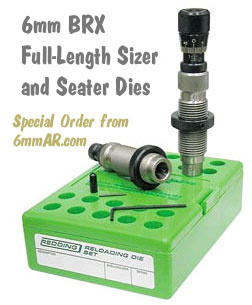 On May 4th we noted that Robert Whitley has commissioned a special run of
 Redding 6BRX Dies Available Soon
 6BRX Cartridge Basics
 From PMA’s website I learned that this turner does NOT use a coarse or fine drive screw to move the cutter towards or away from the mandrel. Nor does the PMA tool move the mandrel on an eccentric (another method of cutting depth control). The PMA tool does something very different. PMA’s Model A Neck Turning Tool simply adjusts by moving the mandrel toward or away from the stationary cutter with an 80 TPI drive screw with 60 indicating marks. Each mark moves the mandrel .0002″ (two ten-thousandths). I found, if you stop between the marks, .0001″ isn’t out of the question. It’s such a smart arrangement, I wondered “why didn’t anyone think of that before?”

 High-Tech Pressure Testing Equipment


