|
|
May 21st, 2008
Regular readers of the Daily Bulletin know we’ve recommended Ballistol as a near-ideal case lube for basic full-length sizing. It’s extremely slick, and goes on very thin when applied with the aerosol version. Unlike many other case lubes, you won’t need to use a solvent or tumble the brass afterwards to remove. All you need is a very thin layer of Ballistol, and this easily wipes off with a paper towel. (For case-forming and neck expansion, we recommend a thicker lube such as Imperial Die Wax or Mobil 1.)

Unfortunately, many folks have told us that they can’t find Ballistol at local shops, or they want to combine it with a reloading supply order to cut down on shipping costs. Here are sources for Ballistol, including Brownell’s and MidwayUSA. For convenience, we recommend the aerosol version, but the liquid version can be diluted and used also.
Brownell’s
1.5 oz. Aerosol $4.43 982-000-001
6.0 oz. Aerosol $6.82 982-000-002
MidwayUSA
1.5 oz. Aerosol $3.99 727130
6.0 oz. Aerosol $6.49 831231
BULK ORDER SOURCES:
Ballistol USA
PACKAGE 1: BALLISTOL-LUBE
Two – 1.5oz. aerosols
Three – 6 oz. aerosols
$ 24.00 + 9.00 s&h = $ 33.00
FireHawktech.com
Basic Aerosol Pack
Two – 1.5 oz. Aerosol Can
One – 6 oz. Aerosol Can
Total $20.95 incl. shipping
Aerosol 5-pak
One – 1.5 oz. Aerosol Can
Four – 6 oz. Aerosol Can
Total $39.95 incl. Shipping
Ballistol Frequently Asked Questions
Q: Is the “Ballistol Lube” with the white label the same as the Ballistol “Sportsman’s Oil” with the green label.
A: Yes. Same product, just different labels. But remember there are both aerosol and liquid versions. The aerosol comes out very thin — like water. The liquid is thick — like motor oil.

Q: The liquid version is more economical by weight, but can I dilute it down?
A: Yes, Ballistol liquid can be diluted with water, up to a 10:1 ratio and it will remain slick. We recommend about a 6:1 ratio for use as a general case cleaner and lubricant — but you should experiment yourself.
Q: Will Ballistol get gummy over time, like other lubricants?
A: Nope. Here’s an interesting story. In 1952, a bottle with Ballistol, with the cap only loosely attached, was found in the attic of a deceased German hunter. The purchase receipt was found proving that the Ballistol had sitting for over 30 years. Yet, it still had the consistency of freshly produced Ballistol.
Q: If Ballistol oil can be diluted with water, does that mean it will promote corrosion?
A: No. Ballistol emulsifies in water. The resulting product will displace H20 like WD40, and then leaves a thin, protective oil. Ballistol is also mildly alkaline (pH between 8.5 and 9.5), so it neutralizes mild acidic residues such as hand sweat or residues from black powder (which are acidic).
Q: What’s Ballistol made from — it smells funny?
A: Ballistol is made from medical grade mineral oil, alkaline salts of oleic acid, several alcohols, Benzyl Acetate and oil from vegetable seeds. The smell comes from medicinal Anethole oil, which is derived from the Anise plant. Ballistol is biodegradable and non-toxic. CLICK HERE for the Material Data Safety Sheet
For more information on Ballistol, contact Ballistol USA, (800) 253 2460, (252) 261 0408 (fax).
April 30th, 2008
The 6mm Dasher is based on the 6mm BR cartridge with the shoulder blown forward about 0.100″ and “improved” to 40°. Case capacity is raised to about 41.0 grains. This allows the Dasher to drive 105-108gr bullets comfortably at 2970-3000 fps without over-stressing the brass.

Robert Hoppe is one of the top 600-yard shooters in the country. Last fall, shooting a 6 Dasher, Robert nailed a 0.5823″, 5-shot group. At the time it was the smallest group ever shot in 600-yard registered benchrest competition. Just last weekend, John Lewis shot even smaller with an IBS Heavy Gun, but Robert’s 0.5823″ still remains the NBRSA 600-yard record, and the smallest group ever shot at 600 by a 17-lb class rifle. Robert has been very successful in the 600-yard game, and he finished 5th recently at the NBRSA 600-yard competition. He knows how to wring the best accuracy out of the 6mm Dasher cartridge. Here Robert offers some tips on load development and tuning for the 6mm Dasher.

CLICK HERE to watch HOPPE VIDEO
April 29th, 2008
Forum member Ron Tilley finished fourth overall at the recent NBRSA 600-Yard Nationals. This was an impressive performance for a relative newcomer to the 600-yard game without “local knowledge” of the Sacramento range. The top 3 finishers, Jerry Tierney, Peter White, and Craig St. Claire, all have extensive experience shooting at Sacramento.

While many of the top shooters were using a 6mm in Light Gun (such as a 6 Dasher or 6-6.5×47), Ron campaigned a 260 Ackley Improved. This is based on a 260 Rem case, with the shoulder blown forward to 40 degrees. Improving the 260 Rem case adds just enough extra capacity to get the 140gr-class bullets into the 2900+ fps velocity window where they seem to perform best.
Ron starts with Lapua 243 cases, necked up to 6.5 mm. He was shooting 140gr Berger VLD bullets, pushed by Hodgdon H4831sc powder and Russian primers. Ron says this combination has been “very accurate right out of the gate.” Ron’s 2920 fps load delivers 5-shot groups in the high teens and low twos, with very low ES and SD. In the video interview below, Ron explains the merits of the 260 AI cartridge, and offers tips on case prep and loading for accuracy.

CLICK HERE to WATCH TILLEY VIDEO
Ron was shooting an eye-catching rifle. It featured a carbon fiber and wood Terry Leonard stock, BAT Action, and Nightforce scope. With all-premium components, Terry’s 260AI is a beautiful rig that shoots as good as it looks.


April 24th, 2008
Forum member Skeeter has put together a new 6mm Dasher falling block varmint rifle. The Dasher case is based on the 6mm BR Norma cartridge with the shoulder blown forward about 0.100″ and out to 40°. This gives the Dasher roughly 3.5 grains added capacity compared to the standard 6BR.
Skeeter needed to form 300 cases for an upcoming varmint holiday. Skeeter decided to fire-form his brass without bullets. This method avoids barrel wear* and saves on components. There are various ways to do this, but Skeeter chose a method using pistol/shotgun powder, some tissue to hold the powder in place, Cream of Wheat filled to within an 1/8″ of top of the neck, and a “plug” of tissue paper to hold it all in place. Shown below are cases filled with a pistol/shotgun powder charge topped with Cream of Wheat and then a tissue paper plug.


To ensure the case headspaced firmly in his Dasher chamber, Skeeter created a “false shoulder” where the new neck-shoulder junction would be after fire-forming. After chamfering his case mouths, Skeeter necked up all his cases with a 0.257″ mandrel (one caliber oversized). Then he used a bushing neck-sizing die to bring the top half of the neck back down to 0.267″ to fit his 0.269″ chamber. The photo below shows how the false shoulder is created.

After creating the false shoulder, Skeeter chambered the cases in his rifle to ensure he could close the bolt and that he had a good “crush fit” on the false shoulder, ensuring proper headspace. All went well.

The next step was determining the optimal load of pistol powder. Among a variety of powders available, Skeeter chose Hodgdon Titewad as it is relatively inexpensive and burns clean. The goal was to find just the right amount of Titewad that would blow the shoulder forward sufficiently. Skeeter wanted to minimize the amount of powder used and work at a pressure that was safe for his falling block action.
Working incrementally, Skeeter started at 5.0 grains of Titewad, working up in 0.5 grain increments. As you can see, the 5.0 grain charge blew the shoulder forward, but left it a hemispherical shape. At about 7.0 grains of Titewad, the edge of the shoulder and case body was shaping up. Skeeter decided that 8.5 grains of Titewad was the “sweet spot”. He tried higher charges, but the shoulder didn’t really form up any better. It will take another firing or two, with a normal match load of rifle powder and a bullet seated, to really sharpen up the shoulders. Be sure to click on the “View Larger Image” link to get a good view of the cases.

The process proved to be a success. Skeeter now has hundreds of fire-formed Dasher cases and he hasn’t had to put one bullet through his nice, new match-grade barrel. The “bulletless” Cream of Wheat method allowed him to fire-form in a tight-necked barrel without neck-turning the brass first. The only step now remaining is to turn the newly Dasher-length necks down about .0025″ to fit his 0.269″ chamber. (To have no-turn necks he would need an 0.271″ or 0.272″ chamber).
Skeeter didn’t lose a single case: “As for the fire-forming loads, I had zero split cases and no signs of pressure in 325 cases fire-formed. Nor did I have any misfires or any that disbursed COW into the action of the firearm. So the COW method really worked out great for me and saved me a lot of money in powder and bullets.” To learn more about Skeeter’s fire-forming process, read this Dasher Fire-Forming Forum Thread.
*Skeeter did have a fire-forming barrel, but it was reamed with a .269 chamber like his 10-twist Krieger “good” barrel. If he fire-formed with bullets, he would have to turn all 300 necks to .267″ BEFORE fire-forming so that loaded rounds would fit in the chamber. Judging just how far to turn is problematic. There’s no need to turn the lower part of the neck that will eventually become shoulder–but how far down the neck to turn is the issue. By fire-forming without bullets now he only has to turn about half the original neck length, and he knows exactly how far to go.
April 20th, 2008
Readers often ask: “What priming tool should I use?” There is no simple, clear-cut answer. Different tools have different advantages and disadvantages. Many short-range benchresters like the Sinclair one-at-a-time priming tool. They believe this unit has the best “feel” for seating primers.
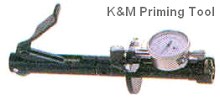 Others prefer the K&M tool, another “single-loader”, because it can be fitted with a seating depth gauge, for the ultimate in precision. On the other hand, one top shooter with a couple National Championships under his belt favors the modest $19.00 Lee Autoprime tool: “It’s simple, efficient and has served me well for years–I’m not convinced the fancy, expensive tools do a better job.” Others prefer the K&M tool, another “single-loader”, because it can be fitted with a seating depth gauge, for the ultimate in precision. On the other hand, one top shooter with a couple National Championships under his belt favors the modest $19.00 Lee Autoprime tool: “It’s simple, efficient and has served me well for years–I’m not convinced the fancy, expensive tools do a better job.”
This editor has tried all of these tools, and personally I favor the RCBS APS hand priming tool. It has two important advantages. Number one, primers are held in color-coded plastic strips so you never have to touch the primers. If you buy the pre-loaded strips, there is no chance of getting an upside-down primer, and you never have to fool with flipping primers in a tray. Second, the APS tool has a “universal” shell-holder. This employs spring-loaded jaws so it can fit any size cartridge, from a 17 Fireball to large magnums. The unit has a comfortable grip and plenty of leverage. Each time you seat a primer, the strip automatically advances.

Currently, only CCI primers can be purchased pre-loaded into strips. But there is an inexpensive tool that allows you to load Federal, Winchester, or Wolf primers into the strips. The strips come in a variety of colors (Red, White, Blue, Orange, Yellow, and Black), so you can sort your primers by color.

The RCBS APS hand primer is ideal when doing primer comparison testing. You can slide one strip of 25 primers in the tool, seat 5 or 10, then easily remove the strip with the remaining primers, and slide in a second strip with another primer type. You can slip the first strip back in a storage box and the primers remain ready to use.
As contained in the strips, primers can also be used in an RCBS 2000 progressive press, a bench-mounted priming unit, and a special device that fits into the top of a Rockchucker or similar press. I have loaded over 20,000 pistol rounds with an RCBS progressive press and I have had not a single flipped primer. Not one. The strip-priming system also makes it easy to switch from small to large primers on the progressive–this can literally be done in under 20 seconds.

The bench-mounted unit is ideal for priming large quantities of cases. The long handle provides plenty of leverage, and you can work fast, as the primers automatically feed through the system. When I load large quantities of varmint rounds, I use the bench-mounted APS system.
April 19th, 2008
Do you have a Wilson case trimmer but can’t afford the $84.00 to add the handy Micrometer upgrade (Sinclair Int’l item 05-4500)? Well Boyd Allen has come up with a clever use of a standard set of calipers that lets you set the cut length precisely within .001″. Just open the jaws of your caliper and put one jaw on the outboard end of the ring (with set screw) that holds the threaded length-adjusting rod. Set the other caliper jaw on the flat face at the end of the threaded rod that contacts the case rim. If you have a sample case set to the correct cut length, use that to set the position of the threaded rod. Then use your calipers to measure that length. This way you can repeat the cut length each time, or adjust the trimmed case precisely in .001″ increments.

If you change from one cartridge to another, just use your calipers to re-set the desired cut length. Alternatively, ReedG notes you can use the inside caliper jaws and measure directly from the end of the threaded rod to the cutter face. That’s a bit trickier, but it measures actual trim length.
April 17th, 2008
This past weekend, Mike Davis set a new 600-yard, IBS score record of 50-2X (0.941″), shooting a 6 BRX that he built himself. Mike nailed the record at the Piedmont Gun Club using Danzac-coated Berger 105gr VLD bullets pushed by 33.5 grains of Varget and CCI 450s. His rifle had a 26″, 1:8.4″-twist Brux barrel, chambered for a no-turn 6 BRX, and a BAT RB/LP/RE action. Congrats to Mike on some great shooting. If you want to see how it was done, here’s a video of Mike shooting 5 rounds at “match pace” with his 6 BRX.
CLICK HERE to WATCH VIDEO (5 Shots in 18 Seconds)


A previous IBS score record was set by Larry Isenhour, also at Piedmont. In August 2007, Isenhour shot a beautiful 50-3X target but it was just slightly larger in group size — 0.944″ as certified. Because group size, not X-count, is the tie-breaker among equal “perfect” 50 scores, Mike Davis just grabbed the record by a few thousandths of an inch.
Mike offers this report: “Saturday, April 12, 2008, was Piedmont Gun Club’s second match of the year. Conditions looked grim. There was lightning in the distance and we were surrounded by black clouds. When the first shot went down range the wind was blowing pretty good. As the day progressed the wind worsened, and was switching terribly. I could tell by the end of the Heavy Gun class that the faster I could get all shots down range the better. I really concentrated on my aiming point, and trying to remain smooth and fast for Light Gun. The first target I shot in Light Gun class was the record target, 50-2X with a .941″ group. The two “X” shots were right on top of each other (see target). I had also cleaned the gun prior to this group. The second target had four shots under 1″ and the fifth shot went straight right approximately 3.5″, making this group a 4″ — I knew I had gotten caught in one of the switching wind conditions. I repeated the same steps for the remaining two targets, and it paid off. I won the Light Gun class for group with a 3″ Aggregate in wind that toppled over the wind flags and blew away our Easy-Up tent.”

Gun Specifications
6BRX no turn neck .112″ free bore
BAT Model B RB/LP/RE 7.5″ round action, Jewell trigger
HV BRUX barrel 1 in 8.4″ twist at 26″ in length
Stock work and bedding by Mike Isenhour (cedar/curly maple/carbon fiber with weight system)
Leupold 45x Competition w/a 3x Gene Davis optical booster mounted with BAT rings
Farley front rest and a Protektor rear bag |

April 15th, 2008
Many of the most popular powders sold under the Hodgdon brand in the USA (including Varget and H4350) are made by ADI Ltd. in Australia. Some load manuals list ADI data, but not Hodgdon data, or vice-versa, so we’ve compiled this list of equivalent powders. If you can’t find a recommended load for a particular Hodgdon powder in your caliber, download the latest ADI Smokeless Powders Handloaders Guide, a 2.8 megabyte Acrobat file.
Here’s a list of ADI to Hodgdon Powder equivalents:
AS30N=Clays
AP50N = (No Hodgdon)
AS50N = International
AP70N = Universal
AP100 = (No Hodgdon)
AR2205 = H4227
AR2207 = H4198
AR2219 = H322
Bench Mark1 = (No Hodgdon)
Bench Mark2 = BenchMark |
AR2206 = (No Hodgdon)
AR2206H = H4895
AR2208 = Varget
AR2209 = H4350
AR2213 = (Discontinued)
AR2213SC = H4831
AR2217 = H1000
AR2225 = Retumbo
AR2218 = H50BMG |
April 9th, 2008
 On today’s episode of ShootingUSA, RCBS factory expert Allan Jernigan demonstrates safe, basic reloading techniques for pistol, rifle, and shotgun. You may be an expert rifle reloader, but specialized techniques can help you load more consistent pistol ammo, on both single-stage and progressive presses. And, of course, shotshell reloading is a different game altogether — you have more components to deal with, and up to three separate stages just for the crimp. In this show, Jernigan offers tips on optimizing accuracy and explains how to save money on components — so you can maintain your reloading output even as the costs of bullets, shot, primers and powder are on the rise. Jernigan demonstrates reloading methods using the RCBS RockChucker, RCBS 2000 Progressive, and RCBS Grand shotshell loader. Also in this episode, Wheelgun wizard Jerry Miculek offers speed-shooting Pro Tips for revolver fans. On today’s episode of ShootingUSA, RCBS factory expert Allan Jernigan demonstrates safe, basic reloading techniques for pistol, rifle, and shotgun. You may be an expert rifle reloader, but specialized techniques can help you load more consistent pistol ammo, on both single-stage and progressive presses. And, of course, shotshell reloading is a different game altogether — you have more components to deal with, and up to three separate stages just for the crimp. In this show, Jernigan offers tips on optimizing accuracy and explains how to save money on components — so you can maintain your reloading output even as the costs of bullets, shot, primers and powder are on the rise. Jernigan demonstrates reloading methods using the RCBS RockChucker, RCBS 2000 Progressive, and RCBS Grand shotshell loader. Also in this episode, Wheelgun wizard Jerry Miculek offers speed-shooting Pro Tips for revolver fans.

ShootingUSA airs Wednesday Nights on the Outdoor Channel:
Eastern Time – 4:30 PM, 8:30 PM, 2:00 AM (Thursday)
Central Time – 3:30 PM, 7:30 PM, 1:00 AM (Thursday)
Mountain Time – 2:30 PM, 6:30 PM, Midnight
Pacific Time – 1:30 PM, 5:30 PM, 11:00 PM (And Arizona)
April 8th, 2008
Norma 203B has been nearly impossible to obtain in the USA in recent years. Expressly formulated for the 6mmBR cartridge, many consider the elusive Norma 203B powder to be the “Holy Grail” of propellants for this popular chambering. It also works well in cartridges for which Varget, VV N150, or Reloder 15 is suitable.

Now, with Black Hills Shooters Supply (BHSS) as a distributor, Norma is finally making 203B available again for American reloaders. Consumers can’t buy direct from BHSS, but retail vendors can place wholesale orders with BHSS, which has 472 pounds of Norma 203B as of 4/7/2008. Powder Valley has Norma 203B in stock right now at $19.00 per pound, and Grafs.com has it for $21.99 per pound (item NP203B1).
Industry scuttlebutt says that Norma 203B is the same as Alliant Reloder 15. While both are crafted by European powder-maker, Bofors, we’re told that 203B is not identical to Reloder 15. At Shot Show, this editor put the question directly to Norma’s CEO, Torb Lindskog: “Is Norma 203B the same as Reloder 15?” Lindskog answered: “The two powders are very similar, yes. But there are some differences–they are not exactly the same. We like to think our powder is more uniform.”
We’ve tried 1998 vintage Norma 203B in a 6BR and it was very similar to Reloder 15 in appearance, but the Alliant powder yielded slightly higher velocities. What we noticed shooting a 6BR with Norma 203B was a HUGE accuracy window. With 105gr bullets, the powder shot very well at a wide variety of charge weights, from mild to max. Plus, ES and SD were extremely low. Average 5-shot Extreme Spread was 8 fps, with three 5-shot groups measured. Norma 203B did display greater temp sensitivity than Varget, however. If you want to try Norma 203B for yourselves, don’t hesitate — call Powder Valley, (800) 227-4299, or other stocking retailer before the current supply is exhausted. It could be many months before the next shipment arrives.
|