|
|
August 14th, 2008
Many of our readers have asked “Where can we buy the Russian small rifle primers?” Currently, Grafs.com, Powder Valley Inc. (PVI), and Wideners.com all have the Wolf-brand, Russian-made primers in all popular sizes. Distributed by Wolf, these are produced by the same factory that made the PMC-brand Russian primers a while back.
Test have shown that Wolf primers deliver very good accuracy and extremely low ES/SD with certain powders. (No guarantees–you need to test with your loads in your gun.) John Whidden used Russian primers to win the NRA Long-Range National Championship. However, we also note that the cup is harder than most domestic-made primers. A few guys have reported ignition problems if they run a fairly “soft” firing pin spring in a Benchrest action. We’ve had no problem firing these primers from Rem and Savage actions with a normal firing pin spring.
| Primer Type |
Grafs.com |
Powder Valley |
Wideners |
| Small Rifle |
$20.59*/1000 |
$19.00/1000 |
$18.50/1000 |
| Small Rifle Mag |
$20.99*/1000 |
$19.00/1000 |
$18.50/1000 |
| Large Rifle |
$20.99*/1000 |
$19.00/1000 |
$18.50/1000 |
* Note: Grafs.com prices include shipping (but not hazmat).

Wolf recommends the Small Rifle Magnum primers for use in ARs and similar semi-autos because the Magnums have a slightly harder cup: “The Wolf Standard Small Rifle Primers have an all-copper cup, which is a little more sensitive than the brass cup magnum primers. If you are loading for an AR15 or Military-style semi auto rifle, or are loading high pressure cartridges in any other type of rifle, we recommend the Magnum Small Rifle Primers. Both primers use the same amount of compound. The only difference is in the cup hardness.”
August 3rd, 2008
It’s great that Reloder 17 can allow shooters to boost velocities by 150 fps or more (in suitable cartridges). Pushing a bullet faster can flatten its trajectory and reduce the amount of wind drift (at a given distance). However, in our quest to shoot bullets ever faster, we must remember that higher speeds come with a price. Higher velocities can increase fouling, may accelerate throat wear, and without question, higher velocities increase recoil.

How can you determine how much added recoil you’ll get when you speed up your bullets? The FREE Point Blank software program has a feature that calculates recoil. All you have to do is type in bullet weight, muzzle velocity, powder charge, and gun weight. Then the program automatically calculates recoil energy in ft/lbs and recoil velocity in fps. To use this feature, after launching Point Blank, click the “Misc Functions” tab, then select “Calculate Recoil”.

Point Blank Software Calculates Ballistics and Much More…
Point Blank Software is very versatile. It offers a full-featured ballistics calculator that figures bullet drop and wind drift. A built-in database will hold all your load data. In addition, you can keep track of your firearms with the firearms inventory database. A target screen lets you plot shots and calculate group size. Among the miscellaneous functions, in addition to calculating recoil, Point Blank can calculate muzzle energy, “knockout factor”, and bullet sectional density. Point Blank even offers a handy English/metric measurement converter.

What does all this calculating power cost? Zero. Zip. Nada. Point Blank Software is FREE. Just click on the link below to go to the download page. Point Blank will run on any PC using Windows 95 or newer operating system.
DOWNLOAD FREE Point Blank Reloading & Ballistics Software
August 1st, 2008
With the relentless pursuit of more velocity and the “next higher node” by many reloaders, it is important to pause and think about safety. And one has to remember that most brass will not hold up to high pressure the way Lapua or RWS does. Many readers have asked us: “How does one detect excess pressure?”. Well first, one can obviously monitor the primer pockets and measure the diameter of the case near the web. Excessive stretch or pocket loosening is a sure sign you’re running too hot. There are also many visible signs of over-pressure which you can see. Reader ScottyS provided this comparison photo of cases, showing the tell-tale signs of over-pressure.

Scotty tells us: “These samples were from a lot of Federal soft-point hunting ammunition that were fired in a custom .308 with a chamber on the tight side (although still allowing a .308 Winchester GO gauge). Among the pressure symptoms were heavy recoil, sticky bolt lift, and the left case had to be manually removed from the boltface. This demonstrates why: 1) you should never assume that all lots of factory ammo are the same (and safe); and 2) you should ALWAYS wear eye protection. This also shows how high pressure can spike once you approach maximum load levels.”
Scotty noted that there was a big pressure difference between the left case and the right case, although both were fired sequentially, and both were from the same lot of ammo. So take heed–always take precautions when testing new ammo, even if it is factory-loaded.
July 21st, 2008
The PACT XP Chronograph is now on sale at MidwayUSA for $206.99, $23.00 off the regular price. (Sale ends July 31, 2008.) This unit contains many advanced features, is fairly easy to set up, and has a handy control unit with built-in printer. An enhanced “Glint Guard” bullet detection system provide greater sensitivity in a wide range of light conditions.

The PACT XP chronograph can also be upgraded with infrared screens. We highly recommend the infrared option, a $49.95 upgrade from PACT. You can also purchase the PACT Pro XP with infrared kit directly from PACT for $269.95.

The PACT Pro XP includes improved “Mark 6″ Skyscreens, mounting bracket, storage case, and a 9-volt battery. With software available from the PACT website, you can transfer your data to a laptop or home computer. The PACT Pro XP also features a built-in ballistics calculator that uses your actual chronograph and bullet data and corrects for windage, elevation, and temperature. PACT provides a bullet database with the Ballistic Coefficient (BC) of nearly all bullet designs from popular bullet-makers.
July 19th, 2008
Alliant’s new Reloder 17 powder is the new “Speed King” in its burn-rate category. It promises to raise the velocity bar in many cartridges which work best with slow-burning propellants. Based on initial test results, if you’re using H4350, IMR4350, Reloader 19, Norma URP, or H4831 currently, you may find that RL17 can deliver dramatically higher velocities than other powders. CLICK HERE for FULL REPORT.

RL17 Boosts Speeds by 200 fps
The day after two pounds of RL17 arrived in Phoenix, German Salazar and Bob Jensen tried the new propellant in 6XC and .308 rifles, using an Oehler 43 chronograph equipped with pressure-testing equipment. The results were eye-opening. German was able to get 3311 fps using 107gr Sierra MKs in the 6XC. That’s roughly 200 fps faster than other popular extruded powders can deliver. With the 115 Berger, the 6XC topped 3200 fps, again a very impressive speed gain. Most 6XC shooters find that 3000-3050 fps is the most they can get with a 115gr bullet.
Speed by Design
What’s the secret to this new powder? First it’s made differently than most other propellants. Most extruded powders have an external coating on the kernels that governs burn rate. With RL17, the burn regulating compound saturates the entire kernel — it’s not just on the outside. The practical effect is that RL17 is able to maintain a higher energy level for a longer time — the energy output does not fall off as steeply as other powders. The other factor is density. Reloder 17 has fairly small kernels so it packs very tightly compared to H4831sc. As a result you can fit more powder (by weight) into the case.
Accuracy Testing Comes Next
German will continue his testing with other calibers — as soon as we can get more RL17 from Alliant. German also plans to start accuracy testing next week. If RL17 can deliver accuracy to match its high velocities, it looks like it would be a very good choice for the 6-6.5×47 Lapua, 6XC, 243 Win, 6mm Remington, .284 Winchester, and 30-caliber cartridges with the big (185+ grain) bullets.
Limited reloading data is available currently, but Alliant has distributed a preliminary load data sheet with loads for a dozen popular calibers. CLICK HERE to DOWNLOAD RELODER 17 DATA.

July 9th, 2008
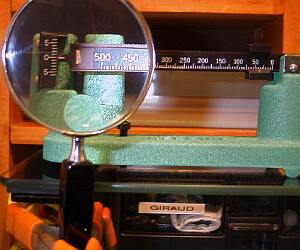
Even in today’s digital age, many reloaders prefer the simplicity and reliabilty of a balance scale for weighing powder charges. In this Bulletin, we reported that our own PACT digital scale suffers from fluctuating read-outs. The weight reading drifted up to 0.3 grains in less than an hour. (PACT Story). LTRDavid has come up with a clever upgrade to an O’Haus-type scale that makes the weighing process easier for those of us with old eyeballs. He simply mounts a magnifying glass in front of the balance marker, using two clamps.
Pretty ingenious wouldn’t you say? We wonder why the scale-makers didn’t offer a small magnifier as a factory option long ago. For more smart reloading tips, check out David’s website, LTRDavid.net.
When working with balance beam scales, be sure you have the device leveled. Even a small amount of tilt will throw off the measurement. We’ve seen folks who keep their scale on a shelf or storage area, and then take it out for use. That’s fine, but remember than your loading bench may not be uniformly level on all sections. Unless you put the scale in exactly the same place on the bench every time (at the same angle), you may have to re-set the level. Likewise, if you take the scale to a range, be sure to re-level it to your new working surface. And remember that is it just as important to level the scale front to back as left to right. Most scales have a leveling adjustment, but that will only level the scale left to right. If your bench has a bad front to back slant, you may have to build a corrective base for your scale.
June 5th, 2008

Sierra Bullets offers a vast, FREE online library, derived from the 4th and 5th Editions of The Sierra Loading Manual. On Sierra’s ExteriorBallistics.com website, you’ll fine dozens of technical articles, plus useful reference charts for powder burn rates, bullet BCs, and measurement conversions. There’s even a comprehensive Glossary of Shooting Terminology. Overall, ExteriorBallistics.com offers hundreds of pages of great, FREE information.

Tech articles from Sierra’s 5th Ed. Manual that are available online include:
Section 2-2.1 The Ballistic Coefficient Explained
Section 2.3 How the Ballistic Coefficient is Measured
Section 2.3.2 Initial Velocity and Time of Flight Method
Section 2.3.3 Doppler Radar Method
Section 2.4 Lessons Learned from Ballistic Coefficient Testing
Section 3.0 Exterior Ballistic Effects on Bullet Flight
Section 3.1 Effects of Altitude and Atmospheric Conditions
Section 3.2 Effects of Wind
Section 3.3 Effects of Shooting Uphill or Downhill
Section 3.4-3.4.1 Trajectory Considerations for Sighting-In
Section 3.4.2 Determining Zero Range from Firing Test
Section 3.4.3 Sighting in for a Change in Shooting Location
Section 3.5 Point Blank Range
Section 4.2 Yaw of Repose and Resulting Crossrange Deflection
and much, much more….
In addition to the ballistics articles listed above, ExteriorBallistics.com offers a detailed Reloading Section covering equipment and loading methods. Some of the more useful reloading articles include:
Scale and Measures
Case Inspection
Neck- and Full-length Sizing
Bullet Seating.
May 29th, 2008
Here’s an inexpensive tip that can help you load straighter ammo, with slightly better measured concentricity (i.e. less run-out) on the case necks and bullets. Simply use a rubber O-Ring on the underside of the die locking ring. This allows the die to self-align itself (slightly) to the case that is being sized. Without the O-Ring, if the flat surface on the top of your press is not perfectly square with the thread axis, your die can end up slightly off-angle. This happens when the bottom of the locking ring butts up tight against the top of the press.
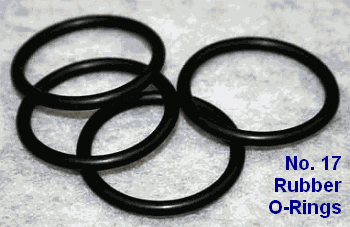
Top prone shooter German Salazar has tried this trick and he says it works: “Go to your local hardware store and get a #17 O-Ring (that’s the designation at Ace Hardware, don’t know if its universal). Slip the O-Ring on the die and re-adjust the lock ring so that the O-Ring is slightly compressed when the die is at the correct height. Size and measure a few more cases. You will probably see a slight improvement in neck concentricity as the die can now float a bit as the case enters and leaves it. This isn’t going to be a dramatic improvement, but it’s a positive one.”
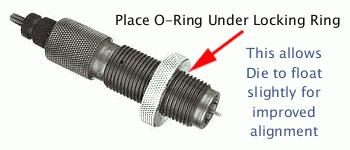
Lee Precision makes die lock rings with built-in O-Rings. Lee’s distinctive lock ring design allows the same kind of self-alignment, which is good. However, Lee lock rings don’t clamp in place on the die threads, so they can move when you insert or remove the dies — and that can throw off your die setting. By using an O-Ring under a conventional die lock ring, you get the advantages of the Lee design, without the risk of the lock ring moving.
May 28th, 2008
Because of increased raw material and fuel costs, prices of bullets and brass have gone up dramatically in recent months. We are hearing from active shooters that cost considerations are influencing their decisions about what calibers and chamberings to shoot. There is a definite trend to smaller cartridges and lighter bullets.
One prominent match shooter told us: “I’ve been debating between a 6.5×47 Lapua and a 6-6.5×47. After comparing the cost of 6.5mm vs. 6mm bullets, I decided on the 6mm. If I save $7 bucks a box, and shoot 4000 rounds a year (40 boxes of bullets), that’s $280.00 in savings–enough to buy a new barrel.”
Here are some comparative bullet prices for 6mm, 6.5mm, 7mm, and 30-caliber bullets at Midsouth Shooters Supply. Prices are for a 100-count box. Note that the 6.5mm match bullets cost 25% more than the 6mms. For active shooters, the price difference adds up quickly.

| Brand |
6mm |
6.5mm |
7mm |
.308 |
| Berger |
105gr VLD
$27.57 |
140gr VLD
$34.25 |
168gr VLD
$39.15 |
190gr VLD
$41.53 |
| Sierra |
107gr MK
$24.61 |
142gr MK
$30.53 |
175gr MK
$29.16 |
200gr MK
$31.64 |

Here are brass costs for Lapua brass from Grafs.com. Prices are for 100-count boxes. Generally speaking, the bigger the case, the higher the price (except for the .308 Win).
| .223 Rem |
6mmBR |
6.5×47 Lapua |
.308 Win |
6.5-284 |
.338 Lapua Mag |
| $44.79 |
$62.39 |
$82.79 |
$54.99 |
$92.99 |
$211.99 |
Consider Barrel Life Also
Certainly, moving to a smaller caliber can often reduce what you have to pay for brass and bullets. On the other hand, you need to consider barrel life. Hot-loaded 6mms, such as a .243 Ackley, can burn up a barrel much more quickly than a .308 Winchester. In comparing the “operating costs” of various cartridges, you need to factor in barrel replacement costs as well as component prices.
May 25th, 2008
 Two new, very small and light reloading scales have recently been introduced. These are small enough to fit in a shirt pocket. While not as precise as a bench-top unit, they can deliver read-outs to within 0.2 grains. These ultra-compact scales should prove very useful for any shooter that needs to load at the range. Additionally, they are affordable enough to be used as a back-up to a larger electronic or balance beam scale. Two new, very small and light reloading scales have recently been introduced. These are small enough to fit in a shirt pocket. While not as precise as a bench-top unit, they can deliver read-outs to within 0.2 grains. These ultra-compact scales should prove very useful for any shooter that needs to load at the range. Additionally, they are affordable enough to be used as a back-up to a larger electronic or balance beam scale.
We knew readers would want to learn about these brand new products. However, both these scales are so NEW that we haven’t yet been able to comparison-test them with a laboratory scale to confirm the claimed levels of weighing precision and see if there are any calibration or “drift” issues. Stay tuned for future test reports.
MTM Mini Reloading Scale — $30
 The new DS-1200 weighs up to 1200 grains. MTM claims accuracy (resolution) to plus or minus 0.1 (one-tenth) grain. You can switch measurements among grains, grams, ounces and carats .The unit features a high-impact, plastic sensor cover that doubles as a large powder pan. The DS-1200 comes with a calibration weight, two (2) CR2032 Batteries, and a foam lined storage/travel case. Up to 1200 grain capacity with To save battery power, the large, backlit display shuts off automatically after 3 minutes. Here are sources for this bargain-priced new scale: The new DS-1200 weighs up to 1200 grains. MTM claims accuracy (resolution) to plus or minus 0.1 (one-tenth) grain. You can switch measurements among grains, grams, ounces and carats .The unit features a high-impact, plastic sensor cover that doubles as a large powder pan. The DS-1200 comes with a calibration weight, two (2) CR2032 Batteries, and a foam lined storage/travel case. Up to 1200 grain capacity with To save battery power, the large, backlit display shuts off automatically after 3 minutes. Here are sources for this bargain-priced new scale:
PrecisionReloading.com Item MTDS1200 | $29.99
Grafs.com Item MTMDS1250 | $29.99 — Coming Soon

Acculab Pocket Pro Mini Scale — $112
Sartorius, makers of the popular Acculab-123 scale and its Denver Instrument clone, the MXX-123, has introduced a new, portable reloading scale that is truly pocket-sized. The compact model PP-62 will work as a portable scale or a back-up for a benchscale. It measures 3.5″ long, 3″ wide, and just 7/8″ thick.

The Pocket Pro can handle a maximum weight of 1000 grains. Acculab claims resolution down to 0.1 (one-tenth) GRAM, which provides readability to 0.20 GRAINS. We like the fact that the unit runs on a single, easy-to-purchase AA battery. Battery life is up to 20 hours, if you turn off the back lighting on the LCD display. A sliding cover also protects the weighing mechanism during transport. The PP-62 offers easy one-button calibration with the supplied check weight.
Sinclair Int’l sells the new Acculab PP-62, for $111.50 (Item 10-6200). This includes battery, weighing pan, and 50 gram calibration weight.


CONSUMER ALERT: On the web you’ll find other versions of the Acculab Pocket-Pro® Scales, priced at $45-$60.00. These are the PP-201 (photo above) and PP-401. Though these scales appear identical to the PP-62 (Sinclair item 10-6200), they are NOT the SAME. The cheaper PP-201 and PP-401 are only rated to one-TENTH of a GRAM. The PP-62 is RATED to one-HUNDRETH of a GRAM — that gives you an 0.2 GRAIN precision.
|


