|
|
September 25th, 2008
Forum member Andy (aka GreyMist) has completed an interesting test, with five (5) different types of .243 Winchester Brass. He collected Federal, Lapua, Remington, and two different lots of Winchester-brand brass. Then he selected ten (10) cases at random from each brand and measured their weights. To ascertain case capacity, three (3) cases from each brand/lot that were closest to the average weight for that brand/lot were selected. The results were surprising: there was less than one (1) grain capacity difference between all the cases, even with a 14.7 grain maximum difference in case weight!
Measuring Procedures
The cases were sized in a Redding body die then primed with a spent primer. All were weighed before and after filling them with distilled water. The capacity shown is an average of all three (3) cases from that lot and represents grains of water. Note, I tested two lots of Winchester brass. Lot A was purchased in 1999. Lot B was from factory .243 ammo. There is a rather large disparity in case weight between the two lots. For more info and to see the weights of individual tested cases, visit GreyMist’s webpage.
| Brand |
Federal |
Lapua |
Remington |
Winchester A |
Winchester B |
| Capacity |
53.9 |
54.4 |
53.7 |
54.8 |
54.8 |
| Aver. Weight |
173.28 |
173.13 |
165.34 |
158.58 |
166.44 |
| SD¹ |
0.46 |
0.39 |
0.17 |
0.58 |
0.42 |
| Range² |
1.70 |
1.10 |
0.40 |
1.80 |
1.40 |
| % of Avg.³ |
0.98% |
0.64% |
0.24% |
1.14% |
0.84% |
1) Standard Deviation in grains.
2) Range is the difference in weight between the heaviest and lightest cases in the test.
3) Case range weight divided by the average weight.
 What the Numbers Mean What the Numbers Mean
… And Some Speculations
Andy observes: “It certainly seems there is a huge difference in case weight between Winchester lot A and any other brand of 243 tested. What is also surprising is that there was less than one (1) grain capacity difference between all the cases, even with a 14.7 grain difference in case weight!
Should one be wary of trying the same loads that were initially tested in the light weight Winchester brass even though the capacity difference is small? I have had some interesting results with one brand brass that I cannot pass on yet, except to say I sent that company a sample of the lot I have been using. The Remington brass weight range was very low. These were taken from a box of once-fired factory ammo. I will have to acquire some more and measure it.”
Results of Larger Lapua Sample
In a previous session Andy weighed all 100 Lapua cases he had on hand. His measurements showed a total variation of 2.1 grains, with the weight range being 172.5 to 174.6 grains. That is a 1.2 percent spread. The most that came in at the same weight were 11 cases at 173.5 grains.
September 16th, 2008
High-School senior Paul Wagner set two potential IBS 600-yard Light Gun records this past weekend at the Piedmont Gun Club in Rutherfordton, NC. Paul started off with a .711″ 5-shot group for his first target in LG class. He ended up with a spectacular 1.6288″ 4-target Aggregate. In order, his four targets were: 0.711″, 1.848″, 2.191″, and 1.765″. We are told that both the 0.711″ group and the Agg are potential IBS records for the new 600-yard target. In the process of setting the records, Paul won LG class (group), beating some pretty good trigger pullers, including 2008 Nationals Winner Samuel Hall. Paul also out-shot his own dad, Rodney Wagner (aka “Eggman” on our Shooters Forum). Rodney reports: “My son Paul is pretty humble about his trigger-pulling abilities. As a Dad, I’m probably more excited than he is!”


Rodney Wagner tells us: “Paul started going to IBS 600-yard matches last year and actually shot his first match the end of 2006 season using a custom Savage model 12 with a SharpShooter Supply 20BR barrel. This year, when I built Paul a rifle he could call his own, he really started winning. Some even thought he had a chance of winning the IBS 600 Nationals at Oak Ridge this year. Several old timers have commented on his good ‘table manners’. I think his secret is he just doesn’t get excited, and takes everything in stride. He has been known to nap between relays with his IPod and earplugs in a folding chair. Paul shoots free recoil using a Protektor bag with medium high ears and a Bald Eagle front rest on a plate.”

Record-Setting Rifle Specs
The rifle features a Stiller drop-port Diamondback action, Jewell trigger, and a 28″, 8-twist Krieger barrel (heavy varmint contour). It was chambered as a “no-turn” 6 BRX by Mike Davis using his 6 BRX reamer. The stock is a Shehane Obeche Tracker II bedded and finished by Mike Isenhour who added his own weight system. On top is a Nightforce 12-42x BR scope mounted with Burris Signature ZEE rings. The load is just basic 6 BRX: 33.6 grains Varget, 105gr Berger VLD, CCI 450 primers, Lapua brass on the 7th firing. Rodney Wagner reports: “I sometimes sort bullets by bearing length but have not done that in a while as I have been getting really good bullets right out of the box from Berger.”
September 10th, 2008
We’ve all heard the old adage: “Keep your powder dry.” Well, tests by Norma have demonstrated that even normal environmental differences in humidity can affect the way powders burn, at least over the long term. In the July issue of Precision Shooting Magazine, Fred Barker reviews the current Norma and Vihtavuori reloading manuals. Fred notes that, in the Norma manual, Sven-Eric Johansson, head of ballistics at Nexplo/Bofors, presents a very important discussion of water vapor absorption by powder. Johansson shows, with supporting test data, that the same powder will burn at different rates depending on its water content.
Powders Leave the Factory with 0.5 to 1.0% Water Content
Johansson explains that, as manufactured, most powders contain 0.5 to 1% of water by weight. (The relative humidity is “equilibrated” at 40-50% during the manufacturing process to maintain this 0.5-1% moisture content). Importantly, Johansson notes that powder exposed to moist air for a long time will absorb water, causing it to burn at a slower rate. On the other hand, long-term storage in a very dry environment reduces powder moisture content, so the powder burns at a faster rate. In addition, Johansson found that single-base powders are MORE sensitive to relative humidity than are double-base powders (which contain nitroglycerine).
 Tests Show Burn Rates Vary with Water Content Tests Show Burn Rates Vary with Water Content
Reviewer Fred Barker notes: “Johansson gives twelve (eye-opening) plots of the velocities and pressures obtained on firing several popular cartridges with dehydrated, normal and hydrated Norma powders (from #200 to MRP). He also gives results on loaded .30-06 and .38 Special cartridges stored for 663 to 683 days in relative humidities of 20 and 86%. So Johansson’s advice is to keep powders tightly capped in their factory containers, and to minimize their exposure to dry or humid air.” Confirming Johansson’s findings that storage conditions can alter burn rates, Barker observes: “I have about 10 pounds of WWII 4831 powder that has been stored in dry (about 20% RH) Colorado air for more than 60 years. It now burns about like IMR3031.”
What does this teach us? First, all powders start out with a small, but chemically important, amount of water content. Second, a powder’s water content can change over time, depending on where and how the powder is stored. Third, the water content of your powder DOES make a difference in how it burns, particularly for single-base powders. For example, over a period of time, a powder used (and then recapped) in the hot, dry Southwest will probably behave differently than the same powder used in the humid Southeast.
Reloaders are advised to keep these things in mind. If you want to maintain your powders’ “as manufactured” burn rate, it is wise to head Johannson’s recommendation to keep your powders tightly capped when you’re not actually dispensing charges and avoid exposing your powder to very dry or very humid conditions. The Norma Reloading Manual is available from a variety of sources, including MidwayUSA.com.
| Real-World Example — “Dry” H4831sc Runs Hotter
Robert Whitley agrees that the burn rate of the powder varies with the humidity it absorbs. Robert writes: “I had an 8-lb. jug of H4831SC I kept in my detached garage (it can be humid there). 43.5-44.0 gr of this was superbly accurate with the 115 Bergers out of my 6mm Super X. I got tired of bringing it in and out of the garage to my house for reloading so I brought and kept the jug in my reloading room (a dehumidified room in my house) and after a few weeks I loaded up 43.5 gr, went to a match and it shot awful. I could not figure out what was going on until I put that load back over the chronograph and figured out it was going a good bit faster than before and the load was out of the “sweet spot” (42.5 – 43.0 gr was the max I could load and keep it accurate when it was stored in less humid air). I put the jug back in the garage for a few weeks and I now am back to loading 43.5 – 44.0 gr and it shoots great again. I have seen this with other powders too.
If you have two jugs of the same powder, one kept in a room in your house and one somewhere else where it is drier or more humid, don’t expect the two jugs of the same lot of powder to chrono the same with the same charge weights unless and until they are both stored long enough in the same place to equalize again. Been there … done that!” |
Do Your Own Test with Sun-Dried Propellants
Johansson studied the effects of humidity variances during long-term storage. Keep in mind that a powder’s water content can change in a much shorter period of time if it is exposed to extreme heat, or if it is used in a very humid environment. You can do your own simple test to show how heat can de-hydrate powder. Throw 100 grains of powder and weigh it. Then put it out in direct sunlight for a full day (shielded from the wind so you don’t lose any kernels). Re-weigh the sun-dried powder. You’ll find it has lost a bit of weight from the water baking out.
September 1st, 2008
As a cartridge case is reloaded multiple times, burnt powder residue and carbon builds up on the inside of the case. Unless the case interior is cleaned in some fashion, eventually you’ll see a reduction in case capacity. One of our Forum members from Australia wonders about the effects of reduced case capacity: “If the capacity of the case decreases as the crud builds up, then it effectively reduces the chamber size. Wouldn’t that change the pressure produced from that of an equivalent clean case?”
Ultrasonic Cleaning Example:
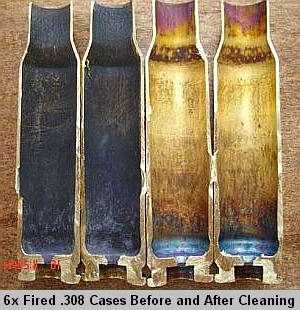
Interesting Test of Case Capacity Changes
Forum member Fred Bohl has actual test results that can help answer the above question. Fred proved that, over a 20-reload cycle, the case capacity of uncleaned cases did, indeed, decline a small amount. However, surprisingly, this did not seem to affect the actual chronographed velocity of the load. ES did increase, but Fred believes the higher ES was due to changes in case-neck tension, rather than due to the slight reduction in case capacity.
Fred reports: “Back when beginning to use ultrasonic case cleaning, part of the motivation was to get the inside clean based on the assumption that allowing burnt residue to build up inside cases would affect capacity, and, ultimately, performance. An experiment was done to test this hypothesis. The load used, 30.5 grains of RL15 behind 107gr SMKs in a 6mmBR, was selected for best group and lowest ES in prior load development. It turned out to be 92% of initial case capacity and neither “full” or compressed. (I would suspect that different powders, load weight, and total case capacity might produce very different results.)
We took 30 cases of identical initial capacity and tracked three lots of 10 each:
LOT 1: No Internal cleaning
LOT 2: Cleaned with media in tumbler
LOT 3: Cleaned with Ultrasound machine
Each case (in each lot) was shot and reloaded 20 times. The simplified results after 20 reloads of each lot were as follows:
Lot 1 (not cleaned) – 0.3 to 0.4 gr. loss of capacity, 5 to 8 fps greater ES.
Lot 2 (tumble cleaned) – 0.1 to 0.3 gr. loss of capacity, 4 to 6 fps greater ES.
Lot 1 (ultrasonic cleaned) – no loss of capacity, no detectable change in ES.
FINDINGS
There was no detectable correlation of velocity change to the lots. An oddity was that on very hot days Lot 1 velocities were, occasionally, slightly higher. [Editor’s note: That does suggest that the carbon build-up inside the uncleaned cases might cause a slight increase in pressure that shows up on hot days. Fred has posted that “A local shooter reported doing the 20 reload, no clean test on a .308 that gave a loss of capacity of 2.0 grains, doubled ES and signficant velocity changes. However, I don’t have any details on his load weight or powder.”]
NOTE: From results of another ongoing test, I believe the above differences in ES are probably due more to variance in bullet grip tension than case capacity. The ultrasound cleaned cases (LOT 3) did maintain the lowest ES, but we are not 100% sure of the reasons why. More consistent bullet seating might be the reason.
[Editor’s comment: Jason found that with his ultrasonically-cleaned cases, the inside of the necks got so “squeaky clean” that he needed to use dry lube in the necks. Jason uses the $10.95 dry lube kit from Neconos.com. This applies ultra-fine Moly powder to the neck using small carbon steel balls]

August 27th, 2008
 When using the Stoney Point type OAL gauge (now sold by Hornady), we sometimes get a bullet stuck in the rifling. This can also happen with a squib load or when extracting a round with the bullet seated hard in the lands. You can use a cleaning rod or a wood dowel to tap out the bullet, but a brass drop rod will do the job faster and easier, with less risk of nicking your crown. When using the Stoney Point type OAL gauge (now sold by Hornady), we sometimes get a bullet stuck in the rifling. This can also happen with a squib load or when extracting a round with the bullet seated hard in the lands. You can use a cleaning rod or a wood dowel to tap out the bullet, but a brass drop rod will do the job faster and easier, with less risk of nicking your crown.
You can make a drop rod yourself from brass or bronze rod. Just make sure to smooth over any burrs or rough spots on the ends. Or just order a set of brass bullet drop rods from Sinclair Int’l. You drop the Sinclair Rods (item 52-500) down the barrel from the muzzle end with the rifle standing upright. Sinclair Bullet Drop Rods are made of brass so they will not harm the rifling in your barrel. Each $11.50 set consists of two Drop Rods that will handle .20 up to .416 caliber.
Remember, for safety sake, Drop Rods are never to be used to dislodge live or loaded rounds! Always remove the Drop Rod from the barrel before chambering another round!

August 24th, 2008
This may surprise you. We’ve learned that time (between neck-sizing operation and bullet seating) can have dramatic effects on neck tension. Controlling neck tension on your cases is a very, very important element of precision reloading. When neck tension is very uniform across all your brass, you’ll see dramatic improvements in ES and SD, and your groups will shrink. Typically you’ll also see fewer fliers. Right now, most reloaders attempt to control neck tension by using different sized neck bushings. This does, indeed, affect how firmly the neck grips your bullets. But time of loading is another key variable.
 James Phillips discovered that time is a critical factor in neck tension. James loaded two sets of 22 Dasher brass. Each had been sized with the SAME bushing, however the first group was sized two weeks before loading, whereas the second group was neck-sized just the day before. James noticed immediately that the bullet seating effort was not the same for both sets of cases — not even close. James Phillips discovered that time is a critical factor in neck tension. James loaded two sets of 22 Dasher brass. Each had been sized with the SAME bushing, however the first group was sized two weeks before loading, whereas the second group was neck-sized just the day before. James noticed immediately that the bullet seating effort was not the same for both sets of cases — not even close.
Using a K&M Arbor press equipped with the optional Bullet-Seating Force Gauge, James determined that over twice as much force was required to seat the bullets which had been neck-sized two weeks before. The dial read-out of seating force for the “older” cases was in the 60s, while the seating force for the recently-neck-sized cases was in the 20s. (These numbers correspond to pounds of force applied to the bullet). Conclusion? In the two weeks that had elapsed since neck-sizing, the necks continued to get tighter and stiffen.
Lesson learned: For match rounds, size ALL your cases at the same time. If you want to reduce neck tension, load immediately after sizing.
August 22nd, 2008
Hexagonal Boron Nitride (HBN) is an advanced bullet-coating material. HBN, also known as ‘White Graphite’, has similar (hexagonal) crystal structure as graphite, though it is a much better lubricant. For those who prefer shooting coated bullets, HBN appears to have many advantages over molybdenum disulfide (moly). First, it is much more slippery, so it can reduce friction more effectively. Second, it goes on clear, and when applied correctly it doesn’t leave a dusty, chalky finish that can come off on your fingers. Most importantly, HBN will not react with moisture to leave potentially harmful chemicals in your barrel.

Boron nitride-coated DTAC bullets are sold by Superior Shooting Sytems (David Tubb). Tubb’s company also offers HBN bullet-coating services for a fee (minimum quantity 1000). However, many shooters want to plate their own bullets with Boron Nitride. Lowerfriction.com sells hexagonal boron nitride dry lubricant powder in 1-lb and 10-lb quantities. The two particle sizes appropriate for bullet coating are 70 nm (MK-hBN-N70-Nano) and 0.50 micron (MKhBN-050). Some shooters prefer the smaller 70 nm version, while others say the larger 0.50 micron works fine. Lowerfriction.com sells 70 nm HBN for $90.00 per pound, and the 0.50 micron HBN for $79.00 per pound. CLICK HERE for order page.
Lowerfriction.com allows provides instructions for coating bullets with Tungsten Disulfide (WS2), but company technicians say the same procedure can be used with HBN:
Tumbling/Vibratory bowl coating
This method is ideal for bullets and other small parts. Speed and friction determine how effectively the material bonds to the part. The greater the speed and the pressure of application, the greater the bond. For best results use a power tool. A buffing wheel, Dremel tool or even a hone can be used.
Clean and degrease the part.
Take 5-6 small empty plastic bottles (empty aspirin bottles will do). Put few parts in the bottle and fill the bottle (up to 75%) with WS2 powder. Fill all bottles likewise.
Put the bottles in vibratory bowl/tumbler with sand or vibratory media.
Vibrate/Tumble for 4-5 hours.
Empty the bottles (you can reuse WS2) and wipe clean the parts with soft tissue/cloth. |
Bullet Coating — Step by Step with Photos
A photo-illustrated Guide to Bullet Coating is available on the WrzWaldo website. This site is maintained by a Pacific NW shooter who retails 0.5 Micron Tungsten Disulfide (WS2) and will soon be offering Hexagonal Boron Nitride (HBN) as well. The website shows how to plate bullets using 0.177″ BBs in pill bottles, which are then agitated in a vibratory tumbler. This is a simple procedure that isolates the plating media from your tumbler, and covers the bullets very completely in 30-40 minutes. WrzWaldo says his method works equally well for both Tungsten Disulfide (WS2) and Boron Nitride (HBN). The photos below show bullets coated with WS2.


August 19th, 2008
Denver Instrument, maker of the MXX and Timberline Series of precision balances, has created a helpful guide explaining how to get the best performance from a digital scale. Denver Instrument knows that, to achieve and maintain a very high level of accuracy with digital scales, they must be calibrated regularly, leveled properly, and kept away from sources of interference. Unfortunately, some reloaders treat their electronic scales as if the machines were toasters — something to place on a tabletop, plug into an outlet, then “set and forget.” There’s a better way to set up your scale and keep it functioning optimally. Here are ten guidelines provided by Denver Instrument. Follow these “TEN Commandments” and you’ll benefit:
 10 COMMANDMENTS OF GOOD BALANCE USE 10 COMMANDMENTS OF GOOD BALANCE USE
ONE: Thou shalt choose the best resting spot. The performance of your balance depends greatly on the surrounding environment. Choose a location away from the main traffic flow of the room, especially doors. Also be aware of heating and cooling vents as these produce air movement. You can adjust the environmental settings on your balance to provide the best performance in the chosen location. Balances must be placed away from magnets as they affect the weigh cell performance.
TWO: Thou shalt avoid vibrations. Vibrations can come from large machinery in production environments and from fume hoods in laboratories. An alternative to fume hoods are Power Safety Workstations which are designed specifically for use with a balance.
THREE: Thou shalt watch temperature changes. On an analytical balance a one degree temperature change can cause a 1 digit (0.0001g) drift. Although Denver balances have temperature correction built-in, it is still important to calibrate your balance when the temperature changes significantly. Choosing to place your balance in a temperature controlled room, away from sunlight, and calibrating often helps minimize the effects of temperature.
FOUR: Thou shalt calibrate often. Upon installation and each time the balance is moved you should calibrate your balance. For example moving an analytical balance to a location that is only 13 feet higher changes the weight reading from 200.0000 g to 199.9997 g; which means the result is 0.0003 g lighter than the actual mass.

FIVE: Remember to check the level. The instrument should be leveled upon installation with all feet (two front feet for round pan units, four feet for square pan units) touching the countertop. If the level changes, the balance should be re-leveled and recalibrated. As an example, a 200g sample would weigh 0.0025 g less when tilted at an angle of 0.3°.
SIX: Honor thy weights. Keep in mind that weights are only as reliable as their quality and certification. Remember, a 1 g does not weigh precisely 1.00000 grams. Weights should be recertified annually. Denver Instrument offers recertification services on all weights 1 mg to 5 kg. Check to make sure you have selected the proper weight class for your balance. The weight tolerance should be better than balance readability. Always use tweezers or gloves when handling weights as smudges and indentations change the value of the weight. Keep weights in cases so they don’t get scratched or dusty.
SEVEN: Thou shalt always use a small container and weigh in the center of the pan. Especially when using an analytical balance, the effects of air buoyancy increase as the sample container size increases. Using a small sample container will minimize the effects. Items placed on the pan provide a downward force. Placing them directly in the center of the pan keeps corner loading errors at a minimum.
EIGHT: Thou shalt not unplug. To perform within published specifications balances must have power applied for 30 minutes to 48 hours depending on the resolution of the balance. Denver balances have a standby mode which turn the display to standby but keep power cycling through the electronics.
NINE: Thou shalt not ignore static. Static is one of the most common weighing “noises”. It can cause reading to appear too high, too low or just be unstable. Denver balances include grounding methods to reduce the effects of static. However sometimes extra supplies are needed. Consider anti-static weigh dishes, anti-static brushes or low tech ways to increase the humidity of the chamber like placing damp cotton balls or glass wool in a small vial in the corner of the analytical draft shield.
TEN: Thou shalt clean often. Dirty weigh pans and powder in weighing chamber can contribute to static issues and lead to a wide variety of problems. Denver weigh pans are made from stainless steel and can be cleaned using a variety of household and laboratory chemicals. A small paint brush can be used to get power away from the edges of the draft shield for easy clean up.
August 19th, 2008
Alliant Powder, a division of ATK, has issued the following safety notice concerning Alliant Blue Dot powder, a popular propellant for handgun loading:

Alliant offers a FREE detailed, 43-page Reloader’s Guide with recipes for shotgun, pistol, and rifle cartridges. This guide includes important safety instructions, plus reloading data for most popular cartridges. Unfortunately the guide does not yet include Alliant’s new Reloder 17 and the listed loads for centerfire rifles only include Speer bullets.

CLICK HERE to download ALLIANT RELOADER’S GUIDE (.pdf format).
August 15th, 2008
Grant, one of our Forum members from New Zealand, asked if there was a universal shell-holder that could hold cartridges securely for neck-turning, trimming, and case prep. He complained that the screwdriver-type case holder he was using didn’t center easily, was hard to tighten, and the case sometimes came loose during rotation. Another forum member agreed that he has experienced the same problems using a screwdriver-type case-holder.
This editor has found that a K&M screwdriver-type case holder CAN work securely if you tighten the locking mechanism tightly with the supplied wrench. But then you need the wrench again to get the case OUT. We were interested to see if there was a better solution that held the case securely, yet was easy to lock and unlock without tools.
Forum member Gunamonth provided a solution: “I use a Lee Zip Trim three-jaw case holder. With a little practice it centers the case quite nicely and holds just about anything. Chuck it in a cordless drill and have at it. It is much better than either the K&M or Sinclair [case-holder] in my opinion and the Zip Trim jaw is a lot cheaper (about $12.00). To use with power, you also need the Zip Trim three-jaw spindle, which is another $2.00.”

|


